Parasympathomimetic
Agents Direct Acting With
SAR & Cholinesters
Reactivation
GROUP NAME : ANTIBIOTICS
GROUP MEMBERS : TANIYA BODHWANI
TEJAS SURUSE
DEWANG THAWKER
UNDER THE GUIDANCE OF : PROF MS.PRADNYA
MAM
PARASYMPATHOMIMETICS
 Parasympathomimetics are a class of medications
that activate the parasympathetic nervous system
by mimicking or modifying the effects of
acetylcholine
 These drugs include muscarinic receptor agonists
(direct-acting parasympathomimetics) and
acetylcholinesterase inhibitors (indirect-acting
parasympathomimetics)
 Also known as cholinergic agonist or drug. The
agents bind with cholinergic receptor and show
their action.
 This activity reviews the indications,
contraindications, activity, adverse events, and
other key elements of parasympathomimetic
therapy in the clinical setting pertinent to
interprofessional team members managing the
care of patients receiving these medications.
STRUCTURE ACTIVITY
RELATIONSHIP OF
PARASYMPATHOMIMETIC
AGENTS
• It is defined as the relationship between
the chemical structure of a molecule and
its biological activity.
 This allow modification of the effect or
potency of a substance by changing its
chemical structure
.
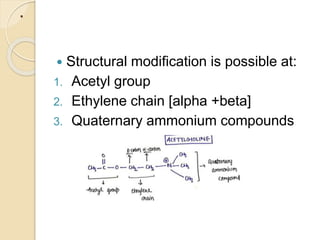
 Structural modification is possible at:
1. Acetyl group
2. Ethylene chain [alpha +beta]
3. Quaternary ammonium compounds
• Substitution on Acetyl group
Replacement of Acetate group by
carbonate group increase activities
and also more stable.
The placement of Easter group by
Ether and Ketone group give
chemically stable and potent
compounds and have some
cholinergic activity.
Substitution on Ethylene chain[alpha +
beta carbon ] :
Increase in the chain length decrease the
activity.
On branching there are also changed in
the activity.
Branching on Alpha carbon: increase
activity of nicotinic , decrease activity of
muscuranic.
Branching of Beta carbon :increase
activity for muscuranic and decrease
active for nicotinic.
Substitution on quarternary
ammonium compounds replacement
of Ammonium group by other group
[bioisoster] like sulphonation,
phosphonium,etc cause loss of
activity .
Replacement of more than one
methyl group of quaternary
Ammonium group leads to complete
loss of Cholinergic activity .
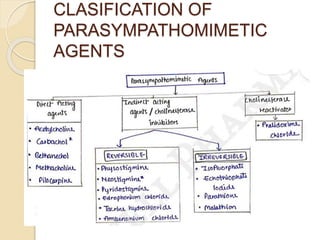
CLASIFICATION OF
PARASYMPATHOMIMETIC
AGENTS
DIRECT ACTING AGENTS
 Direct-acting cholinomimetics are
drugs that act directly by stimulating
cholinergic receptors. Act at
muscarinic ACh receptors to mimic the
physiologic effects resulting from
activation of the parasympathetic
nervous system. These drugs are
divided into drugs that stimulate
muscarinic (M-cholinoreceptors) or
nicotinic (N-cholinoreceptors)
receptors.
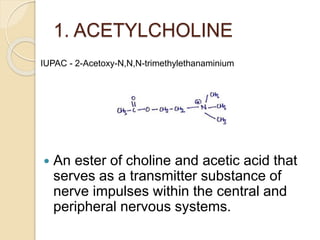
1. ACETYLCHOLINE
 An ester of choline and acetic acid that
serves as a transmitter substance of
nerve impulses within the central and
peripheral nervous systems.
IUPAC - 2-Acetoxy-N,N,N-trimethylethanaminium
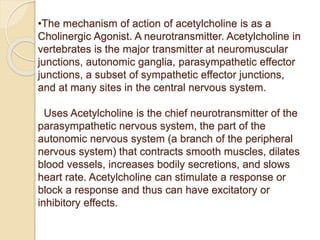
•The mechanism of action of acetylcholine is as a
Cholinergic Agonist. A neurotransmitter. Acetylcholine in
vertebrates is the major transmitter at neuromuscular
junctions, autonomic ganglia, parasympathetic effector
junctions, a subset of sympathetic effector junctions,
and at many sites in the central nervous system.
Uses Acetylcholine is the chief neurotransmitter of the
parasympathetic nervous system, the part of the
autonomic nervous system (a branch of the peripheral
nervous system) that contracts smooth muscles, dilates
blood vessels, increases bodily secretions, and slows
heart rate. Acetylcholine can stimulate a response or
block a response and thus can have excitatory or
inhibitory effects.
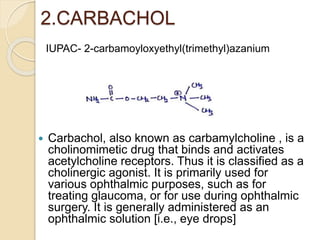
2.CARBACHOL
 Carbachol, also known as carbamylcholine , is a
cholinomimetic drug that binds and activates
acetylcholine receptors. Thus it is classified as a
cholinergic agonist. It is primarily used for
various ophthalmic purposes, such as for
treating glaucoma, or for use during ophthalmic
surgery. It is generally administered as an
ophthalmic solution [i.e., eye drops]
IUPAC- 2-carbamoyloxyethyl(trimethyl)azanium
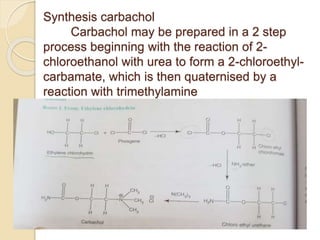
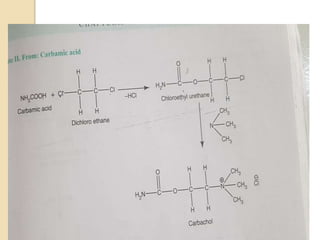
Synthesis carbachol
Carbachol may be prepared in a 2 step
process beginning with the reaction of 2-
chloroethanol with urea to form a 2-chloroethyl-
carbamate, which is then quaternised by a
reaction with trimethylamine
Uses :
Carbachol lowers pressure in the eye by
increasing the amount of fluid that drains
from the eye. Carbachol ophthalmic (for
the eye) is used to treat glaucoma.
Carbachol ophthalmic may also be used
for purposes not listed in this medication
guide
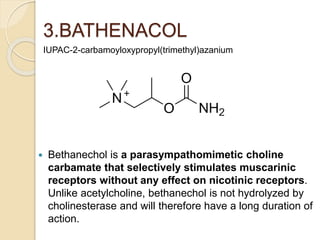
3.BATHENACOL
 Bethanechol is a parasympathomimetic choline
carbamate that selectively stimulates muscarinic
receptors without any effect on nicotinic receptors.
Unlike acetylcholine, bethanechol is not hydrolyzed by
cholinesterase and will therefore have a long duration of
action.
IUPAC-2-carbamoyloxypropyl(trimethyl)azanium
Mechanism of Action
Bethanechol primarily affects the urinary and GI
tracts. Its effect on the bladder results
from stimulation of muscarinic receptors in
the detrusor muscle. The detrusor contracts,
decreasing bladder capacity and producing
urination.
Bethanechol is used to relieve difficulties in
urinating caused by surgery, drugs, or other
factors. This medication is sometimes
prescribed for other uses.
4.METHACHOLINE
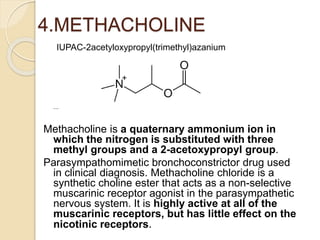
 IUPAC Name
Methacholine is a quaternary ammonium ion in
which the nitrogen is substituted with three
methyl groups and a 2-acetoxypropyl group.
Parasympathomimetic bronchoconstrictor drug used
in clinical diagnosis. Methacholine chloride is a
synthetic choline ester that acts as a non-selective
muscarinic receptor agonist in the parasympathetic
nervous system. It is highly active at all of the
muscarinic receptors, but has little effect on the
nicotinic receptors.
IUPAC-2acetyloxypropyl(trimethyl)azanium
4.METHACHOLINE
 Mechanism Of Action
Methacholine chloride is a cholinergic agonist.
Bronchial smooth muscle contains significant
parasympathetic (cholinergic) innervation.
Methacholine chloride agonizes the
muscarinic receptors which eventually
induce bronchoconstriction.
 Methacholine is a parasympathomimetic
bronchoconstrictor used to diagnose
bronchial hyperreactivity in subjects who
do not have clinically apparent asthma.
5.PILOCARPINE
 Pilocarpine is a medication used to
reduce pressure inside the eye and
treat dry mouth. As eye drops it is used
to manage angle closure glaucoma until
surgery can be performed, ocular
hypertension, primary open angle
glaucoma, and to bring about constriction
of the pupil following its dilation.
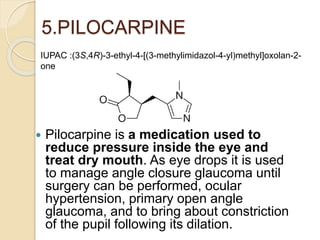
IUPAC :(3S,4R)-3-ethyl-4-[(3-methylimidazol-4-yl)methyl]oxolan-2-
one
5.PILOCARPINE
 MECHANISM OF ACTION
Pilocarpine is a cholinergic muscarinic receptor
agonist. By directly stimulating these
receptors, pilocarpine causes smooth
muscles, such as the iris sphincter muscle
and ciliary muscle, to contract.
 Pilocarpine is used to treat dry mouth caused
by radiotherapy in people with head and
neck cancer and to treat dry mouth in
people with Sjogren's syndrome (a condition
that affects the immune system and causes
dryness of certain parts of the body such as
the eyes and mouth).
CHOLINESTRASE
REACTIVATOR
 This cholinesterase reactivator is used as an
antidote for poisoning due to organophosphate
pesticides or other chemicals that have
anticholinesterase activity. It is also of value in
the control of overdosage by anticholinesterase
drugs used in the treatment of myasthenia gravis.
 Which of the following drugs is used as
cholinesterase Reactivator?
The main drugs are anticholinergics that antagonize
the effects of accumulated acetylcholine at the
cholinergic synapses and cholinesterase
reactivators (oximes) reactivating inhibited
AChE. Anticonvulsants such as diazepam are
also used to treat convulsions.
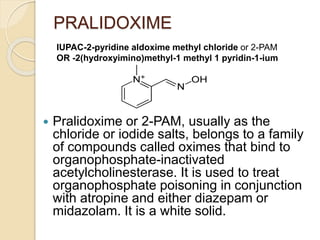
PRALIDOXIME
 Pralidoxime or 2-PAM, usually as the
chloride or iodide salts, belongs to a family
of compounds called oximes that bind to
organophosphate-inactivated
acetylcholinesterase. It is used to treat
organophosphate poisoning in conjunction
with atropine and either diazepam or
midazolam. It is a white solid.
IUPAC-2-pyridine aldoxime methyl chloride or 2-PAM
OR -2(hydroxyimino)methyl-1 methyl 1 pyridin-1-ium
PRALIDOXIME
Mechanism of action
The principal action of pralidoxime is to
reactivate cholinesterase (mainly
outside of the central nervous system)
which has been inactivated by
phosphorylation due to an
organophosphate pesticide or related
compound.
Pralidoxime injection is used together with
another medicine called atropine to treat
poisoning caused by organic
phosphorus pesticides (e.g., diazinon,
malathion, mevinphos, parathion, and sarin)
and by organophosphate chemicals (“nerve
gases”) used
Parasympathomimetic Agents Direct Acting with SAR & Cholinesters Reactivation