PRESENTATION ON:
PARASYMPATHOMIMETICS
Presented by: Under the guidence of
MOHD KHUSHTAR SIRMohd Fahad
M.pharm, Pharmacology
1st year
INTEGRAL UNIVERSITY,lucknow
session: 2016-2017
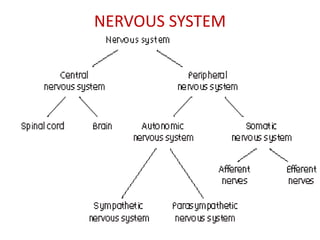
NERVOUS SYSTEM
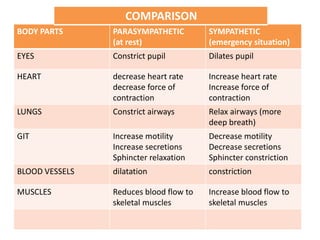
BODY PARTS PARASYMPATHETIC
(at rest)
SYMPATHETIC
(emergency situation)
EYES Constrict pupil Dilates pupil
HEART decrease heart rate
decrease force of
contraction
Increase heart rate
Increase force of
contraction
LUNGS Constrict airways Relax airways (more
deep breath)
GIT Increase motility
Increase secretions
Sphincter relaxation
Decrease motility
Decrease secretions
Sphincter constriction
BLOOD VESSELS dilatation constriction
MUSCLES Reduces blood flow to
skeletal muscles
Increase blood flow to
skeletal muscles
COMPARISON
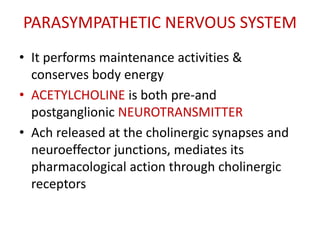
PARASYMPATHETIC NERVOUS SYSTEM
• It performs maintenance activities &
conserves body energy
• ACETYLCHOLINE is both pre-and
postganglionic NEUROTRANSMITTER
• Ach released at the cholinergic synapses and
neuroeffector junctions, mediates its
pharmacological action through cholinergic
receptors
• PARASYMPATHOMIMETICS/ CHOLINERGIC
DRUGS are agents which mimic the effects of
Ach
• PARASYMPATHOLYTIC/ ANTICHOLINERGIC
DRUGS antagonise the effects of
parasympathetic stimulation
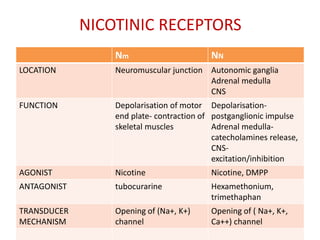
NICOTINIC RECEPTORS
Nm NN
LOCATION Neuromuscular junction Autonomic ganglia
Adrenal medulla
CNS
FUNCTION Depolarisation of motor
end plate- contraction of
skeletal muscles
Depolarisation-
postganglionic impulse
Adrenal medulla-
catecholamines release,
CNS-
excitation/inhibition
AGONIST Nicotine Nicotine, DMPP
ANTAGONIST tubocurarine Hexamethonium,
trimethaphan
TRANSDUCER
MECHANISM
Opening of (Na+, K+)
channel
Opening of ( Na+, K+,
Ca++) channel
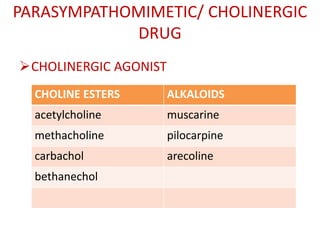
PARASYMPATHOMIMETIC/ CHOLINERGIC
DRUG
CHOLINERGIC AGONIST
CHOLINE ESTERS ALKALOIDS
acetylcholine muscarine
methacholine pilocarpine
carbachol arecoline
bethanechol
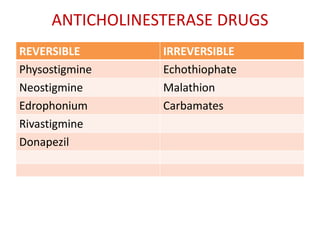
ANTICHOLINESTERASE DRUGS
REVERSIBLE IRREVERSIBLE
Physostigmine Echothiophate
Neostigmine Malathion
Edrophonium Carbamates
Rivastigmine
Donapezil
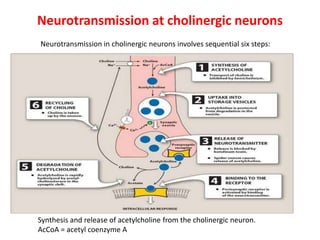
Neurotransmission at cholinergic neurons
Synthesis and release of acetylcholine from the cholinergic neuron.
AcCoA = acetyl coenzyme A
Neurotransmission in cholinergic neurons involves sequential six steps:
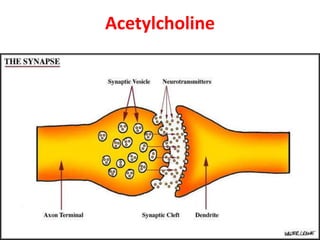
Acetylcholine
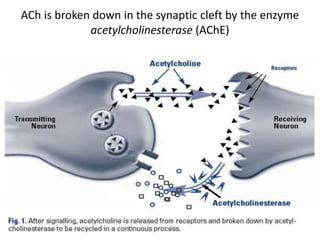
ACh is broken down in the synaptic cleft by the enzyme
acetylcholinesterase (AChE)
Cholinergic Drugs
Cholinomimetics, Parasympathomimetics
• These are the drugs which produces
actions similar to that of ACh, either
by directly or indirectly interacting
with cholinergic receptors or by
increasing availability of Ach at these
sites ( anticholinesterases )
Direct-Acting Cholinergic Agonists
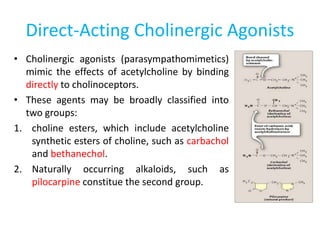
• Cholinergic agonists (parasympathomimetics)
mimic the effects of acetylcholine by binding
directly to cholinoceptors.
• These agents may be broadly classified into
two groups:
1. choline esters, which include acetylcholine
synthetic esters of choline, such as carbachol
and bethanechol.
2. Naturally occurring alkaloids, such as
pilocarpine constitue the second group.
• All of the direct-acting cholinergic drugs have
longer durations of action than acetylcholine.
• Some of the more therapeutically useful drugs
pilocarpine and bethanechol preferentially
bind to muscarinic receptors and are
sometimes referred to as muscarinic agents.
• As a group, the direct-acting agonists show
little specificity in their actions, which limits
their clinical usefulness.
A. Acetylcholine: is a quaternary ammonium
compound that cannot penetrate
membranes.
it is therapeutically of no importance
because of its multiplicity of actions and its
rapid inactivation by the cholinesterases.
• Acetylcholine has both muscarinic and nicotinic
activity.
1. Decrease in heart rate and cardiac output:
The actions of acetylcholine on the heart
mimic the effects of vagal stimulation. For
example, acetylcholine, if injected
intravenously, produces a brief decrease in
cardiac rate and stroke volume as a result of
a reduction in the rate of firing at the
sinoatrial (SA) node.
ACTIONS OF ACH
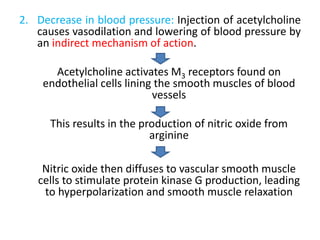
2. Decrease in blood pressure: Injection of acetylcholine
causes vasodilation and lowering of blood pressure by
an indirect mechanism of action.
Acetylcholine activates M3 receptors found on
endothelial cells lining the smooth muscles of blood
vessels
This results in the production of nitric oxide from
arginine
Nitric oxide then diffuses to vascular smooth muscle
cells to stimulate protein kinase G production, leading
to hyperpolarization and smooth muscle relaxation
• Other actions: A. In the gastrointestinal tract,
acetylcholine increases salivary secretion and
stimulates intestinal secretions and motility.
Bronchiolar secretions are also enhanced. In the
urinary tract, the tone of the detrusor muscle is
increased, causing expulsion of urine.
• B. In the eye, acetylcholine is involved in
stimulating ciliary muscle contraction for near
vision and in the constriction of the pupillae
sphincter muscle, causing miosis (marked
constriction of the pupil). Acetylcholine (1%
solution) is instilled into the anterior chamber of
the eye to produce miosis during ophthalmic
surgery.
B. Bethanechol: is structurally related to
acetylcholine, in which the acetate is replaced
by carbamate and the choline is methylated.
• It is not hydrolyzed by acetylcholinesterase (due
to the addition of carbonic acid), although it is
inactivated through hydrolysis by other
esterases.
• It lacks nicotinic actions (due to the addition of
the methyl group) but does have strong
muscarinic activity.
• Its major actions are on the smooth muscle of
the bladder and gastrointestinal tract. It has a
duration of action of about 1 hour.
• Actions: Bethanechol directly stimulates muscarinic
receptors, causing increased intestinal motility and tone. It
also stimulates the detrusor muscles of the bladder
whereas the trigone and sphincter are relaxed, causing
expulsion of urine.
• Therapeutic applications: In urologic treatment,
bethanechol is used to stimulate the atonic bladder,
particularly in postpartum or postoperative, nonobstructive
urinary retention. Bethanechol may also be used to treat
neurogenic atony ( poor muscular condition ). as well as
megacolon (Hypertrophy and dilation of the colon
associated with prolonged constipation).
• Adverse effects: Bethanechol causes the effects of
generalized cholinergic stimulation. These include
sweating, salivation, flushing, decreased blood pressure,
nausea, abdominal pain, diarrhea, and bronchospasm.
C. Carbachol (carbamylcholine): has both
muscarinic as well as nicotinic actions (lacks a
methyl group present in bethanechol).
• Like bethanechol, carbachol is an ester of
carbamic acid and a poor substrate for
acetylcholinesterase.
• It is biotransformed by other esterases, but at
a much slower rate.
• Actions: Carbachol has profound effects on
both the cardiovascular system and the
gastrointestinal system because of its
ganglion-stimulating activity, and it may first
stimulate and then depress these systems.
• It can cause release of epinephrine from the
adrenal medulla by its nicotinic action.
• Locally instilled into the eye, it mimics the
effects of acetylcholine, causing miosis and a
spasm of accommodation in which the ciliary
muscle of the eye remains in a constant state
of contraction.
• Therapeutic uses: Because of its high potency,
receptor nonselectivity, and relatively long
duration of action, carbachol is rarely used
therapeutically except in the eye as a miotic
agent to treat glaucoma by causing pupillary
contraction and a decrease in intraocular
pressure.
• Adverse effects: At doses used
ophthalmologically, little or no side effects
occur due to lack of systemic penetration.
D. Pilocarpine: is alkaloid with a tertiary amine and is
stable to hydrolysis by acetylcholinesterase.
• Compared with acetylcholine and its derivatives, it is
far less potent, but it is uncharged and penetrate the
CNS at therapeutic doses.
• Pilocarpine exhibits muscarinic activity and is used
primarily in ophthalmology.
• Actions: Applied topically to the cornea,
pilocarpine produces a rapid miosis and
contraction of the ciliary muscle.
Pilocarpine is one of the most potent
stimulators of secretions such as sweat, tears,
and saliva, but its use for producing these
effects has been limited due to its lack of
selectivity.
The drug is beneficial in promoting salivation
in patients with xerostomia (dryness of
mouth)
Anticholinesterases:
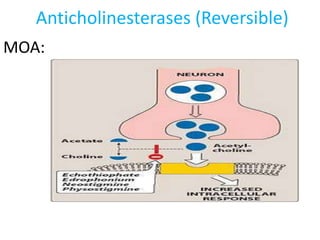
Anticholinesterases are the agents which inhibit
ChE, protect Ach from hydrolysis- produce
cholinergic effects and potentiates Ach.
Reversible:
Carbamates: Physostigmine, Neostigmine,
Pyridostigmine, Edrophonium, Rivastigmine,
Donepeizil, Galantamine
Acridine: Tacrine
Irreversible:
Organophosphates: Carbamates:
Dyflos ( DFP ) Carbaryl
Echothiophate Propoxur
Parathion
Malathion
Diazinon
Tabun, Sarin, Soman
Anticholinesterases (Reversible)
MOA:
Anticholinesterases (Irreversible)
A number of synthetic organophosphate
compounds have the capacity to bind
covalently to acetylcholinesterase.
A.Echothiophate
Mechanism of action:
Echothiophate is an organophosphate that
covalently binds via its phosphate group to the
serine-OH group at the active site of
acetylcholinesterase.
Once this occurs, the enzyme is permanently
inactivated, and restoration of
acetylcholinesterase activity requires the
synthesis of new enzyme molecules.
Thank you

parasympathomimetics drugs

  • 1.
    PRESENTATION ON: PARASYMPATHOMIMETICS Presented by:Under the guidence of MOHD KHUSHTAR SIRMohd Fahad M.pharm, Pharmacology 1st year INTEGRAL UNIVERSITY,lucknow session: 2016-2017
  • 2.
  • 3.
    BODY PARTS PARASYMPATHETIC (atrest) SYMPATHETIC (emergency situation) EYES Constrict pupil Dilates pupil HEART decrease heart rate decrease force of contraction Increase heart rate Increase force of contraction LUNGS Constrict airways Relax airways (more deep breath) GIT Increase motility Increase secretions Sphincter relaxation Decrease motility Decrease secretions Sphincter constriction BLOOD VESSELS dilatation constriction MUSCLES Reduces blood flow to skeletal muscles Increase blood flow to skeletal muscles COMPARISON
  • 4.
    PARASYMPATHETIC NERVOUS SYSTEM •It performs maintenance activities & conserves body energy • ACETYLCHOLINE is both pre-and postganglionic NEUROTRANSMITTER • Ach released at the cholinergic synapses and neuroeffector junctions, mediates its pharmacological action through cholinergic receptors
  • 5.
    • PARASYMPATHOMIMETICS/ CHOLINERGIC DRUGSare agents which mimic the effects of Ach • PARASYMPATHOLYTIC/ ANTICHOLINERGIC DRUGS antagonise the effects of parasympathetic stimulation
  • 7.
    NICOTINIC RECEPTORS Nm NN LOCATIONNeuromuscular junction Autonomic ganglia Adrenal medulla CNS FUNCTION Depolarisation of motor end plate- contraction of skeletal muscles Depolarisation- postganglionic impulse Adrenal medulla- catecholamines release, CNS- excitation/inhibition AGONIST Nicotine Nicotine, DMPP ANTAGONIST tubocurarine Hexamethonium, trimethaphan TRANSDUCER MECHANISM Opening of (Na+, K+) channel Opening of ( Na+, K+, Ca++) channel
  • 8.
    PARASYMPATHOMIMETIC/ CHOLINERGIC DRUG CHOLINERGIC AGONIST CHOLINEESTERS ALKALOIDS acetylcholine muscarine methacholine pilocarpine carbachol arecoline bethanechol
  • 9.
    ANTICHOLINESTERASE DRUGS REVERSIBLE IRREVERSIBLE PhysostigmineEchothiophate Neostigmine Malathion Edrophonium Carbamates Rivastigmine Donapezil
  • 10.
    Neurotransmission at cholinergicneurons Synthesis and release of acetylcholine from the cholinergic neuron. AcCoA = acetyl coenzyme A Neurotransmission in cholinergic neurons involves sequential six steps:
  • 11.
  • 12.
    ACh is brokendown in the synaptic cleft by the enzyme acetylcholinesterase (AChE)
  • 13.
    Cholinergic Drugs Cholinomimetics, Parasympathomimetics •These are the drugs which produces actions similar to that of ACh, either by directly or indirectly interacting with cholinergic receptors or by increasing availability of Ach at these sites ( anticholinesterases )
  • 14.
    Direct-Acting Cholinergic Agonists •Cholinergic agonists (parasympathomimetics) mimic the effects of acetylcholine by binding directly to cholinoceptors. • These agents may be broadly classified into two groups: 1. choline esters, which include acetylcholine synthetic esters of choline, such as carbachol and bethanechol. 2. Naturally occurring alkaloids, such as pilocarpine constitue the second group.
  • 15.
    • All ofthe direct-acting cholinergic drugs have longer durations of action than acetylcholine. • Some of the more therapeutically useful drugs pilocarpine and bethanechol preferentially bind to muscarinic receptors and are sometimes referred to as muscarinic agents. • As a group, the direct-acting agonists show little specificity in their actions, which limits their clinical usefulness.
  • 16.
    A. Acetylcholine: isa quaternary ammonium compound that cannot penetrate membranes. it is therapeutically of no importance because of its multiplicity of actions and its rapid inactivation by the cholinesterases. • Acetylcholine has both muscarinic and nicotinic activity.
  • 17.
    1. Decrease inheart rate and cardiac output: The actions of acetylcholine on the heart mimic the effects of vagal stimulation. For example, acetylcholine, if injected intravenously, produces a brief decrease in cardiac rate and stroke volume as a result of a reduction in the rate of firing at the sinoatrial (SA) node. ACTIONS OF ACH
  • 18.
    2. Decrease inblood pressure: Injection of acetylcholine causes vasodilation and lowering of blood pressure by an indirect mechanism of action. Acetylcholine activates M3 receptors found on endothelial cells lining the smooth muscles of blood vessels This results in the production of nitric oxide from arginine Nitric oxide then diffuses to vascular smooth muscle cells to stimulate protein kinase G production, leading to hyperpolarization and smooth muscle relaxation
  • 19.
    • Other actions:A. In the gastrointestinal tract, acetylcholine increases salivary secretion and stimulates intestinal secretions and motility. Bronchiolar secretions are also enhanced. In the urinary tract, the tone of the detrusor muscle is increased, causing expulsion of urine. • B. In the eye, acetylcholine is involved in stimulating ciliary muscle contraction for near vision and in the constriction of the pupillae sphincter muscle, causing miosis (marked constriction of the pupil). Acetylcholine (1% solution) is instilled into the anterior chamber of the eye to produce miosis during ophthalmic surgery.
  • 20.
    B. Bethanechol: isstructurally related to acetylcholine, in which the acetate is replaced by carbamate and the choline is methylated. • It is not hydrolyzed by acetylcholinesterase (due to the addition of carbonic acid), although it is inactivated through hydrolysis by other esterases. • It lacks nicotinic actions (due to the addition of the methyl group) but does have strong muscarinic activity. • Its major actions are on the smooth muscle of the bladder and gastrointestinal tract. It has a duration of action of about 1 hour.
  • 21.
    • Actions: Bethanecholdirectly stimulates muscarinic receptors, causing increased intestinal motility and tone. It also stimulates the detrusor muscles of the bladder whereas the trigone and sphincter are relaxed, causing expulsion of urine. • Therapeutic applications: In urologic treatment, bethanechol is used to stimulate the atonic bladder, particularly in postpartum or postoperative, nonobstructive urinary retention. Bethanechol may also be used to treat neurogenic atony ( poor muscular condition ). as well as megacolon (Hypertrophy and dilation of the colon associated with prolonged constipation). • Adverse effects: Bethanechol causes the effects of generalized cholinergic stimulation. These include sweating, salivation, flushing, decreased blood pressure, nausea, abdominal pain, diarrhea, and bronchospasm.
  • 22.
    C. Carbachol (carbamylcholine):has both muscarinic as well as nicotinic actions (lacks a methyl group present in bethanechol). • Like bethanechol, carbachol is an ester of carbamic acid and a poor substrate for acetylcholinesterase. • It is biotransformed by other esterases, but at a much slower rate.
  • 23.
    • Actions: Carbacholhas profound effects on both the cardiovascular system and the gastrointestinal system because of its ganglion-stimulating activity, and it may first stimulate and then depress these systems. • It can cause release of epinephrine from the adrenal medulla by its nicotinic action. • Locally instilled into the eye, it mimics the effects of acetylcholine, causing miosis and a spasm of accommodation in which the ciliary muscle of the eye remains in a constant state of contraction.
  • 24.
    • Therapeutic uses:Because of its high potency, receptor nonselectivity, and relatively long duration of action, carbachol is rarely used therapeutically except in the eye as a miotic agent to treat glaucoma by causing pupillary contraction and a decrease in intraocular pressure. • Adverse effects: At doses used ophthalmologically, little or no side effects occur due to lack of systemic penetration.
  • 25.
    D. Pilocarpine: isalkaloid with a tertiary amine and is stable to hydrolysis by acetylcholinesterase. • Compared with acetylcholine and its derivatives, it is far less potent, but it is uncharged and penetrate the CNS at therapeutic doses. • Pilocarpine exhibits muscarinic activity and is used primarily in ophthalmology.
  • 26.
    • Actions: Appliedtopically to the cornea, pilocarpine produces a rapid miosis and contraction of the ciliary muscle. Pilocarpine is one of the most potent stimulators of secretions such as sweat, tears, and saliva, but its use for producing these effects has been limited due to its lack of selectivity. The drug is beneficial in promoting salivation in patients with xerostomia (dryness of mouth)
  • 27.
    Anticholinesterases: Anticholinesterases are theagents which inhibit ChE, protect Ach from hydrolysis- produce cholinergic effects and potentiates Ach. Reversible: Carbamates: Physostigmine, Neostigmine, Pyridostigmine, Edrophonium, Rivastigmine, Donepeizil, Galantamine Acridine: Tacrine
  • 28.
    Irreversible: Organophosphates: Carbamates: Dyflos (DFP ) Carbaryl Echothiophate Propoxur Parathion Malathion Diazinon Tabun, Sarin, Soman
  • 29.
  • 30.
    Anticholinesterases (Irreversible) A numberof synthetic organophosphate compounds have the capacity to bind covalently to acetylcholinesterase.
  • 31.
    A.Echothiophate Mechanism of action: Echothiophateis an organophosphate that covalently binds via its phosphate group to the serine-OH group at the active site of acetylcholinesterase. Once this occurs, the enzyme is permanently inactivated, and restoration of acetylcholinesterase activity requires the synthesis of new enzyme molecules.
  • 32.