Prepared By:
Ms. Jyoti Rani
Assistant Professor
BUEST,SPES
Acetylcholine (ACh) is a major neurohumoral transmitter at autonomic,
somatic as well as central sites.
Parasympathetic stimulation causes slowing down of the heart beat,
lowering of blood pressure, constriction of the pupils, increased blood
flow to the skin and viscera, peristalsis of the GI tract
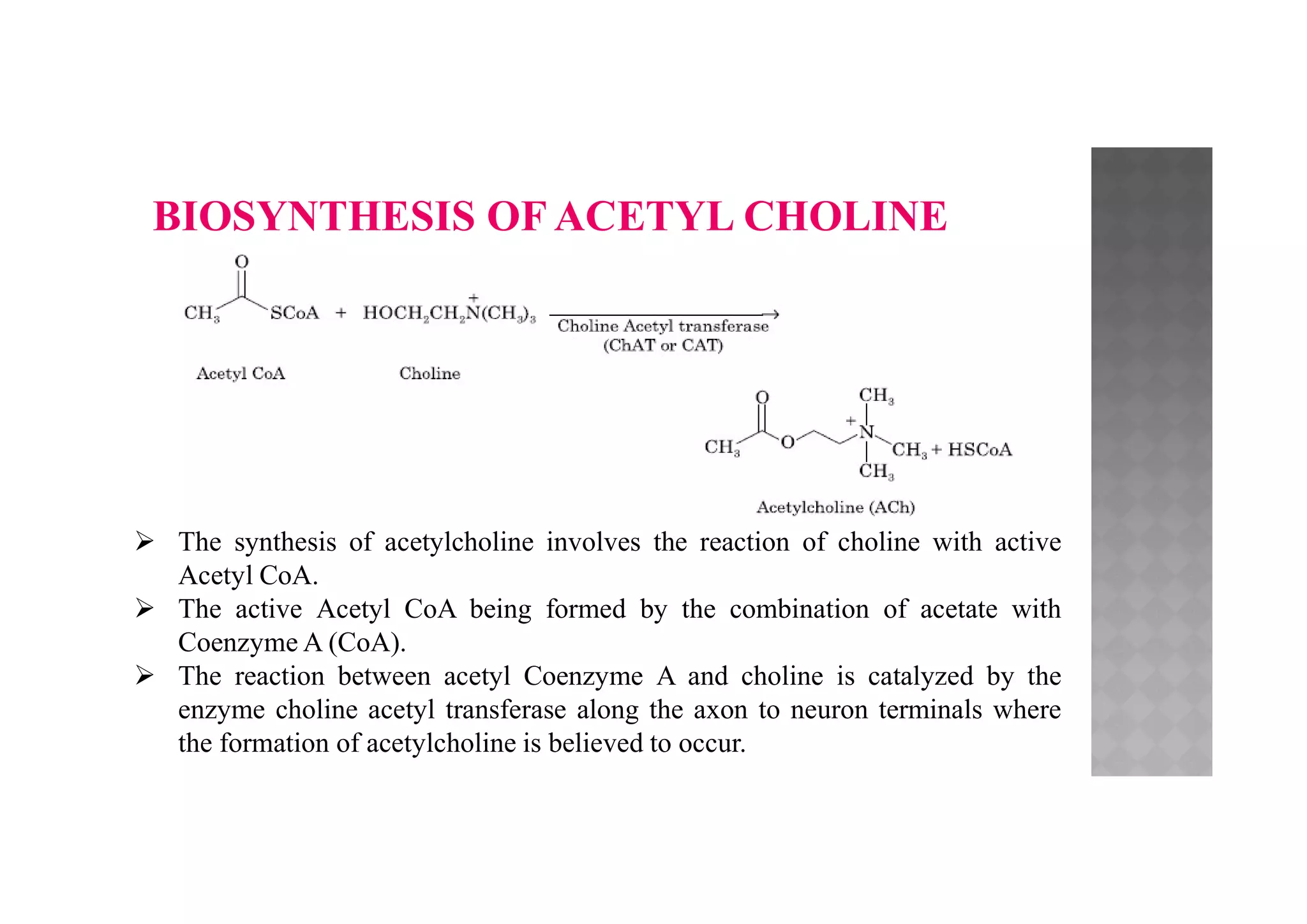
BIOSYNTHESIS OF ACETYL CHOLINE
 The synthesis of acetylcholine involves the reaction of choline with active
Acetyl CoA.
 The active Acetyl CoA being formed by the combination of acetate with
Coenzyme A (CoA).
 The reaction between acetyl Coenzyme A and choline is catalyzed by the
enzyme choline acetyl transferase along the axon to neuron terminals where
the formation of acetylcholine is believed to occur.
STORAGE, RELEASE AND METABOLISM OF ACH
 ACh is stored in synaptic vesicles, which is released in response to
depolarization of the nerve terminal and an increased influx of Ca++.
 When a nerve impulse occurs, depolarization of nerve terminal causes influx
of Ca++, which facilitates the fusion of the axonal and vesicular storage
membranes, and release formed acetylcholine into the synaptic cleft by
exocytosis.
exocytosis.
 The released acetylcholine combines with
the receptors at target organ, remains bound
for less than a millisecond and is quickly
hydrolyzed by acetycholinesterase enzyme into
choline and acetate. acetycholinesterase
CHOLINERGIC RECEPTORS AND
THEIR DISTRIBUTION
Acetylcholine acts on two different classes of receptors-
1. Nicotinic receptors (ligand gated cation channel) and
2. Muscarinic receptors (G-protein coupled receptor)
Nicotinic Receptors. Nicotinic receptors are selectively
activated by nicotine and blocked by tubocurarine or
hexamethonium.
These are rosette like pentameric structures which enclose a l
igand gated cation channel, their activation causes opening of the
channel and rapid flow of cations resulting in depolarization and
generation of action potential..
On the basis of location and selectivity. They are divided into two types;
N1 : These are present at skeletal muscle endplate and mediate skeletal
muscle contractions. They are selectively stimulated by phenyltrimethyl
ammonium and are blocked by tubocurarine.
N2 : These are present in ganglionic cells, adrenal medullary cells, in
spinal cord and in certain areas of brain. They are primarily stimulated
by dimethylphenyl- piperazine and blocked by hexamethonium
Muscarinic Receptors. These receptors are selectively
stimulated by muscarine and blocked by atropine.They are
located primarily on autonomic effector cells in heart, blood
vessels, eye, smooth musclesand glands of gastrointestinal,
respiratory and urinary tracts, sweat glands, etc. and in the CNS.
Although five Muscarinic receptors have been identified, helpfully labeled M1 to
M5, only three are well characterized.
M1 receptors are mainly found in the nervous system. They mediate excitatory
effects, lowering transmembrane potential by a decrease in K+ ion conductance;
as an added wrinkle, they mediate increased gastric acid secretion seen with
vagal stimulation. M1 receptors work via phospholipase C, increasing IP3 and
DAG levels.
M2 receptors mediate the cardiac effects of vagal stimulation. They are
inhibitory (hyperpolarizing membranes by increasing potassium conductance).
M2 receptors are found presynaptically in a variety of situations. This fits on
cardiac cells and smooth muscle. M2 receptors lower intracellular cAMP levels.
M3 receptors are the cholinergic excitatory receptors found on glands and
smooth muscle. M3 receptors are similar to M1 in their use of phospholipase C,
vascular smooth muscle relaxes in some situations due to M3 receptor
stimulation. This relaxation is mediated by endothelial release of nitric oxide
(NO).
M4 are similar to M2 ; M5 receptors seem similar to M1 and M3 in their effects.
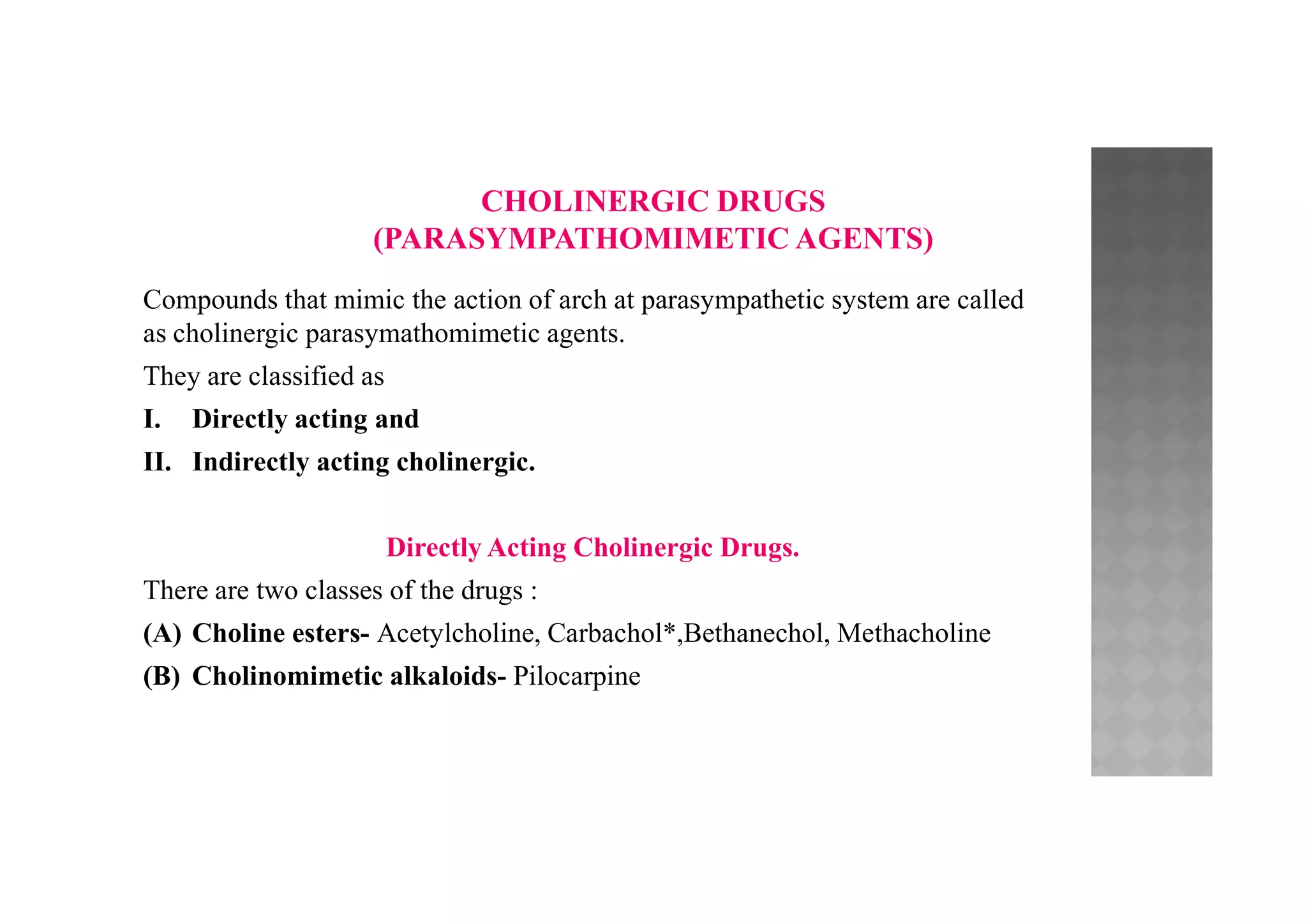
CHOLINERGIC DRUGS
(PARASYMPATHOMIMETIC AGENTS)
Compounds that mimic the action of arch at parasympathetic system are called
as cholinergic parasymathomimetic agents.
They are classified as
I. Directly acting and
II. Indirectly acting cholinergic.
Directly Acting Cholinergic Drugs.
There are two classes of the drugs :
(A) Choline esters- Acetylcholine, Carbachol*,Bethanechol, Methacholine
(B) Cholinomimetic alkaloids- Pilocarpine
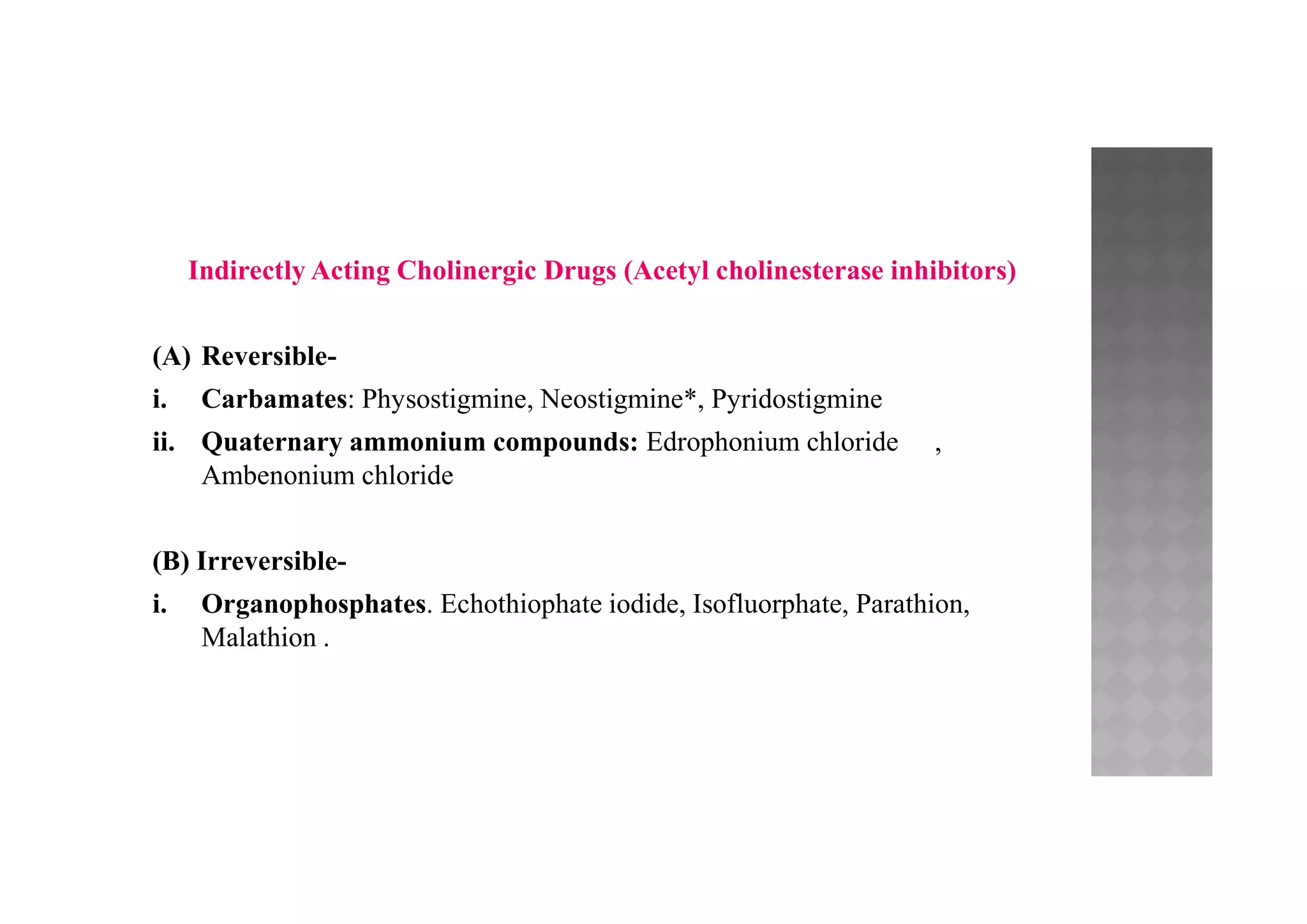
Indirectly Acting Cholinergic Drugs (Acetyl cholinesterase inhibitors)
(A) Reversible-
i. Carbamates: Physostigmine, Neostigmine*, Pyridostigmine
ii. Quaternary ammonium compounds: Edrophonium chloride ,
Ambenonium chloride
Ambenonium chloride
(B) Irreversible-
i. Organophosphates. Echothiophate iodide, Isofluorphate, Parathion,
Malathion .
I. DIRECTLY ACTING CHOLINERGIC DRUGS
(A) Choline esters
Choline esters are synthetic derivatives of choline. They stimulate muscarinic receptors
affecting the cardiac muscle, smooth muscle, exocrine glands and the eye. Choline esters
are lipid insoluble and do not readily enter the CNS (effects occur primarily in the
periphery).
They are highly resistant to being destroyed by acetyl cholinesterase (AChE).
Structure Activity Relationships :
 ACh is the acetyl ester of choline, and is a quaternary ammonium compound which
possesses a cationic (positively charged) head joined by a two carbon chain to an ester
group.
1. Methacholine, due to the methyl substitution at the
α- carbon of ethylene bridge possesses mainly muscarinic
activity, has its effects predominantly on the heart.
2. The degree of Muscarinic activity decreases by replacement
of acetyl group, however, some substitutions result in resistance
to hydrolysis.
For e.g.; Carbachol, where the acetyl group is replaced
by a carbonyl, has both muscarinic and nicotinic properties,
but is almost entirely resistant to hydrolysis by AChE .
3. Bethanechol is similarly resistant to hydrolysis ; however, it
possesses mainly muscarinic activity same as Methacholine,
due to the methyl substitution
4. Although both Carbachol and Bethanechol possess
muscarinic activity, their effects on the heart are minimal and
their GIT effects predominate.
SPECIFIC CHOLINE ESTER DRUGS
Carbachol *
Chemistry. Carbachol is an ester of carbamic acid. In carbachol, the terminal
methyl group of acetyl choline is replaced by amino (-NH2) group as shown in fig.
MOA. Carbachol is a poor substrate for acetycholinesterase and therefore is not
readily hydrolyzed than acetyl choline. It has both muscarinic as well as nicotinic
actions.
Uses. Carbachol is used to reduce intraocular pressure by inducing miosis (pupil
constriction) and relieves intraocular pressure of glaucoma.
Synthesis. Carbachol was first synthesized by Kreitmar in 1932.
1. Carbachol is prepared from ethylene chlorohydrin by reacting with phosgene,
2. The resulting chloroethyl chloroformate treated with ammonia in ether solution forms
urethane,
3. Which on heating with trimethylamine forms carbachol.
C
H2
H2
C
Cl
OH Cl
O
Cl
O
O Cl
H2
C
C
H2
Cl
+
-HCl
2
ethylenechlorohydrin phosgene chloroethyl chloroformate
NH3, Ether
O
O NH2
H2
C
C
H2
Cl
Urethane
N
H3C CH3
CH3
Trimethylamine
CH3
N+
CH3
CH3
C
H2
H2
C
O
H2N
O
Carbachol
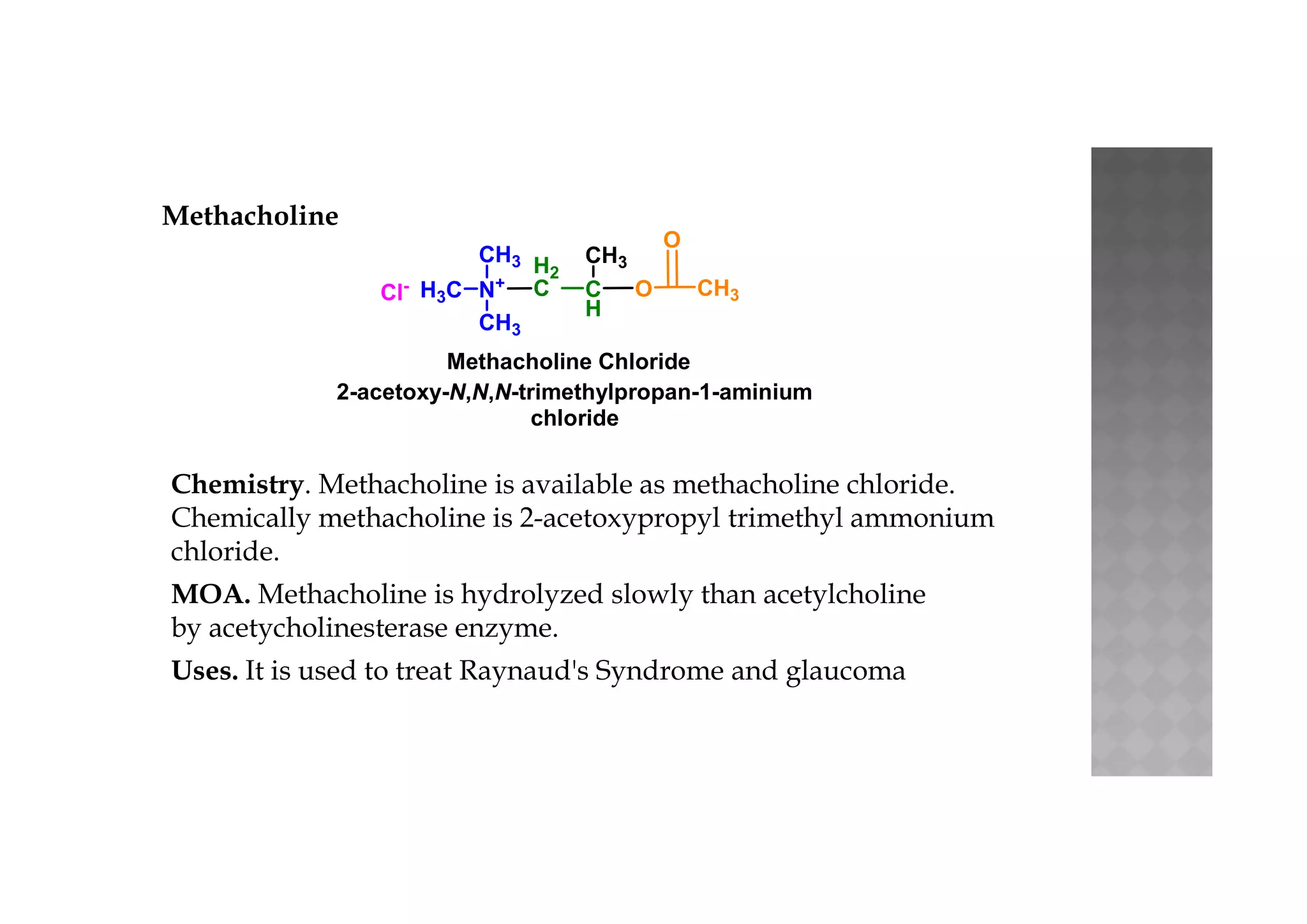
Methacholine
H3C N+
CH3
CH3
H2
C C
H
O CH3
O
Methacholine Chloride
Cl-
CH3
2-acetoxy-N,N,N-trimethylpropan-1-aminium
chloride
Chemistry. Methacholine is available as methacholine chloride.
Chemically methacholine is 2-acetoxypropyl trimethyl ammonium
chloride.
MOA. Methacholine is hydrolyzed slowly than acetylcholine
by acetycholinesterase enzyme.
Uses. It is used to treat Raynaud's Syndrome and glaucoma
Bethanechol.
Chemistry. Bethanechol is a synthetic
derivative of Choline esters. Bethanechol is
a carbomic ester of Methacholine.
MOA.
 It is not rapidly hydrolyzed by acetyl cholinesterase and has strong muscarinic
actions but little nicotinic actions.
 It produces smooth muscle contractions.
 It is not well absorbed from GI tract (large doses required).
 It can be given subcutaneously but not by IM or IV routes because of severe
adverse effects.
Uses.
It is used in the relief of urinary retention and abdominal distention after surgery.
THERAPEUTIC USES OF CHOLINESTER DRUGS :
1. Methacholine was used in the past to control supraventricular tachycardia and is replaced
with edrophonium and other drugs, which are safer.
2. Bethanechol is used as a G.I. tract stimulant to relieve a variety of conditions and to relieve
urinary retention when there is no physical obstruction so that catheterization may be avoided.
3. ACh is used to produce brief periods of miosis during extraction of cataracts. Methacholine,
bethanechol and carbachol are used in treatment of glaucoma to cause miosis which enhances
drainage of aqueous humor.
4. Methacholine is also used for diagnosis of
 Belladonna (i.e., Muscarinic Antagonist) Poisoning,
 Familial Dysautonomia, and
 Bronchial Hyper reactivity (i.e., Super sensitivity leading to bronchoconstriction in patients
with asthma).
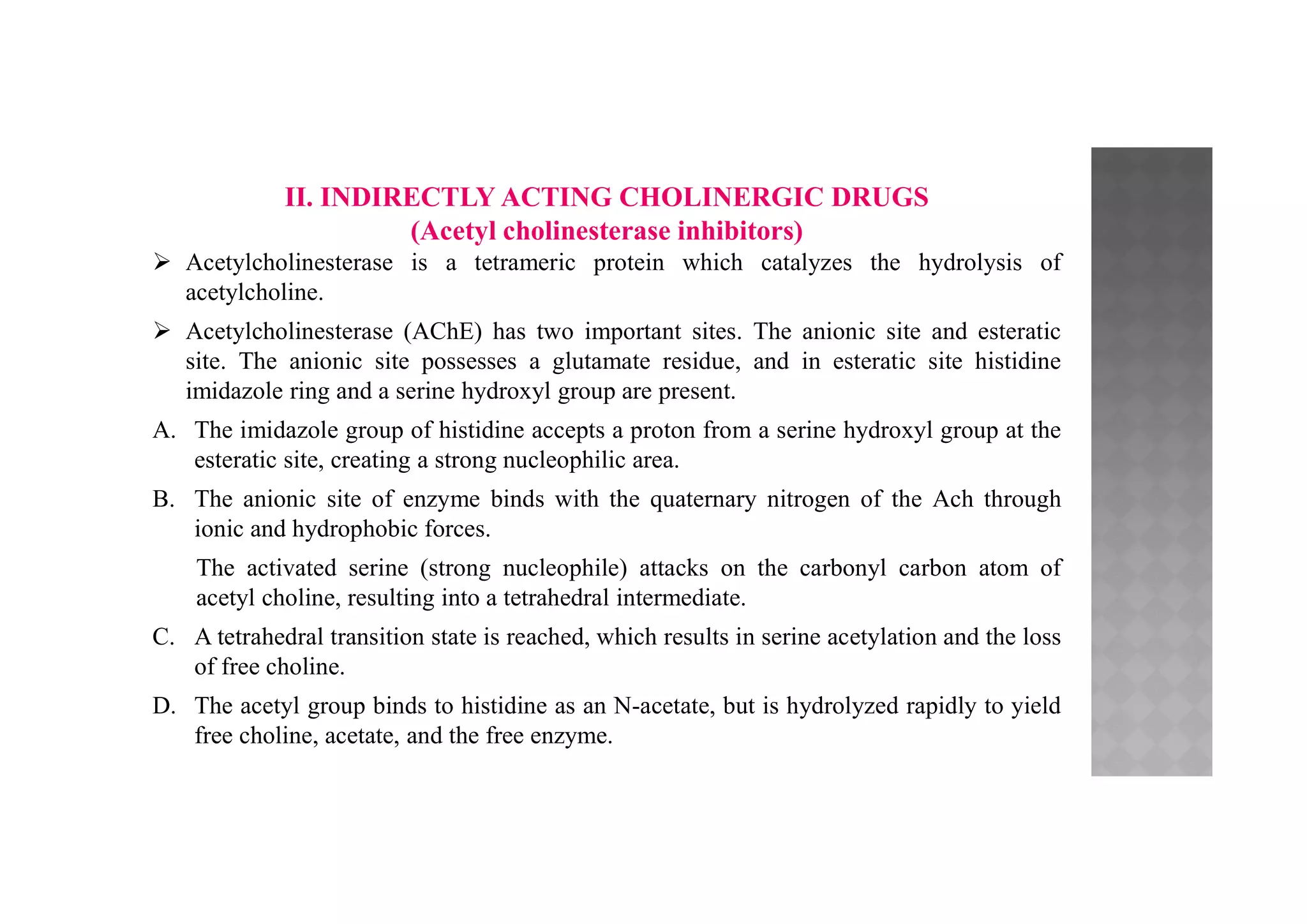
(B) CHOLINOMIMETIC ALKALOIDS
Chemistry. Muscarine, arecoline, pilocarpine are natural alkaloids.
Pilocarpine and muscarine are relatively specific for muscarinic acetyl choline
receptors, while arecoline can activate nicotinic receptors.
MOA. The pharmacological actions of the alkaloids are similar to that of the choline
esters:
esters:
i. miosis, increased tone and motility of G.I. and urinary tracts,
ii. increased secretion of the exocrine glands, hypotension and bradycardia.
iii. Unlike the choline esters, these drugs cross the blood-brain barrier and
therefore have profound CNS side effects.
Pilocarpine
Pilocarpine is the chief constituent of the leaves of the
Pilocarpus jaborandi of South America. It is available as
hydrochloride and nitrate salt.
Chemically it is (3S,4R)-3-ethyl-4-((1-methyl-1H-imidazol-
5-yl)methyl)dihydrofuran-2(3H)-one
MOA.
• Pilocarpine, unlike many of the other quaternary agents,
(S)
(R)
N
N
O
O
(Z)
(Z)
• Pilocarpine, unlike many of the other quaternary agents,
which penetrate membranes poorly. It can penetrate the
eye when applied topically and
• is unaffected by acetylcholinesterase.
• It mainly exhibits muscarinic activity.
Uses.
Its use today is limited to topical miosis for the treatment
of glaucoma for the reversal of mydriasis to relieve
intraocular pressure of glaucoma.
Pilocarpine
(3S,4R)-3-ethyl-4-((1-methyl-
1H-imidazol-5-yl)methyl)
dihydrofuran-2(3H)-one
II. INDIRECTLY ACTING CHOLINERGIC DRUGS
(Acetyl cholinesterase inhibitors)
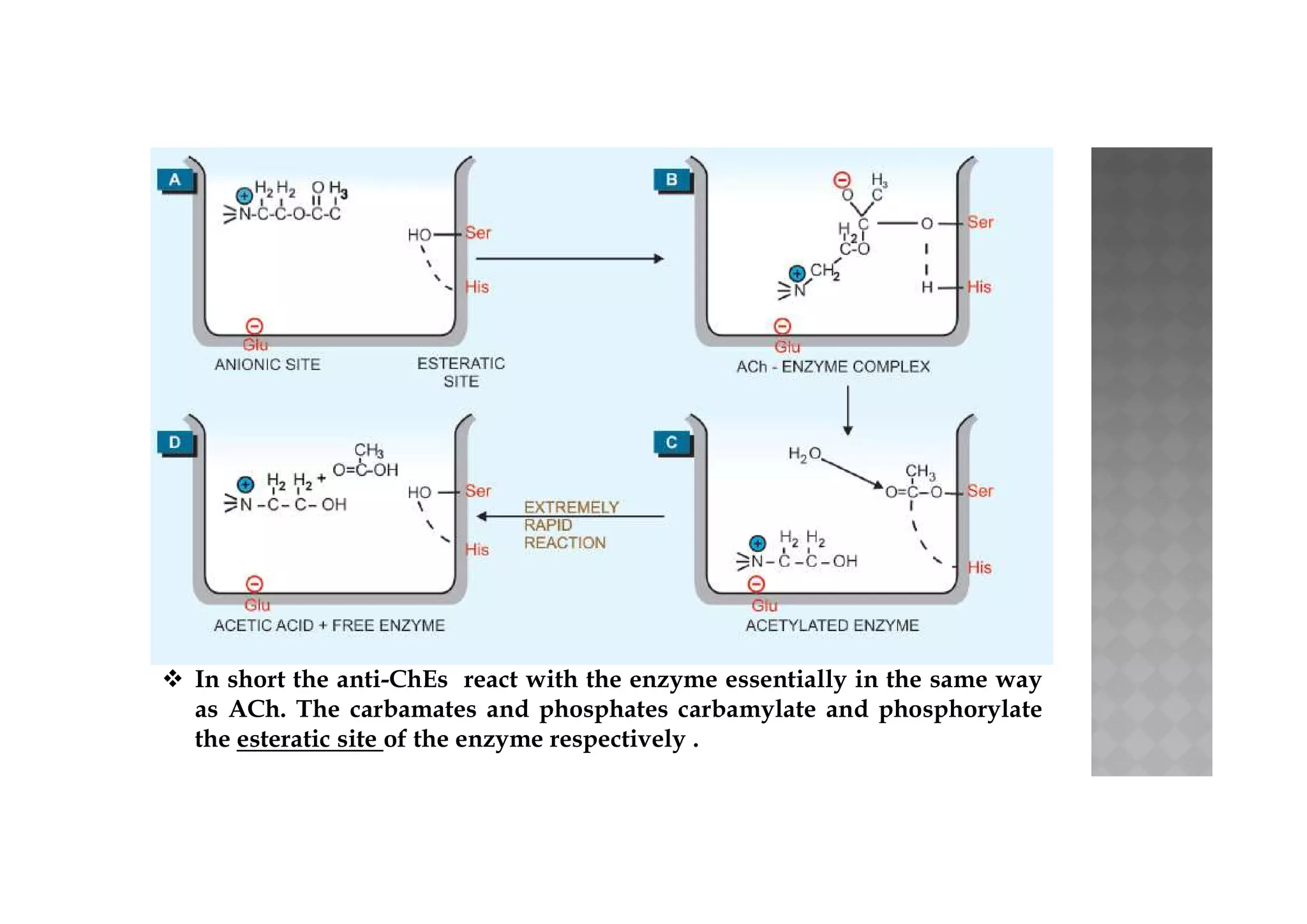
 Acetylcholinesterase is a tetrameric protein which catalyzes the hydrolysis of
acetylcholine.
 Acetylcholinesterase (AChE) has two important sites. The anionic site and esteratic
site. The anionic site possesses a glutamate residue, and in esteratic site histidine
imidazole ring and a serine hydroxyl group are present.
A. The imidazole group of histidine accepts a proton from a serine hydroxyl group at the
esteratic site, creating a strong nucleophilic area.
B. The anionic site of enzyme binds with the quaternary nitrogen of the Ach through
ionic and hydrophobic forces.
The activated serine (strong nucleophile) attacks on the carbonyl carbon atom of
acetyl choline, resulting into a tetrahedral intermediate.
C. A tetrahedral transition state is reached, which results in serine acetylation and the loss
of free choline.
D. The acetyl group binds to histidine as an N-acetate, but is hydrolyzed rapidly to yield
free choline, acetate, and the free enzyme.
 In short the anti-ChEs react with the enzyme essentially in the same way
as ACh. The carbamates and phosphates carbamylate and phosphorylate
the esteratic site of the enzyme respectively .
A. Reversible anticholinesterase inhibitors.
All these drugs are structurally resemble to cholinesterase enzyme and have
greater affinity for the active sites which results into a temporary inhibition of
the enzyme. Hence they are termed as reversible anticholinesterases.
i. Carbamates: can be represented by the following general formula ;
Physostigmine.
Physostigmine, a tertiary amine, is an alkaloid
obtained from the Calabar bean of West Africa
(Physostigma venenosum).
Chemically it is 1, 2, 3, 3α, 8, 8α -hexahydro-
1,3α,8-trimethyl-pyrrolo [2,3-b] indol-5-ol-methylcarbamate.
MOA.
 Physostigmine reversibly inhibits acetycholinesterase thus results in
potentiation of cholinergic activity.
 It stimulates muscarinic, nicotinic sites of ANS and nicotinic receptors of
neuromuscular junction.
Uses.Physostigmine has been used in the treatment of
1. glaucoma,
2. atropine intoxication and
3. overdose with the tricyclic antidepressants.
Neostigmine*.
Chemically neostigmine is 3-(dimethylcarbamoyloxy)-N, N, N-trimethylaniline.
Synthesis. Neostigmine is synthesizesd from 3-hydroxy N, N-dimethylaniline as follows :
MOA. Neostigmine inhibits both AchE reversibly and potentiates nicotinic and muscarinic
effects of acetylcholine. It exists as cations at physiological pH, thus enhancing their
association with the active site.
Uses.
1. It is used to treat myasthenia gravis.
2. It is also used to treat constipation, post-operative distention and urinary retention.
Pyridostigmine.
Chemistry. Pyridostigmine is a pyridine analogue of
Neostigmine. It is 3-dimethylcarbamoyloxy-
1-methylpyridinium.
MOA.
 Pyridostigmine is a potent reversible inhibitor
of acetylcholinesterase.
 By inhibiting the enzyme it permits free transmission of nerve impulses across
the neuromuscular junction.
CH3
N
O
N
O
H3C
CH3
Pyridostigmine
3-((dimethylcarbamoyl)oxy)-
1-methylpyridin-1-ium
the neuromuscular junction.
 It is hydrolyzed by acetyl cholinesterase but much more slowly than acetyl
choline itself.
 Pyridostigmine intensifies both the nicotinic and muscarinic effects of
acetylcholine.
Uses.
1. Pyridostigmine is used in the treatment of myasthenia gravis.
2. It is also used in paralytic ileus or postoperative urinary retention.
Quaternary ammonium compounds:
Quaternary ammonium compounds inhibit the enzyme reversibly by either binding with the
esteratic site, or with the peripheral anionic site
Edrophonium.
Chemistry. It is Ethyl-(m-hydroxyphenyl)
dimethylammonium chloride.
MOA.
CH3
H2
C
N+
H3C
HO
CH3
Edrophonium
Edrophonium chloride is an anti-AChE agent
with a rapid onset but short duration of action.
Edrophonium binds reversibly and selectively to the active center;
this reversible binding and its rapid renal elimination result in its short duration of action.
Use. It has been used in the investigation of myasthenia gravis.
Edrophonium
N-ethyl-3-hydroxy-N,N-dimethyl
benzenaminium
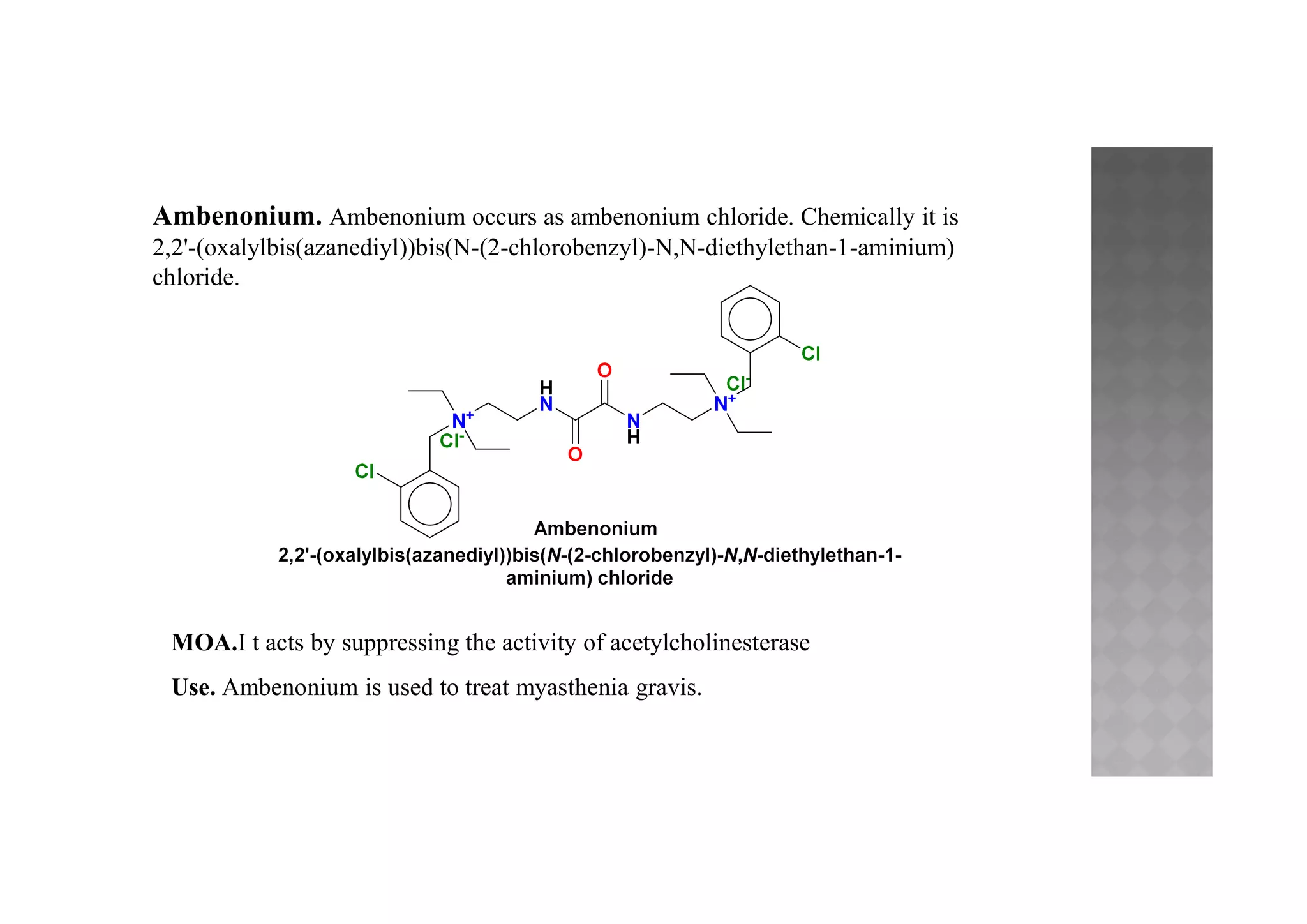
Ambenonium. Ambenonium occurs as ambenonium chloride. Chemically it is
2,2'-(oxalylbis(azanediyl))bis(N-(2-chlorobenzyl)-N,N-diethylethan-1-aminium)
chloride.
MOA.I t acts by suppressing the activity of acetylcholinesterase
Use. Ambenonium is used to treat myasthenia gravis.
(B) Irreversible anticholinesterase inhibitors. -
Organic esters of phosphoric acid were first shown to inhibit AChE in 1937 and were
subsequently used as insecticides in agriculture. All of the organophosphates
irreversibly bind AChE. These compounds form reversible complex with enzyme at the
esteratic site. The reversible complex then immediately converts into an irreversible
complex.
Organophosphates are usually represented by the following formula :
P
A
R2
R1
X
Organophosphates
R1 = Alkoxyl
R2 = Alkoxyl, alkyl or 3° amine
A = Oxygen/Sulphur/Selenium
X = Good leaving group (Ex. F, CN etc.)
I-
O
P
O
O
S
N+
H3C
CH3
H3C
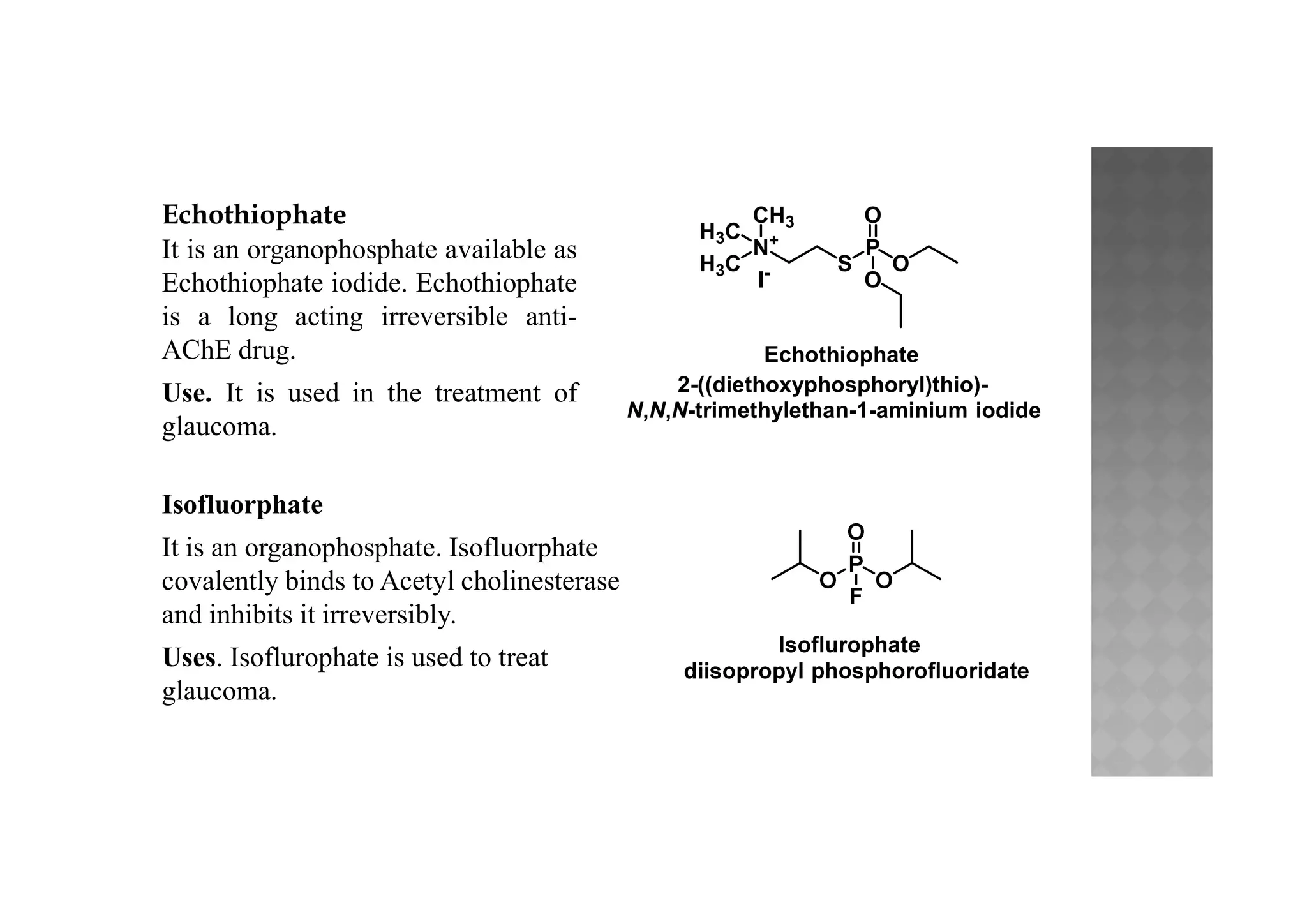
2-((diethoxyphosphoryl)thio)-
N,N,N-trimethylethan-1-aminium iodide
Echothiophate
Echothiophate
It is an organophosphate available as
Echothiophate iodide. Echothiophate
is a long acting irreversible anti-
AChE drug.
Use. It is used in the treatment of
glaucoma.
Isofluorphate
It is an organophosphate. Isofluorphate
covalently binds to Acetyl cholinesterase
and inhibits it irreversibly.
Uses. Isoflurophate is used to treat
glaucoma.
O
O
S
P
O
S
O
O
Malathion is another effective pesticide, which is more effective on insects
than on humans because it requires biotransformation to the phosphate form,
which can only be carried out by insects. Malathion is a phosphodithioate ester.
Chemically it is 2-[(dimethoxyphosphinothioyl)thio]-butanedioic acid diethyl
ester. It is a poor irreversible inhibitor of choline esterase enzyme.
S
O
O
O
Malathion
diethyl 2-((dimethoxyphosphorothioyl)
thio)succinate
Uses.
 Malathion is used extensively for controlling insects on vegetables, fruits,
and cereal crops.
 It is also used for controlling insects affecting man and animals.
Parathion is O, O-diethyl O-p-nitrophenyl
phosphorothioate. It is a weak cholinesterase inhibitor.
Use
Parathion is used as an agricultural insecticide.
It is especially used for controlling
aphids, spider mites, and scale insects.
Tacrine
Tacrine
It is a lipophilic acridine compound which interacts
with ChE in a manner analogous to edrophonium. It
crosses blood-brain barrier and has a longer duration
of action.
By increasing brain ACh levels it was found to
produce some symptomatic improvement in
Alzheimer’s disease, but has gone into disuse due to
hepatotoxicity.
ANTICHOLINESTERASE POISONING
Anticholinesterases are easily available and extensively used as agricultural and
household insecticides; accidental as well as suicidal and homicidal poisoning is
common.
Treatment
1. Termination of further exposure to the poison— fresh air, wash the skin and
mucous membranes with soap and water, gastric lavage according to need.
2. Maintain patent airway, positive pressure respiration if it is failing.
3. Supportive measures—maintain BP, hydration, control of convulsions with
judicious use of diazepam.
4. Specific antidote—Cholinesterase reactivator: Pralidoxime chloride.
Pralidoxime is an aldoxime and available as pralidoxime
chloride. Chemically it is 2-formyl-1-methylpyridinium chloride
oxime.
Uses. The molecule pralidoxime is a useful antidote for
intoxication with cholinesterase inhibitors such as the
organophosphates. The molecule removes the inhibitor from the
activesite in the form of an oxime phosphonate.
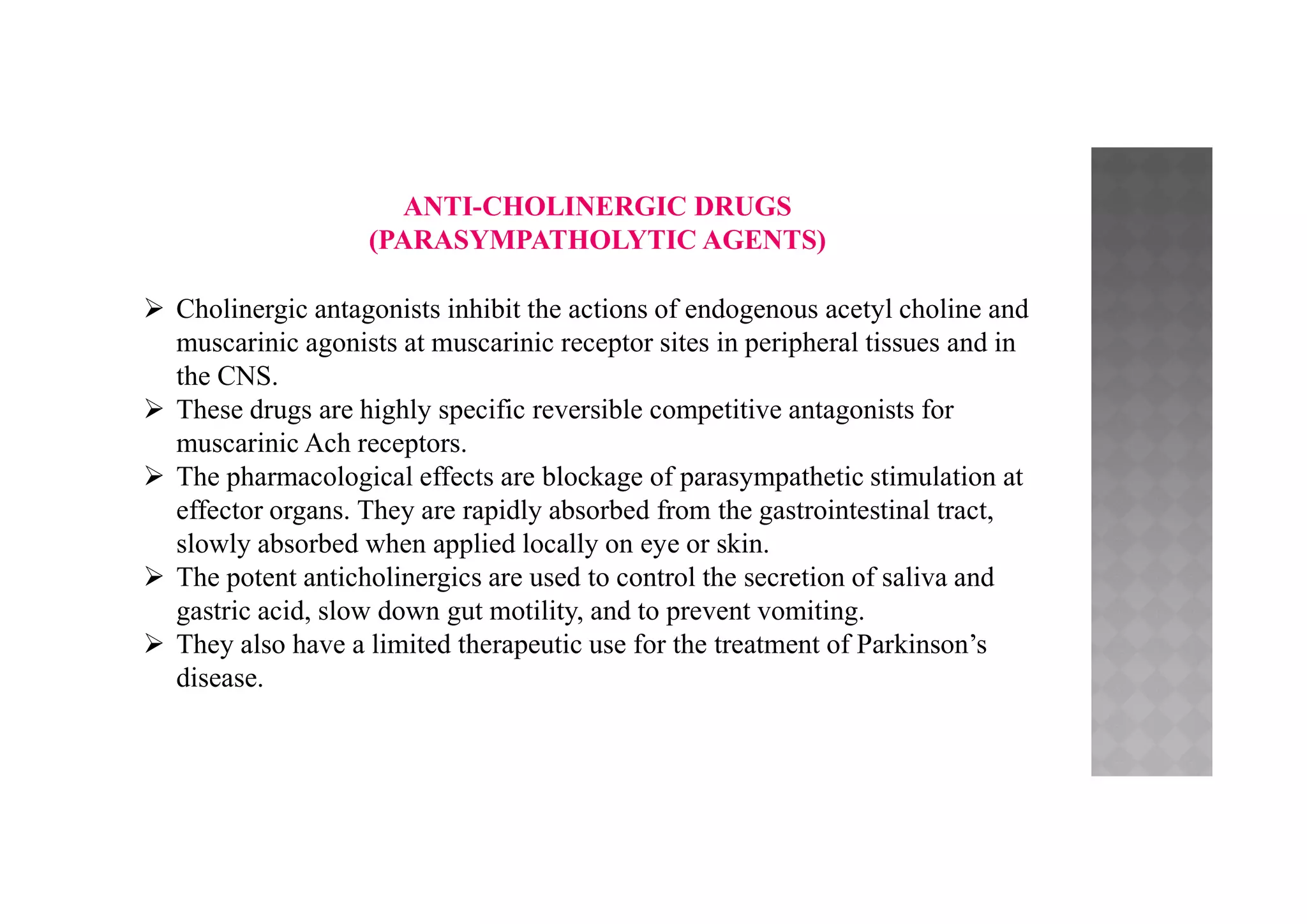
ANTI-CHOLINERGIC DRUGS
(PARASYMPATHOLYTIC AGENTS)
 Cholinergic antagonists inhibit the actions of endogenous acetyl choline and
muscarinic agonists at muscarinic receptor sites in peripheral tissues and in
the CNS.
 These drugs are highly specific reversible competitive antagonists for
muscarinic Ach receptors.
 The pharmacological effects are blockage of parasympathetic stimulation at
effector organs. They are rapidly absorbed from the gastrointestinal tract,
slowly absorbed when applied locally on eye or skin.
 The potent anticholinergics are used to control the secretion of saliva and
gastric acid, slow down gut motility, and to prevent vomiting.
 They also have a limited therapeutic use for the treatment of Parkinson’s
disease.
Structure-activity Relationships of Muscarinic Antagonistis :
1. Anticholinergic agents are bulky. They combine with muscarinic receptors and
shield the binding site from acetylcholine.
2. The general structure of the compounds in this category is
3. Substituent R1 should be carbocyclic or heterocyclic ring
for maximal antagonist activity
4. Substituent R2 should be a hydrogen atom, hydroxy group, hydroxymethyl group,
or methyl group.
5. The nature of the group X effects only the duration of action, the physicochemical
properties and the side effects of the drug molecule but not its ability to bind with
the receptor.
6. There is a limitation for the N-substitution. Optimal potency is associated with 2-3
ethyl groups.
7. The stereochemistry at the benzylic carbon is critical for muscarinic antagonist
activity. i.e. it should be in the same absolute configuration as depicted in the
general formula above.
8. The presence of an N-methyl group on atropine or scopolamine changes the activity
of the ligand, possibly by preventing a close interaction between the ligand and the
membrane or lipophilic sites on the receptor. The methyl group also prevents the
penetration into the brain.
STRUCTURE ACTIVITY RELATIONSHIP OF CHOLINOLYTICS
The SAR for muscarinic antagonists can be summarized as follows:
1. Substituents R1 and R2 should be carbocyclic or heterocyclic rings for maximal
antagonist potency. The rings can be identical, but the more potent compounds have
different rings. Generally, one ring is aromatic and the other saturated or possessing only
one olefinic bond. Substituents R1 and R2, however, can be combined into a fused
aromatic tricyclic ring system, such as that found in propantheline .
2. The R3 substituent can be a hydrogen atom, a hydroxyl group, a hydroxy methyl
group, or a carboxamide, or it can be a component of one of the R1 and R2 ring systems.
When this substituent is either a hydroxyl group or a hydroxy methyl group, the antagonist
is usually more potent than the same compound without this group. The hydroxyl group
presumably increases binding strength by participating in a hydrogen bond interaction at
the receptor.
3.The X substituent in the most potent anticholinergic agents is an ester, but an ester
functional group is not an absolute necessity for muscarinic antagonist activity. This
substituent can be an ether oxygen, or it can be absent completely.
4. The N substituent is a quaternary ammonium salt in the most potent anticholinergic
agents. This is not a requirement, however, because tertiary amines also possess antagonist
activity, presumably by binding to the receptor in the cationic (conjugate acid) form. The
alkyl substituents are usually methyl, ethyl, propyl, or isopropyl.
5. The distance between the ring-substituted carbon and the amine nitrogen apparently is
not critical; the length of the alkyl chain connecting these can be from two to four carbons.
The most potent anticholinergic agents have two methylene units in this chain.
ANTI-CHOLINERGIC DRUGS
(PARASYMPATHOLYTIC AGENTS)
CLASSIFICATION
I. Natural Alkaloids- Atropine Sulphate, Hyoscyamine sulphate , Scopolamine
hydrobromide
II. Semi-synthetic Derivatives- Homatropine Hydrobromide , Ipratropium bromide*.
III. Synthetic Compounds- Tropicamide, Cyclopentolatehydrochloride, Clidinium
bromide, Dicyclomine hydrochloride*, Glycopyrrolate, Methantheline bromide,
Propantheline bromide,Benztropine mesylate, Orphenadrine citrate, Biperidine
hydrochloride, Procyclidine hydrochloride*, Tridihexethyl chloride, Isopropamide
iodide, Ethopropazine hydrochloride.
I. Natural Alkaloids-
The natural alkaloids are found in plants of the solanaceae family. The levo-
isomers are much more active than the dextroisomers.
Atropine. It is anticholinergic that blocks muscarinic receptors. It was the first
anticholinergic alkaloid extracted from Solanaceae plant. It is an ester of tropine
and tropic acid and used as a sulphate salt in racemic form. At therapeutic does it
can penetrate the brain and stimulate the CNS
Uses
Uses
– Treat Bardycardia
– Reduce secretion before surgery
– Treat Iritis (painful inflammation of eye)
– Organophosphate poisoning
(only to decrease muscarinic action, not an
antidote like PAM)
MOA – It competitively binds to muscarinic receptor and antagonizes it thus
blocking all cholinergic effects
Atropine
8-methyl-8-azabicyclo[3.2.1]
octan-3-yl 3-hydroxy-2-phenylpropanoate
O
O
OH
N
Hyoscyamine Sulphate.
The difference between atropine and
Hyoscyamine
is that atropine is (poison|pharmaceutical drug) an
alkaloid extracted from the plant deadly nightshade
(atropa belladonna ) and other sources though
overdoses would be fatal it is used as a drug in
medicine for its paralytic effects (eg in surgery to relax
muscles, in dentistry to dry the mouth, in
ophthalmology to dilate the pupils)
while hyoscyamine is (chemistry) an alkaloid, the
stereoisomer of atropine, used medicinally to treat
abdominal pain and similar conditions.
Use. Hyoscyamine is an anticholinergic drug used to
treat peptic ulcers
Scopolamine or Hyoscine
It is anticholinergic that blocks muscarinic
receptors
• It is an alkaloid extracted from
Solanaceae plant
• It is used as salt hydrobromide salt
in enantiopure (-) levo form
• At therapeutic does it depresses CNS
• Uses
– Treat Iritis (painful inflammation of eye)
– Treat Parkinson
– Treat Motion sickness
• MOA - It competitively binds to muscarinic receptor and antagonizes
it thus blocking all cholinergic effects
Homatropine
It is a synthetic alkaloid and is official as
homatropine hydrobromide or
homatropine methylbromide.
Uses :
1. Homatropine is mainly used as mydriatic and
2. is preferred over atropine due to its more rapid and short duration of action.
3. Homatropine is used to treat peptic ulcer and gastro-intestinal spasm
II. Semi-synthetic Derivatives-
N O OH
O
Homatropine
8-methyl-8-azabicyclo[3.2.1]octan-3-yl
-2-hydroxy-2-phenylacetate
3. Homatropine is used to treat peptic ulcer and gastro-intestinal spasm
Ipratropium is a quaternary ammonium
derivative of atropine that acts as an
anticholinergic agent.
Use. It is used to treat the symptoms
of chronic obstructive pulmonary
disease and asthama.
III. Synthetic Compounds-
Tropicamide
OH
N
N
O
N-ethyl-3-hydroxy-2-phenyl-
N-(pyridin-4-ylmethyl)propanamide
Tropicamide.
It is an effective anticholinergic drug for
ophthalmic use. It antagonizes M4 receptors.
Uses.
Tropicamide is a very short acting mydriatic and
cycloplegic
Cyclopentolate hydrochloride.
Cyclopentolate is also an amino-alcohol ester.
Uses :
1. Cyclopentolate hydrochloride is used as a
mydriatic agent
2. It is used for the treatment of iritis, keratitis,
and choroiditis
N
O
OHO
Cyclopentolate
2-(dimethylamino)ethyl 2-(1-
hydroxycyclopentyl)-2-phenylacetate
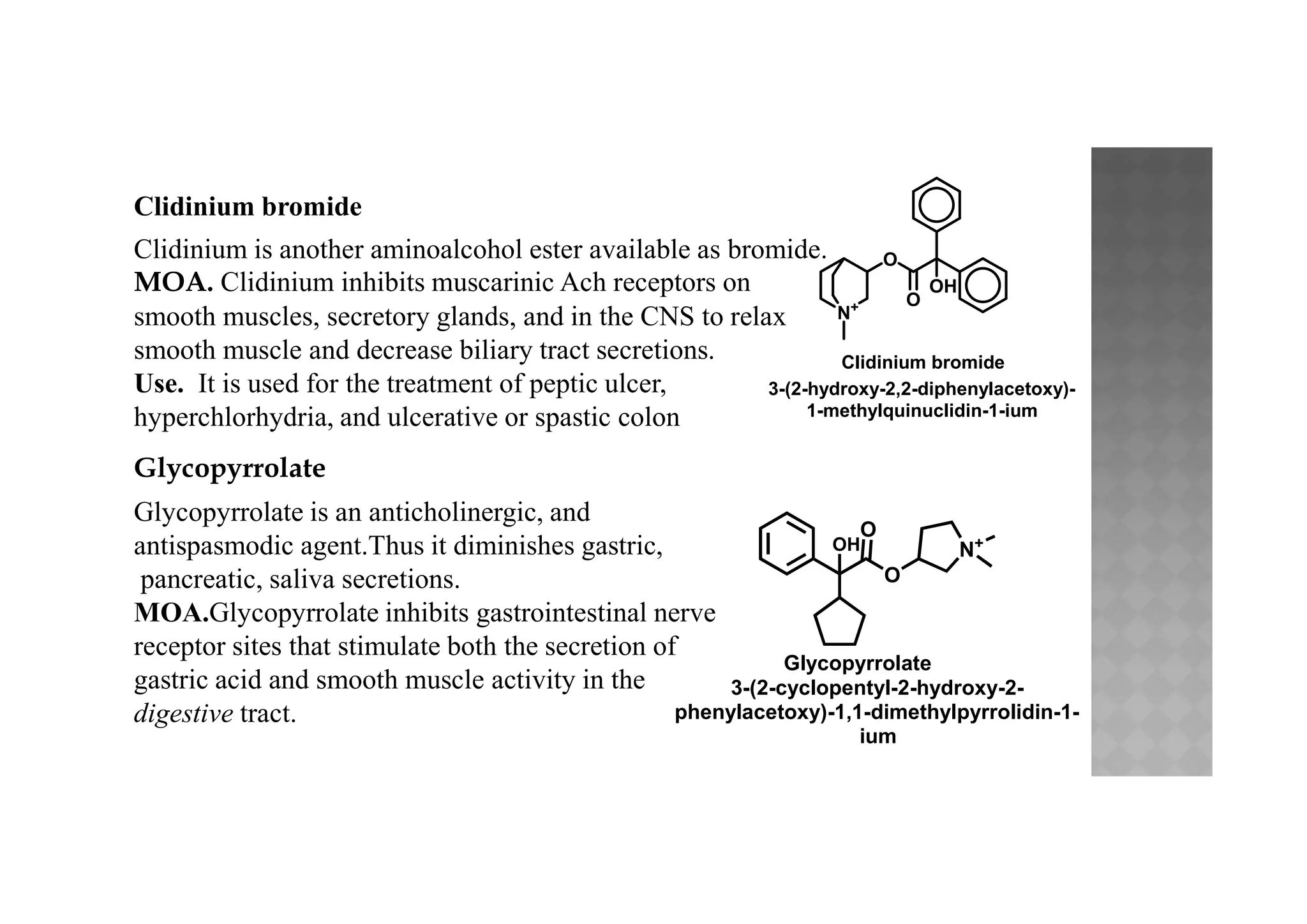
Clidinium bromide
Clidinium is another aminoalcohol ester available as bromide.
MOA. Clidinium inhibits muscarinic Ach receptors on
smooth muscles, secretory glands, and in the CNS to relax
smooth muscle and decrease biliary tract secretions.
Use. It is used for the treatment of peptic ulcer,
hyperchlorhydria, and ulcerative or spastic colon
Glycopyrrolate
Clidinium bromide
O
O
N+
OH
3-(2-hydroxy-2,2-diphenylacetoxy)-
1-methylquinuclidin-1-ium
Glycopyrrolate
Glycopyrrolate is an anticholinergic, and
antispasmodic agent.Thus it diminishes gastric,
pancreatic, saliva secretions.
MOA.Glycopyrrolate inhibits gastrointestinal nerve
receptor sites that stimulate both the secretion of
gastric acid and smooth muscle activity in the
digestive tract.
N+
O
O
OH
3-(2-cyclopentyl-2-hydroxy-2-
phenylacetoxy)-1,1-dimethylpyrrolidin-1-
ium
Glycopyrrolate
Dicyclomine hydrochloride*
Dicyclomine is an aminoalcohol ester and is available
as hydrochloride salt.
Dicyclomine is synthesized from cyclohexylnitrile by the
following steps :
(a) Cyclohexylnitrile on alkylation with 1, 5-dibromopentane
yields a cyclohexane intermediate, which is hydrolysed to get acid.
Dicyclomine
O
O
N
2-(diethylamino)ethyl
[1,1'-bi(cyclohexane)]-1-carboxylate
(b) The above acid is esterified with N, N-diethylamino ethanol to get dicyclomine.
Methantheline bromide
Methantheline bromide is a member of xanthenes.
MOA. Dicyclomine is an anticholinergic and antispasmodic. It relieves smooth
muscle spasm in the GI tract and urinary tract.
This effect is due to direct action on the pain muscle.
Use.
It is used to treat intestinal, biliary, renal and ureteric colic, irritable bowel
syndrome and dysmenorrhoea.
Methantheline bromide is a member of xanthenes.
A quaternary ammonium compound that acts
as an antimuscarinic agent.
Use.
1. It has been used in the treatment of
peptic ulcer,
2. in gastrointestinal disorders associated with
smooth muscle spasm, and
3. in the management of urinary incontinence
Propantheline bromide is an antimuscarinic agent.
MOA. Propantheline is one of a group
of antispasmodic medications which work by
blocking the action of the chemical
messenger acetylcholine.
Use. It is used as antispasmodic and
in the treatment of peptic ulcers.
Benztropine mesylate
Benzatropine is a centrally acting anticholinergic
/antihistamine agent. It is a selective M1 muscarinic Ach
receptor antagonist.
Use. It is a medication used to treat a type of movement
disorder due to antipsychotics known as dystonia .
It is also a second-line drug for the treatment of
Parkinson's disease. It improves tremor, and may
alleviate rigidity and bradykinesia.
N O
Benztropine
3-(benzhydryloxy)-8-methyl-8-
azabicyclo[3.2.1]octane
Orphenadrine citrate
Orphenadrine is an aminoalcohol ether derivative.
It has anticholinergic and antihistaminic activities.
It is closely related to diphenhydramine.
Uses. Orphenadrine is used for symptomatic treatment of
Parkinson’s disease. It is also used as skeletal muscle
relaxant.
O
N
N,N-dimethyl-2-(phenyl(o-
tolyl)methoxy)ethan-1-amine
Orphenadrine
Biperidine hydrochloride
Biperiden is a weak visceral anticholinergic agent.
It has strong nicotinolytic action.
Uses.
1. Biperiden is used to treat parkinson’s disease
2. It is also used to cure akineasia, rigidity and
tremor
Biperidine
OH
N
1-(bicyclo[2.2.1]hept-5-en-2-yl)-1-
phenyl-3-(piperidin-1-yl)propan-1-ol
Procyclidine hydrochloride*
Procyclidine is an effective peripheral anticholinergic
aminoalcohol derivative. Procyclidine occurs as
procyclidine hydrochloride salt.
Use.
Procyclidine is used in treatment of
Parkinson’s disease
OH
N
Procyclidine
1-cyclohexyl-1-phenyl-3-
(pyrrolidin-1-yl)propan-1-ol
Tridihexethyl chloride
It is an anticholinergic, antimuscarinic and
antispasmodic drug. It is an M1 receptor
antagonist.
Use. to treat peptic ulcer disease. Tridihexethyl
OH
N+
3-cyclohexyl-N,N,N-triethyl-3-
hydroxy-3-phenylpropan-1-aminium
Isopropamide iodide
Isopropamide is an aminoamide and occurs as
ispropamide iodide. It is a long acting
anticholinergic drug.
Uses :
1. Isopropamide is a potent anticholinergic drug.
2. It has antispasmodic and antisecretory effects.
3. It is used in the treatment of peptic ulcer.
Ethopropazine hydrochloride
also known as Profenamine is a phenothiazine
derivative that has anticholinergic, antihistamine,
and antiadrenergic actions.
Use.
It is used in the treatment of Parkinsonism disease.
Thank you
Thank you

Cholinergics and anti cholinergic drugs

  • 1.
    Prepared By: Ms. JyotiRani Assistant Professor BUEST,SPES
  • 2.
    Acetylcholine (ACh) isa major neurohumoral transmitter at autonomic, somatic as well as central sites. Parasympathetic stimulation causes slowing down of the heart beat, lowering of blood pressure, constriction of the pupils, increased blood flow to the skin and viscera, peristalsis of the GI tract
  • 3.
    BIOSYNTHESIS OF ACETYLCHOLINE  The synthesis of acetylcholine involves the reaction of choline with active Acetyl CoA.  The active Acetyl CoA being formed by the combination of acetate with Coenzyme A (CoA).  The reaction between acetyl Coenzyme A and choline is catalyzed by the enzyme choline acetyl transferase along the axon to neuron terminals where the formation of acetylcholine is believed to occur.
  • 4.
    STORAGE, RELEASE ANDMETABOLISM OF ACH  ACh is stored in synaptic vesicles, which is released in response to depolarization of the nerve terminal and an increased influx of Ca++.  When a nerve impulse occurs, depolarization of nerve terminal causes influx of Ca++, which facilitates the fusion of the axonal and vesicular storage membranes, and release formed acetylcholine into the synaptic cleft by exocytosis. exocytosis.  The released acetylcholine combines with the receptors at target organ, remains bound for less than a millisecond and is quickly hydrolyzed by acetycholinesterase enzyme into choline and acetate. acetycholinesterase
  • 5.
    CHOLINERGIC RECEPTORS AND THEIRDISTRIBUTION Acetylcholine acts on two different classes of receptors- 1. Nicotinic receptors (ligand gated cation channel) and 2. Muscarinic receptors (G-protein coupled receptor) Nicotinic Receptors. Nicotinic receptors are selectively Nicotinic Receptors. Nicotinic receptors are selectively activated by nicotine and blocked by tubocurarine or hexamethonium. These are rosette like pentameric structures which enclose a l igand gated cation channel, their activation causes opening of the channel and rapid flow of cations resulting in depolarization and generation of action potential..
  • 6.
    On the basisof location and selectivity. They are divided into two types; N1 : These are present at skeletal muscle endplate and mediate skeletal muscle contractions. They are selectively stimulated by phenyltrimethyl ammonium and are blocked by tubocurarine. N2 : These are present in ganglionic cells, adrenal medullary cells, in spinal cord and in certain areas of brain. They are primarily stimulated by dimethylphenyl- piperazine and blocked by hexamethonium
  • 7.
    Muscarinic Receptors. Thesereceptors are selectively stimulated by muscarine and blocked by atropine.They are located primarily on autonomic effector cells in heart, blood vessels, eye, smooth musclesand glands of gastrointestinal, respiratory and urinary tracts, sweat glands, etc. and in the CNS. Although five Muscarinic receptors have been identified, helpfully labeled M1 to Although five Muscarinic receptors have been identified, helpfully labeled M1 to M5, only three are well characterized. M1 receptors are mainly found in the nervous system. They mediate excitatory effects, lowering transmembrane potential by a decrease in K+ ion conductance; as an added wrinkle, they mediate increased gastric acid secretion seen with vagal stimulation. M1 receptors work via phospholipase C, increasing IP3 and DAG levels.
  • 8.
    M2 receptors mediatethe cardiac effects of vagal stimulation. They are inhibitory (hyperpolarizing membranes by increasing potassium conductance). M2 receptors are found presynaptically in a variety of situations. This fits on cardiac cells and smooth muscle. M2 receptors lower intracellular cAMP levels. M3 receptors are the cholinergic excitatory receptors found on glands and smooth muscle. M3 receptors are similar to M1 in their use of phospholipase C, vascular smooth muscle relaxes in some situations due to M3 receptor vascular smooth muscle relaxes in some situations due to M3 receptor stimulation. This relaxation is mediated by endothelial release of nitric oxide (NO). M4 are similar to M2 ; M5 receptors seem similar to M1 and M3 in their effects.
  • 9.
    CHOLINERGIC DRUGS (PARASYMPATHOMIMETIC AGENTS) Compoundsthat mimic the action of arch at parasympathetic system are called as cholinergic parasymathomimetic agents. They are classified as I. Directly acting and II. Indirectly acting cholinergic. II. Indirectly acting cholinergic. Directly Acting Cholinergic Drugs. There are two classes of the drugs : (A) Choline esters- Acetylcholine, Carbachol*,Bethanechol, Methacholine (B) Cholinomimetic alkaloids- Pilocarpine
  • 10.
    Indirectly Acting CholinergicDrugs (Acetyl cholinesterase inhibitors) (A) Reversible- i. Carbamates: Physostigmine, Neostigmine*, Pyridostigmine ii. Quaternary ammonium compounds: Edrophonium chloride , Ambenonium chloride Ambenonium chloride (B) Irreversible- i. Organophosphates. Echothiophate iodide, Isofluorphate, Parathion, Malathion .
  • 11.
    I. DIRECTLY ACTINGCHOLINERGIC DRUGS (A) Choline esters Choline esters are synthetic derivatives of choline. They stimulate muscarinic receptors affecting the cardiac muscle, smooth muscle, exocrine glands and the eye. Choline esters are lipid insoluble and do not readily enter the CNS (effects occur primarily in the periphery). They are highly resistant to being destroyed by acetyl cholinesterase (AChE). Structure Activity Relationships : Structure Activity Relationships :  ACh is the acetyl ester of choline, and is a quaternary ammonium compound which possesses a cationic (positively charged) head joined by a two carbon chain to an ester group.
  • 12.
    1. Methacholine, dueto the methyl substitution at the α- carbon of ethylene bridge possesses mainly muscarinic activity, has its effects predominantly on the heart. 2. The degree of Muscarinic activity decreases by replacement of acetyl group, however, some substitutions result in resistance to hydrolysis. For e.g.; Carbachol, where the acetyl group is replaced by a carbonyl, has both muscarinic and nicotinic properties, but is almost entirely resistant to hydrolysis by AChE . but is almost entirely resistant to hydrolysis by AChE . 3. Bethanechol is similarly resistant to hydrolysis ; however, it possesses mainly muscarinic activity same as Methacholine, due to the methyl substitution 4. Although both Carbachol and Bethanechol possess muscarinic activity, their effects on the heart are minimal and their GIT effects predominate.
  • 13.
    SPECIFIC CHOLINE ESTERDRUGS Carbachol * Chemistry. Carbachol is an ester of carbamic acid. In carbachol, the terminal methyl group of acetyl choline is replaced by amino (-NH2) group as shown in fig. MOA. Carbachol is a poor substrate for acetycholinesterase and therefore is not readily hydrolyzed than acetyl choline. It has both muscarinic as well as nicotinic actions. Uses. Carbachol is used to reduce intraocular pressure by inducing miosis (pupil constriction) and relieves intraocular pressure of glaucoma.
  • 14.
    Synthesis. Carbachol wasfirst synthesized by Kreitmar in 1932. 1. Carbachol is prepared from ethylene chlorohydrin by reacting with phosgene, 2. The resulting chloroethyl chloroformate treated with ammonia in ether solution forms urethane, 3. Which on heating with trimethylamine forms carbachol. C H2 H2 C Cl OH Cl O Cl O O Cl H2 C C H2 Cl + -HCl 2 ethylenechlorohydrin phosgene chloroethyl chloroformate NH3, Ether O O NH2 H2 C C H2 Cl Urethane N H3C CH3 CH3 Trimethylamine CH3 N+ CH3 CH3 C H2 H2 C O H2N O Carbachol
  • 15.
    Methacholine H3C N+ CH3 CH3 H2 C C H OCH3 O Methacholine Chloride Cl- CH3 2-acetoxy-N,N,N-trimethylpropan-1-aminium chloride Chemistry. Methacholine is available as methacholine chloride. Chemically methacholine is 2-acetoxypropyl trimethyl ammonium chloride. MOA. Methacholine is hydrolyzed slowly than acetylcholine by acetycholinesterase enzyme. Uses. It is used to treat Raynaud's Syndrome and glaucoma
  • 16.
    Bethanechol. Chemistry. Bethanechol isa synthetic derivative of Choline esters. Bethanechol is a carbomic ester of Methacholine. MOA.  It is not rapidly hydrolyzed by acetyl cholinesterase and has strong muscarinic actions but little nicotinic actions. actions but little nicotinic actions.  It produces smooth muscle contractions.  It is not well absorbed from GI tract (large doses required).  It can be given subcutaneously but not by IM or IV routes because of severe adverse effects. Uses. It is used in the relief of urinary retention and abdominal distention after surgery.
  • 17.
    THERAPEUTIC USES OFCHOLINESTER DRUGS : 1. Methacholine was used in the past to control supraventricular tachycardia and is replaced with edrophonium and other drugs, which are safer. 2. Bethanechol is used as a G.I. tract stimulant to relieve a variety of conditions and to relieve urinary retention when there is no physical obstruction so that catheterization may be avoided. 3. ACh is used to produce brief periods of miosis during extraction of cataracts. Methacholine, bethanechol and carbachol are used in treatment of glaucoma to cause miosis which enhances drainage of aqueous humor. drainage of aqueous humor. 4. Methacholine is also used for diagnosis of  Belladonna (i.e., Muscarinic Antagonist) Poisoning,  Familial Dysautonomia, and  Bronchial Hyper reactivity (i.e., Super sensitivity leading to bronchoconstriction in patients with asthma).
  • 18.
    (B) CHOLINOMIMETIC ALKALOIDS Chemistry.Muscarine, arecoline, pilocarpine are natural alkaloids. Pilocarpine and muscarine are relatively specific for muscarinic acetyl choline receptors, while arecoline can activate nicotinic receptors. MOA. The pharmacological actions of the alkaloids are similar to that of the choline esters: esters: i. miosis, increased tone and motility of G.I. and urinary tracts, ii. increased secretion of the exocrine glands, hypotension and bradycardia. iii. Unlike the choline esters, these drugs cross the blood-brain barrier and therefore have profound CNS side effects.
  • 19.
    Pilocarpine Pilocarpine is thechief constituent of the leaves of the Pilocarpus jaborandi of South America. It is available as hydrochloride and nitrate salt. Chemically it is (3S,4R)-3-ethyl-4-((1-methyl-1H-imidazol- 5-yl)methyl)dihydrofuran-2(3H)-one MOA. • Pilocarpine, unlike many of the other quaternary agents, (S) (R) N N O O (Z) (Z) • Pilocarpine, unlike many of the other quaternary agents, which penetrate membranes poorly. It can penetrate the eye when applied topically and • is unaffected by acetylcholinesterase. • It mainly exhibits muscarinic activity. Uses. Its use today is limited to topical miosis for the treatment of glaucoma for the reversal of mydriasis to relieve intraocular pressure of glaucoma. Pilocarpine (3S,4R)-3-ethyl-4-((1-methyl- 1H-imidazol-5-yl)methyl) dihydrofuran-2(3H)-one
  • 20.
    II. INDIRECTLY ACTINGCHOLINERGIC DRUGS (Acetyl cholinesterase inhibitors)  Acetylcholinesterase is a tetrameric protein which catalyzes the hydrolysis of acetylcholine.  Acetylcholinesterase (AChE) has two important sites. The anionic site and esteratic site. The anionic site possesses a glutamate residue, and in esteratic site histidine imidazole ring and a serine hydroxyl group are present. A. The imidazole group of histidine accepts a proton from a serine hydroxyl group at the esteratic site, creating a strong nucleophilic area. esteratic site, creating a strong nucleophilic area. B. The anionic site of enzyme binds with the quaternary nitrogen of the Ach through ionic and hydrophobic forces. The activated serine (strong nucleophile) attacks on the carbonyl carbon atom of acetyl choline, resulting into a tetrahedral intermediate. C. A tetrahedral transition state is reached, which results in serine acetylation and the loss of free choline. D. The acetyl group binds to histidine as an N-acetate, but is hydrolyzed rapidly to yield free choline, acetate, and the free enzyme.
  • 21.
     In shortthe anti-ChEs react with the enzyme essentially in the same way as ACh. The carbamates and phosphates carbamylate and phosphorylate the esteratic site of the enzyme respectively .
  • 22.
    A. Reversible anticholinesteraseinhibitors. All these drugs are structurally resemble to cholinesterase enzyme and have greater affinity for the active sites which results into a temporary inhibition of the enzyme. Hence they are termed as reversible anticholinesterases. i. Carbamates: can be represented by the following general formula ;
  • 23.
    Physostigmine. Physostigmine, a tertiaryamine, is an alkaloid obtained from the Calabar bean of West Africa (Physostigma venenosum). Chemically it is 1, 2, 3, 3α, 8, 8α -hexahydro- 1,3α,8-trimethyl-pyrrolo [2,3-b] indol-5-ol-methylcarbamate. MOA.  Physostigmine reversibly inhibits acetycholinesterase thus results in potentiation of cholinergic activity.  It stimulates muscarinic, nicotinic sites of ANS and nicotinic receptors of neuromuscular junction. Uses.Physostigmine has been used in the treatment of 1. glaucoma, 2. atropine intoxication and 3. overdose with the tricyclic antidepressants.
  • 24.
    Neostigmine*. Chemically neostigmine is3-(dimethylcarbamoyloxy)-N, N, N-trimethylaniline. Synthesis. Neostigmine is synthesizesd from 3-hydroxy N, N-dimethylaniline as follows : MOA. Neostigmine inhibits both AchE reversibly and potentiates nicotinic and muscarinic effects of acetylcholine. It exists as cations at physiological pH, thus enhancing their association with the active site. Uses. 1. It is used to treat myasthenia gravis. 2. It is also used to treat constipation, post-operative distention and urinary retention.
  • 25.
    Pyridostigmine. Chemistry. Pyridostigmine isa pyridine analogue of Neostigmine. It is 3-dimethylcarbamoyloxy- 1-methylpyridinium. MOA.  Pyridostigmine is a potent reversible inhibitor of acetylcholinesterase.  By inhibiting the enzyme it permits free transmission of nerve impulses across the neuromuscular junction. CH3 N O N O H3C CH3 Pyridostigmine 3-((dimethylcarbamoyl)oxy)- 1-methylpyridin-1-ium the neuromuscular junction.  It is hydrolyzed by acetyl cholinesterase but much more slowly than acetyl choline itself.  Pyridostigmine intensifies both the nicotinic and muscarinic effects of acetylcholine. Uses. 1. Pyridostigmine is used in the treatment of myasthenia gravis. 2. It is also used in paralytic ileus or postoperative urinary retention.
  • 26.
    Quaternary ammonium compounds: Quaternaryammonium compounds inhibit the enzyme reversibly by either binding with the esteratic site, or with the peripheral anionic site Edrophonium. Chemistry. It is Ethyl-(m-hydroxyphenyl) dimethylammonium chloride. MOA. CH3 H2 C N+ H3C HO CH3 Edrophonium Edrophonium chloride is an anti-AChE agent with a rapid onset but short duration of action. Edrophonium binds reversibly and selectively to the active center; this reversible binding and its rapid renal elimination result in its short duration of action. Use. It has been used in the investigation of myasthenia gravis. Edrophonium N-ethyl-3-hydroxy-N,N-dimethyl benzenaminium
  • 27.
    Ambenonium. Ambenonium occursas ambenonium chloride. Chemically it is 2,2'-(oxalylbis(azanediyl))bis(N-(2-chlorobenzyl)-N,N-diethylethan-1-aminium) chloride. MOA.I t acts by suppressing the activity of acetylcholinesterase Use. Ambenonium is used to treat myasthenia gravis.
  • 28.
    (B) Irreversible anticholinesteraseinhibitors. - Organic esters of phosphoric acid were first shown to inhibit AChE in 1937 and were subsequently used as insecticides in agriculture. All of the organophosphates irreversibly bind AChE. These compounds form reversible complex with enzyme at the esteratic site. The reversible complex then immediately converts into an irreversible complex. Organophosphates are usually represented by the following formula : Organophosphates are usually represented by the following formula : P A R2 R1 X Organophosphates R1 = Alkoxyl R2 = Alkoxyl, alkyl or 3° amine A = Oxygen/Sulphur/Selenium X = Good leaving group (Ex. F, CN etc.)
  • 29.
    I- O P O O S N+ H3C CH3 H3C 2-((diethoxyphosphoryl)thio)- N,N,N-trimethylethan-1-aminium iodide Echothiophate Echothiophate It isan organophosphate available as Echothiophate iodide. Echothiophate is a long acting irreversible anti- AChE drug. Use. It is used in the treatment of glaucoma. Isofluorphate It is an organophosphate. Isofluorphate covalently binds to Acetyl cholinesterase and inhibits it irreversibly. Uses. Isoflurophate is used to treat glaucoma.
  • 30.
    O O S P O S O O Malathion is anothereffective pesticide, which is more effective on insects than on humans because it requires biotransformation to the phosphate form, which can only be carried out by insects. Malathion is a phosphodithioate ester. Chemically it is 2-[(dimethoxyphosphinothioyl)thio]-butanedioic acid diethyl ester. It is a poor irreversible inhibitor of choline esterase enzyme. S O O O Malathion diethyl 2-((dimethoxyphosphorothioyl) thio)succinate Uses.  Malathion is used extensively for controlling insects on vegetables, fruits, and cereal crops.  It is also used for controlling insects affecting man and animals.
  • 31.
    Parathion is O,O-diethyl O-p-nitrophenyl phosphorothioate. It is a weak cholinesterase inhibitor. Use Parathion is used as an agricultural insecticide. It is especially used for controlling aphids, spider mites, and scale insects. Tacrine Tacrine It is a lipophilic acridine compound which interacts with ChE in a manner analogous to edrophonium. It crosses blood-brain barrier and has a longer duration of action. By increasing brain ACh levels it was found to produce some symptomatic improvement in Alzheimer’s disease, but has gone into disuse due to hepatotoxicity.
  • 32.
    ANTICHOLINESTERASE POISONING Anticholinesterases areeasily available and extensively used as agricultural and household insecticides; accidental as well as suicidal and homicidal poisoning is common. Treatment 1. Termination of further exposure to the poison— fresh air, wash the skin and mucous membranes with soap and water, gastric lavage according to need. 2. Maintain patent airway, positive pressure respiration if it is failing. 3. Supportive measures—maintain BP, hydration, control of convulsions with 3. Supportive measures—maintain BP, hydration, control of convulsions with judicious use of diazepam. 4. Specific antidote—Cholinesterase reactivator: Pralidoxime chloride. Pralidoxime is an aldoxime and available as pralidoxime chloride. Chemically it is 2-formyl-1-methylpyridinium chloride oxime. Uses. The molecule pralidoxime is a useful antidote for intoxication with cholinesterase inhibitors such as the organophosphates. The molecule removes the inhibitor from the activesite in the form of an oxime phosphonate.
  • 33.
    ANTI-CHOLINERGIC DRUGS (PARASYMPATHOLYTIC AGENTS) Cholinergic antagonists inhibit the actions of endogenous acetyl choline and muscarinic agonists at muscarinic receptor sites in peripheral tissues and in the CNS.  These drugs are highly specific reversible competitive antagonists for muscarinic Ach receptors.  The pharmacological effects are blockage of parasympathetic stimulation at  The pharmacological effects are blockage of parasympathetic stimulation at effector organs. They are rapidly absorbed from the gastrointestinal tract, slowly absorbed when applied locally on eye or skin.  The potent anticholinergics are used to control the secretion of saliva and gastric acid, slow down gut motility, and to prevent vomiting.  They also have a limited therapeutic use for the treatment of Parkinson’s disease.
  • 34.
    Structure-activity Relationships ofMuscarinic Antagonistis : 1. Anticholinergic agents are bulky. They combine with muscarinic receptors and shield the binding site from acetylcholine. 2. The general structure of the compounds in this category is 3. Substituent R1 should be carbocyclic or heterocyclic ring for maximal antagonist activity 4. Substituent R2 should be a hydrogen atom, hydroxy group, hydroxymethyl group, or methyl group. 5. The nature of the group X effects only the duration of action, the physicochemical properties and the side effects of the drug molecule but not its ability to bind with properties and the side effects of the drug molecule but not its ability to bind with the receptor. 6. There is a limitation for the N-substitution. Optimal potency is associated with 2-3 ethyl groups. 7. The stereochemistry at the benzylic carbon is critical for muscarinic antagonist activity. i.e. it should be in the same absolute configuration as depicted in the general formula above. 8. The presence of an N-methyl group on atropine or scopolamine changes the activity of the ligand, possibly by preventing a close interaction between the ligand and the membrane or lipophilic sites on the receptor. The methyl group also prevents the penetration into the brain.
  • 35.
    STRUCTURE ACTIVITY RELATIONSHIPOF CHOLINOLYTICS The SAR for muscarinic antagonists can be summarized as follows: 1. Substituents R1 and R2 should be carbocyclic or heterocyclic rings for maximal antagonist potency. The rings can be identical, but the more potent compounds have different rings. Generally, one ring is aromatic and the other saturated or possessing only one olefinic bond. Substituents R1 and R2, however, can be combined into a fused aromatic tricyclic ring system, such as that found in propantheline .
  • 36.
    2. The R3substituent can be a hydrogen atom, a hydroxyl group, a hydroxy methyl group, or a carboxamide, or it can be a component of one of the R1 and R2 ring systems. When this substituent is either a hydroxyl group or a hydroxy methyl group, the antagonist is usually more potent than the same compound without this group. The hydroxyl group presumably increases binding strength by participating in a hydrogen bond interaction at the receptor. 3.The X substituent in the most potent anticholinergic agents is an ester, but an ester functional group is not an absolute necessity for muscarinic antagonist activity. This substituent can be an ether oxygen, or it can be absent completely. substituent can be an ether oxygen, or it can be absent completely. 4. The N substituent is a quaternary ammonium salt in the most potent anticholinergic agents. This is not a requirement, however, because tertiary amines also possess antagonist activity, presumably by binding to the receptor in the cationic (conjugate acid) form. The alkyl substituents are usually methyl, ethyl, propyl, or isopropyl. 5. The distance between the ring-substituted carbon and the amine nitrogen apparently is not critical; the length of the alkyl chain connecting these can be from two to four carbons. The most potent anticholinergic agents have two methylene units in this chain.
  • 37.
    ANTI-CHOLINERGIC DRUGS (PARASYMPATHOLYTIC AGENTS) CLASSIFICATION I.Natural Alkaloids- Atropine Sulphate, Hyoscyamine sulphate , Scopolamine hydrobromide II. Semi-synthetic Derivatives- Homatropine Hydrobromide , Ipratropium bromide*. III. Synthetic Compounds- Tropicamide, Cyclopentolatehydrochloride, Clidinium bromide, Dicyclomine hydrochloride*, Glycopyrrolate, Methantheline bromide, Propantheline bromide,Benztropine mesylate, Orphenadrine citrate, Biperidine hydrochloride, Procyclidine hydrochloride*, Tridihexethyl chloride, Isopropamide iodide, Ethopropazine hydrochloride.
  • 38.
    I. Natural Alkaloids- Thenatural alkaloids are found in plants of the solanaceae family. The levo- isomers are much more active than the dextroisomers. Atropine. It is anticholinergic that blocks muscarinic receptors. It was the first anticholinergic alkaloid extracted from Solanaceae plant. It is an ester of tropine and tropic acid and used as a sulphate salt in racemic form. At therapeutic does it can penetrate the brain and stimulate the CNS Uses Uses – Treat Bardycardia – Reduce secretion before surgery – Treat Iritis (painful inflammation of eye) – Organophosphate poisoning (only to decrease muscarinic action, not an antidote like PAM) MOA – It competitively binds to muscarinic receptor and antagonizes it thus blocking all cholinergic effects Atropine 8-methyl-8-azabicyclo[3.2.1] octan-3-yl 3-hydroxy-2-phenylpropanoate O O OH N
  • 39.
    Hyoscyamine Sulphate. The differencebetween atropine and Hyoscyamine is that atropine is (poison|pharmaceutical drug) an alkaloid extracted from the plant deadly nightshade (atropa belladonna ) and other sources though overdoses would be fatal it is used as a drug in medicine for its paralytic effects (eg in surgery to relax muscles, in dentistry to dry the mouth, in muscles, in dentistry to dry the mouth, in ophthalmology to dilate the pupils) while hyoscyamine is (chemistry) an alkaloid, the stereoisomer of atropine, used medicinally to treat abdominal pain and similar conditions. Use. Hyoscyamine is an anticholinergic drug used to treat peptic ulcers
  • 40.
    Scopolamine or Hyoscine Itis anticholinergic that blocks muscarinic receptors • It is an alkaloid extracted from Solanaceae plant • It is used as salt hydrobromide salt in enantiopure (-) levo form • At therapeutic does it depresses CNS • At therapeutic does it depresses CNS • Uses – Treat Iritis (painful inflammation of eye) – Treat Parkinson – Treat Motion sickness • MOA - It competitively binds to muscarinic receptor and antagonizes it thus blocking all cholinergic effects
  • 41.
    Homatropine It is asynthetic alkaloid and is official as homatropine hydrobromide or homatropine methylbromide. Uses : 1. Homatropine is mainly used as mydriatic and 2. is preferred over atropine due to its more rapid and short duration of action. 3. Homatropine is used to treat peptic ulcer and gastro-intestinal spasm II. Semi-synthetic Derivatives- N O OH O Homatropine 8-methyl-8-azabicyclo[3.2.1]octan-3-yl -2-hydroxy-2-phenylacetate 3. Homatropine is used to treat peptic ulcer and gastro-intestinal spasm Ipratropium is a quaternary ammonium derivative of atropine that acts as an anticholinergic agent. Use. It is used to treat the symptoms of chronic obstructive pulmonary disease and asthama.
  • 42.
    III. Synthetic Compounds- Tropicamide OH N N O N-ethyl-3-hydroxy-2-phenyl- N-(pyridin-4-ylmethyl)propanamide Tropicamide. Itis an effective anticholinergic drug for ophthalmic use. It antagonizes M4 receptors. Uses. Tropicamide is a very short acting mydriatic and cycloplegic Cyclopentolate hydrochloride. Cyclopentolate is also an amino-alcohol ester. Uses : 1. Cyclopentolate hydrochloride is used as a mydriatic agent 2. It is used for the treatment of iritis, keratitis, and choroiditis N O OHO Cyclopentolate 2-(dimethylamino)ethyl 2-(1- hydroxycyclopentyl)-2-phenylacetate
  • 43.
    Clidinium bromide Clidinium isanother aminoalcohol ester available as bromide. MOA. Clidinium inhibits muscarinic Ach receptors on smooth muscles, secretory glands, and in the CNS to relax smooth muscle and decrease biliary tract secretions. Use. It is used for the treatment of peptic ulcer, hyperchlorhydria, and ulcerative or spastic colon Glycopyrrolate Clidinium bromide O O N+ OH 3-(2-hydroxy-2,2-diphenylacetoxy)- 1-methylquinuclidin-1-ium Glycopyrrolate Glycopyrrolate is an anticholinergic, and antispasmodic agent.Thus it diminishes gastric, pancreatic, saliva secretions. MOA.Glycopyrrolate inhibits gastrointestinal nerve receptor sites that stimulate both the secretion of gastric acid and smooth muscle activity in the digestive tract. N+ O O OH 3-(2-cyclopentyl-2-hydroxy-2- phenylacetoxy)-1,1-dimethylpyrrolidin-1- ium Glycopyrrolate
  • 44.
    Dicyclomine hydrochloride* Dicyclomine isan aminoalcohol ester and is available as hydrochloride salt. Dicyclomine is synthesized from cyclohexylnitrile by the following steps : (a) Cyclohexylnitrile on alkylation with 1, 5-dibromopentane yields a cyclohexane intermediate, which is hydrolysed to get acid. Dicyclomine O O N 2-(diethylamino)ethyl [1,1'-bi(cyclohexane)]-1-carboxylate (b) The above acid is esterified with N, N-diethylamino ethanol to get dicyclomine.
  • 45.
    Methantheline bromide Methantheline bromideis a member of xanthenes. MOA. Dicyclomine is an anticholinergic and antispasmodic. It relieves smooth muscle spasm in the GI tract and urinary tract. This effect is due to direct action on the pain muscle. Use. It is used to treat intestinal, biliary, renal and ureteric colic, irritable bowel syndrome and dysmenorrhoea. Methantheline bromide is a member of xanthenes. A quaternary ammonium compound that acts as an antimuscarinic agent. Use. 1. It has been used in the treatment of peptic ulcer, 2. in gastrointestinal disorders associated with smooth muscle spasm, and 3. in the management of urinary incontinence
  • 46.
    Propantheline bromide isan antimuscarinic agent. MOA. Propantheline is one of a group of antispasmodic medications which work by blocking the action of the chemical messenger acetylcholine. Use. It is used as antispasmodic and in the treatment of peptic ulcers. Benztropine mesylate Benztropine mesylate Benzatropine is a centrally acting anticholinergic /antihistamine agent. It is a selective M1 muscarinic Ach receptor antagonist. Use. It is a medication used to treat a type of movement disorder due to antipsychotics known as dystonia . It is also a second-line drug for the treatment of Parkinson's disease. It improves tremor, and may alleviate rigidity and bradykinesia. N O Benztropine 3-(benzhydryloxy)-8-methyl-8- azabicyclo[3.2.1]octane
  • 47.
    Orphenadrine citrate Orphenadrine isan aminoalcohol ether derivative. It has anticholinergic and antihistaminic activities. It is closely related to diphenhydramine. Uses. Orphenadrine is used for symptomatic treatment of Parkinson’s disease. It is also used as skeletal muscle relaxant. O N N,N-dimethyl-2-(phenyl(o- tolyl)methoxy)ethan-1-amine Orphenadrine Biperidine hydrochloride Biperiden is a weak visceral anticholinergic agent. It has strong nicotinolytic action. Uses. 1. Biperiden is used to treat parkinson’s disease 2. It is also used to cure akineasia, rigidity and tremor Biperidine OH N 1-(bicyclo[2.2.1]hept-5-en-2-yl)-1- phenyl-3-(piperidin-1-yl)propan-1-ol
  • 48.
    Procyclidine hydrochloride* Procyclidine isan effective peripheral anticholinergic aminoalcohol derivative. Procyclidine occurs as procyclidine hydrochloride salt. Use. Procyclidine is used in treatment of Parkinson’s disease OH N Procyclidine 1-cyclohexyl-1-phenyl-3- (pyrrolidin-1-yl)propan-1-ol Tridihexethyl chloride It is an anticholinergic, antimuscarinic and antispasmodic drug. It is an M1 receptor antagonist. Use. to treat peptic ulcer disease. Tridihexethyl OH N+ 3-cyclohexyl-N,N,N-triethyl-3- hydroxy-3-phenylpropan-1-aminium
  • 49.
    Isopropamide iodide Isopropamide isan aminoamide and occurs as ispropamide iodide. It is a long acting anticholinergic drug. Uses : 1. Isopropamide is a potent anticholinergic drug. 2. It has antispasmodic and antisecretory effects. 3. It is used in the treatment of peptic ulcer. Ethopropazine hydrochloride also known as Profenamine is a phenothiazine derivative that has anticholinergic, antihistamine, and antiadrenergic actions. Use. It is used in the treatment of Parkinsonism disease.
  • 50.