Parametric
VERSUS
Non Parametric test
BY JWANIKA VANSIYA
Parametric test
• A statistical test, in which specific assumptions
are made about the population parameter is
known as parametric test.
Parametric test
When to use parametric test?
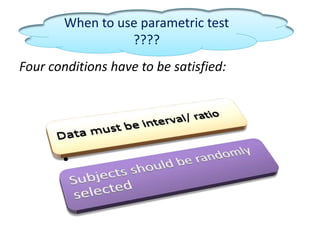
Four conditions have to be satisfied:
When to use parametric test
????
.
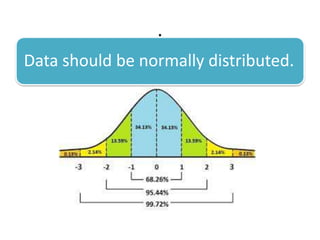
Data should be normally distributed.
.
Variation in the results should be
roughly same..
• Homogenecity of variances assessed by
Levene’s test
Non parametric test
• Nonparametric tests are also called
distribution-free tests because they don’t
assume that your data follow a specific
distribution.
Non parametric test
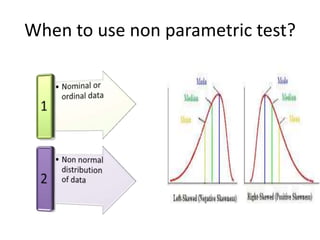
When to use non parametric test?
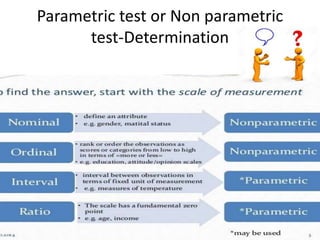
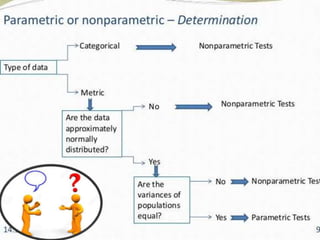
Parametric test or Non parametric
test-Determination
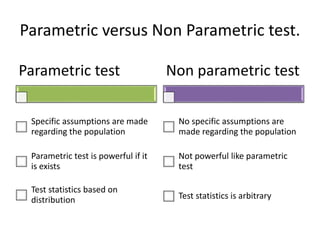
Parametric versus Non Parametric test.
Parametric test
Specific assumptions are made
regarding the population
Parametric test is powerful if it
is exists
Test statistics based on
distribution
Non parametric test
No specific assumptions are
made regarding the population
Not powerful like parametric
test
Test statistics is arbitrary
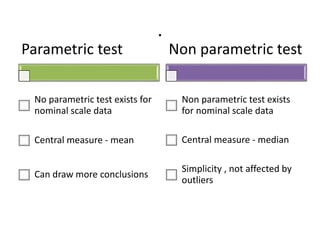
.
Parametric test
No parametric test exists for
nominal scale data
Central measure - mean
Can draw more conclusions
Non parametric test
Non parametric test exists
for nominal scale data
Central measure - median
Simplicity , not affected by
outliers
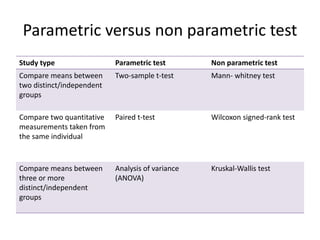
Parametric versus non parametric test
Study type Parametric test Non parametric test
Compare means between
two distinct/independent
groups
Two-sample t-test Mann- whitney test
Compare two quantitative
measurements taken from
the same individual
Paired t-test Wilcoxon signed-rank test
Compare means between
three or more
distinct/independent
groups
Analysis of variance
(ANOVA)
Kruskal-Wallis test
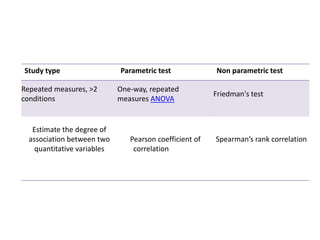
Study type Parametric test Non parametric test
Repeated measures, >2
conditions
One-way, repeated
measures ANOVA
Friedman's test
Estimate the degree of
association between two
quantitative variables
Pearson coefficient of
correlation
Spearman’s rank correlation
Thank you

Parametric versus non parametric test

  • 1.
  • 2.
    Parametric test • Astatistical test, in which specific assumptions are made about the population parameter is known as parametric test. Parametric test
  • 3.
    When to useparametric test? Four conditions have to be satisfied: When to use parametric test ????
  • 4.
    . Data should benormally distributed.
  • 5.
    . Variation in theresults should be roughly same.. • Homogenecity of variances assessed by Levene’s test
  • 6.
    Non parametric test •Nonparametric tests are also called distribution-free tests because they don’t assume that your data follow a specific distribution. Non parametric test
  • 7.
    When to usenon parametric test?
  • 8.
    Parametric test orNon parametric test-Determination
  • 10.
    Parametric versus NonParametric test. Parametric test Specific assumptions are made regarding the population Parametric test is powerful if it is exists Test statistics based on distribution Non parametric test No specific assumptions are made regarding the population Not powerful like parametric test Test statistics is arbitrary
  • 11.
    . Parametric test No parametrictest exists for nominal scale data Central measure - mean Can draw more conclusions Non parametric test Non parametric test exists for nominal scale data Central measure - median Simplicity , not affected by outliers
  • 12.
    Parametric versus nonparametric test Study type Parametric test Non parametric test Compare means between two distinct/independent groups Two-sample t-test Mann- whitney test Compare two quantitative measurements taken from the same individual Paired t-test Wilcoxon signed-rank test Compare means between three or more distinct/independent groups Analysis of variance (ANOVA) Kruskal-Wallis test
  • 13.
    Study type Parametrictest Non parametric test Repeated measures, >2 conditions One-way, repeated measures ANOVA Friedman's test Estimate the degree of association between two quantitative variables Pearson coefficient of correlation Spearman’s rank correlation
  • 15.