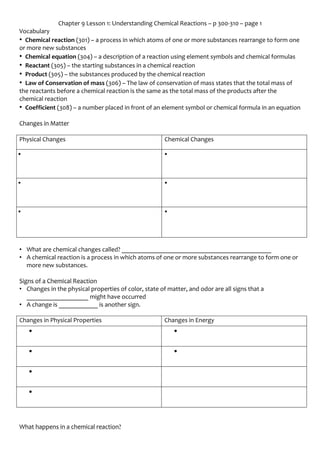
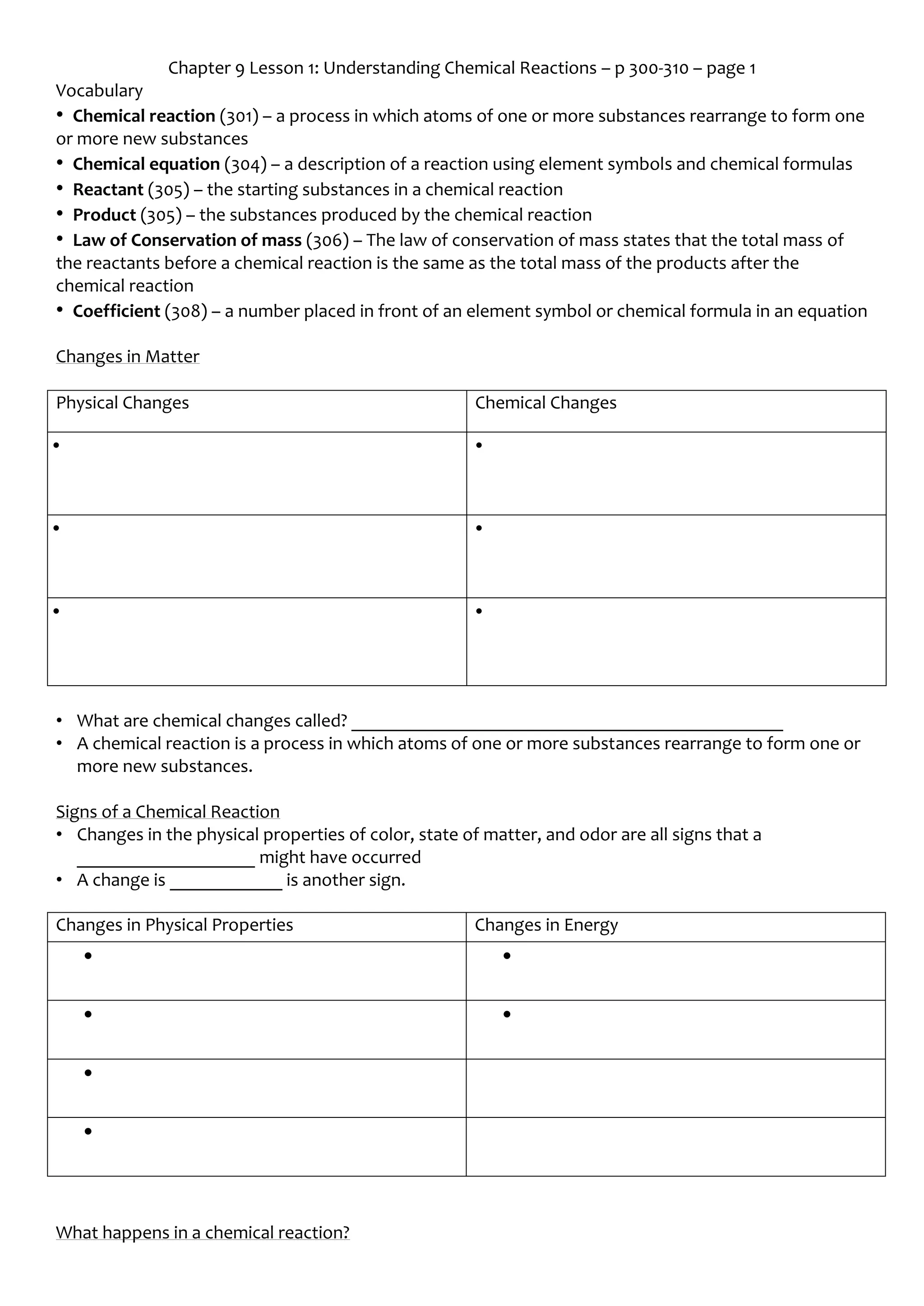
Chapter 9 Lesson 1: Understanding Chemical Reactions – p 300-310 – page 1
Vocabulary
• Chemical reaction (301) – a process in which atoms of one or more substances rearrange to form one
or more new substances
• Chemical equation (304) – a description of a reaction using element symbols and chemical formulas
• Reactant (305) – the starting substances in a chemical reaction
• Product (305) – the substances produced by the chemical reaction
• Law of Conservation of mass (306) – The law of conservation of mass states that the total mass of
the reactants before a chemical reaction is the same as the total mass of the products after the
chemical reaction
• Coefficient (308) – a number placed in front of an element symbol or chemical formula in an equation
Changes in Matter
Physical Changes

Chemical Changes

•

•

•

•

•

•

• What are chemical changes called? ______________________________________________
• A chemical reaction is a process in which atoms of one or more substances rearrange to form one or
more new substances.
Signs of a Chemical Reaction
• Changes in the physical properties of color, state of matter, and odor are all signs that a
___________________ might have occurred
• A change is ____________ is another sign.
Changes in Physical Properties

Changes in Energy












What happens in a chemical reaction?
Chapter 9 Lesson 1: Understanding Chemical Reactions – p 300-310 – page 2
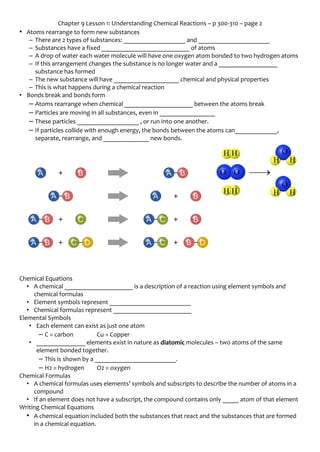
• Atoms rearrange to form new substances
– There are 2 types of substances: ___________________ and ______________________
– Substances have a fixed ___________________________ of atoms
– A drop of water each water molecule will have one oxygen atom bonded to two hydrogen atoms
– If this arrangement changes the substance is no longer water and a __________________
substance has formed
– The new substance will have ____________________ chemical and physical properties
– This is what happens during a chemical reaction
• Bonds break and bonds form
– Atoms rearrange when chemical _____________________ between the atoms break
– Particles are moving in all substances, even in _________________
– These particles ___________________ , or run into one another.
– If particles collide with enough energy, the bonds between the atoms can_____________,
separate, rearrange, and ______________ new bonds.

Chemical Equations
• A chemical _____________________ is a description of a reaction using element symbols and
chemical formulas
• Element symbols represent _________________________
• Chemical formulas represent ________________________
Elemental Symbols
• Each element can exist as just one atom
– C = carbon
Cu = Copper
• _______________ elements exist in nature as diatomic molecules – two atoms of the same
element bonded together.
– This is shown by a _________________________.
– H2 = hydrogen
O2 = oxygen
Chemical Formulas
• A chemical formulas uses elements’ symbols and subscripts to describe the number of atoms in a
compound
• If an element does not have a subscript, the compound contains only _____ atom of that element
Writing Chemical Equations
• A chemical equation included both the substances that react and the substances that are formed
in a chemical equation.
•
•
•
•

Chapter 9 Lesson 1: Understanding Chemical Reactions – p 300-310 – page 3
The starting substances in a chemical reaction are the
__________________________
The substances produced by the chemical reaction are
_________________________
The arrow shows the direction of the reaction
Reactants are written _____________of the arrow and
products are written to the _________

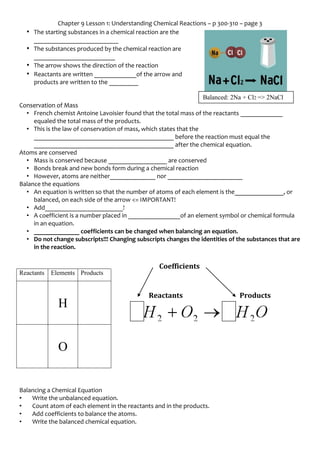
Balanced: 2Na + Cl2 => 2NaCl
Conservation of Mass
• French chemist Antoine Lavoisier found that the total mass of the reactants _____________
equaled the total mass of the products.
• This is the law of conservation of mass, which states that the
___________________________________________ before the reaction must equal the
___________________________________________ after the chemical equation.
Atoms are conserved
• Mass is conserved because __________________ are conserved
• Bonds break and new bonds form during a chemical reaction
• However, atoms are neither______________ nor _______________________
Balance the equations
• An equation is written so that the number of atoms of each element is the_______________, or
balanced, on each side of the arrow <= IMPORTANT!
• Add________________________!
• A coefficient is a number placed in ________________of an element symbol or chemical formula
in an equation.
• ______________ coefficients can be changed when balancing an equation.
• Do not change subscripts!!! Changing subscripts changes the identities of the substances that are
in the reaction.

Coefficients
Reactants

Elements Products

H

Reactants

O

Balancing a Chemical Equation
•
Write the unbalanced equation.
•
Count atom of each element in the reactants and in the products.
•
Add coefficients to balance the atoms.
•
Write the balanced chemical equation.

Products
Chapter 9 Lesson 1: Understanding Chemical Reactions – p 300-310 – page 4
Balance
•____ N2 + ____ H2 → ____ NH3

•____ Al + ____ HCl → ____ AlCl3 + ____ H2 (g)

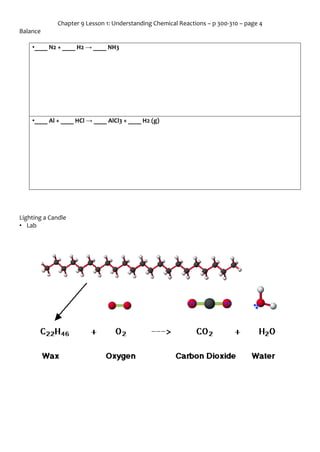
Lighting a Candle
• Lab

Chapter 9.1: Understanding Chemical Reactions

  • 1.
    Chapter 9 Lesson1: Understanding Chemical Reactions – p 300-310 – page 1 Vocabulary • Chemical reaction (301) – a process in which atoms of one or more substances rearrange to form one or more new substances • Chemical equation (304) – a description of a reaction using element symbols and chemical formulas • Reactant (305) – the starting substances in a chemical reaction • Product (305) – the substances produced by the chemical reaction • Law of Conservation of mass (306) – The law of conservation of mass states that the total mass of the reactants before a chemical reaction is the same as the total mass of the products after the chemical reaction • Coefficient (308) – a number placed in front of an element symbol or chemical formula in an equation Changes in Matter Physical Changes Chemical Changes • • • • • • • What are chemical changes called? ______________________________________________ • A chemical reaction is a process in which atoms of one or more substances rearrange to form one or more new substances. Signs of a Chemical Reaction • Changes in the physical properties of color, state of matter, and odor are all signs that a ___________________ might have occurred • A change is ____________ is another sign. Changes in Physical Properties Changes in Energy       What happens in a chemical reaction?
  • 2.
    Chapter 9 Lesson1: Understanding Chemical Reactions – p 300-310 – page 2 • Atoms rearrange to form new substances – There are 2 types of substances: ___________________ and ______________________ – Substances have a fixed ___________________________ of atoms – A drop of water each water molecule will have one oxygen atom bonded to two hydrogen atoms – If this arrangement changes the substance is no longer water and a __________________ substance has formed – The new substance will have ____________________ chemical and physical properties – This is what happens during a chemical reaction • Bonds break and bonds form – Atoms rearrange when chemical _____________________ between the atoms break – Particles are moving in all substances, even in _________________ – These particles ___________________ , or run into one another. – If particles collide with enough energy, the bonds between the atoms can_____________, separate, rearrange, and ______________ new bonds. Chemical Equations • A chemical _____________________ is a description of a reaction using element symbols and chemical formulas • Element symbols represent _________________________ • Chemical formulas represent ________________________ Elemental Symbols • Each element can exist as just one atom – C = carbon Cu = Copper • _______________ elements exist in nature as diatomic molecules – two atoms of the same element bonded together. – This is shown by a _________________________. – H2 = hydrogen O2 = oxygen Chemical Formulas • A chemical formulas uses elements’ symbols and subscripts to describe the number of atoms in a compound • If an element does not have a subscript, the compound contains only _____ atom of that element Writing Chemical Equations • A chemical equation included both the substances that react and the substances that are formed in a chemical equation.
  • 3.
    • • • • Chapter 9 Lesson1: Understanding Chemical Reactions – p 300-310 – page 3 The starting substances in a chemical reaction are the __________________________ The substances produced by the chemical reaction are _________________________ The arrow shows the direction of the reaction Reactants are written _____________of the arrow and products are written to the _________ Balanced: 2Na + Cl2 => 2NaCl Conservation of Mass • French chemist Antoine Lavoisier found that the total mass of the reactants _____________ equaled the total mass of the products. • This is the law of conservation of mass, which states that the ___________________________________________ before the reaction must equal the ___________________________________________ after the chemical equation. Atoms are conserved • Mass is conserved because __________________ are conserved • Bonds break and new bonds form during a chemical reaction • However, atoms are neither______________ nor _______________________ Balance the equations • An equation is written so that the number of atoms of each element is the_______________, or balanced, on each side of the arrow <= IMPORTANT! • Add________________________! • A coefficient is a number placed in ________________of an element symbol or chemical formula in an equation. • ______________ coefficients can be changed when balancing an equation. • Do not change subscripts!!! Changing subscripts changes the identities of the substances that are in the reaction. Coefficients Reactants Elements Products H Reactants O Balancing a Chemical Equation • Write the unbalanced equation. • Count atom of each element in the reactants and in the products. • Add coefficients to balance the atoms. • Write the balanced chemical equation. Products
  • 4.
    Chapter 9 Lesson1: Understanding Chemical Reactions – p 300-310 – page 4 Balance •____ N2 + ____ H2 → ____ NH3 •____ Al + ____ HCl → ____ AlCl3 + ____ H2 (g) Lighting a Candle • Lab