+
You guys are going to do great.
Final Review 2015
+
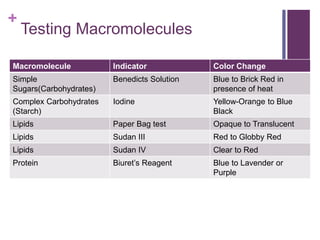
Testing Macromolecules
Macromolecule Indicator Color Change
Simple
Sugars(Carbohydrates)
Benedicts Solution Blue to Brick Red in
presence of heat
Complex Carbohydrates
(Starch)
Iodine Yellow-Orange to Blue
Black
Lipids Paper Bag test Opaque to Translucent
Lipids Sudan III Red to Globby Red
Lipids Sudan IV Clear to Red
Protein Biuret’s Reagent Blue to Lavender or
Purple
+
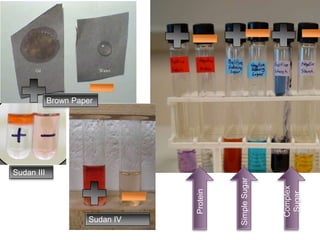
Protein
Complex
Sugar
SimpleSugar
Brown Paper
Sudan III
Sudan IV
+
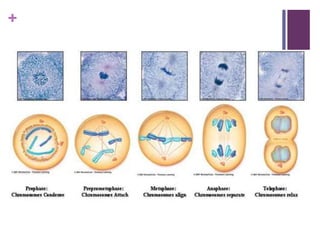
Cell Cycle
Period of growth and division for the
cell.
Interphase
G1-Cell Growth
S- DNA replication
G2- Preparation for Mitosis
Mitosis
Prophase-Chromatin Condenses,
nuclear envelope dissolves
Metaphase-Chromosomes line up
on equator of cell.
Anaphas e-Sister Chromatids
separate to opposite poles
Telophase-Chromatids start to
unwind, nuclear envelope reforms
Cytokinesis
Cytoplasm is split.
In animal cells forms
cleavage furrow
In plant cells forms cell plate
+
+
+
Which Phase?
+
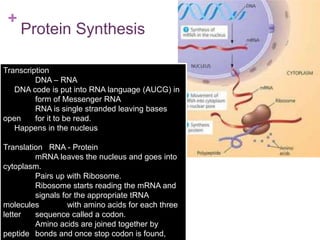
Protein Synthesis
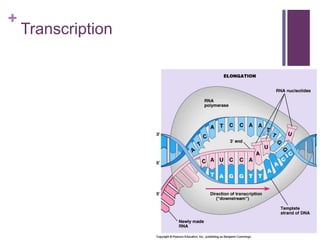
Transcription
DNA – RNA
DNA code is put into RNA language (AUCG) in
form of Messenger RNA
RNA is single stranded leaving bases
open for it to be read.
Happens in the nucleus
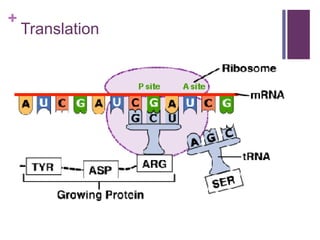
Translation RNA - Protein
mRNA leaves the nucleus and goes into
cytoplasm.
Pairs up with Ribosome.
Ribosome starts reading the mRNA and
signals for the appropriate tRNA
molecules with amino acids for each three
letter sequence called a codon.
Amino acids are joined together by
peptide bonds and once stop codon is found,
+
Transcription
+
Translation
+
Transcription
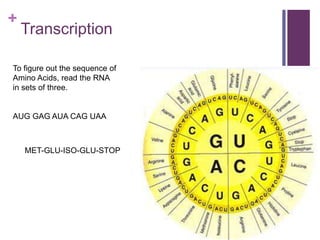
To figure out the sequence of
Amino Acids, read the RNA
in sets of three.
AUG GAG AUA CAG UAA
MET-GLU-ISO-GLU-STOP
+
DNA Replication
+
DNA Replication
 Making an exact copy of the DNA
 Happens during the S-phase of the cell cycle.
 Get two strands from 1
 Unzip with helicase
 Add bases with DNA Polymerase
+
+
Evolution
 The process of Change over time.
 Process of Natural Selection-in which environmental pressures have
impacts on organisms and bring about change in the population.
 Main theories supported by evidence gathered in
 Fossil Record
 Anatomical Similarities
 DNA Similarities
 Embryological Similarities
 Geographic Distribution
+
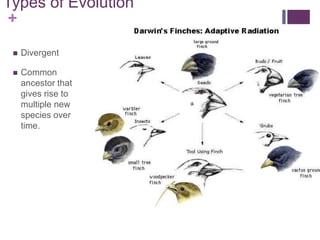
Types of Evolution
 Divergent
 Common
ancestor that
gives rise to
multiple new
species over
time.
+
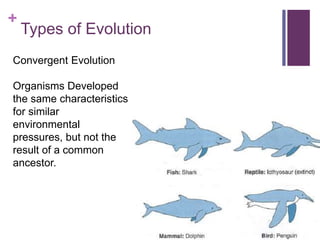
Types of Evolution
Convergent Evolution
Organisms Developed
the same characteristics
for similar
environmental
pressures, but not the
result of a common
ancestor.
+
Types of Evolution
Coevolution
Species evolve together in response to changes.
Insects and flowers
Predator and Prey
+
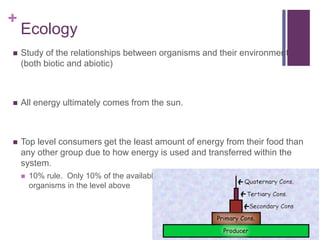
Ecology
 Study of the relationships between organisms and their environment
(both biotic and abiotic)
 All energy ultimately comes from the sun.
 Top level consumers get the least amount of energy from their food than
any other group due to how energy is used and transferred within the
system.
 10% rule. Only 10% of the available energy is available for use by the
organisms in the level above
+Ecology
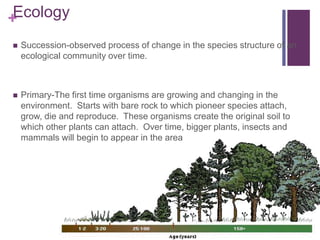
 Succession-observed process of change in the species structure of an
ecological community over time.
 Primary-The first time organisms are growing and changing in the
environment. Starts with bare rock to which pioneer species attach,
grow, die and reproduce. These organisms create the original soil to
which other plants can attach. Over time, bigger plants, insects and
mammals will begin to appear in the area
+
Ecology
 Secondary Succession
 Caused by Natural Disaster-established community wiped out and then must
restart the process.
 Volcano
 Earthquake
 Fire
 Land Slide
+
Enzymes
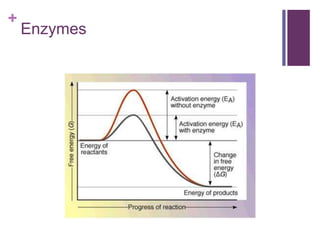
 Enzymes are special kinds of proteins that help reactions get
started by lowering the activation energy necessary for the
reaction to take place.
 Typically will end in the suffix –ase (Catalase, Helicase)
 Substrate Specific
 Reusable
+
Enzymes
+
DNA and RNA
DNA
 Double Stranded
 Found in Nucleus
 Deoxyribose sugar
 ATCG
 Holds Genetic Code
RNA
 Single Stranded
 Found in Cytoplasm
 Ribose Sugar
 AUCG
 Produces protein
+
Pedigrees
Choosing Patterns of Inheritance
+
Autosomal Dominant
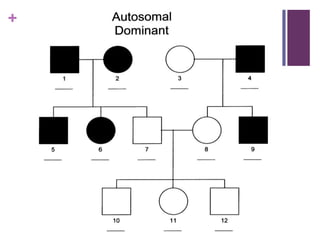
 Males and Females are equally likely to have the trait.
 Traits do not skip generations (generally)
 The trait is present whenever the corresponding gene is
present.
 There is male to male transmission
+
+
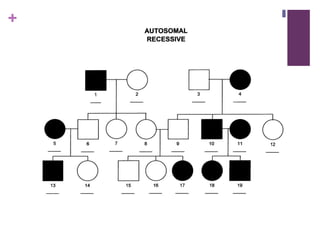
Autosomal Recessive
 Males and Females are equally likely to have the trait.
 Traits often skip generations
 Often, both parents of offspring who have the trait, are
heterozygous.
 Only homozygous individuals have the trait.
 Traits may appear in siblings without appearing in their parents.
 If a parent has the trait, those offspring who do not have it are
heterozygous carriers of the trait.
+
+
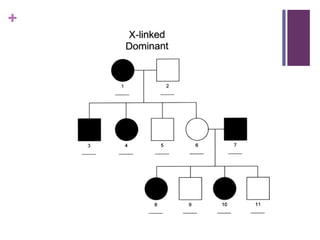
X-Linked Dominant
 All daughters of a male who has the trait will also have the trait.
 There is no male to male transmission
 A female who has the trait may or may not pass the gene for
that trait to her son or daughter.
+
+
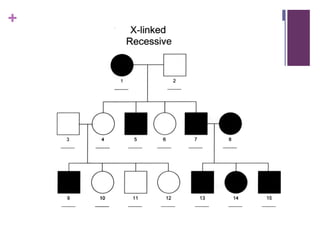
X-Linked Recessive
 The trait is far more common in males than in females.
 All daughters of a male who has the trait are heterozygous
carriers.
 The son of a female carrier has a 50% chance of having the
trait.
 There is no male to male transmission.
 Mothers of males who have the trait are either heterozygous
carriers or homozygous and express the trait.
 Daughters of female carriers have a 50% chance of being
carriers.
+
+
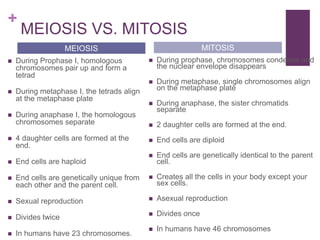
MEIOSIS VS. MITOSIS
 During Prophase I, homologous
chromosomes pair up and form a
tetrad
 During metaphase I, the tetrads align
at the metaphase plate
 During anaphase I, the homologous
chromosomes separate
 4 daughter cells are formed at the
end.
 End cells are haploid
 End cells are genetically unique from
each other and the parent cell.
 Sexual reproduction
 Divides twice
 In humans have 23 chromosomes.
 During prophase, chromosomes condense and
the nuclear envelope disappears
 During metaphase, single chromosomes align
on the metaphase plate
 During anaphase, the sister chromatids
separate
 2 daughter cells are formed at the end.
 End cells are diploid
 End cells are genetically identical to the parent
cell.
 Creates all the cells in your body except your
sex cells.
 Asexual reproduction
 Divides once
 In humans have 46 chromosomes
MEIOSIS MITOSIS
+
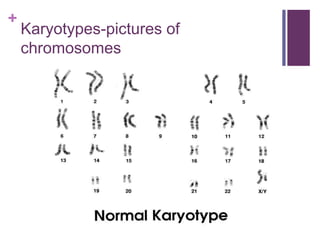
Karyotypes-pictures of
chromosomes
+
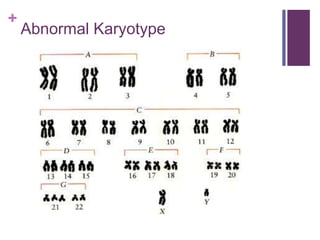
Abnormal Karyotype
+
Genetics Vocabulary
 Genotype-letters for the alleles in your genetic code.
 Phenotype-the physical expression of the genotype
 Homozygous-have two identical alleles for trait
 Heterozygous-have two different alleles for trait
 Dominant-Trait that masks other traits when present.
 Recessive-Trait that is masked when dominant trait is present.
Requires two alleles to be expressed.
+
Punnett Squares
When reading a genetics problem, make
a Genotype, Phenotype chart.
Then draw the box, put the gametes on
the edges, bring letters down and over
and solve.
Genotype Phenotype
R Red
r White
+
Types of Inheritance
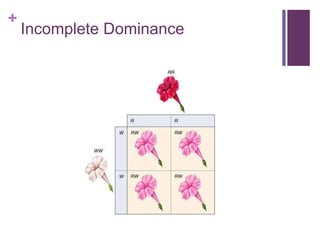
 Incomplete Dominance-Heterozygous Phenotype is a blending
of the two phenotypes (red and white make Pink)
 Codominance-Heterozygous phenotype shows both
phenotypes
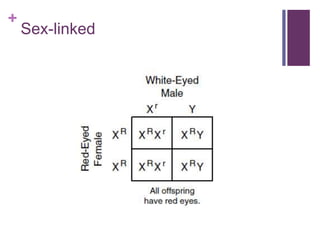
 Sex-Linked-Traits that are found on the sex chromosomes.
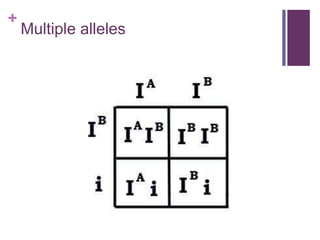
 Multiple Alleles-Two dominant alleles and one recessive.
(Blood type)
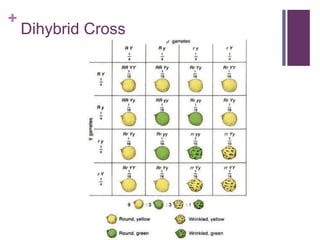
 Dihybrid Traits-Traits that are linked and probability of both
events happening is calculated using the 16 square punnett
square.
+
Incomplete Dominance
+
Codominance
+
Sex-linked
+
Multiple alleles
+
Dihybrid Cross
+
Ratios
 Phenotypic Ratio: Number of each type of expression you
have.
 Monohybrid Ratio for two heterozygous individuals- 3:1
 For double heterozygous 9:3:3:1
 Genotypic Ratio-Number of each genotype combination
 Monohybrid Ratio for two heterozygous individuals- 1:2:1

1st 4th 5th Final Review

  • 1.
    + You guys aregoing to do great. Final Review 2015
  • 2.
    + Testing Macromolecules Macromolecule IndicatorColor Change Simple Sugars(Carbohydrates) Benedicts Solution Blue to Brick Red in presence of heat Complex Carbohydrates (Starch) Iodine Yellow-Orange to Blue Black Lipids Paper Bag test Opaque to Translucent Lipids Sudan III Red to Globby Red Lipids Sudan IV Clear to Red Protein Biuret’s Reagent Blue to Lavender or Purple
  • 3.
  • 4.
    + Cell Cycle Period ofgrowth and division for the cell. Interphase G1-Cell Growth S- DNA replication G2- Preparation for Mitosis Mitosis Prophase-Chromatin Condenses, nuclear envelope dissolves Metaphase-Chromosomes line up on equator of cell. Anaphas e-Sister Chromatids separate to opposite poles Telophase-Chromatids start to unwind, nuclear envelope reforms Cytokinesis Cytoplasm is split. In animal cells forms cleavage furrow In plant cells forms cell plate
  • 5.
  • 6.
  • 7.
  • 8.
    + Protein Synthesis Transcription DNA –RNA DNA code is put into RNA language (AUCG) in form of Messenger RNA RNA is single stranded leaving bases open for it to be read. Happens in the nucleus Translation RNA - Protein mRNA leaves the nucleus and goes into cytoplasm. Pairs up with Ribosome. Ribosome starts reading the mRNA and signals for the appropriate tRNA molecules with amino acids for each three letter sequence called a codon. Amino acids are joined together by peptide bonds and once stop codon is found,
  • 9.
  • 10.
  • 11.
    + Transcription To figure outthe sequence of Amino Acids, read the RNA in sets of three. AUG GAG AUA CAG UAA MET-GLU-ISO-GLU-STOP
  • 12.
  • 13.
    + DNA Replication  Makingan exact copy of the DNA  Happens during the S-phase of the cell cycle.  Get two strands from 1  Unzip with helicase  Add bases with DNA Polymerase
  • 14.
  • 15.
    + Evolution  The processof Change over time.  Process of Natural Selection-in which environmental pressures have impacts on organisms and bring about change in the population.  Main theories supported by evidence gathered in  Fossil Record  Anatomical Similarities  DNA Similarities  Embryological Similarities  Geographic Distribution
  • 16.
    + Types of Evolution Divergent  Common ancestor that gives rise to multiple new species over time.
  • 17.
    + Types of Evolution ConvergentEvolution Organisms Developed the same characteristics for similar environmental pressures, but not the result of a common ancestor.
  • 18.
    + Types of Evolution Coevolution Speciesevolve together in response to changes. Insects and flowers Predator and Prey
  • 19.
    + Ecology  Study ofthe relationships between organisms and their environment (both biotic and abiotic)  All energy ultimately comes from the sun.  Top level consumers get the least amount of energy from their food than any other group due to how energy is used and transferred within the system.  10% rule. Only 10% of the available energy is available for use by the organisms in the level above
  • 20.
    +Ecology  Succession-observed processof change in the species structure of an ecological community over time.  Primary-The first time organisms are growing and changing in the environment. Starts with bare rock to which pioneer species attach, grow, die and reproduce. These organisms create the original soil to which other plants can attach. Over time, bigger plants, insects and mammals will begin to appear in the area
  • 21.
    + Ecology  Secondary Succession Caused by Natural Disaster-established community wiped out and then must restart the process.  Volcano  Earthquake  Fire  Land Slide
  • 22.
    + Enzymes  Enzymes arespecial kinds of proteins that help reactions get started by lowering the activation energy necessary for the reaction to take place.  Typically will end in the suffix –ase (Catalase, Helicase)  Substrate Specific  Reusable
  • 23.
  • 24.
    + DNA and RNA DNA Double Stranded  Found in Nucleus  Deoxyribose sugar  ATCG  Holds Genetic Code RNA  Single Stranded  Found in Cytoplasm  Ribose Sugar  AUCG  Produces protein
  • 25.
  • 26.
    + Autosomal Dominant  Malesand Females are equally likely to have the trait.  Traits do not skip generations (generally)  The trait is present whenever the corresponding gene is present.  There is male to male transmission
  • 27.
  • 28.
    + Autosomal Recessive  Malesand Females are equally likely to have the trait.  Traits often skip generations  Often, both parents of offspring who have the trait, are heterozygous.  Only homozygous individuals have the trait.  Traits may appear in siblings without appearing in their parents.  If a parent has the trait, those offspring who do not have it are heterozygous carriers of the trait.
  • 29.
  • 30.
    + X-Linked Dominant  Alldaughters of a male who has the trait will also have the trait.  There is no male to male transmission  A female who has the trait may or may not pass the gene for that trait to her son or daughter.
  • 31.
  • 32.
    + X-Linked Recessive  Thetrait is far more common in males than in females.  All daughters of a male who has the trait are heterozygous carriers.  The son of a female carrier has a 50% chance of having the trait.  There is no male to male transmission.  Mothers of males who have the trait are either heterozygous carriers or homozygous and express the trait.  Daughters of female carriers have a 50% chance of being carriers.
  • 33.
  • 34.
    + MEIOSIS VS. MITOSIS During Prophase I, homologous chromosomes pair up and form a tetrad  During metaphase I, the tetrads align at the metaphase plate  During anaphase I, the homologous chromosomes separate  4 daughter cells are formed at the end.  End cells are haploid  End cells are genetically unique from each other and the parent cell.  Sexual reproduction  Divides twice  In humans have 23 chromosomes.  During prophase, chromosomes condense and the nuclear envelope disappears  During metaphase, single chromosomes align on the metaphase plate  During anaphase, the sister chromatids separate  2 daughter cells are formed at the end.  End cells are diploid  End cells are genetically identical to the parent cell.  Creates all the cells in your body except your sex cells.  Asexual reproduction  Divides once  In humans have 46 chromosomes MEIOSIS MITOSIS
  • 35.
  • 36.
  • 37.
    + Genetics Vocabulary  Genotype-lettersfor the alleles in your genetic code.  Phenotype-the physical expression of the genotype  Homozygous-have two identical alleles for trait  Heterozygous-have two different alleles for trait  Dominant-Trait that masks other traits when present.  Recessive-Trait that is masked when dominant trait is present. Requires two alleles to be expressed.
  • 38.
    + Punnett Squares When readinga genetics problem, make a Genotype, Phenotype chart. Then draw the box, put the gametes on the edges, bring letters down and over and solve. Genotype Phenotype R Red r White
  • 39.
    + Types of Inheritance Incomplete Dominance-Heterozygous Phenotype is a blending of the two phenotypes (red and white make Pink)  Codominance-Heterozygous phenotype shows both phenotypes  Sex-Linked-Traits that are found on the sex chromosomes.  Multiple Alleles-Two dominant alleles and one recessive. (Blood type)  Dihybrid Traits-Traits that are linked and probability of both events happening is calculated using the 16 square punnett square.
  • 40.
  • 41.
  • 42.
  • 43.
  • 44.
  • 45.
    + Ratios  Phenotypic Ratio:Number of each type of expression you have.  Monohybrid Ratio for two heterozygous individuals- 3:1  For double heterozygous 9:3:3:1  Genotypic Ratio-Number of each genotype combination  Monohybrid Ratio for two heterozygous individuals- 1:2:1