TEKS 8.5D recognize that chemical formulas are used to identify substances
and determine the number of atoms of each element in chemical formulas
containing subscripts
TEKS 8.5F recognize whether a chemical equation containing coefficients is
balanced or not and how that relates to the law of conservation of mass

Balancing
Chemical
Equations
A chemical reaction
occurs when the
chemical bonds
between elements
are formed or
broken.
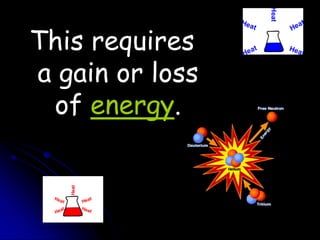
This requires
a gain or loss
of energy.
A chemical equation
is a short, simple
way to describe a
chemical reactions
using symbols and
formulas instead of
words.
Reactants
are the substances
you begin with in a
chemical reaction.
These are shown to the
left side of an arrow
called the yield sign.
Fe

+

2 HCl

reactants

FeCl2
yield
sign

+

products

H2
During a chemical reaction,
the atoms rearrange to form
new bonds between atoms.
Products

are the substances you
end with in a chemical
reaction.
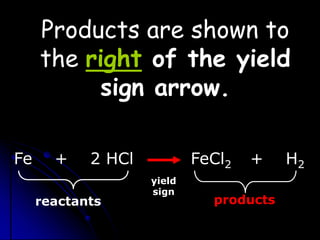
Products are shown to
the right of the yield
sign arrow.
Fe

+

2 HCl

reactants

FeCl2
yield
sign

+

products

H2
The products formed in a
chemical reaction have
different properties from the
reactants.
A yield sign
is used to show the
direction of the
chemical reaction.
Fe + 2 HCl

FeCl 2 + H 2
A chemical equation is read
like this:
Fe +
1 atom
of iron

2 HCl
2 molecules

reacts
of
with hydrochloric
acid

FeCl2 +
to yield

1
molecule
of Iron
chloride

H2
1

and

molecule
of
hydrogen
During a chemical reaction, atoms
cannot be created or destroyed,
so the number of atoms at the
beginning of a reaction MUST
equal the number at the end of
the reaction!
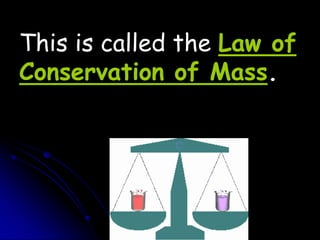
This is called the Law of
Conservation of Mass.
This law also means that
the mass of the reactants
must equal the mass of the
products.
What if the number of
atoms in the reactants
does not match the
number in the products?
C3H8 +

O2

mass =76 grams
3-carbon
8-hydrogen
2-oxygen

CO2

+

H2O

mass = 62 grams
1-carbon
2-hydrogen
3-oxygen
The Law of Conservation of Mass
says that the number of each
atom must be equal on both
sides of the yield sign along
with the masses. Let’s balance
the equation using some basic
rules.
Basic Rules for
Balanced
Equations
Chemical
formulas
CANNOT be
altered!
When balancing an
equation, the subscript
cannot be changed.
Don’t
change me!

H 2O
Coefficients can be
added before an
element or
molecule.
C3H8 + 5 O2 => 3CO2 + 4 H2O
Add coefficients to
the equation to
balance the number of
atoms
C3H8 + 5O2 => 3CO2 + 4H2O
3-carbon
8-hydrogen
10-oxygen

3-carbon
8-hydrogen
10-oxygen

Atoms on
each side are
equal!!
Coefficients were used
to balance the number
of atoms on each side
of the chemical
equation.
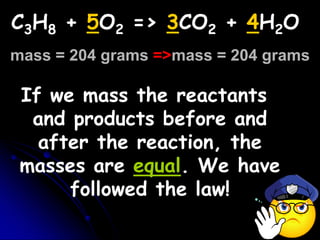
C3H8 + 5O2 => 3CO2 + 4H2O
mass = 204 grams =>mass = 204 grams

If we mass the reactants
and products before and
after the reaction, the
masses are equal. We have
followed the law!

Notes chemical equations

  • 1.
    TEKS 8.5D recognizethat chemical formulas are used to identify substances and determine the number of atoms of each element in chemical formulas containing subscripts TEKS 8.5F recognize whether a chemical equation containing coefficients is balanced or not and how that relates to the law of conservation of mass Balancing Chemical Equations
  • 2.
    A chemical reaction occurswhen the chemical bonds between elements are formed or broken.
  • 3.
    This requires a gainor loss of energy.
  • 4.
    A chemical equation isa short, simple way to describe a chemical reactions using symbols and formulas instead of words.
  • 5.
    Reactants are the substances youbegin with in a chemical reaction.
  • 6.
    These are shownto the left side of an arrow called the yield sign. Fe + 2 HCl reactants FeCl2 yield sign + products H2
  • 7.
    During a chemicalreaction, the atoms rearrange to form new bonds between atoms.
  • 8.
    Products are the substancesyou end with in a chemical reaction.
  • 9.
    Products are shownto the right of the yield sign arrow. Fe + 2 HCl reactants FeCl2 yield sign + products H2
  • 10.
    The products formedin a chemical reaction have different properties from the reactants.
  • 11.
    A yield sign isused to show the direction of the chemical reaction. Fe + 2 HCl FeCl 2 + H 2
  • 12.
    A chemical equationis read like this: Fe + 1 atom of iron 2 HCl 2 molecules reacts of with hydrochloric acid FeCl2 + to yield 1 molecule of Iron chloride H2 1 and molecule of hydrogen
  • 13.
    During a chemicalreaction, atoms cannot be created or destroyed, so the number of atoms at the beginning of a reaction MUST equal the number at the end of the reaction!
  • 14.
    This is calledthe Law of Conservation of Mass.
  • 15.
    This law alsomeans that the mass of the reactants must equal the mass of the products.
  • 16.
    What if thenumber of atoms in the reactants does not match the number in the products?
  • 17.
    C3H8 + O2 mass =76grams 3-carbon 8-hydrogen 2-oxygen CO2 + H2O mass = 62 grams 1-carbon 2-hydrogen 3-oxygen
  • 18.
    The Law ofConservation of Mass says that the number of each atom must be equal on both sides of the yield sign along with the masses. Let’s balance the equation using some basic rules.
  • 19.
  • 20.
  • 21.
    When balancing an equation,the subscript cannot be changed. Don’t change me! H 2O
  • 22.
    Coefficients can be addedbefore an element or molecule.
  • 23.
    C3H8 + 5O2 => 3CO2 + 4 H2O Add coefficients to the equation to balance the number of atoms
  • 24.
    C3H8 + 5O2=> 3CO2 + 4H2O 3-carbon 8-hydrogen 10-oxygen 3-carbon 8-hydrogen 10-oxygen Atoms on each side are equal!!
  • 25.
    Coefficients were used tobalance the number of atoms on each side of the chemical equation.
  • 26.
    C3H8 + 5O2=> 3CO2 + 4H2O mass = 204 grams =>mass = 204 grams If we mass the reactants and products before and after the reaction, the masses are equal. We have followed the law!