LecturePLUS Timberlake 1
Chapter 5
Chemical Reactions and
Quantities
Chemical Changes
Balancing Chemical Equations
LecturePLUS Timberlake 2
Physical Properties
 color
 melting point
 boiling point
 electrical conductivity
 specific heat
 density
 state (solid, liquid, or gas)
LecturePLUS Timberlake 3
Physical Change
Changes in physical properties
 melting
 boiling
condensation
No change occurs in the identity of the
substance
Example:
Ice , rain, and steam are all water
LecturePLUS Timberlake 4
Chemical Change
Atoms in the reactants are rearranged to
form one or more different substances
Old bonds are broken; new bonds form
Examples:
Fe and O2 form rust (Fe2O3)
Ag and S form tarnish (Ag2S)
LecturePLUS Timberlake 5
Learning Check E1
Classify each of the following as a
1) physical change or 2) chemical change
A. ____ a burning candle
B. ____ melting ice
C. ____ toasting a marshmallow
D. ____ cutting a pizza
E. ____ polishing silver
LecturePLUS Timberlake 6
Solution E1
Classify each of the following as a
1) physical change or 2) chemical change
A. __2__ a burning candle
B. __1_ melting ice
C. __2__ toasting a marshmallow
D. __1__ cutting a pizza
E. __2__ polishing silver
LecturePLUS Timberlake 7
Chemical Reaction
A process in which at least one new
substance is produced as a result of
chemical change.
LecturePLUS Timberlake 8
A Chemical Reaction
Reactants Products
LecturePLUS Timberlake 9
Learning Check E2
A. How does an equation indicate a change in
the identity of the reacting substances?
B. How did the yellow and green reactants
combine?
C. Did all the reactants form product? Why or
why not?
LecturePLUS Timberlake 10
Learning Check E2
A. How does an equation indicate a change in
the identity of the reacting substances?
The formulas of the reactants are different
than the formulas of the products.
B. How did the yellow and green reactants
combine? 1 yellow combined with 1 green.
C. Did all the reactants form product? Why or
why not? No. There were more yellow
reactants than green.
LecturePLUS Timberlake 11
Writing a Chemical Equation
Chemical symbols give a “before-and-after”
picture of a chemical reaction
Reactants Products
MgO + C CO + Mg
magnesium oxide to form carbon monoxide
reacts with carbon and magnesium
LecturePLUS Timberlake 12
Learning Check E3
12 oz of dough, 4 oz mushrooms, 12 slices
pepperoni, 8 oz cheese and 5 oz tomato sauce
are used to make a pizza. Write a recipe in
words for putting together a pizza.
How would you write the recipe as an
equation?
LecturePLUS Timberlake 13
Solution E3
Example: Combine 12 oz dough + 4 oz
mushrooms + 12 slices pepperoni + 8
oz cheese + 5 oz tomato sauce and heat
30 minutes at 350°C to produce 1 pizza
12 oz dough + 4 oz mshrm
+ 12 pep + 8 oz chse 1 pizza
+ 5 oz tom sauce
LecturePLUS Timberlake 14
Reading A Chemical Equation
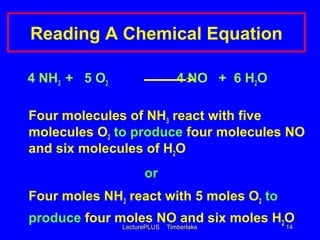
4 NH3 + 5 O2 4 NO + 6 H2O
Four molecules of NH3 react with five
molecules O2 to produce four molecules NO
and six molecules of H2O
or
Four moles NH3 react with 5 moles O2 to
produce four moles NO and six moles H2O
LecturePLUS Timberlake 15
A Balanced Chemical Equation
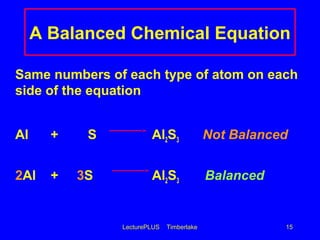
Same numbers of each type of atom on each
side of the equation
Al + S Al2S3 Not Balanced
2Al + 3S Al2S3 Balanced
LecturePLUS Timberlake 16
Matter Is Conserved
H2 + Cl2 2 HCl
+ +
Total atoms = Total atoms
2 H, 2 Cl 2H, 2 Cl
Total Mass = Total Mass
2(1.0) + 2(35.5) 2(36.5)
73.0 g = 73.0 g
LecturePLUS Timberlake 17
Law of Conservation of Mass
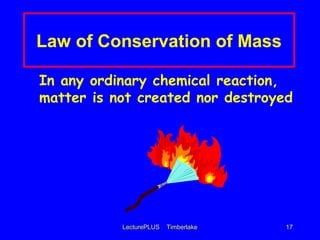
In any ordinary chemical reaction,
matter is not created nor destroyed
LecturePLUS Timberlake 18
Balance Equations with
Coefficients
Coefficients in front of formulas balance
each type of atom
4NH3 + 5O2 4NO + 6H2O
4 N = 4 N
12 H = 12 H
10 O = 10 O
LecturePLUS Timberlake 19
Steps in Balancing An Equation
Fe3O4 + H2 Fe + H2O
Fe: Fe3O4 + H2 3 Fe + H2O
O: Fe3O4 + H2 3 Fe + 4H2O
H: Fe3O4 + 4 H2 3 Fe + 4H2O
LecturePLUS Timberlake 20
Learning Check E4
Fe3O4 + 4 H2 3 Fe + 4H2O
A. Number of H atoms in 4 H2O
1) 2 2) 4 3) 8
B. Number of O atoms in 4 H2O
1) 2 2) 4 3) 8
C. Number of Fe atoms in Fe3O4
1) 1 2) 3 3) 4
LecturePLUS Timberlake 21
Solution E4
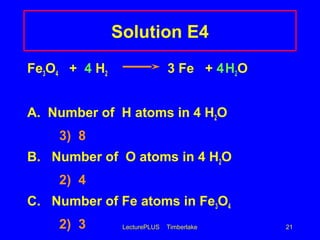
Fe3O4 + 4 H2 3 Fe + 4H2O
A. Number of H atoms in 4 H2O
3) 8
B. Number of O atoms in 4 H2O
2) 4
C. Number of Fe atoms in Fe3O4
2) 3
LecturePLUS Timberlake 22
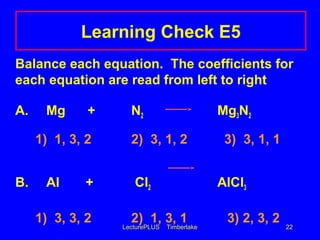
Learning Check E5
Balance each equation. The coefficients for
each equation are read from left to right
A. Mg + N2 Mg3N2
1) 1, 3, 2 2) 3, 1, 2 3) 3, 1, 1
B. Al + Cl2 AlCl3
1) 3, 3, 2 2) 1, 3, 1 3) 2, 3, 2
LecturePLUS Timberlake 23
Learning Check E5
C. Fe2O3 + C Fe + CO2
1) 2, 3, 2,3 2) 2, 3, 4, 3 3) 1, 1, 2, 3
D. Al + FeO Fe + Al2O3
1) 2, 3, 3, 1 2) 2, 1, 1, 1 3) 3, 3, 3, 1
E. Al + H2SO4 Al2(SO4)3 + H2
1) 3, 2, 1, 2 2) 2, 3, 1, 3 3) 2, 3, 2, 3
LecturePLUS Timberlake 24
Solution E5
A. 3 Mg + N2 Mg3N2
B. 2 Al + 3 Cl2 2 AlCl3
C. 2 Fe2O3 + 3 C 4 Fe + 3 CO2
D. 2 Al + 3 FeO 3 Fe + Al2O3
E. 2 Al + 3 H2SO4 Al2(SO4)3 + 3 H2

Chapter 4 chemical equations

  • 1.
    LecturePLUS Timberlake 1 Chapter5 Chemical Reactions and Quantities Chemical Changes Balancing Chemical Equations
  • 2.
    LecturePLUS Timberlake 2 PhysicalProperties  color  melting point  boiling point  electrical conductivity  specific heat  density  state (solid, liquid, or gas)
  • 3.
    LecturePLUS Timberlake 3 PhysicalChange Changes in physical properties  melting  boiling condensation No change occurs in the identity of the substance Example: Ice , rain, and steam are all water
  • 4.
    LecturePLUS Timberlake 4 ChemicalChange Atoms in the reactants are rearranged to form one or more different substances Old bonds are broken; new bonds form Examples: Fe and O2 form rust (Fe2O3) Ag and S form tarnish (Ag2S)
  • 5.
    LecturePLUS Timberlake 5 LearningCheck E1 Classify each of the following as a 1) physical change or 2) chemical change A. ____ a burning candle B. ____ melting ice C. ____ toasting a marshmallow D. ____ cutting a pizza E. ____ polishing silver
  • 6.
    LecturePLUS Timberlake 6 SolutionE1 Classify each of the following as a 1) physical change or 2) chemical change A. __2__ a burning candle B. __1_ melting ice C. __2__ toasting a marshmallow D. __1__ cutting a pizza E. __2__ polishing silver
  • 7.
    LecturePLUS Timberlake 7 ChemicalReaction A process in which at least one new substance is produced as a result of chemical change.
  • 8.
    LecturePLUS Timberlake 8 AChemical Reaction Reactants Products
  • 9.
    LecturePLUS Timberlake 9 LearningCheck E2 A. How does an equation indicate a change in the identity of the reacting substances? B. How did the yellow and green reactants combine? C. Did all the reactants form product? Why or why not?
  • 10.
    LecturePLUS Timberlake 10 LearningCheck E2 A. How does an equation indicate a change in the identity of the reacting substances? The formulas of the reactants are different than the formulas of the products. B. How did the yellow and green reactants combine? 1 yellow combined with 1 green. C. Did all the reactants form product? Why or why not? No. There were more yellow reactants than green.
  • 11.
    LecturePLUS Timberlake 11 Writinga Chemical Equation Chemical symbols give a “before-and-after” picture of a chemical reaction Reactants Products MgO + C CO + Mg magnesium oxide to form carbon monoxide reacts with carbon and magnesium
  • 12.
    LecturePLUS Timberlake 12 LearningCheck E3 12 oz of dough, 4 oz mushrooms, 12 slices pepperoni, 8 oz cheese and 5 oz tomato sauce are used to make a pizza. Write a recipe in words for putting together a pizza. How would you write the recipe as an equation?
  • 13.
    LecturePLUS Timberlake 13 SolutionE3 Example: Combine 12 oz dough + 4 oz mushrooms + 12 slices pepperoni + 8 oz cheese + 5 oz tomato sauce and heat 30 minutes at 350°C to produce 1 pizza 12 oz dough + 4 oz mshrm + 12 pep + 8 oz chse 1 pizza + 5 oz tom sauce
  • 14.
    LecturePLUS Timberlake 14 ReadingA Chemical Equation 4 NH3 + 5 O2 4 NO + 6 H2O Four molecules of NH3 react with five molecules O2 to produce four molecules NO and six molecules of H2O or Four moles NH3 react with 5 moles O2 to produce four moles NO and six moles H2O
  • 15.
    LecturePLUS Timberlake 15 ABalanced Chemical Equation Same numbers of each type of atom on each side of the equation Al + S Al2S3 Not Balanced 2Al + 3S Al2S3 Balanced
  • 16.
    LecturePLUS Timberlake 16 MatterIs Conserved H2 + Cl2 2 HCl + + Total atoms = Total atoms 2 H, 2 Cl 2H, 2 Cl Total Mass = Total Mass 2(1.0) + 2(35.5) 2(36.5) 73.0 g = 73.0 g
  • 17.
    LecturePLUS Timberlake 17 Lawof Conservation of Mass In any ordinary chemical reaction, matter is not created nor destroyed
  • 18.
    LecturePLUS Timberlake 18 BalanceEquations with Coefficients Coefficients in front of formulas balance each type of atom 4NH3 + 5O2 4NO + 6H2O 4 N = 4 N 12 H = 12 H 10 O = 10 O
  • 19.
    LecturePLUS Timberlake 19 Stepsin Balancing An Equation Fe3O4 + H2 Fe + H2O Fe: Fe3O4 + H2 3 Fe + H2O O: Fe3O4 + H2 3 Fe + 4H2O H: Fe3O4 + 4 H2 3 Fe + 4H2O
  • 20.
    LecturePLUS Timberlake 20 LearningCheck E4 Fe3O4 + 4 H2 3 Fe + 4H2O A. Number of H atoms in 4 H2O 1) 2 2) 4 3) 8 B. Number of O atoms in 4 H2O 1) 2 2) 4 3) 8 C. Number of Fe atoms in Fe3O4 1) 1 2) 3 3) 4
  • 21.
    LecturePLUS Timberlake 21 SolutionE4 Fe3O4 + 4 H2 3 Fe + 4H2O A. Number of H atoms in 4 H2O 3) 8 B. Number of O atoms in 4 H2O 2) 4 C. Number of Fe atoms in Fe3O4 2) 3
  • 22.
    LecturePLUS Timberlake 22 LearningCheck E5 Balance each equation. The coefficients for each equation are read from left to right A. Mg + N2 Mg3N2 1) 1, 3, 2 2) 3, 1, 2 3) 3, 1, 1 B. Al + Cl2 AlCl3 1) 3, 3, 2 2) 1, 3, 1 3) 2, 3, 2
  • 23.
    LecturePLUS Timberlake 23 LearningCheck E5 C. Fe2O3 + C Fe + CO2 1) 2, 3, 2,3 2) 2, 3, 4, 3 3) 1, 1, 2, 3 D. Al + FeO Fe + Al2O3 1) 2, 3, 3, 1 2) 2, 1, 1, 1 3) 3, 3, 3, 1 E. Al + H2SO4 Al2(SO4)3 + H2 1) 3, 2, 1, 2 2) 2, 3, 1, 3 3) 2, 3, 2, 3
  • 24.
    LecturePLUS Timberlake 24 SolutionE5 A. 3 Mg + N2 Mg3N2 B. 2 Al + 3 Cl2 2 AlCl3 C. 2 Fe2O3 + 3 C 4 Fe + 3 CO2 D. 2 Al + 3 FeO 3 Fe + Al2O3 E. 2 Al + 3 H2SO4 Al2(SO4)3 + 3 H2