FINAL REVIEW 2nd period
You smarties are going to do great. 
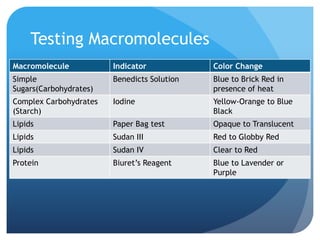
Testing Macromolecules
Macromolecule Indicator Color Change
Simple
Sugars(Carbohydrates)
Benedicts Solution Blue to Brick Red in
presence of heat
Complex Carbohydrates
(Starch)
Iodine Yellow-Orange to Blue
Black
Lipids Paper Bag test Opaque to Translucent
Lipids Sudan III Red to Globby Red
Lipids Sudan IV Clear to Red
Protein Biuret’s Reagent Blue to Lavender or
Purple
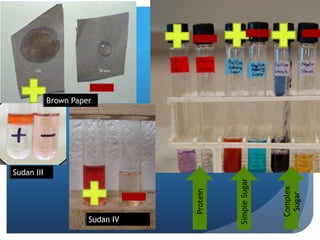
Protein
Complex
Sugar
SimpleSugar
Brown Paper
Sudan III
Sudan IV
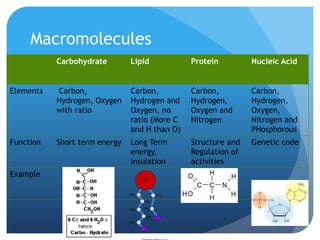
Macromolecules
Carbohydrate Lipid Protein Nucleic Acid
Elements Carbon,
Hydrogen, Oxygen
with ratio
Carbon,
Hydrogen and
Oxygen, no
ratio (More C
and H than O)
Carbon,
Hydrogen,
Oxygen and
Nitrogen
Carbon,
Hydrogen,
Oxygen,
Nitrogen and
PHosphorous
Function Short term energy Long Term
energy,
insulation
Structure and
Regulation of
activities
Genetic code
Example
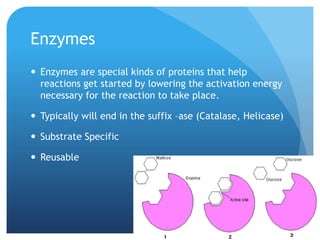
Enzymes
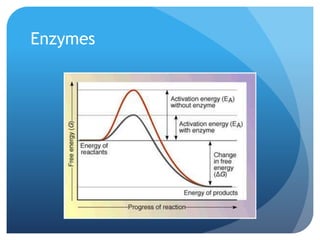
 Enzymes are special kinds of proteins that help
reactions get started by lowering the activation energy
necessary for the reaction to take place.
 Typically will end in the suffix –ase (Catalase, Helicase)
 Substrate Specific
 Reusable
Enzymes
DNA and RNA
DNA
 Double Stranded
 Found in Nucleus
 Deoxyribose sugar
 ATCG
 Holds Genetic Code
RNA
 Single Stranded
 Found in Cytoplasm
 Ribose Sugar
 AUCG
 Produces protein
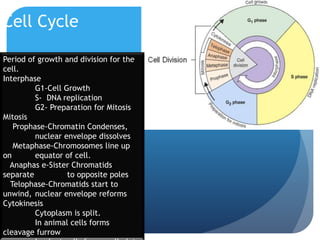
Cell Cycle
Period of growth and division for the
cell.
Interphase
G1-Cell Growth
S- DNA replication
G2- Preparation for Mitosis
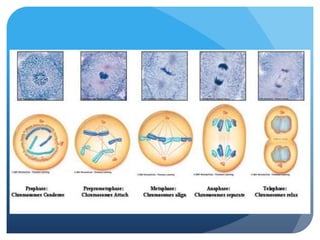
Mitosis
Prophase-Chromatin Condenses,
nuclear envelope dissolves
Metaphase-Chromosomes line up
on equator of cell.
Anaphas e-Sister Chromatids
separate to opposite poles
Telophase-Chromatids start to
unwind, nuclear envelope reforms
Cytokinesis
Cytoplasm is split.
In animal cells forms
cleavage furrow
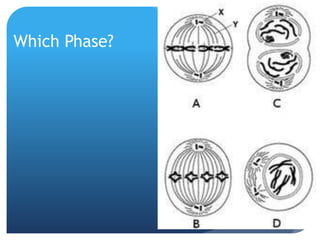
Which Phase?
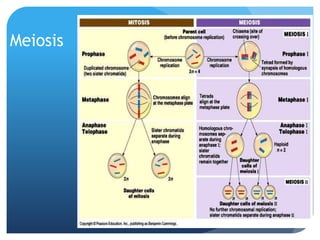
Meiosis
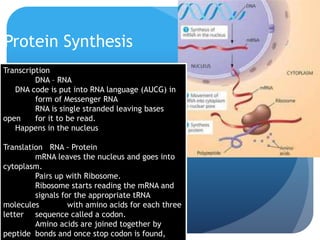
Protein Synthesis
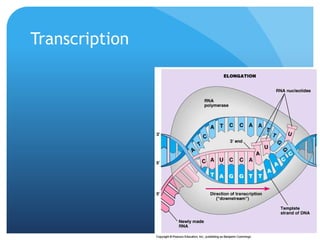
Transcription
DNA – RNA
DNA code is put into RNA language (AUCG) in
form of Messenger RNA
RNA is single stranded leaving bases
open for it to be read.
Happens in the nucleus
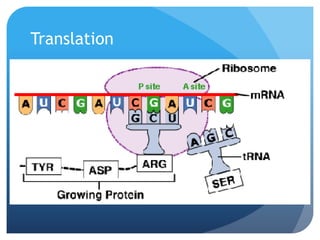
Translation RNA - Protein
mRNA leaves the nucleus and goes into
cytoplasm.
Pairs up with Ribosome.
Ribosome starts reading the mRNA and
signals for the appropriate tRNA
molecules with amino acids for each three
letter sequence called a codon.
Amino acids are joined together by
peptide bonds and once stop codon is found,
Transcription
Translation
Transcription
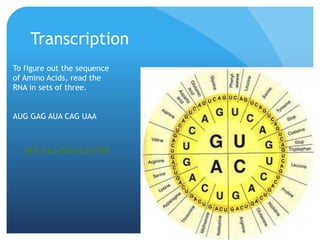
To figure out the sequence
of Amino Acids, read the
RNA in sets of three.
AUG GAG AUA CAG UAA
MET-GLU-ISO-GLU-STOP
DNA Replication
DNA Replication
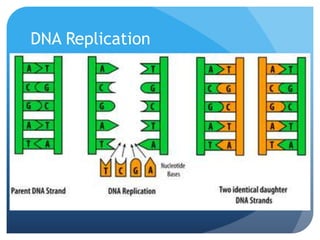
 Making an exact copy of the DNA
 Happens during the S-phase of the cell cycle.
 Get two strands from 1
 Unzip with helicase
 Add bases with DNA Polymerase
Pedigrees
Choosing Patterns of Inheritance
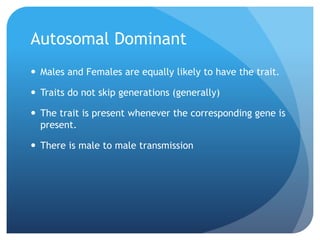
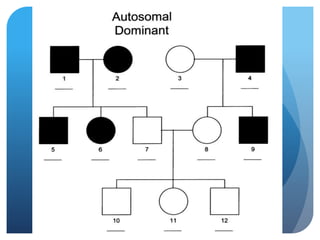
Autosomal Dominant
 Males and Females are equally likely to have the trait.
 Traits do not skip generations (generally)
 The trait is present whenever the corresponding gene is
present.
 There is male to male transmission
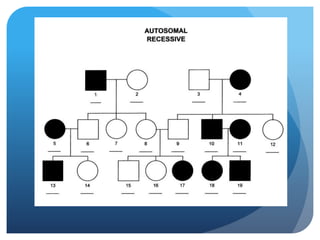
Autosomal Recessive
 Males and Females are equally likely to have the trait.
 Traits often skip generations
 Often, both parents of offspring who have the trait, are
heterozygous.
 Only homozygous individuals have the trait.
 Traits may appear in siblings without appearing in their
parents.
 If a parent has the trait, those offspring who do not
have it are heterozygous carriers of the trait.
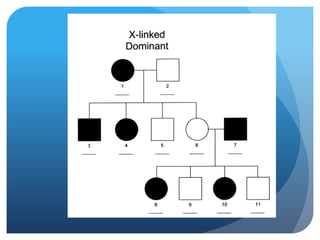
X-Linked Dominant
 All daughters of a male who has the trait will also have
the trait.
 There is no male to male transmission
 A female who has the trait may or may not pass the
gene for that trait to her son or daughter.
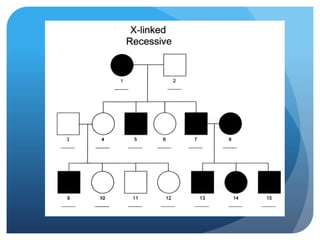
X-Linked Recessive
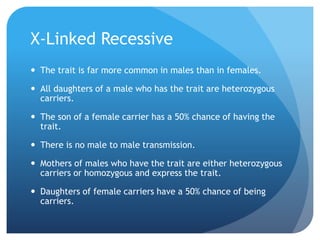
 The trait is far more common in males than in females.
 All daughters of a male who has the trait are heterozygous
carriers.
 The son of a female carrier has a 50% chance of having the
trait.
 There is no male to male transmission.
 Mothers of males who have the trait are either heterozygous
carriers or homozygous and express the trait.
 Daughters of female carriers have a 50% chance of being
carriers.
Ecology
 Study of the relationships between organisms and their
environment (both biotic and abiotic)
 All energy ultimately comes from the sun.
 Top level consumers get the least amount of energy from their
food than any other group due to how energy is used and
transferred within the system.
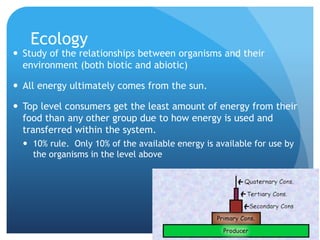
 10% rule. Only 10% of the available energy is available for use by
the organisms in the level above
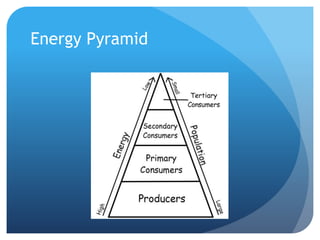
Energy Pyramid
 Shows relationships between different trophic levels of
organisms.
 As you go up the pyramid, amount of available energy
decreases
 As you go up the pyramid, concentration of toxins
increases.
Energy Pyramid

2nd 3rd FInal Review

  • 1.
    FINAL REVIEW 2ndperiod You smarties are going to do great. 
  • 2.
    Testing Macromolecules Macromolecule IndicatorColor Change Simple Sugars(Carbohydrates) Benedicts Solution Blue to Brick Red in presence of heat Complex Carbohydrates (Starch) Iodine Yellow-Orange to Blue Black Lipids Paper Bag test Opaque to Translucent Lipids Sudan III Red to Globby Red Lipids Sudan IV Clear to Red Protein Biuret’s Reagent Blue to Lavender or Purple
  • 3.
  • 4.
    Macromolecules Carbohydrate Lipid ProteinNucleic Acid Elements Carbon, Hydrogen, Oxygen with ratio Carbon, Hydrogen and Oxygen, no ratio (More C and H than O) Carbon, Hydrogen, Oxygen and Nitrogen Carbon, Hydrogen, Oxygen, Nitrogen and PHosphorous Function Short term energy Long Term energy, insulation Structure and Regulation of activities Genetic code Example
  • 5.
    Enzymes  Enzymes arespecial kinds of proteins that help reactions get started by lowering the activation energy necessary for the reaction to take place.  Typically will end in the suffix –ase (Catalase, Helicase)  Substrate Specific  Reusable
  • 6.
  • 7.
    DNA and RNA DNA Double Stranded  Found in Nucleus  Deoxyribose sugar  ATCG  Holds Genetic Code RNA  Single Stranded  Found in Cytoplasm  Ribose Sugar  AUCG  Produces protein
  • 8.
    Cell Cycle Period ofgrowth and division for the cell. Interphase G1-Cell Growth S- DNA replication G2- Preparation for Mitosis Mitosis Prophase-Chromatin Condenses, nuclear envelope dissolves Metaphase-Chromosomes line up on equator of cell. Anaphas e-Sister Chromatids separate to opposite poles Telophase-Chromatids start to unwind, nuclear envelope reforms Cytokinesis Cytoplasm is split. In animal cells forms cleavage furrow
  • 11.
  • 12.
  • 13.
    Protein Synthesis Transcription DNA –RNA DNA code is put into RNA language (AUCG) in form of Messenger RNA RNA is single stranded leaving bases open for it to be read. Happens in the nucleus Translation RNA - Protein mRNA leaves the nucleus and goes into cytoplasm. Pairs up with Ribosome. Ribosome starts reading the mRNA and signals for the appropriate tRNA molecules with amino acids for each three letter sequence called a codon. Amino acids are joined together by peptide bonds and once stop codon is found,
  • 14.
  • 15.
  • 16.
    Transcription To figure outthe sequence of Amino Acids, read the RNA in sets of three. AUG GAG AUA CAG UAA MET-GLU-ISO-GLU-STOP
  • 17.
  • 18.
    DNA Replication  Makingan exact copy of the DNA  Happens during the S-phase of the cell cycle.  Get two strands from 1  Unzip with helicase  Add bases with DNA Polymerase
  • 20.
  • 21.
    Autosomal Dominant  Malesand Females are equally likely to have the trait.  Traits do not skip generations (generally)  The trait is present whenever the corresponding gene is present.  There is male to male transmission
  • 23.
    Autosomal Recessive  Malesand Females are equally likely to have the trait.  Traits often skip generations  Often, both parents of offspring who have the trait, are heterozygous.  Only homozygous individuals have the trait.  Traits may appear in siblings without appearing in their parents.  If a parent has the trait, those offspring who do not have it are heterozygous carriers of the trait.
  • 25.
    X-Linked Dominant  Alldaughters of a male who has the trait will also have the trait.  There is no male to male transmission  A female who has the trait may or may not pass the gene for that trait to her son or daughter.
  • 27.
    X-Linked Recessive  Thetrait is far more common in males than in females.  All daughters of a male who has the trait are heterozygous carriers.  The son of a female carrier has a 50% chance of having the trait.  There is no male to male transmission.  Mothers of males who have the trait are either heterozygous carriers or homozygous and express the trait.  Daughters of female carriers have a 50% chance of being carriers.
  • 29.
    Ecology  Study ofthe relationships between organisms and their environment (both biotic and abiotic)  All energy ultimately comes from the sun.  Top level consumers get the least amount of energy from their food than any other group due to how energy is used and transferred within the system.  10% rule. Only 10% of the available energy is available for use by the organisms in the level above
  • 30.
    Energy Pyramid  Showsrelationships between different trophic levels of organisms.  As you go up the pyramid, amount of available energy decreases  As you go up the pyramid, concentration of toxins increases.
  • 31.