Unit 7 – Chemical Reactions Chemical equations, Energy of Reactions, Rates of reactions, Limiting reactants
Intro Vocabulary Chemical reaction  is the changing of substances to other substances by the breaking of bonds in reactants and the formation of bonds in the products - when some chemicals come into contact, they  break apart, join, or rearrange to form new  chemicals  (always to become more stable) Chemical equations  are shorthand representations of chemical reactions.
Some more vocabulary Reactants  are the elements or compounds that enter into a reaction Products  are the elements or compounds that are formed as a result of a chemical reaction Arrow  (  ) means yields, produces or forms Reactant(s)    product(s)
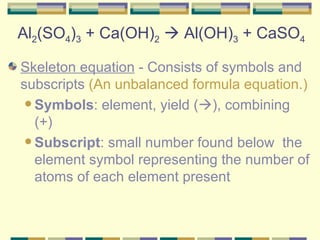
Al 2 (SO 4 ) 3  + Ca(OH) 2     Al(OH) 3  + CaSO 4 Skeleton equation  - Consists of symbols and subscripts  (An unbalanced formula equation.) Symbols : element, yield (  ), combining (+)  Subscript : small number found below  the element symbol representing the number of atoms of each element present
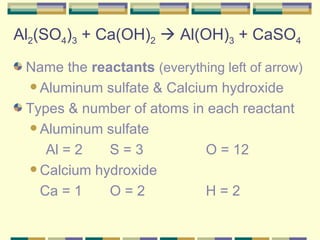
Al 2 (SO 4 ) 3  + Ca(OH) 2     Al(OH) 3  + CaSO 4 Name the  reactants   (everything left of arrow) Aluminum sulfate & Calcium hydroxide Types & number of atoms in each reactant Aluminum sulfate  Al = 2 S = 3 O = 12 Calcium hydroxide Ca = 1  O = 2 H = 2
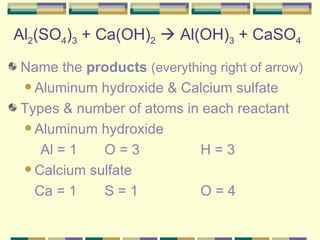
Al 2 (SO 4 ) 3  + Ca(OH) 2     Al(OH) 3  + CaSO 4 Name the  products   (everything right of arrow) Aluminum hydroxide & Calcium sulfate Types & number of atoms in each reactant Aluminum hydroxide  Al = 1 O = 3 H = 3 Calcium sulfate Ca = 1  S = 1 O = 4
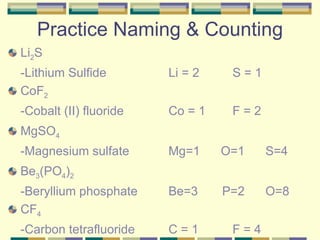
Practice Naming & Counting Li 2 S -Lithium Sulfide Li = 2 S = 1 CoF 2 -Cobalt (II) fluoride Co = 1 F = 2 MgSO 4 -Magnesium sulfate  Mg=1  O=1  S=4 Be 3 (PO 4 ) 2 -Beryllium phosphate Be=3  P=2  O=8 CF 4 -Carbon tetrafluoride C = 1 F = 4
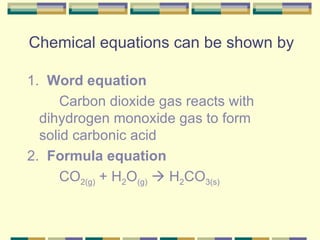
Chemical equations can be shown by 1.  Word equation Carbon dioxide gas reacts with  dihydrogen monoxide gas to form  solid carbonic acid 2.  Formula equation CO 2(g)  + H 2 O (g)     H 2 CO 3(s)
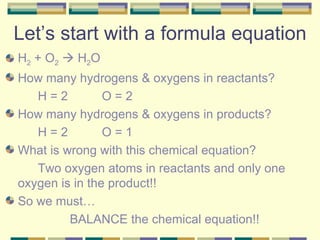
Let’s start with a formula equation H 2  + O 2     H 2 O How many hydrogens & oxygens in reactants? H = 2 O = 2 How many hydrogens & oxygens in products? H = 2 O = 1 What is wrong with this chemical equation? Two oxygen atoms in reactants and only one  oxygen is in the product!! So we must… BALANCE the chemical equation!!
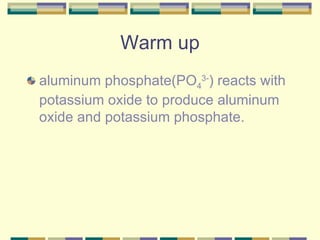
Warm up aluminum phosphate(PO 4 3- ) reacts with potassium oxide to produce aluminum oxide and potassium phosphate.
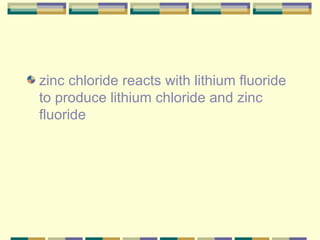
zinc chloride reacts with lithium fluoride to produce lithium chloride and zinc fluoride
iron (II) oxide reacts with calcium sulfate to form iron (II) sulfate and calcium oxide.
Balancing equations why & how Why do we balance equations? Law of conservation of mass -atoms are not created or destroyed in an ordinary chemical reaction, just rearranged to form new substances Whatever goes into a reaction must come out.
Activity Follow instructions as given. When finished with procedure answer the post activity questions on the sheet. Notebook paper is fine If time allows: Create your own procedure to prove the LCM using a flask, water, effervescent tablet, and balloon.
Think about this… You want to make a bicycle out of the following parts:  frame, wheel, handlebar, pedal, seat  Write the word equation for making a bicycle: frame + wheel + handlebar + pedal + seat    bicycle Is the equation balanced? No frame + 2 wheels + handlebar + 2 pedals + seat    bicycle
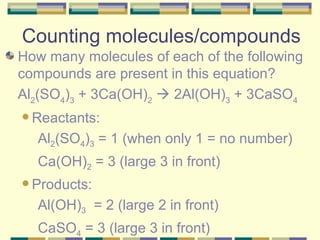
Counting molecules/compounds How many molecules of each of the following compounds are present in this equation?  Al 2 (SO 4 ) 3  + 3Ca(OH) 2     2Al(OH) 3  + 3CaSO 4   Reactants: Al 2 (SO 4 ) 3  = 1 (when only 1 = no number) Ca(OH) 2  = 3 (large 3 in front) Products: Al(OH) 3   = 2 (large 2 in front) CaSO 4  = 3 (large 3 in front)
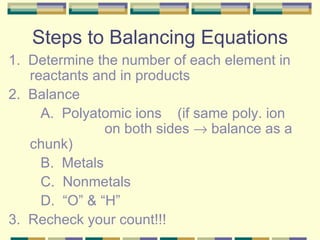
Steps to Balancing Equations 1.  Determine the number of each element in reactants and in products 2.  Balance A.  Polyatomic ions  (if same poly. ion    on both sides    balance as a chunk) B.  Metals C.  Nonmetals D.  “O” & “H” 3.  Recheck your count!!!
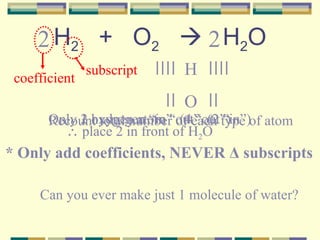
H 2   +  O 2      H 2 O Only 1 oxygen atom “out”  (2 “in”)    place 2 in front of H 2 O H O Only 2 hydrogen “in”  (4 “out”)    place 2 in front of H 2 Recount total number of each type of atom 2 2 * Only add coefficients, NEVER Δ subscripts Can you ever make just 1 molecule of water? coefficient subscript
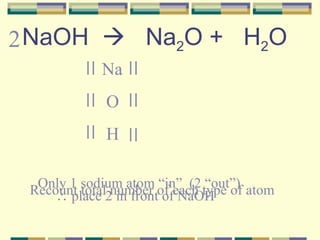
NaOH     Na 2 O +  H 2 O Only 1 sodium atom “in”  (2 “out”)    place 2 in front of NaOH Recount total number of each type of atom 2 Na O H
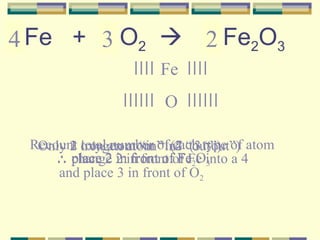
Fe  +  O 2      Fe 2 O 3 Only 1 iron atom “in”  (2 “out”)    place 2 in front of Fe Recount total number of each type of atom 2 Fe O Only 2 oxygen atom “in”  (3 “out”)    place 2 in front of Fe 2 O 3 and place 3 in front of O 2 Only 2 iron atom “in”  (4 “out”)    change 2 in front of Fe into a 4 2 3 4
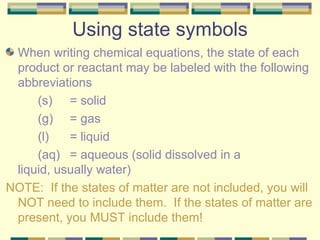
Using state symbols When writing chemical equations, the state of each product or reactant may be labeled with the following abbreviations (s)  = solid (g)  = gas (l)  = liquid (aq) = aqueous (solid dissolved in a  liquid, usually water) NOTE:  If the states of matter are not included, you will NOT need to include them.  If the states of matter are present, you MUST include them!
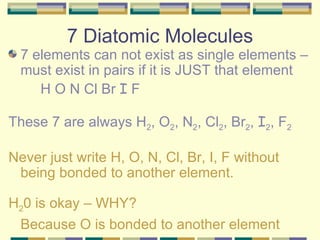
7 Diatomic Molecules 7 elements can not exist as single elements – must exist in pairs if it is JUST that element H O N Cl Br  I  F These 7 are always H 2 , O 2 , N 2 , Cl 2 , Br 2 ,  I 2 , F 2 Never just write H, O, N, Cl, Br, I, F without being bonded to another element. H 2 0 is okay – WHY? Because O is bonded to another element
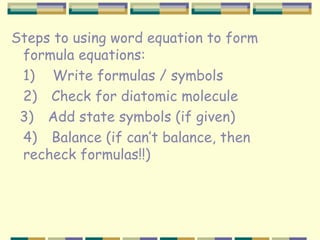
Steps to using word equation to form formula equations: 1)       Write formulas / symbols 2)      Check for diatomic molecule 3)      Add state symbols (if given) 4)   Balance (if can’t balance, then  recheck formulas!!)
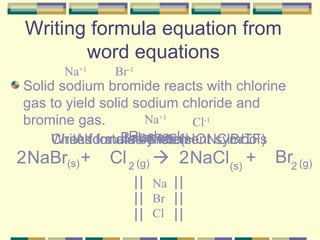
Writing formula equation from word equations Solid sodium bromide reacts with chlorine gas to yield solid sodium chloride and bromine gas. Na +1 Br -1 Na +1 Cl -1 NaBr + Cl  NaCl + Br Write formulas & element symbols Check for diatomics (HONClBr I F) Add state symbols  Balance Recheck 2 2 (s) (s) (g) (g) NaBrCl 2 2
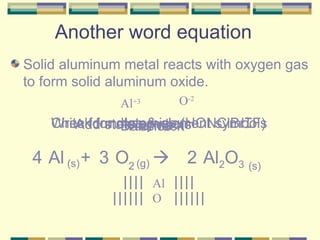
Another word equation Solid aluminum metal reacts with oxygen gas to form solid aluminum oxide.   Al +3 O -2 Al + O  Al 2 O 3 Write formulas & element symbols Check for diatomics (HONClBr I F) Add state symbols  Balance Recheck 2 (s) (s) (g) AlO 2 2 3 4
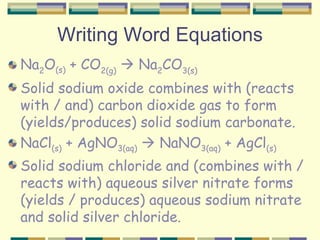
Writing Word Equations Na 2 O (s)  + CO 2(g)     Na 2 CO 3(s) Solid sodium oxide combines with (reacts with / and) carbon dioxide gas to form (yields/produces) solid sodium carbonate. NaCl (s)  + AgNO 3(aq)     NaNO 3(aq)  + AgCl (s) Solid sodium chloride and (combines with / reacts with) aqueous silver nitrate forms (yields / produces) aqueous sodium nitrate and solid silver chloride.
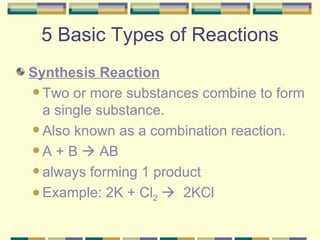
5 Basic Types of Reactions Synthesis Reaction Two or more substances combine to form a single substance.  Also known as a combination reaction. A + B    AB always forming 1 product Example: 2K + Cl 2      2KCl
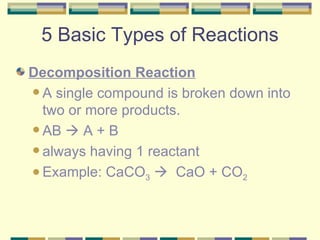
5 Basic Types of Reactions Decomposition Reaction A single compound is broken down into two or more products. AB    A + B  always having 1 reactant Example: CaCO 3      CaO + CO 2
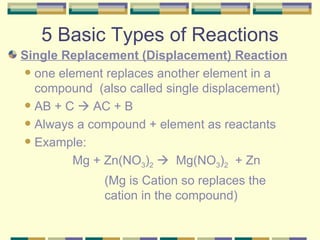
5 Basic Types of Reactions Single Replacement (Displacement) Reaction one element replaces another element in a compound  (also called single displacement)  AB + C    AC + B  Always a compound + element as reactants Example:  Mg + Zn(NO 3 ) 2      Mg(NO 3 ) 2   + Zn (Mg is Cation so replaces the  cation in the compound)
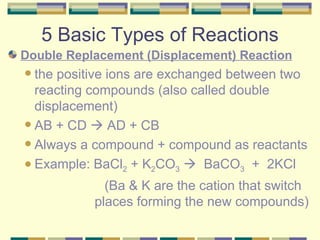
5 Basic Types of Reactions Double Replacement (Displacement) Reaction the positive ions are exchanged between two reacting compounds (also called double displacement) AB + CD    AD + CB  Always a compound + compound as reactants Example: BaCl 2  + K 2 CO 3      BaCO 3   +  2KCl (Ba & K are the cation that switch    places forming the new compounds)
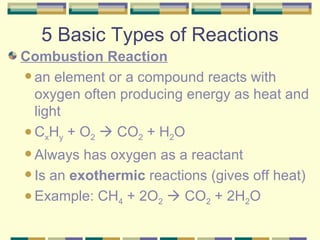
5 Basic Types of Reactions Combustion Reaction an element or a compound reacts with oxygen often producing energy as heat and light C x H y  + O 2     CO 2  + H 2 O  Always has oxygen as a reactant Is an  exothermic  reactions (gives off heat) Example: CH 4  + 2O 2     CO 2  + 2H 2 O
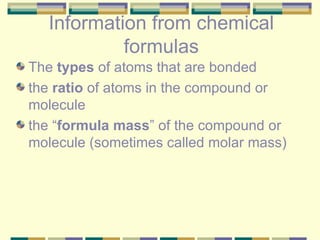
Information from chemical formulas The  types  of atoms that are bonded the  ratio  of atoms in the compound or molecule the “ formula mass ” of the compound or molecule (sometimes called molar mass)
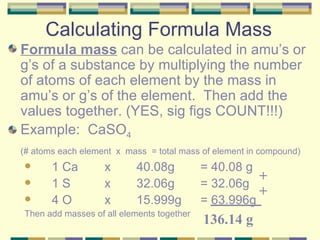
Calculating Formula Mass Formula mass  can be calculated in amu’s or g’s of a substance by multiplying the number of atoms of each element by the mass in amu’s or g’s of the element.  Then add the values together. (YES, sig figs COUNT!!!) Example:  CaSO 4 (# atoms each element  x  mass  = total mass of element in compound) 1 Ca  x  40.08g  = 40.08 g 1 S  x  32.06g  = 32.06g 4 O  x  15.999g  = 63.996g Then add masses of all elements together + + 136.14 g
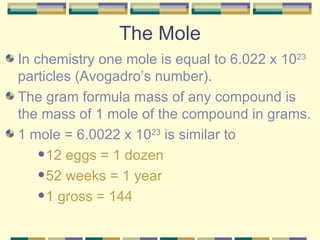
The Mole In chemistry one mole is equal to 6.022 x 10 23  particles (Avogadro’s number). The gram formula mass of any compound is the mass of 1 mole of the compound in grams. 1 mole = 6.0022 x 10 23  is similar to  12 eggs = 1 dozen 52 weeks = 1 year 1 gross = 144
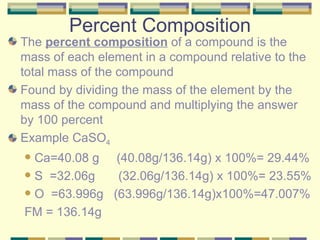
Percent Composition The  percent composition  of a compound is the mass of each element in a compound relative to the total mass of the compound Found by dividing the mass of the element by the mass of the compound and multiplying the answer by 100 percent Example CaSO 4 Ca=40.08 g  (40.08g/136.14g) x 100%= 29.44% S  =32.06g   (32.06g/136.14g) x 100%= 23.55% O  =63.996g  (63.996g/136.14g)x100%=47.007% FM = 136.14g
Limiting Reactants The  limiting reactant  is the reactant that determines the maximum amount of product that is formed. The limiting reactant will be completely used up in a reaction and then the reaction stops.  The other reactant will have some unchanged so it is said to be the  excess reactant . For example, if you need to make 10 chicken sandwiches.  You have 10 slices of bread and 10 pieces of chicken.  If each sandwich requires 2 slices of bread and 1 piece of chicken, which is the limiting reactant?  Excess reactant?
Rates of Reactions The  reaction rate  is the change in concentration of reactants and products in a certain amount of time. Rate at which the reactants disappear and the products appear. Combining two substances (causing a reaction) means forcing their particles to hit, or collide with, one another Collision Theory  states that molecules must collide in order to react
Activation Energy The  activation energy  is the energy needed to start the reaction. When particles collide with sufficient energy – at least equal to the activation energy – existing bonds may be disrupted and new bonds can form Endothermic reaction  – the energy of the product is greater than that of the reactants (energy is absorbed into the reaction) Exothermic reaction  – the energy of the products is lower than that of the reactants (energy is released from the reaction)
Factors Affecting Reaction Rates 1.  Nature of Reactants Depends on the state of particular reactants and the complexity of the bonds that have to be broken and formed in order for the reaction to proceed The more bonds to be broken then the longer the reaction takes A reaction between two gases will be quicker than a reaction between two liquids or two solids.
Factors Affecting Reaction Rates 2.  Temperature The higher the temperature at which a reaction occurs, the faster the particles will move and the more frequent the collisions For example, food spoils faster at room temperature than when it is refrigerated.
Factors Affecting Reaction Rates 3.  Concentration Deals with how many particles are there An increase in concentration means that there are more particles within a given volume and thus smaller spaces between the reacting particles. Thus, the higher the concentration of reactants, the greater the frequency of collisions among their particles. For example, the more people there are in a room the more people you will bump into as you walk through the room.
Factors Affecting Reaction Rates 4.  Surface Area Surface area deals with the number of particles that are exposed for reaction. The larger the surface area the greater the number of particles that are exposed for reaction. For example, many small pieces of coal will burn faster than a lump of coal (small pieces have more particles exposed to react with more oxygen particles)
Factors Affecting Reaction Rates 5.  Catalysts A catalyst is a substance that increases the rate of the reaction without itself being used up in the reaction (doesn’t appear as a reactant or a product) Catalysts lower the activation energy required for a reaction to occur. Thus a catalyst creates a different pathway from reactants to products – one that requires less energy. Catalysts in the body are enzymes – there to speed up reactions in the body that are essential to life.

Notes unit six

  • 1.
    Unit 7 –Chemical Reactions Chemical equations, Energy of Reactions, Rates of reactions, Limiting reactants
  • 2.
    Intro Vocabulary Chemicalreaction is the changing of substances to other substances by the breaking of bonds in reactants and the formation of bonds in the products - when some chemicals come into contact, they break apart, join, or rearrange to form new chemicals (always to become more stable) Chemical equations are shorthand representations of chemical reactions.
  • 3.
    Some more vocabularyReactants are the elements or compounds that enter into a reaction Products are the elements or compounds that are formed as a result of a chemical reaction Arrow (  ) means yields, produces or forms Reactant(s)  product(s)
  • 4.
    Al 2 (SO4 ) 3 + Ca(OH) 2  Al(OH) 3 + CaSO 4 Skeleton equation - Consists of symbols and subscripts (An unbalanced formula equation.) Symbols : element, yield (  ), combining (+) Subscript : small number found below the element symbol representing the number of atoms of each element present
  • 5.
    Al 2 (SO4 ) 3 + Ca(OH) 2  Al(OH) 3 + CaSO 4 Name the reactants (everything left of arrow) Aluminum sulfate & Calcium hydroxide Types & number of atoms in each reactant Aluminum sulfate Al = 2 S = 3 O = 12 Calcium hydroxide Ca = 1 O = 2 H = 2
  • 6.
    Al 2 (SO4 ) 3 + Ca(OH) 2  Al(OH) 3 + CaSO 4 Name the products (everything right of arrow) Aluminum hydroxide & Calcium sulfate Types & number of atoms in each reactant Aluminum hydroxide Al = 1 O = 3 H = 3 Calcium sulfate Ca = 1 S = 1 O = 4
  • 7.
    Practice Naming &Counting Li 2 S -Lithium Sulfide Li = 2 S = 1 CoF 2 -Cobalt (II) fluoride Co = 1 F = 2 MgSO 4 -Magnesium sulfate Mg=1 O=1 S=4 Be 3 (PO 4 ) 2 -Beryllium phosphate Be=3 P=2 O=8 CF 4 -Carbon tetrafluoride C = 1 F = 4
  • 8.
    Chemical equations canbe shown by 1. Word equation Carbon dioxide gas reacts with dihydrogen monoxide gas to form solid carbonic acid 2. Formula equation CO 2(g) + H 2 O (g)  H 2 CO 3(s)
  • 9.
    Let’s start witha formula equation H 2 + O 2  H 2 O How many hydrogens & oxygens in reactants? H = 2 O = 2 How many hydrogens & oxygens in products? H = 2 O = 1 What is wrong with this chemical equation? Two oxygen atoms in reactants and only one oxygen is in the product!! So we must… BALANCE the chemical equation!!
  • 10.
    Warm up aluminumphosphate(PO 4 3- ) reacts with potassium oxide to produce aluminum oxide and potassium phosphate.
  • 11.
    zinc chloride reactswith lithium fluoride to produce lithium chloride and zinc fluoride
  • 12.
    iron (II) oxidereacts with calcium sulfate to form iron (II) sulfate and calcium oxide.
  • 13.
    Balancing equations why& how Why do we balance equations? Law of conservation of mass -atoms are not created or destroyed in an ordinary chemical reaction, just rearranged to form new substances Whatever goes into a reaction must come out.
  • 14.
    Activity Follow instructionsas given. When finished with procedure answer the post activity questions on the sheet. Notebook paper is fine If time allows: Create your own procedure to prove the LCM using a flask, water, effervescent tablet, and balloon.
  • 15.
    Think about this…You want to make a bicycle out of the following parts: frame, wheel, handlebar, pedal, seat Write the word equation for making a bicycle: frame + wheel + handlebar + pedal + seat  bicycle Is the equation balanced? No frame + 2 wheels + handlebar + 2 pedals + seat  bicycle
  • 16.
    Counting molecules/compounds Howmany molecules of each of the following compounds are present in this equation? Al 2 (SO 4 ) 3 + 3Ca(OH) 2  2Al(OH) 3 + 3CaSO 4 Reactants: Al 2 (SO 4 ) 3 = 1 (when only 1 = no number) Ca(OH) 2 = 3 (large 3 in front) Products: Al(OH) 3 = 2 (large 2 in front) CaSO 4 = 3 (large 3 in front)
  • 17.
    Steps to BalancingEquations 1. Determine the number of each element in reactants and in products 2. Balance A. Polyatomic ions (if same poly. ion on both sides  balance as a chunk) B. Metals C. Nonmetals D. “O” & “H” 3. Recheck your count!!!
  • 18.
    H 2 + O 2  H 2 O Only 1 oxygen atom “out” (2 “in”)  place 2 in front of H 2 O H O Only 2 hydrogen “in” (4 “out”)  place 2 in front of H 2 Recount total number of each type of atom 2 2 * Only add coefficients, NEVER Δ subscripts Can you ever make just 1 molecule of water? coefficient subscript
  • 19.
    NaOH  Na 2 O + H 2 O Only 1 sodium atom “in” (2 “out”)  place 2 in front of NaOH Recount total number of each type of atom 2 Na O H
  • 20.
    Fe + O 2  Fe 2 O 3 Only 1 iron atom “in” (2 “out”)  place 2 in front of Fe Recount total number of each type of atom 2 Fe O Only 2 oxygen atom “in” (3 “out”)  place 2 in front of Fe 2 O 3 and place 3 in front of O 2 Only 2 iron atom “in” (4 “out”)  change 2 in front of Fe into a 4 2 3 4
  • 21.
    Using state symbolsWhen writing chemical equations, the state of each product or reactant may be labeled with the following abbreviations (s) = solid (g) = gas (l) = liquid (aq) = aqueous (solid dissolved in a liquid, usually water) NOTE: If the states of matter are not included, you will NOT need to include them. If the states of matter are present, you MUST include them!
  • 22.
    7 Diatomic Molecules7 elements can not exist as single elements – must exist in pairs if it is JUST that element H O N Cl Br I F These 7 are always H 2 , O 2 , N 2 , Cl 2 , Br 2 , I 2 , F 2 Never just write H, O, N, Cl, Br, I, F without being bonded to another element. H 2 0 is okay – WHY? Because O is bonded to another element
  • 23.
    Steps to usingword equation to form formula equations: 1)       Write formulas / symbols 2)     Check for diatomic molecule 3)     Add state symbols (if given) 4) Balance (if can’t balance, then recheck formulas!!)
  • 24.
    Writing formula equationfrom word equations Solid sodium bromide reacts with chlorine gas to yield solid sodium chloride and bromine gas. Na +1 Br -1 Na +1 Cl -1 NaBr + Cl  NaCl + Br Write formulas & element symbols Check for diatomics (HONClBr I F) Add state symbols Balance Recheck 2 2 (s) (s) (g) (g) NaBrCl 2 2
  • 25.
    Another word equationSolid aluminum metal reacts with oxygen gas to form solid aluminum oxide. Al +3 O -2 Al + O  Al 2 O 3 Write formulas & element symbols Check for diatomics (HONClBr I F) Add state symbols Balance Recheck 2 (s) (s) (g) AlO 2 2 3 4
  • 26.
    Writing Word EquationsNa 2 O (s) + CO 2(g)  Na 2 CO 3(s) Solid sodium oxide combines with (reacts with / and) carbon dioxide gas to form (yields/produces) solid sodium carbonate. NaCl (s) + AgNO 3(aq)  NaNO 3(aq) + AgCl (s) Solid sodium chloride and (combines with / reacts with) aqueous silver nitrate forms (yields / produces) aqueous sodium nitrate and solid silver chloride.
  • 27.
    5 Basic Typesof Reactions Synthesis Reaction Two or more substances combine to form a single substance. Also known as a combination reaction. A + B  AB always forming 1 product Example: 2K + Cl 2  2KCl
  • 28.
    5 Basic Typesof Reactions Decomposition Reaction A single compound is broken down into two or more products. AB  A + B always having 1 reactant Example: CaCO 3  CaO + CO 2
  • 29.
    5 Basic Typesof Reactions Single Replacement (Displacement) Reaction one element replaces another element in a compound (also called single displacement) AB + C  AC + B Always a compound + element as reactants Example: Mg + Zn(NO 3 ) 2  Mg(NO 3 ) 2 + Zn (Mg is Cation so replaces the cation in the compound)
  • 30.
    5 Basic Typesof Reactions Double Replacement (Displacement) Reaction the positive ions are exchanged between two reacting compounds (also called double displacement) AB + CD  AD + CB Always a compound + compound as reactants Example: BaCl 2 + K 2 CO 3  BaCO 3 + 2KCl (Ba & K are the cation that switch places forming the new compounds)
  • 31.
    5 Basic Typesof Reactions Combustion Reaction an element or a compound reacts with oxygen often producing energy as heat and light C x H y + O 2  CO 2 + H 2 O Always has oxygen as a reactant Is an exothermic reactions (gives off heat) Example: CH 4 + 2O 2  CO 2 + 2H 2 O
  • 32.
    Information from chemicalformulas The types of atoms that are bonded the ratio of atoms in the compound or molecule the “ formula mass ” of the compound or molecule (sometimes called molar mass)
  • 33.
    Calculating Formula MassFormula mass can be calculated in amu’s or g’s of a substance by multiplying the number of atoms of each element by the mass in amu’s or g’s of the element. Then add the values together. (YES, sig figs COUNT!!!) Example: CaSO 4 (# atoms each element x mass = total mass of element in compound) 1 Ca x 40.08g = 40.08 g 1 S x 32.06g = 32.06g 4 O x 15.999g = 63.996g Then add masses of all elements together + + 136.14 g
  • 34.
    The Mole Inchemistry one mole is equal to 6.022 x 10 23 particles (Avogadro’s number). The gram formula mass of any compound is the mass of 1 mole of the compound in grams. 1 mole = 6.0022 x 10 23 is similar to 12 eggs = 1 dozen 52 weeks = 1 year 1 gross = 144
  • 35.
    Percent Composition The percent composition of a compound is the mass of each element in a compound relative to the total mass of the compound Found by dividing the mass of the element by the mass of the compound and multiplying the answer by 100 percent Example CaSO 4 Ca=40.08 g (40.08g/136.14g) x 100%= 29.44% S =32.06g (32.06g/136.14g) x 100%= 23.55% O =63.996g (63.996g/136.14g)x100%=47.007% FM = 136.14g
  • 36.
    Limiting Reactants The limiting reactant is the reactant that determines the maximum amount of product that is formed. The limiting reactant will be completely used up in a reaction and then the reaction stops. The other reactant will have some unchanged so it is said to be the excess reactant . For example, if you need to make 10 chicken sandwiches. You have 10 slices of bread and 10 pieces of chicken. If each sandwich requires 2 slices of bread and 1 piece of chicken, which is the limiting reactant? Excess reactant?
  • 37.
    Rates of ReactionsThe reaction rate is the change in concentration of reactants and products in a certain amount of time. Rate at which the reactants disappear and the products appear. Combining two substances (causing a reaction) means forcing their particles to hit, or collide with, one another Collision Theory states that molecules must collide in order to react
  • 38.
    Activation Energy The activation energy is the energy needed to start the reaction. When particles collide with sufficient energy – at least equal to the activation energy – existing bonds may be disrupted and new bonds can form Endothermic reaction – the energy of the product is greater than that of the reactants (energy is absorbed into the reaction) Exothermic reaction – the energy of the products is lower than that of the reactants (energy is released from the reaction)
  • 39.
    Factors Affecting ReactionRates 1. Nature of Reactants Depends on the state of particular reactants and the complexity of the bonds that have to be broken and formed in order for the reaction to proceed The more bonds to be broken then the longer the reaction takes A reaction between two gases will be quicker than a reaction between two liquids or two solids.
  • 40.
    Factors Affecting ReactionRates 2. Temperature The higher the temperature at which a reaction occurs, the faster the particles will move and the more frequent the collisions For example, food spoils faster at room temperature than when it is refrigerated.
  • 41.
    Factors Affecting ReactionRates 3. Concentration Deals with how many particles are there An increase in concentration means that there are more particles within a given volume and thus smaller spaces between the reacting particles. Thus, the higher the concentration of reactants, the greater the frequency of collisions among their particles. For example, the more people there are in a room the more people you will bump into as you walk through the room.
  • 42.
    Factors Affecting ReactionRates 4. Surface Area Surface area deals with the number of particles that are exposed for reaction. The larger the surface area the greater the number of particles that are exposed for reaction. For example, many small pieces of coal will burn faster than a lump of coal (small pieces have more particles exposed to react with more oxygen particles)
  • 43.
    Factors Affecting ReactionRates 5. Catalysts A catalyst is a substance that increases the rate of the reaction without itself being used up in the reaction (doesn’t appear as a reactant or a product) Catalysts lower the activation energy required for a reaction to occur. Thus a catalyst creates a different pathway from reactants to products – one that requires less energy. Catalysts in the body are enzymes – there to speed up reactions in the body that are essential to life.