The Liquid State
General properties
Liquefaction of gases
Vapor pressure of liquids
Boiling point
General properties
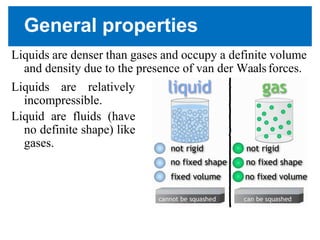
Liquids are denser than gases and occupy a definite volume
and density due to the presence of van der Waalsforces.
Liquids are relatively
incompressible.
Liquid are fluids (have
no definite shape) like
gases.
General properties
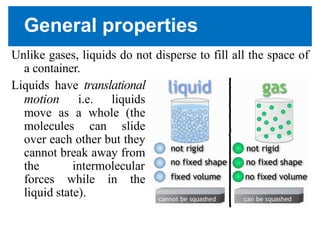
Unlike gases, liquids do not disperse to fill all the space of
a container.
Liquids have translational
motion i.e. liquids
move as a whole (the
molecules can slide
over each other but they
cannot break away from
the intermolecular
forces while in the
liquid state).
Liquefaction of gases
Effect of temperature and pressure
• The transitions from a gas to a liquid and from a liquid
to a solid depend on both temperature and pressure.
• When a gas is cooled, it loses some of its kinetic energy
in and the velocity of the molecules decreases.
• If pressure is applied to the gas, the molecules are
brought within the range of the van der Waals forces
and pass into the liquid state.
Liquefaction of gases
Critical temperature and pressure
• Critical temperature is the temperature above which it is
impossible to liquefy a gas regardless of the pressure applied.
• Critical pressure is
the pressure
required to liquefy
a gas at its critical
temperature
• The further a gas is
cooled below its
critical temperature,
the less pressure is
required to liquefy
it.
Liquefaction of gases
Critical temperature and pressure
• The critical temperature and pressure of water is 374 °C
(647 K) and 218 atm respectively, whereas the
corresponding values for helium are 5.2 K and 2.26 atm.
• The high critical values for water result from the strong
hydrogen bonding between the molecules.
• Conversely, helium molecules are only attracted by the
weak London forces, and therefore; must be cooled to
the extremely low temperature of 5.2 K before it can be
liquefied. Above this critical temperature, helium
remains a gas no matter what the pressure.
Liquefaction of gases
Joule-Thomson effect (adiabatic expansion)
• If we allow gas to expand rapidly (inside a vacuum
flask) so that no heat enters system, such expansion is
known as adiabatic expansion.
• Energy to expand gas comes from gas itself. Energy
spend to overcome cohesive forces.
• As a result of that temperature of gas reduces. This
cooling effect is known as Joule-Thomson effect
• If we repeat this cycle several times, liquefaction of
gas could be achieved
Liquefaction of gases
Aerosols
• In pharmaceutical aerosols a
drug is dissolved or suspended
in a propellant (a material that
is liquid under the high
pressure inside the container
but forms a gas under normal
atmospheric conditions e.g.
CFCs, N2, CO2 ).
• Part of the propellant exists as a
gas and exerts the pressure
necessary to expel the drug,
whereas the remainder exists as
liquid and provides a solution or
suspension vehicle for the drug.
Liquefaction of gases
Aerosols
• By depressing a valve on the
container, some of the drug–
propellant mixture is
expelled owing to the excess
pressure inside the
container.
• Outside the container, the
liquid propellant reverts to
gas and vaporizes off, while
the drug forms a fine spray.
Vapor pressure of liquids
Equilibrium vapor pressure
• When a liquid is placed in a closed container at a
constant temperature, the molecules with the highest
energies break away from the surface of the liquid and
pass into the gaseous state (evaporate), and some of the
molecules subsequently return to the liquid state
(condense).
• When the rate of condensation equals the rate of
vaporization at a definite temperature, the vapor
becomes saturated and a dynamic equilibrium is
established.
• The pressure of the saturated vapor above the liquid is
then known as the equilibrium vapor pressure.
Vapor pressure of liquids
Clausius–Clapeyron equation
• Any point on one of the
curve represents a
condition in which the
liquid and the vapour
exist together in
equilibrium.
• If the temperature of any
of the liquids is increased
while the pressure is held
constant, or if the
pressure is decreased
while the temperature is
held constant, all the
liquid will pass into the
vapor state.
Vapor pressure of liquids
Clausius–Clapeyron equation
Clausius–Clapeyron equation expresses the relationship
between the vapor pressure and the absolute temperature
of a liquid:
𝑷 𝟐 ∆𝑯 𝒗 𝑻 𝟐 − 𝑻 𝟏
𝒍og =
𝑷 𝟏 2.303 𝑹𝑻 𝟏 𝑻 𝟐
P1 and P2: vapor pressures at absolute temperatures T1 and T2.
ΔHv: the molar heat of vaporization (the heat absorbed by 1 mole of
liquid when it passes into the vapor state).
Vapor pressure of liquids
Clausius–Clapeyron equation: Example
Example: Compute the vapor pressure of water at 120°C.
The vapor pressure of water at 100°C is 1 atm, and
ΔHv is 9720 cal/mole.
𝒍og
𝑷 𝟐
=
∆𝑯 𝒗 𝑻 𝟐 − 𝑻 𝟏
𝑷 𝟏 2.303 𝑹𝑻 𝟏 𝑻 𝟐
𝒍og
𝑷 𝟐
=
9720 393 − 373
1 1.987 × 393 × 373
𝑷 𝟐 = 1.95 atm
Vapor pressure of liquids
Clausius–Clapeyron equation
The Clausius–Clapeyron equation can be written in a more
general form:
∆𝑯 𝒗 𝟏
𝒍og𝑷 = + 𝑪𝒐𝒏𝒔𝒕𝒂𝒏𝒕
2.303𝑹𝑻
Aplot of 𝒍og𝑷 against1/T
results in a straight line.
The heat of vaporization of the
liquid can be calculated
from the slope of the line.
Boiling point
Definition
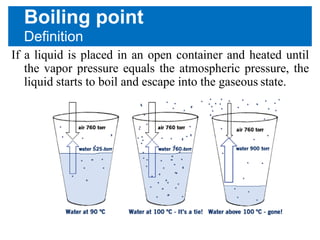
If a liquid is placed in an open container and heated until
the vapor pressure equals the atmospheric pressure, the
liquid starts to boil and escape into the gaseous state.
Boiling point
Definition
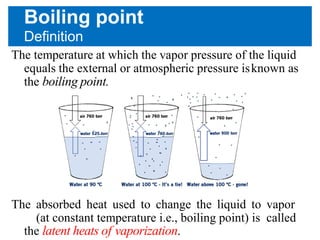
The temperature at which the vapor pressure of the liquid
equals the external or atmospheric pressure isknown as
the boiling point.
The absorbed heat used to change the liquid to vapor
(at constant temperature i.e., boiling point) is called
the latent heats of vaporization.
Boiling point
Clausius–Clapeyron equation
• The temperature at which the vapor pressure of the
liquid equals an atmospheric pressure of 1 atm is called
normal boiling point
• At higher elevations, the atmospheric pressure decreases
and the boiling point is lowered.
• At a pressure of 700 mm Hg, water boils at 97.7°C; at
17.5 mm Hg, it boils at 20°C.
• The change in boiling point with pressure can be
computed by using the Clausius–Clapeyron equation.
Boiling point
Clausius–Clapeyron equation: Examples
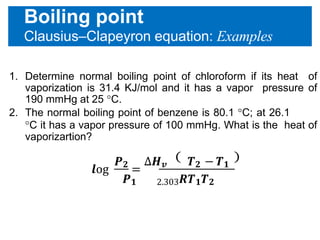
1. Determine normal boiling point of chloroform if its heat of
vaporization is 31.4 KJ/mol and it has a vapor pressure of
190 mmHg at 25 °C.
2. The normal boiling point of benzene is 80.1 °C; at 26.1
°C it has a vapor pressure of 100 mmHg. What is the heat of
vaporizartion?
𝒍og
𝑷 𝟐
=
∆𝑯 𝒗 𝑻 𝟐 − 𝑻 𝟏
𝑷 𝟏 2.303 𝑹𝑻 𝟏 𝑻 𝟐
Boiling point
Intermolecular forces
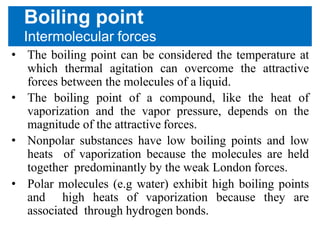
• The boiling point can be considered the temperature at
which thermal agitation can overcome the attractive
forces between the molecules of a liquid.
• The boiling point of a compound, like the heat of
vaporization and the vapor pressure, depends on the
magnitude of the attractive forces.
• Nonpolar substances have low boiling points and low
heats of vaporization because the molecules are held
together predominantly by the weak London forces.
• Polar molecules (e.g water) exhibit high boiling points
and high heats of vaporization because they are
associated through hydrogen bonds.
Boiling point
Intermolecular forces
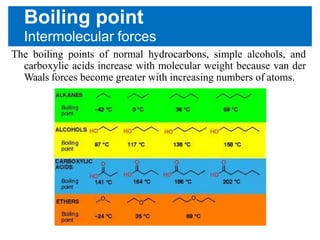
The boiling points of normal hydrocarbons, simple alcohols, and
carboxylic acids increase with molecular weight because van der
Waals forces become greater with increasing numbers of atoms.
Boiling point
Intermolecular forces
Branching of the chain produces a less compact molecule
with reduced intermolecular attraction, and a decrease in
the boiling point.
Boiling point
Intermolecular forces
Alcohols boil at a much higher
temperature than saturated
hydrocarbons of the same
molecular weight because of
association of the alcohol
molecules through hydrogen
bonding.
The boiling points of carboxylic
acids are higher than that of
alcohols because the acids
form dimers through
hydrogen bonding.
Reference
Sinko, P. J. M. A. N. 2006. Martin's physical pharmacy and
pharmaceutical sciences

Liquid State SB

  • 1.
    The Liquid State Generalproperties Liquefaction of gases Vapor pressure of liquids Boiling point
  • 2.
    General properties Liquids aredenser than gases and occupy a definite volume and density due to the presence of van der Waalsforces. Liquids are relatively incompressible. Liquid are fluids (have no definite shape) like gases.
  • 3.
    General properties Unlike gases,liquids do not disperse to fill all the space of a container. Liquids have translational motion i.e. liquids move as a whole (the molecules can slide over each other but they cannot break away from the intermolecular forces while in the liquid state).
  • 4.
    Liquefaction of gases Effectof temperature and pressure • The transitions from a gas to a liquid and from a liquid to a solid depend on both temperature and pressure. • When a gas is cooled, it loses some of its kinetic energy in and the velocity of the molecules decreases. • If pressure is applied to the gas, the molecules are brought within the range of the van der Waals forces and pass into the liquid state.
  • 5.
    Liquefaction of gases Criticaltemperature and pressure • Critical temperature is the temperature above which it is impossible to liquefy a gas regardless of the pressure applied. • Critical pressure is the pressure required to liquefy a gas at its critical temperature • The further a gas is cooled below its critical temperature, the less pressure is required to liquefy it.
  • 6.
    Liquefaction of gases Criticaltemperature and pressure • The critical temperature and pressure of water is 374 °C (647 K) and 218 atm respectively, whereas the corresponding values for helium are 5.2 K and 2.26 atm. • The high critical values for water result from the strong hydrogen bonding between the molecules. • Conversely, helium molecules are only attracted by the weak London forces, and therefore; must be cooled to the extremely low temperature of 5.2 K before it can be liquefied. Above this critical temperature, helium remains a gas no matter what the pressure.
  • 7.
    Liquefaction of gases Joule-Thomsoneffect (adiabatic expansion) • If we allow gas to expand rapidly (inside a vacuum flask) so that no heat enters system, such expansion is known as adiabatic expansion. • Energy to expand gas comes from gas itself. Energy spend to overcome cohesive forces. • As a result of that temperature of gas reduces. This cooling effect is known as Joule-Thomson effect • If we repeat this cycle several times, liquefaction of gas could be achieved
  • 8.
    Liquefaction of gases Aerosols •In pharmaceutical aerosols a drug is dissolved or suspended in a propellant (a material that is liquid under the high pressure inside the container but forms a gas under normal atmospheric conditions e.g. CFCs, N2, CO2 ). • Part of the propellant exists as a gas and exerts the pressure necessary to expel the drug, whereas the remainder exists as liquid and provides a solution or suspension vehicle for the drug.
  • 9.
    Liquefaction of gases Aerosols •By depressing a valve on the container, some of the drug– propellant mixture is expelled owing to the excess pressure inside the container. • Outside the container, the liquid propellant reverts to gas and vaporizes off, while the drug forms a fine spray.
  • 10.
    Vapor pressure ofliquids Equilibrium vapor pressure • When a liquid is placed in a closed container at a constant temperature, the molecules with the highest energies break away from the surface of the liquid and pass into the gaseous state (evaporate), and some of the molecules subsequently return to the liquid state (condense). • When the rate of condensation equals the rate of vaporization at a definite temperature, the vapor becomes saturated and a dynamic equilibrium is established. • The pressure of the saturated vapor above the liquid is then known as the equilibrium vapor pressure.
  • 11.
    Vapor pressure ofliquids Clausius–Clapeyron equation • Any point on one of the curve represents a condition in which the liquid and the vapour exist together in equilibrium. • If the temperature of any of the liquids is increased while the pressure is held constant, or if the pressure is decreased while the temperature is held constant, all the liquid will pass into the vapor state.
  • 12.
    Vapor pressure ofliquids Clausius–Clapeyron equation Clausius–Clapeyron equation expresses the relationship between the vapor pressure and the absolute temperature of a liquid: 𝑷 𝟐 ∆𝑯 𝒗 𝑻 𝟐 − 𝑻 𝟏 𝒍og = 𝑷 𝟏 2.303 𝑹𝑻 𝟏 𝑻 𝟐 P1 and P2: vapor pressures at absolute temperatures T1 and T2. ΔHv: the molar heat of vaporization (the heat absorbed by 1 mole of liquid when it passes into the vapor state).
  • 13.
    Vapor pressure ofliquids Clausius–Clapeyron equation: Example Example: Compute the vapor pressure of water at 120°C. The vapor pressure of water at 100°C is 1 atm, and ΔHv is 9720 cal/mole. 𝒍og 𝑷 𝟐 = ∆𝑯 𝒗 𝑻 𝟐 − 𝑻 𝟏 𝑷 𝟏 2.303 𝑹𝑻 𝟏 𝑻 𝟐 𝒍og 𝑷 𝟐 = 9720 393 − 373 1 1.987 × 393 × 373 𝑷 𝟐 = 1.95 atm
  • 14.
    Vapor pressure ofliquids Clausius–Clapeyron equation The Clausius–Clapeyron equation can be written in a more general form: ∆𝑯 𝒗 𝟏 𝒍og𝑷 = + 𝑪𝒐𝒏𝒔𝒕𝒂𝒏𝒕 2.303𝑹𝑻 Aplot of 𝒍og𝑷 against1/T results in a straight line. The heat of vaporization of the liquid can be calculated from the slope of the line.
  • 15.
    Boiling point Definition If aliquid is placed in an open container and heated until the vapor pressure equals the atmospheric pressure, the liquid starts to boil and escape into the gaseous state.
  • 16.
    Boiling point Definition The temperatureat which the vapor pressure of the liquid equals the external or atmospheric pressure isknown as the boiling point. The absorbed heat used to change the liquid to vapor (at constant temperature i.e., boiling point) is called the latent heats of vaporization.
  • 17.
    Boiling point Clausius–Clapeyron equation •The temperature at which the vapor pressure of the liquid equals an atmospheric pressure of 1 atm is called normal boiling point • At higher elevations, the atmospheric pressure decreases and the boiling point is lowered. • At a pressure of 700 mm Hg, water boils at 97.7°C; at 17.5 mm Hg, it boils at 20°C. • The change in boiling point with pressure can be computed by using the Clausius–Clapeyron equation.
  • 18.
    Boiling point Clausius–Clapeyron equation:Examples 1. Determine normal boiling point of chloroform if its heat of vaporization is 31.4 KJ/mol and it has a vapor pressure of 190 mmHg at 25 °C. 2. The normal boiling point of benzene is 80.1 °C; at 26.1 °C it has a vapor pressure of 100 mmHg. What is the heat of vaporizartion? 𝒍og 𝑷 𝟐 = ∆𝑯 𝒗 𝑻 𝟐 − 𝑻 𝟏 𝑷 𝟏 2.303 𝑹𝑻 𝟏 𝑻 𝟐
  • 19.
    Boiling point Intermolecular forces •The boiling point can be considered the temperature at which thermal agitation can overcome the attractive forces between the molecules of a liquid. • The boiling point of a compound, like the heat of vaporization and the vapor pressure, depends on the magnitude of the attractive forces. • Nonpolar substances have low boiling points and low heats of vaporization because the molecules are held together predominantly by the weak London forces. • Polar molecules (e.g water) exhibit high boiling points and high heats of vaporization because they are associated through hydrogen bonds.
  • 20.
    Boiling point Intermolecular forces Theboiling points of normal hydrocarbons, simple alcohols, and carboxylic acids increase with molecular weight because van der Waals forces become greater with increasing numbers of atoms.
  • 21.
    Boiling point Intermolecular forces Branchingof the chain produces a less compact molecule with reduced intermolecular attraction, and a decrease in the boiling point.
  • 22.
    Boiling point Intermolecular forces Alcoholsboil at a much higher temperature than saturated hydrocarbons of the same molecular weight because of association of the alcohol molecules through hydrogen bonding. The boiling points of carboxylic acids are higher than that of alcohols because the acids form dimers through hydrogen bonding.
  • 23.
    Reference Sinko, P. J.M. A. N. 2006. Martin's physical pharmacy and pharmaceutical sciences