Biogeochemical Cycles
Ecosystem defined: a community
of organisms and it’s corresponding abiotic
environment through which matter cycles
and energy flows
• Wide variation in ecosystems
• Boarders can be well defined or vague
• Can be natural or artificial, managed or
wild
• Wide range in scale
• Common to all ecosystems: energy flow
and cycling of matter
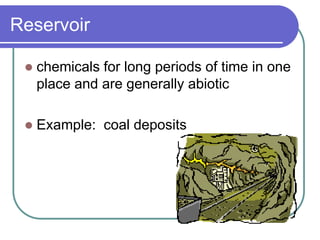
Reservoir
 chemicals for long periods of time in one
place and are generally abiotic
 Example: coal deposits
Exchange Pools
 chemicals are held for only short periods
of time and are generally biotic
 Example: plants and animals (which
temporarily use carbon in their systems
and then release back into the air)
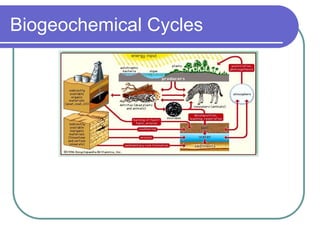
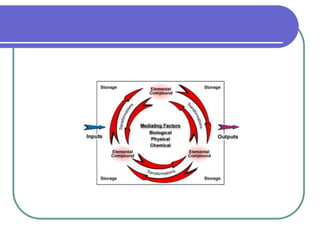
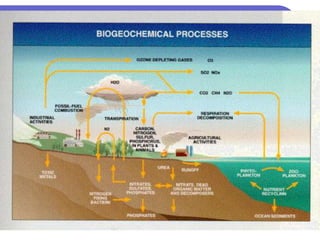
Biogeochemical Cycle
circuit or pathway by which a
chemical element or molecule
moves through both biotic ("bio-")
and abiotic ("geo-") compartments
of an ecosystem.
In effect, the element is recycled
BIO
 Biology. Life. Living things. These cycles
all play a role in the lives of living things.
The cycles might limit the organisms of
Earth or they might happen along side,
changing the environment
GEO
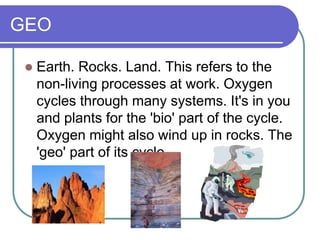
 Earth. Rocks. Land. This refers to the
non-living processes at work. Oxygen
cycles through many systems. It's in you
and plants for the 'bio' part of the cycle.
Oxygen might also wind up in rocks. The
'geo' part of its cycle.
Chemical
• Molecules. Reactions. Atoms. All cycles
include these small pathways. Complete
molecules are not always passed from
one point to the next. Sometimes
chemical reactions take place that
changes the molecules and locations of
the atoms. Think about oxidation as an
example of the
'chemical' part of these pathways.
What are the main cycles?
 In a gas cycle elements move through
the atmosphere. Main reservoirs are the
atmosphere and the ocean.
 In a sedimentary cycle elements move
from land to water to sediment. Main
reservoirs are the soil and sedimentary
rocks.
What are the Biogeochemical
Cycles of interest to Ecology?
• Carbon Cycle (gas)
• Nitrogen Cycle (gas)
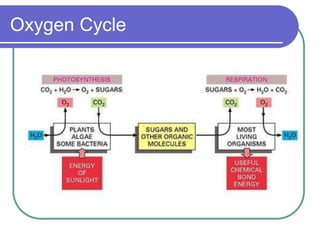
• Oxygen Cycle (gas)
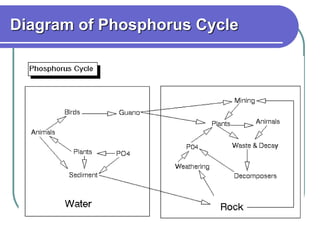
• Phosphorous Cycle (sedimentary)
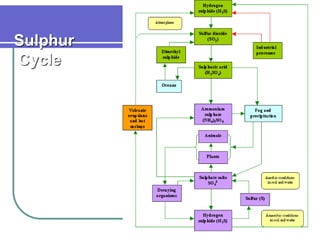
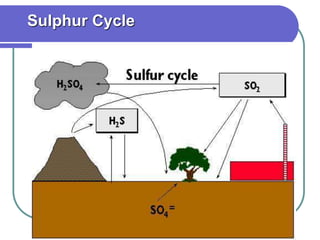
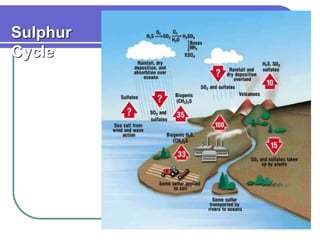
• Sulfur Cycle (sedimentary)
• Hydrogen Cycle (gas)
• Water Cycle
• Mercury Cycle (new one)
• human caused cycle of atrazine (new one)
What does it need?
 It always involves equilibrium states:
a balance in the cycling of the element
between compartments.
 However, overall balance may involve
compartments distributed on a global
scale.
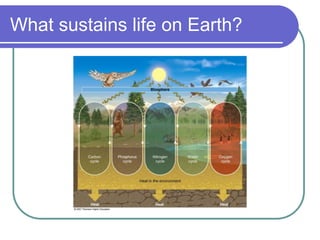
What sustains life on Earth?
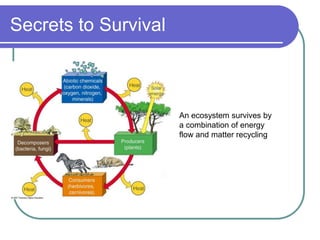
Secrets to Survival
An ecosystem survives by
a combination of energy
flow and matter recycling
Matter cycling in ecosystems
 Nutrient Cycles: Global Recycling
 Global Cycles recycle nutrients through the
earth’s air, land, water, and living
organisms.
 Nutrients are the elements and compounds
that organisms need to live, grow, and
reproduce.
 Biogeochemical cycles move these
substances through air, water, soil, rock and
living organisms.
Oxygen Cycle
THE CARBON CYCLE
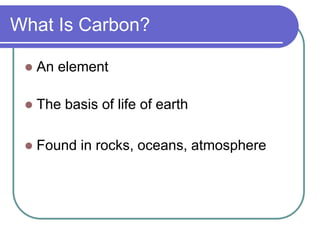
What Is Carbon?
 An element
 The basis of life of earth
 Found in rocks, oceans, atmosphere
Carbon Cycle
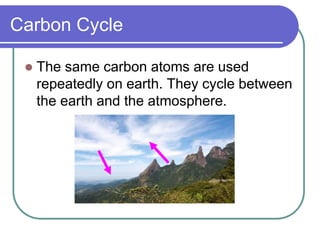
 The same carbon atoms are used
repeatedly on earth. They cycle between
the earth and the atmosphere.
Plants Use Carbon Dioxide
 Plants pull carbon dioxide from the
atmosphere and use it to make food –—
photosynthesis.
 The carbon becomes part of the plant
(stored food).
Animals Eat Plants
 When organisms eat plants, they take in
the carbon and some of it becomes part
of their own bodies.
Plants and Animal Die
 When plants and animals die, most of
their bodies are decomposed and carbon
atoms are returned to the atmosphere.
 Some are not decomposed fully and end
up in deposits underground (oil, coal,
etc.).
Carbon Slowly Returns to Atmosphere
 Carbon in rocks and underground
deposits is released very slowly into the
atmosphere.
 This process takes many years.
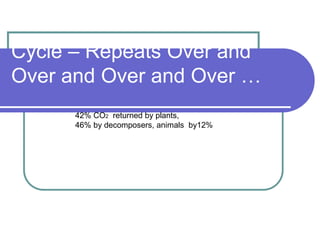
Cycle – Repeats Over and
Over and Over and Over …
42% CO2 returned by plants,
46% by decomposers, animals by12%
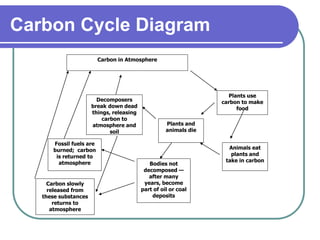
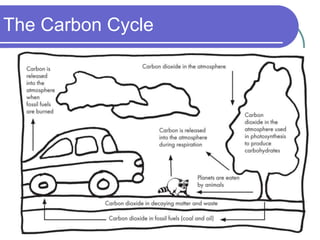
Carbon Cycle Diagram
Carbon in Atmosphere
Plants use
carbon to make
food
Animals eat
plants and
take in carbon
Plants and
animals die
Decomposers
break down dead
things, releasing
carbon to
atmosphere and
soil
Bodies not
decomposed —
after many
years, become
part of oil or coal
deposits
Fossil fuels are
burned; carbon
is returned to
atmosphere
Carbon slowly
released from
these substances
returns to
atmosphere
Carbon in Oceans
 Additional carbon is stored in the ocean.
 Many animals pull carbon from water to use in
shells, etc.
 Animals die and carbon substances are
deposited at the bottom of the ocean.
 Oceans contain earth’s largest store of carbon.
The Carbon Cycle
Human Impact
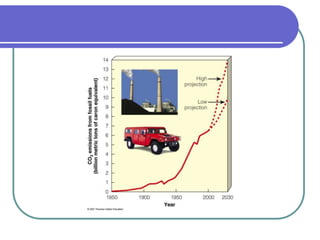
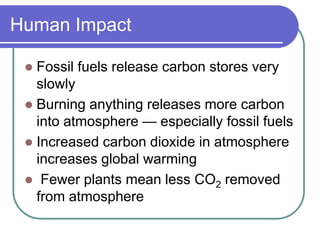
 Fossil fuels release carbon stores very
slowly
 Burning anything releases more carbon
into atmosphere — especially fossil fuels
 Increased carbon dioxide in atmosphere
increases global warming
 Fewer plants mean less CO2 removed
from atmosphere
What We Need to Do
 Burn less, especially fossil fuels
 Promote plant life, especially trees
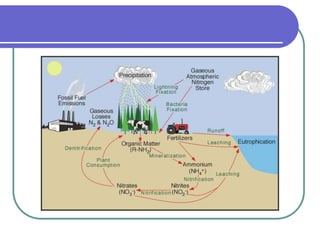
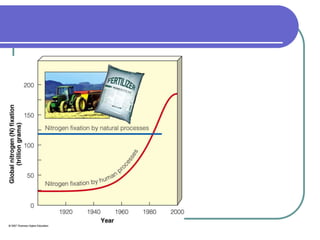
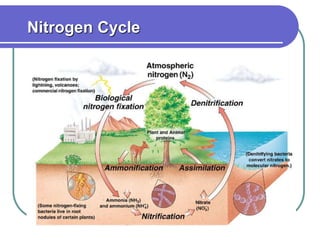
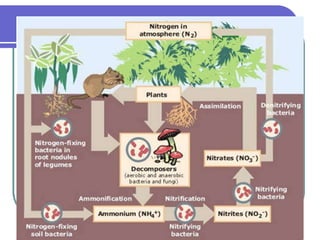
Nitrogen Cycle
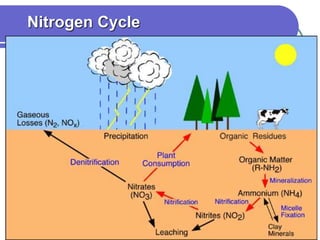
Nitrogen Cycle
Effects of Increased Nitrogen
1. Loss of soil nutrients (calcium, potassium)
2. Acidification of rivers and lakes (fertilizers and
combustion of coal).
3. Increases nitrogen oxides in the atmosphere
(greenhouse gas—global warming).
(reduce ozone—increasing UV penetration).
Effects of Increased Nitrogen
4. Aids in spreading weeds into nitrogen poor
areas (+Eutrophication of lakes, ponds,
streams).
5. Increasing nitrogen increases carbon fixation
(linked to carbon cycle).
6. Increasing acidification increases weathering
(increases rate of phosphorous cycle).
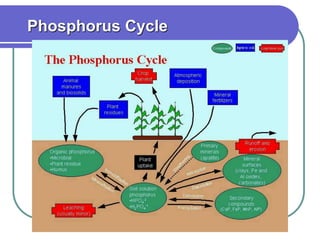
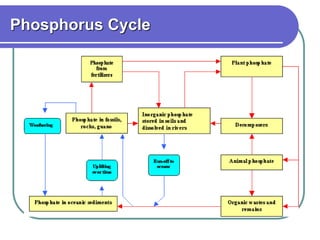
Phosphorus Cycle
Phosphorus Cycle
Diagram of Phosphorus Cycle
Sulphur
Cycle
Sulphur Cycle
Sulphur
Cycle
Biogeochemical Cycle =
Recycling
 All the chemicals, nutrients, or elements
— such as carbon, nitrogen, oxygen,
phosphorus — used in ecosystems by
living organisms operate on a closed
system
Gaia Hypothosis
 Some have proposed that the earth’s
various forms of life control or at least
influence its chemical cycles and other
earth-sustaining processes.
 The strong Gaia hypothesis: life controls the
earth’s life-sustaining processes.
 The weak Gaia hypothesis: life influences
the earth’s life-sustaining processes.
Conclusions
In contrast to energy, which moves in
one direction through the ecosystem,
materials are continually recycled
from the abiotic environment to
organisms, and back to the abiotic
environment.
Changes in one of the biogeochemical
cycles usually influences the other
biogeochemical cycles.

biogeochemical_cycles_chapter_5_1.ppt

  • 1.
  • 3.
    Ecosystem defined: acommunity of organisms and it’s corresponding abiotic environment through which matter cycles and energy flows • Wide variation in ecosystems • Boarders can be well defined or vague • Can be natural or artificial, managed or wild • Wide range in scale • Common to all ecosystems: energy flow and cycling of matter
  • 4.
    Reservoir  chemicals forlong periods of time in one place and are generally abiotic  Example: coal deposits
  • 5.
    Exchange Pools  chemicalsare held for only short periods of time and are generally biotic  Example: plants and animals (which temporarily use carbon in their systems and then release back into the air)
  • 7.
    Biogeochemical Cycle circuit orpathway by which a chemical element or molecule moves through both biotic ("bio-") and abiotic ("geo-") compartments of an ecosystem. In effect, the element is recycled
  • 8.
    BIO  Biology. Life.Living things. These cycles all play a role in the lives of living things. The cycles might limit the organisms of Earth or they might happen along side, changing the environment
  • 9.
    GEO  Earth. Rocks.Land. This refers to the non-living processes at work. Oxygen cycles through many systems. It's in you and plants for the 'bio' part of the cycle. Oxygen might also wind up in rocks. The 'geo' part of its cycle.
  • 10.
    Chemical • Molecules. Reactions.Atoms. All cycles include these small pathways. Complete molecules are not always passed from one point to the next. Sometimes chemical reactions take place that changes the molecules and locations of the atoms. Think about oxidation as an example of the 'chemical' part of these pathways.
  • 11.
    What are themain cycles?  In a gas cycle elements move through the atmosphere. Main reservoirs are the atmosphere and the ocean.  In a sedimentary cycle elements move from land to water to sediment. Main reservoirs are the soil and sedimentary rocks.
  • 12.
    What are theBiogeochemical Cycles of interest to Ecology? • Carbon Cycle (gas) • Nitrogen Cycle (gas) • Oxygen Cycle (gas) • Phosphorous Cycle (sedimentary) • Sulfur Cycle (sedimentary) • Hydrogen Cycle (gas) • Water Cycle • Mercury Cycle (new one) • human caused cycle of atrazine (new one)
  • 13.
    What does itneed?  It always involves equilibrium states: a balance in the cycling of the element between compartments.  However, overall balance may involve compartments distributed on a global scale.
  • 14.
  • 15.
    Secrets to Survival Anecosystem survives by a combination of energy flow and matter recycling
  • 16.
    Matter cycling inecosystems  Nutrient Cycles: Global Recycling  Global Cycles recycle nutrients through the earth’s air, land, water, and living organisms.  Nutrients are the elements and compounds that organisms need to live, grow, and reproduce.  Biogeochemical cycles move these substances through air, water, soil, rock and living organisms.
  • 18.
  • 19.
  • 20.
    What Is Carbon? An element  The basis of life of earth  Found in rocks, oceans, atmosphere
  • 21.
    Carbon Cycle  Thesame carbon atoms are used repeatedly on earth. They cycle between the earth and the atmosphere.
  • 22.
    Plants Use CarbonDioxide  Plants pull carbon dioxide from the atmosphere and use it to make food –— photosynthesis.  The carbon becomes part of the plant (stored food).
  • 23.
    Animals Eat Plants When organisms eat plants, they take in the carbon and some of it becomes part of their own bodies.
  • 24.
    Plants and AnimalDie  When plants and animals die, most of their bodies are decomposed and carbon atoms are returned to the atmosphere.  Some are not decomposed fully and end up in deposits underground (oil, coal, etc.).
  • 25.
    Carbon Slowly Returnsto Atmosphere  Carbon in rocks and underground deposits is released very slowly into the atmosphere.  This process takes many years.
  • 26.
    Cycle – RepeatsOver and Over and Over and Over … 42% CO2 returned by plants, 46% by decomposers, animals by12%
  • 27.
    Carbon Cycle Diagram Carbonin Atmosphere Plants use carbon to make food Animals eat plants and take in carbon Plants and animals die Decomposers break down dead things, releasing carbon to atmosphere and soil Bodies not decomposed — after many years, become part of oil or coal deposits Fossil fuels are burned; carbon is returned to atmosphere Carbon slowly released from these substances returns to atmosphere
  • 28.
    Carbon in Oceans Additional carbon is stored in the ocean.  Many animals pull carbon from water to use in shells, etc.  Animals die and carbon substances are deposited at the bottom of the ocean.  Oceans contain earth’s largest store of carbon.
  • 30.
  • 31.
    Human Impact  Fossilfuels release carbon stores very slowly  Burning anything releases more carbon into atmosphere — especially fossil fuels  Increased carbon dioxide in atmosphere increases global warming  Fewer plants mean less CO2 removed from atmosphere
  • 32.
    What We Needto Do  Burn less, especially fossil fuels  Promote plant life, especially trees
  • 33.
  • 35.
  • 36.
    Effects of IncreasedNitrogen 1. Loss of soil nutrients (calcium, potassium) 2. Acidification of rivers and lakes (fertilizers and combustion of coal). 3. Increases nitrogen oxides in the atmosphere (greenhouse gas—global warming). (reduce ozone—increasing UV penetration).
  • 37.
    Effects of IncreasedNitrogen 4. Aids in spreading weeds into nitrogen poor areas (+Eutrophication of lakes, ponds, streams). 5. Increasing nitrogen increases carbon fixation (linked to carbon cycle). 6. Increasing acidification increases weathering (increases rate of phosphorous cycle).
  • 39.
  • 40.
  • 41.
  • 42.
  • 43.
  • 44.
  • 46.
    Biogeochemical Cycle = Recycling All the chemicals, nutrients, or elements — such as carbon, nitrogen, oxygen, phosphorus — used in ecosystems by living organisms operate on a closed system
  • 47.
    Gaia Hypothosis  Somehave proposed that the earth’s various forms of life control or at least influence its chemical cycles and other earth-sustaining processes.  The strong Gaia hypothesis: life controls the earth’s life-sustaining processes.  The weak Gaia hypothesis: life influences the earth’s life-sustaining processes.
  • 48.
    Conclusions In contrast toenergy, which moves in one direction through the ecosystem, materials are continually recycled from the abiotic environment to organisms, and back to the abiotic environment. Changes in one of the biogeochemical cycles usually influences the other biogeochemical cycles.