Organic
Chemistry
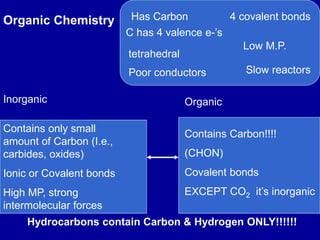
Organic Chemistry
Inorganic Organic
Hydrocarbons contain Carbon & Hydrogen ONLY!!!!!!
C has 4 valence e-’s
4 covalent bonds
tetrahedral
Low M.P.
Slow reactors
Poor conductors
Contains only small
amount of Carbon (I.e.,
carbides, oxides)
Ionic or Covalent bonds
High MP, strong
intermolecular forces
Contains Carbon!!!!
(CHON)
Covalent bonds
EXCEPT CO2 it’s inorganic
Has Carbon
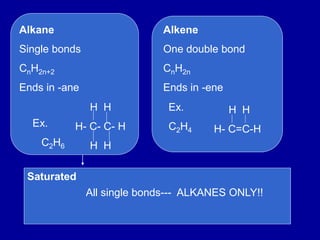
Alkane
Single bonds
CnH2n+2
Ends in -ane
Alkene
One double bond
CnH2n
Ends in -ene
Saturated
All single bonds--- ALKANES ONLY!!
Ex.
C2H6
H H
H- C- C- H
H H
Ex.
C2H4
H H
H- C=C-H
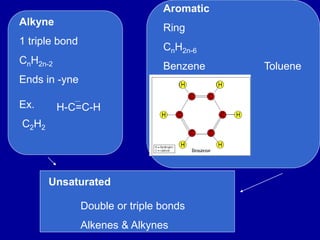
Alkyne
1 triple bond
CnH2n-2
Ends in -yne
Aromatic
Ring
CnH2n-6
Benzene Toluene
Unsaturated
Double or triple bonds
Alkenes & Alkynes
Ex.
C2H2
H-C=C-H
Naming Hydrocarbons
Prefix
1-meth
2-eth
3-prop
4-but
5-pent
6-hex
7-hept
8-oct
9-non
10-dec
Branches
F-fluoro-
Cl-chloro-
Br-bromo-
CH3- methyl
CH3CH2- ethyl
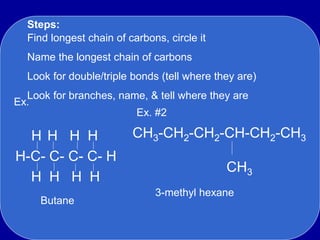
Steps:
Find longest chain of carbons, circle it
Name the longest chain of carbons
Look for double/triple bonds (tell where they are)
Look for branches, name, & tell where they are
Ex.
H H H H
H-C- C- C- C- H
H H H H
Butane
Ex. #2
CH3-CH2-CH2-CH-CH2-CH3
CH3
3-methyl hexane
Characteristics of Hydrocarbons:
Carbon has 4 valence e-’s, so it makes 4 covalent bonds
Can be found in nature
Can be straight chained or branched
Contains only Carbon &
Hydrogen
Soluble in nonpolar solvents
Non electrolytes
Non polar
Low M.P.
Isomers
Same molecular formula
Different structural formula
Count up the atoms, put in different order
C5H12
-C-C-C-C-C-
C5H12
-C-C-C-C-
C
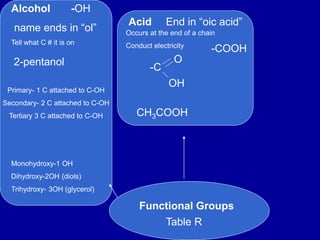
Functional Groups
Primary- 1 C attached to C-OH
Secondary- 2 C attached to C-OH
Tertiary 3 C attached to C-OH
Alcohol -OH
name ends in “ol”
Tell what C # it is on
Monohydroxy-1 OH
Dihydroxy-2OH (diols)
Trihydroxy- 3OH (glycerol)
Acid End in “oic acid”
Occurs at the end of a chain
Conduct electricity
-COOH
-C
O
OH
Table R
CH3COOH
2-pentanol
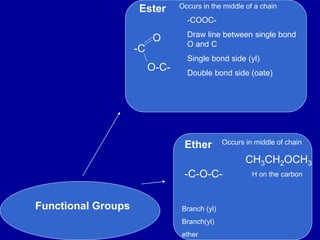
Functional Groups
Ester
Ether
Occurs in the middle of a chain
-COOC-
Draw line between single bond
O and C
Single bond side (yl)
Double bond side (oate)
Occurs in middle of chain
CH3CH2OCH3
H on the carbon
Branch (yl)
Branch(yl)
ether
-C-O-C-
-C
O
O-C-
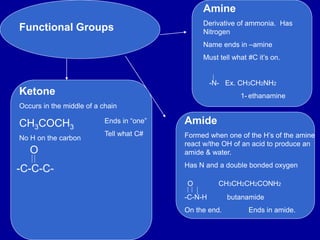
Functional Groups
Amine
Derivative of ammonia. Has
Nitrogen
Name ends in –amine
Must tell what #C it’s on.
-N- Ex. CH3CH2NH2
1- ethanamine
Amide
Formed when one of the H’s of the amine
react w/the OH of an acid to produce an
amide & water.
Has N and a double bonded oxygen
O CH3CH2CH2CONH2
-C-N-H butanamide
On the end. Ends in amide.
Ketone
Occurs in the middle of a chain
CH3COCH3
No H on the carbon
-C-C-C-
O
Ends in “one”
Tell what C#
Functional Groups
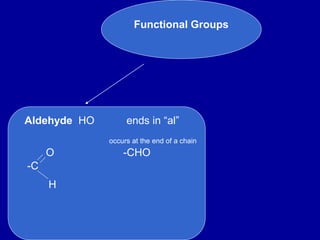
Aldehyde HO ends in “al”
occurs at the end of a chain
-CHO
-C
O
H
Types of
Organic
Reactions
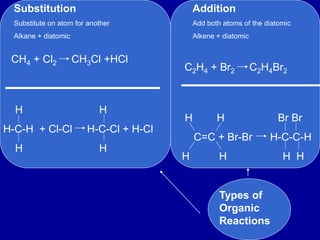
Substitution
Substitute on atom for another
Alkane + diatomic
Addition
Add both atoms of the diatomic
Alkene + diatomic
CH4 + Cl2 CH3Cl +HCl
H H
H-C-H + Cl-Cl H-C-Cl + H-Cl
H H
C2H4 + Br2 C2H4Br2
H H Br Br
C=C + Br-Br H-C-C-H
H H H H
Types of
Organic
Reactions
Fermentation
Enzymatic reaction (zymase)
Glucose ==> ethanol + CO2
Saponification
Fatty acid + strong base==> soap
C6H12O6 ==> C2H5OH + CO2
R-COOH + NaOH ==>
3CH3(CH2)16- C-O-Na+
O
Types of
Organic
Reactions
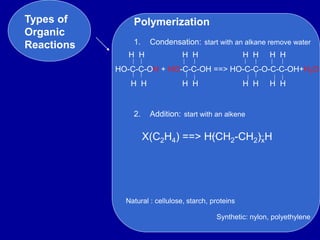
Polymerization
1. Condensation: start with an alkane remove water
2. Addition: start with an alkene
Natural : cellulose, starch, proteins
Synthetic: nylon, polyethylene
X(C2H4) ==> H(CH2-CH2)xH
H H H H H H H H
HO-C-C-OH + HO-C-C-OH ==> HO-C-C-O-C-C-OH+H2O
H H H H H H H H
Types of
Reactions
Esterification
Alcohol + acid ==> ester + water
Combustion
Oxidation or burning
Fractional Distillation
Cracking
CH4 + O2 ==> CO2 +H2O
A controlled process by which hydrocarbons are broken
down or rearranged into smaller, more useful molecules.
A process used to separate liquids with different B.P.’s (which is
boiled to produce a vapor that’s then condensed into a liquid).

Carbon compounds.ppt

  • 1.
  • 2.
    Organic Chemistry Inorganic Organic Hydrocarbonscontain Carbon & Hydrogen ONLY!!!!!! C has 4 valence e-’s 4 covalent bonds tetrahedral Low M.P. Slow reactors Poor conductors Contains only small amount of Carbon (I.e., carbides, oxides) Ionic or Covalent bonds High MP, strong intermolecular forces Contains Carbon!!!! (CHON) Covalent bonds EXCEPT CO2 it’s inorganic Has Carbon
  • 3.
    Alkane Single bonds CnH2n+2 Ends in-ane Alkene One double bond CnH2n Ends in -ene Saturated All single bonds--- ALKANES ONLY!! Ex. C2H6 H H H- C- C- H H H Ex. C2H4 H H H- C=C-H
  • 4.
    Alkyne 1 triple bond CnH2n-2 Endsin -yne Aromatic Ring CnH2n-6 Benzene Toluene Unsaturated Double or triple bonds Alkenes & Alkynes Ex. C2H2 H-C=C-H
  • 5.
  • 6.
    Steps: Find longest chainof carbons, circle it Name the longest chain of carbons Look for double/triple bonds (tell where they are) Look for branches, name, & tell where they are Ex. H H H H H-C- C- C- C- H H H H H Butane Ex. #2 CH3-CH2-CH2-CH-CH2-CH3 CH3 3-methyl hexane
  • 7.
    Characteristics of Hydrocarbons: Carbonhas 4 valence e-’s, so it makes 4 covalent bonds Can be found in nature Can be straight chained or branched Contains only Carbon & Hydrogen Soluble in nonpolar solvents Non electrolytes Non polar Low M.P.
  • 8.
    Isomers Same molecular formula Differentstructural formula Count up the atoms, put in different order C5H12 -C-C-C-C-C- C5H12 -C-C-C-C- C
  • 9.
    Functional Groups Primary- 1C attached to C-OH Secondary- 2 C attached to C-OH Tertiary 3 C attached to C-OH Alcohol -OH name ends in “ol” Tell what C # it is on Monohydroxy-1 OH Dihydroxy-2OH (diols) Trihydroxy- 3OH (glycerol) Acid End in “oic acid” Occurs at the end of a chain Conduct electricity -COOH -C O OH Table R CH3COOH 2-pentanol
  • 10.
    Functional Groups Ester Ether Occurs inthe middle of a chain -COOC- Draw line between single bond O and C Single bond side (yl) Double bond side (oate) Occurs in middle of chain CH3CH2OCH3 H on the carbon Branch (yl) Branch(yl) ether -C-O-C- -C O O-C-
  • 11.
    Functional Groups Amine Derivative ofammonia. Has Nitrogen Name ends in –amine Must tell what #C it’s on. -N- Ex. CH3CH2NH2 1- ethanamine Amide Formed when one of the H’s of the amine react w/the OH of an acid to produce an amide & water. Has N and a double bonded oxygen O CH3CH2CH2CONH2 -C-N-H butanamide On the end. Ends in amide. Ketone Occurs in the middle of a chain CH3COCH3 No H on the carbon -C-C-C- O Ends in “one” Tell what C#
  • 12.
    Functional Groups Aldehyde HOends in “al” occurs at the end of a chain -CHO -C O H
  • 13.
    Types of Organic Reactions Substitution Substitute onatom for another Alkane + diatomic Addition Add both atoms of the diatomic Alkene + diatomic CH4 + Cl2 CH3Cl +HCl H H H-C-H + Cl-Cl H-C-Cl + H-Cl H H C2H4 + Br2 C2H4Br2 H H Br Br C=C + Br-Br H-C-C-H H H H H
  • 14.
    Types of Organic Reactions Fermentation Enzymatic reaction(zymase) Glucose ==> ethanol + CO2 Saponification Fatty acid + strong base==> soap C6H12O6 ==> C2H5OH + CO2 R-COOH + NaOH ==> 3CH3(CH2)16- C-O-Na+ O
  • 15.
    Types of Organic Reactions Polymerization 1. Condensation:start with an alkane remove water 2. Addition: start with an alkene Natural : cellulose, starch, proteins Synthetic: nylon, polyethylene X(C2H4) ==> H(CH2-CH2)xH H H H H H H H H HO-C-C-OH + HO-C-C-OH ==> HO-C-C-O-C-C-OH+H2O H H H H H H H H
  • 16.
    Types of Reactions Esterification Alcohol +acid ==> ester + water Combustion Oxidation or burning Fractional Distillation Cracking CH4 + O2 ==> CO2 +H2O A controlled process by which hydrocarbons are broken down or rearranged into smaller, more useful molecules. A process used to separate liquids with different B.P.’s (which is boiled to produce a vapor that’s then condensed into a liquid).