Biomedical Signal processing
Chapter 9 Computation of the Discrete
             Fourier Transform
                      Zhongguo Liu
                  Biomedical Engineering
    School of Control Science and Engineering, Shandong
                         University


 02/19/13              1
                       1      Zhongguo Liu_Biomedical Engineering_Shandong Univ
Chapter 9 Computation of the
     Discrete Fourier Transform
9.0 Introduction
9.1 Efficient Computation of Discrete Fourier Transform
9.2 The Goertzel Algorithm
9.3 decimation-in-time FFT Algorithms
9.4 decimation-in-frequency FFT Algorithms
9.5 practical considerations ( software realization)

2
9.0 Introduction
Implement a convolution of two sequences
 by the following procedure:
1. Compute the N-point DFT X 1 [ k ] and X 2 [ k ]
 of the two sequence x1 [ n] and x2 [ n]
2. Compute X 3 [ k ] = X 1 [ k ] X 2 [ k ]for   0 ≤ k ≤ N −1
3. Compute x3 [ n] = x1 [ n] N x2 [ n] the inverse
                                     as
 DFT of X 3 [ k ]
Why not convolve the two sequences directly?

There are efficient algorithms called Fast
  Fourier Transform (FFT) that can be orders of
3 magnitude more efficient than others.
9.1 Efficient Computation of Discrete
                Fourier Transform
    The DFT pair was given as
            N −1
                        − j ( 2π / N ) kn          1   N −1
                                                                    j ( 2π / N ) kn
    X [ k ] = ∑ x[n]e                       x[n] =     ∑ X [ k] e
            n =0
                                                   N   k =0

    Baseline for computational complexity:
     Each DFT coefficient requires
        N complex multiplications;
        N-1 complex additions
     All N DFT coefficients require
        N2 complex multiplications;
        N(N-1) complex additions
4                                                                                 4
9.1 Efficient Computation of Discrete
              Fourier Transform
             N −1
                         − j ( 2π / N ) kn
     X [ k ] = ∑ x[n]e
             n =0


Complexity in terms of real operations
    4N2 real multiplications
    2N(N-1) real additions (approximate 2N2)

5                                               5
9.1 Efficient Computation of
                    Discrete Fourier Transform
Most fast methods are based on Periodicity
 properties
  ( Periodicity in n−and /k;) Conjugate )symmetry( 2π / N ) kn
  − j 2π / N ) k ( N − n ) j ( 2π N kN − j ( 2π / N k ( − n ) j
    e                           =e                      e                       =e
            − j ( 2π / N ) kn        − j ( 2π / N ) k ( n + N )        j ( 2π / N ) ( k + N ) n
        e                       =e                                =e
Re {            }                                                                             ]


6                                                                                                 6
9.2 The Goertzel Algorithm
 Makes use of the periodicity j ( 2π / N ) Nk
                              e                = e j 2π k = 1
 Multiply DFT equation with this factor
              j ( 2π / N ) kN
                                N −1
                                               − j ( 2π / N ) rk     N −1
                                                                                     j ( 2π / N ) k ( N −r )
 X [ k] = e                     ∑ x[r ]e                           = ∑ x[r ]e
                                r =0                                 r =0
                                        ∞
                                                       j ( 2π / N ) k ( n −r )
 Define            yk [ n ] =         ∑ x[r ]e                                  u[ n − r]
                                       r =−∞
 using x[n]=0 for n<0 and n>N-1
                            X [ k ] = yk [ n ] n = N
X[k] can be viewed as the output of a filter to the input x[n]
  Impulse response of filter:                 j ( 2π / N ) kn
                                      h[n] = e                 u [ n]
  X[k] is the output of the filter at time n=N
7                                                                                                        7
9.2 The Goertzel Algorithm
Goertzel          j ( 2π / N ) kn
          h[n] = e                 u[n] = W − knu[n]
    Filter:                                  N


                        1
        Hk ( z ) =
                   1 − WN k z −1
                         −


                        −
    yk [n] = yk [n − 1]WN k + x[n], n = 0,1,..., N ,       yk [−1] = 0

 X [ k ] = yk [ n ] n = N , k = 0,1,..., N
                                                         N −1
                                                 X [ k ] = ∑ x[n]WN
                                                                  kn

                                                         n =0
Computational complexity
  4N real multiplications; 4N real additions
  Slightly less efficient than the direct method
     But it avoids computation and storage of kn
                                             WN
8                                                                   8
Second Order Goertzel Filter
  Goertzel Filter
                            1
    Hk ( z ) =              2π
                        j      k −1
                 1− e       N z

Multiply both numerator and denominator
                                − j 2π k                 −j
                                                              2π
                                                                 k
                    1− e            N
                                           z −1        1− e   N
                                                                   z −1
Hk ( z ) =                                      =
                   2π
                         −1 
                                  − j k −1 
                                     2π                    2π k −1 −2
             1 − e N z ÷ 1 − e N z ÷ 1 − 2 cos N z + z
                  j    k
           
                                         
                                2π k
   y[n] = − y[n − 2] + 2 cos          y[n − 1] + x[n], n = 0,1,..., N
                                 N
     yk [ N ] = y[ N ] − WNk y[ N − 1] = X [ k ] , k = 0,1, ..., N
 9                                                                   9
Second Order Goertzel Filter
                              2π k
 y[n] = − y[n − 2] + 2 cos         y[n − 1] + x[n], n = 0,1,..., N
                               N
  yk [ N ] = y[ N ] − WNk y[ N − 1] = X [ k ] , k = 0,1, ..., N
 Complexity for one DFT coefficient ( x(n) is complex
   sequence).
    Poles: 2N real multiplications and 4N real additions
    Zeros: Need to be implement only once:
      4 real multiplications and 4 real additions
 Complexity for all DFT coefficients
    Each pole is used for two DFT coefficients
    Approximately N2 real multiplications and 2N2 real
     additions
10                                                    10
Second Order Goertzel Filter

                            2π k
  y[n] = − y[n − 2] + 2 cos      y[n − 1] + x[n], n = 0,1,..., N
                             N

  yk [ N ] = y[ N ] − WNk y[ N − 1]   = X [ k ] , k = 0,1, ..., N


If do not need to evaluate all N DFT coefficients
 Goertzel Algorithm is more efficient than FFT
    if
 less than M DFT coefficients are needed,M <
    log2N
 11                                                                 11
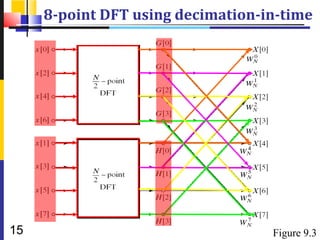
9.3 decimation-in-time FFT Algorithms

 Makes use of both periodicity and symmetry
 Consider special case of N an integer power of
  2
 Separate x[n] into two sequence of length N/2
   Even indexed samples in the first sequence
   Odd indexed samples in the other sequence
           N −1
                                 − j ( 2π / N ) kn
     X [ k ] = ∑ x[n]e
                  n =0

                         − j ( 2π / N ) kn                 − j ( 2π / N ) kn
     =   ∑ x[n]e
         n even
                                             +   ∑ x[n]e
                                                 n odd
12                                                                        12
9.3 decimation-in-time FFT Algorithms
                                  − j ( 2π / N ) kn                             − j ( 2π / N ) kn
  X [ k] =         ∑ x[n]e                                 +   ∑ x[n]e
                n even                                         n odd
 Substitute variables n=2r for n even and n=2r+1 for odd

             N / 2 −1                      N / 2 −1
 X [ k] =     ∑         x[2r ]W 2 rk
                                N      +    ∑ x[2r + 1]W               ( 2 r +1) k
                                                                       N
              r =0                          r =0
           N /2 −1                             N /2 −1
       =    ∑
            r =0
                     x[2r ]WN /2 + WN
                            rk      k
                                                ∑
                                                r =0
                                                          x[2r + 1]WN / 2
                                                                    rk


       = G[ k] +W H [ k]   k                                − j 2π 2            − j 2π
                           N                   W      2
                                                      N   =e N             =   e N /2    = WN /2
G[k] and H[k] are the N/2-point DFT’s of each subsequence

13                                                                                           13
9.3 decimation-in-time FFT Algorithms
               N /2 −1                        N /2 −1
   X [ k] =     ∑ x[2r ]W       rk
                                N /2   +W k
                                          N    ∑ x[2r + 1]W        rk
                                                                   N /2
                r =0                           r =0


          = G[ k] +W H [ k]k
                                               − j 2π 2 rk      − j 2π rk
                           N
                                              e N            = e N /2       = WNrk/2
                       N −1
          k = 0,1,...,                            k = 0,1,..., N
                        2
             N                               N
       G k +  = G [ k ]                 H k +  = H [ k ]
              2                              2
G[k] and H[k] are the N/2-point DFT’s of each subsequence

 14                                                                            14
8-point DFT using decimation-in-time


15                                 Figure 9.3
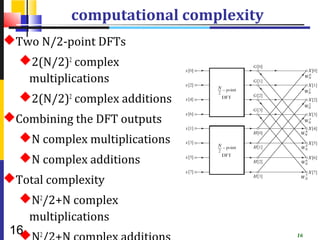
computational complexity
Two N/2-point DFTs
  2(N/2)2 complex
   multiplications
  2(N/2)2 complex additions
Combining the DFT outputs
  N complex multiplications
  N complex additions
Total complexity
  N2/2+N complex
   multiplications
 16 2
                                     16
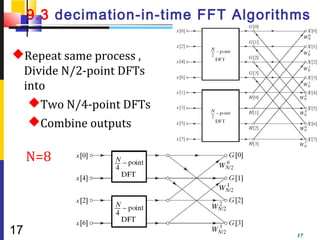
9.3 decimation-in-time FFT Algorithms

Repeat same process ,
 Divide N/2-point DFTs
 into
  Two N/4-point DFTs
     Combine outputs

     N=8


17                                      17
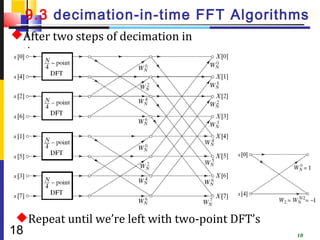
9.3 decimation-in-time FFT Algorithms
After two steps of decimation in
 time


 Repeat until we’re left with two-point DFT’s
18                                               18
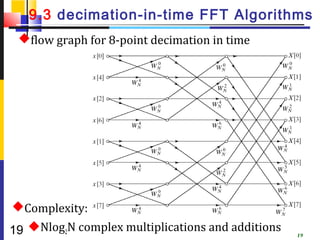
9.3 decimation-in-time FFT Algorithms
 flow graph for 8-point decimation in time


Complexity:
19 Nlog2N complex multiplications and additions   19
Butterfly Computation

    Flow graph constitutes of butterflies


We can implement each butterfly with one multiplication


Final complexity for decimation-in-time FFT
  (N/2)log2N complex multiplications and additions
 20                                                        20
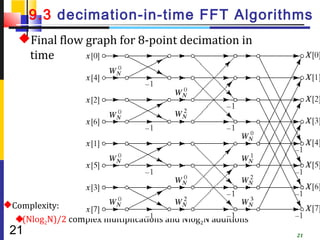
9.3 decimation-in-time FFT Algorithms
   Final flow graph for 8-point decimation in
    time


Complexity:
  (Nlog2N)/2 complex multiplications and Nlog2N additions
 21                                                          21
9.3.1 In-Place Computation 同址运
                        算
Decimation-in-time flow graphs require two sets of
 registers
    Input and output for each stage


    X 0 [ 0] = x [ 0]    x [ 0]   X 2 [ 0]   X [ 0]
    X 0 [ 1] = x [ 4]    x [ 4]   X 2 [ 1]   X [ 1]
    X 0 [ 2] = x [ 2]    x [ 2]   X 2 [ 2]   X [ 2]
    X 0 [ 3] = x [ 6]    x [ 6]   X 2 [ 3]   X [ 3]
    X 0 [ 4] = x [ 1]    x [ 1]   X 2 [ 4]   X [ 4]
    X 0 [ 5] = x [ 5 ]   x [ 5]   X 2 [ 5]   X [ 5]
    X 0 [ 6] = x [ 3]    x [ 3]   X 2 [ 6]   X [ 6]
 22X 0 [ 7] = x [ 7]     x [ 7]   X 2 [ 7]   X [ 7]   22
9.3.1 In-Place Computation 同址运 算

Note the arrangement of the input indices
    Bit reversed indexing (码位倒置)

 X 0 [ 0] = x [ 0] ↔ X 0 [ 000] = x [ 000] x [ 0]            X [ 0]
 X 0 [ 1] = x [ 4] ↔ X 0 [ 001] = x [ 100]     x [ 4]        X [ 1]
 X 0 [ 2] = x [ 2] ↔ X 0 [ 010] = x [ 010] x [ 2]            X [ 2]
 X 0 [ 3] = x [ 6] ↔ X 0 [ 011] = x [ 110]     x [ 6]        X [ 3]
 X 0 [ 4] = x [ 1] ↔ X 0 [ 100] = x [ 001]     x [ 1]        X [ 4]
 X 0 [ 5] = x [ 5] ↔ X 0 [ 101] = x [ 101]     x [ 5]        X [ 5]
 X 0 [ 6] = x [ 3] ↔ X 0 [ 110] = x [ 011]     x [ 3]        X [ 6]
 X 0 [ 7 ] = x [ 7 ] ↔ X 0 [ 111] = x [ 111]   x [ 7]        X [ 7]
 23                                                     23
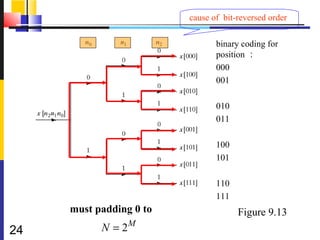
cause of bit-reversed order

                                binary coding for
                                position :
                                000
                                001

                                010
                                011

                                100
                                101

                                110
                                111
     must padding 0 to                Figure 9.13
24         N = 2M
9.3.2 Alternative forms
Note the arrangement of the input indices
    Bit reversed indexing (码位倒置)

 X 0 [ 0] = x [ 0] ↔ X 0 [ 000] = x [ 000] x [ 0]            X [ 0]
 X 0 [ 1] = x [ 4] ↔ X 0 [ 001] = x [ 100]     x [ 4]        X [ 1]
 X 0 [ 2] = x [ 2] ↔ X 0 [ 010] = x [ 010] x [ 2]            X [ 2]
 X 0 [ 3] = x [ 6] ↔ X 0 [ 011] = x [ 110]     x [ 6]        X [ 3]
 X 0 [ 4] = x [ 1] ↔ X 0 [ 100] = x [ 001]     x [ 1]        X [ 4]
 X 0 [ 5] = x [ 5] ↔ X 0 [ 101] = x [ 101]     x [ 5]        X [ 5]
 X 0 [ 6] = x [ 3] ↔ X 0 [ 110] = x [ 011]     x [ 3]        X [ 6]
 X 0 [ 7 ] = x [ 7 ] ↔ X 0 [ 111] = x [ 111]   x [ 7]        X [ 7]
 25                                                     25
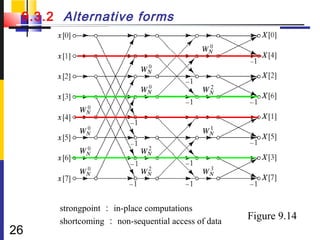
9.3.2 Alternative forms


      strongpoint : in-place computations
      shortcoming : non-sequential access of data
                                                    Figure 9.14
26
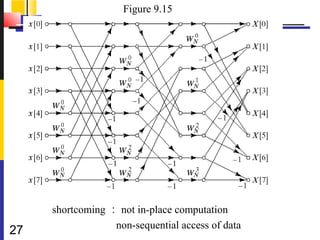
Figure 9.15


     shortcoming : not in-place computation
                  non-sequential access of data
27
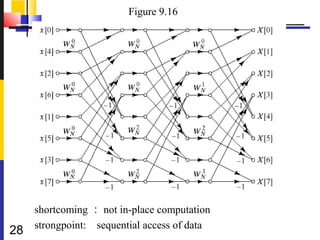
Figure 9.16


     shortcoming : not in-place computation
     strongpoint: sequential access of data
28
9.3 decimation-in-time FFT Algorithms
                                  − j ( 2π / N ) kn                             − j ( 2π / N ) kn
  X [ k] =         ∑ x[n]e                                 +   ∑ x[n]e
                n even                                         n odd
 Substitute variables n=2r for n even and n=2r+1 for odd

             N / 2 −1                      N / 2 −1
 X [ k] =     ∑         x[2r ]W 2 rk
                                N      +    ∑ x[2r + 1]W               ( 2 r +1) k
                                                                       N
              r =0                          r =0
                                                                                     Review
           N /2 −1                             N /2 −1
       =    ∑
            r =0
                     x[2r ]WN /2 + WN
                            rk      k
                                                ∑
                                                r =0
                                                          x[2r + 1]WN / 2
                                                                    rk


       = G[ k] +W H [ k]   k                                − j 2π 2            − j 2π
                           N                   W      2
                                                      N   =e N             =   e N /2    = WN /2
G[k] and H[k] are the N/2-point DFT’s of each subsequence

29                                                                                           29
9.3.1 In-Place Computation 同址运 算
     Bit reversed indexing (码位倒置)
X 0 [ 000] = x [ 000] x [ 0]              X [ 0]
X 0 [ 001] = x [ 100] x [ 4]              X [ 1]
X 0 [ 010] = x [ 010] x [ 2]              X [ 2]
X 0 [ 011] = x [ 110] x [ 6]              X [ 3]
X 0 [ 100] = x [ 001] x [ 1]              X [ 4]
X 0 [ 101] = x [ 101]   x [ 5]            X [ 5]
X 0 [ 110] = x [ 011] x [ 3]              X [ 6]
X 0 [ 111] = x [ 111]   x [ 7]            X [ 7]

  30                                       30
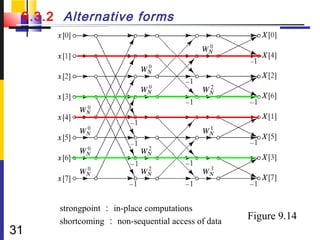
9.3.2 Alternative forms


      strongpoint : in-place computations
      shortcoming : non-sequential access of data
                                                    Figure 9.14
31
9.4 Decimation-In-Frequency FFT Algorithm
                                                        N −1
   The DFT equation                     X [ k ] = ∑ x[n]WN
                                                          nk

                                                        n =0
   Split the DFT equation into even and odd frequency indexes

               N −1                        N / 2 −1                   N −1
      X [ 2r ] = ∑ x[n]WN 2 r =
                        n
                                            ∑         x[n]WN 2 r +
                                                           n
                                                                      ∑         x[n]WN 2 r
                                                                                     n

               n =0                         n =0                     n= N / 2
                          N /2 −1                      N / 2 −1
Substitute
 variables
                  =        ∑ x[n]W
                          n =0
                                           n2r
                                           N       +    ∑ x[n + N / 2]W
                                                        n =0
                                                                                  ( n + N /2 ) 2 r
                                                                                  N

                          N / 2 −1
                      =    ∑ ( x[n] + x[n + N / 2]) W
                           n =0
                                                                      nr
                                                                      N /2

                          N /2 −1
                      =    ∑               rn
                                     g (n)WN / 2
 32                         n =0
                                                                                              32
9.4 Decimation-In-Frequency FFT Algorithm
                                                             N −1
  The DFT equation                          X [ k ] = ∑ x[n]WN
                                                              nk

                                                               n =0
                  N −1                           N /2 −1                                  N −1
X [ 2r + 1] = ∑ x[n]W           n (2 r +1)
                                N            =   ∑         x[n]W       n (2 r +1)
                                                                       N            +     ∑        x[n]W     n (2 r +1)
                                                                                                             N
                  n=0                               n=0                                 n = N /2
      N /2 −1                             N /2 −1
  =    ∑
       n =0
                 x[n]W   n (2 r +1)
                         N            +      ∑ x[n + N / 2]W
                                             n =0
                                                                                    N
                                                                                        ( n + N / 2 ) (2 r +1)

      N /2 −1
  =    ∑ ( x[n] − x[n + N / 2]) W
       n =0
                                                           n (2 r +1)
                                                           N

      N / 2 −1                                                                N /2 −1
  =    ∑ ( x[n] − x[n + N / 2]) W W                        n
                                                           N
                                                                  rn
                                                                  N /2
                                                                          =    ∑n =0
                                                                                          h(n)WN WNn2
                                                                                               n  r
                                                                                                    /
       n =0
                                                                       N
  n ( 2 r +1)                                                            (2 r +1)
W N              =W W =W W
                     2 rn
                     N
                            n
                            N
                                          rn
                                          N /2
                                                     n
                                                     N          W      2
                                                                                    = WNNrWNN / 2 = −1
33                                                                    N
                                                                                                                 33
decimation-in-frequency decomposition of an N-
            point DFT to N/2-point DFT


             N /2 −1                                      N /2 −1
X [ 2r ] =    ∑        ( x[n] + x[n + N / 2]) WN /2=
                                               nr
                                                           ∑              rn
                                                                    g (n)WN /2
              n = 0 /2 −1
                  N                                      n =0       N /2 −1
X [ 2r + 1] =
 34               ∑
                  n =0
                            ( x[n] − x[n + N / 2]) WN W
                                                    n  rn
                                                       N /2
                                                              =      ∑
                                                                     n =0
                                                                              h(n)WN WNn2
                                                                                   n  r

                                                                                     34
                                                                                        /
decimation-in-frequency decomposition of an 8-
            point DFT to four 2-point DFT


                 N / 4 −1                                          N / 4 −1
X [ 2* 2 s ] =    ∑         [ g (n) + g (n + N / 4)]WNsn =
                                                       /4           ∑          p(n)WNsn
                                                                                      /4
                  n =0                                              n =0
                      N / 4 −1                                         N /4 −1
X [ 2*(2 s + 1) ] =      ∑       [ g (n) − g (n + N / 4)]W W
                                                       2n   sn
                                                                   =    ∑        q ( n)WN nWNn
                                                                                        2   s
 35                      n =0
                                                       N    N /4
                                                                        n =0              35
                                                                                              /4
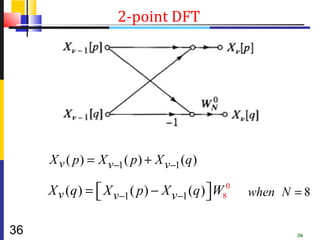
2-point DFT


     X v ( p ) = X v−1 ( p ) + X v −1 (q )

     X v (q ) =  X v −1 ( p ) − X v−1 (q )  W80
                                                  when N = 8

36                                                         36
N /2 −1                                                  N /2 −1
X [ 2r ] =    ∑ ( x[n] + x[n + N / 2])                 nr
                                                      WN /2       =    ∑              rn
                                                                                g (n)WN /2
              n =0                                                     n =0


                          N /4 −1                      N /2 −1
      X [ 2* 2 s ] =       ∑        g (n)WN /2 +
                                          2 sn
                                                        ∑               2 sn
                                                                  g (n)WN /2
                           n =0                        n = N /4
          N /4 −1                     N /4 −1
      =    ∑
           n =0
                    g (n)WN /2 +
                          2 sn
                                       ∑
                                       n =0
                                                g (n + N / 4)WN /2( n + N /4)
                                                              2s


          N /4 −1                     N /4 −1
      =    ∑ g (n)W
           n =0
                            sn
                           N /4   +    ∑ g (n + N / 4)W
                                       n =0
                                                                        sn
                                                                       N /4

          N /4 −1                                                     N /4 −1
      =    ∑ [ g (n) + g (n + N / 4)]W                  sn
                                                        N /4
                                                                  =    ∑
                                                                       n =0
                                                                                p(n)WNsn
                                                                                       /4
           n =0


 37
N /2 −1                                                 N /2 −1
X [ 2r ] =       ∑ ( x[n] + x[n + N / 2])                nr
                                                        WN /2       =    ∑              rn
                                                                                  g (n)WN /2
                 n =0                                                    n =0
                           N /2 −1
  X [ 2*(2 s + 1) ] =       ∑        g (n)WN /2 +1) n
                                           (2 s

                            n =0
     N /4 −1                         N /2 −1
 =    ∑
      n =0
               g (n)WN /2+1) n +
                     (2 s
                                      ∑
                                   n= N / 4
                                               g (n)WN /2 +1) n
                                                     (2 s


     N /4 −1                           N /4 −1
 =    ∑
      n =0
               g (n)WNsn WN /2 +
                       /4
                          n
                                        ∑
                                        n =0
                                                 g (n + N / 4)WN /2+1)( n + N /4)
                                                               (2 s


     N /4 −1                          N /4 −1
 =    ∑
      n =0
               g (n)WNsn WN n +
                       /4
                          2
                                       ∑
                                       n =0
                                                g (n + N / 4)WNsn WN nWN / 2+1) N /4
                                                                /4
                                                                   2   (2 s


     N /4 −1                                                        N /4 −1

 =    ∑ [ g (n) − g (n + N / 4)]W                  2n
                                                   N W   sn
                                                         N /4
                                                                =    ∑
                                                                     n =0
                                                                              q (n)WN nWNsn
                                                                                    2
                                                                                          /4
      n =0
 38                                                     WN /2 +1) N /4 = WNsN /2WNN/2 = −1
                                                         (2 s
                                                                            /2
                                                                                    /4
N /4 −1
     X [ 2* 2 s ] =         ∑        p (n)WNsn
                                             /4
                            n =0

                                   N /4 −1
     X [ 2* 2* 2t ] =               ∑        p (n)W     2 tn
                                                        N /4
                                    n =0
         N /8 −1                           N /4 −1
     =    ∑
          n =0
                   p (n)W    2 tn
                             N /4    +      ∑
                                         n = N /8
                                                     p (n)W    2 tn
                                                               N /4


         N /8 −1                         N /8 −1
     =   ∑n =0
                   p (n)W   2 tn
                            N /4     +     ∑
                                           n =0
                                                     p(n + N / 8)W    2 t ( n + N /8)
                                                                      N /4


             N /8 −1
         =    ∑  n =0
                        [ p(n) + p (n + N / 8)]WN /8
                                                tn


                  = p(n) + p (n + 1)                           when N = 8
39
N /4 −1
        X [ 2* 2 s ] =      ∑        p (n)WNsn
                                             /4
                            n =0
                                      N /4 −1
    X [ 2* 2*(2t + 1) ] =              ∑         p(n)WN /4+1) n
                                                      (2 t

                                       n =0
        N /8 −1                         N /4 −1
    =    ∑n =0
                  p (n)WN /4+1) n +
                        (2 t
                                         ∑
                                       n = N /8
                                                  p (n)WN / 4+1) n
                                                        (2 t


        N /8 −1                        N /8 −1
 =      ∑n =0
                  p (n)WN /4+1) n +
                        (2 t
                                        ∑
                                        n =0
                                                 p (n + N / 8)WN /4+1)( n + N /8)
                                                               (2 t


        N /8 −1                           N /8−1
    =    ∑
        n =0
                  p (n)WN /4WN /4 +
                        2 tn n
                                              ∑
                                              n =0
                                                     p (n + N / 8)WN /4WN /4WN /4+1) N /8
                                                                   2 tn n    (2 t


    N /8 −1
=   ∑       [ p(n) − p(n + N / 8)]WN /8WN n
                                   tn   4

     n =0                                                    WN(2/4+1) N /8 = WNtN /4WNN/4 = − 1
                                                                  t
                                                                                 /4
                                                                                         /8


= [ p (n) − p (n + 1)]W80 when N = 8
40
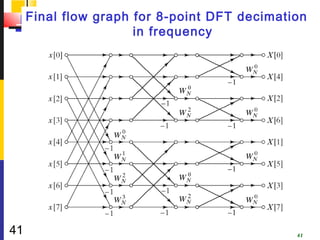
Final flow graph for 8-point DFT decimation
                      in frequency


41                                            41
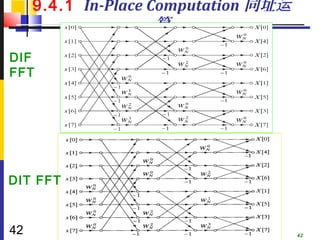
9.4.1 In-Place Computation 同址运
                     算
DIF
FFT


DIT FFT


42                                    42
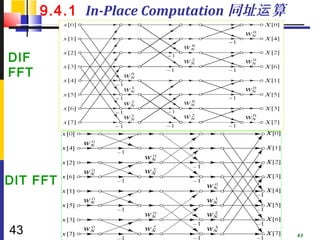
9.4.1 In-Place Computation 同址运 算


DIF
FFT


DIT FFT


43                                       43
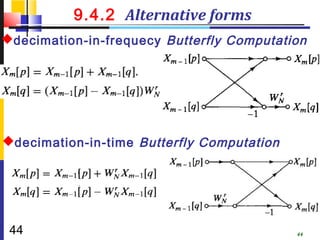
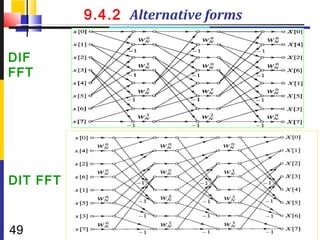
9.4.2 Alternative forms
decimation-in-frequecy Butterfly Computation


decimation-in-time Butterfly Computation


 44                                         44
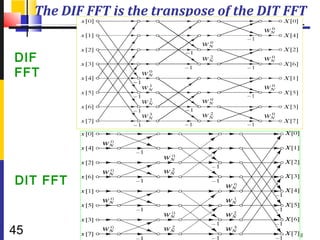
The DIF FFT is the transpose of the DIT FFT


DIF
FFT


DIT FFT


45                                            45
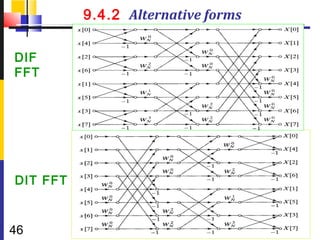
9.4.2 Alternative forms

DIF
FFT


DIT FFT


46
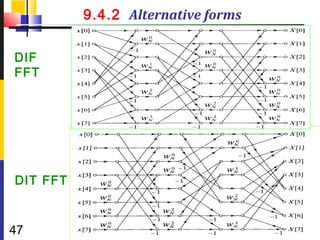
9.4.2 Alternative forms

DIF
FFT


DIT FFT


47
Figure 9.24 erratum
                           x [ 0]
                           x [ 4]
                           x [ 2]
                           x [ 6]
                           x [ 1]
                           x [ 5]
                           x [ 3]
                           x [ 7]
48
9.4.2 Alternative forms

DIF
FFT


DIT FFT


49
Chapter 9 HW
          9.1, 9.2, 9.3,


50
 50   返   回02/19/13   上一页
                              Zhongguo Liu_Biomedical Engineering_Shandong
                            下一页                  Univ.

Chapter 9 computation of the dft

  • 1.
    Biomedical Signal processing Chapter9 Computation of the Discrete Fourier Transform Zhongguo Liu Biomedical Engineering School of Control Science and Engineering, Shandong University 02/19/13 1 1 Zhongguo Liu_Biomedical Engineering_Shandong Univ
  • 2.
    Chapter 9 Computationof the Discrete Fourier Transform 9.0 Introduction 9.1 Efficient Computation of Discrete Fourier Transform 9.2 The Goertzel Algorithm 9.3 decimation-in-time FFT Algorithms 9.4 decimation-in-frequency FFT Algorithms 9.5 practical considerations ( software realization) 2
  • 3.
    9.0 Introduction Implement aconvolution of two sequences by the following procedure: 1. Compute the N-point DFT X 1 [ k ] and X 2 [ k ] of the two sequence x1 [ n] and x2 [ n] 2. Compute X 3 [ k ] = X 1 [ k ] X 2 [ k ]for 0 ≤ k ≤ N −1 3. Compute x3 [ n] = x1 [ n] N x2 [ n] the inverse as DFT of X 3 [ k ] Why not convolve the two sequences directly? There are efficient algorithms called Fast Fourier Transform (FFT) that can be orders of 3 magnitude more efficient than others.
  • 4.
    9.1 Efficient Computationof Discrete Fourier Transform The DFT pair was given as N −1 − j ( 2π / N ) kn 1 N −1 j ( 2π / N ) kn X [ k ] = ∑ x[n]e x[n] = ∑ X [ k] e n =0 N k =0 Baseline for computational complexity: Each DFT coefficient requires N complex multiplications; N-1 complex additions All N DFT coefficients require N2 complex multiplications; N(N-1) complex additions 4 4
  • 5.
    9.1 Efficient Computationof Discrete Fourier Transform N −1 − j ( 2π / N ) kn X [ k ] = ∑ x[n]e n =0 Complexity in terms of real operations 4N2 real multiplications 2N(N-1) real additions (approximate 2N2) 5 5
  • 6.
    9.1 Efficient Computationof Discrete Fourier Transform Most fast methods are based on Periodicity properties ( Periodicity in n−and /k;) Conjugate )symmetry( 2π / N ) kn − j 2π / N ) k ( N − n ) j ( 2π N kN − j ( 2π / N k ( − n ) j e =e e =e − j ( 2π / N ) kn − j ( 2π / N ) k ( n + N ) j ( 2π / N ) ( k + N ) n e =e =e Re { } ] 6 6
  • 7.
    9.2 The GoertzelAlgorithm Makes use of the periodicity j ( 2π / N ) Nk e = e j 2π k = 1 Multiply DFT equation with this factor j ( 2π / N ) kN N −1 − j ( 2π / N ) rk N −1 j ( 2π / N ) k ( N −r ) X [ k] = e ∑ x[r ]e = ∑ x[r ]e r =0 r =0 ∞ j ( 2π / N ) k ( n −r ) Define yk [ n ] = ∑ x[r ]e u[ n − r] r =−∞ using x[n]=0 for n<0 and n>N-1 X [ k ] = yk [ n ] n = N X[k] can be viewed as the output of a filter to the input x[n] Impulse response of filter: j ( 2π / N ) kn h[n] = e u [ n] X[k] is the output of the filter at time n=N 7 7
  • 8.
    9.2 The GoertzelAlgorithm Goertzel j ( 2π / N ) kn h[n] = e u[n] = W − knu[n] Filter: N 1 Hk ( z ) = 1 − WN k z −1 − − yk [n] = yk [n − 1]WN k + x[n], n = 0,1,..., N , yk [−1] = 0 X [ k ] = yk [ n ] n = N , k = 0,1,..., N N −1 X [ k ] = ∑ x[n]WN kn n =0 Computational complexity 4N real multiplications; 4N real additions Slightly less efficient than the direct method But it avoids computation and storage of kn WN 8 8
  • 9.
    Second Order GoertzelFilter Goertzel Filter 1 Hk ( z ) = 2π j k −1 1− e N z Multiply both numerator and denominator − j 2π k −j 2π k 1− e N z −1 1− e N z −1 Hk ( z ) = =  2π −1  − j k −1  2π 2π k −1 −2 1 − e N z ÷ 1 − e N z ÷ 1 − 2 cos N z + z j k     2π k y[n] = − y[n − 2] + 2 cos y[n − 1] + x[n], n = 0,1,..., N N yk [ N ] = y[ N ] − WNk y[ N − 1] = X [ k ] , k = 0,1, ..., N 9 9
  • 10.
    Second Order GoertzelFilter 2π k y[n] = − y[n − 2] + 2 cos y[n − 1] + x[n], n = 0,1,..., N N yk [ N ] = y[ N ] − WNk y[ N − 1] = X [ k ] , k = 0,1, ..., N Complexity for one DFT coefficient ( x(n) is complex sequence). Poles: 2N real multiplications and 4N real additions Zeros: Need to be implement only once: 4 real multiplications and 4 real additions Complexity for all DFT coefficients Each pole is used for two DFT coefficients Approximately N2 real multiplications and 2N2 real additions 10 10
  • 11.
    Second Order GoertzelFilter 2π k y[n] = − y[n − 2] + 2 cos y[n − 1] + x[n], n = 0,1,..., N N yk [ N ] = y[ N ] − WNk y[ N − 1] = X [ k ] , k = 0,1, ..., N If do not need to evaluate all N DFT coefficients Goertzel Algorithm is more efficient than FFT if less than M DFT coefficients are needed,M < log2N 11 11
  • 12.
    9.3 decimation-in-time FFTAlgorithms Makes use of both periodicity and symmetry Consider special case of N an integer power of 2 Separate x[n] into two sequence of length N/2 Even indexed samples in the first sequence Odd indexed samples in the other sequence N −1 − j ( 2π / N ) kn X [ k ] = ∑ x[n]e n =0 − j ( 2π / N ) kn − j ( 2π / N ) kn = ∑ x[n]e n even + ∑ x[n]e n odd 12 12
  • 13.
    9.3 decimation-in-time FFTAlgorithms − j ( 2π / N ) kn − j ( 2π / N ) kn X [ k] = ∑ x[n]e + ∑ x[n]e n even n odd Substitute variables n=2r for n even and n=2r+1 for odd N / 2 −1 N / 2 −1 X [ k] = ∑ x[2r ]W 2 rk N + ∑ x[2r + 1]W ( 2 r +1) k N r =0 r =0 N /2 −1 N /2 −1 = ∑ r =0 x[2r ]WN /2 + WN rk k ∑ r =0 x[2r + 1]WN / 2 rk = G[ k] +W H [ k] k − j 2π 2 − j 2π N W 2 N =e N = e N /2 = WN /2 G[k] and H[k] are the N/2-point DFT’s of each subsequence 13 13
  • 14.
    9.3 decimation-in-time FFTAlgorithms N /2 −1 N /2 −1 X [ k] = ∑ x[2r ]W rk N /2 +W k N ∑ x[2r + 1]W rk N /2 r =0 r =0 = G[ k] +W H [ k]k − j 2π 2 rk − j 2π rk N e N = e N /2 = WNrk/2 N −1 k = 0,1,..., k = 0,1,..., N 2  N  N G k +  = G [ k ] H k +  = H [ k ]  2  2 G[k] and H[k] are the N/2-point DFT’s of each subsequence 14 14
  • 15.
    8-point DFT usingdecimation-in-time 15 Figure 9.3
  • 16.
    computational complexity Two N/2-pointDFTs 2(N/2)2 complex multiplications 2(N/2)2 complex additions Combining the DFT outputs N complex multiplications N complex additions Total complexity N2/2+N complex multiplications 16 2  16
  • 17.
    9.3 decimation-in-time FFTAlgorithms Repeat same process , Divide N/2-point DFTs into Two N/4-point DFTs Combine outputs N=8 17 17
  • 18.
    9.3 decimation-in-time FFTAlgorithms After two steps of decimation in time Repeat until we’re left with two-point DFT’s 18 18
  • 19.
    9.3 decimation-in-time FFTAlgorithms flow graph for 8-point decimation in time Complexity: 19 Nlog2N complex multiplications and additions 19
  • 20.
    Butterfly Computation Flow graph constitutes of butterflies We can implement each butterfly with one multiplication Final complexity for decimation-in-time FFT (N/2)log2N complex multiplications and additions 20 20
  • 21.
    9.3 decimation-in-time FFTAlgorithms Final flow graph for 8-point decimation in time Complexity: (Nlog2N)/2 complex multiplications and Nlog2N additions 21 21
  • 22.
    9.3.1 In-Place Computation同址运 算 Decimation-in-time flow graphs require two sets of registers Input and output for each stage X 0 [ 0] = x [ 0] x [ 0] X 2 [ 0] X [ 0] X 0 [ 1] = x [ 4] x [ 4] X 2 [ 1] X [ 1] X 0 [ 2] = x [ 2] x [ 2] X 2 [ 2] X [ 2] X 0 [ 3] = x [ 6] x [ 6] X 2 [ 3] X [ 3] X 0 [ 4] = x [ 1] x [ 1] X 2 [ 4] X [ 4] X 0 [ 5] = x [ 5 ] x [ 5] X 2 [ 5] X [ 5] X 0 [ 6] = x [ 3] x [ 3] X 2 [ 6] X [ 6] 22X 0 [ 7] = x [ 7] x [ 7] X 2 [ 7] X [ 7] 22
  • 23.
    9.3.1 In-Place Computation同址运 算 Note the arrangement of the input indices Bit reversed indexing (码位倒置) X 0 [ 0] = x [ 0] ↔ X 0 [ 000] = x [ 000] x [ 0] X [ 0] X 0 [ 1] = x [ 4] ↔ X 0 [ 001] = x [ 100] x [ 4] X [ 1] X 0 [ 2] = x [ 2] ↔ X 0 [ 010] = x [ 010] x [ 2] X [ 2] X 0 [ 3] = x [ 6] ↔ X 0 [ 011] = x [ 110] x [ 6] X [ 3] X 0 [ 4] = x [ 1] ↔ X 0 [ 100] = x [ 001] x [ 1] X [ 4] X 0 [ 5] = x [ 5] ↔ X 0 [ 101] = x [ 101] x [ 5] X [ 5] X 0 [ 6] = x [ 3] ↔ X 0 [ 110] = x [ 011] x [ 3] X [ 6] X 0 [ 7 ] = x [ 7 ] ↔ X 0 [ 111] = x [ 111] x [ 7] X [ 7] 23 23
  • 24.
    cause of bit-reversedorder binary coding for position : 000 001 010 011 100 101 110 111 must padding 0 to Figure 9.13 24 N = 2M
  • 25.
    9.3.2 Alternative forms Notethe arrangement of the input indices Bit reversed indexing (码位倒置) X 0 [ 0] = x [ 0] ↔ X 0 [ 000] = x [ 000] x [ 0] X [ 0] X 0 [ 1] = x [ 4] ↔ X 0 [ 001] = x [ 100] x [ 4] X [ 1] X 0 [ 2] = x [ 2] ↔ X 0 [ 010] = x [ 010] x [ 2] X [ 2] X 0 [ 3] = x [ 6] ↔ X 0 [ 011] = x [ 110] x [ 6] X [ 3] X 0 [ 4] = x [ 1] ↔ X 0 [ 100] = x [ 001] x [ 1] X [ 4] X 0 [ 5] = x [ 5] ↔ X 0 [ 101] = x [ 101] x [ 5] X [ 5] X 0 [ 6] = x [ 3] ↔ X 0 [ 110] = x [ 011] x [ 3] X [ 6] X 0 [ 7 ] = x [ 7 ] ↔ X 0 [ 111] = x [ 111] x [ 7] X [ 7] 25 25
  • 26.
    9.3.2 Alternative forms strongpoint : in-place computations shortcoming : non-sequential access of data Figure 9.14 26
  • 27.
    Figure 9.15 shortcoming : not in-place computation non-sequential access of data 27
  • 28.
    Figure 9.16 shortcoming : not in-place computation strongpoint: sequential access of data 28
  • 29.
    9.3 decimation-in-time FFTAlgorithms − j ( 2π / N ) kn − j ( 2π / N ) kn X [ k] = ∑ x[n]e + ∑ x[n]e n even n odd Substitute variables n=2r for n even and n=2r+1 for odd N / 2 −1 N / 2 −1 X [ k] = ∑ x[2r ]W 2 rk N + ∑ x[2r + 1]W ( 2 r +1) k N r =0 r =0 Review N /2 −1 N /2 −1 = ∑ r =0 x[2r ]WN /2 + WN rk k ∑ r =0 x[2r + 1]WN / 2 rk = G[ k] +W H [ k] k − j 2π 2 − j 2π N W 2 N =e N = e N /2 = WN /2 G[k] and H[k] are the N/2-point DFT’s of each subsequence 29 29
  • 30.
    9.3.1 In-Place Computation同址运 算 Bit reversed indexing (码位倒置) X 0 [ 000] = x [ 000] x [ 0] X [ 0] X 0 [ 001] = x [ 100] x [ 4] X [ 1] X 0 [ 010] = x [ 010] x [ 2] X [ 2] X 0 [ 011] = x [ 110] x [ 6] X [ 3] X 0 [ 100] = x [ 001] x [ 1] X [ 4] X 0 [ 101] = x [ 101] x [ 5] X [ 5] X 0 [ 110] = x [ 011] x [ 3] X [ 6] X 0 [ 111] = x [ 111] x [ 7] X [ 7] 30 30
  • 31.
    9.3.2 Alternative forms strongpoint : in-place computations shortcoming : non-sequential access of data Figure 9.14 31
  • 32.
    9.4 Decimation-In-Frequency FFTAlgorithm N −1 The DFT equation X [ k ] = ∑ x[n]WN nk n =0 Split the DFT equation into even and odd frequency indexes N −1 N / 2 −1 N −1 X [ 2r ] = ∑ x[n]WN 2 r = n ∑ x[n]WN 2 r + n ∑ x[n]WN 2 r n n =0 n =0 n= N / 2 N /2 −1 N / 2 −1 Substitute variables = ∑ x[n]W n =0 n2r N + ∑ x[n + N / 2]W n =0 ( n + N /2 ) 2 r N N / 2 −1 = ∑ ( x[n] + x[n + N / 2]) W n =0 nr N /2 N /2 −1 = ∑ rn g (n)WN / 2 32 n =0 32
  • 33.
    9.4 Decimation-In-Frequency FFTAlgorithm N −1 The DFT equation X [ k ] = ∑ x[n]WN nk n =0 N −1 N /2 −1 N −1 X [ 2r + 1] = ∑ x[n]W n (2 r +1) N = ∑ x[n]W n (2 r +1) N + ∑ x[n]W n (2 r +1) N n=0 n=0 n = N /2 N /2 −1 N /2 −1 = ∑ n =0 x[n]W n (2 r +1) N + ∑ x[n + N / 2]W n =0 N ( n + N / 2 ) (2 r +1) N /2 −1 = ∑ ( x[n] − x[n + N / 2]) W n =0 n (2 r +1) N N / 2 −1 N /2 −1 = ∑ ( x[n] − x[n + N / 2]) W W n N rn N /2 = ∑n =0 h(n)WN WNn2 n r / n =0 N n ( 2 r +1) (2 r +1) W N =W W =W W 2 rn N n N rn N /2 n N W 2 = WNNrWNN / 2 = −1 33 N 33
  • 34.
    decimation-in-frequency decomposition ofan N- point DFT to N/2-point DFT N /2 −1 N /2 −1 X [ 2r ] = ∑ ( x[n] + x[n + N / 2]) WN /2= nr ∑ rn g (n)WN /2 n = 0 /2 −1 N n =0 N /2 −1 X [ 2r + 1] = 34 ∑ n =0 ( x[n] − x[n + N / 2]) WN W n rn N /2 = ∑ n =0 h(n)WN WNn2 n r 34 /
  • 35.
    decimation-in-frequency decomposition ofan 8- point DFT to four 2-point DFT N / 4 −1 N / 4 −1 X [ 2* 2 s ] = ∑ [ g (n) + g (n + N / 4)]WNsn = /4 ∑ p(n)WNsn /4 n =0 n =0 N / 4 −1 N /4 −1 X [ 2*(2 s + 1) ] = ∑ [ g (n) − g (n + N / 4)]W W 2n sn = ∑ q ( n)WN nWNn 2 s 35 n =0 N N /4 n =0 35 /4
  • 36.
    2-point DFT X v ( p ) = X v−1 ( p ) + X v −1 (q ) X v (q ) =  X v −1 ( p ) − X v−1 (q )  W80   when N = 8 36 36
  • 37.
    N /2 −1 N /2 −1 X [ 2r ] = ∑ ( x[n] + x[n + N / 2]) nr WN /2 = ∑ rn g (n)WN /2 n =0 n =0 N /4 −1 N /2 −1 X [ 2* 2 s ] = ∑ g (n)WN /2 + 2 sn ∑ 2 sn g (n)WN /2 n =0 n = N /4 N /4 −1 N /4 −1 = ∑ n =0 g (n)WN /2 + 2 sn ∑ n =0 g (n + N / 4)WN /2( n + N /4) 2s N /4 −1 N /4 −1 = ∑ g (n)W n =0 sn N /4 + ∑ g (n + N / 4)W n =0 sn N /4 N /4 −1 N /4 −1 = ∑ [ g (n) + g (n + N / 4)]W sn N /4 = ∑ n =0 p(n)WNsn /4 n =0 37
  • 38.
    N /2 −1 N /2 −1 X [ 2r ] = ∑ ( x[n] + x[n + N / 2]) nr WN /2 = ∑ rn g (n)WN /2 n =0 n =0 N /2 −1 X [ 2*(2 s + 1) ] = ∑ g (n)WN /2 +1) n (2 s n =0 N /4 −1 N /2 −1 = ∑ n =0 g (n)WN /2+1) n + (2 s ∑ n= N / 4 g (n)WN /2 +1) n (2 s N /4 −1 N /4 −1 = ∑ n =0 g (n)WNsn WN /2 + /4 n ∑ n =0 g (n + N / 4)WN /2+1)( n + N /4) (2 s N /4 −1 N /4 −1 = ∑ n =0 g (n)WNsn WN n + /4 2 ∑ n =0 g (n + N / 4)WNsn WN nWN / 2+1) N /4 /4 2 (2 s N /4 −1 N /4 −1 = ∑ [ g (n) − g (n + N / 4)]W 2n N W sn N /4 = ∑ n =0 q (n)WN nWNsn 2 /4 n =0 38 WN /2 +1) N /4 = WNsN /2WNN/2 = −1 (2 s /2 /4
  • 39.
    N /4 −1 X [ 2* 2 s ] = ∑ p (n)WNsn /4 n =0 N /4 −1 X [ 2* 2* 2t ] = ∑ p (n)W 2 tn N /4 n =0 N /8 −1 N /4 −1 = ∑ n =0 p (n)W 2 tn N /4 + ∑ n = N /8 p (n)W 2 tn N /4 N /8 −1 N /8 −1 = ∑n =0 p (n)W 2 tn N /4 + ∑ n =0 p(n + N / 8)W 2 t ( n + N /8) N /4 N /8 −1 = ∑ n =0 [ p(n) + p (n + N / 8)]WN /8 tn = p(n) + p (n + 1) when N = 8 39
  • 40.
    N /4 −1 X [ 2* 2 s ] = ∑ p (n)WNsn /4 n =0 N /4 −1 X [ 2* 2*(2t + 1) ] = ∑ p(n)WN /4+1) n (2 t n =0 N /8 −1 N /4 −1 = ∑n =0 p (n)WN /4+1) n + (2 t ∑ n = N /8 p (n)WN / 4+1) n (2 t N /8 −1 N /8 −1 = ∑n =0 p (n)WN /4+1) n + (2 t ∑ n =0 p (n + N / 8)WN /4+1)( n + N /8) (2 t N /8 −1 N /8−1 = ∑ n =0 p (n)WN /4WN /4 + 2 tn n ∑ n =0 p (n + N / 8)WN /4WN /4WN /4+1) N /8 2 tn n (2 t N /8 −1 = ∑ [ p(n) − p(n + N / 8)]WN /8WN n tn 4 n =0 WN(2/4+1) N /8 = WNtN /4WNN/4 = − 1 t /4 /8 = [ p (n) − p (n + 1)]W80 when N = 8 40
  • 41.
    Final flow graphfor 8-point DFT decimation in frequency 41 41
  • 42.
    9.4.1 In-Place Computation同址运 算 DIF FFT DIT FFT 42 42
  • 43.
    9.4.1 In-Place Computation同址运 算 DIF FFT DIT FFT 43 43
  • 44.
    9.4.2 Alternative forms decimation-in-frequecyButterfly Computation decimation-in-time Butterfly Computation 44 44
  • 45.
    The DIF FFTis the transpose of the DIT FFT DIF FFT DIT FFT 45 45
  • 46.
  • 47.
  • 48.
    Figure 9.24 erratum x [ 0] x [ 4] x [ 2] x [ 6] x [ 1] x [ 5] x [ 3] x [ 7] 48
  • 49.
  • 50.
    Chapter 9 HW 9.1, 9.2, 9.3, 50 50 返 回02/19/13 上一页 Zhongguo Liu_Biomedical Engineering_Shandong 下一页 Univ.