Faster Polynomial Multiplication via
    Discrete Fourier Transforms

                   Alexey Pospelov

    Computer Science Department, Saarland University

Cluster of Excellence Multimodal Computing and Interaction


                   June 14th, 2011
Polynomial multiplication
   Given

    a(x) = a0 + a1 x + · · · + an x n , b(x) = b0 + b1 x + · · · + bn x n ,

   Compute

              c(x) = c0 + c1 x + · · · + c2n x 2n = a(x)b(x).
Polynomial multiplication
   Given

     a(x) = a0 + a1 x + · · · + an x n , b(x) = b0 + b1 x + · · · + bn x n ,

   Compute

               c(x) = c0 + c1 x + · · · + c2n x 2n = a(x)b(x).


   For all 0 ≤ i ≤ 2n, compute

               a0 bi + a1 bi−1 + · · · + ai b0 ,           0 ≤ i ≤ n,
       ci =
               ai−n bn + ai−n+1 bn−1 + · · · + an bi−n ,   n < i ≤ 2n.
In what model?


      Arithmetic circuits with binary “+”, “−”, “·”
      Each binary gate has unit cost
      No divisions
      Constants from the field available at no cost
      Inputs are the coefficients of the polynomials to be multiplied
      Outputs are the coefficients of the product polynomial
      Interested in a circuit for degree n polynomial multiplication
      of the minimal size
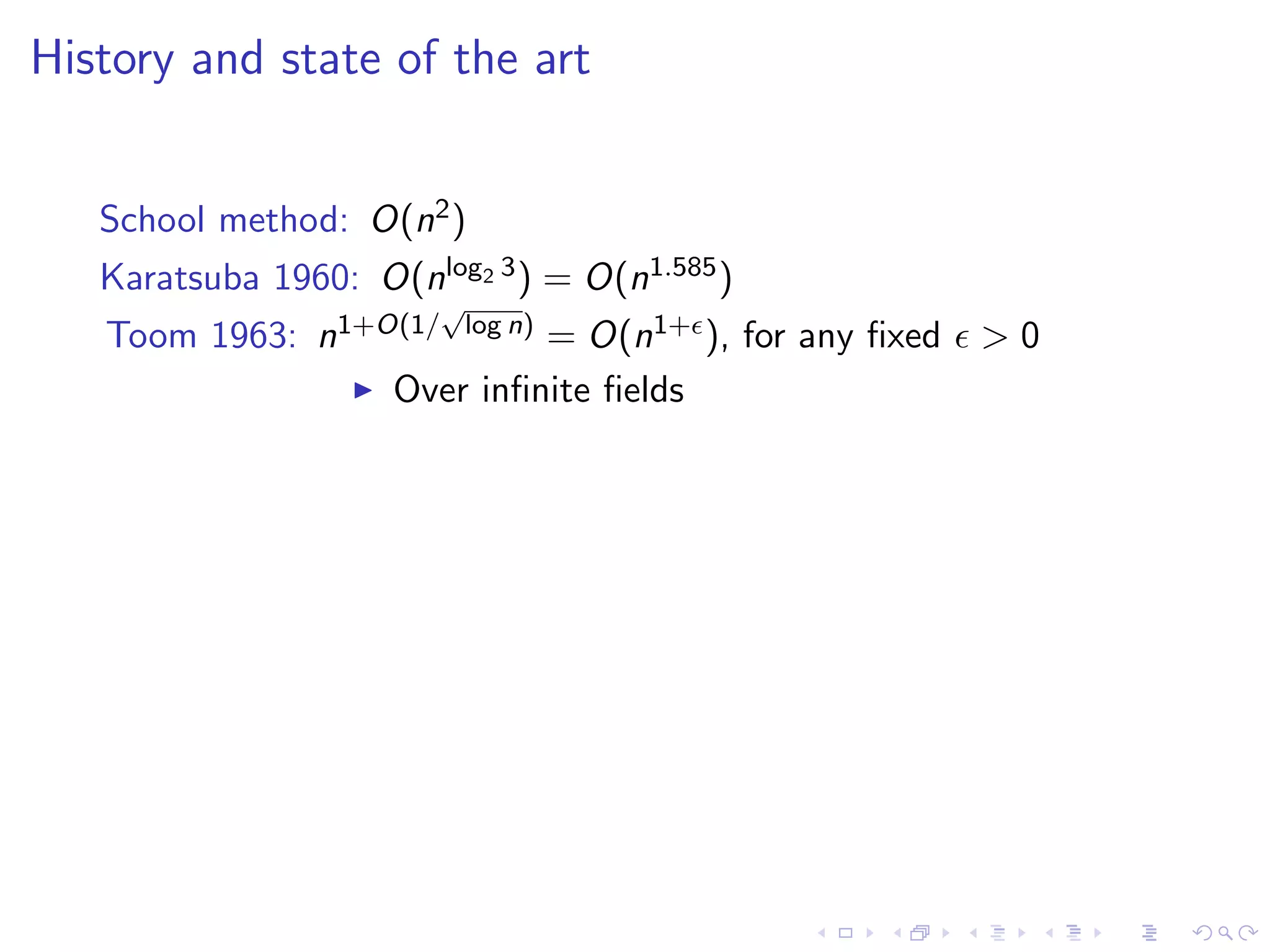
History and state of the art


   School method: O(n2 )
   Karatsuba 1960: O(nlog2 3 ) = O(n1.585 )
                        √
   Toom 1963: n1+O(1/ log n) = O(n1+ ), for any fixed   >0
                  Over infinite fields
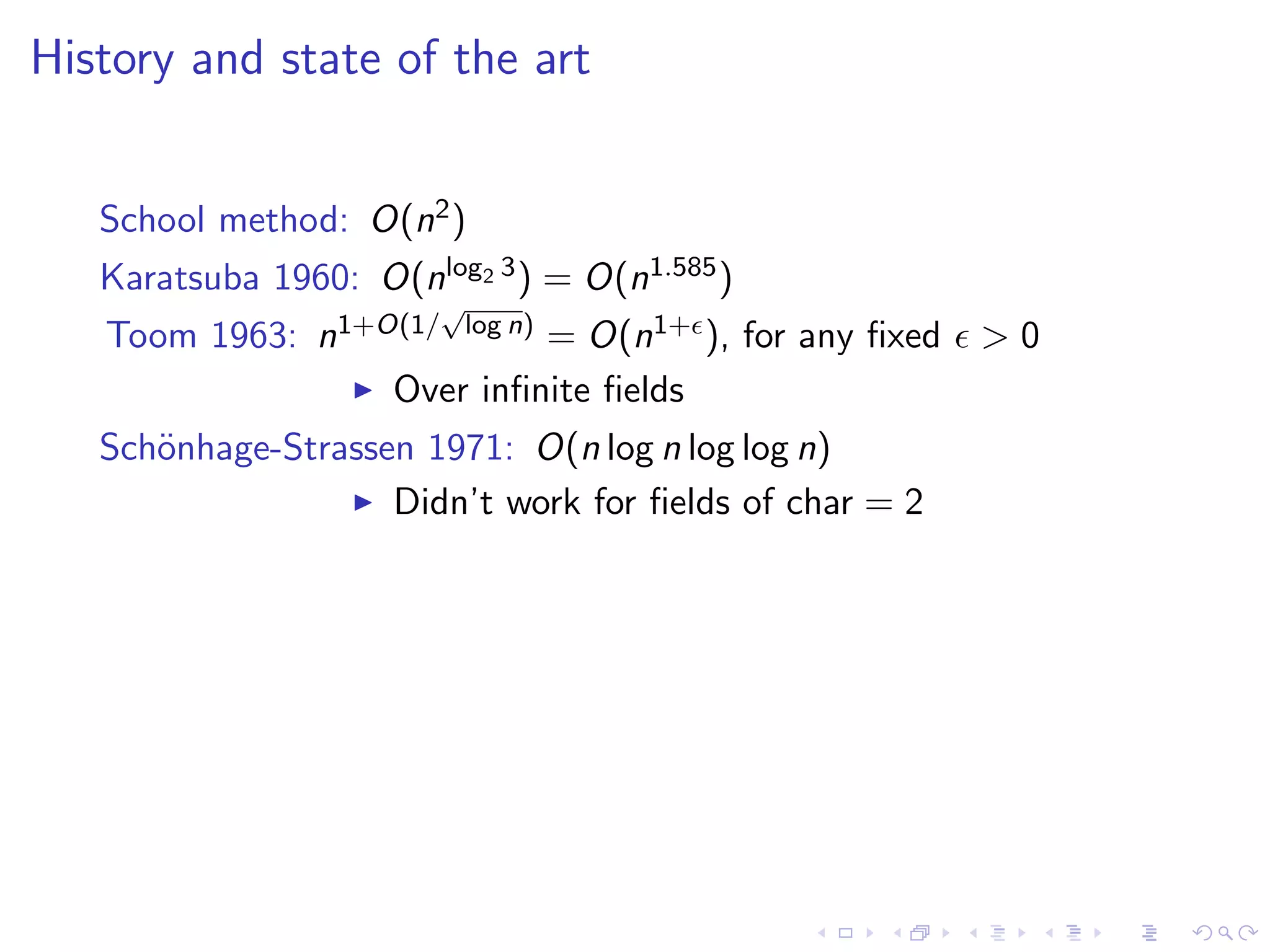
History and state of the art


   School method: O(n2 )
   Karatsuba 1960: O(nlog2 3 ) = O(n1.585 )
                        √
   Toom 1963: n1+O(1/ log n) = O(n1+ ), for any fixed    >0
                  Over infinite fields
   Sch¨nhage-Strassen 1971: O(n log n log log n)
      o
                    Didn’t work for fields of char = 2
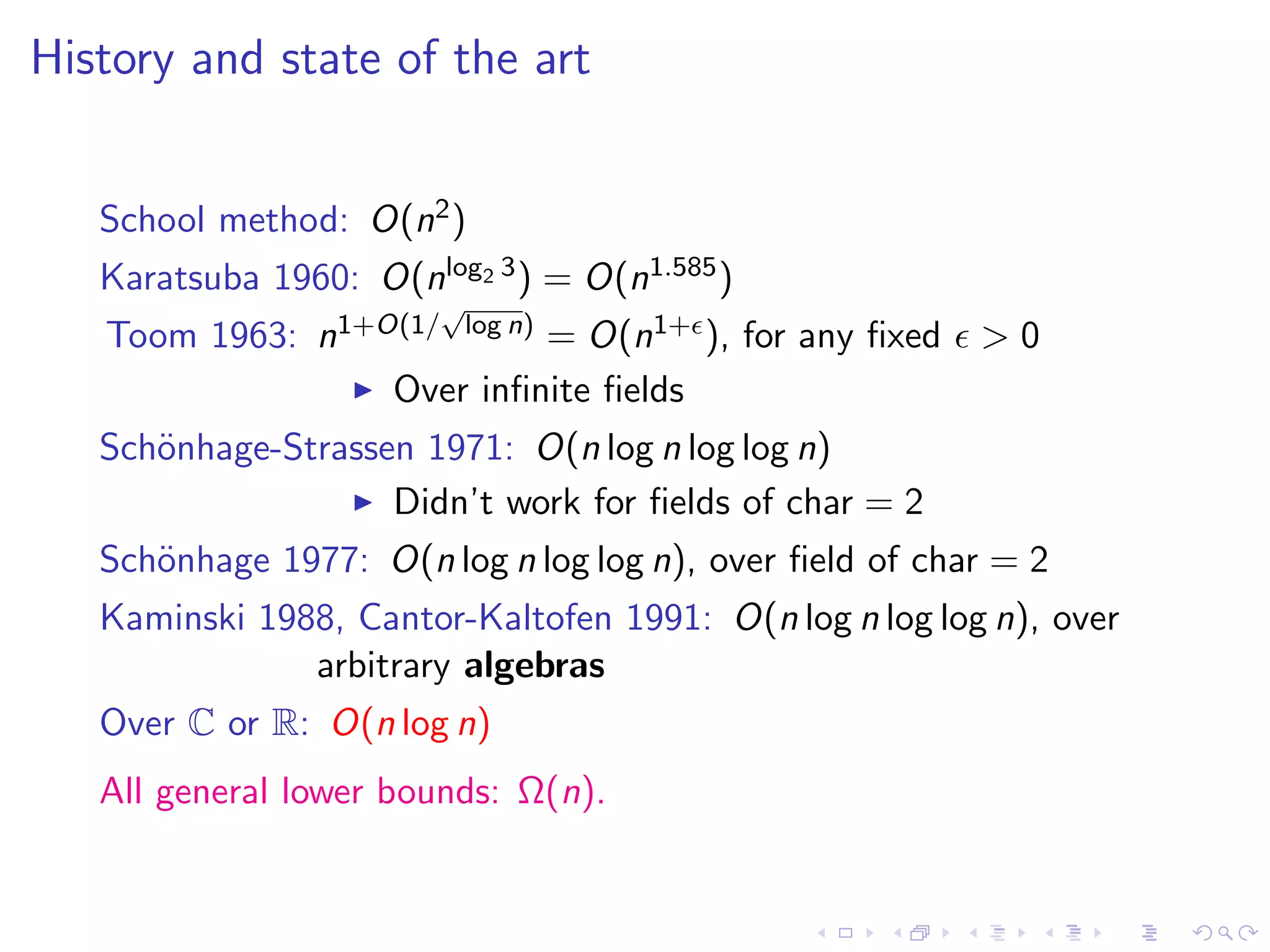
History and state of the art


   School method: O(n2 )
   Karatsuba 1960: O(nlog2 3 ) = O(n1.585 )
                        √
   Toom 1963: n1+O(1/ log n) = O(n1+ ), for any fixed     >0
                  Over infinite fields
   Sch¨nhage-Strassen 1971: O(n log n log log n)
      o
                    Didn’t work for fields of char = 2
   Sch¨nhage 1977: O(n log n log log n), over field of char = 2
      o
   Kaminski 1988, Cantor-Kaltofen 1991: O(n log n log log n), over
               arbitrary algebras
   Over C or R: O(n log n)
   All general lower bounds: Ω(n).
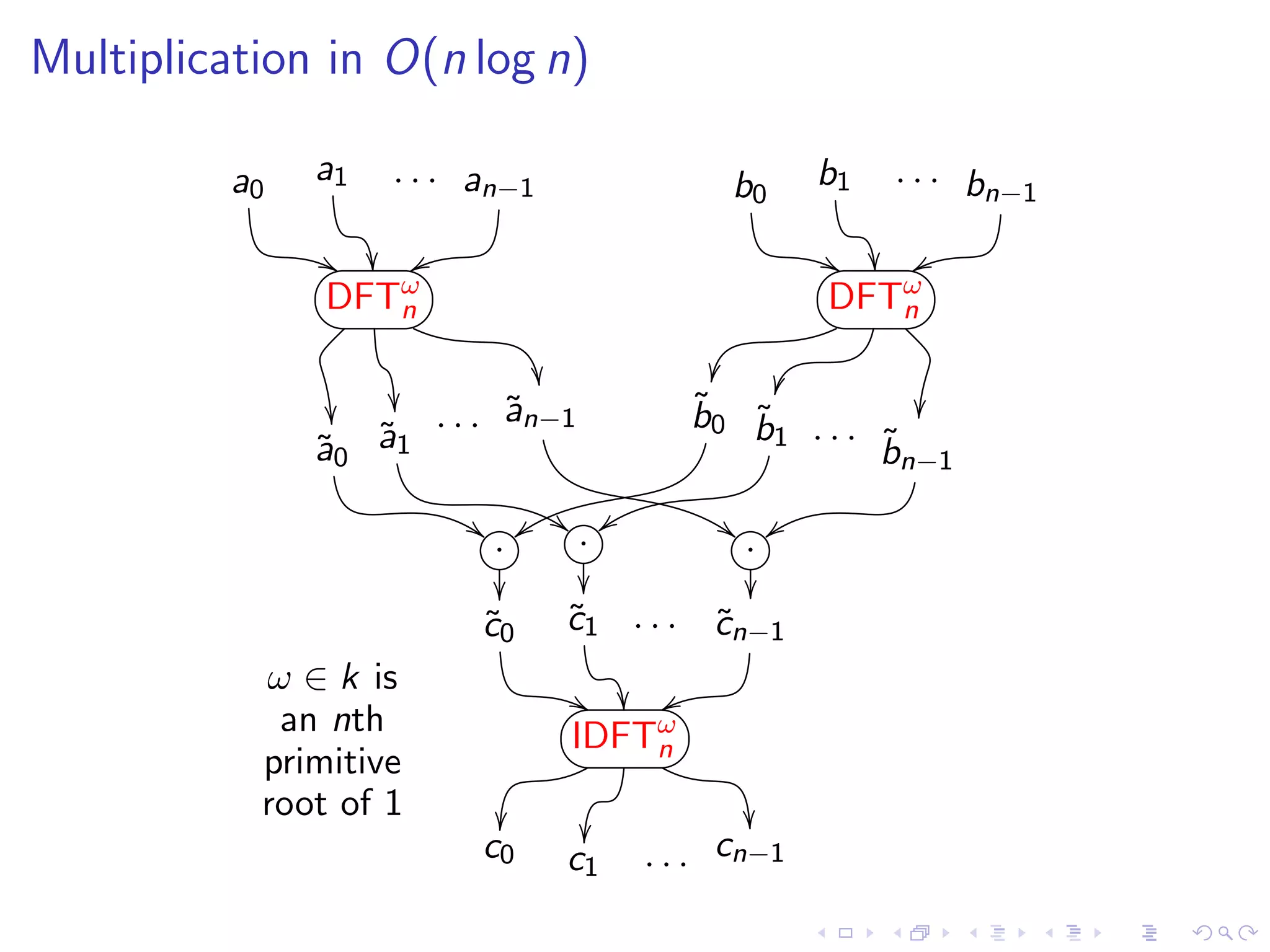
Multiplication in O(n log n)


   Given

                  a(x) = a0 + a1 x + · · · + an−1 x n−1 ,
                  b(x) = b0 + b1 x + · · · + bn−1 x n−1 ,

   Compute

     c(x) = c0 + c1 x + · · · + xn−1 x n−1 = a(x)b(x) (mod x n − 1).

   (Can always choose a larger n and pad polynomials with zeroes to
   reduce the ordinary polynomial multiplication to the product in
   k[x]/(x n − 1).)
Multiplication in O(n log n)

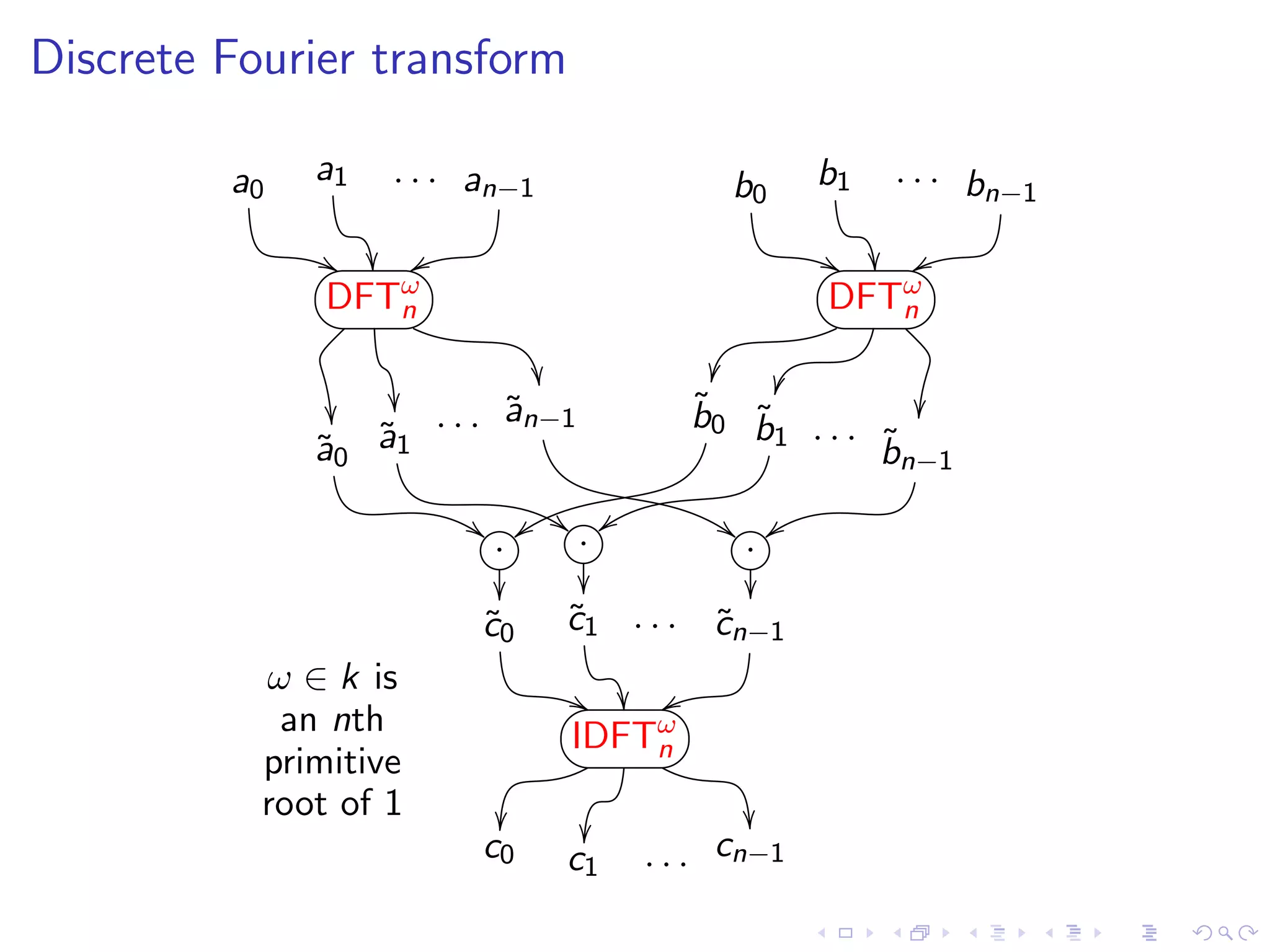
          a0   a1           . . . an−1                                         b0           b1       . . . bn−1

                    8          x                                                            8       x
               DFTω
                  n                                                                         DFTω
                                                                                               n

                                                                                      
                                  . . . ˜n−1
                                          a                               ˜ ˜
                                                                          b0 b1 . . .   
               ˜0 ˜1
               a a                                                                    ˜n−1
                                                                                      b
                                       5 {          5 {                        5 {
                                        ·           ·                          ·
                                                                                  
                                       c0
                                       ˜            c1 . . . cn−1
                                                    ˜        ˜
           ω ∈ k is
                                                             8       x
            an nth                                  IDFTω
                                                        n
           primitive
           root of 1                                                           
                                                         
                                       c0           c1               . . . cn−1
Discrete Fourier transform
       Maps a degree n − 1 polynomial to its values at n distinct nth
       roots of unity:
                                   n−1
                 ˜i := a(ω i ) =
                 a                       aj ω ij ,   0≤i ≤n−1
                                   j=0

             DFTω : (a0 , a1 , . . . , an−1 ) → (˜0 , ˜1 , . . . , ˜n−1 )
                n                                a a               a

       (ω is a primitive nth root of unity)
       Linear transform: DFTω : k[x] → k n
                               n
       Isomorphism: DFTω : k[x]/(x n − 1) → k n
                           n
       Can be often computed in O(n log n)
       The inverse isomorphism is almost a DFT again:
           1      n−1
             DFTω
                n     : (˜0 , ˜1 , . . . , ˜n−1 ) → (a0 , a1 , . . . , an−1 )
                         a a               a
           n
Discrete Fourier transform

         a0   a1           . . . an−1                                         b0           b1       . . . bn−1

                   8          x                                                            8       x
               DFTω
                  n                                                                        DFTω
                                                                                              n

                                                                                     
                                 . . . ˜n−1
                                         a                               ˜ ˜
                                                                         b0 b1 . . .   
              ˜0 ˜1
              a a                                                                    ˜n−1
                                                                                     b
                                      5 {          5 {                        5 {
                                       ·           ·                          ·
                                                                                 
                                      c0
                                      ˜            c1 . . . cn−1
                                                   ˜        ˜
           ω ∈ k is
                                                            8       x
            an nth                                 IDFTω
                                                       n
           primitive
           root of 1                                                          
                                                        
                                      c0           c1               . . . cn−1
Discrete Fourier transform
       Lk (n): the complexity of degree n polynomial multiplication
       over a field k
       Dk (n): the complexity of computing length n DFT over k
                  Lk (n) ≤ 3Dk (n) + 2n = O(n log n).
   Note: we need roots of unity.
What if roots of unity are not available?


   Attach them!
What if roots of unity are not available?


   Attach them!
       Switch from the field k to its algebraic extension Am where
       roots of unity of sufficiently large order exist.
What if roots of unity are not available?


   Attach them!
       Switch from the field k to its algebraic extension Am where
       roots of unity of sufficiently large order exist.
       More precisely: take a (ring) extension Am of k of degree m
       over k with a 2 th root of unity ω ∈ Am :
           For example,
                                 Am = k[x]/pm (x),
           pm (x) ∈ k[x] is a polynomial of degree m,
           pm (x) vanishes on ω2 ,
           (ω2 is a primitive 2 th root of unity in the algebraic closure of
           the field k.)
What if roots of unity are not available?


   Attach them!
       Switch from the field k to its algebraic extension Am where
       roots of unity of sufficiently large order exist.
       More precisely: take a (ring) extension Am of k of degree m
       over k with a 2 th root of unity ω ∈ Am :
            For example,
                                  Am = k[x]/pm (x),
            pm (x) ∈ k[x] is a polynomial of degree m,
            pm (x) vanishes on ω2 ,
            (ω2 is a primitive 2 th root of unity in the algebraic closure of
            the field k.)
   How can it help?
What if roots of unity are not available?


   Attach them!
       Switch from the field k to its algebraic extension Am where
       roots of unity of sufficiently large order exist.
       More precisely: take a (ring) extension Am of k of degree m
       over k with a 2 th root of unity ω ∈ Am :
            For example,
                                  Am = k[x]/pm (x),
            pm (x) ∈ k[x] is a polynomial of degree m,
            pm (x) vanishes on ω2 ,
            (ω2 is a primitive 2 th root of unity in the algebraic closure of
            the field k.)
   How can it help? See next slide.
Fast polynomial multiplication

            a0 . . . a m −1 . . . an−1
                       2                                               b0 . . . b m −1 . . . bn−1
                                                                                  2
               %   }                              %                        %               }                       % 
             → Am          ...           → Am                              → Am                          ...       → Am

              A0       7         y                  A2   −1                B0                        7         y      B2   −1

                       DFTω
                          2                                                                         DFTω
                                                                                                       2
                                                  ˜
                                                  A2    −1                 ˜
                                                                           B0

                           ˜
                           A0            5          y                           7               { B2
                                                                                                  ˜
                                             ·                   ...                    ·                 −1


         2 ·m =n                         ˜
                                         C0                  7         y                    ˜
                                                                                            C2      −1
      Am = k[x]/pm (x)                                   IDFTω
                                                             2
                                                  C0                       C2           −1
           ω ∈ Am
          is a 2 th                                                                    
          primitive                  ← Am                        ...       ← Am
          root of 1                  Õ                   3                          Ù           
                                 c0 . . . cm−1 . . .                                        cn−1
Fast polynomial multiplication
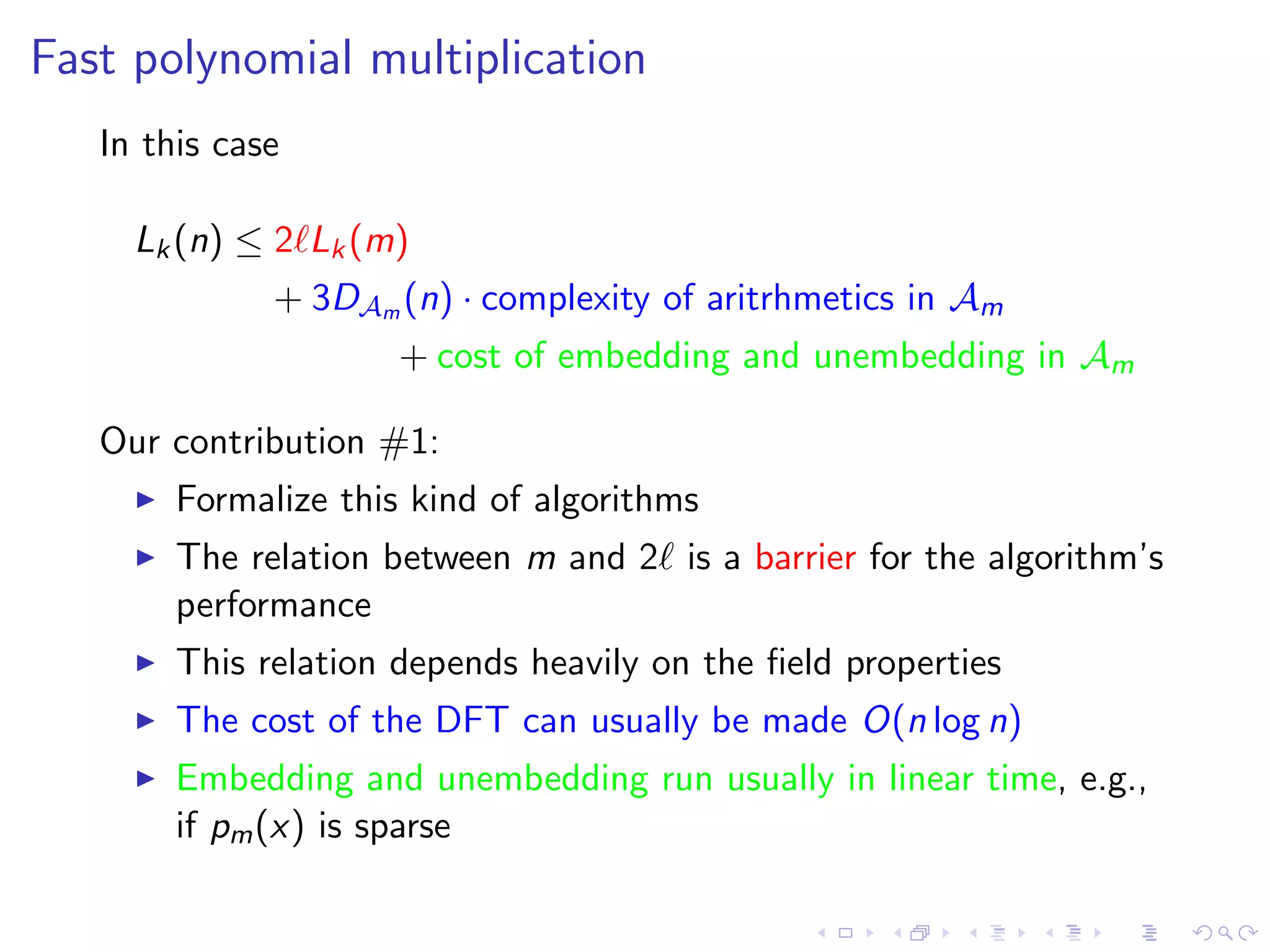
   In this case

     Lk (n) ≤ 2 Lk (m)
              + 3DAm (n) · complexity of aritrhmetics in Am
                      + cost of embedding and unembedding in Am

   Our contribution #1:
        Formalize this kind of algorithms
        The relation between m and 2 is a barrier for the algorithm’s
        performance
        This relation depends heavily on the field properties
        The cost of the DFT can usually be made O(n log n)
        Embedding and unembedding run usually in linear time, e.g.,
        if pm (x) is sparse
Does it work?


   Yes!!!
   Sch¨nhage-Strassen 1971:
      o                       =m
   Sch¨nhage 1977: 3 = 2m (+ a little trick)
      o
   Kaminski 1988:   = φ(m) (Euler’s totient function)
   Cantor-Kaltofen 1991: = m (and Am is a little more complicated
                than k[x]/pm (x))
Slow fields
Slow fields
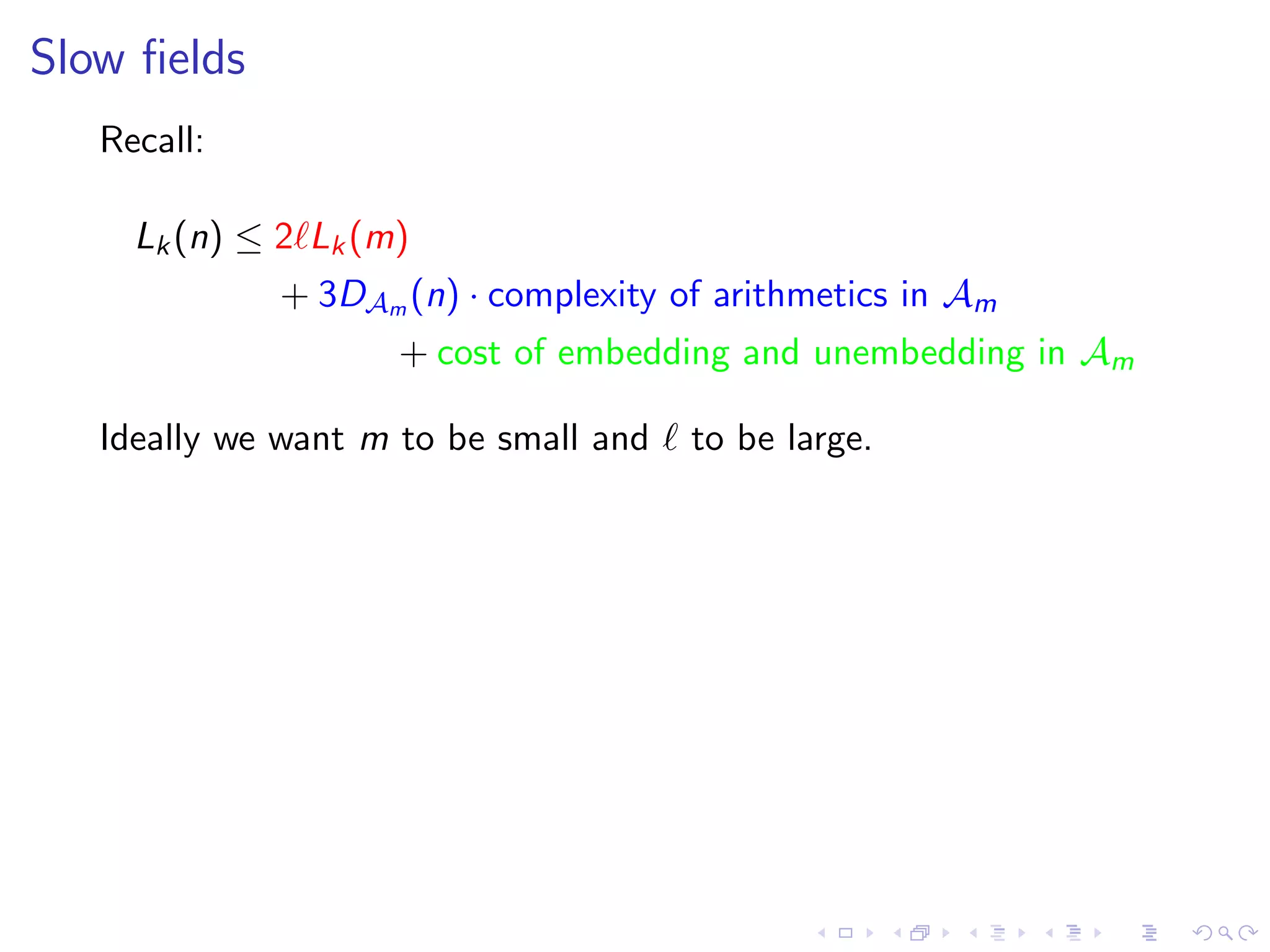
   Recall:

     Lk (n) ≤ 2 Lk (m)
              + 3DAm (n) · complexity of arithmetics in Am
                     + cost of embedding and unembedding in Am

   Ideally we want m to be small and   to be large.
Slow fields
   Recall:

     Lk (n) ≤ 2 Lk (m)
               + 3DAm (n) · complexity of arithmetics in Am
                      + cost of embedding and unembedding in Am

   Ideally we want m to be small and      to be large.
   Definition
   For a field k, and n, s.t. char k n, let fk (n) be [k(ωn ) : k], the
   degree function of k.
Slow fields
   Recall:

     Lk (n) ≤ 2 Lk (m)
               + 3DAm (n) · complexity of arithmetics in Am
                      + cost of embedding and unembedding in Am

   Ideally we want m to be small and      to be large.
   Definition
   For a field k, and n, s.t. char k n, let fk (n) be [k(ωn ) : k], the
   degree function of k.
   Our contribution #2:
        If fk (n) = o(log log n) for some not too sparse set of n then k
        is fast and Lk (n) = o(n log n log log n)
        If fk (n) = Ω(n1− ) for any fixed  0, then k is slow and any
        algorithm of that kind runs in Ω(n log n log log n)
More details

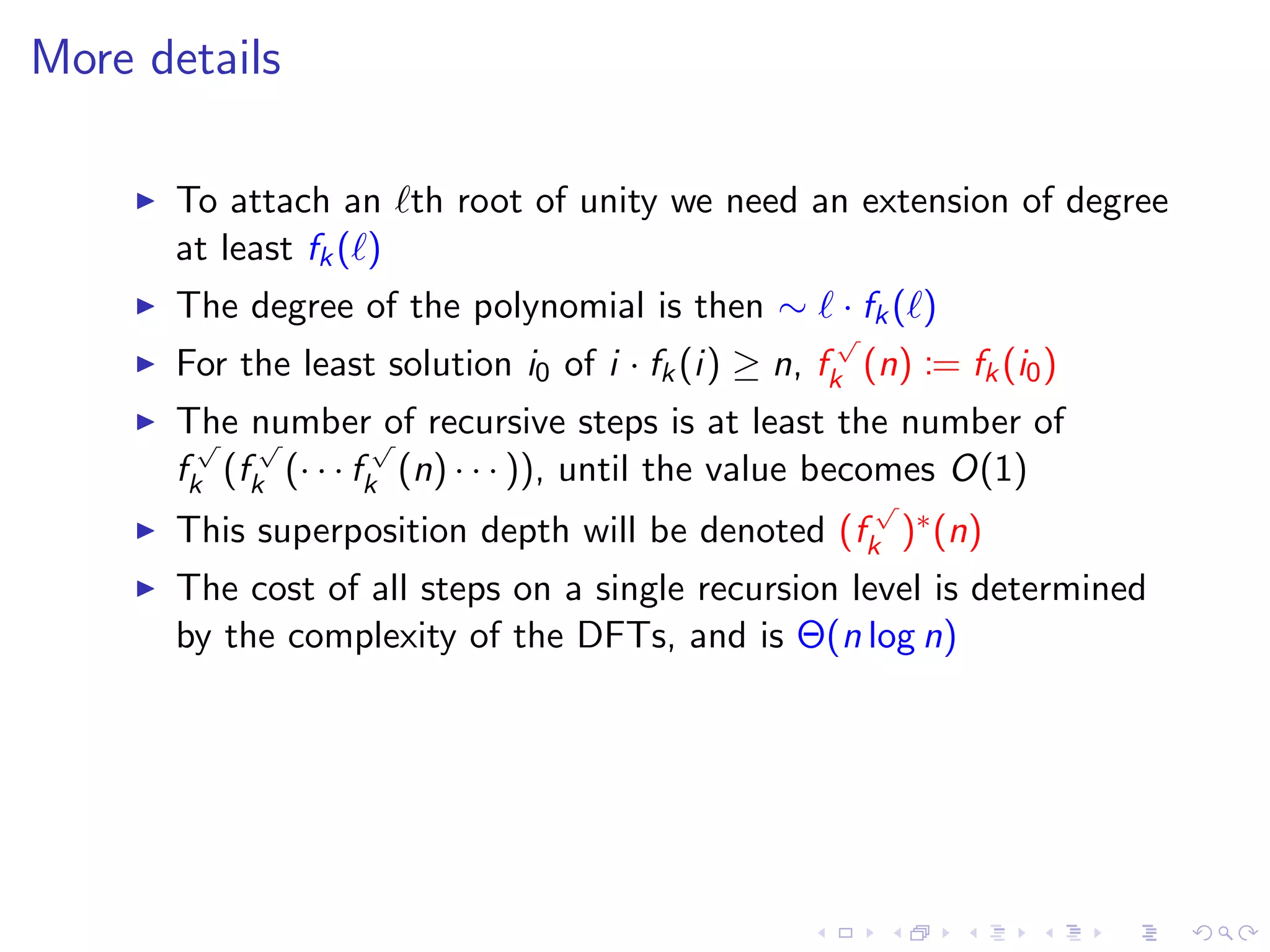
      To attach an th root of unity we need an extension of degree
      at least fk ( )
      The degree of the polynomial is then ∼ · fk ( )
                                                     √
      For the least solution i0 of i · fk (i) ≥ n, fk (n) := fk (i0 )
      The number√of recursive steps is at least the number of
        √   √
      fk (fk (· · · fk (n) · · · )), until the value becomes O(1)
                                                       √
      This superposition depth will be denoted (fk )∗ (n)
      The cost of all steps on a single recursion level is determined
      by the complexity of the DFTs, and is Θ(n log n)
More details

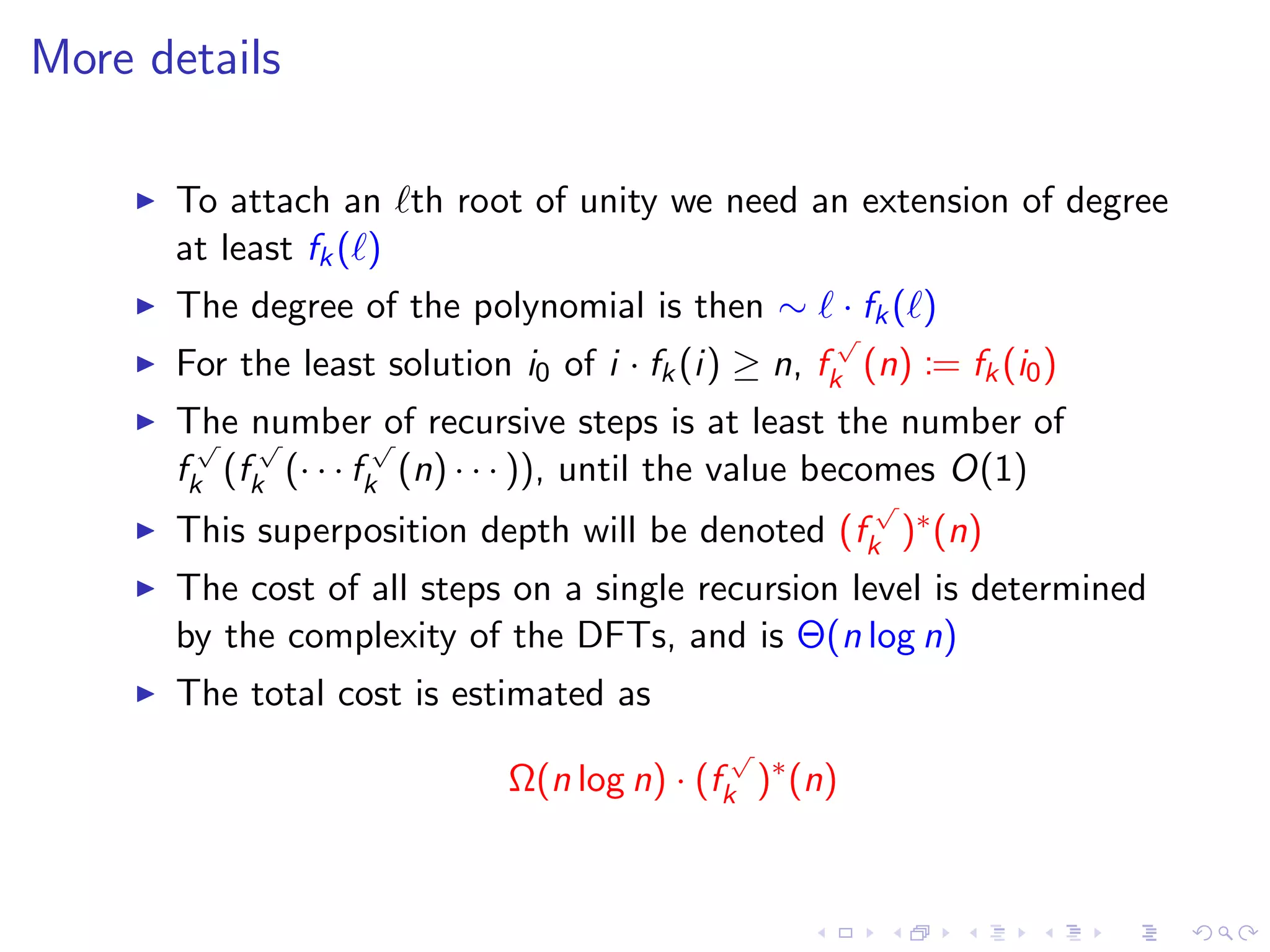
      To attach an th root of unity we need an extension of degree
      at least fk ( )
      The degree of the polynomial is then ∼ · fk ( )
                                                     √
      For the least solution i0 of i · fk (i) ≥ n, fk (n) := fk (i0 )
      The number√of recursive steps is at least the number of
        √   √
      fk (fk (· · · fk (n) · · · )), until the value becomes O(1)
                                                       √
      This superposition depth will be denoted (fk )∗ (n)
      The cost of all steps on a single recursion level is determined
      by the complexity of the DFTs, and is Θ(n log n)
      The total cost is estimated as
                                             √
                             Ω(n log n) · (fk )∗ (n)
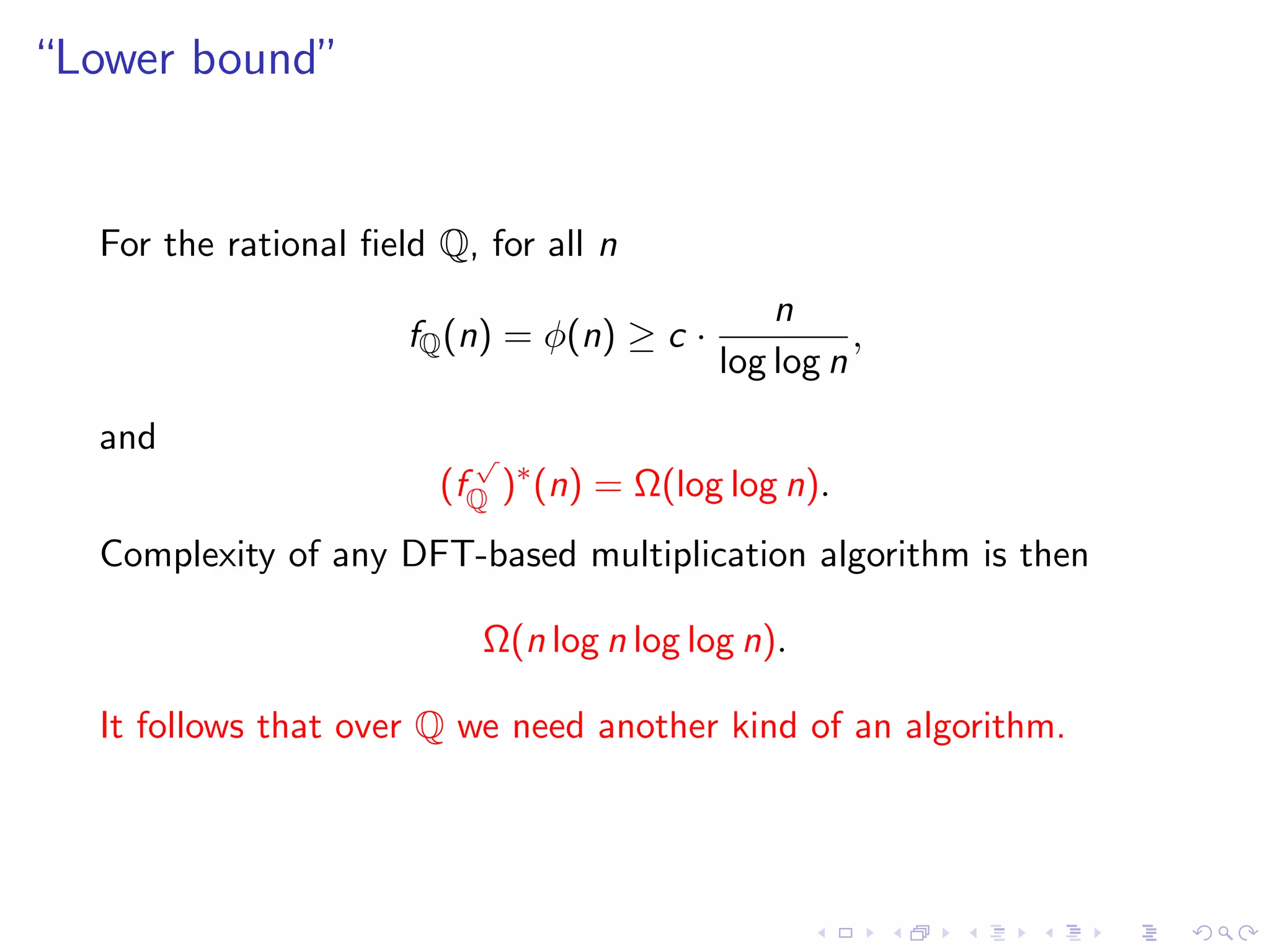
“Lower bound”


  For the rational field Q, for all n
                                                n
                      fQ (n) = φ(n) ≥ c ·             ,
                                            log log n
  and                     √
                        (fQ )∗ (n) = Ω(log log n).
“Lower bound”


  For the rational field Q, for all n
                                                n
                      fQ (n) = φ(n) ≥ c ·             ,
                                            log log n
  and                     √
                        (fQ )∗ (n) = Ω(log log n).
  Complexity of any DFT-based multiplication algorithm is then

                           Ω(n log n log log n).

  It follows that over Q we need another kind of an algorithm.
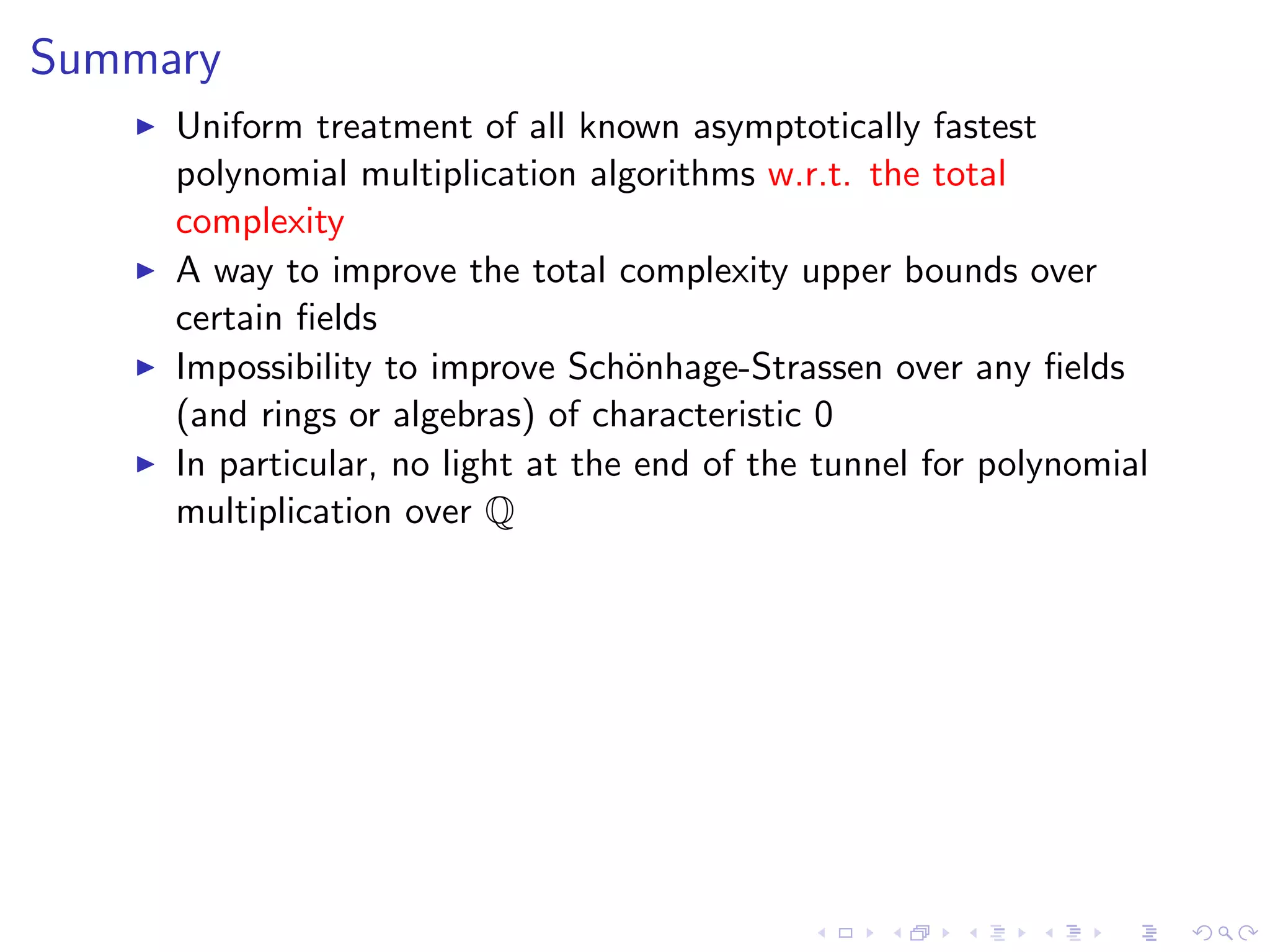
Summary
     Uniform treatment of all known asymptotically fastest
     polynomial multiplication algorithms w.r.t. the total
     complexity
     A way to improve the total complexity upper bounds over
     certain fields
     Impossibility to improve Sch¨nhage-Strassen over any fields
                                   o
     (and rings or algebras) of characteristic 0
     In particular, no light at the end of the tunnel for polynomial
     multiplication over Q
Summary
     Uniform treatment of all known asymptotically fastest
     polynomial multiplication algorithms w.r.t. the total
     complexity
     A way to improve the total complexity upper bounds over
     certain fields
     Impossibility to improve Sch¨nhage-Strassen over any fields
                                   o
     (and rings or algebras) of characteristic 0
     In particular, no light at the end of the tunnel for polynomial
     multiplication over Q
     Over fields of positive characteristic,
Thank you for attention!

Csr2011 june14 17_00_pospelov

  • 1.
    Faster Polynomial Multiplicationvia Discrete Fourier Transforms Alexey Pospelov Computer Science Department, Saarland University Cluster of Excellence Multimodal Computing and Interaction June 14th, 2011
  • 2.
    Polynomial multiplication Given a(x) = a0 + a1 x + · · · + an x n , b(x) = b0 + b1 x + · · · + bn x n , Compute c(x) = c0 + c1 x + · · · + c2n x 2n = a(x)b(x).
  • 3.
    Polynomial multiplication Given a(x) = a0 + a1 x + · · · + an x n , b(x) = b0 + b1 x + · · · + bn x n , Compute c(x) = c0 + c1 x + · · · + c2n x 2n = a(x)b(x). For all 0 ≤ i ≤ 2n, compute a0 bi + a1 bi−1 + · · · + ai b0 , 0 ≤ i ≤ n, ci = ai−n bn + ai−n+1 bn−1 + · · · + an bi−n , n < i ≤ 2n.
  • 4.
    In what model? Arithmetic circuits with binary “+”, “−”, “·” Each binary gate has unit cost No divisions Constants from the field available at no cost Inputs are the coefficients of the polynomials to be multiplied Outputs are the coefficients of the product polynomial Interested in a circuit for degree n polynomial multiplication of the minimal size
  • 5.
    History and stateof the art School method: O(n2 ) Karatsuba 1960: O(nlog2 3 ) = O(n1.585 ) √ Toom 1963: n1+O(1/ log n) = O(n1+ ), for any fixed >0 Over infinite fields
  • 6.
    History and stateof the art School method: O(n2 ) Karatsuba 1960: O(nlog2 3 ) = O(n1.585 ) √ Toom 1963: n1+O(1/ log n) = O(n1+ ), for any fixed >0 Over infinite fields Sch¨nhage-Strassen 1971: O(n log n log log n) o Didn’t work for fields of char = 2
  • 7.
    History and stateof the art School method: O(n2 ) Karatsuba 1960: O(nlog2 3 ) = O(n1.585 ) √ Toom 1963: n1+O(1/ log n) = O(n1+ ), for any fixed >0 Over infinite fields Sch¨nhage-Strassen 1971: O(n log n log log n) o Didn’t work for fields of char = 2 Sch¨nhage 1977: O(n log n log log n), over field of char = 2 o Kaminski 1988, Cantor-Kaltofen 1991: O(n log n log log n), over arbitrary algebras Over C or R: O(n log n) All general lower bounds: Ω(n).
  • 8.
    Multiplication in O(nlog n) Given a(x) = a0 + a1 x + · · · + an−1 x n−1 , b(x) = b0 + b1 x + · · · + bn−1 x n−1 , Compute c(x) = c0 + c1 x + · · · + xn−1 x n−1 = a(x)b(x) (mod x n − 1). (Can always choose a larger n and pad polynomials with zeroes to reduce the ordinary polynomial multiplication to the product in k[x]/(x n − 1).)
  • 9.
    Multiplication in O(nlog n) a0 a1 . . . an−1 b0 b1 . . . bn−1 8 x 8 x DFTω n DFTω n . . . ˜n−1 a ˜ ˜ b0 b1 . . . ˜0 ˜1 a a ˜n−1 b 5 { 5 { 5 { · · · c0 ˜ c1 . . . cn−1 ˜ ˜ ω ∈ k is 8 x an nth IDFTω n primitive root of 1 c0 c1 . . . cn−1
  • 10.
  • 11.
    Discrete Fourier transform Maps a degree n − 1 polynomial to its values at n distinct nth roots of unity: n−1 ˜i := a(ω i ) = a aj ω ij , 0≤i ≤n−1 j=0 DFTω : (a0 , a1 , . . . , an−1 ) → (˜0 , ˜1 , . . . , ˜n−1 ) n a a a (ω is a primitive nth root of unity) Linear transform: DFTω : k[x] → k n n Isomorphism: DFTω : k[x]/(x n − 1) → k n n Can be often computed in O(n log n) The inverse isomorphism is almost a DFT again: 1 n−1 DFTω n : (˜0 , ˜1 , . . . , ˜n−1 ) → (a0 , a1 , . . . , an−1 ) a a a n
  • 12.
    Discrete Fourier transform a0 a1 . . . an−1 b0 b1 . . . bn−1 8 x 8 x DFTω n DFTω n . . . ˜n−1 a ˜ ˜ b0 b1 . . . ˜0 ˜1 a a ˜n−1 b 5 { 5 { 5 { · · · c0 ˜ c1 . . . cn−1 ˜ ˜ ω ∈ k is 8 x an nth IDFTω n primitive root of 1 c0 c1 . . . cn−1
  • 13.
    Discrete Fourier transform Lk (n): the complexity of degree n polynomial multiplication over a field k Dk (n): the complexity of computing length n DFT over k Lk (n) ≤ 3Dk (n) + 2n = O(n log n). Note: we need roots of unity.
  • 14.
    What if rootsof unity are not available?
  • 15.
    What if rootsof unity are not available? Attach them!
  • 16.
    What if rootsof unity are not available? Attach them! Switch from the field k to its algebraic extension Am where roots of unity of sufficiently large order exist.
  • 17.
    What if rootsof unity are not available? Attach them! Switch from the field k to its algebraic extension Am where roots of unity of sufficiently large order exist. More precisely: take a (ring) extension Am of k of degree m over k with a 2 th root of unity ω ∈ Am : For example, Am = k[x]/pm (x), pm (x) ∈ k[x] is a polynomial of degree m, pm (x) vanishes on ω2 , (ω2 is a primitive 2 th root of unity in the algebraic closure of the field k.)
  • 18.
    What if rootsof unity are not available? Attach them! Switch from the field k to its algebraic extension Am where roots of unity of sufficiently large order exist. More precisely: take a (ring) extension Am of k of degree m over k with a 2 th root of unity ω ∈ Am : For example, Am = k[x]/pm (x), pm (x) ∈ k[x] is a polynomial of degree m, pm (x) vanishes on ω2 , (ω2 is a primitive 2 th root of unity in the algebraic closure of the field k.) How can it help?
  • 19.
    What if rootsof unity are not available? Attach them! Switch from the field k to its algebraic extension Am where roots of unity of sufficiently large order exist. More precisely: take a (ring) extension Am of k of degree m over k with a 2 th root of unity ω ∈ Am : For example, Am = k[x]/pm (x), pm (x) ∈ k[x] is a polynomial of degree m, pm (x) vanishes on ω2 , (ω2 is a primitive 2 th root of unity in the algebraic closure of the field k.) How can it help? See next slide.
  • 20.
    Fast polynomial multiplication a0 . . . a m −1 . . . an−1 2 b0 . . . b m −1 . . . bn−1 2 % } % % } % → Am ... → Am → Am ... → Am A0 7 y A2 −1 B0 7 y B2 −1 DFTω 2 DFTω 2 ˜ A2 −1 ˜ B0 ˜ A0 5 y 7 { B2 ˜ · ... · −1 2 ·m =n ˜ C0 7 y ˜ C2 −1 Am = k[x]/pm (x) IDFTω 2 C0 C2 −1 ω ∈ Am is a 2 th primitive ← Am ... ← Am root of 1 Õ 3 Ù c0 . . . cm−1 . . . cn−1
  • 21.
    Fast polynomial multiplication In this case Lk (n) ≤ 2 Lk (m) + 3DAm (n) · complexity of aritrhmetics in Am + cost of embedding and unembedding in Am Our contribution #1: Formalize this kind of algorithms The relation between m and 2 is a barrier for the algorithm’s performance This relation depends heavily on the field properties The cost of the DFT can usually be made O(n log n) Embedding and unembedding run usually in linear time, e.g., if pm (x) is sparse
  • 22.
    Does it work? Yes!!! Sch¨nhage-Strassen 1971: o =m Sch¨nhage 1977: 3 = 2m (+ a little trick) o Kaminski 1988: = φ(m) (Euler’s totient function) Cantor-Kaltofen 1991: = m (and Am is a little more complicated than k[x]/pm (x))
  • 23.
  • 24.
    Slow fields Recall: Lk (n) ≤ 2 Lk (m) + 3DAm (n) · complexity of arithmetics in Am + cost of embedding and unembedding in Am Ideally we want m to be small and to be large.
  • 25.
    Slow fields Recall: Lk (n) ≤ 2 Lk (m) + 3DAm (n) · complexity of arithmetics in Am + cost of embedding and unembedding in Am Ideally we want m to be small and to be large. Definition For a field k, and n, s.t. char k n, let fk (n) be [k(ωn ) : k], the degree function of k.
  • 26.
    Slow fields Recall: Lk (n) ≤ 2 Lk (m) + 3DAm (n) · complexity of arithmetics in Am + cost of embedding and unembedding in Am Ideally we want m to be small and to be large. Definition For a field k, and n, s.t. char k n, let fk (n) be [k(ωn ) : k], the degree function of k. Our contribution #2: If fk (n) = o(log log n) for some not too sparse set of n then k is fast and Lk (n) = o(n log n log log n) If fk (n) = Ω(n1− ) for any fixed 0, then k is slow and any algorithm of that kind runs in Ω(n log n log log n)
  • 27.
    More details To attach an th root of unity we need an extension of degree at least fk ( ) The degree of the polynomial is then ∼ · fk ( ) √ For the least solution i0 of i · fk (i) ≥ n, fk (n) := fk (i0 ) The number√of recursive steps is at least the number of √ √ fk (fk (· · · fk (n) · · · )), until the value becomes O(1) √ This superposition depth will be denoted (fk )∗ (n) The cost of all steps on a single recursion level is determined by the complexity of the DFTs, and is Θ(n log n)
  • 28.
    More details To attach an th root of unity we need an extension of degree at least fk ( ) The degree of the polynomial is then ∼ · fk ( ) √ For the least solution i0 of i · fk (i) ≥ n, fk (n) := fk (i0 ) The number√of recursive steps is at least the number of √ √ fk (fk (· · · fk (n) · · · )), until the value becomes O(1) √ This superposition depth will be denoted (fk )∗ (n) The cost of all steps on a single recursion level is determined by the complexity of the DFTs, and is Θ(n log n) The total cost is estimated as √ Ω(n log n) · (fk )∗ (n)
  • 29.
    “Lower bound” For the rational field Q, for all n n fQ (n) = φ(n) ≥ c · , log log n and √ (fQ )∗ (n) = Ω(log log n).
  • 30.
    “Lower bound” For the rational field Q, for all n n fQ (n) = φ(n) ≥ c · , log log n and √ (fQ )∗ (n) = Ω(log log n). Complexity of any DFT-based multiplication algorithm is then Ω(n log n log log n). It follows that over Q we need another kind of an algorithm.
  • 31.
    Summary Uniform treatment of all known asymptotically fastest polynomial multiplication algorithms w.r.t. the total complexity A way to improve the total complexity upper bounds over certain fields Impossibility to improve Sch¨nhage-Strassen over any fields o (and rings or algebras) of characteristic 0 In particular, no light at the end of the tunnel for polynomial multiplication over Q
  • 32.
    Summary Uniform treatment of all known asymptotically fastest polynomial multiplication algorithms w.r.t. the total complexity A way to improve the total complexity upper bounds over certain fields Impossibility to improve Sch¨nhage-Strassen over any fields o (and rings or algebras) of characteristic 0 In particular, no light at the end of the tunnel for polynomial multiplication over Q Over fields of positive characteristic,
  • 33.
    Thank you forattention!