Features Used
                                                                                                 <, Í, limit(), ∑, #,
                                                                                                 NewProb, DelVar,
                                                                                                 $, %,
                                                                                                 ±
                                                                                                 Setup
           C h a p t e r                           8
                                                                                                 ¥1
                                                                                                 NewFold fourier
.


               Fourier Series                                This chapter shows how to compute and graph the complex
                                                             Fourier Series coefficients for a square wave.


Topic 35: Square Wave: Computing the Coefficients
The TI-89 can easily sum the Fourier Series
                               ∞
                x( t) =     ∑ ck e − j2nkf t        o

                           k =−∞

and evaluate the complex Fourier coefficients defined by the integral
                               T0
                               2
                       1                                                 1
                ck =
                       T0
                               −
                                   z
                                   T0
                                         x( t)e − j2 nkf0 t where f0 =
                                                                         T0
                                   2

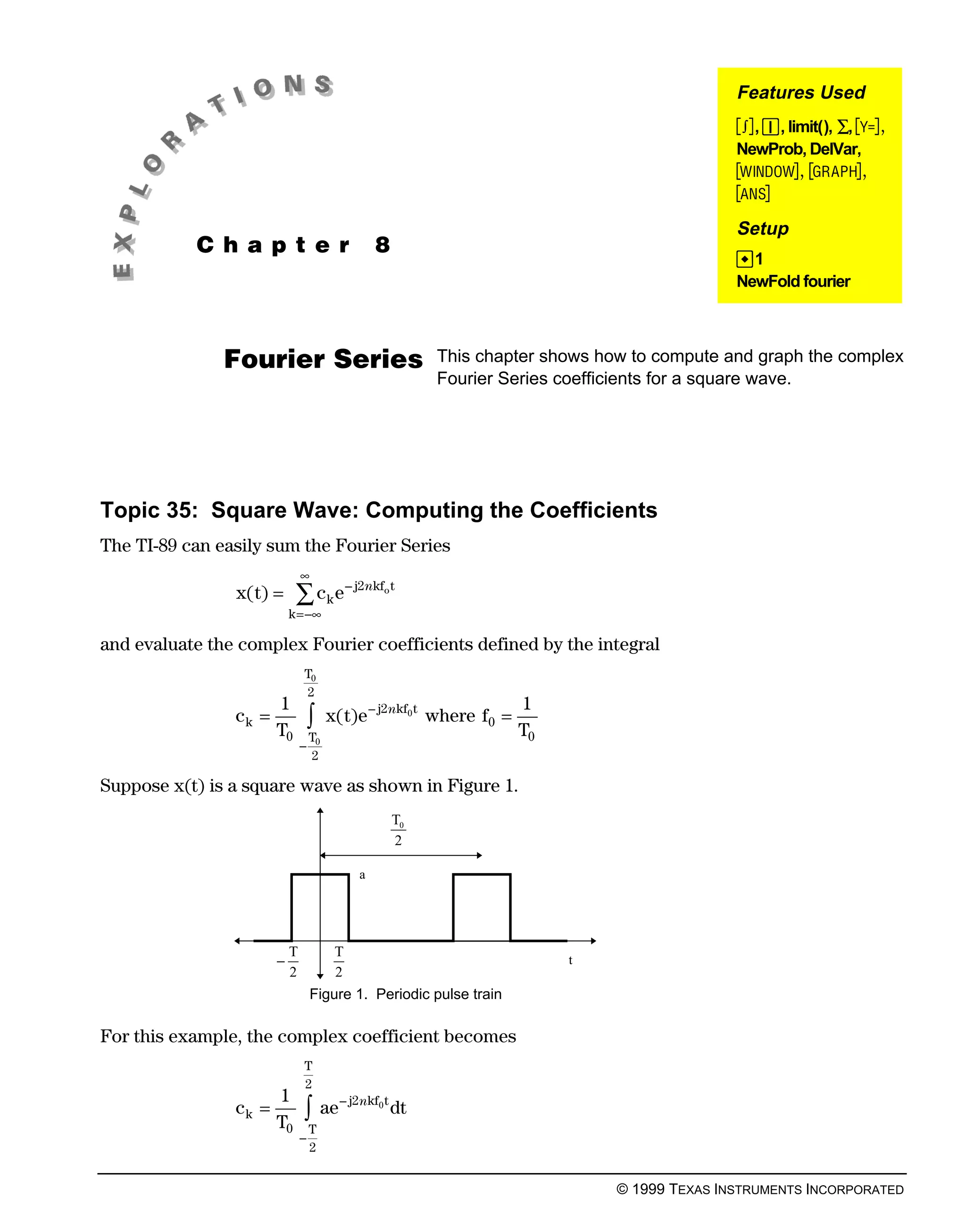
Suppose x(t) is a square wave as shown in Figure 1.
                                                        T0
                                                        2

                                               a


                           T              T
                       −                                                      t
                           2              2
                                   Figure 1. Periodic pulse train

For this example, the complex coefficient becomes
                               T
                               2
                       1
                ck =
                       T0
                               z
                               −
                                   T
                                        ae − j2 nkf0 t dt

                                   2


                                                                                  © 1999 TEXAS INSTRUMENTS INCORPORATED
78     ELECTRICAL ENGINEERING APPLICATIONS WITH THE TI-89


1.   Clear the TI-89 by pressing 2 ˆ 2:NewProb ¸.
2.   Three variable substitutions are needed before entering
     the expression for the complex coefficient. T0 is entered
     as t00 (t0 is reserved), T is entered as tt (t and T are the
     same on the TI-89), and j is ) which is entered as
     2 ). Before entering the equation, any previous
     values of the variables used must be deleted as shown
                                                                     (1)
     in screen 1.
     ½ DelVar t00 b tt b f0
3.   Enter the integral (screen 2).
     1 e t00 2 < a ¥ s · 2 ) 2 2 T k p f0 p t d
     b t b · tt e 2 b tt e 2 d § tmp


                                                                     (2)
                                                                     Note: If a Domain Error message
                                                                     appears, try switching to radian
                                                                     angle mode by pressing 3 and
                                                                     selecting RADIAN.
4.   Next plot the coefficients. To do this, pick values for a,
     f0 (which sets t00 also), and tt. Try the values shown in
     screen 3.


                                                                     (3)
5.   In this example, a is set to 1 and f0 to 1000 Hz. With tt set
     to t00/2, the duty cycle is ½ so the square wave will be
     “on” half the time. Display the value of tmp (top of
     screen 4).
6.   Now save the formula for the coefficient in a function
     called c(k) as shown in screen 4.                               (4)

     2±§cckd
     Using the answer from the integral ensures that the
     value stored in c(k) is the result of the integral, not the
     integral itself. If the integral is saved, it is reevaluated
     every time a coefficient is computed. With c(k) stored
     as a function, the integral is evaluated once and the
     resulting formula is used each time a coefficient value
     is needed.


© 1999 TEXAS INSTRUMENTS INCORPORATED
CHAPTER 8: FOURIER SERIES   79

7.   Check a few data points as shown in screen 5.


                                                                   (5)
8.   All the coefficients look fine except for k=0. The
     equation for c(k) shows that for k=0 the result is 0/0.
     The correct value can be found by using limit( )
     (screen 6).
     ½ limit( c c k d b k b 0 d
                                                                   (6)
     The correct value of c(k) for k=0 is ½. This makes sense
     since the square wave is turned on half the time with an
     average value of ½.
9.   Use the when( ) function to define c(k) so that the k=0
     case is calculated correctly (screen 7).
     ½ when( k Á 0 b 1 e 2 b c c k d d § cc c k
     d
     The value of c(k) valid for all k is stored in cc(k). Now
                                                                   (7)
     the coefficients can be plotted.
10. Set the Graph mode to SEQUENCE (3 B 4:SEQUENCE
    ¸), press ¥ #, and enter cc(n) as the sequence to
     be plotted, as shown in screen 8. Note that the sequence
     plot mode uses the variable n.

                                                                   (8)
11. Press ¥ $ to set the plot range as shown in                   Note: nmin must be greater than or
     screen 9.                                                    equal to 0.


                                                                   (9)
12. Press ¥ % to see the results as shown in screen 10.

     The graph also could be done in Function graphing
     mode. Sequence graphing mode is chosen to emphasize
     that the coefficients only appear at integer values.

                                                                  (10)


                                                                 © 1999 TEXAS INSTRUMENTS INCORPORATED
80     ELECTRICAL ENGINEERING APPLICATIONS WITH THE TI-89


Topic 36: Square Wave: Constructing the Wave from the Coefficients
The original signal can be rebuilt from the coefficients by using
                             ∞        − j2 πkf0 t
                  x( t) =    ∑ ck e
                            k =−∞

1.   To do this, return to the Home screen and enter the
     expression as shown in screen 11.
     ½ G( cc c k d ¥ s 2 ) 2 2 T k p f0 p t
     dbkb·3b3d
     Notice that the TI-89 applied Euler’s Identity to terms of
                                                                    (11)
     the form eiθ+ eNiθ to get 2cos(θ).
     The complete output is
                   −2 cos(6000πt ) 2 cos(2000πt )
                                  +               +1/ 2
                         3π              π
2.   Save the result as y1(x), screen 12.
     2 ± Í t Á x § y1 c x d                                         (12)

3.   Switch the Graph mode to FUNCTION by pressing 3
     B 1:FUNCTION ¸. Then press ¥ # to verify that
     the equation is entered in the Y= Editor (screen 13).


                                                                    (13)
4.   Press ¥ $ and set the plot range as shown in
     screen 14.


                                                                    (14)
5.   Press ¥ % to see the graph of x(t) as shown in
     screen 15.
     It’s not quite a square wave, but it’s not too bad for
     using only 5 non-zero coefficients. Recall that c(-3),
     c(-1), c(0), c(1) and c(3) are non-zero; c(-2)=c(2)=0.
                                                                    (15)
6.   To get a more accurate representation, include more
     coefficients of the series. On the Home screen, change
     the summation range to -5 to 5 as shown in screen 16.
     ½ G( cc c k d ¥ s 2 ) 2 2 T k p f0 p t
     dbkb·5b5d
                                                                    (16)


© 1999 TEXAS INSTRUMENTS INCORPORATED
CHAPTER 8: FOURIER SERIES   81

     The output for the 5-term series is
                  2 cos(10000πt ) 2 cos(6000πt )
                                  −
                        5π                  3π
                    2 cos(2000πt )
                  +                + 1 / 2.
                          π
                                                                   (17)
7.   Save the result in y2(x) as shown in screen 17.
     2 ± Í t Á x § y2 c x d
8.   Press ¥ %. Screen 18 compares the resulting graph
     of the sum for k=.5 to 5 with the original graph for the
     sum of k=.3 to 3. The new result more closely
     represents a square wave because the sum more closely
     represents a square wave as the number of terms
     increases. With an infinite number of terms, the sum
                                                                   (18)
     exactly represents the square wave.
Tips and Generalizations
The TI-89 can easily find the Fourier Series coefficients in closed form for many periodic signals.
In this chapter, c(k) could be expressed as a simple equation. More complex signals may not have a
closed form solution. In these cases, use numeric integration (nInt) to find each of the coefficients.
Chapter 9 adds a new dimension by showing how the TI-89 can manipulate vectors.


                                                                 © 1999 TEXAS INSTRUMENTS INCORPORATED
82    ELECTRICAL ENGINEERING APPLICATIONS WITH THE TI-89


© 1999 TEXAS INSTRUMENTS INCORPORATED

08 fouri

  • 1.
    Features Used <, Í, limit(), ∑, #, NewProb, DelVar, $, %, ± Setup C h a p t e r 8 ¥1 NewFold fourier . Fourier Series This chapter shows how to compute and graph the complex Fourier Series coefficients for a square wave. Topic 35: Square Wave: Computing the Coefficients The TI-89 can easily sum the Fourier Series ∞ x( t) = ∑ ck e − j2nkf t o k =−∞ and evaluate the complex Fourier coefficients defined by the integral T0 2 1 1 ck = T0 − z T0 x( t)e − j2 nkf0 t where f0 = T0 2 Suppose x(t) is a square wave as shown in Figure 1. T0 2 a T T − t 2 2 Figure 1. Periodic pulse train For this example, the complex coefficient becomes T 2 1 ck = T0 z − T ae − j2 nkf0 t dt 2 © 1999 TEXAS INSTRUMENTS INCORPORATED
  • 2.
    78 ELECTRICAL ENGINEERING APPLICATIONS WITH THE TI-89 1. Clear the TI-89 by pressing 2 ˆ 2:NewProb ¸. 2. Three variable substitutions are needed before entering the expression for the complex coefficient. T0 is entered as t00 (t0 is reserved), T is entered as tt (t and T are the same on the TI-89), and j is ) which is entered as 2 ). Before entering the equation, any previous values of the variables used must be deleted as shown (1) in screen 1. ½ DelVar t00 b tt b f0 3. Enter the integral (screen 2). 1 e t00 2 < a ¥ s · 2 ) 2 2 T k p f0 p t d b t b · tt e 2 b tt e 2 d § tmp (2) Note: If a Domain Error message appears, try switching to radian angle mode by pressing 3 and selecting RADIAN. 4. Next plot the coefficients. To do this, pick values for a, f0 (which sets t00 also), and tt. Try the values shown in screen 3. (3) 5. In this example, a is set to 1 and f0 to 1000 Hz. With tt set to t00/2, the duty cycle is ½ so the square wave will be “on” half the time. Display the value of tmp (top of screen 4). 6. Now save the formula for the coefficient in a function called c(k) as shown in screen 4. (4) 2±§cckd Using the answer from the integral ensures that the value stored in c(k) is the result of the integral, not the integral itself. If the integral is saved, it is reevaluated every time a coefficient is computed. With c(k) stored as a function, the integral is evaluated once and the resulting formula is used each time a coefficient value is needed. © 1999 TEXAS INSTRUMENTS INCORPORATED
  • 3.
    CHAPTER 8: FOURIERSERIES 79 7. Check a few data points as shown in screen 5. (5) 8. All the coefficients look fine except for k=0. The equation for c(k) shows that for k=0 the result is 0/0. The correct value can be found by using limit( ) (screen 6). ½ limit( c c k d b k b 0 d (6) The correct value of c(k) for k=0 is ½. This makes sense since the square wave is turned on half the time with an average value of ½. 9. Use the when( ) function to define c(k) so that the k=0 case is calculated correctly (screen 7). ½ when( k Á 0 b 1 e 2 b c c k d d § cc c k d The value of c(k) valid for all k is stored in cc(k). Now (7) the coefficients can be plotted. 10. Set the Graph mode to SEQUENCE (3 B 4:SEQUENCE ¸), press ¥ #, and enter cc(n) as the sequence to be plotted, as shown in screen 8. Note that the sequence plot mode uses the variable n. (8) 11. Press ¥ $ to set the plot range as shown in Note: nmin must be greater than or screen 9. equal to 0. (9) 12. Press ¥ % to see the results as shown in screen 10. The graph also could be done in Function graphing mode. Sequence graphing mode is chosen to emphasize that the coefficients only appear at integer values. (10) © 1999 TEXAS INSTRUMENTS INCORPORATED
  • 4.
    80 ELECTRICAL ENGINEERING APPLICATIONS WITH THE TI-89 Topic 36: Square Wave: Constructing the Wave from the Coefficients The original signal can be rebuilt from the coefficients by using ∞ − j2 πkf0 t x( t) = ∑ ck e k =−∞ 1. To do this, return to the Home screen and enter the expression as shown in screen 11. ½ G( cc c k d ¥ s 2 ) 2 2 T k p f0 p t dbkb·3b3d Notice that the TI-89 applied Euler’s Identity to terms of (11) the form eiθ+ eNiθ to get 2cos(θ). The complete output is −2 cos(6000πt ) 2 cos(2000πt ) + +1/ 2 3π π 2. Save the result as y1(x), screen 12. 2 ± Í t Á x § y1 c x d (12) 3. Switch the Graph mode to FUNCTION by pressing 3 B 1:FUNCTION ¸. Then press ¥ # to verify that the equation is entered in the Y= Editor (screen 13). (13) 4. Press ¥ $ and set the plot range as shown in screen 14. (14) 5. Press ¥ % to see the graph of x(t) as shown in screen 15. It’s not quite a square wave, but it’s not too bad for using only 5 non-zero coefficients. Recall that c(-3), c(-1), c(0), c(1) and c(3) are non-zero; c(-2)=c(2)=0. (15) 6. To get a more accurate representation, include more coefficients of the series. On the Home screen, change the summation range to -5 to 5 as shown in screen 16. ½ G( cc c k d ¥ s 2 ) 2 2 T k p f0 p t dbkb·5b5d (16) © 1999 TEXAS INSTRUMENTS INCORPORATED
  • 5.
    CHAPTER 8: FOURIERSERIES 81 The output for the 5-term series is 2 cos(10000πt ) 2 cos(6000πt ) − 5π 3π 2 cos(2000πt ) + + 1 / 2. π (17) 7. Save the result in y2(x) as shown in screen 17. 2 ± Í t Á x § y2 c x d 8. Press ¥ %. Screen 18 compares the resulting graph of the sum for k=.5 to 5 with the original graph for the sum of k=.3 to 3. The new result more closely represents a square wave because the sum more closely represents a square wave as the number of terms increases. With an infinite number of terms, the sum (18) exactly represents the square wave. Tips and Generalizations The TI-89 can easily find the Fourier Series coefficients in closed form for many periodic signals. In this chapter, c(k) could be expressed as a simple equation. More complex signals may not have a closed form solution. In these cases, use numeric integration (nInt) to find each of the coefficients. Chapter 9 adds a new dimension by showing how the TI-89 can manipulate vectors. © 1999 TEXAS INSTRUMENTS INCORPORATED
  • 6.
    82 ELECTRICAL ENGINEERING APPLICATIONS WITH THE TI-89 © 1999 TEXAS INSTRUMENTS INCORPORATED