Chemical department
Topic.construction
Guided by
J.M.J SIR
D.M.P SIR
1. Zavin gajera(group leader) ch-07
2. Jaydeep rangani ch-10
3. Ninma chandu ch-09
4. Nadan shah ch-12
5. Subham ch-11
GROUP-2
 Introduction
 Types of building
 Design load/building load
 Common building components
 Introduction building bye-laws
Topic:construction
 Two types of building
1. Based upon occupancy
2. Based on structure
Types of building
 Building include based upon occupany.
1. Residential building
2. Educational building
3. Institutional building
4. Assembly building
5. Business building
6. Mercantile building
7. Industrial building
8. Storage building
Based upon occopany
Based on structure
1.Load bearing structure
 It has lod bearing walls which receive the
loads and transmit the same to the ground
though their foundation.
 20,30,40,cm thick walls are load bearing walls.
 R.c.c slab is provided directly on load bearing
walls.
Based on structure(contd…)
2.Framed structure
 In the buildings with frammed structure,load is
transferred through a frame of R.C.C
slab,beam,colomn.
 In this type of structures,there are partition
walls of 10 cm thick,which divide and
enclosethe space.
 Construction time is less.
Based on structure(contd…)
Designloads/buildingload
Various loads are taken into account while
designing the foundation of a structure loads
coming on a structure are:
 Live load:
Live load consists of moving or variable
load due to people or occupants, their
furniture, temporary stores, machinery
etc.
No. Type of floor Minimum live lord
( Kg/)
1 Dwelling house,
hospitals , hostels
200
2 Office ,light work room 250-400
3 Bank, office, reading
room
300
4 Shops, classrooms,
assembly halls,
restaurants, power station
400
5 Warehouse, workshop,
factory, store room ,
dancehall
500-1000
6 Light garage 250-400
7 Heavy garage 750
8 Stairs 300-500
9 Balcony 300-500
The above stated loads are uniformly distributed statin loads in
kg/m2 on the plane area and provide for normal effects of impact
and acceleration.
For multi-storeyed buildings, live loads are considered in
designing columns, walls, and foundations depend upon number
of floors.
Number of floors carried
by member (column,
foundation, wall etc.)
Total L.L on all floors above the member
1 100%
2 90%
3 80%
4 70%
5 60%
6 or more 50%
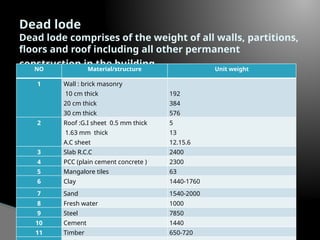
Dead lode
Dead lode comprises of the weight of all walls, partitions,
floors and roof including all other permanent
construction in the building.
NO Material/structure Unit weight
1 Wall : brick masonry
10 cm thick
20 cm thick
30 cm thick
192
384
576
2 Roof :G.I sheet 0.5 mm thick
1.63 mm thick
A.C sheet
5
13
12.15.6
3 Slab R.C.C 2400
4 PCC (plain cement concrete ) 2300
5 Mangalore tiles 63
6 Clay 1440-1760
7 Sand 1540-2000
8 Fresh water 1000
9 Steel 7850
10 Cement 1440
11 Timber 650-720
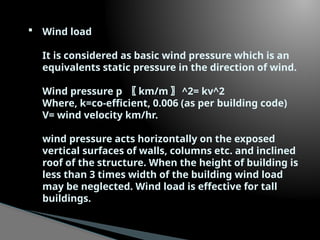
 Wind load
It is considered as basic wind pressure which is an
equivalents static pressure in the direction of wind.
Wind pressure p 〖 km/m 〗 ^2= kv^2
Where, k=co-efficient, 0.006 (as per building code)
V= wind velocity km/hr.
wind pressure acts horizontally on the exposed
vertical surfaces of walls, columns etc. and inclined
roof of the structure. When the height of building is
less than 3 times width of the building wind load
may be neglected. Wind load is effective for tall
buildings.
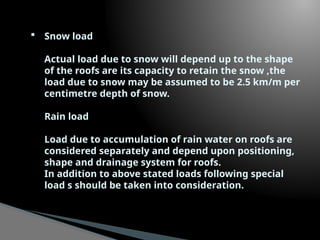
 Snow load
Actual load due to snow will depend up to the shape
of the roofs are its capacity to retain the snow ,the
load due to snow may be assumed to be 2.5 km/m per
centimetre depth of snow.
Rain load
Load due to accumulation of rain water on roofs are
considered separately and depend upon positioning,
shape and drainage system for roofs.
In addition to above stated loads following special
load s should be taken into consideration.
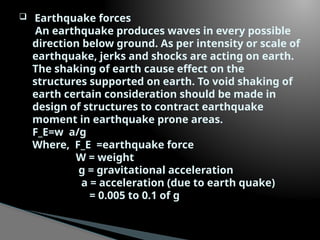
 Earthquake forces
An earthquake produces waves in every possible
direction below ground. As per intensity or scale of
earthquake, jerks and shocks are acting on earth.
The shaking of earth cause effect on the
structures supported on earth. To void shaking of
earth certain consideration should be made in
design of structures to contract earthquake
moment in earthquake prone areas.
F_E=w a/g
Where, F_E =earthquake force
W = weight
g = gravitational acceleration
a = acceleration (due to earth quake)
= 0.005 to 0.1 of g
 Hydrostatic forces:
The pressure generated by water is called as
hydrostatic pressure. They act on the
structure which remain in the water and
which are erected in flowing water body.
Hence for strength and stability hydrostatic
pressure should be taken into consideration
for special structure like overhead water tank,
supports of bridge, dams etc.
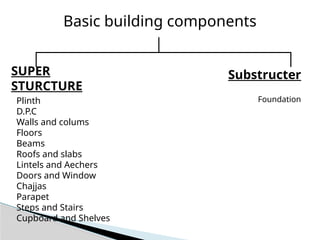
Basic building components
SUPER
STURCTURE
Plinth
D.P.C
Walls and colums
Floors
Beams
Roofs and slabs
Lintels and Aechers
Doors and Window
Chajjas
Parapet
Steps and Stairs
Cupboard and Shelves
Substructer
Foundation
A typical cross section through door and window showing all
Building components
Foundetion - It is a sturcture below the G.L . It is the lowest part of a
building
Plinth – It is the portion of a building above ground up to the finished floor
level. It
is the loer most part of building
Walls – It costructed by the use of bricks, stone, concrete , blocks , etc.
Column – It is a load bearingg member of smaal section of bricks or stone or
concreate
Stair – It is series of steps to connect the different floors of building
Roof – It is the uppermost part of a building to cover the space below
Floors – The floors of each storey, above ground level are none as upper floors
Lintel – It is defined as a horizontal structural member provided across the
opening the
doors and window
Beam – It is defined as a horizontal structural member provided rested above
wals and
Defination of building
Components
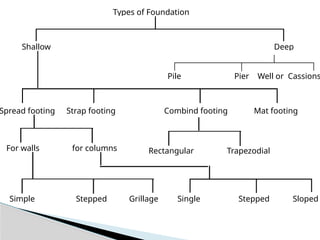
Types of Foundation
Shallow Deep
Pile Pier Well or Cassions
Spread footing Strap footing Combind footing Mat footing
For walls for columns Rectangular Trapezodial
Simple Stepped Grillage Single Stepped Sloped
1 - Shallow Foundation
If depth of foundation is equal to or less than its width, it is called shallow foundations
Generally it is 3 to 4 m.
Spread footing -- which spread the super improsed load of wall or colom
over larger area. Masonary walls have stepped footing
with a concrete base.
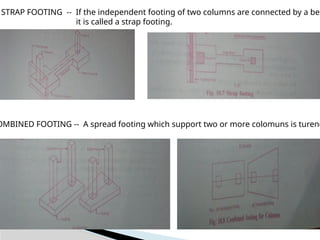
STRAP FOOTING -- If the independent footing of two columns are connected by a bea
it is called a strap footing.
OMBINED FOOTING -- A spread footing which support two or more colomuns is turend
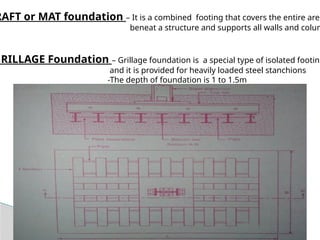
RAFT or MAT foundation – It is a combined footing that covers the entire area
beneat a structure and supports all walls and colum
GRILLAGE Foundation – Grillage foundation is a special type of isolated footing
and it is provided for heavily loaded steel stanchions
-The depth of foundation is 1 to 1.5m
SUPER STRUCTURE
)Plinth
) Wall
(i) Load bearing ( 20,30,40 cm)
(ii) Non-load bearing (Partition wall – 10 )
rick Masonry Wall
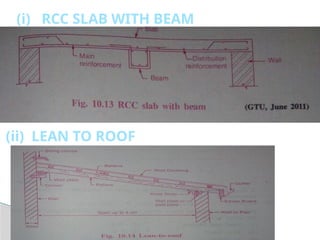
(3) Roof --
Types of roof
Flat Sloped Domes
Lean-to-roof King post trussQueen post truss
Cylindrical Spherical
(i) RCC SLAB WITH BEAM
(ii) LEAN TO ROOF
(4) FLOOR -- A floor provides a plane surface to support the occupants, furnitur
and any equipment.
•TYPES OF FLOOR
(1) Ground floors
(2) Upper floors
The different types of floor which are commonly used for floor constuction is
(1) Mud and Muram (9) Brick
(2) Flag stone (10) C.C
(3) Terrazzo (11)Marble
(4) Tiles (12)Asphalt
(5) Timber (13)Glass
(6) Rubber (14)Granite
(7) Cor (15)Mosaic tiles
(8) Plastic or PVC
Doors & Window
(A)Types of Door
(1) Battened and ledged door
(2) Framed and panelled door
(3) Flush door
(4) Revolving door
(5) Swing door
(6) Collapsible steel door
(7) Mild steel sheet door
(8) Glazed door
Building construction in civil engineering

Building construction in civil engineering

  • 1.
  • 2.
    1. Zavin gajera(groupleader) ch-07 2. Jaydeep rangani ch-10 3. Ninma chandu ch-09 4. Nadan shah ch-12 5. Subham ch-11 GROUP-2
  • 3.
     Introduction  Typesof building  Design load/building load  Common building components  Introduction building bye-laws Topic:construction
  • 4.
     Two typesof building 1. Based upon occupancy 2. Based on structure Types of building
  • 5.
     Building includebased upon occupany. 1. Residential building 2. Educational building 3. Institutional building 4. Assembly building 5. Business building 6. Mercantile building 7. Industrial building 8. Storage building Based upon occopany
  • 6.
    Based on structure 1.Loadbearing structure  It has lod bearing walls which receive the loads and transmit the same to the ground though their foundation.  20,30,40,cm thick walls are load bearing walls.  R.c.c slab is provided directly on load bearing walls.
  • 7.
  • 8.
    2.Framed structure  Inthe buildings with frammed structure,load is transferred through a frame of R.C.C slab,beam,colomn.  In this type of structures,there are partition walls of 10 cm thick,which divide and enclosethe space.  Construction time is less. Based on structure(contd…)
  • 9.
  • 10.
    Designloads/buildingload Various loads aretaken into account while designing the foundation of a structure loads coming on a structure are:
  • 11.
     Live load: Liveload consists of moving or variable load due to people or occupants, their furniture, temporary stores, machinery etc.
  • 12.
    No. Type offloor Minimum live lord ( Kg/) 1 Dwelling house, hospitals , hostels 200 2 Office ,light work room 250-400 3 Bank, office, reading room 300 4 Shops, classrooms, assembly halls, restaurants, power station 400 5 Warehouse, workshop, factory, store room , dancehall 500-1000 6 Light garage 250-400 7 Heavy garage 750 8 Stairs 300-500 9 Balcony 300-500
  • 13.
    The above statedloads are uniformly distributed statin loads in kg/m2 on the plane area and provide for normal effects of impact and acceleration. For multi-storeyed buildings, live loads are considered in designing columns, walls, and foundations depend upon number of floors. Number of floors carried by member (column, foundation, wall etc.) Total L.L on all floors above the member 1 100% 2 90% 3 80% 4 70% 5 60% 6 or more 50%
  • 14.
    Dead lode Dead lodecomprises of the weight of all walls, partitions, floors and roof including all other permanent construction in the building. NO Material/structure Unit weight 1 Wall : brick masonry 10 cm thick 20 cm thick 30 cm thick 192 384 576 2 Roof :G.I sheet 0.5 mm thick 1.63 mm thick A.C sheet 5 13 12.15.6 3 Slab R.C.C 2400 4 PCC (plain cement concrete ) 2300 5 Mangalore tiles 63 6 Clay 1440-1760 7 Sand 1540-2000 8 Fresh water 1000 9 Steel 7850 10 Cement 1440 11 Timber 650-720
  • 15.
     Wind load Itis considered as basic wind pressure which is an equivalents static pressure in the direction of wind. Wind pressure p 〖 km/m 〗 ^2= kv^2 Where, k=co-efficient, 0.006 (as per building code) V= wind velocity km/hr. wind pressure acts horizontally on the exposed vertical surfaces of walls, columns etc. and inclined roof of the structure. When the height of building is less than 3 times width of the building wind load may be neglected. Wind load is effective for tall buildings.
  • 16.
     Snow load Actualload due to snow will depend up to the shape of the roofs are its capacity to retain the snow ,the load due to snow may be assumed to be 2.5 km/m per centimetre depth of snow. Rain load Load due to accumulation of rain water on roofs are considered separately and depend upon positioning, shape and drainage system for roofs. In addition to above stated loads following special load s should be taken into consideration.
  • 17.
     Earthquake forces Anearthquake produces waves in every possible direction below ground. As per intensity or scale of earthquake, jerks and shocks are acting on earth. The shaking of earth cause effect on the structures supported on earth. To void shaking of earth certain consideration should be made in design of structures to contract earthquake moment in earthquake prone areas. F_E=w a/g Where, F_E =earthquake force W = weight g = gravitational acceleration a = acceleration (due to earth quake) = 0.005 to 0.1 of g
  • 18.
     Hydrostatic forces: Thepressure generated by water is called as hydrostatic pressure. They act on the structure which remain in the water and which are erected in flowing water body. Hence for strength and stability hydrostatic pressure should be taken into consideration for special structure like overhead water tank, supports of bridge, dams etc.
  • 19.
    Basic building components SUPER STURCTURE Plinth D.P.C Wallsand colums Floors Beams Roofs and slabs Lintels and Aechers Doors and Window Chajjas Parapet Steps and Stairs Cupboard and Shelves Substructer Foundation
  • 20.
    A typical crosssection through door and window showing all Building components
  • 21.
    Foundetion - Itis a sturcture below the G.L . It is the lowest part of a building Plinth – It is the portion of a building above ground up to the finished floor level. It is the loer most part of building Walls – It costructed by the use of bricks, stone, concrete , blocks , etc. Column – It is a load bearingg member of smaal section of bricks or stone or concreate Stair – It is series of steps to connect the different floors of building Roof – It is the uppermost part of a building to cover the space below Floors – The floors of each storey, above ground level are none as upper floors Lintel – It is defined as a horizontal structural member provided across the opening the doors and window Beam – It is defined as a horizontal structural member provided rested above wals and Defination of building Components
  • 22.
    Types of Foundation ShallowDeep Pile Pier Well or Cassions Spread footing Strap footing Combind footing Mat footing For walls for columns Rectangular Trapezodial Simple Stepped Grillage Single Stepped Sloped
  • 23.
    1 - ShallowFoundation If depth of foundation is equal to or less than its width, it is called shallow foundations Generally it is 3 to 4 m.
  • 24.
    Spread footing --which spread the super improsed load of wall or colom over larger area. Masonary walls have stepped footing with a concrete base.
  • 25.
    STRAP FOOTING --If the independent footing of two columns are connected by a bea it is called a strap footing. OMBINED FOOTING -- A spread footing which support two or more colomuns is turend
  • 26.
    RAFT or MATfoundation – It is a combined footing that covers the entire area beneat a structure and supports all walls and colum GRILLAGE Foundation – Grillage foundation is a special type of isolated footing and it is provided for heavily loaded steel stanchions -The depth of foundation is 1 to 1.5m
  • 27.
    SUPER STRUCTURE )Plinth ) Wall (i)Load bearing ( 20,30,40 cm) (ii) Non-load bearing (Partition wall – 10 ) rick Masonry Wall
  • 28.
    (3) Roof -- Typesof roof Flat Sloped Domes Lean-to-roof King post trussQueen post truss Cylindrical Spherical
  • 29.
    (i) RCC SLABWITH BEAM (ii) LEAN TO ROOF
  • 30.
    (4) FLOOR --A floor provides a plane surface to support the occupants, furnitur and any equipment. •TYPES OF FLOOR (1) Ground floors (2) Upper floors The different types of floor which are commonly used for floor constuction is (1) Mud and Muram (9) Brick (2) Flag stone (10) C.C (3) Terrazzo (11)Marble (4) Tiles (12)Asphalt (5) Timber (13)Glass (6) Rubber (14)Granite (7) Cor (15)Mosaic tiles (8) Plastic or PVC
  • 31.
    Doors & Window (A)Typesof Door (1) Battened and ledged door (2) Framed and panelled door (3) Flush door (4) Revolving door (5) Swing door (6) Collapsible steel door (7) Mild steel sheet door (8) Glazed door