11
2
CH:- 8 INTRODUCTION
What is a bridge?
 A bridge is a structure that spans a
divide such as:
 A stream/river/ravine/valley
 Railroad track/roadway/waterway
 The traffic that
uses a bridge
may include:
 Pedestrian or cycle traffic
 Vehicular or rail traffic
 Water/gas pipes
 A combination of all the above
3
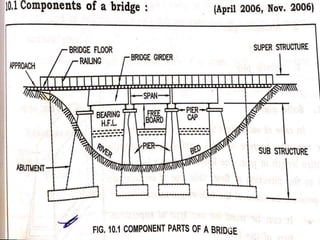
Components of bridge
4
The components of the bridge above the
bearing is known as Super Structure.
 Beams, Girders
 Arch, Cables
 Flooring
 Bearing
 Parapet wall,
Hand Rail
Super structure
5
The components of the bridge below the level of
bearings is known as Sub Structure.
 Abutments
 Piers
 Wing walls
 Foundation
for
abutments
and Piers
Sub structure
6
Classification of
Bridges
Based on material
As per alignment
As per location of bridges
Purpose
Acc. To type of super structure
Acc. To HFL
Acc. To type of span
Acc. To span length
Acc. To navigation facilities
Acc. To loading
Acc. Life of bridges 7
2. Stone1. Timber Bridge:
Masonry Bridge
SOURCE: GOOGLE IMAGES
8
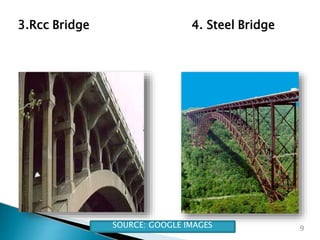
3.Rcc Bridge 4. Steel Bridge
SOURCE: GOOGLE IMAGES 9
6. Composite Bridge5. Prestressed concrete
Bridge
SOURCE: GOOGLE IMAGES
Pamban road bridge- tamilnadu
10
1. Straight Alignment:
When the
alignment of bridge is
perpendicular to the
centre line of a river, it
is called straight bridge.
2. Skew Bridge:
alignm
When the
not
ent of a bridge is
cen
perpendicular to the
cal
tre line of river, is
led Skew Bridge.
11
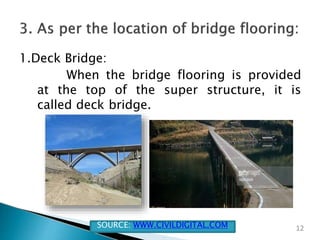
1.Deck Bridge:
When the bridge flooring is provided
at the top of the super structure, it is
called deck bridge.
SOURCE: WWW.CIVILDIGITAL.COM 12
2. Through Bridge:
When the bridge
flooring is provided at
the bottom of the super
structure, it is
Semi-Through
super
called
Bridge.
Bayonne Bridge-new york
structure, it is called
Through Bridge.
Chaotianmen Bridge -china
3. Semi-Through Bridge:
When the flooring
is located at some
intermediate level in the
13
1. Aquaduct:
It is small bridge constructed
over a stream which remains dry for most
part of the year is called aquaduct.
SOURCE: WWW.CIVILDIGITAL.COM 14
2. Viaduct:
str
It is a long continuous
ucture which carries a
road or railway like bridge
over dry valley composed of
a series of spans trestle
bents instead of solid piers.
3. Grade separator:
When two roads crosses
each other and there is
considerable differences in
their formation level, a
bridge structure is
constructed , which is known
as grade separator.
4. Highway Bridge:
It is constructed on a
roadway for the movement
of vehicles.
Panval Viaduct, India
Koyambedu
grade
separator,
Tamilnadu,
India.
Eastern
Peripheral
Expressway
India
15
5. Railway Bridge
It is constructed for the railway.
6. Foot Bridge
A foot bridge is a bridge exclusively used
for carrying pedestrians, cycles and animals.
7. Pipe Bridge
It is used to support pipeline for water, gas,
oil, etc.
16
1. Slab Bridge:
When the span of
bridge is 3 to 6m, slab
bridge is used, It is also
called culvert.
2. Girder bridge:
When the span of a
bridge is more, flooring
is supported on RCC or
steel girder. Such type
of bridge is called
girder bridge.
17
3. Truss Bridge
When the flooring of a bridge is supported
over steel trusses it is called truss bridge.
Normally such type of bridges are used for
railways.
SOURCE: WWW.CIVILDIGITAL.COM 18
4. Suspension Bridge:
Suspension bridges consists of sets of
cables hanging in a curve from which the
roadway is supported.
A flooring load is transferred suspenders
and cables to the piers.
Narmada bridge
19
5. Arch Bridge:
In such type of bridge the weight of
flooring is transferred to the piers through the
arch. the floor beam is suspended trough
hangers from arch.
SOURCE: WWW.CIVILDIGITAL.COM
20
1.Submersible bridge or
causeway:
A road causeway is a
pucca dip which allows
floods to pass over it. It may
or may not have openings or
vents for low water to flow.
2. Non-Submersible bridge:
In this types of bridge
formation level is kept above
the HFL, so that maximum
flood does not affect the
traffic on the bridge.
21
1. Simply supported Bridge:
When the bridge girders are simply
supported on piers, it is known as simply
supported bridges.
2. Continuous Bridge:
When the super structure of a bridge is
continuous over more than two supports, it is
called continuous bridge.
SOURCE: GOOGLE IMAGES
Glenn L. Jackson Memorial Bridge,USA
22
3. Cantilever bridge:
A cantilever bridge is formed of cantilevers
projecting from the supporting piers. The ends
of a cantilever bridges are treated as fixed.
4. Balanced cantilever bridge:
A balanced cantilever bridge consists of
spans simply supported over cantilever.
Forth Bridge,
United Kingdom, Edinburgh,
23
1. Culvert - span up to 8m.
2. Minor bridge – span 8 to 30m.
3. Major bridge – span 30 to 120m.
4. Long span bridge – span above 120m.
24
1. Swing bridge:
In case of swing bridge a central pier is
provided with suitable bearing or rollers. The
super structure consists of a pair of steel
trusses and it can be rotated in a horizontal
plan about vertical axis.
SOURCE: GOOGLE IMAGES
Lake Okeechobee
LAKE, FLORIDA, UNITED STATES
25
2. Bascule bridge:
In case of bascule bridge, the entire
structure is rotated in a vertical plane about a
horizontal axis.
Lowestoft
26
3. Traverser bridge:
In case of traverser bridge, it is so arranged
that the whole bridge can fully or partially be rolled
forward or backward across the openings.
4. Lift bridge:
In this type of bridge the truss is lifted up.
5. Transporter bridge:
In case of transporter bridge, a moving cage is
suspended from an overhead truss with the help of
cable or wire ropes.
27
1. Temporary bridge:
a. pontoon bridge- KUMBH MELA
b. boat bridge : COLKATA-RABINDRANATH SETU
c. flying bridge- West India Quay
London, UK
28
2. Permanent bridge:
a. RCC bridges
b. masonry bridges -Rajasthan
c. steel bridges : Surat tapti river
29
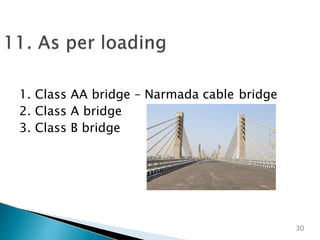
1. Class AA bridge – Narmada cable bridge
2. Class A bridge
3. Class B bridge
30
 A low coast bridge may be define as bridge
constructed at low cost and capable of being
maintained at low cost.
Reason to construct low coast bridge
 Lack of money, resource
 Lack of time and materials
 Temporary need
 Repairs to permanent works
 Undertaking project surveys in the interiors
 To facilitate the execution of permanent works.
31
 Causeways
 Culverts
 Timber bridges
 Floating bridges
 Flying bridges
32
33
CH:- 9 INVESTIGATIONS FOR
BRIDGE
• Span length
• Bridge length
• Beam spacing
• Material available
•Site conditions (foundation, height, apace
constraints)
• Speed of construction
• Aesthetics
• Cost
• Access for maintenance
Selection of site
34
 Width of bridge
 A straight reach
 Foundations
 River banks
 Square alignment
 Materials and labour
 Velocity of flow
 Free board
 Minimum obstruction to waterway
 Absence of scouring and silting
 No confluence of large tributaries
 Adequate vertical height
35
 Length of the bridge:- The distance between inner
faces of two abutments is called length of the
bridge.(L)
 The clear distance between two piers or between
abutment and pier is called the clear span.
 Let , there are n numbers of spans.
NO. of piers=n-1
Length of bridge,
L=(n*l)+(n-l)*b
where, l=clear span
n=number of span
b=width of span
36
37
 Linear water way: The area through which the water
flows under a bridge super structure is known as
the water way of the bridge & the linear
measurement of waterway between the two edges
of the flow of the water, perpendicular to the
abutments is called linear water way.
 Linear water way=sum of all the clear span
 Effective linear water way:
= width of river bed - obstructions to flow like pier
width
38
39
 Afflux: when a bridge is constructed, the structures such as
abutment and piers cause the reduction of the natural
water way area, so to carry the maximum flood discharge ,
the velocity under a bridge increase. This increased velocity
gives rise to a sudden heading up of water on the upstream
side of the stream.This phenomenon of heading up of
water on the upstream side of the stream is known as
afflux. afflux= Increased in water level due to obstructions
- Normal water level.
Free board: Free board is the vertical distance between the
designed high flood level, allowing for afflux, if any , and
the level of the bottom of the bridge girders.
Vertical clearance: They are of two types:
1) Below super structure
2) Above super structure 40
41
FREE BOARD
42
Type of bridge Free board in mm
High level bridge 600
Arch 300
Girder 600 to 900
Navigational streams 2400 to 3000
FREE BOARD
43
 Below super structure: IT is a vertical intercept
between the lowest level of supporting structure of
bridge flooring and the maximum water level at
time of HFL.
 Above super structure: When vehicle travel on
abridge any projecting part of the vehicle should
not strike with sides or at the top.
 High flood level: it is the level of the highest flood
ever recorded or calculated.
 Formation level: The level of flooring of a bridge
super structure is called formation level.
44
45
46
 Scour depth: The term scour used to indicate the
increase in depth in vertical direction of the bed of
river , such increase in depth in mainly due to the
currents of flowing water. The bridge foundations
should be taken beyond the depth of scour.
 Economic span: The economic span of a bridge is
the one which reduces the overall cost of a bridge
to be a minimum.
 Thus most economic span length is that which
satisfies the following,i.e,
The cost of the super structure=The cost of the
substructure.
47
48
49
50
CH:- 10 BRIDGE STRUCTURE
AND SUPER STRUCTURE
51
52
 Solid pier
 Dumb bell
 Column pier
 Cylindrical pier
 Abutment pier
 Pile pier
 Trestle pier
 Cellular pier
53
54
Solid pier Dumbell pier
Column pier Cylindrical pier
55
Abutment pier
Pile pier
Trestle pier
Cellular pier
 To transfer the load of the superstructure to the
soil through foundation.
 To divide the bridge length into suitable spans.
Function of weep holes:
 Weep holes are provided to drain off water which
gets access to the earth filling.
56
 The end support of a bridge super structure is
known as an abutment.
Function :
 To finish up the bridge so that it can be put for
use.
 To retain the earth filling.
 To transmit the reaction of superstructure to the
foundation.
57
 The device which are provided over the supports
of the bridge to accommodate the changes in the
main girders due to deflection, temperature,
vertical movement due to shrinkage, creep.
prestressing etc ,and to transmit the load from the
superstructure to the substructure are known as
bearings.
58
 To absorb movement of girders.
 To distribute load on large area.
 To simplify the procedure in design.
 To keep the procedure in design.
 To keep the compressive stress within limits.
 To transfer horizontal forces due to braking.
59
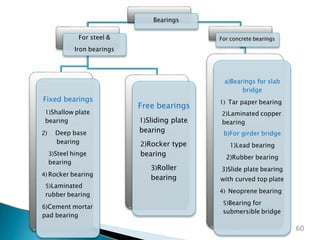
Bearings
For steel &
Iron bearings
Fixed bearings
1)Shallow plate
bearing
2) Deep base
bearing
3)Steel hinge
bearing
4) Rocker bearing
5)Laminated
rubber bearing
6)Cement mortar
pad bearing
Free bearings
1)Sliding plate
bearing
2)Rocker type
bearing
3)Roller
bearing
For concrete bearings
a)Bearings for slab
bridge
1) Tar paper bearing
2)Laminated copper
bearing
b)For girder bridge
1)Lead bearing
2)Rubber bearing
3)Slide plate bearing
with curved top plate
4) Neoprene bearing
5)Bearing for
submersible bridge
60
61
CH:- 11 MAINTENANCE
OF BRIDGE
Factors affecting deterioration:
 Defective design of bridge
 Poor quality of construction materials
 Poor quality control during construction
 Effect of water on the parts in contact with water
 Resistance to weathering effects
 Temperature changes
 Movement of vehicles heavier than the design load
 Miscellaneous factors like flood,earthquake,etc.
 Negligence to minor defects.
62
Various inspection were carried out to prevent
deterioration are:
 Inspection of foundation
 Inspection of substructure
 Inspection of superstructure
 Inspection of approach road
 Inspection of bearings
 Inspection of waterway
 Inspection of protection works
 Inspection about scouring
63
 Weakening of foundation : In such case, the bridge
should be closed for traffic. By underpinning
technique the foundation should be strengthened
by providing grillage foundation or pile foundation.
 Erosion of foundation: If erosion is substantial,
urgent repair is required. The soil surrounding the
old foundation is excavated and new concrete bed
is provided. If depth of scour is more sheet piles
are driven around the old foundation.
64
 Damage flooring and approaches: In case of
cement concrete road , if the wearing surface of
road is worm out due to heavy traffic and
reinforcement bars are visible , it is visible to
provide a new layer of cement concrete or
bituminous concrete.
 Defects in bearings: For effective functioning of
bearing following care is to be taken:
 Cleaning of bearing regularly
 Regular lubrication
 There should not be cracks in the bearing
 It should be free from corrosion.
65
66
Purpose of inspection report:
 To get the information regarding damage to the
various components.
 To prepare an estimate of repair
 To know the cause of damage
 To decide the importance of works of repair
 To make arrangement of funds for repair
Necessity of inspection report:
 Inspection report is necessary to decide the
requirement of skilled and unskilled labours
machinery machinery and equipments.
 To make alternative planning for diversion of traffic
in advance.
67
68

Bridge Engineering

  • 1.
  • 2.
  • 3.
    What is abridge?  A bridge is a structure that spans a divide such as:  A stream/river/ravine/valley  Railroad track/roadway/waterway  The traffic that uses a bridge may include:  Pedestrian or cycle traffic  Vehicular or rail traffic  Water/gas pipes  A combination of all the above 3
  • 4.
  • 5.
    The components ofthe bridge above the bearing is known as Super Structure.  Beams, Girders  Arch, Cables  Flooring  Bearing  Parapet wall, Hand Rail Super structure 5
  • 6.
    The components ofthe bridge below the level of bearings is known as Sub Structure.  Abutments  Piers  Wing walls  Foundation for abutments and Piers Sub structure 6
  • 7.
    Classification of Bridges Based onmaterial As per alignment As per location of bridges Purpose Acc. To type of super structure Acc. To HFL Acc. To type of span Acc. To span length Acc. To navigation facilities Acc. To loading Acc. Life of bridges 7
  • 8.
    2. Stone1. TimberBridge: Masonry Bridge SOURCE: GOOGLE IMAGES 8
  • 9.
    3.Rcc Bridge 4.Steel Bridge SOURCE: GOOGLE IMAGES 9
  • 10.
    6. Composite Bridge5.Prestressed concrete Bridge SOURCE: GOOGLE IMAGES Pamban road bridge- tamilnadu 10
  • 11.
    1. Straight Alignment: Whenthe alignment of bridge is perpendicular to the centre line of a river, it is called straight bridge. 2. Skew Bridge: alignm When the not ent of a bridge is cen perpendicular to the cal tre line of river, is led Skew Bridge. 11
  • 12.
    1.Deck Bridge: When thebridge flooring is provided at the top of the super structure, it is called deck bridge. SOURCE: WWW.CIVILDIGITAL.COM 12
  • 13.
    2. Through Bridge: Whenthe bridge flooring is provided at the bottom of the super structure, it is Semi-Through super called Bridge. Bayonne Bridge-new york structure, it is called Through Bridge. Chaotianmen Bridge -china 3. Semi-Through Bridge: When the flooring is located at some intermediate level in the 13
  • 14.
    1. Aquaduct: It issmall bridge constructed over a stream which remains dry for most part of the year is called aquaduct. SOURCE: WWW.CIVILDIGITAL.COM 14
  • 15.
    2. Viaduct: str It isa long continuous ucture which carries a road or railway like bridge over dry valley composed of a series of spans trestle bents instead of solid piers. 3. Grade separator: When two roads crosses each other and there is considerable differences in their formation level, a bridge structure is constructed , which is known as grade separator. 4. Highway Bridge: It is constructed on a roadway for the movement of vehicles. Panval Viaduct, India Koyambedu grade separator, Tamilnadu, India. Eastern Peripheral Expressway India 15
  • 16.
    5. Railway Bridge Itis constructed for the railway. 6. Foot Bridge A foot bridge is a bridge exclusively used for carrying pedestrians, cycles and animals. 7. Pipe Bridge It is used to support pipeline for water, gas, oil, etc. 16
  • 17.
    1. Slab Bridge: Whenthe span of bridge is 3 to 6m, slab bridge is used, It is also called culvert. 2. Girder bridge: When the span of a bridge is more, flooring is supported on RCC or steel girder. Such type of bridge is called girder bridge. 17
  • 18.
    3. Truss Bridge Whenthe flooring of a bridge is supported over steel trusses it is called truss bridge. Normally such type of bridges are used for railways. SOURCE: WWW.CIVILDIGITAL.COM 18
  • 19.
    4. Suspension Bridge: Suspensionbridges consists of sets of cables hanging in a curve from which the roadway is supported. A flooring load is transferred suspenders and cables to the piers. Narmada bridge 19
  • 20.
    5. Arch Bridge: Insuch type of bridge the weight of flooring is transferred to the piers through the arch. the floor beam is suspended trough hangers from arch. SOURCE: WWW.CIVILDIGITAL.COM 20
  • 21.
    1.Submersible bridge or causeway: Aroad causeway is a pucca dip which allows floods to pass over it. It may or may not have openings or vents for low water to flow. 2. Non-Submersible bridge: In this types of bridge formation level is kept above the HFL, so that maximum flood does not affect the traffic on the bridge. 21
  • 22.
    1. Simply supportedBridge: When the bridge girders are simply supported on piers, it is known as simply supported bridges. 2. Continuous Bridge: When the super structure of a bridge is continuous over more than two supports, it is called continuous bridge. SOURCE: GOOGLE IMAGES Glenn L. Jackson Memorial Bridge,USA 22
  • 23.
    3. Cantilever bridge: Acantilever bridge is formed of cantilevers projecting from the supporting piers. The ends of a cantilever bridges are treated as fixed. 4. Balanced cantilever bridge: A balanced cantilever bridge consists of spans simply supported over cantilever. Forth Bridge, United Kingdom, Edinburgh, 23
  • 24.
    1. Culvert -span up to 8m. 2. Minor bridge – span 8 to 30m. 3. Major bridge – span 30 to 120m. 4. Long span bridge – span above 120m. 24
  • 25.
    1. Swing bridge: Incase of swing bridge a central pier is provided with suitable bearing or rollers. The super structure consists of a pair of steel trusses and it can be rotated in a horizontal plan about vertical axis. SOURCE: GOOGLE IMAGES Lake Okeechobee LAKE, FLORIDA, UNITED STATES 25
  • 26.
    2. Bascule bridge: Incase of bascule bridge, the entire structure is rotated in a vertical plane about a horizontal axis. Lowestoft 26
  • 27.
    3. Traverser bridge: Incase of traverser bridge, it is so arranged that the whole bridge can fully or partially be rolled forward or backward across the openings. 4. Lift bridge: In this type of bridge the truss is lifted up. 5. Transporter bridge: In case of transporter bridge, a moving cage is suspended from an overhead truss with the help of cable or wire ropes. 27
  • 28.
    1. Temporary bridge: a.pontoon bridge- KUMBH MELA b. boat bridge : COLKATA-RABINDRANATH SETU c. flying bridge- West India Quay London, UK 28
  • 29.
    2. Permanent bridge: a.RCC bridges b. masonry bridges -Rajasthan c. steel bridges : Surat tapti river 29
  • 30.
    1. Class AAbridge – Narmada cable bridge 2. Class A bridge 3. Class B bridge 30
  • 31.
     A lowcoast bridge may be define as bridge constructed at low cost and capable of being maintained at low cost. Reason to construct low coast bridge  Lack of money, resource  Lack of time and materials  Temporary need  Repairs to permanent works  Undertaking project surveys in the interiors  To facilitate the execution of permanent works. 31
  • 32.
     Causeways  Culverts Timber bridges  Floating bridges  Flying bridges 32
  • 33.
  • 34.
    • Span length •Bridge length • Beam spacing • Material available •Site conditions (foundation, height, apace constraints) • Speed of construction • Aesthetics • Cost • Access for maintenance Selection of site 34
  • 35.
     Width ofbridge  A straight reach  Foundations  River banks  Square alignment  Materials and labour  Velocity of flow  Free board  Minimum obstruction to waterway  Absence of scouring and silting  No confluence of large tributaries  Adequate vertical height 35
  • 36.
     Length ofthe bridge:- The distance between inner faces of two abutments is called length of the bridge.(L)  The clear distance between two piers or between abutment and pier is called the clear span.  Let , there are n numbers of spans. NO. of piers=n-1 Length of bridge, L=(n*l)+(n-l)*b where, l=clear span n=number of span b=width of span 36
  • 37.
  • 38.
     Linear waterway: The area through which the water flows under a bridge super structure is known as the water way of the bridge & the linear measurement of waterway between the two edges of the flow of the water, perpendicular to the abutments is called linear water way.  Linear water way=sum of all the clear span  Effective linear water way: = width of river bed - obstructions to flow like pier width 38
  • 39.
  • 40.
     Afflux: whena bridge is constructed, the structures such as abutment and piers cause the reduction of the natural water way area, so to carry the maximum flood discharge , the velocity under a bridge increase. This increased velocity gives rise to a sudden heading up of water on the upstream side of the stream.This phenomenon of heading up of water on the upstream side of the stream is known as afflux. afflux= Increased in water level due to obstructions - Normal water level. Free board: Free board is the vertical distance between the designed high flood level, allowing for afflux, if any , and the level of the bottom of the bridge girders. Vertical clearance: They are of two types: 1) Below super structure 2) Above super structure 40
  • 41.
  • 42.
  • 43.
    Type of bridgeFree board in mm High level bridge 600 Arch 300 Girder 600 to 900 Navigational streams 2400 to 3000 FREE BOARD 43
  • 44.
     Below superstructure: IT is a vertical intercept between the lowest level of supporting structure of bridge flooring and the maximum water level at time of HFL.  Above super structure: When vehicle travel on abridge any projecting part of the vehicle should not strike with sides or at the top.  High flood level: it is the level of the highest flood ever recorded or calculated.  Formation level: The level of flooring of a bridge super structure is called formation level. 44
  • 45.
  • 46.
  • 47.
     Scour depth:The term scour used to indicate the increase in depth in vertical direction of the bed of river , such increase in depth in mainly due to the currents of flowing water. The bridge foundations should be taken beyond the depth of scour.  Economic span: The economic span of a bridge is the one which reduces the overall cost of a bridge to be a minimum.  Thus most economic span length is that which satisfies the following,i.e, The cost of the super structure=The cost of the substructure. 47
  • 48.
  • 49.
  • 50.
    50 CH:- 10 BRIDGESTRUCTURE AND SUPER STRUCTURE
  • 51.
  • 52.
  • 53.
     Solid pier Dumb bell  Column pier  Cylindrical pier  Abutment pier  Pile pier  Trestle pier  Cellular pier 53
  • 54.
    54 Solid pier Dumbellpier Column pier Cylindrical pier
  • 55.
  • 56.
     To transferthe load of the superstructure to the soil through foundation.  To divide the bridge length into suitable spans. Function of weep holes:  Weep holes are provided to drain off water which gets access to the earth filling. 56
  • 57.
     The endsupport of a bridge super structure is known as an abutment. Function :  To finish up the bridge so that it can be put for use.  To retain the earth filling.  To transmit the reaction of superstructure to the foundation. 57
  • 58.
     The devicewhich are provided over the supports of the bridge to accommodate the changes in the main girders due to deflection, temperature, vertical movement due to shrinkage, creep. prestressing etc ,and to transmit the load from the superstructure to the substructure are known as bearings. 58
  • 59.
     To absorbmovement of girders.  To distribute load on large area.  To simplify the procedure in design.  To keep the procedure in design.  To keep the compressive stress within limits.  To transfer horizontal forces due to braking. 59
  • 60.
    Bearings For steel & Ironbearings Fixed bearings 1)Shallow plate bearing 2) Deep base bearing 3)Steel hinge bearing 4) Rocker bearing 5)Laminated rubber bearing 6)Cement mortar pad bearing Free bearings 1)Sliding plate bearing 2)Rocker type bearing 3)Roller bearing For concrete bearings a)Bearings for slab bridge 1) Tar paper bearing 2)Laminated copper bearing b)For girder bridge 1)Lead bearing 2)Rubber bearing 3)Slide plate bearing with curved top plate 4) Neoprene bearing 5)Bearing for submersible bridge 60
  • 61.
  • 62.
    Factors affecting deterioration: Defective design of bridge  Poor quality of construction materials  Poor quality control during construction  Effect of water on the parts in contact with water  Resistance to weathering effects  Temperature changes  Movement of vehicles heavier than the design load  Miscellaneous factors like flood,earthquake,etc.  Negligence to minor defects. 62
  • 63.
    Various inspection werecarried out to prevent deterioration are:  Inspection of foundation  Inspection of substructure  Inspection of superstructure  Inspection of approach road  Inspection of bearings  Inspection of waterway  Inspection of protection works  Inspection about scouring 63
  • 64.
     Weakening offoundation : In such case, the bridge should be closed for traffic. By underpinning technique the foundation should be strengthened by providing grillage foundation or pile foundation.  Erosion of foundation: If erosion is substantial, urgent repair is required. The soil surrounding the old foundation is excavated and new concrete bed is provided. If depth of scour is more sheet piles are driven around the old foundation. 64
  • 65.
     Damage flooringand approaches: In case of cement concrete road , if the wearing surface of road is worm out due to heavy traffic and reinforcement bars are visible , it is visible to provide a new layer of cement concrete or bituminous concrete.  Defects in bearings: For effective functioning of bearing following care is to be taken:  Cleaning of bearing regularly  Regular lubrication  There should not be cracks in the bearing  It should be free from corrosion. 65
  • 66.
  • 67.
    Purpose of inspectionreport:  To get the information regarding damage to the various components.  To prepare an estimate of repair  To know the cause of damage  To decide the importance of works of repair  To make arrangement of funds for repair Necessity of inspection report:  Inspection report is necessary to decide the requirement of skilled and unskilled labours machinery machinery and equipments.  To make alternative planning for diversion of traffic in advance. 67
  • 68.