Prof. Karan S. Chauhan
Assistant Professor
Department Of Civil Engineering
@ Shri Labhubhai Trivedi Institute Of
Engineering And Technology
Stair & StaircaseStair & Staircase
Subject :- Building Construction
Subject Code : 2130607
 A stair is a set of steps, leading from one floor to other ,
provided to afford the means of ascent or descent between
the various floors of building.
 The room or enclosure of building in which the stair is
located is known as stair-case.
 STEP: It’s a portion of stair which permits ascent or
descent it is comprised of a trend and a riser
 The upper horizontal of a step upon which the foot is
placed while ascending or descending
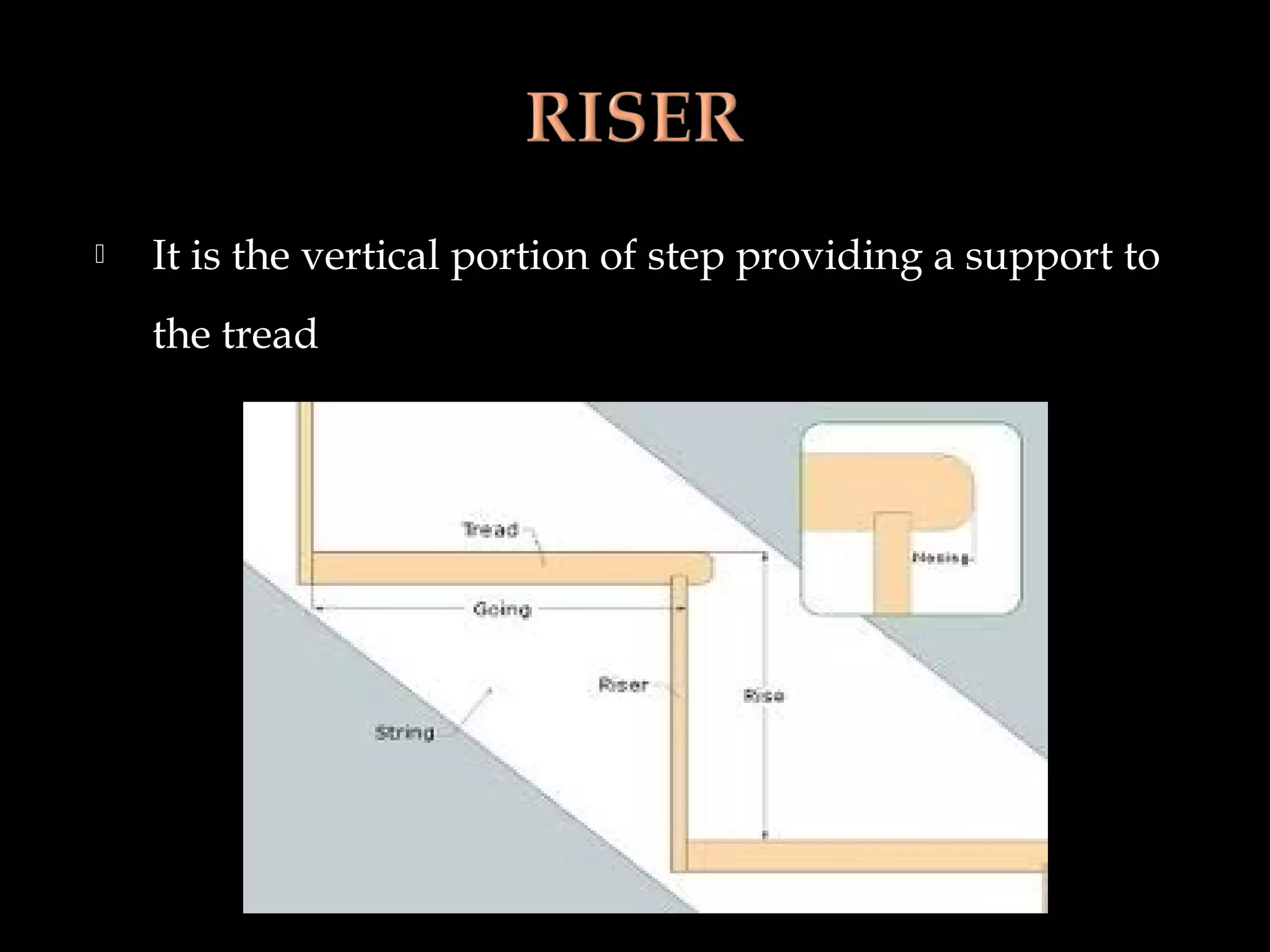
 It is the vertical portion of step providing a support to
the tread
 This is an unbroken series of steps between lading
 Its level platform at the top or bottom of a flight
between the floors
 Main reason for lading is providing some rest for the
climber
 Vertical distance between two successive tread faces.
 It’s the horizontal distance between two successive
riser faces
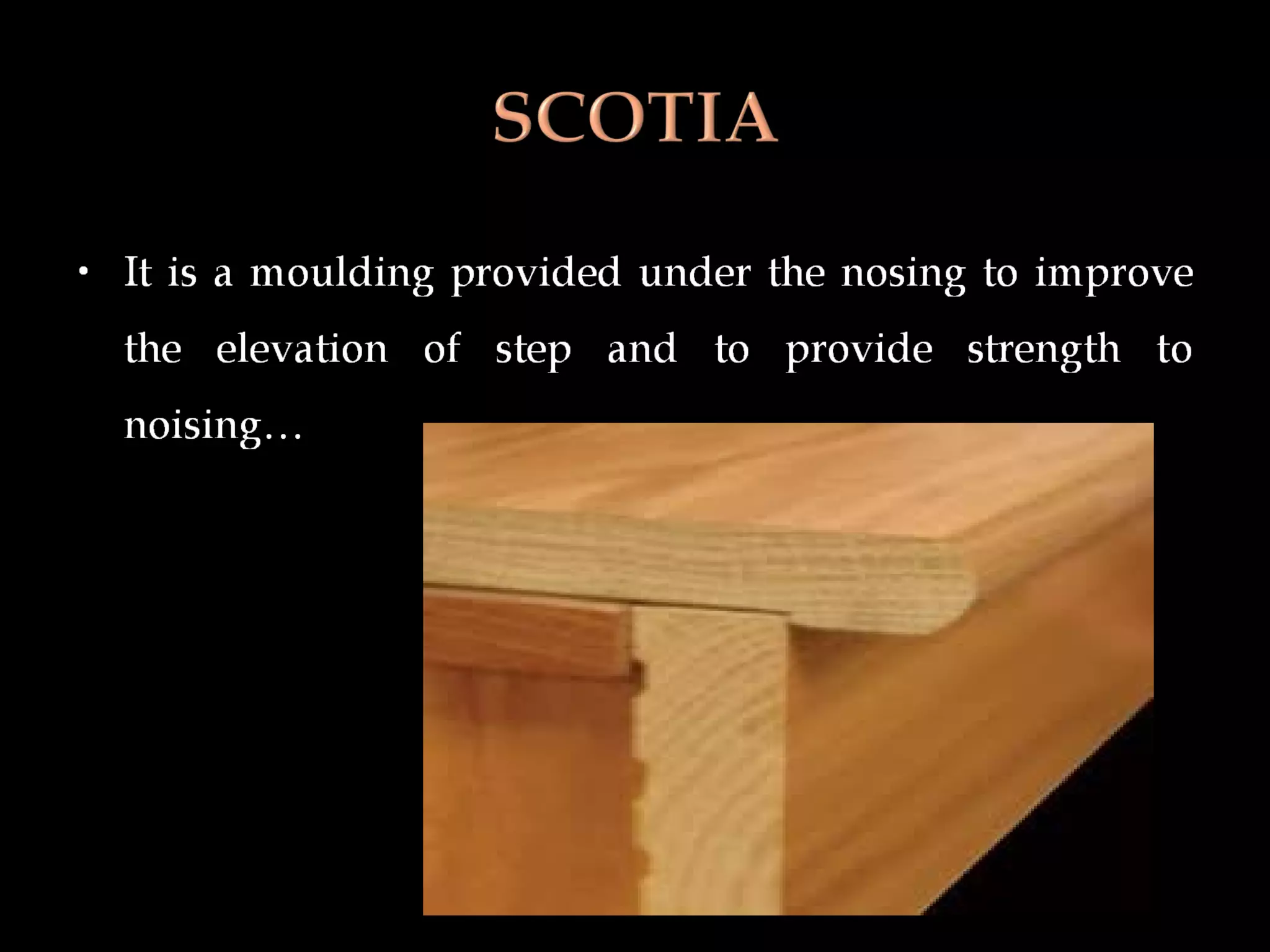
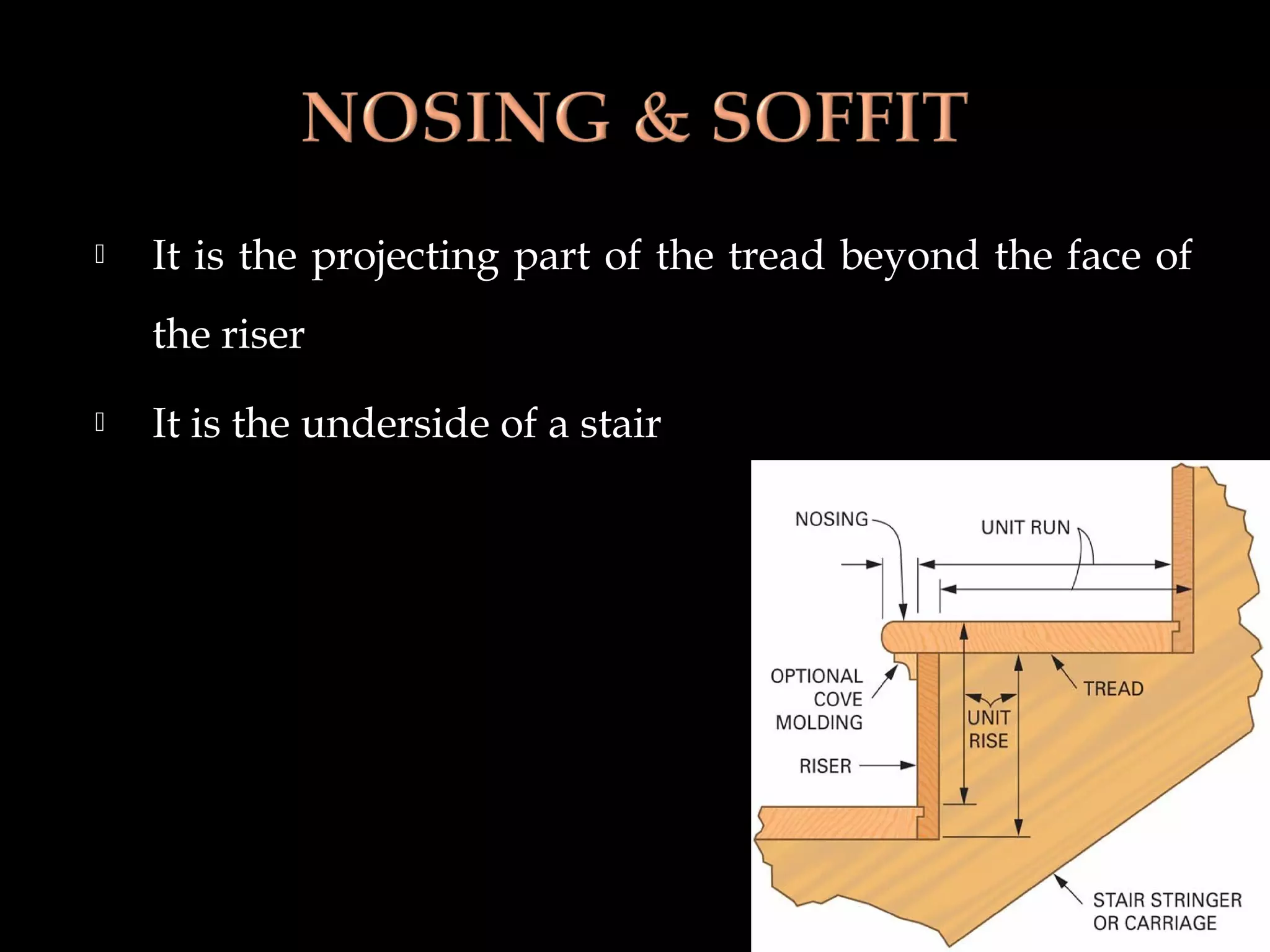
 It is the projecting part of the tread beyond the face of
the riser
 It is the underside of a stair
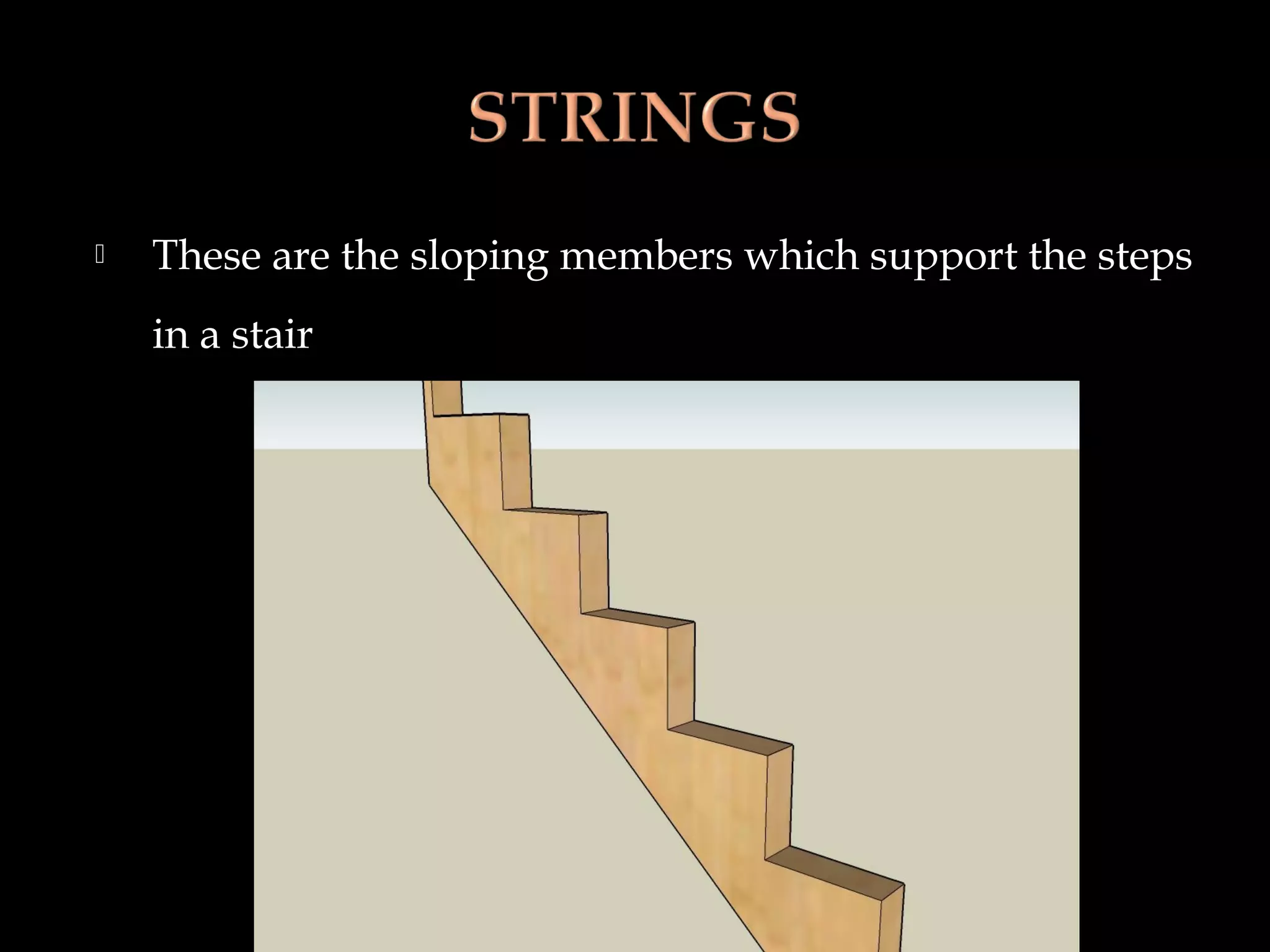
 These are the sloping members which support the steps
in a stair
 Newel post is a vertical member which is placed at the
ends of flights to connect the ends of strings and hard
rail…
 It is vertical member of wood or metal, supporting the
hand rail
 It is a rounded or moulded memoire of wood or metal
following generally the contour of the nosing line and
fixed on the top of balusters
 It is the minimum clear vertical distance between the
treads and overhead structure
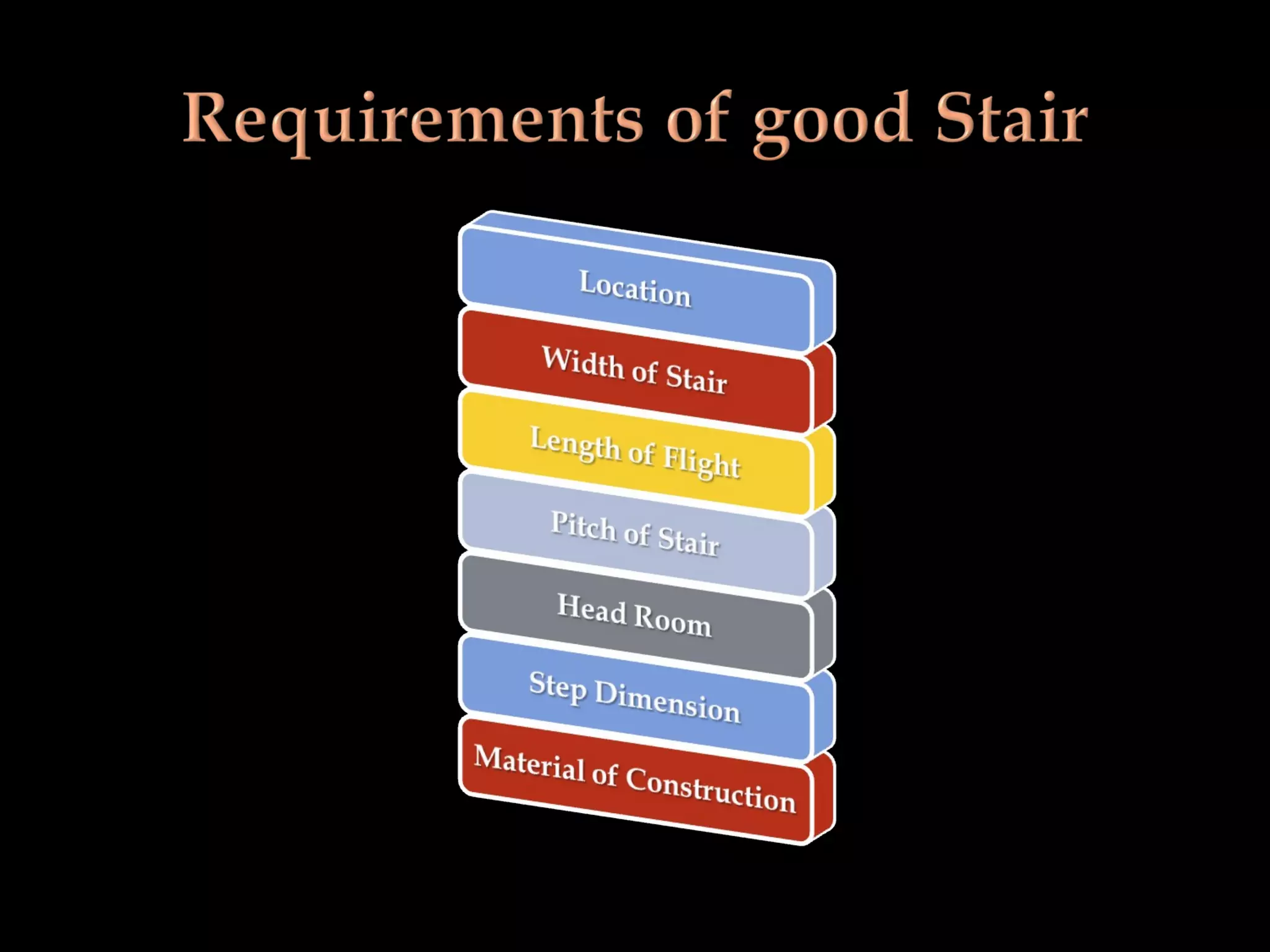
1. LOCATION
It should preferably be located centrally, ensuring
sufficient light and ventilation.
2. WIDTH OF STAIR
The width of stairs for public buildings should be 1.8 m
and for residential buildings 0.9 m.
3. LENGTH
The flight of the stairs should be restricted to a maximum
of 12 and minimum of 3 steps.
4. PITCH OF STAIR
The pitch of long stairs should be made flatter by introducing
landing. The slope should not exceed 400 and should not be
less than 250.
5. HEAD ROOM
The distance between the tread and soffit of the flight
immediately above it, should not be less than 2.1 to 2.3 m. This
much of height is maintained so that a tall person can use the
stairs with some luggage on its head.
6. MATERIALS
Stairs should be constructed using fire resisting materials.
Materials also should have sufficient strength to resist any
impact.
7. BALUSTRADE
All open well stairs should be provided with balustrades,
to avoid accidents. In case of wide stairs it should be
provided with hand rails on both sides.
8. LANDING
The width of the landing should not be less than the
width of the stair.
9. WINDERS
These should be avoided and if found necessary, may be
provided at lower end of the flight.
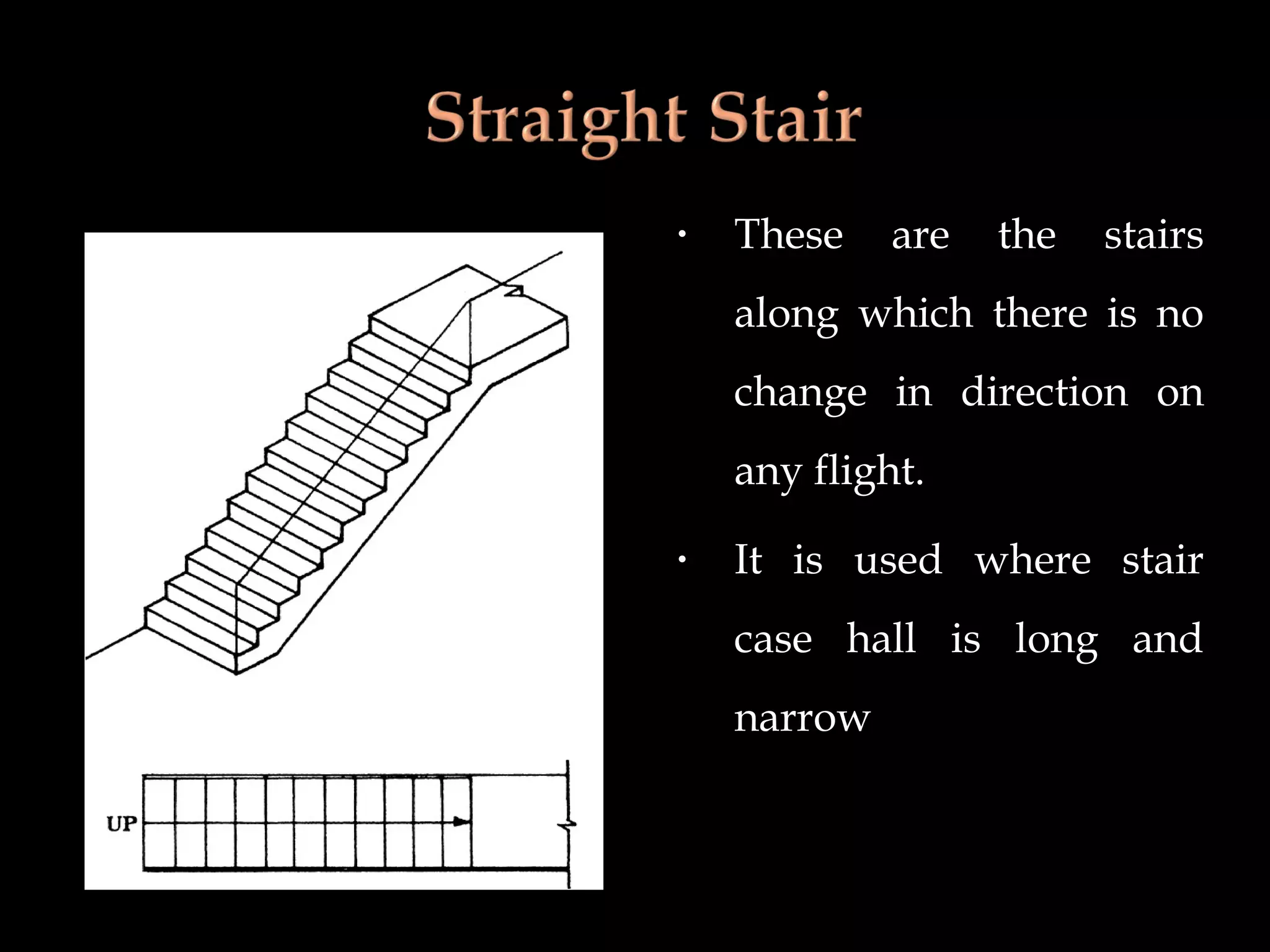
• These are the stairs
along which there is no
change in direction on
any flight.
• It is used where stair
case hall is long and
narrow
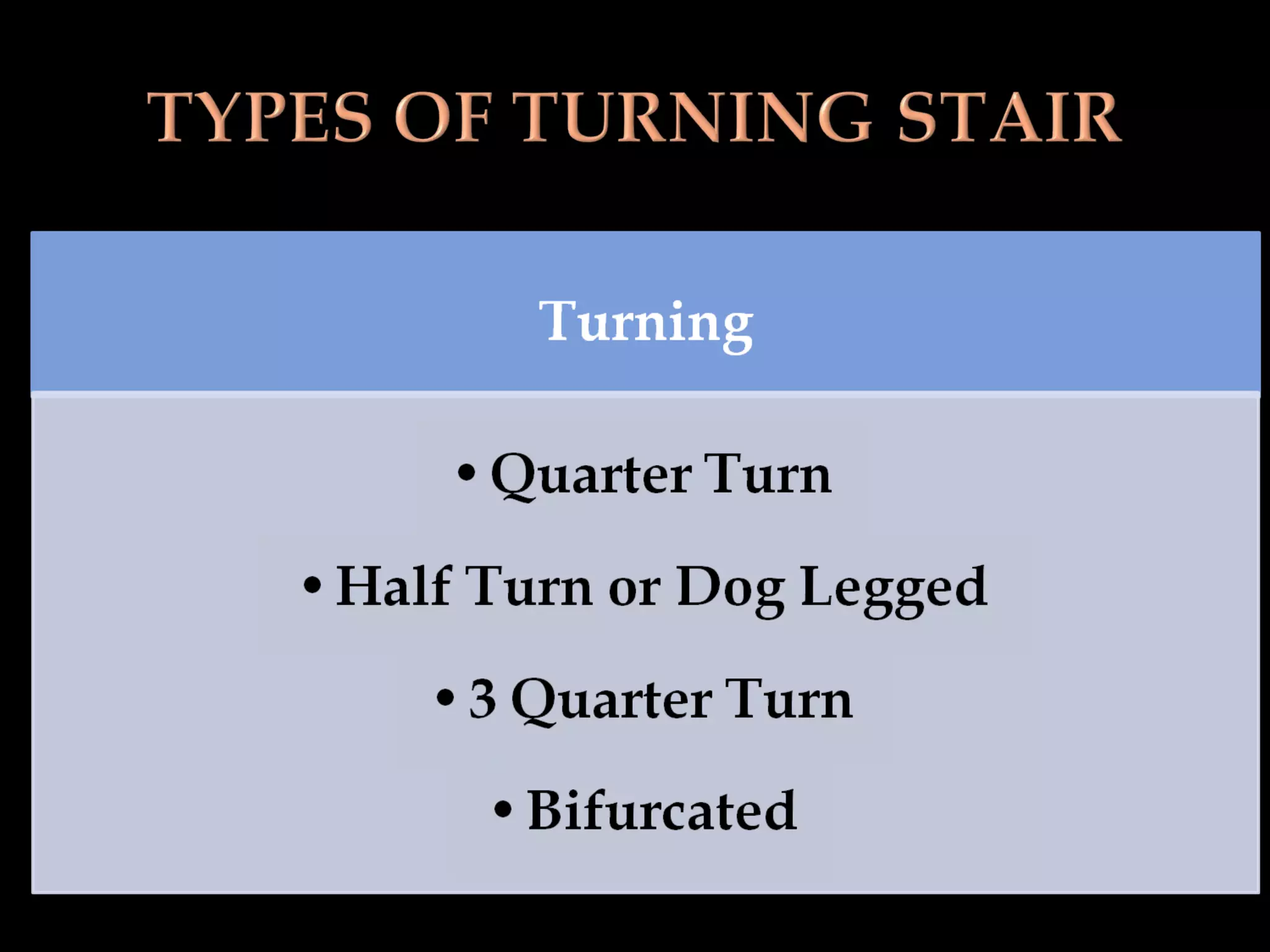
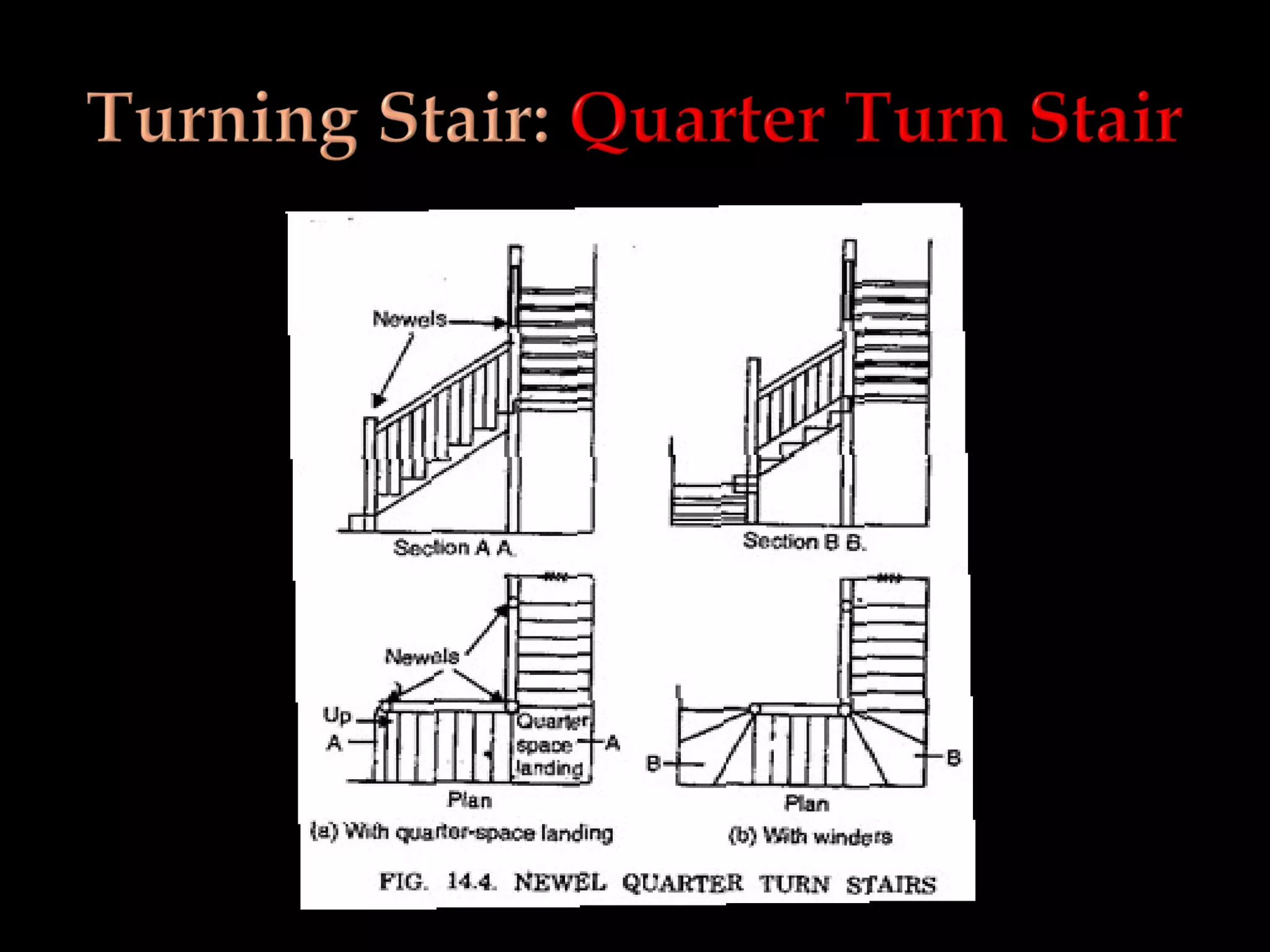
• A stair turning through
one right angle is known
as quarter turn stair.
• The change in direction
can be affected by either
introducing a landing or
by providing winders.
Changes direction either to left or Right by 900
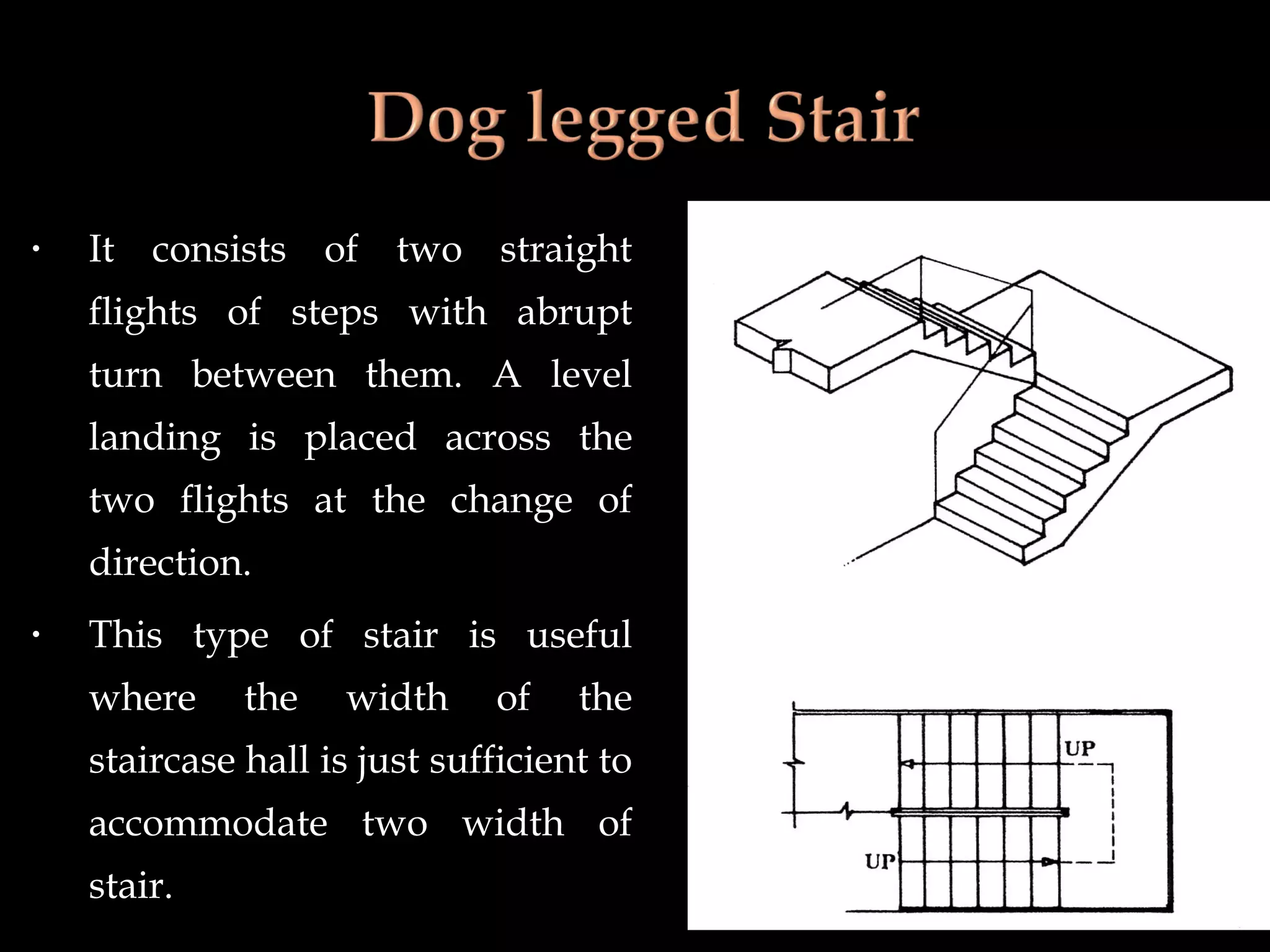
• It consists of two straight
flights of steps with abrupt
turn between them. A level
landing is placed across the
two flights at the change of
direction.
• This type of stair is useful
where the width of the
staircase hall is just sufficient to
accommodate two width of
stair.
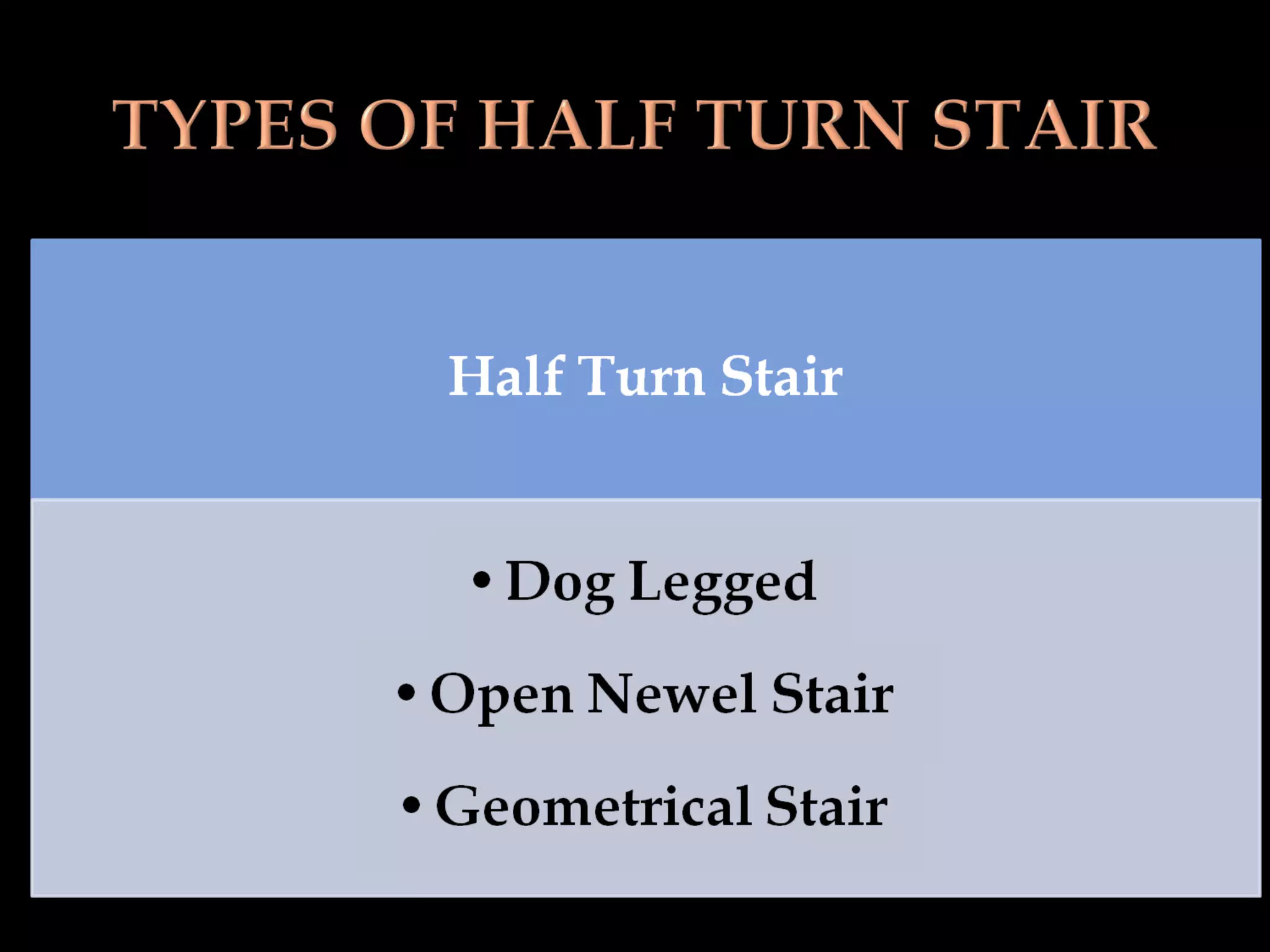
 Changes Direction in
opposite direction of by
1800.
1. Dog Legged Stair
2. Open Newel Half Turn
3. Geometric half turn Stair
 These may be of two
forms
1. Half space Landing
2. Quarter Space Landing
with winders
 No Space between Two
Flights
• In these type of stair there
is a well or opening
between the flights in plan.
• This well may be
rectangular or of any
geometrical shape and it
can be used for fixing lift.
• A stair turning through right
angles (270 degree) is known
as three quarter turn stair.
• In this case an open well is
formed.
 Direction Changed Three Times
 Limited Length of Stair Room
 Too large vertical Distance
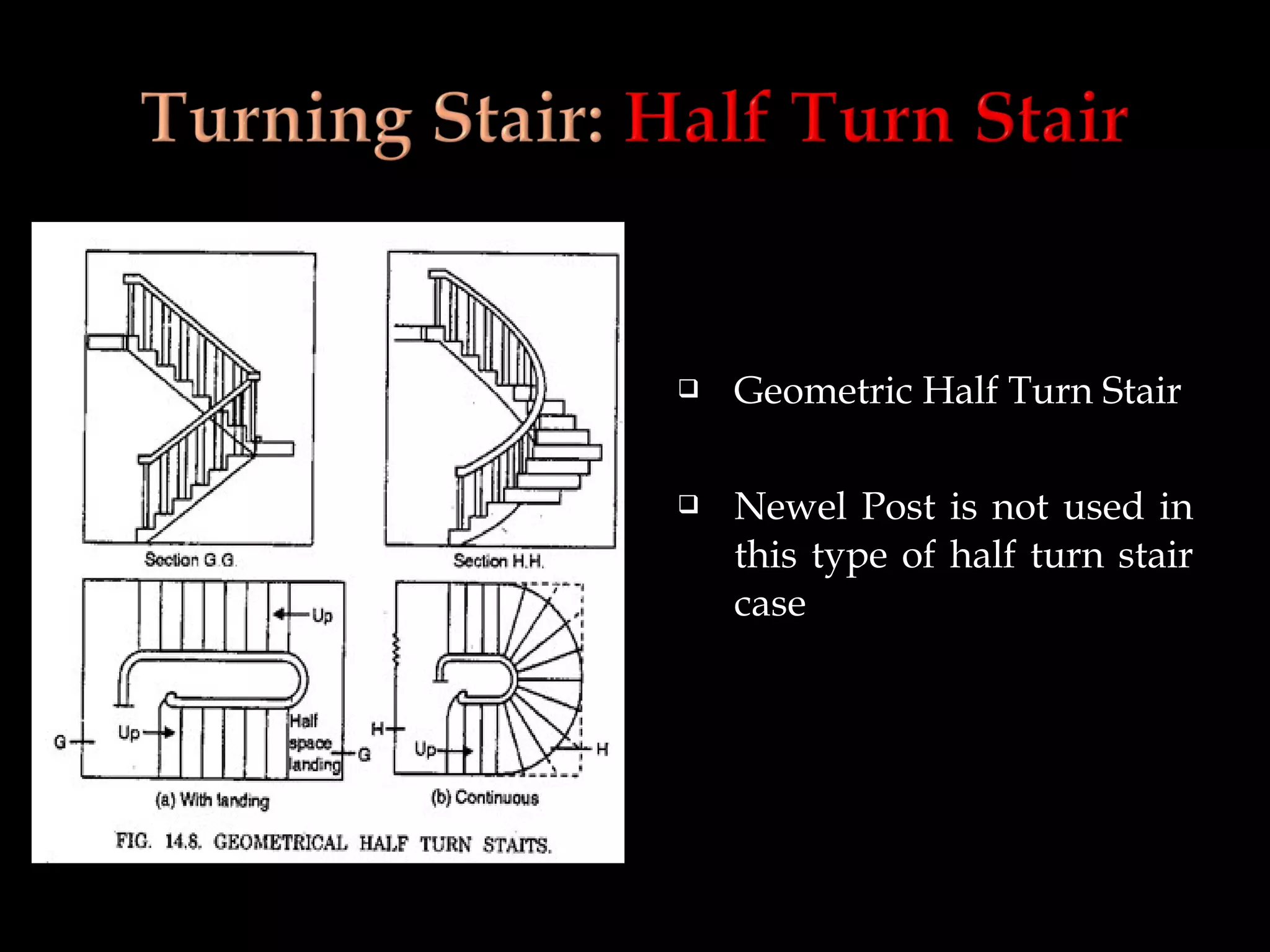
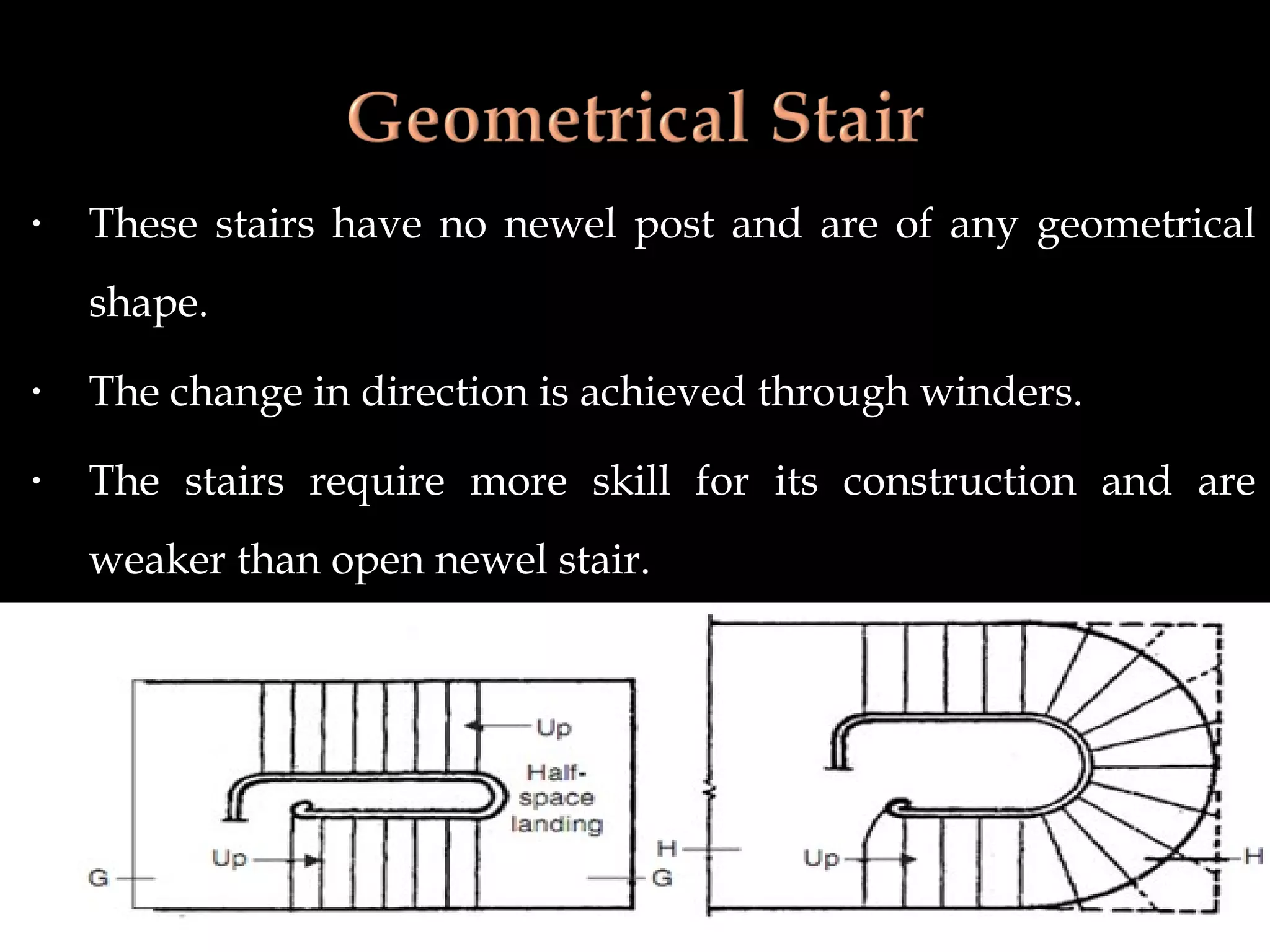
• These stairs have no newel post and are of any geometrical
shape.
• The change in direction is achieved through winders.
• The stairs require more skill for its construction and are
weaker than open newel stair.
 Geometric Half Turn Stair
 Newel Post is not used in
this type of half turn stair
case
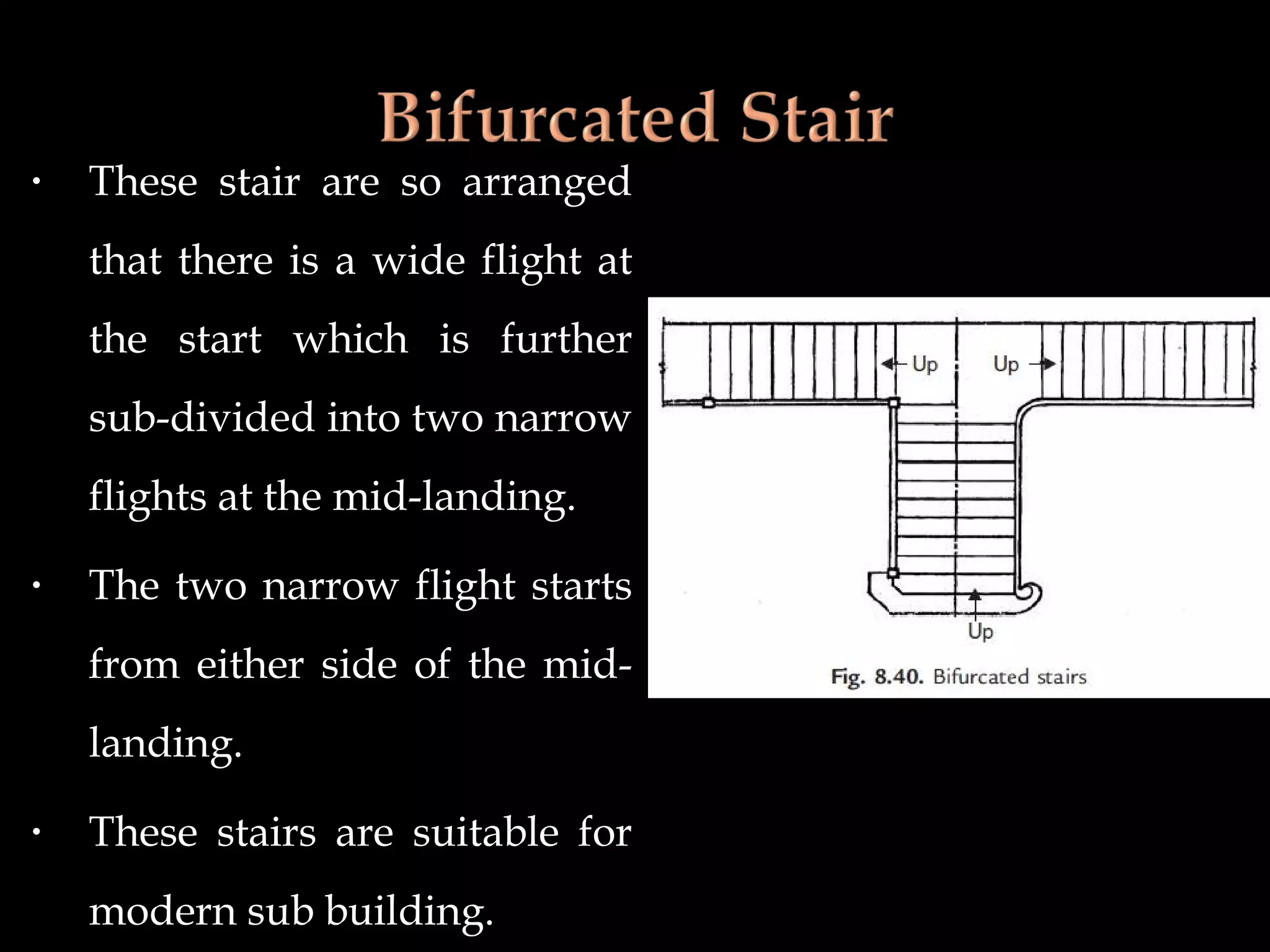
• These stair are so arranged
that there is a wide flight at
the start which is further
sub-divided into two narrow
flights at the mid-landing.
• The two narrow flight starts
from either side of the mid-
landing.
• These stairs are suitable for
modern sub building.
 Public Buildings
 Wider Flight at bottom
 Bifurcated two narrow
flights, one turning left
and other right.
 It is known as spiral stair.
 When viewed from top it
appears to follow a circle with
a single centre of curvature.
 The spiral stairs are provided
where space available is
limited and traffic is low.
 These stairs can be constructed
in R.C.C., Steel or Stone
 Space Limitation
 Emergency Stair
with winder steps
 Uncomfortable
 Very Complicated
Structural Design
and Construction
 Made of RCC
 The ratio of the going and the rise of a step should be well
proportioned to ensure a comfortable access to the stair
way.
 According to Basic Thumb Rule,
 (2 x Rise in cm) + (Going in cm) = 60 cm
 (Rise in cm) + (Going in cm) = 40 to 45 cm
 (Rise in mm) + (Going in mm) = 400 to 450 mm
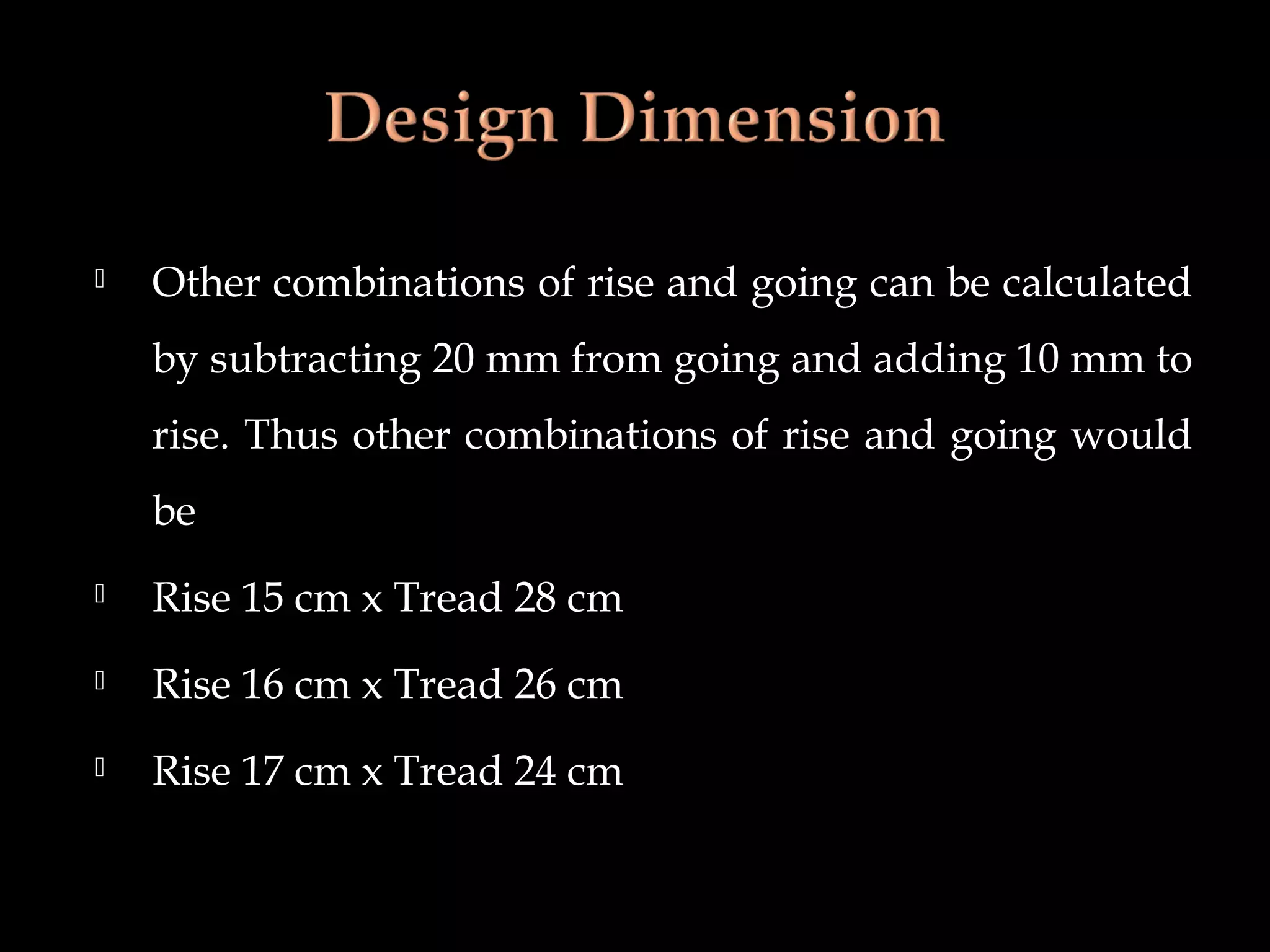
 Other combinations of rise and going can be calculated
by subtracting 20 mm from going and adding 10 mm to
rise. Thus other combinations of rise and going would
be
 Rise 15 cm x Tread 28 cm
 Rise 16 cm x Tread 26 cm
 Rise 17 cm x Tread 24 cm
 Generally adopted sizes of steps are:
 Public buildings: (27 cm x 15 cm) to (30 x 14 cm)
 Residential buildings: 25 cm x 16 cm
 Standard sizes of steps are:
 Riser = 150 mm
 Trade = 300 mm
Le
LANDING
WAIST SLAB
Case (a)
WALL
Effective Span For
Longitudinally Spanning
Staircases
Waist Slab Supported at
the Ends of Landings
X X Y Y
Le
Case (c)
Case (b)
Le
Le=G +[ X +Y], X ≤1m AND Y ≤1m
Le=c/c of beams
GOING=G
Effective Span For
Longitudinally
Spanning Staircases
 Steel at bottom longitudinally-tension
 Anchorage and development steel
 Distribution steel
 Nominal foundation for ground flight
 A dog legged stair case is to be detailed with the
following particulars:
 Clear dimension of stair case room = 4.48 m x 2.1 m
 The floor to floor height is 3.2 m
 Width of each tread = 250 mm
 Width of each rise = 160 mm
 Thickness of waist slab = 150 mm
 Width of flight = 1m
 All round wall = 230 mm
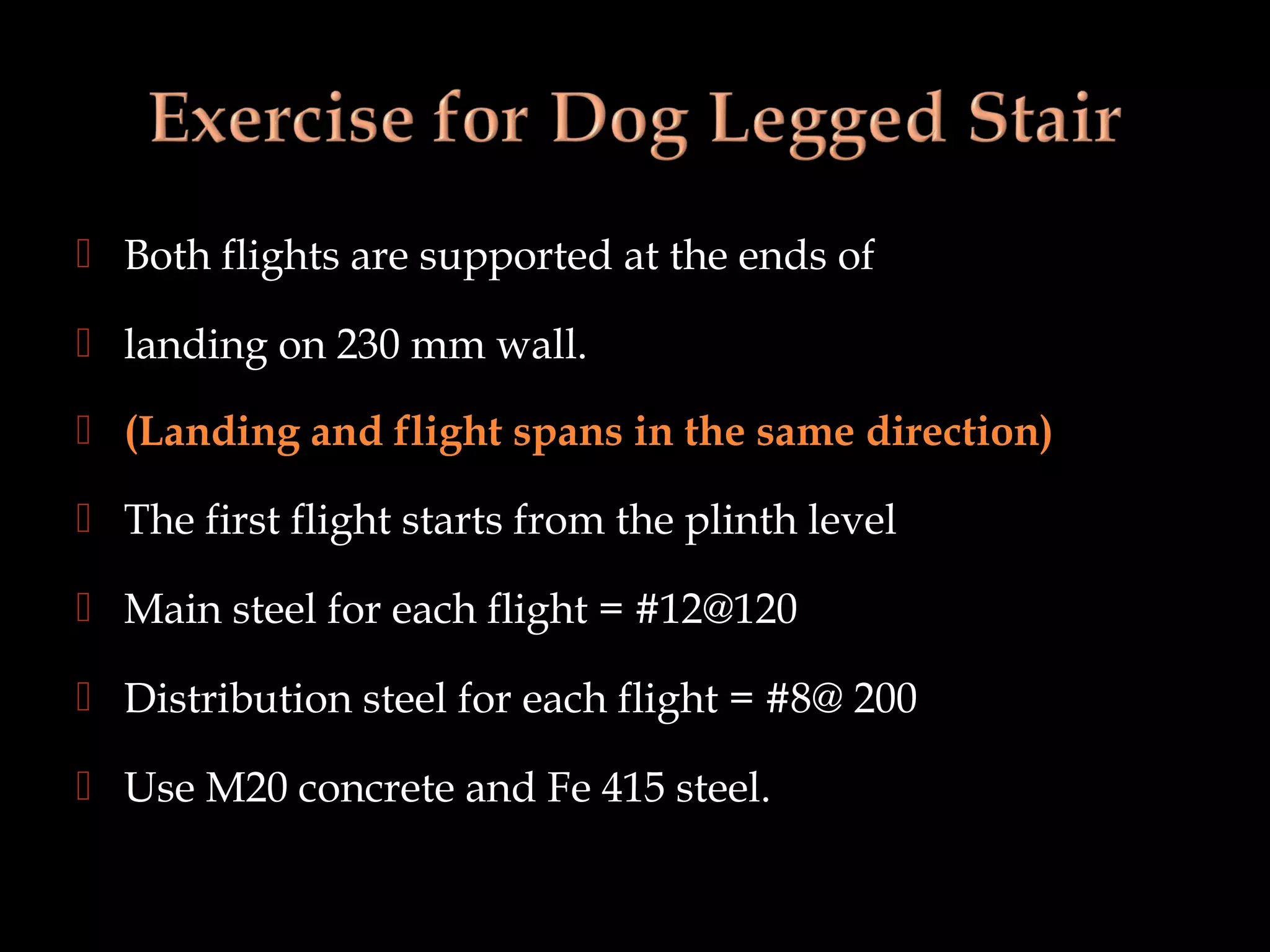
 Both flights are supported at the ends of
 landing on 230 mm wall.
 (Landing and flight spans in the same direction)
 The first flight starts from the plinth level
 Main steel for each flight = #12@120
 Distribution steel for each flight = #8@ 200
 Use M20 concrete and Fe 415 steel.
 Draw to a suitable scale
 The plan of stair case
 Sectional elevation of the Ground flight
 Sectional elevation of the First flight
 Dimensioning:
R = 160 mm
T = 250 mm
 Floor to floor height = 3200 mm
 No of rises = 3200/R
= 20. (Each flight has 10 rises)
 No of treads per flight = 10 - 1
= 9
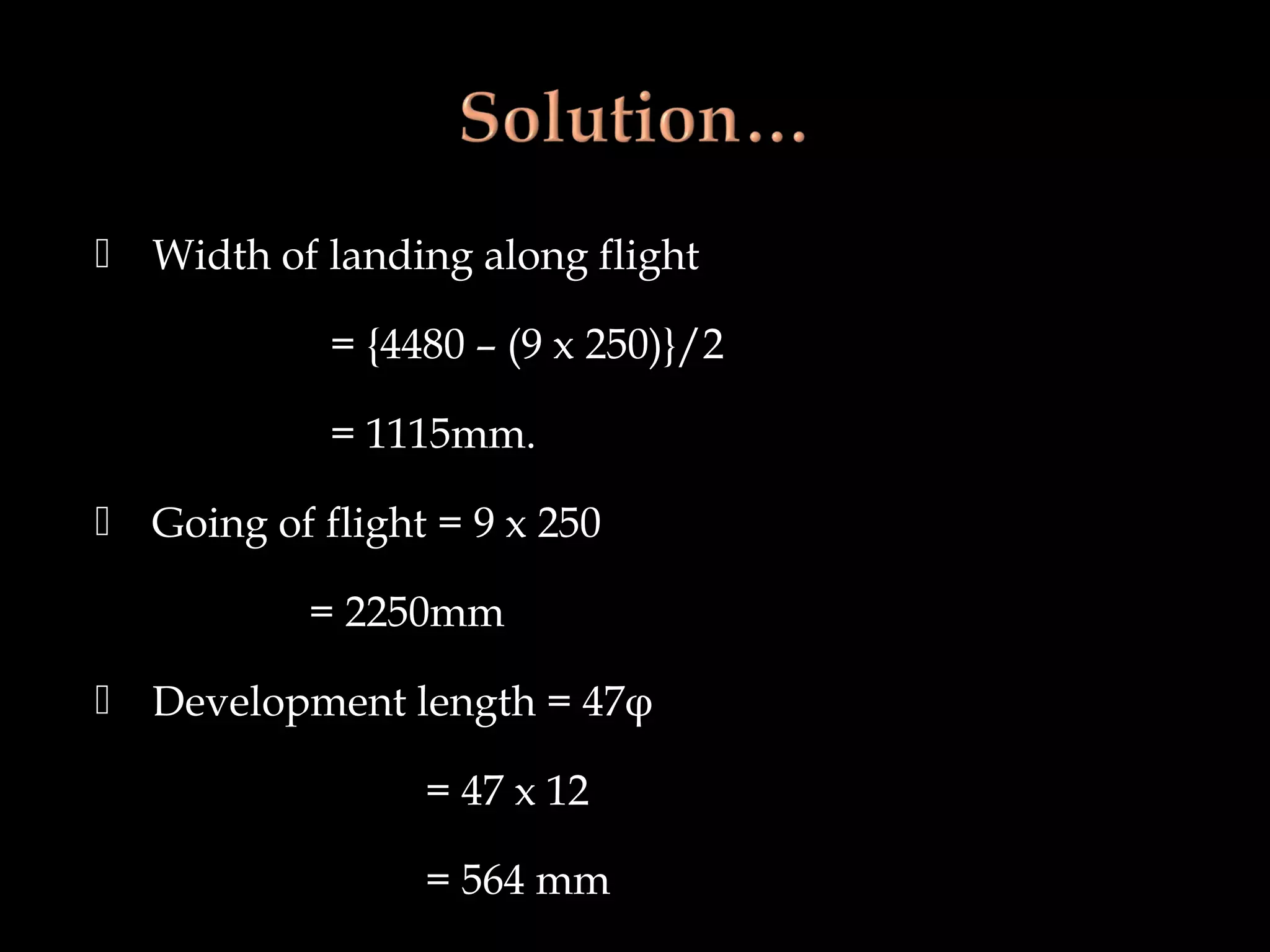
 Width of landing along flight
= {4480 – (9 x 250)}/2
= 1115mm.
 Going of flight = 9 x 250
= 2250mm
 Development length = 47φ
= 47 x 12
= 564 mm
Gap=0.1m
PLAN
1115 mm 1115 mm2250 mm
Le = 4710 mm
2100
Types of Stairs & Staircase in Building Construction

Types of Stairs & Staircase in Building Construction

  • 1.
    Prof. Karan S.Chauhan Assistant Professor Department Of Civil Engineering @ Shri Labhubhai Trivedi Institute Of Engineering And Technology Stair & StaircaseStair & Staircase Subject :- Building Construction Subject Code : 2130607
  • 3.
     A stairis a set of steps, leading from one floor to other , provided to afford the means of ascent or descent between the various floors of building.  The room or enclosure of building in which the stair is located is known as stair-case.
  • 5.
     STEP: It’sa portion of stair which permits ascent or descent it is comprised of a trend and a riser
  • 6.
     The upperhorizontal of a step upon which the foot is placed while ascending or descending
  • 7.
     It isthe vertical portion of step providing a support to the tread
  • 8.
     This isan unbroken series of steps between lading  Its level platform at the top or bottom of a flight between the floors  Main reason for lading is providing some rest for the climber
  • 9.
     Vertical distancebetween two successive tread faces.  It’s the horizontal distance between two successive riser faces
  • 11.
     It isthe projecting part of the tread beyond the face of the riser  It is the underside of a stair
  • 12.
     These arethe sloping members which support the steps in a stair
  • 13.
     Newel postis a vertical member which is placed at the ends of flights to connect the ends of strings and hard rail…
  • 14.
     It isvertical member of wood or metal, supporting the hand rail
  • 15.
     It isa rounded or moulded memoire of wood or metal following generally the contour of the nosing line and fixed on the top of balusters
  • 16.
     It isthe minimum clear vertical distance between the treads and overhead structure
  • 18.
    1. LOCATION It should preferablybe located centrally, ensuring sufficient light and ventilation. 2. WIDTH OF STAIR The width of stairs for public buildings should be 1.8 m and for residential buildings 0.9 m. 3. LENGTH The flight of the stairs should be restricted to a maximum of 12 and minimum of 3 steps.
  • 19.
    4. PITCH OF STAIR Thepitch of long stairs should be made flatter by introducing landing. The slope should not exceed 400 and should not be less than 250. 5. HEAD ROOM The distance between the tread and soffit of the flight immediately above it, should not be less than 2.1 to 2.3 m. This much of height is maintained so that a tall person can use the stairs with some luggage on its head.
  • 20.
    6. MATERIALS Stairs should beconstructed using fire resisting materials. Materials also should have sufficient strength to resist any impact. 7. BALUSTRADE All open well stairs should be provided with balustrades, to avoid accidents. In case of wide stairs it should be provided with hand rails on both sides.
  • 21.
    8. LANDING The width ofthe landing should not be less than the width of the stair. 9. WINDERS These should be avoided and if found necessary, may be provided at lower end of the flight.
  • 24.
    • These arethe stairs along which there is no change in direction on any flight. • It is used where stair case hall is long and narrow
  • 27.
    • A stairturning through one right angle is known as quarter turn stair. • The change in direction can be affected by either introducing a landing or by providing winders.
  • 28.
    Changes direction eitherto left or Right by 900
  • 31.
    • It consistsof two straight flights of steps with abrupt turn between them. A level landing is placed across the two flights at the change of direction. • This type of stair is useful where the width of the staircase hall is just sufficient to accommodate two width of stair.
  • 32.
     Changes Directionin opposite direction of by 1800. 1. Dog Legged Stair 2. Open Newel Half Turn 3. Geometric half turn Stair
  • 34.
     These maybe of two forms 1. Half space Landing 2. Quarter Space Landing with winders  No Space between Two Flights
  • 35.
    • In thesetype of stair there is a well or opening between the flights in plan. • This well may be rectangular or of any geometrical shape and it can be used for fixing lift.
  • 36.
    • A stairturning through right angles (270 degree) is known as three quarter turn stair. • In this case an open well is formed.
  • 37.
     Direction ChangedThree Times  Limited Length of Stair Room  Too large vertical Distance
  • 39.
    • These stairshave no newel post and are of any geometrical shape. • The change in direction is achieved through winders. • The stairs require more skill for its construction and are weaker than open newel stair.
  • 41.
     Geometric HalfTurn Stair  Newel Post is not used in this type of half turn stair case
  • 42.
    • These stairare so arranged that there is a wide flight at the start which is further sub-divided into two narrow flights at the mid-landing. • The two narrow flight starts from either side of the mid- landing. • These stairs are suitable for modern sub building.
  • 43.
     Public Buildings Wider Flight at bottom  Bifurcated two narrow flights, one turning left and other right.
  • 46.
     It isknown as spiral stair.  When viewed from top it appears to follow a circle with a single centre of curvature.  The spiral stairs are provided where space available is limited and traffic is low.  These stairs can be constructed in R.C.C., Steel or Stone
  • 48.
     Space Limitation Emergency Stair with winder steps  Uncomfortable
  • 49.
     Very Complicated StructuralDesign and Construction  Made of RCC
  • 51.
     The ratioof the going and the rise of a step should be well proportioned to ensure a comfortable access to the stair way.  According to Basic Thumb Rule,  (2 x Rise in cm) + (Going in cm) = 60 cm  (Rise in cm) + (Going in cm) = 40 to 45 cm  (Rise in mm) + (Going in mm) = 400 to 450 mm
  • 52.
     Other combinationsof rise and going can be calculated by subtracting 20 mm from going and adding 10 mm to rise. Thus other combinations of rise and going would be  Rise 15 cm x Tread 28 cm  Rise 16 cm x Tread 26 cm  Rise 17 cm x Tread 24 cm
  • 53.
     Generally adoptedsizes of steps are:  Public buildings: (27 cm x 15 cm) to (30 x 14 cm)  Residential buildings: 25 cm x 16 cm  Standard sizes of steps are:  Riser = 150 mm  Trade = 300 mm
  • 54.
    Le LANDING WAIST SLAB Case (a) WALL EffectiveSpan For Longitudinally Spanning Staircases Waist Slab Supported at the Ends of Landings
  • 55.
    X X YY Le Case (c) Case (b) Le Le=G +[ X +Y], X ≤1m AND Y ≤1m Le=c/c of beams GOING=G Effective Span For Longitudinally Spanning Staircases
  • 56.
     Steel atbottom longitudinally-tension  Anchorage and development steel  Distribution steel  Nominal foundation for ground flight
  • 57.
     A doglegged stair case is to be detailed with the following particulars:  Clear dimension of stair case room = 4.48 m x 2.1 m  The floor to floor height is 3.2 m  Width of each tread = 250 mm  Width of each rise = 160 mm  Thickness of waist slab = 150 mm  Width of flight = 1m  All round wall = 230 mm
  • 58.
     Both flightsare supported at the ends of  landing on 230 mm wall.  (Landing and flight spans in the same direction)  The first flight starts from the plinth level  Main steel for each flight = #12@120  Distribution steel for each flight = #8@ 200  Use M20 concrete and Fe 415 steel.
  • 59.
     Draw toa suitable scale  The plan of stair case  Sectional elevation of the Ground flight  Sectional elevation of the First flight
  • 60.
     Dimensioning: R =160 mm T = 250 mm  Floor to floor height = 3200 mm  No of rises = 3200/R = 20. (Each flight has 10 rises)  No of treads per flight = 10 - 1 = 9
  • 61.
     Width oflanding along flight = {4480 – (9 x 250)}/2 = 1115mm.  Going of flight = 9 x 250 = 2250mm  Development length = 47φ = 47 x 12 = 564 mm
  • 62.
    Gap=0.1m PLAN 1115 mm 1115mm2250 mm Le = 4710 mm 2100

Editor's Notes

  • #29 Changes direction either to left or Right by 900