GT Geom. Drill 12/13/13
Define each of the following.
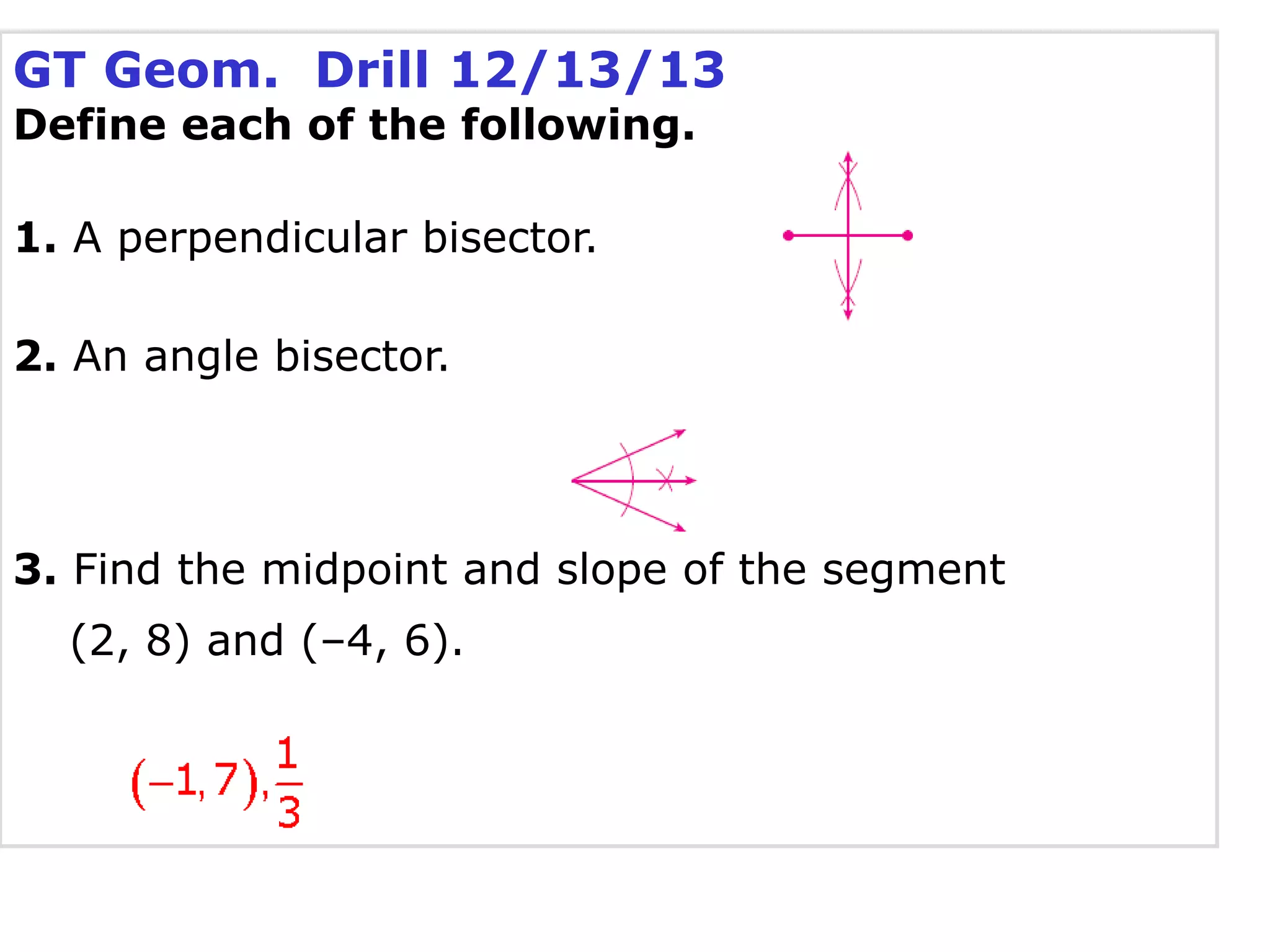
1. A perpendicular bisector.
2. An angle bisector.

3. Find the midpoint and slope of the segment
(2, 8) and (–4, 6).
Objectives
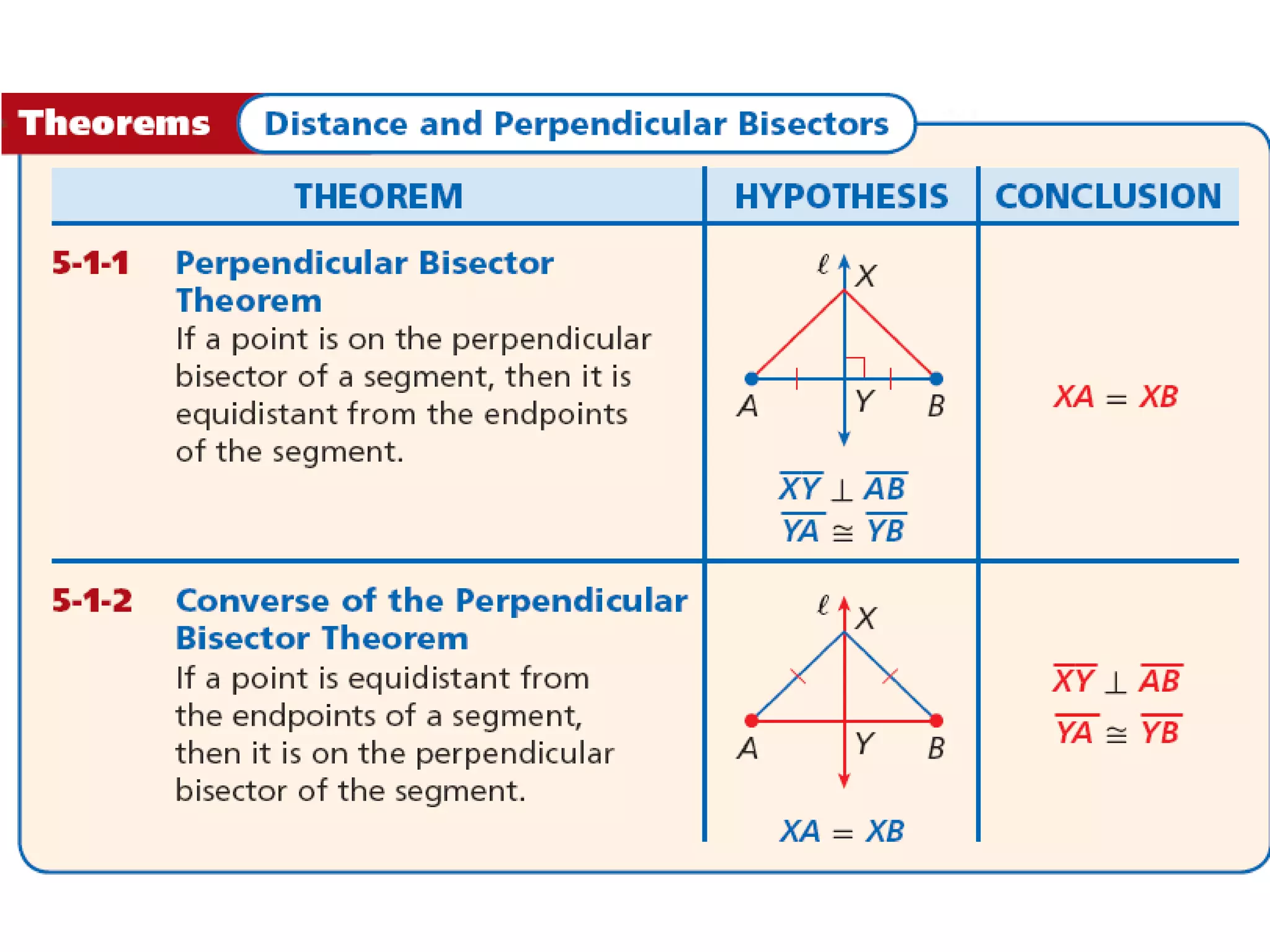
Prove and apply theorems about
perpendicular bisectors.
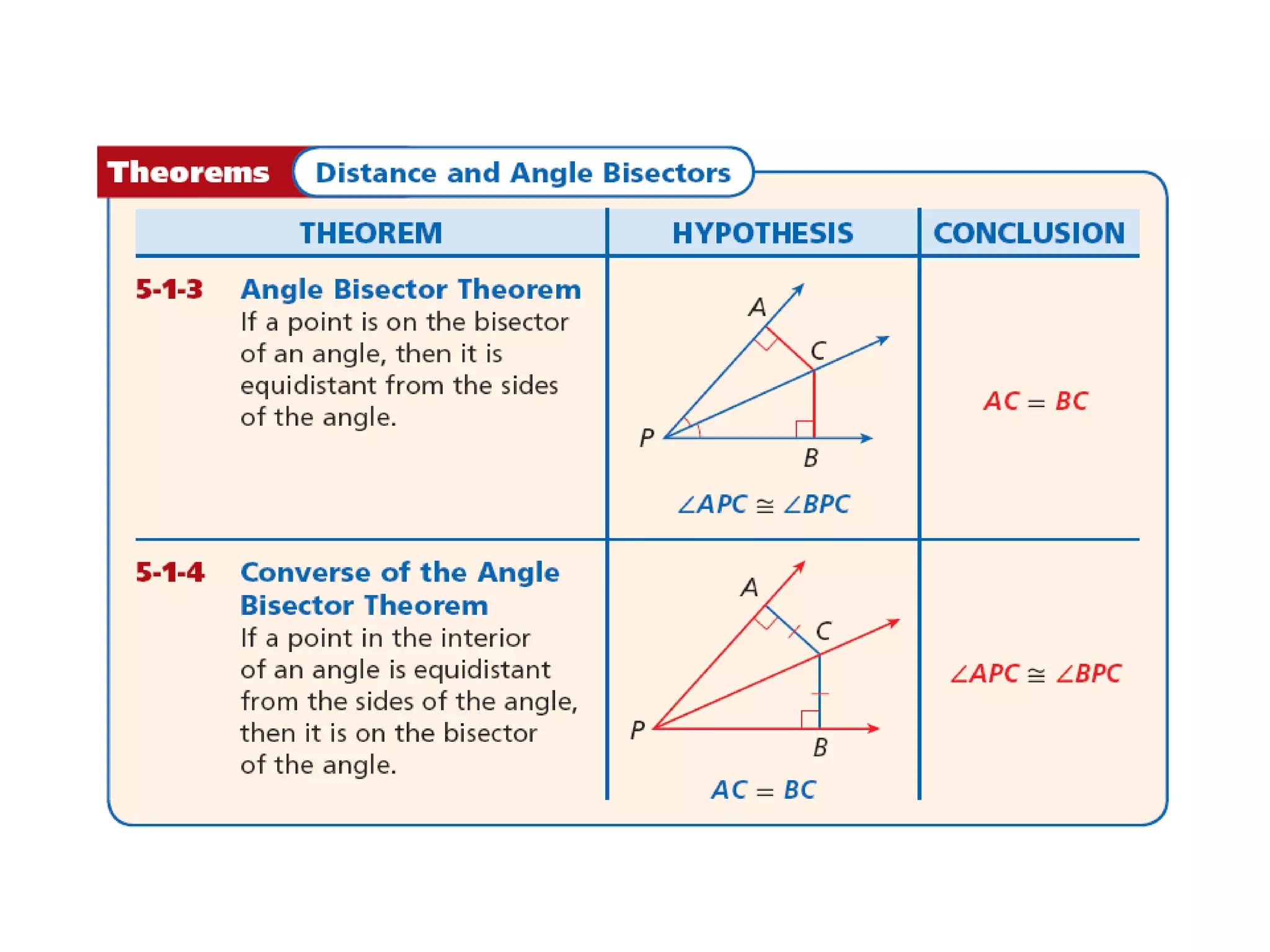
Prove and apply theorems about angle
bisectors.
Vocabulary
equidistant
locus
When a point is the same
distance from two or more
objects, the point is said to be
equidistant from the objects.
Triangle congruence theorems
can be used to prove
theorems about equidistant
points.
Based on these theorems, an angle bisector can be
defined as the locus of all points in the interior of the
angle that are equidistant from the sides of the angle.
A locus is a set of points that
satisfies a given condition. The
perpendicular bisector of a
segment can be defined as the
locus of points in a plane that
are equidistant from the
endpoints of the segment.
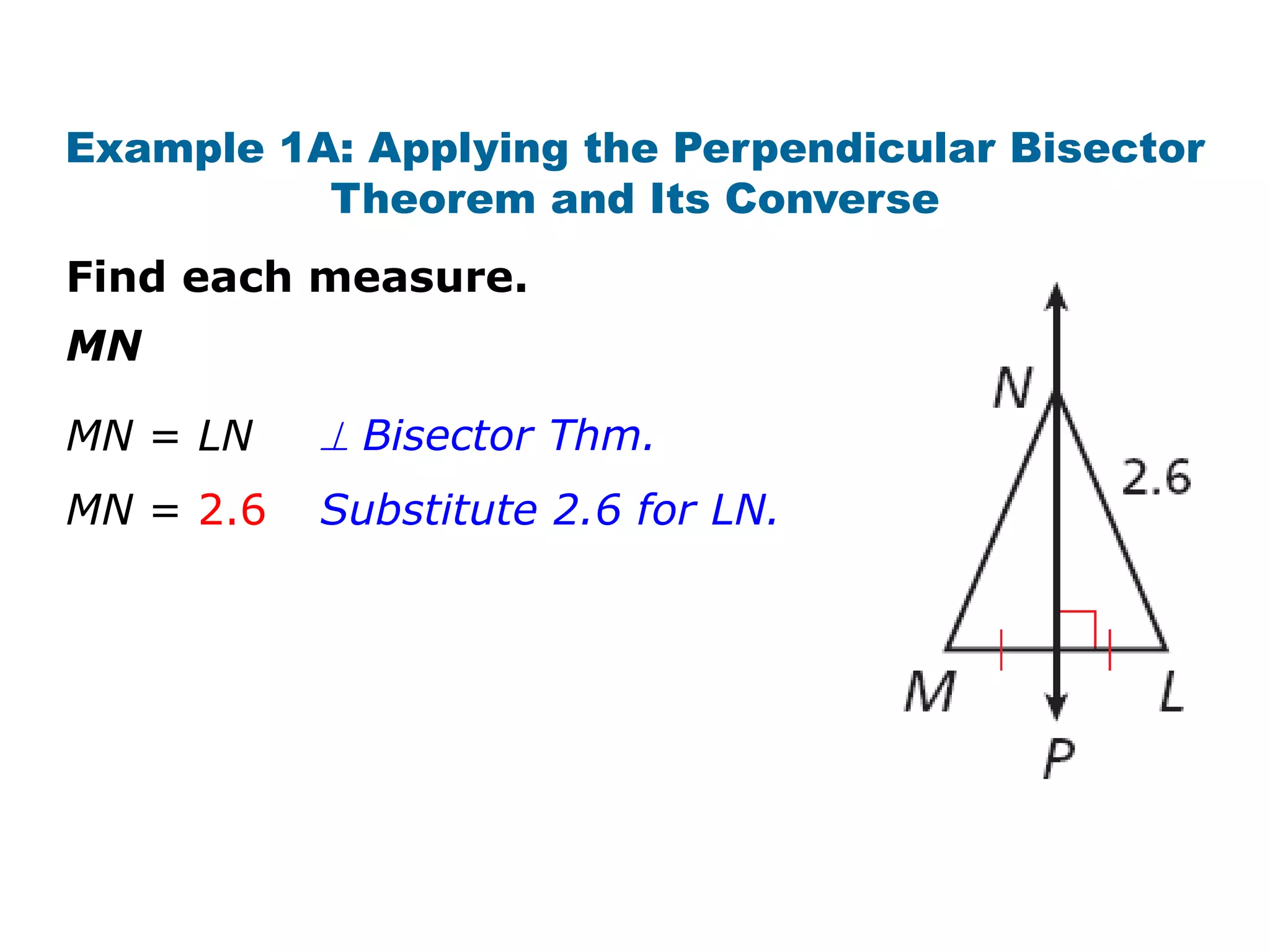
Example 1A: Applying the Perpendicular Bisector
Theorem and Its Converse
Find each measure.
MN
MN = LN

 Bisector Thm.

MN = 2.6

Substitute 2.6 for LN.
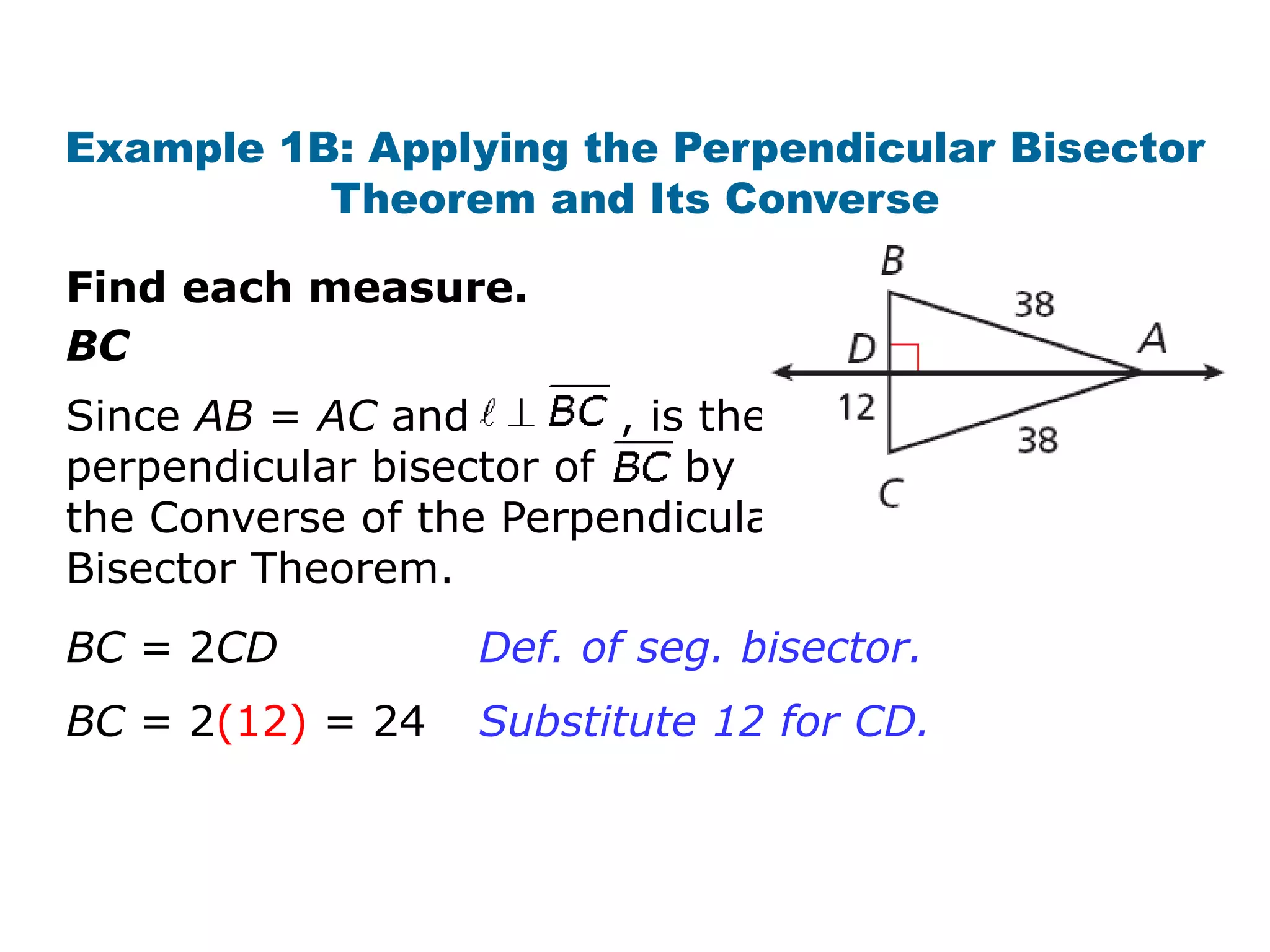
Example 1B: Applying the Perpendicular Bisector
Theorem and Its Converse
Find each measure.
BC
Since AB = AC and
, is the
perpendicular bisector of
by
the Converse of the Perpendicular
Bisector Theorem.
BC = 2CD

Def. of seg. bisector.

BC = 2(12) = 24

Substitute 12 for CD.
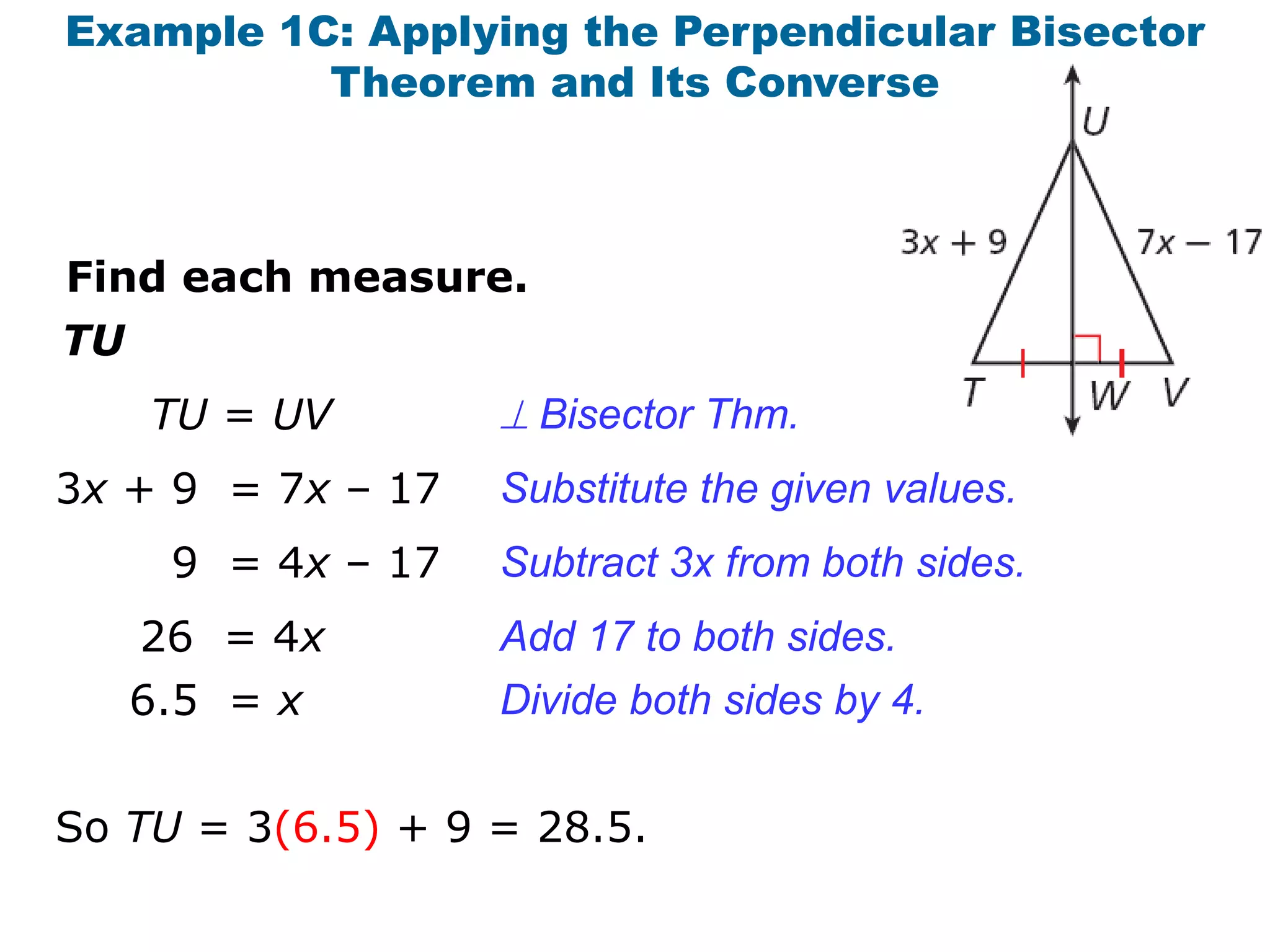
Example 1C: Applying the Perpendicular Bisector
Theorem and Its Converse

Find each measure.

TU
TU = UV

 Bisector Thm.

3x + 9 = 7x – 17

Substitute the given values.

9 = 4x – 17

Subtract 3x from both sides.

26 = 4x
6.5 = x

Add 17 to both sides.
Divide both sides by 4.

So TU = 3(6.5) + 9 = 28.5.
Remember that the distance between a point and a
line is the length of the perpendicular segment from
the point to the line.
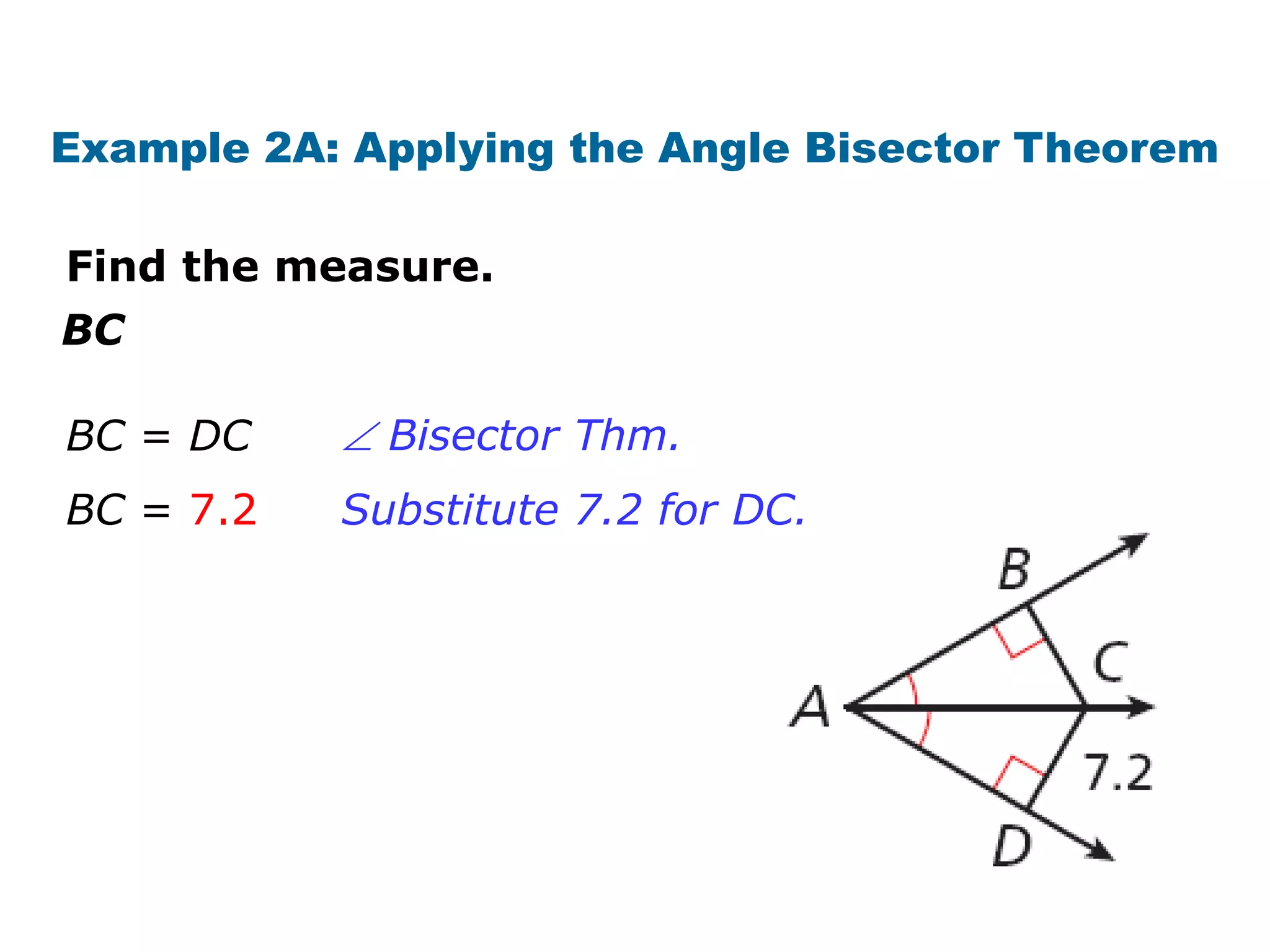
Example 2A: Applying the Angle Bisector Theorem
Find the measure.

BC
BC = DC

 Bisector Thm.

BC = 7.2

Substitute 7.2 for DC.
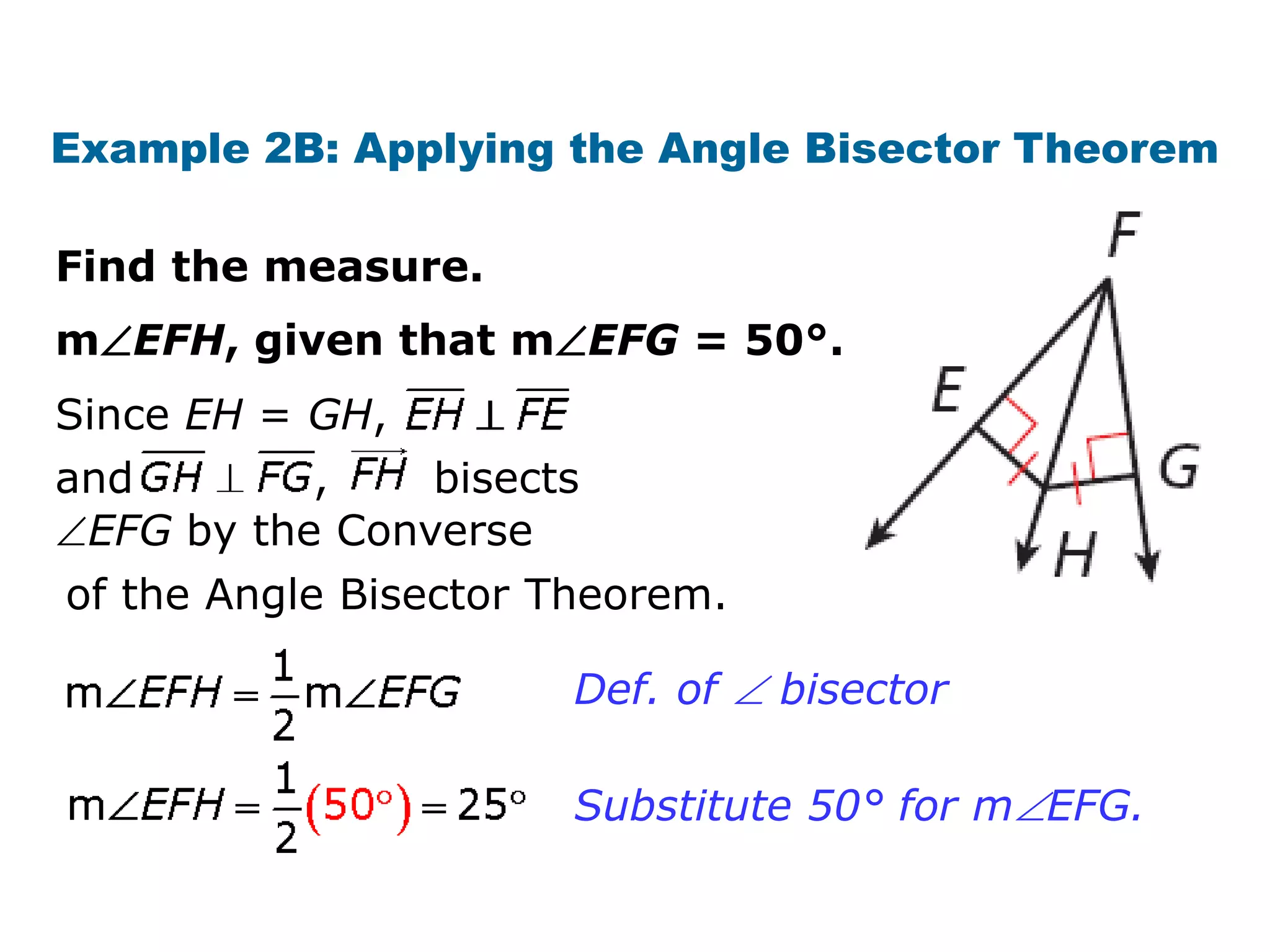
Example 2B: Applying the Angle Bisector Theorem
Find the measure.

mEFH, given that mEFG = 50°.
Since EH = GH,
and
,
bisects
EFG by the Converse
of the Angle Bisector Theorem.
Def. of  bisector
Substitute 50° for mEFG.
Example 2C: Applying the Angle Bisector Theorem

Find mMKL.
Since, JM = LM,

and

,
bisects JKL
by the Converse of the Angle
Bisector Theorem.
mMKL = mJKM
Def. of  bisector
3a + 20 = 2a + 26
a + 20 = 26

a=6

Substitute the given values.
Subtract 2a from both sides.

Subtract 20 from both sides.

So mMKL = [2(6) + 26]° = 38°
Example 4: Writing Equations of Bisectors in the
Coordinate Plane
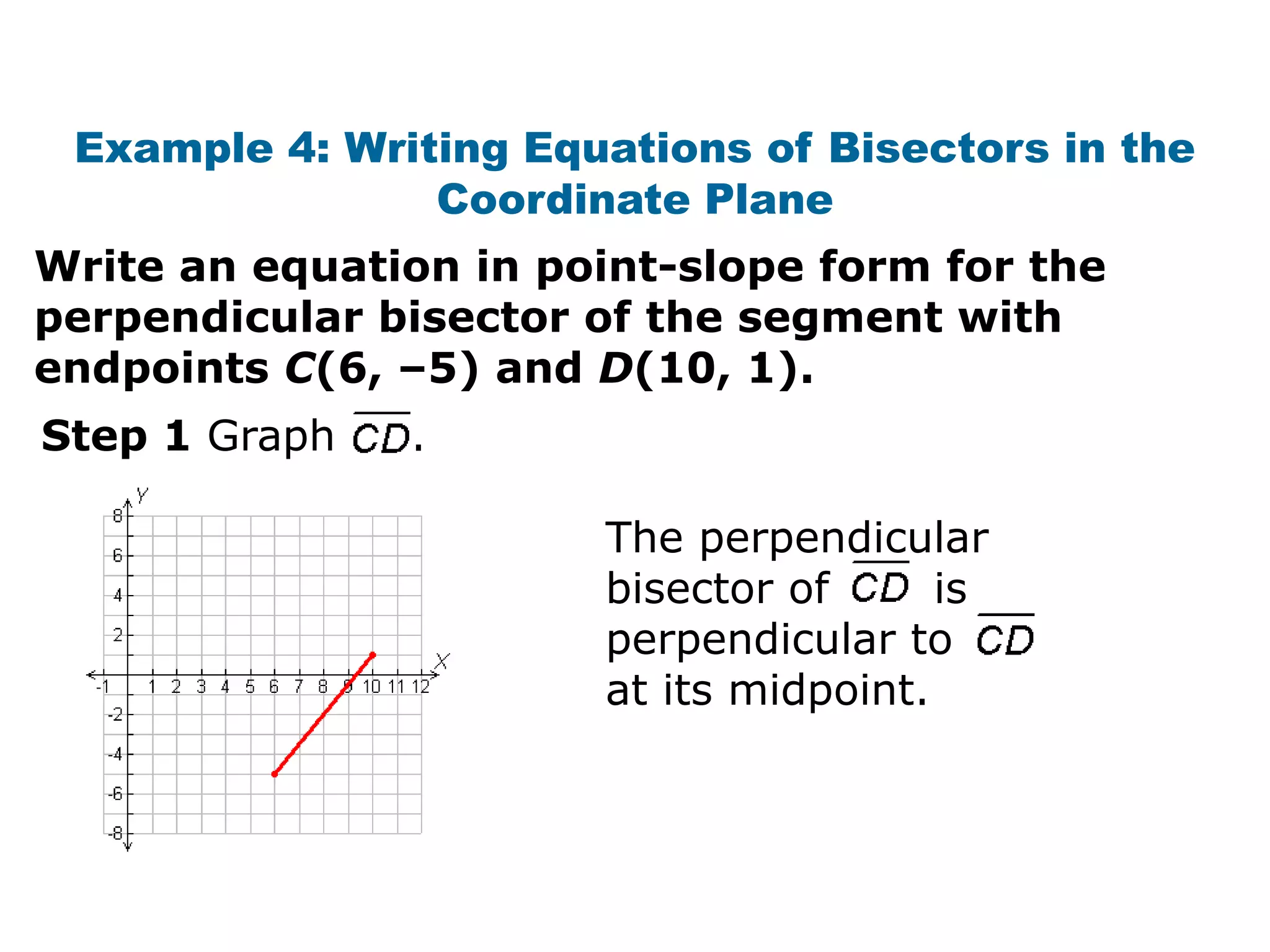
Write an equation in point-slope form for the
perpendicular bisector of the segment with
endpoints C(6, –5) and D(10, 1).
Step 1 Graph

.
The perpendicular
bisector of
is
perpendicular to
at its midpoint.
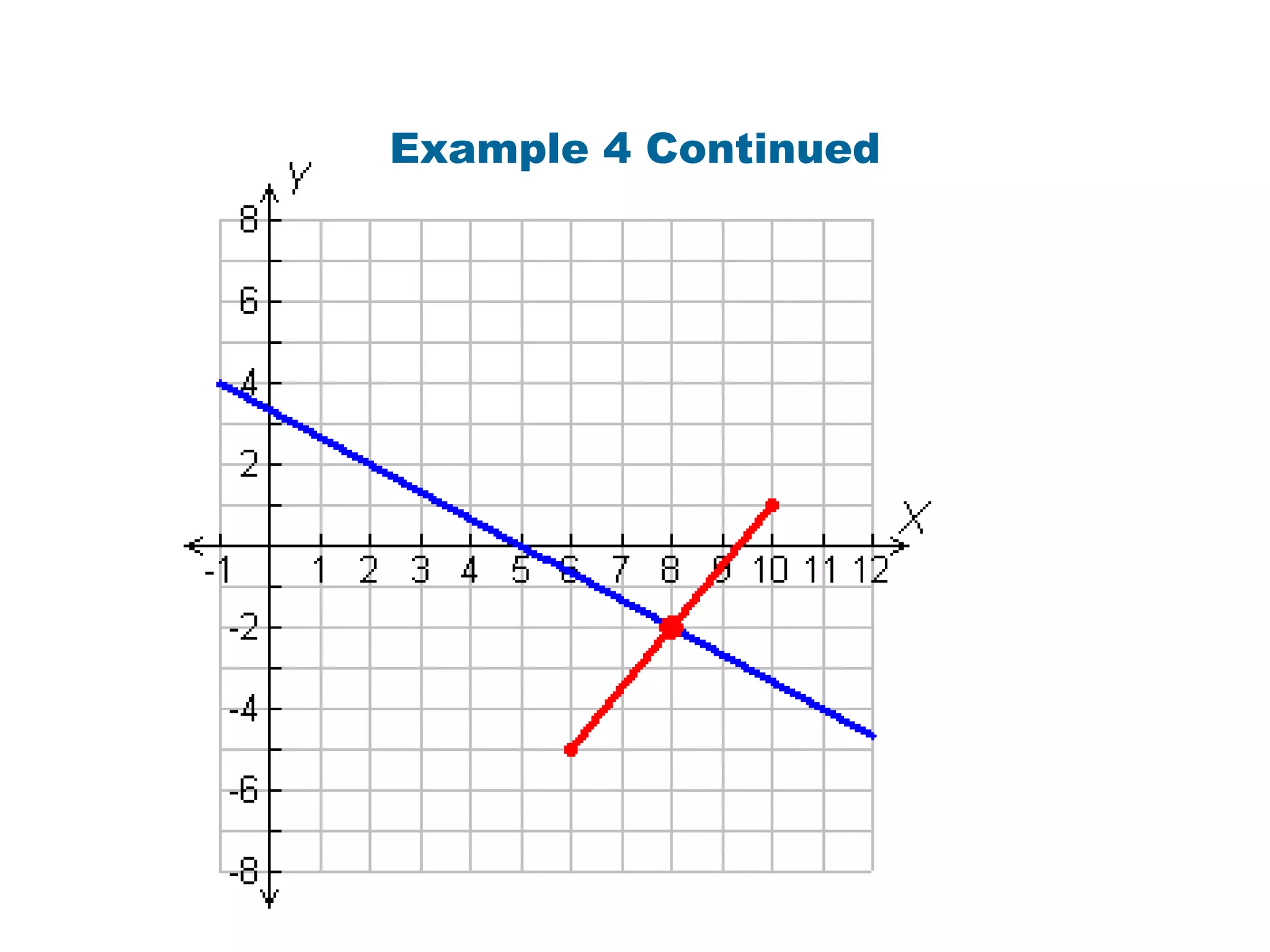
Example 4 Continued
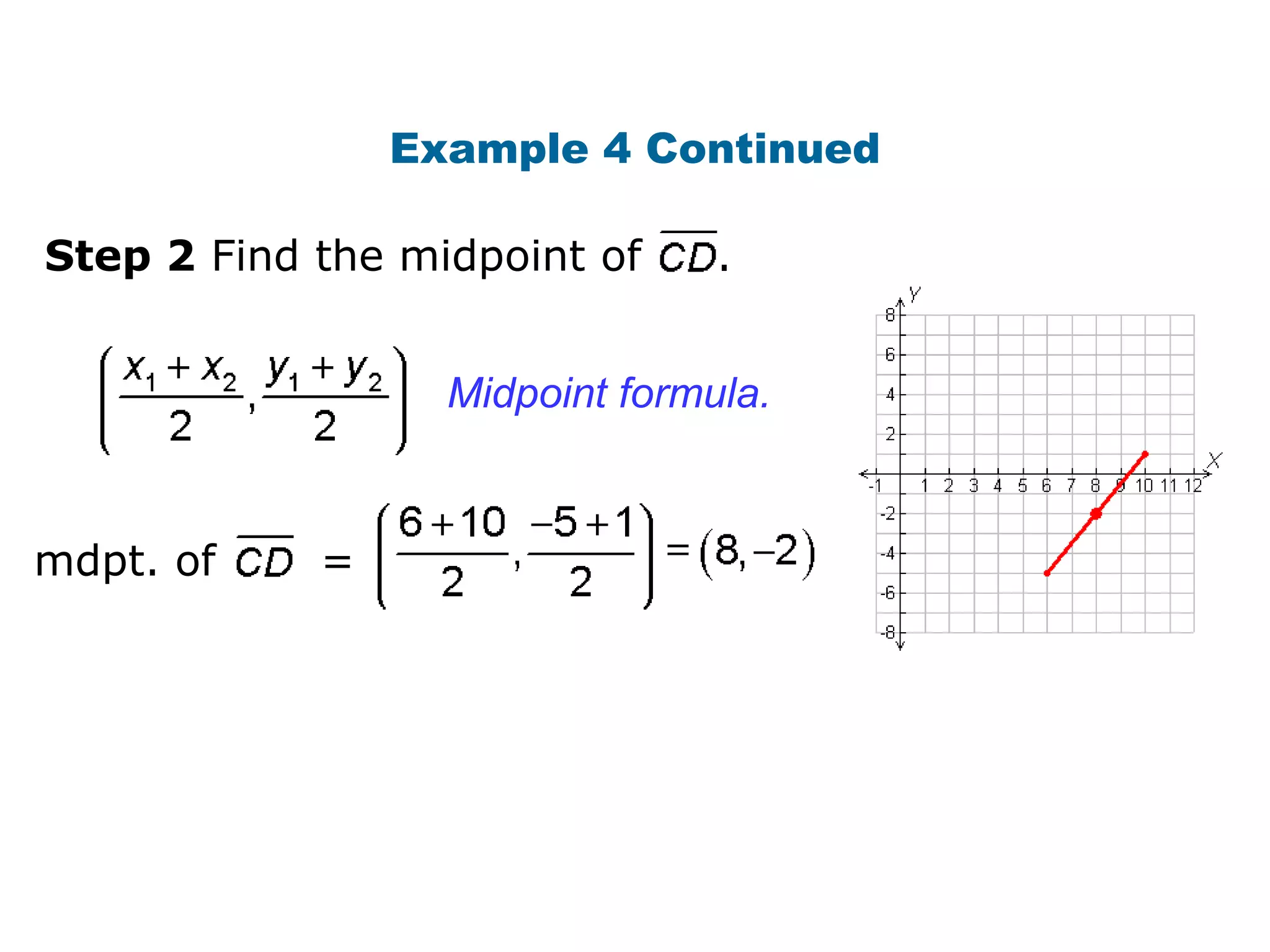
Step 2 Find the midpoint of

.

Midpoint formula.

mdpt. of

=
Example 4 Continued
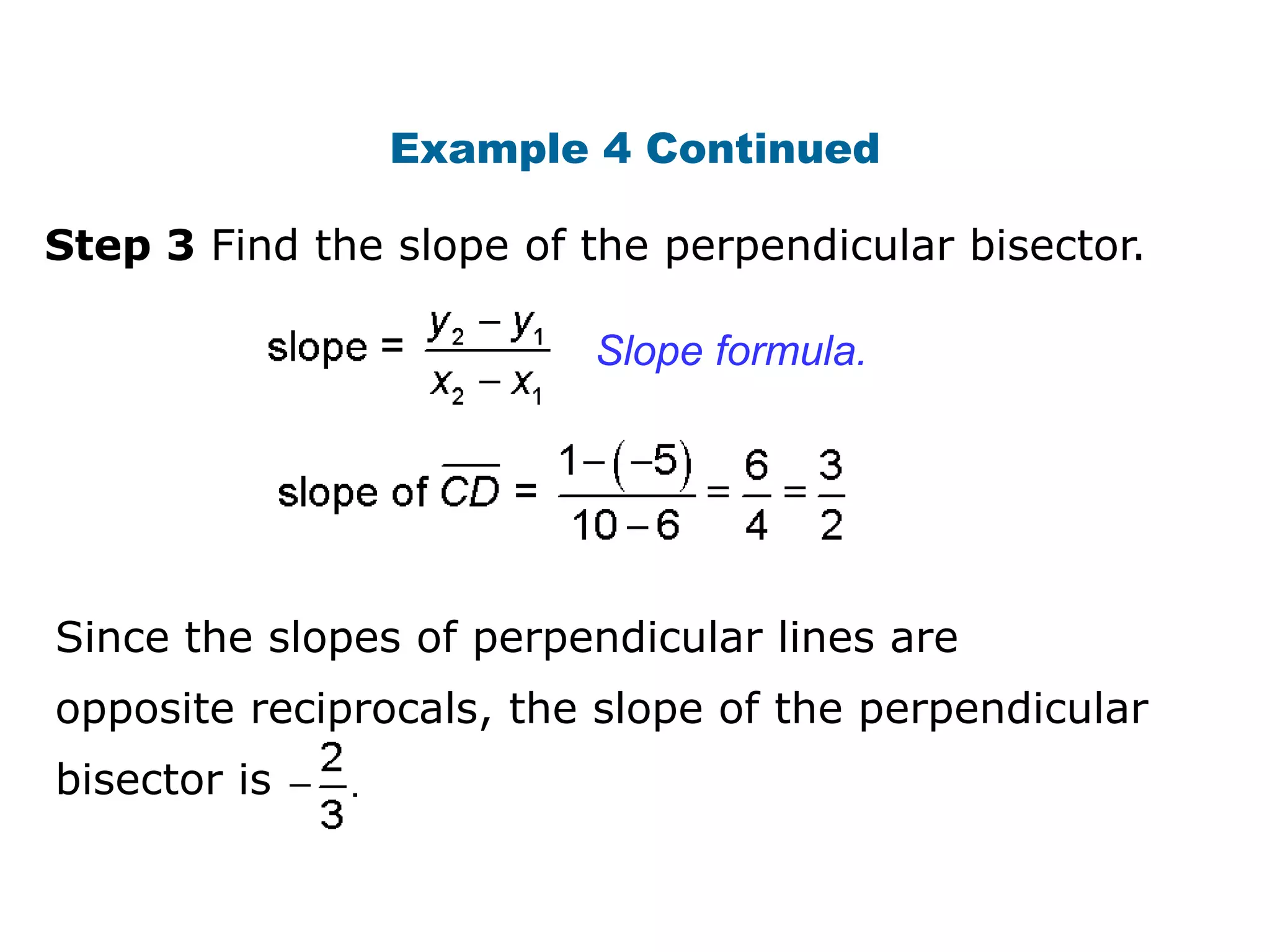
Step 3 Find the slope of the perpendicular bisector.
Slope formula.

Since the slopes of perpendicular lines are
opposite reciprocals, the slope of the perpendicular
bisector is
Example 4 Continued
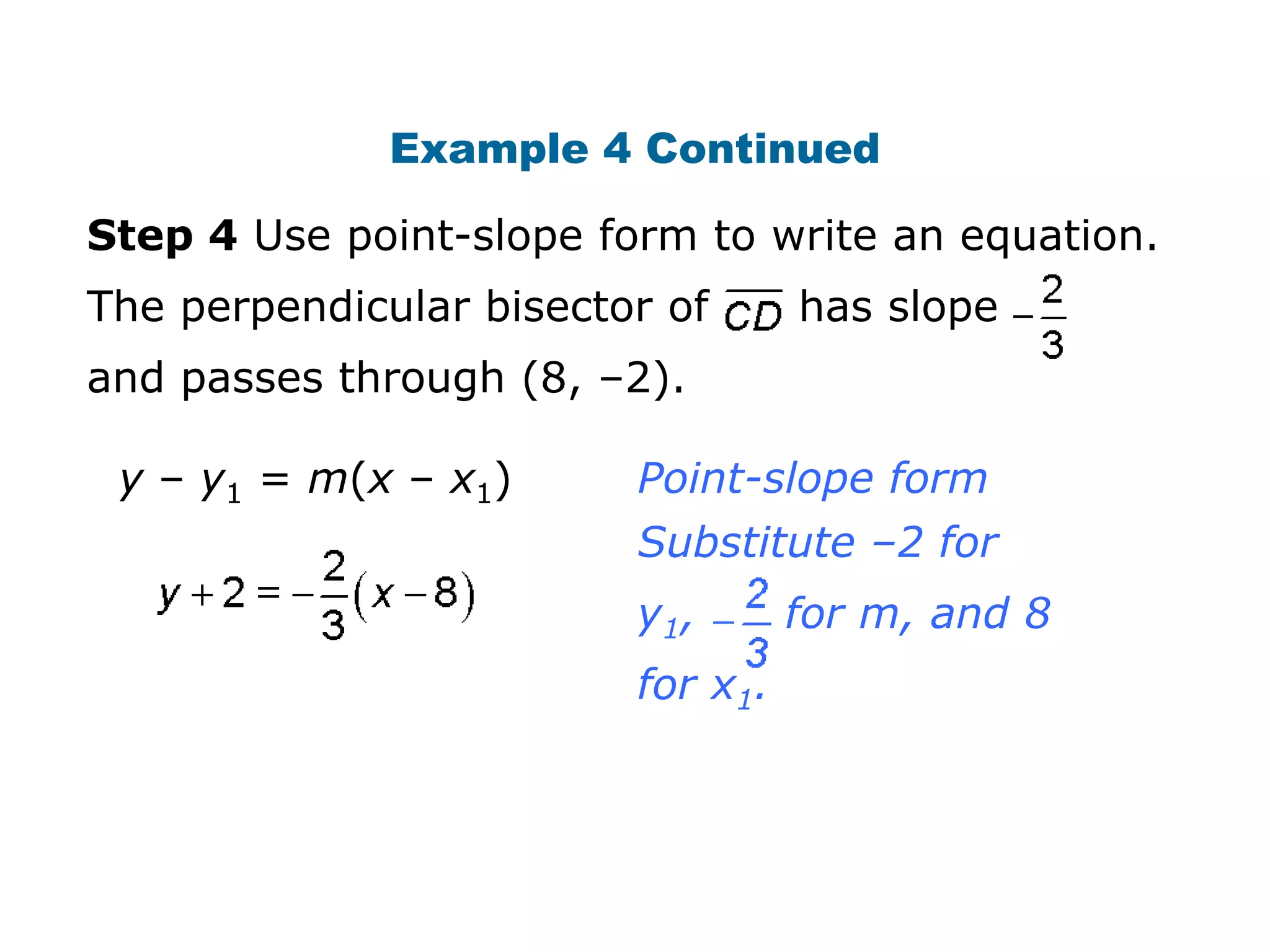
Step 4 Use point-slope form to write an equation.
The perpendicular bisector of

has slope

and passes through (8, –2).
y – y1 = m(x – x1)

Point-slope form

Substitute –2 for
y1,
for x1.

for m, and 8
Example 4 Continued
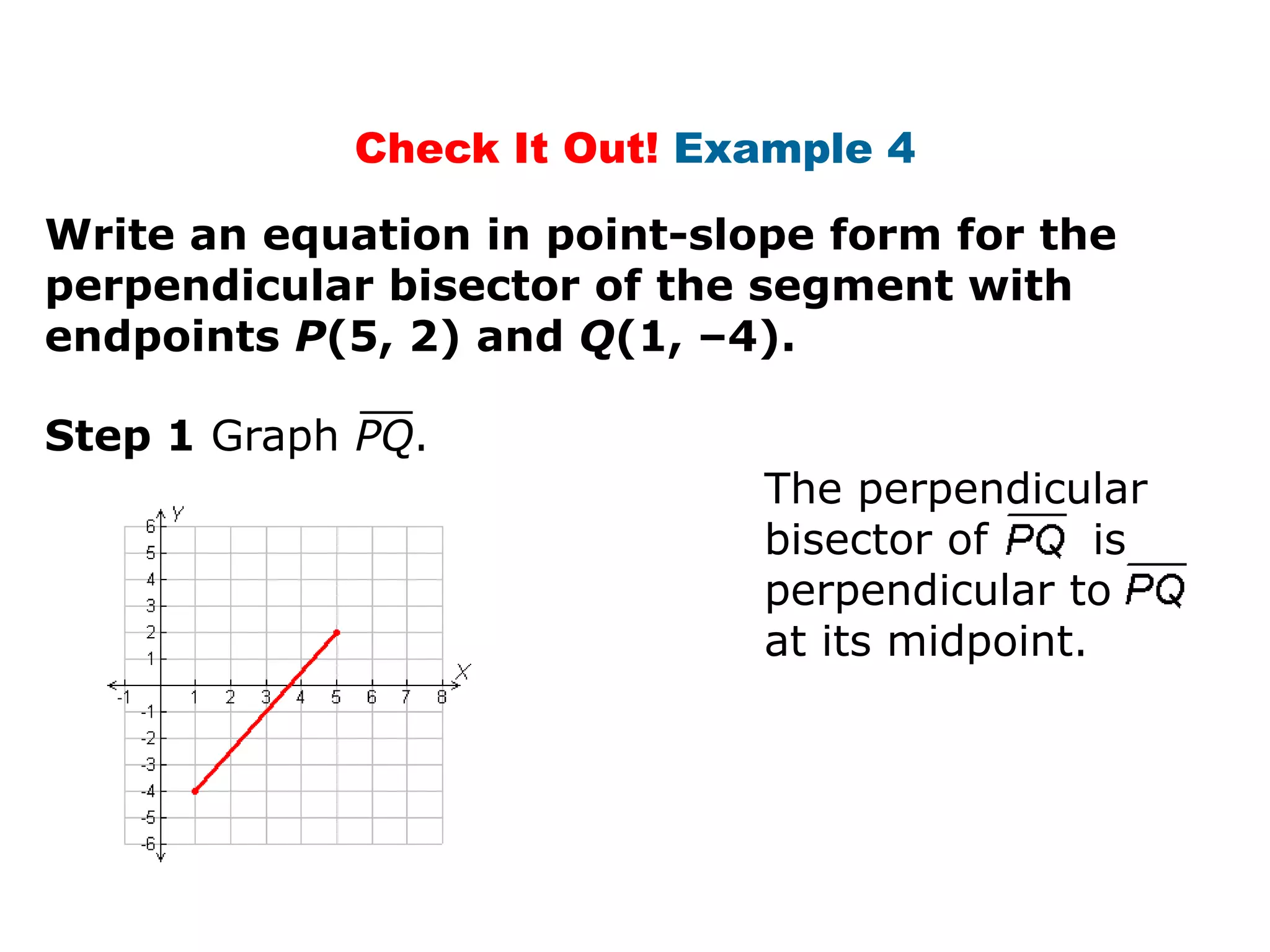
Check It Out! Example 4
Write an equation in point-slope form for the
perpendicular bisector of the segment with
endpoints P(5, 2) and Q(1, –4).
Step 1 Graph PQ.
The perpendicular
bisector of
is
perpendicular to
at its midpoint.
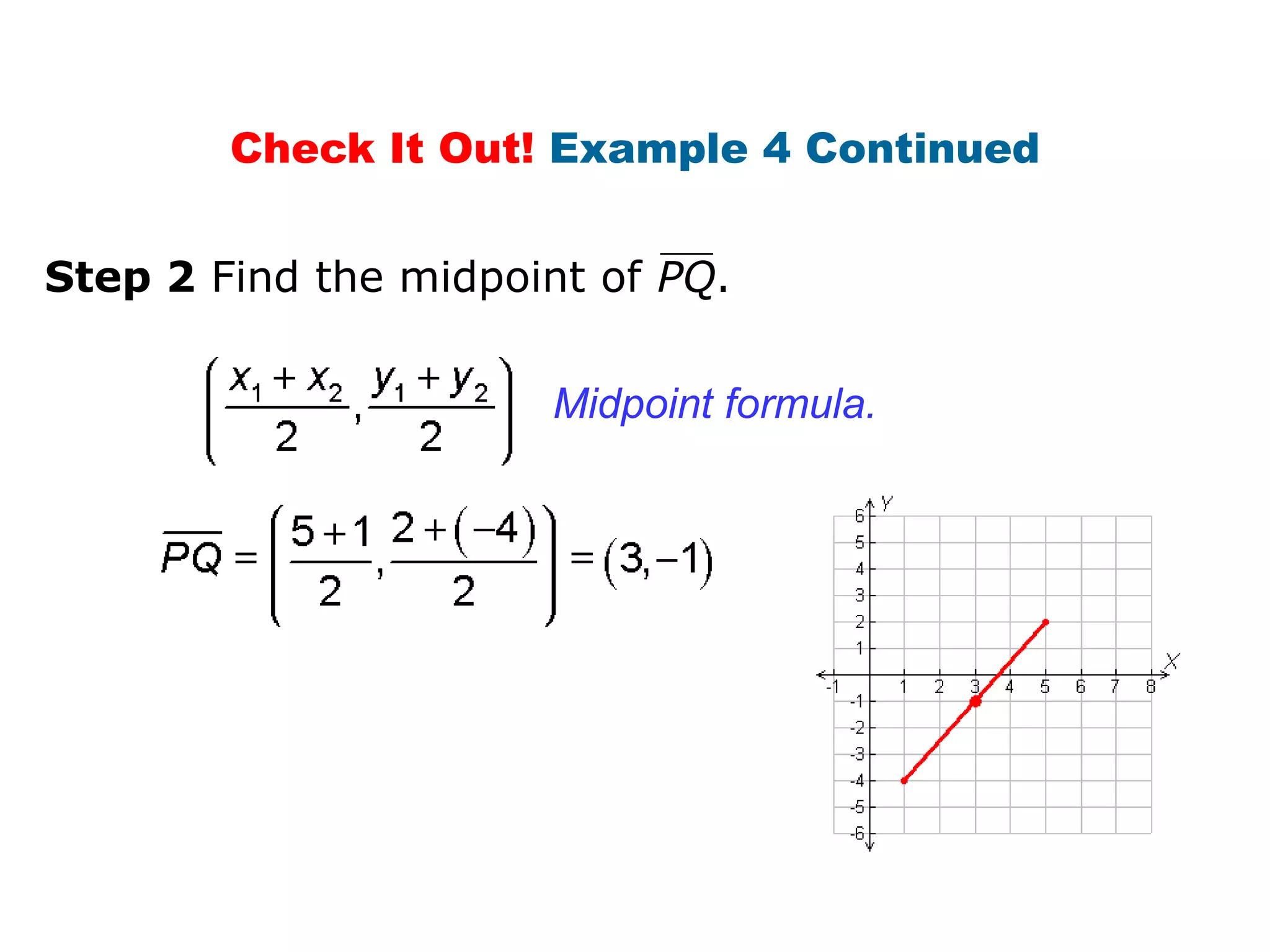
Check It Out! Example 4 Continued
Step 2 Find the midpoint of PQ.
Midpoint formula.
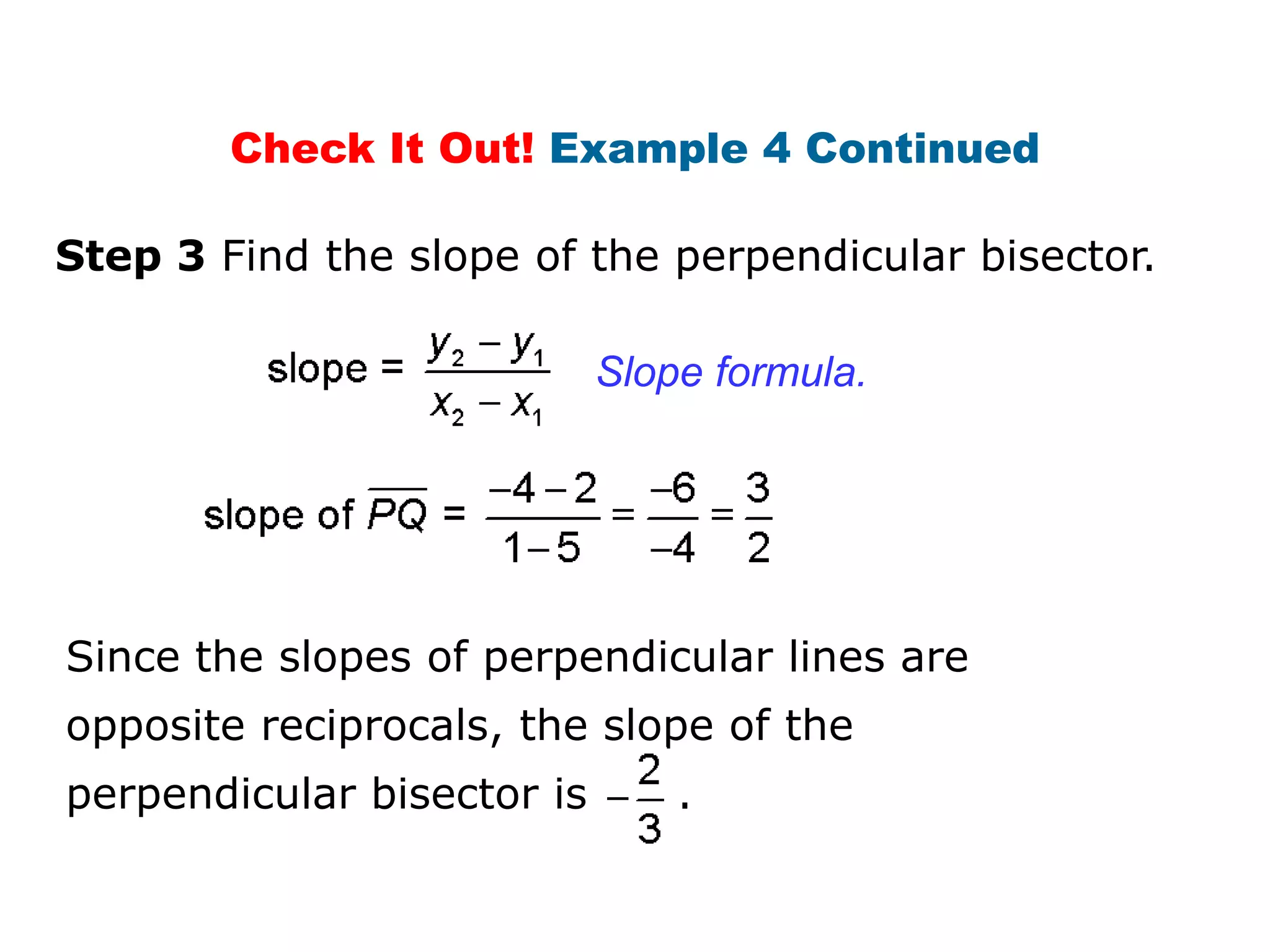
Check It Out! Example 4 Continued
Step 3 Find the slope of the perpendicular bisector.
Slope formula.

Since the slopes of perpendicular lines are
opposite reciprocals, the slope of the
perpendicular bisector is

.
Check It Out! Example 4 Continued
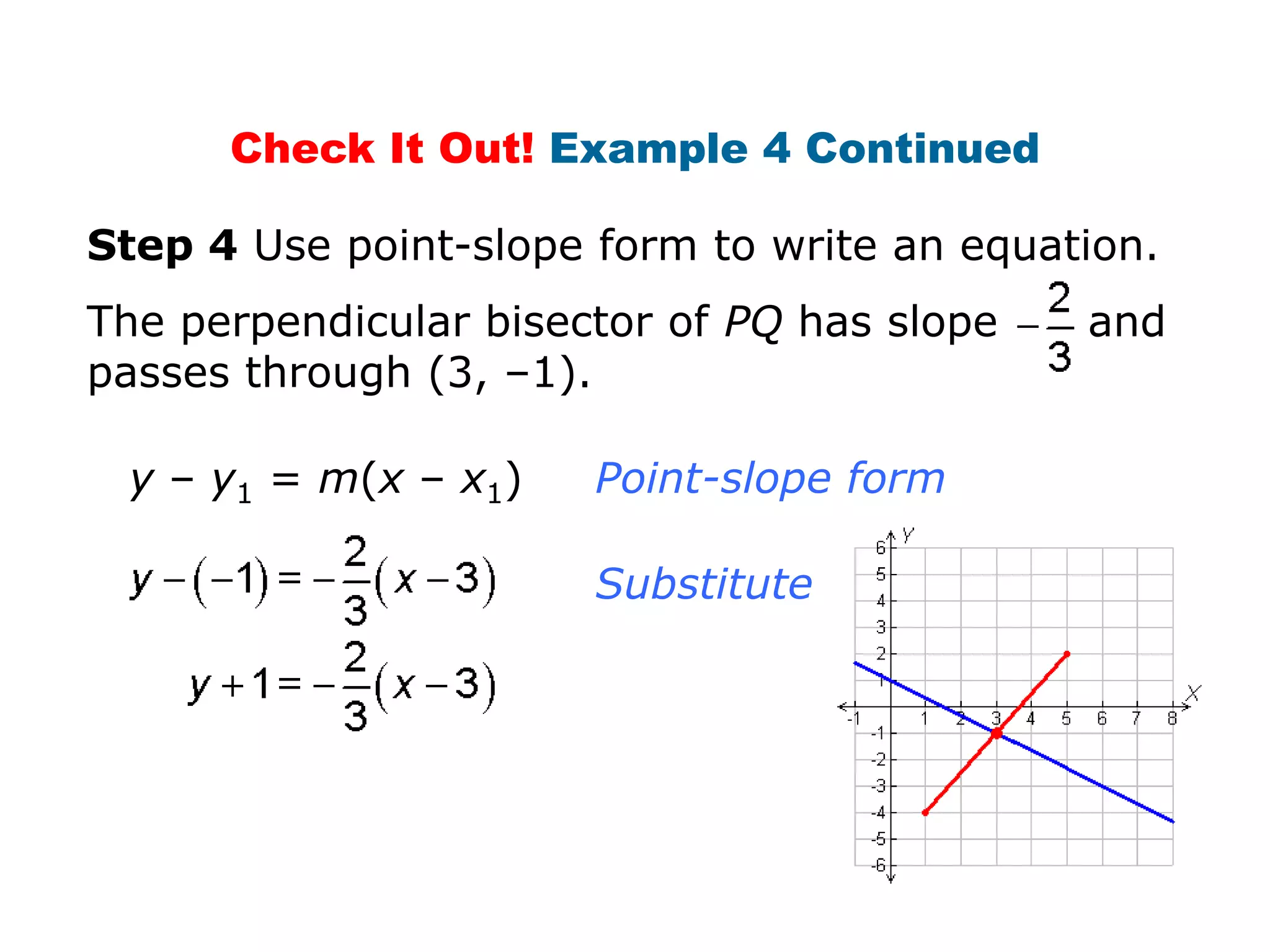
Step 4 Use point-slope form to write an equation.
The perpendicular bisector of PQ has slope
passes through (3, –1).
y – y1 = m(x – x1)

Point-slope form
Substitute.

and
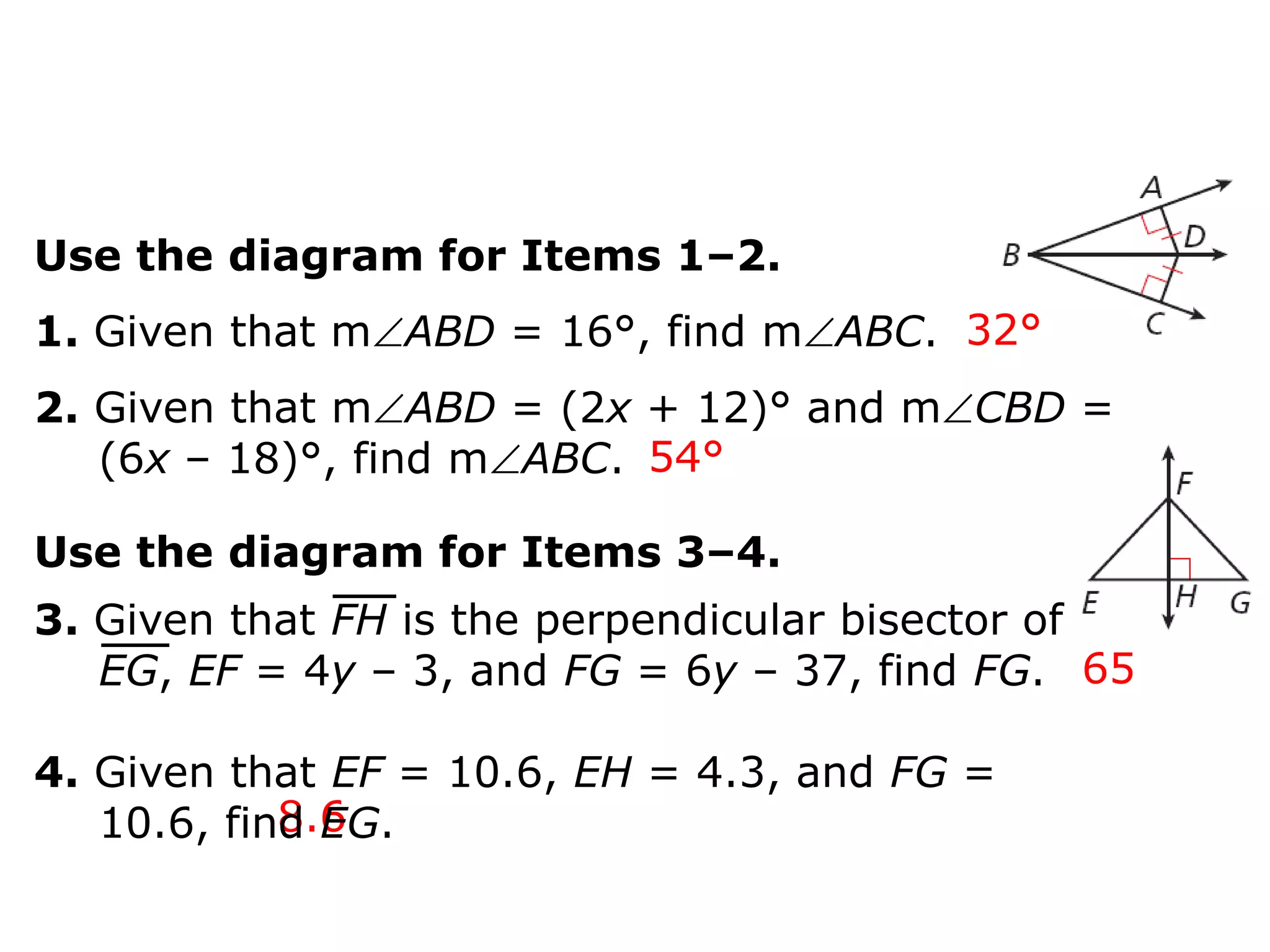
Use the diagram for Items 1–2.
1. Given that mABD = 16°, find mABC. 32°
2. Given that mABD = (2x + 12)° and mCBD =
(6x – 18)°, find mABC. 54°

Use the diagram for Items 3–4.
3. Given that FH is the perpendicular bisector of
EG, EF = 4y – 3, and FG = 6y – 37, find FG. 65

4. Given that EF = 10.6, EH = 4.3, and FG =
8.6
10.6, find EG.
Assignment #48?

• Handout from book
• P304-305 (myhrw.com)#12- 32, for 30 and
31 two column proof
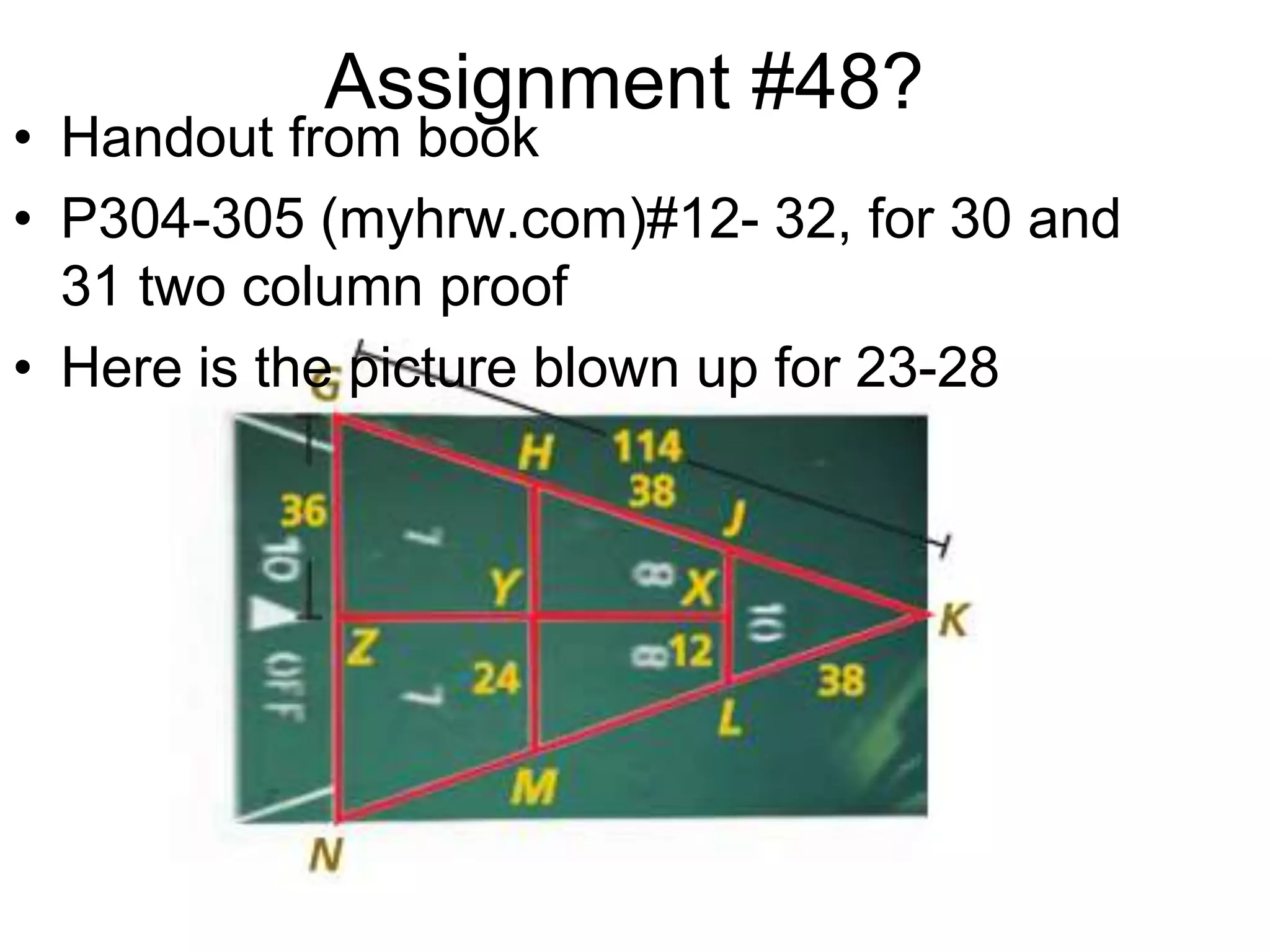
• Here is the picture blown up for 23-28

Chapter 5 unit f 001

  • 1.
    GT Geom. Drill12/13/13 Define each of the following. 1. A perpendicular bisector. 2. An angle bisector. 3. Find the midpoint and slope of the segment (2, 8) and (–4, 6).
  • 2.
    Objectives Prove and applytheorems about perpendicular bisectors. Prove and apply theorems about angle bisectors.
  • 3.
  • 4.
    When a pointis the same distance from two or more objects, the point is said to be equidistant from the objects. Triangle congruence theorems can be used to prove theorems about equidistant points.
  • 7.
    Based on thesetheorems, an angle bisector can be defined as the locus of all points in the interior of the angle that are equidistant from the sides of the angle.
  • 8.
    A locus isa set of points that satisfies a given condition. The perpendicular bisector of a segment can be defined as the locus of points in a plane that are equidistant from the endpoints of the segment.
  • 9.
    Example 1A: Applyingthe Perpendicular Bisector Theorem and Its Converse Find each measure. MN MN = LN  Bisector Thm. MN = 2.6 Substitute 2.6 for LN.
  • 10.
    Example 1B: Applyingthe Perpendicular Bisector Theorem and Its Converse Find each measure. BC Since AB = AC and , is the perpendicular bisector of by the Converse of the Perpendicular Bisector Theorem. BC = 2CD Def. of seg. bisector. BC = 2(12) = 24 Substitute 12 for CD.
  • 11.
    Example 1C: Applyingthe Perpendicular Bisector Theorem and Its Converse Find each measure. TU TU = UV  Bisector Thm. 3x + 9 = 7x – 17 Substitute the given values. 9 = 4x – 17 Subtract 3x from both sides. 26 = 4x 6.5 = x Add 17 to both sides. Divide both sides by 4. So TU = 3(6.5) + 9 = 28.5.
  • 12.
    Remember that thedistance between a point and a line is the length of the perpendicular segment from the point to the line.
  • 13.
    Example 2A: Applyingthe Angle Bisector Theorem Find the measure. BC BC = DC  Bisector Thm. BC = 7.2 Substitute 7.2 for DC.
  • 14.
    Example 2B: Applyingthe Angle Bisector Theorem Find the measure. mEFH, given that mEFG = 50°. Since EH = GH, and , bisects EFG by the Converse of the Angle Bisector Theorem. Def. of  bisector Substitute 50° for mEFG.
  • 15.
    Example 2C: Applyingthe Angle Bisector Theorem Find mMKL. Since, JM = LM, and , bisects JKL by the Converse of the Angle Bisector Theorem. mMKL = mJKM Def. of  bisector 3a + 20 = 2a + 26 a + 20 = 26 a=6 Substitute the given values. Subtract 2a from both sides. Subtract 20 from both sides. So mMKL = [2(6) + 26]° = 38°
  • 16.
    Example 4: WritingEquations of Bisectors in the Coordinate Plane Write an equation in point-slope form for the perpendicular bisector of the segment with endpoints C(6, –5) and D(10, 1). Step 1 Graph . The perpendicular bisector of is perpendicular to at its midpoint.
  • 17.
    Example 4 Continued Step2 Find the midpoint of . Midpoint formula. mdpt. of =
  • 18.
    Example 4 Continued Step3 Find the slope of the perpendicular bisector. Slope formula. Since the slopes of perpendicular lines are opposite reciprocals, the slope of the perpendicular bisector is
  • 19.
    Example 4 Continued Step4 Use point-slope form to write an equation. The perpendicular bisector of has slope and passes through (8, –2). y – y1 = m(x – x1) Point-slope form Substitute –2 for y1, for x1. for m, and 8
  • 20.
  • 21.
    Check It Out!Example 4 Write an equation in point-slope form for the perpendicular bisector of the segment with endpoints P(5, 2) and Q(1, –4). Step 1 Graph PQ. The perpendicular bisector of is perpendicular to at its midpoint.
  • 22.
    Check It Out!Example 4 Continued Step 2 Find the midpoint of PQ. Midpoint formula.
  • 23.
    Check It Out!Example 4 Continued Step 3 Find the slope of the perpendicular bisector. Slope formula. Since the slopes of perpendicular lines are opposite reciprocals, the slope of the perpendicular bisector is .
  • 24.
    Check It Out!Example 4 Continued Step 4 Use point-slope form to write an equation. The perpendicular bisector of PQ has slope passes through (3, –1). y – y1 = m(x – x1) Point-slope form Substitute. and
  • 25.
    Use the diagramfor Items 1–2. 1. Given that mABD = 16°, find mABC. 32° 2. Given that mABD = (2x + 12)° and mCBD = (6x – 18)°, find mABC. 54° Use the diagram for Items 3–4. 3. Given that FH is the perpendicular bisector of EG, EF = 4y – 3, and FG = 6y – 37, find FG. 65 4. Given that EF = 10.6, EH = 4.3, and FG = 8.6 10.6, find EG.
  • 26.
    Assignment #48? • Handoutfrom book • P304-305 (myhrw.com)#12- 32, for 30 and 31 two column proof • Here is the picture blown up for 23-28