
UNIT 4.5 ISOSCELES AANNDD EEQQUUIILLAATTEERRAALL 
TTRRIIAANNLLEESS 
Warm Up 
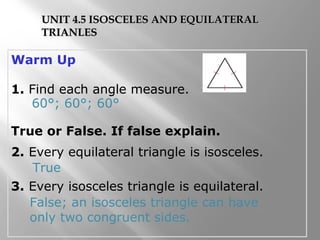
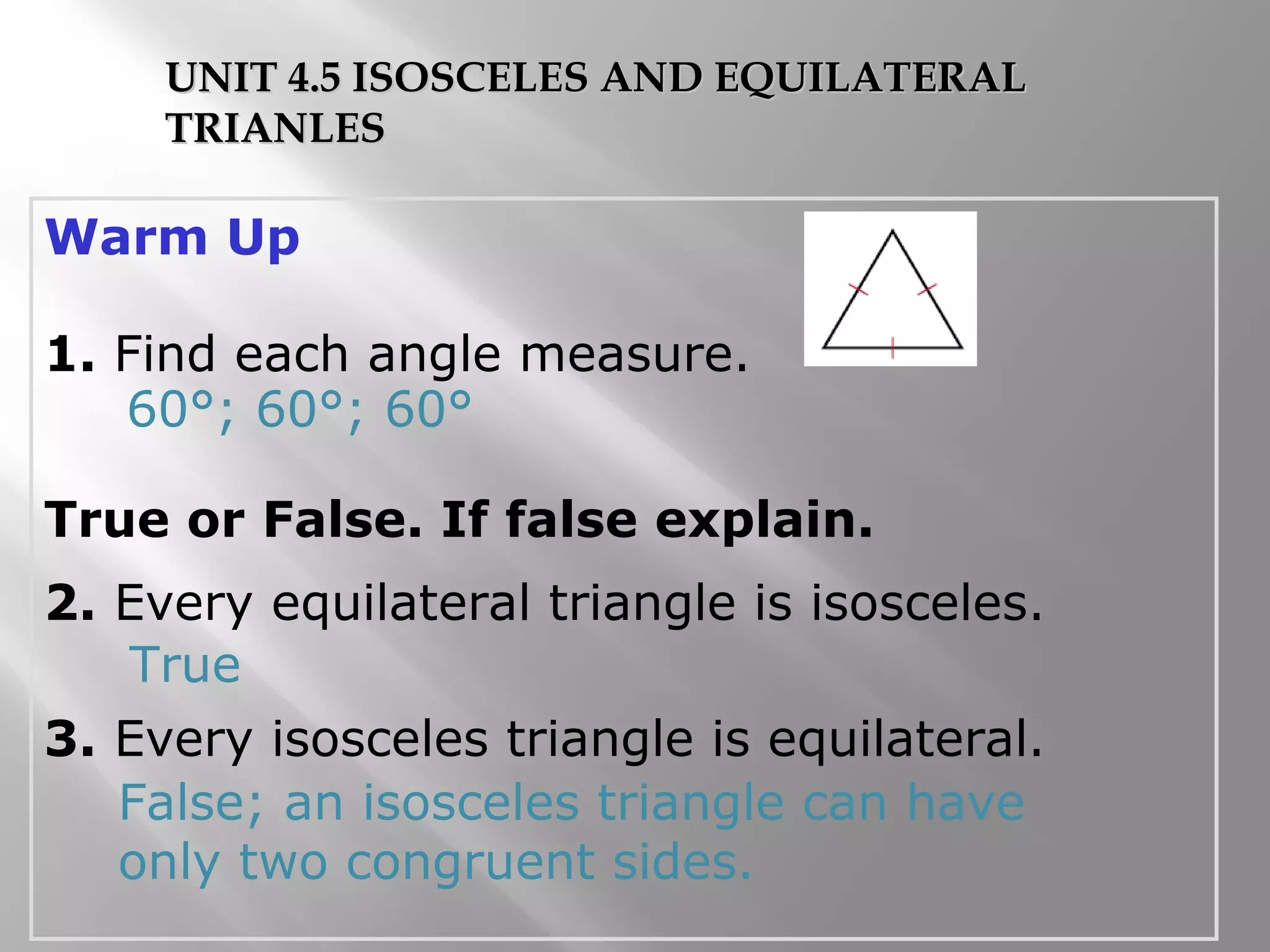
1. Find each angle measure. 
60°; 60°; 60° 
True or False. If false explain. 
2. Every equilateral triangle is isosceles. 
True 
3. Every isosceles triangle is equilateral. 
False; an isosceles triangle can have 
only two congruent sides.
Objectives 
Prove theorems about isosceles and 
equilateral triangles. 
Apply properties of isosceles and 
equilateral triangles.
Vocabulary 
legs of an isosceles triangle 
vertex angle 
base 
base angles
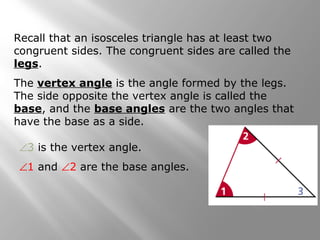
Recall that an isosceles triangle has at least two 
congruent sides. The congruent sides are called the 
legs. 
The vertex angle is the angle formed by the legs. 
The side opposite the vertex angle is called the 
base, and the base angles are the two angles that 
have the base as a side. 
Ð3 is the vertex angle. 
Ð1 and Ð2 are the base angles.
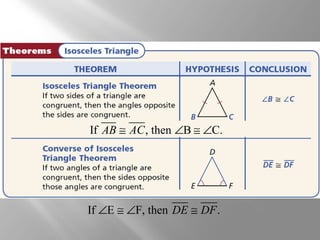
If AB @ AC, then ÐB @ ÐC. 
If ÐE @ ÐF, then DE @ DF.
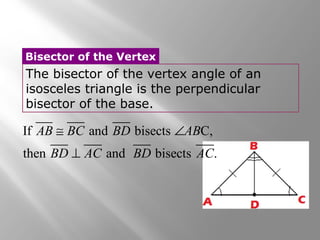
Bisector of the Vertex 
The bisector of the vertex angle of an 
isosceles triangle is the perpendicular 
bisector of the base. 
AB @ BC BD Ð 
AB 
BD ^ 
AC BD AC 
If and bisects C, 
then and bisects .
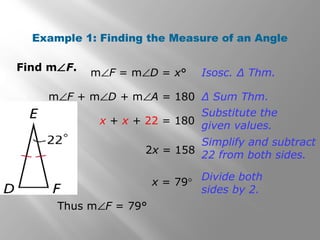
Example 1: Finding the Measure of an Angle 
Find mÐF. 
mÐF = mÐD = x° Isosc. Δ Thm. 
mÐF + mÐD + mÐA = 180 Δ Sum Thm. 
x + x + 22 = 180 
Thus mÐF = 79° 
Substitute the 
given values. 
2x = 158 
Simplify and subtract 
22 from both sides. 
x = 79° Divide both 
sides by 2.
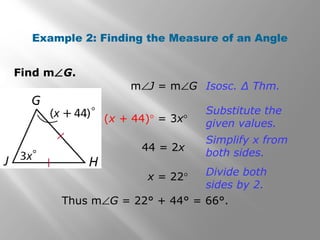
Example 2: Finding the Measure of an Angle 
Find mÐG. 
mÐJ = mÐG Isosc. Δ Thm. 
(x + 44)° = 3x° 
Substitute the 
given values. 
44 = 2x 
Simplify x from 
both sides. 
x = 22° Divide both 
sides by 2. 
Thus mÐG = 22° + 44° = 66°.
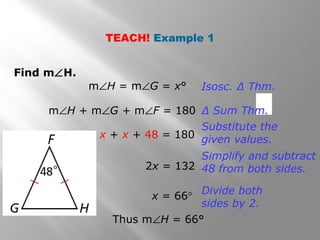
TEACH! Example 1 
Find mÐH. 
mÐH = mÐG = x° Isosc. Δ Thm. 
mÐH + mÐG + mÐF = 180 Δ Sum Thm. 
x + x + 48 = 180 
Substitute the 
given values. 
2x = 132 
Simplify and subtract 
48 from both sides. 
x = 66° Divide both 
sides by 2. 
Thus mÐH = 66°
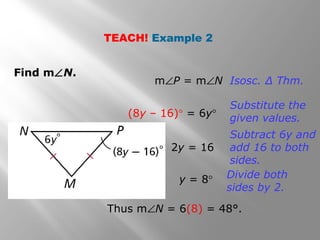
TEACH! Example 2 
Find mÐN. 
mÐP = mÐN Isosc. Δ Thm. 
(8y – 16)° = 6y° 
Substitute the 
given values. 
2y = 16 
Subtract 6y and 
add 16 to both 
sides. 
y = 8° Divide both 
sides by 2. 
Thus mÐN = 6(8) = 48°.
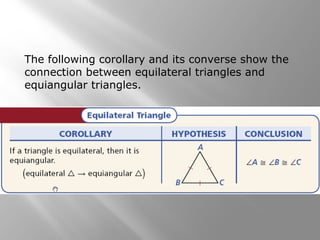
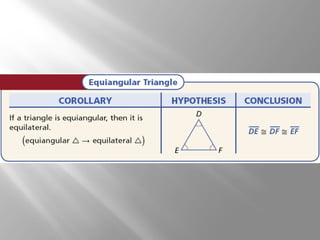
The following corollary and its converse show the 
connection between equilateral triangles and 
equiangular triangles.
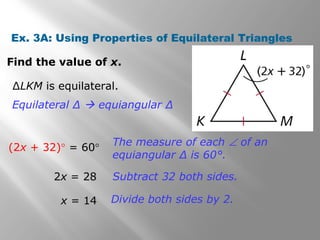
Ex. 3A: Using Properties of Equilateral Triangles 
Find the value of x. 
ΔLKM is equilateral. 
Equilateral Δ  equiangular Δ 
(2x + 32)° = 60° The measure of each Ð of an 
equiangular Δ is 60°. 
2x = 28 Subtract 32 both sides. 
x = 14 Divide both sides by 2.
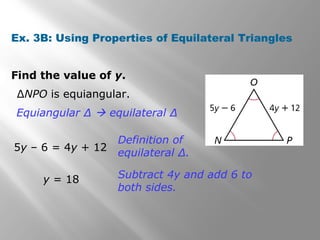
Ex. 3B: Using Properties of Equilateral Triangles 
Find the value of y. 
ΔNPO is equiangular. 
Equiangular Δ  equilateral Δ 
5y – 6 = 4y + 12 
Definition of 
equilateral Δ. 
y = 18 Subtract 4y and add 6 to 
both sides.
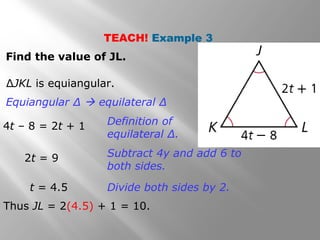
TEACH! Example 3 
Find the value of JL. 
ΔJKL is equiangular. 
Equiangular Δ  equilateral Δ 
4t – 8 = 2t + 1 Definition of 
equilateral Δ. 
2t = 9 Subtract 4y and add 6 to 
both sides. 
t = 4.5 Divide both sides by 2. 
Thus JL = 2(4.5) + 1 = 10.
Remember! 
A coordinate proof may be easier if you 
place one side of the triangle along the 
x-axis and locate a vertex at the origin or 
on the y-axis.
Example 4: Using Coordinate Proof 
Prove that the segment joining the midpoints of 
two sides of an isosceles triangle is half the base. 
Given: In isosceles ΔABC, X is the mdpt. of AB, and 
Y is the mdpt. of BC. 
1 
2 
Prove: XY = AC.
Example 4 Continued 
Proof: 
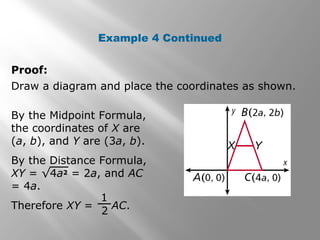
Draw a diagram and place the coordinates as shown. 
By the Midpoint Formula, 
the coordinates of X are 
(a, b), and Y are (3a, b). 
By the Distance Formula, 
XY = √4a2 = 2a, and AC 
= 4a. 
Therefore XY = AC. 
1 
2
TEACH! Example 4 
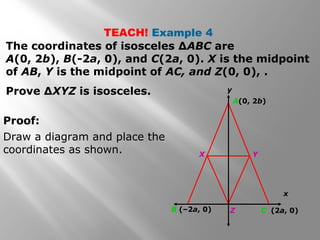
The coordinates of isosceles ΔABC are 
A(0, 2b), B(-2a, 0), and C(2a, 0). X is the midpoint 
of AB, Y is the midpoint of AC, and Z(0, 0), . 
Prove ΔXYZ is isosceles. 
x 
A(0, 2b) 
y 
X Y 
B (–2a, 0) Z 
C (2a, 0) 
Proof: 
Draw a diagram and place the 
coordinates as shown.
Check It Out! Example 4 Continued 
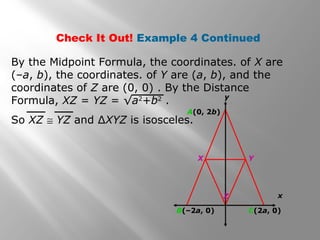
By the Midpoint Formula, the coordinates. of X are 
(–a, b), the coordinates. of Y are (a, b), and the 
coordinates of Z are (0, 0) . By the Distance 
Formula, XZ = YZ = √a2+b2 . 
So XZ @ YZ and ΔXYZ is isosceles. 
x 
A(0, 2b) 
y 
X Y 
Z 
B(–2a, 0) C(2a, 0)
Lesson Quiz: Part I 
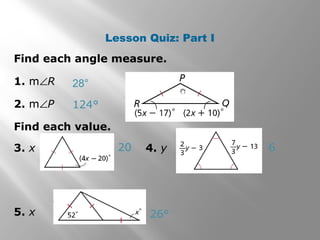
Find each angle measure. 
1. mÐR 
2. mÐP 
Find each value. 
3. x 4. y 
5. x 
28° 
124° 
20 6 
26°
Lesson Quiz: Part II 
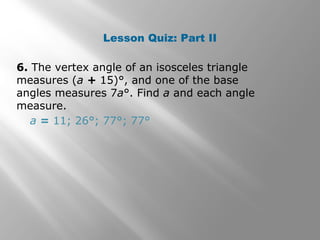
6. The vertex angle of an isosceles triangle 
measures (a + 15)°, and one of the base 
angles measures 7a°. Find a and each angle 
measure. 
a = 11; 26°; 77°; 77°
All rights belong to their 
respective owners. 
Copyright Disclaimer Under 
Section 107 of the 
Copyright Act 1976, 
allowance is made for "fair 
use" for purposes such as 
criticism, comment, news 
reporting, TEACHING, 
scholarship, and research. 
Fair use is a use permitted 
by copyright statute that 
might otherwise be 
infringing. 
Non-profit, EDUCATIONAL 
or personal use tips the 
balance in favor of fair use.

Geometry unit 4.5

  • 1.
    UNIT 4.5 ISOSCELESAANNDD EEQQUUIILLAATTEERRAALL TTRRIIAANNLLEESS Warm Up 1. Find each angle measure. 60°; 60°; 60° True or False. If false explain. 2. Every equilateral triangle is isosceles. True 3. Every isosceles triangle is equilateral. False; an isosceles triangle can have only two congruent sides.
  • 2.
    Objectives Prove theoremsabout isosceles and equilateral triangles. Apply properties of isosceles and equilateral triangles.
  • 3.
    Vocabulary legs ofan isosceles triangle vertex angle base base angles
  • 4.
    Recall that anisosceles triangle has at least two congruent sides. The congruent sides are called the legs. The vertex angle is the angle formed by the legs. The side opposite the vertex angle is called the base, and the base angles are the two angles that have the base as a side. Ð3 is the vertex angle. Ð1 and Ð2 are the base angles.
  • 5.
    If AB @AC, then ÐB @ ÐC. If ÐE @ ÐF, then DE @ DF.
  • 6.
    Bisector of theVertex The bisector of the vertex angle of an isosceles triangle is the perpendicular bisector of the base. AB @ BC BD Ð AB BD ^ AC BD AC If and bisects C, then and bisects .
  • 7.
    Example 1: Findingthe Measure of an Angle Find mÐF. mÐF = mÐD = x° Isosc. Δ Thm. mÐF + mÐD + mÐA = 180 Δ Sum Thm. x + x + 22 = 180 Thus mÐF = 79° Substitute the given values. 2x = 158 Simplify and subtract 22 from both sides. x = 79° Divide both sides by 2.
  • 8.
    Example 2: Findingthe Measure of an Angle Find mÐG. mÐJ = mÐG Isosc. Δ Thm. (x + 44)° = 3x° Substitute the given values. 44 = 2x Simplify x from both sides. x = 22° Divide both sides by 2. Thus mÐG = 22° + 44° = 66°.
  • 9.
    TEACH! Example 1 Find mÐH. mÐH = mÐG = x° Isosc. Δ Thm. mÐH + mÐG + mÐF = 180 Δ Sum Thm. x + x + 48 = 180 Substitute the given values. 2x = 132 Simplify and subtract 48 from both sides. x = 66° Divide both sides by 2. Thus mÐH = 66°
  • 10.
    TEACH! Example 2 Find mÐN. mÐP = mÐN Isosc. Δ Thm. (8y – 16)° = 6y° Substitute the given values. 2y = 16 Subtract 6y and add 16 to both sides. y = 8° Divide both sides by 2. Thus mÐN = 6(8) = 48°.
  • 11.
    The following corollaryand its converse show the connection between equilateral triangles and equiangular triangles.
  • 13.
    Ex. 3A: UsingProperties of Equilateral Triangles Find the value of x. ΔLKM is equilateral. Equilateral Δ  equiangular Δ (2x + 32)° = 60° The measure of each Ð of an equiangular Δ is 60°. 2x = 28 Subtract 32 both sides. x = 14 Divide both sides by 2.
  • 14.
    Ex. 3B: UsingProperties of Equilateral Triangles Find the value of y. ΔNPO is equiangular. Equiangular Δ  equilateral Δ 5y – 6 = 4y + 12 Definition of equilateral Δ. y = 18 Subtract 4y and add 6 to both sides.
  • 15.
    TEACH! Example 3 Find the value of JL. ΔJKL is equiangular. Equiangular Δ  equilateral Δ 4t – 8 = 2t + 1 Definition of equilateral Δ. 2t = 9 Subtract 4y and add 6 to both sides. t = 4.5 Divide both sides by 2. Thus JL = 2(4.5) + 1 = 10.
  • 16.
    Remember! A coordinateproof may be easier if you place one side of the triangle along the x-axis and locate a vertex at the origin or on the y-axis.
  • 17.
    Example 4: UsingCoordinate Proof Prove that the segment joining the midpoints of two sides of an isosceles triangle is half the base. Given: In isosceles ΔABC, X is the mdpt. of AB, and Y is the mdpt. of BC. 1 2 Prove: XY = AC.
  • 18.
    Example 4 Continued Proof: Draw a diagram and place the coordinates as shown. By the Midpoint Formula, the coordinates of X are (a, b), and Y are (3a, b). By the Distance Formula, XY = √4a2 = 2a, and AC = 4a. Therefore XY = AC. 1 2
  • 19.
    TEACH! Example 4 The coordinates of isosceles ΔABC are A(0, 2b), B(-2a, 0), and C(2a, 0). X is the midpoint of AB, Y is the midpoint of AC, and Z(0, 0), . Prove ΔXYZ is isosceles. x A(0, 2b) y X Y B (–2a, 0) Z C (2a, 0) Proof: Draw a diagram and place the coordinates as shown.
  • 20.
    Check It Out!Example 4 Continued By the Midpoint Formula, the coordinates. of X are (–a, b), the coordinates. of Y are (a, b), and the coordinates of Z are (0, 0) . By the Distance Formula, XZ = YZ = √a2+b2 . So XZ @ YZ and ΔXYZ is isosceles. x A(0, 2b) y X Y Z B(–2a, 0) C(2a, 0)
  • 21.
    Lesson Quiz: PartI Find each angle measure. 1. mÐR 2. mÐP Find each value. 3. x 4. y 5. x 28° 124° 20 6 26°
  • 22.
    Lesson Quiz: PartII 6. The vertex angle of an isosceles triangle measures (a + 15)°, and one of the base angles measures 7a°. Find a and each angle measure. a = 11; 26°; 77°; 77°
  • 23.
    All rights belongto their respective owners. Copyright Disclaimer Under Section 107 of the Copyright Act 1976, allowance is made for "fair use" for purposes such as criticism, comment, news reporting, TEACHING, scholarship, and research. Fair use is a use permitted by copyright statute that might otherwise be infringing. Non-profit, EDUCATIONAL or personal use tips the balance in favor of fair use.