11
Chapter 3Chapter 3
Total Quality inTotal Quality in
OrganizationsOrganizations
Dr. John V. PaduaDr. John V. Padua
The
Management
& Control of
Quality, 7e
Learning ObjectivesLearning Objectives
22
At the end of this session, the students are all
expected to understand the following:
• The Systems and its importance
• Manufacturing Systems
• Quality in Different Areas
• Critical Quality Differences in Service and
Manufacturing
Key IdeaKey Idea
As consumer expectations have risen, a
focus on quality has permeated other key
sectors of the economy, most notably
health care, education, not-for-profits,
and government.
33
SystemsSystems
 AA systemsystem is a set of functions or activitiesis a set of functions or activities
within an organization that work together forwithin an organization that work together for
the aim of the organization.the aim of the organization.
 Subsystems of an organization are linkedSubsystems of an organization are linked
together as internal customers andtogether as internal customers and
suppliers.suppliers.
 A systems perspective acknowledges theA systems perspective acknowledges the
importance of the interactions ofimportance of the interactions of
subsystems, not the actions of themsubsystems, not the actions of them
individually.individually.
44
55
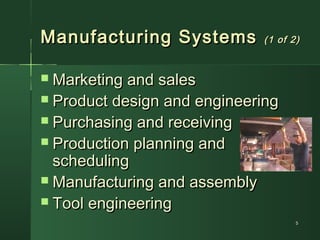
Manufacturing SystemsManufacturing Systems (1 of 2)(1 of 2)
 Marketing and salesMarketing and sales
 Product design and engineeringProduct design and engineering
 Purchasing and receivingPurchasing and receiving
 Production planning andProduction planning and
schedulingscheduling
 Manufacturing and assemblyManufacturing and assembly
 Tool engineeringTool engineering
66
Manufacturing SystemsManufacturing Systems (2 of(2 of
2)2)
 Industrial engineering and processIndustrial engineering and process
designdesign
 Finished goods inspection and testFinished goods inspection and test
 Packaging, shipping, andPackaging, shipping, and
warehousingwarehousing
 Installation and serviceInstallation and service
Key IdeaKey Idea
Traditional quality assurance systems in
manufacturing focus primarily on technical
issues such as equipment reliability,
inspection, defect measurement, and
process control.
77
Quality in MarketingQuality in Marketing
Marketing and sales personnel are
responsible for determining the needs
and expectations of consumers.
88
Quality in ProductQuality in Product
DesignDesign
Product design and engineering functions
develop technical specifications for
products and production processes to
meet the requirements determined by the
marketing function.
99
Quality in PurchasingQuality in Purchasing
A purchasing agent should not simply be
responsible for low-cost procurement, but
should maintain a clear focus on the
quality of purchased goods and materials.
1010
Quality in ProductionQuality in Production
Planning & SchedulingPlanning & Scheduling
Poor quality often results from time
pressures caused by insufficient planning
and scheduling.
1111
Quality in ManufacturingQuality in Manufacturing
and Assemblyand Assembly
Both technology and people are essential
to high-quality manufacturing.
1212
Quality in ProcessQuality in Process
DesignDesign
Manufacturing processes must be
capable of producing output that meets
specifications consistently.
1313
Quality in Finished GoodsQuality in Finished Goods
Inspection and TestingInspection and Testing
The purposes of final product inspection
are to judge the quality of manufacturing,
to discover and help to resolve production
problems that may arise, and to ensure
that no defective items reach the customer.
1414
Quality in Installation andQuality in Installation and
ServiceService
Service after the sale is one of the most
important factors in establishing customer
perception of quality and customer
loyalty.
1515
1616
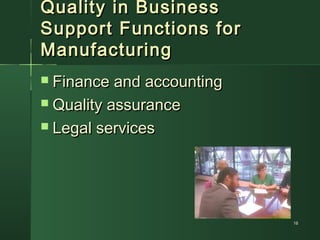
Quality in BusinessQuality in Business
Support Functions forSupport Functions for
ManufacturingManufacturing
 Finance and accountingFinance and accounting
 Quality assuranceQuality assurance
 Legal servicesLegal services
Key IdeaKey Idea
Every manager is responsible for
studying and improving the quality of the
process for which he or she is
responsible; thus, every manager is a
quality manager.
1717
1818
Quality in ServicesQuality in Services
 ServiceService is defined as “any primary oris defined as “any primary or
complementary activity that does notcomplementary activity that does not
directly produce a physical product –directly produce a physical product –
that is, the non-goods part of thethat is, the non-goods part of the
transaction between buyer (customer)transaction between buyer (customer)
and seller (provider).”and seller (provider).”
Key IdeaKey Idea
The American Management Association
estimates that the average company
loses as many as 35 percent of its
customers each year, and that about two-
thirds of these are lost because of poor
customer service.
1919
2020
Critical Differences BetweenCritical Differences Between
Service and ManufacturingService and Manufacturing (1 of(1 of
2)2)
 Customer needs and performanceCustomer needs and performance
standards are more difficult tostandards are more difficult to
identify and measureidentify and measure
 Services requires a higher degree ofServices requires a higher degree of
customizationcustomization
 Output is intangibleOutput is intangible
Critical Differences BetweenCritical Differences Between
Service and ManufacturingService and Manufacturing (2 of(2 of
2)2)
 Services are produced and consumedServices are produced and consumed
simultaneouslysimultaneously
 Customers are often involved in actualCustomers are often involved in actual
processprocess
 Services are more labor-intensive thanServices are more labor-intensive than
manufacturingmanufacturing
 Services handle large numbers ofServices handle large numbers of
transactionstransactions
2121

Chapter 3 Total Quality Management - Total Quality in Organizations

  • 1.
    11 Chapter 3Chapter 3 TotalQuality inTotal Quality in OrganizationsOrganizations Dr. John V. PaduaDr. John V. Padua The Management & Control of Quality, 7e
  • 2.
    Learning ObjectivesLearning Objectives 22 Atthe end of this session, the students are all expected to understand the following: • The Systems and its importance • Manufacturing Systems • Quality in Different Areas • Critical Quality Differences in Service and Manufacturing
  • 3.
    Key IdeaKey Idea Asconsumer expectations have risen, a focus on quality has permeated other key sectors of the economy, most notably health care, education, not-for-profits, and government. 33
  • 4.
    SystemsSystems  AA systemsystemis a set of functions or activitiesis a set of functions or activities within an organization that work together forwithin an organization that work together for the aim of the organization.the aim of the organization.  Subsystems of an organization are linkedSubsystems of an organization are linked together as internal customers andtogether as internal customers and suppliers.suppliers.  A systems perspective acknowledges theA systems perspective acknowledges the importance of the interactions ofimportance of the interactions of subsystems, not the actions of themsubsystems, not the actions of them individually.individually. 44
  • 5.
    55 Manufacturing SystemsManufacturing Systems(1 of 2)(1 of 2)  Marketing and salesMarketing and sales  Product design and engineeringProduct design and engineering  Purchasing and receivingPurchasing and receiving  Production planning andProduction planning and schedulingscheduling  Manufacturing and assemblyManufacturing and assembly  Tool engineeringTool engineering
  • 6.
    66 Manufacturing SystemsManufacturing Systems(2 of(2 of 2)2)  Industrial engineering and processIndustrial engineering and process designdesign  Finished goods inspection and testFinished goods inspection and test  Packaging, shipping, andPackaging, shipping, and warehousingwarehousing  Installation and serviceInstallation and service
  • 7.
    Key IdeaKey Idea Traditionalquality assurance systems in manufacturing focus primarily on technical issues such as equipment reliability, inspection, defect measurement, and process control. 77
  • 8.
    Quality in MarketingQualityin Marketing Marketing and sales personnel are responsible for determining the needs and expectations of consumers. 88
  • 9.
    Quality in ProductQualityin Product DesignDesign Product design and engineering functions develop technical specifications for products and production processes to meet the requirements determined by the marketing function. 99
  • 10.
    Quality in PurchasingQualityin Purchasing A purchasing agent should not simply be responsible for low-cost procurement, but should maintain a clear focus on the quality of purchased goods and materials. 1010
  • 11.
    Quality in ProductionQualityin Production Planning & SchedulingPlanning & Scheduling Poor quality often results from time pressures caused by insufficient planning and scheduling. 1111
  • 12.
    Quality in ManufacturingQualityin Manufacturing and Assemblyand Assembly Both technology and people are essential to high-quality manufacturing. 1212
  • 13.
    Quality in ProcessQualityin Process DesignDesign Manufacturing processes must be capable of producing output that meets specifications consistently. 1313
  • 14.
    Quality in FinishedGoodsQuality in Finished Goods Inspection and TestingInspection and Testing The purposes of final product inspection are to judge the quality of manufacturing, to discover and help to resolve production problems that may arise, and to ensure that no defective items reach the customer. 1414
  • 15.
    Quality in InstallationandQuality in Installation and ServiceService Service after the sale is one of the most important factors in establishing customer perception of quality and customer loyalty. 1515
  • 16.
    1616 Quality in BusinessQualityin Business Support Functions forSupport Functions for ManufacturingManufacturing  Finance and accountingFinance and accounting  Quality assuranceQuality assurance  Legal servicesLegal services
  • 17.
    Key IdeaKey Idea Everymanager is responsible for studying and improving the quality of the process for which he or she is responsible; thus, every manager is a quality manager. 1717
  • 18.
    1818 Quality in ServicesQualityin Services  ServiceService is defined as “any primary oris defined as “any primary or complementary activity that does notcomplementary activity that does not directly produce a physical product –directly produce a physical product – that is, the non-goods part of thethat is, the non-goods part of the transaction between buyer (customer)transaction between buyer (customer) and seller (provider).”and seller (provider).”
  • 19.
    Key IdeaKey Idea TheAmerican Management Association estimates that the average company loses as many as 35 percent of its customers each year, and that about two- thirds of these are lost because of poor customer service. 1919
  • 20.
    2020 Critical Differences BetweenCriticalDifferences Between Service and ManufacturingService and Manufacturing (1 of(1 of 2)2)  Customer needs and performanceCustomer needs and performance standards are more difficult tostandards are more difficult to identify and measureidentify and measure  Services requires a higher degree ofServices requires a higher degree of customizationcustomization  Output is intangibleOutput is intangible
  • 21.
    Critical Differences BetweenCriticalDifferences Between Service and ManufacturingService and Manufacturing (2 of(2 of 2)2)  Services are produced and consumedServices are produced and consumed simultaneouslysimultaneously  Customers are often involved in actualCustomers are often involved in actual processprocess  Services are more labor-intensive thanServices are more labor-intensive than manufacturingmanufacturing  Services handle large numbers ofServices handle large numbers of transactionstransactions 2121