LECTURE # 3:
Customer Satisfaction by M. Salman Jamil
 Customer is considered as one of asset for an
organization & treat as Boss or ’King’
 Customer dictates the market trends and direction
 Customer not only has needs to be supplied( basic
performance functions)
 Also he ‘wants what he wants!’( additional features satisfy
him and influence his purchase decision)
 Manufacturing and service organizations are using
customer satisfaction to measure quality.
 Hence the Suppliers and Manufacturers have to closely
follow at the heel of the customer.
2
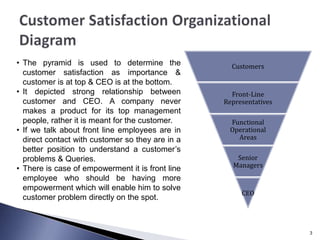
Customers
Front-Line
Representatives
Functional
Operational
Areas
Senior
Managers
CEO
3
• The pyramid is used to determine the
customer satisfaction as importance &
customer is at top & CEO is at the bottom.
• It depicted strong relationship between
customer and CEO. A company never
makes a product for its top management
people, rather it is meant for the customer.
• If we talk about front line employees are in
direct contact with customer so they are in a
better position to understand a customer’s
problems & Queries.
• There is case of empowerment it is front line
employee who should be having more
empowerment which will enable him to solve
customer problem directly on the spot.
4
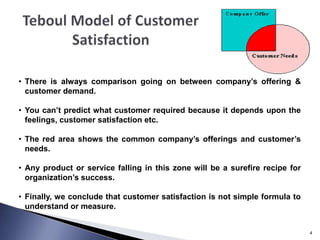
• There is always comparison going on between company’s offering &
customer demand.
• You can’t predict what customer required because it depends upon the
feelings, customer satisfaction etc.
• The red area shows the common company’s offerings and customer’s
needs.
• Any product or service falling in this zone will be a surefire recipe for
organization’s success.
• Finally, we conclude that customer satisfaction is not simple formula to
understand or measure.
 External and Internal customers
 External – Current, Prospective and Lost Customers
 Internal – Every person in a process is a customer of the previous
operation.(Applies to design, manufacturing, sales, supplies etc.)
[Each worker should see that the quality meets expectations of
the next person in the supplier-to-customer chain ]
 TQM is commitment to customer-focus - internal and external
customers.
5
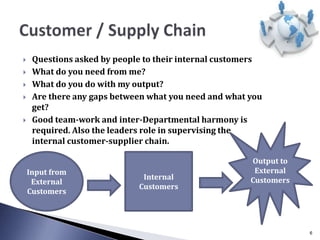
 Questions asked by people to their internal customers
 What do you need from me?
 What do you do with my output?
 Are there any gaps between what you need and what you
get?
 Good team-work and inter-Departmental harmony is
required. Also the leaders role in supervising the
internal customer-supplier chain.
6
Input from
External
Customers
Internal
Customers
Output to
External
Customers
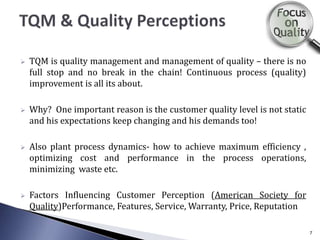
 TQM is quality management and management of quality – there is no
full stop and no break in the chain! Continuous process (quality)
improvement is all its about.
 Why? One important reason is the customer quality level is not static
and his expectations keep changing and his demands too!
 Also plant process dynamics- how to achieve maximum efficiency ,
optimizing cost and performance in the process operations,
minimizing waste etc.
 Factors Influencing Customer Perception (American Society for
Quality)Performance, Features, Service, Warranty, Price, Reputation
7
 Performance: It involves “fitness for use” determine product feature
ready for customer usage.
 Features: It involves attributes of product/services for primary &
secondary nature depend upon psychological, time-oriented,
contractual, technological etc.
 Services: It related customer services part to give customer added
value considered as intangible features. Although there is difference
between better customer services then better quality of product.
 Warranty: It is considered as public promise backed by guarantee for
customer satisfaction. It gives customer for commitment. It generates
feedback about product’s features & services. It encourage to purchase
product & reduce risk level.
8
 Price: The perception of customer changed about pricing, they
can pay higher price to obtain value. The customers have trend
to compare multiple company’s product / services. If the
company wants to retain the customer they have to increase
ongoing effort in terms of identification, verification & update
according to customer requirement.
 Reputation: It sometimes relates to the goodwill for an
organization. Total customer satisfaction gives an organization
reputation . Customer perception relates to purchase trusted
brand name which gives cost increase 5 times related to
product. The strategy maker of an organization consider the
economical condition under consideration.
9
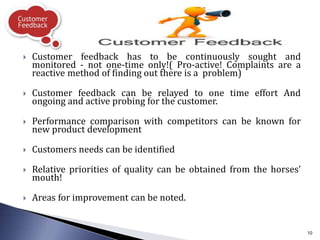
 Customer feedback has to be continuously sought and
monitored - not one-time only!( Pro-active! Complaints are a
reactive method of finding out there is a problem)
 Customer feedback can be relayed to one time effort And
ongoing and active probing for the customer.
 Performance comparison with competitors can be known for
new product development
 Customers needs can be identified
 Relative priorities of quality can be obtained from the horses’
mouth!
 Areas for improvement can be noted.
10
 Comment cards enclosed with warranty card when product
is purchased.
 Customer survey with some general information and
questionnaire
 Customer visits also determine in shaping about product.
 Customer focus groups plays an important role that gives
direction to the product.
 Quarterly reports also help customer as figure speaks itself.
 Toll-free phones E-mail, Internet, Newsgroups, Discussion
forums
 Employee feedback
 Mass customization.
11
 It is considered as one of the most popular tool where multiple
Questions asked by people regarding multiple opinion & perception
related to product / services.
 The basic purpose of customer questionnaire that what do you need
from me & what you do with output?
 There are multiple grading systems that helps an organization
quantitative data.
 Good team-work and inter-Departmental harmony is required. Also
the leaders role in supervising the internal customer-supplier chain
are basic role of these methods.
 These sort of survey helps an organization’s management to intact
with customers also it would help to meet customer expectation.
 There are multiple form of questionnaire apply according to the
requirement of an organization such as open ended or close ended.
12
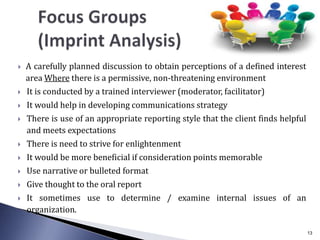
 A carefully planned discussion to obtain perceptions of a defined interest
area Where there is a permissive, non-threatening environment
 It is conducted by a trained interviewer (moderator, facilitator)
 It would help in developing communications strategy
 There is use of an appropriate reporting style that the client finds helpful
and meets expectations
 There is need to strive for enlightenment
 It would be more beneficial if consideration points memorable
 Use narrative or bulleted format
 Give thought to the oral report
 It sometimes use to determine / examine internal issues of an
organization.
13
 It is a technique that is used to determine customer
complaint / feedback.
 The organization needs to respond quickly because
it’s the matter of customer’s retention.
 It gives an idea to the customer that whether to
purchase product or not or information about
competitor’s product.
 According to statistics it is considered as 50%
organizations have toll free numbers & this trend is
increasing day by day.
14
 Visit to a customer place of business is an effective
way of collection of an information.
 There is need of accurate information is required –
People can see first hand how the product is
performing.
 The report card is effective way for gathering
information which sent each customer on quarterly
basis. The report card is analysis tool for area which
needs to improve.
15
 It is considered as one of the important tool for
analysis for an organization with source of
information
 Customers research reveals what is happening &
employees research reveals why it is happening
 It should be regularly solicited rather than
checking the wooden box annually
16
 It gives importance to the customer & provide exactly what
customer demand from company
 In the outset there is a price tag on such products was prohibitive, but
mass customization provides this at affordable price
 Mass Customization is result of flexible manufacturing system, JIT ,&
cycle time reduction. For Example: In Automobile industry customer
determine what type of seat covers, color, stereo system require so that
it provide its process of assembly.
 In short, it is considered as customer satisfaction achieved from mass
customization to provide more standard product for a company. It also
helps in evaluating for purchasing customer & have no room for non-
purchasing customer.
17
 The company named ACSI established in 1994 responsible for
determining Quality standard to meet customer satisfaction.
The company conduct a survey in which participants are
selected who are user of company’s product.
 There are multiple sectors involved in the survey related to
manufacturing & E-Commerce.
 There is comparison between the firms, industry provided in
the specified time frame.
 Its just the forecasting not exact values & score might be differ
as compare private and government firms.
18
 It is considered as proactive method relation to customer requirement
& failure to its implement eventually lost customer.
 There is requirement of consideration that complaint should be
accepted, analyzed & acted.
 Multiple organizations are achieving benefits in its own perspective &
it may vary from organization to organization in terms of approach.
 Some of complaint management actions are as follows:
 Investigate customer
 Analyze Complaints through front-line personal
 Identification for root cause of complaint
 Responding of survey by Sr. Managers
 Measurement of customer satisfaction
 Communicate regarding complaint with relevant departments
 Provide monthly report & designate the tasks to multiple teams
19
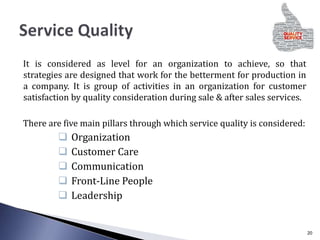
It is considered as level for an organization to achieve, so that
strategies are designed that work for the betterment for production in
a company. It is group of activities in an organization for customer
satisfaction by quality consideration during sale & after sales services.
There are five main pillars through which service quality is considered:
 Organization
 Customer Care
 Communication
 Front-Line People
 Leadership
20
21
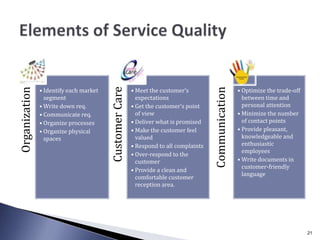
Organization
• Identify each market
segment
• Write down req.
• Communicate req.
• Organize processes
• Organize physical
spaces
CustomerCare
• Meet the customer’s
expectations
• Get the customer’s point
of view
• Deliver what is promised
• Make the customer feel
valued
• Respond to all complaints
• Over-respond to the
customer
• Provide a clean and
comfortable customer
reception area.
Communication
• Optimize the trade-off
between time and
personal attention
• Minimize the number
of contact points
• Provide pleasant,
knowledgeable and
enthusiastic
employees
• Write documents in
customer-friendly
language
22
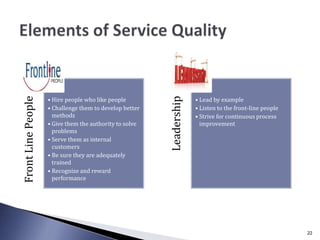
FrontLinePeople
• Hire people who like people
• Challenge them to develop better
methods
• Give them the authority to solve
problems
• Serve them as internal
customers
• Be sure they are adequately
trained
• Recognize and reward
performance Leadership
• Lead by example
• Listen to the front-line people
• Strive for continuous process
improvement
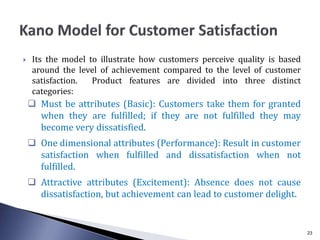
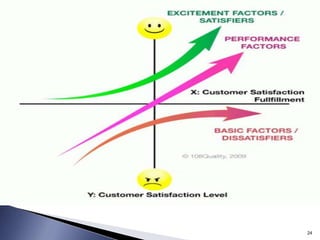
 Its the model to illustrate how customers perceive quality is based
around the level of achievement compared to the level of customer
satisfaction. Product features are divided into three distinct
categories:
 Must be attributes (Basic): Customers take them for granted
when they are fulfilled; if they are not fulfilled they may
become very dissatisfied.
 One dimensional attributes (Performance): Result in customer
satisfaction when fulfilled and dissatisfaction when not
fulfilled.
 Attractive attributes (Excitement): Absence does not cause
dissatisfaction, but achievement can lead to customer delight.
23
24
 Customer satisfaction should lead to customer loyalty and
customer retention.
 This is the acid test and bottom line- when the customer
repeatedly comes back to you for repeat orders and to
purchase new products manufactured by you. (Stiff
competition and multiple Suppliers )
 Firm orders received or cash payments registered , market
share, customer referrals and customer retention are an
indication of your customer success and penetration .
Prepared By: Muhammad Salman
Jamil 25
26

Total Quality Management

  • 1.
    LECTURE # 3: CustomerSatisfaction by M. Salman Jamil
  • 2.
     Customer isconsidered as one of asset for an organization & treat as Boss or ’King’  Customer dictates the market trends and direction  Customer not only has needs to be supplied( basic performance functions)  Also he ‘wants what he wants!’( additional features satisfy him and influence his purchase decision)  Manufacturing and service organizations are using customer satisfaction to measure quality.  Hence the Suppliers and Manufacturers have to closely follow at the heel of the customer. 2
  • 3.
    Customers Front-Line Representatives Functional Operational Areas Senior Managers CEO 3 • The pyramidis used to determine the customer satisfaction as importance & customer is at top & CEO is at the bottom. • It depicted strong relationship between customer and CEO. A company never makes a product for its top management people, rather it is meant for the customer. • If we talk about front line employees are in direct contact with customer so they are in a better position to understand a customer’s problems & Queries. • There is case of empowerment it is front line employee who should be having more empowerment which will enable him to solve customer problem directly on the spot.
  • 4.
    4 • There isalways comparison going on between company’s offering & customer demand. • You can’t predict what customer required because it depends upon the feelings, customer satisfaction etc. • The red area shows the common company’s offerings and customer’s needs. • Any product or service falling in this zone will be a surefire recipe for organization’s success. • Finally, we conclude that customer satisfaction is not simple formula to understand or measure.
  • 5.
     External andInternal customers  External – Current, Prospective and Lost Customers  Internal – Every person in a process is a customer of the previous operation.(Applies to design, manufacturing, sales, supplies etc.) [Each worker should see that the quality meets expectations of the next person in the supplier-to-customer chain ]  TQM is commitment to customer-focus - internal and external customers. 5
  • 6.
     Questions askedby people to their internal customers  What do you need from me?  What do you do with my output?  Are there any gaps between what you need and what you get?  Good team-work and inter-Departmental harmony is required. Also the leaders role in supervising the internal customer-supplier chain. 6 Input from External Customers Internal Customers Output to External Customers
  • 7.
     TQM isquality management and management of quality – there is no full stop and no break in the chain! Continuous process (quality) improvement is all its about.  Why? One important reason is the customer quality level is not static and his expectations keep changing and his demands too!  Also plant process dynamics- how to achieve maximum efficiency , optimizing cost and performance in the process operations, minimizing waste etc.  Factors Influencing Customer Perception (American Society for Quality)Performance, Features, Service, Warranty, Price, Reputation 7
  • 8.
     Performance: Itinvolves “fitness for use” determine product feature ready for customer usage.  Features: It involves attributes of product/services for primary & secondary nature depend upon psychological, time-oriented, contractual, technological etc.  Services: It related customer services part to give customer added value considered as intangible features. Although there is difference between better customer services then better quality of product.  Warranty: It is considered as public promise backed by guarantee for customer satisfaction. It gives customer for commitment. It generates feedback about product’s features & services. It encourage to purchase product & reduce risk level. 8
  • 9.
     Price: Theperception of customer changed about pricing, they can pay higher price to obtain value. The customers have trend to compare multiple company’s product / services. If the company wants to retain the customer they have to increase ongoing effort in terms of identification, verification & update according to customer requirement.  Reputation: It sometimes relates to the goodwill for an organization. Total customer satisfaction gives an organization reputation . Customer perception relates to purchase trusted brand name which gives cost increase 5 times related to product. The strategy maker of an organization consider the economical condition under consideration. 9
  • 10.
     Customer feedbackhas to be continuously sought and monitored - not one-time only!( Pro-active! Complaints are a reactive method of finding out there is a problem)  Customer feedback can be relayed to one time effort And ongoing and active probing for the customer.  Performance comparison with competitors can be known for new product development  Customers needs can be identified  Relative priorities of quality can be obtained from the horses’ mouth!  Areas for improvement can be noted. 10
  • 11.
     Comment cardsenclosed with warranty card when product is purchased.  Customer survey with some general information and questionnaire  Customer visits also determine in shaping about product.  Customer focus groups plays an important role that gives direction to the product.  Quarterly reports also help customer as figure speaks itself.  Toll-free phones E-mail, Internet, Newsgroups, Discussion forums  Employee feedback  Mass customization. 11
  • 12.
     It isconsidered as one of the most popular tool where multiple Questions asked by people regarding multiple opinion & perception related to product / services.  The basic purpose of customer questionnaire that what do you need from me & what you do with output?  There are multiple grading systems that helps an organization quantitative data.  Good team-work and inter-Departmental harmony is required. Also the leaders role in supervising the internal customer-supplier chain are basic role of these methods.  These sort of survey helps an organization’s management to intact with customers also it would help to meet customer expectation.  There are multiple form of questionnaire apply according to the requirement of an organization such as open ended or close ended. 12
  • 13.
     A carefullyplanned discussion to obtain perceptions of a defined interest area Where there is a permissive, non-threatening environment  It is conducted by a trained interviewer (moderator, facilitator)  It would help in developing communications strategy  There is use of an appropriate reporting style that the client finds helpful and meets expectations  There is need to strive for enlightenment  It would be more beneficial if consideration points memorable  Use narrative or bulleted format  Give thought to the oral report  It sometimes use to determine / examine internal issues of an organization. 13
  • 14.
     It isa technique that is used to determine customer complaint / feedback.  The organization needs to respond quickly because it’s the matter of customer’s retention.  It gives an idea to the customer that whether to purchase product or not or information about competitor’s product.  According to statistics it is considered as 50% organizations have toll free numbers & this trend is increasing day by day. 14
  • 15.
     Visit toa customer place of business is an effective way of collection of an information.  There is need of accurate information is required – People can see first hand how the product is performing.  The report card is effective way for gathering information which sent each customer on quarterly basis. The report card is analysis tool for area which needs to improve. 15
  • 16.
     It isconsidered as one of the important tool for analysis for an organization with source of information  Customers research reveals what is happening & employees research reveals why it is happening  It should be regularly solicited rather than checking the wooden box annually 16
  • 17.
     It givesimportance to the customer & provide exactly what customer demand from company  In the outset there is a price tag on such products was prohibitive, but mass customization provides this at affordable price  Mass Customization is result of flexible manufacturing system, JIT ,& cycle time reduction. For Example: In Automobile industry customer determine what type of seat covers, color, stereo system require so that it provide its process of assembly.  In short, it is considered as customer satisfaction achieved from mass customization to provide more standard product for a company. It also helps in evaluating for purchasing customer & have no room for non- purchasing customer. 17
  • 18.
     The companynamed ACSI established in 1994 responsible for determining Quality standard to meet customer satisfaction. The company conduct a survey in which participants are selected who are user of company’s product.  There are multiple sectors involved in the survey related to manufacturing & E-Commerce.  There is comparison between the firms, industry provided in the specified time frame.  Its just the forecasting not exact values & score might be differ as compare private and government firms. 18
  • 19.
     It isconsidered as proactive method relation to customer requirement & failure to its implement eventually lost customer.  There is requirement of consideration that complaint should be accepted, analyzed & acted.  Multiple organizations are achieving benefits in its own perspective & it may vary from organization to organization in terms of approach.  Some of complaint management actions are as follows:  Investigate customer  Analyze Complaints through front-line personal  Identification for root cause of complaint  Responding of survey by Sr. Managers  Measurement of customer satisfaction  Communicate regarding complaint with relevant departments  Provide monthly report & designate the tasks to multiple teams 19
  • 20.
    It is consideredas level for an organization to achieve, so that strategies are designed that work for the betterment for production in a company. It is group of activities in an organization for customer satisfaction by quality consideration during sale & after sales services. There are five main pillars through which service quality is considered:  Organization  Customer Care  Communication  Front-Line People  Leadership 20
  • 21.
    21 Organization • Identify eachmarket segment • Write down req. • Communicate req. • Organize processes • Organize physical spaces CustomerCare • Meet the customer’s expectations • Get the customer’s point of view • Deliver what is promised • Make the customer feel valued • Respond to all complaints • Over-respond to the customer • Provide a clean and comfortable customer reception area. Communication • Optimize the trade-off between time and personal attention • Minimize the number of contact points • Provide pleasant, knowledgeable and enthusiastic employees • Write documents in customer-friendly language
  • 22.
    22 FrontLinePeople • Hire peoplewho like people • Challenge them to develop better methods • Give them the authority to solve problems • Serve them as internal customers • Be sure they are adequately trained • Recognize and reward performance Leadership • Lead by example • Listen to the front-line people • Strive for continuous process improvement
  • 23.
     Its themodel to illustrate how customers perceive quality is based around the level of achievement compared to the level of customer satisfaction. Product features are divided into three distinct categories:  Must be attributes (Basic): Customers take them for granted when they are fulfilled; if they are not fulfilled they may become very dissatisfied.  One dimensional attributes (Performance): Result in customer satisfaction when fulfilled and dissatisfaction when not fulfilled.  Attractive attributes (Excitement): Absence does not cause dissatisfaction, but achievement can lead to customer delight. 23
  • 24.
  • 25.
     Customer satisfactionshould lead to customer loyalty and customer retention.  This is the acid test and bottom line- when the customer repeatedly comes back to you for repeat orders and to purchase new products manufactured by you. (Stiff competition and multiple Suppliers )  Firm orders received or cash payments registered , market share, customer referrals and customer retention are an indication of your customer success and penetration . Prepared By: Muhammad Salman Jamil 25
  • 26.