0
WORLD CLASS SERVICE THROUGH
QUALITY MANAGEMENT
Professor Jayashree Sadri and Dr. Sorab
Sadri
1
Quality Management
2
Overview
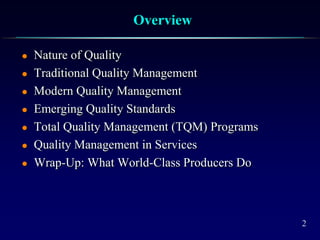
 Nature of Quality
 Traditional Quality Management
 Modern Quality Management
 Emerging Quality Standards
 Total Quality Management (TQM) Programs
 Quality Management in Services
 Wrap-Up: What World-Class Producers Do
3
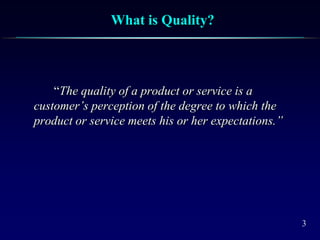
What is Quality?
“The quality of a product or service is a
customer’s perception of the degree to which the
product or service meets his or her expectations.”
4
Nature of Quality
 Dimensions of Quality
 Determinants of Quality
 Costs of Quality
5
Best-In-Class and World-Class
 Customers’ expectations of quality are not the same
for different classes of products or services.
 Best-in-class quality means being the best product or
service in a particular class of products or services.
 Being a world-class company means that each of its
products and services are considered best-in-class by
its customers.
6
Some Dimensions of Product Quality
 Performance
 Features
 Reliability
 Serviceability
 Durability
 Appearance
 Customer service
 Safety
7
Determinants of Quality
 Quality of design
 Quality capability of production processes
 Quality of conformance
 Quality of customer service
 Organizational quality culture
8
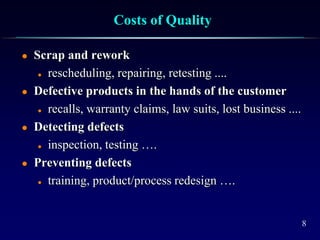
Costs of Quality
 Scrap and rework
 rescheduling, repairing, retesting ....
 Defective products in the hands of the customer
 recalls, warranty claims, law suits, lost business ....
 Detecting defects
 inspection, testing ….
 Preventing defects
 training, product/process redesign ….
9
Modern Quality Management
 Quality Gurus
 Quality Drives the Productivity Machine
 Other Aspects of the Quality Picture
1
0
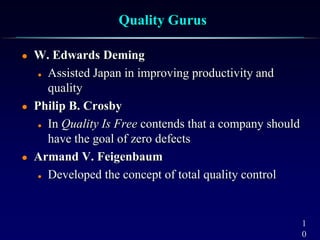
Quality Gurus
 W. Edwards Deming
 Assisted Japan in improving productivity and
quality
 Philip B. Crosby
 In Quality Is Free contends that a company should
have the goal of zero defects
 Armand V. Feigenbaum
 Developed the concept of total quality control
1
1
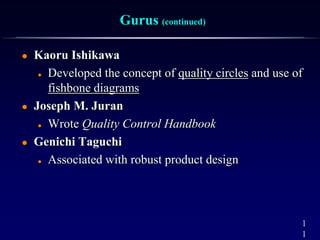
Gurus (continued)
 Kaoru Ishikawa
 Developed the concept of quality circles and use of
fishbone diagrams
 Joseph M. Juran
 Wrote Quality Control Handbook
 Genichi Taguchi
 Associated with robust product design
1
2
Quality Drives the Productivity Machine
 If production does it right the first time and produces
products and services that are defect-free, waste is
eliminated and costs are reduced.
 Quality management programs today are viewed by
many companies as productivity improvement
programs.
1
3
Other Aspects of the Quality Picture
 Just-In-Time (JIT) manufacturing
 Product standardization
 Automated equipment
 Preventive maintenance
1
4
JIT Manufacturing
 “A system of enforced problem solving”
 Lot sizes are cut
 In-process inventories are drastically reduced
 Any interruption causes production to stop
 Quality problems are immediately addressed
 The necessary teamwork contributes to increased
pride in quality
1
5
Emerging Quality Standards
 Malcolm Baldrige National Quality Award
 Deming Prize
 ISO 9000 Standards
1
6
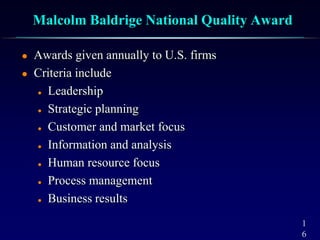
Malcolm Baldrige National Quality Award
 Awards given annually to U.S. firms
 Criteria include
 Leadership
 Strategic planning
 Customer and market focus
 Information and analysis
 Human resource focus
 Process management
 Business results
1
7
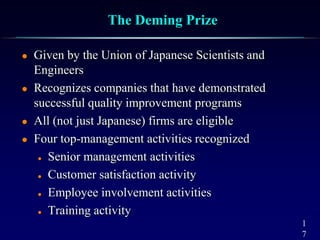
The Deming Prize
 Given by the Union of Japanese Scientists and
Engineers
 Recognizes companies that have demonstrated
successful quality improvement programs
 All (not just Japanese) firms are eligible
 Four top-management activities recognized
 Senior management activities
 Customer satisfaction activity
 Employee involvement activities
 Training activity
1
8
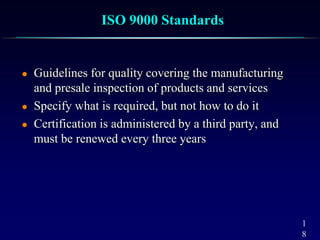
ISO 9000 Standards
 Guidelines for quality covering the manufacturing
and presale inspection of products and services
 Specify what is required, but not how to do it
 Certification is administered by a third party, and
must be renewed every three years
1
9
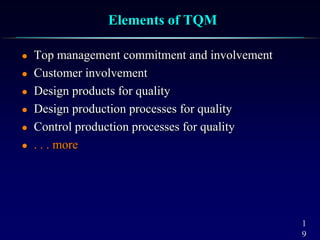
Elements of TQM
 Top management commitment and involvement
 Customer involvement
 Design products for quality
 Design production processes for quality
 Control production processes for quality
 . . . more
2
0
Elements of TQM
 Develop supplier partnerships
 Customer service, distribution and installation
 Building teams of empowered employees
 Benchmarking and continuous improvement
2
1
Top Management
Commitment and Involvement
 Support must be genuine or TQM will be seen as just
another passing fad
 Fundamental changes must occur in the culture of the
organization
 Such fundamental changes are not easy, but are
impossible without top management’s commitment
and involvement
2
2
Customer Involvement
 Mechanisms to involve the customer
 Focus groups
 Market surveys
 Customer questionnaires
 Market research programs
 Quality Function Deployment (QFD)
 Formal system for identifying customer wants
 Eliminate wasteful product features and activities
that do not contribute
2
3
Designing Products for Quality
 Designing for Robustness
Product will perform as intended even if
undesirable conditions occur in production or in
field.
 Designing for Manufacturability (DFM)
Products typically have fewer parts and can be
assembled quickly, easily, and error-free.
 Designing for Reliability
Manufacturing parts to closer tolerances.
Redundant components where necessary.
2
4
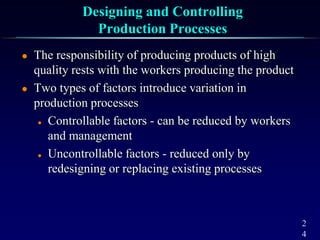
Designing and Controlling
Production Processes
 The responsibility of producing products of high
quality rests with the workers producing the product
 Two types of factors introduce variation in
production processes
 Controllable factors - can be reduced by workers
and management
 Uncontrollable factors - reduced only by
redesigning or replacing existing processes
2
5
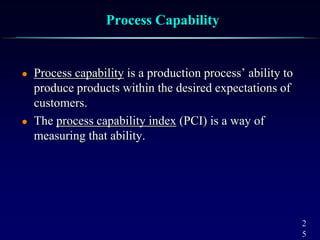
Process Capability
 Process capability is a production process’ ability to
produce products within the desired expectations of
customers.
 The process capability index (PCI) is a way of
measuring that ability.
2
6
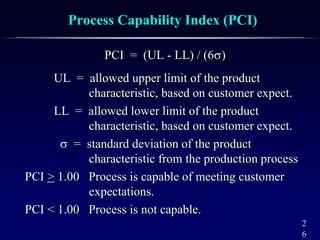
Process Capability Index (PCI)
PCI = (UL - LL) / (6 )
UL = allowed upper limit of the product
characteristic, based on customer expect.
LL = allowed lower limit of the product
characteristic, based on customer expect.
= standard deviation of the product
characteristic from the production process
PCI > 1.00 Process is capable of meeting customer
expectations.
PCI < 1.00 Process is not capable.
2
7
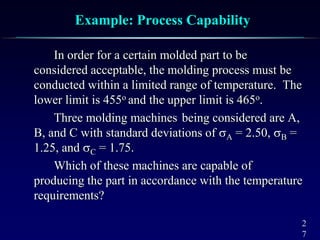
Example: Process Capability
In order for a certain molded part to be
considered acceptable, the molding process must be
conducted within a limited range of temperature. The
lower limit is 455o and the upper limit is 465o.
Three molding machines being considered are A,
B, and C with standard deviations of A = 2.50, B =
1.25, and C = 1.75.
Which of these machines are capable of
producing the part in accordance with the temperature
requirements?
2
8
Example: Process Capability
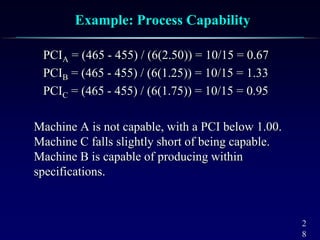
PCIA = (465 - 455) / (6(2.50)) = 10/15 = 0.67
PCIB = (465 - 455) / (6(1.25)) = 10/15 = 1.33
PCIC = (465 - 455) / (6(1.75)) = 10/15 = 0.95
Machine A is not capable, with a PCI below 1.00.
Machine C falls slightly short of being capable.
Machine B is capable of producing within
specifications.
2
9
Developing Supplier Partnerships
 Supplier becomes part of the customer’s TQM
program
 The relationship between the supplier and the
customer becomes long-lasting and durable
3
0
Customer Service, Distribution, and Installation
 Packaging, shipping, and installation must be
included in TQM.
 Warehousing, marketing, and the distribution
function must be committed to perfect quality.
 Contact between the customers and the firm’s product
must be planned and managed to provide satisfied
customers.
3
1
Building Teams of Empowered Employees
 Employee training programs
 Employees at all levels are trained in quality.
 Works teams and empowerment
 Workers are given the authority to act.
 Quality at the source
 Workers are responsible for their own work.
 Quality circles
 Small groups of employees who analyze and
solve quality problems and implement
improvement programs.
3
2
Benchmarking and Continuous Improvement
 Benchmarking
 The practice of establishing internal standards of
performance by looking to how world-class
companies run their businesses
 Continuous Improvement
 The company makes small incremental
improvements toward excellence on a continual
basis
3
3
TQM in Services
 Since many services are intangible, it is difficult to
determine their quality
 Customers set their own standards for services
 Perceived quality of service affected by the
surroundings
 Performance of service employees determines in
large part the quality of the services
3
4
Wrap-Up: World-Class Practice
 Quality begins when business strategy is formulated
 Quality is the weapon of choice to capture global
markets
 Quality drives the productivity machine
 Not depending on inspection to catch defects;
concentrating on doing things right the first time
 Committing tremendous resources to put in place
TQM programs aimed at continuous improvement

World class management

  • 1.
    0 WORLD CLASS SERVICETHROUGH QUALITY MANAGEMENT Professor Jayashree Sadri and Dr. Sorab Sadri
  • 2.
  • 3.
    2 Overview  Nature ofQuality  Traditional Quality Management  Modern Quality Management  Emerging Quality Standards  Total Quality Management (TQM) Programs  Quality Management in Services  Wrap-Up: What World-Class Producers Do
  • 4.
    3 What is Quality? “Thequality of a product or service is a customer’s perception of the degree to which the product or service meets his or her expectations.”
  • 5.
    4 Nature of Quality Dimensions of Quality  Determinants of Quality  Costs of Quality
  • 6.
    5 Best-In-Class and World-Class Customers’ expectations of quality are not the same for different classes of products or services.  Best-in-class quality means being the best product or service in a particular class of products or services.  Being a world-class company means that each of its products and services are considered best-in-class by its customers.
  • 7.
    6 Some Dimensions ofProduct Quality  Performance  Features  Reliability  Serviceability  Durability  Appearance  Customer service  Safety
  • 8.
    7 Determinants of Quality Quality of design  Quality capability of production processes  Quality of conformance  Quality of customer service  Organizational quality culture
  • 9.
    8 Costs of Quality Scrap and rework  rescheduling, repairing, retesting ....  Defective products in the hands of the customer  recalls, warranty claims, law suits, lost business ....  Detecting defects  inspection, testing ….  Preventing defects  training, product/process redesign ….
  • 10.
    9 Modern Quality Management Quality Gurus  Quality Drives the Productivity Machine  Other Aspects of the Quality Picture
  • 11.
    1 0 Quality Gurus  W.Edwards Deming  Assisted Japan in improving productivity and quality  Philip B. Crosby  In Quality Is Free contends that a company should have the goal of zero defects  Armand V. Feigenbaum  Developed the concept of total quality control
  • 12.
    1 1 Gurus (continued)  KaoruIshikawa  Developed the concept of quality circles and use of fishbone diagrams  Joseph M. Juran  Wrote Quality Control Handbook  Genichi Taguchi  Associated with robust product design
  • 13.
    1 2 Quality Drives theProductivity Machine  If production does it right the first time and produces products and services that are defect-free, waste is eliminated and costs are reduced.  Quality management programs today are viewed by many companies as productivity improvement programs.
  • 14.
    1 3 Other Aspects ofthe Quality Picture  Just-In-Time (JIT) manufacturing  Product standardization  Automated equipment  Preventive maintenance
  • 15.
    1 4 JIT Manufacturing  “Asystem of enforced problem solving”  Lot sizes are cut  In-process inventories are drastically reduced  Any interruption causes production to stop  Quality problems are immediately addressed  The necessary teamwork contributes to increased pride in quality
  • 16.
    1 5 Emerging Quality Standards Malcolm Baldrige National Quality Award  Deming Prize  ISO 9000 Standards
  • 17.
    1 6 Malcolm Baldrige NationalQuality Award  Awards given annually to U.S. firms  Criteria include  Leadership  Strategic planning  Customer and market focus  Information and analysis  Human resource focus  Process management  Business results
  • 18.
    1 7 The Deming Prize Given by the Union of Japanese Scientists and Engineers  Recognizes companies that have demonstrated successful quality improvement programs  All (not just Japanese) firms are eligible  Four top-management activities recognized  Senior management activities  Customer satisfaction activity  Employee involvement activities  Training activity
  • 19.
    1 8 ISO 9000 Standards Guidelines for quality covering the manufacturing and presale inspection of products and services  Specify what is required, but not how to do it  Certification is administered by a third party, and must be renewed every three years
  • 20.
    1 9 Elements of TQM Top management commitment and involvement  Customer involvement  Design products for quality  Design production processes for quality  Control production processes for quality  . . . more
  • 21.
    2 0 Elements of TQM Develop supplier partnerships  Customer service, distribution and installation  Building teams of empowered employees  Benchmarking and continuous improvement
  • 22.
    2 1 Top Management Commitment andInvolvement  Support must be genuine or TQM will be seen as just another passing fad  Fundamental changes must occur in the culture of the organization  Such fundamental changes are not easy, but are impossible without top management’s commitment and involvement
  • 23.
    2 2 Customer Involvement  Mechanismsto involve the customer  Focus groups  Market surveys  Customer questionnaires  Market research programs  Quality Function Deployment (QFD)  Formal system for identifying customer wants  Eliminate wasteful product features and activities that do not contribute
  • 24.
    2 3 Designing Products forQuality  Designing for Robustness Product will perform as intended even if undesirable conditions occur in production or in field.  Designing for Manufacturability (DFM) Products typically have fewer parts and can be assembled quickly, easily, and error-free.  Designing for Reliability Manufacturing parts to closer tolerances. Redundant components where necessary.
  • 25.
    2 4 Designing and Controlling ProductionProcesses  The responsibility of producing products of high quality rests with the workers producing the product  Two types of factors introduce variation in production processes  Controllable factors - can be reduced by workers and management  Uncontrollable factors - reduced only by redesigning or replacing existing processes
  • 26.
    2 5 Process Capability  Processcapability is a production process’ ability to produce products within the desired expectations of customers.  The process capability index (PCI) is a way of measuring that ability.
  • 27.
    2 6 Process Capability Index(PCI) PCI = (UL - LL) / (6 ) UL = allowed upper limit of the product characteristic, based on customer expect. LL = allowed lower limit of the product characteristic, based on customer expect. = standard deviation of the product characteristic from the production process PCI > 1.00 Process is capable of meeting customer expectations. PCI < 1.00 Process is not capable.
  • 28.
    2 7 Example: Process Capability Inorder for a certain molded part to be considered acceptable, the molding process must be conducted within a limited range of temperature. The lower limit is 455o and the upper limit is 465o. Three molding machines being considered are A, B, and C with standard deviations of A = 2.50, B = 1.25, and C = 1.75. Which of these machines are capable of producing the part in accordance with the temperature requirements?
  • 29.
    2 8 Example: Process Capability PCIA= (465 - 455) / (6(2.50)) = 10/15 = 0.67 PCIB = (465 - 455) / (6(1.25)) = 10/15 = 1.33 PCIC = (465 - 455) / (6(1.75)) = 10/15 = 0.95 Machine A is not capable, with a PCI below 1.00. Machine C falls slightly short of being capable. Machine B is capable of producing within specifications.
  • 30.
    2 9 Developing Supplier Partnerships Supplier becomes part of the customer’s TQM program  The relationship between the supplier and the customer becomes long-lasting and durable
  • 31.
    3 0 Customer Service, Distribution,and Installation  Packaging, shipping, and installation must be included in TQM.  Warehousing, marketing, and the distribution function must be committed to perfect quality.  Contact between the customers and the firm’s product must be planned and managed to provide satisfied customers.
  • 32.
    3 1 Building Teams ofEmpowered Employees  Employee training programs  Employees at all levels are trained in quality.  Works teams and empowerment  Workers are given the authority to act.  Quality at the source  Workers are responsible for their own work.  Quality circles  Small groups of employees who analyze and solve quality problems and implement improvement programs.
  • 33.
    3 2 Benchmarking and ContinuousImprovement  Benchmarking  The practice of establishing internal standards of performance by looking to how world-class companies run their businesses  Continuous Improvement  The company makes small incremental improvements toward excellence on a continual basis
  • 34.
    3 3 TQM in Services Since many services are intangible, it is difficult to determine their quality  Customers set their own standards for services  Perceived quality of service affected by the surroundings  Performance of service employees determines in large part the quality of the services
  • 35.
    3 4 Wrap-Up: World-Class Practice Quality begins when business strategy is formulated  Quality is the weapon of choice to capture global markets  Quality drives the productivity machine  Not depending on inspection to catch defects; concentrating on doing things right the first time  Committing tremendous resources to put in place TQM programs aimed at continuous improvement