CONTENT
Concept
DifferentDefinitions and Dimensions
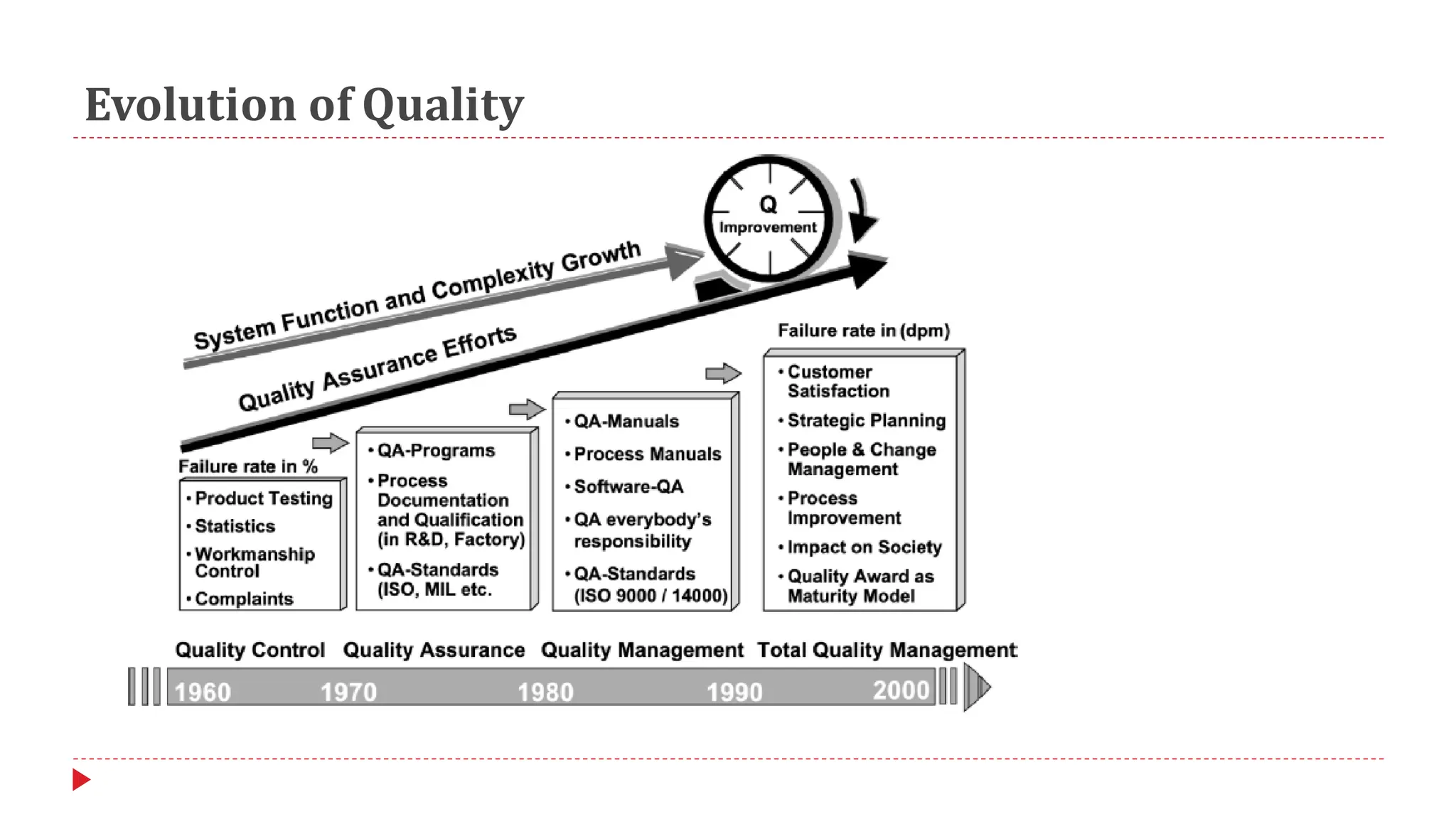
Inspection, Quality Control
QualityAssurance and Quality Management
Quality as Wining Strategy
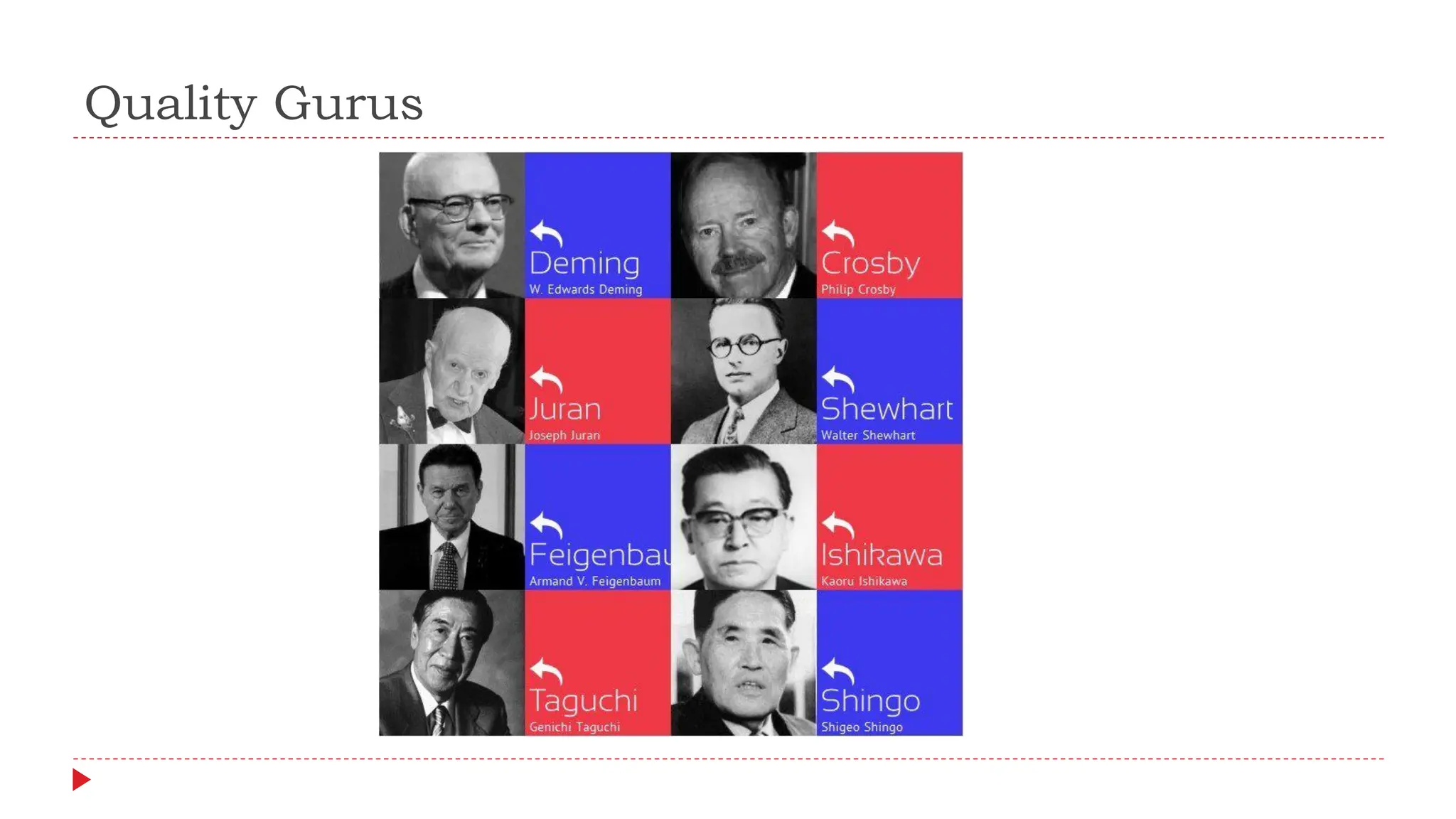
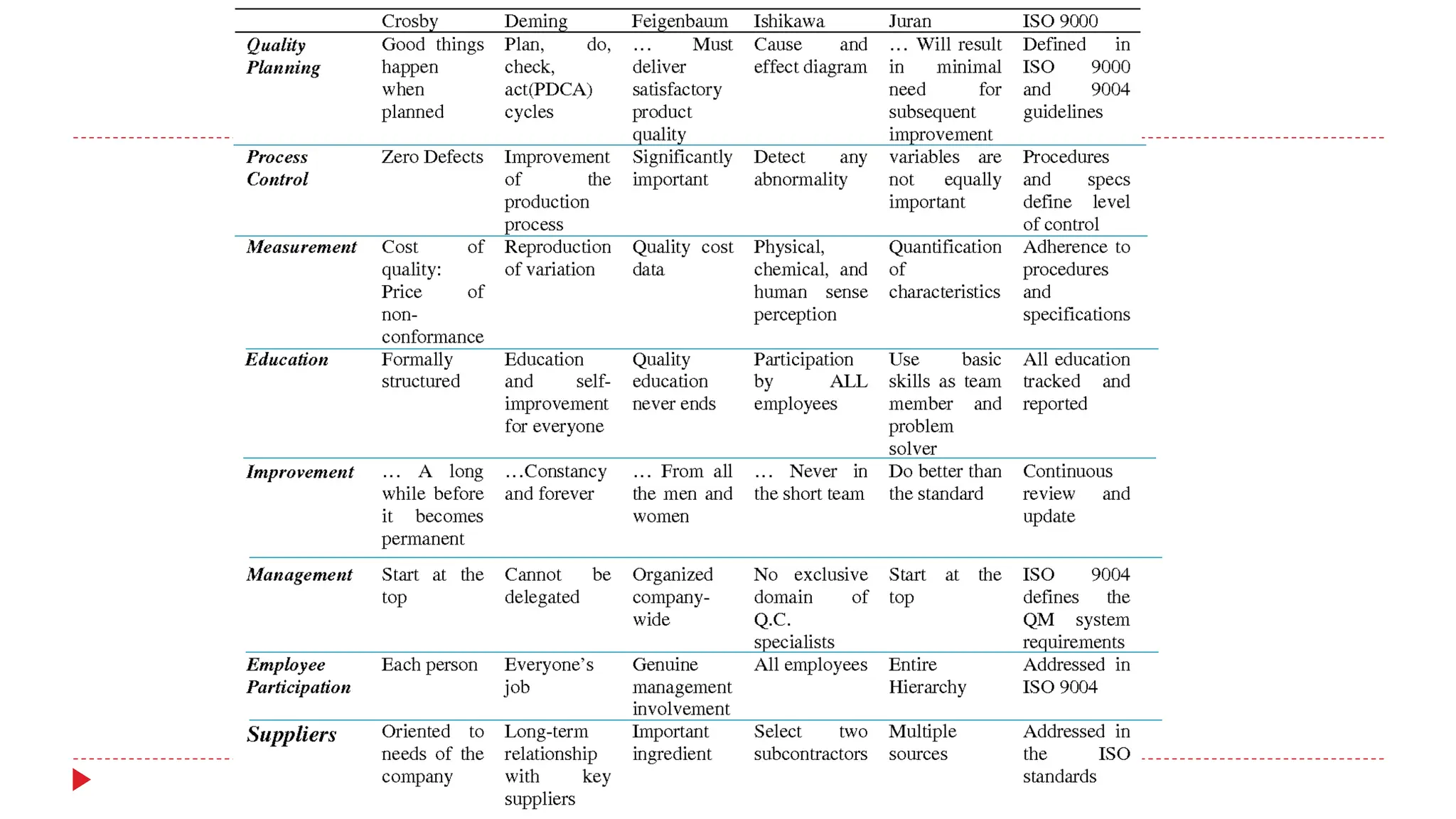
Views of different Quality Gurus.
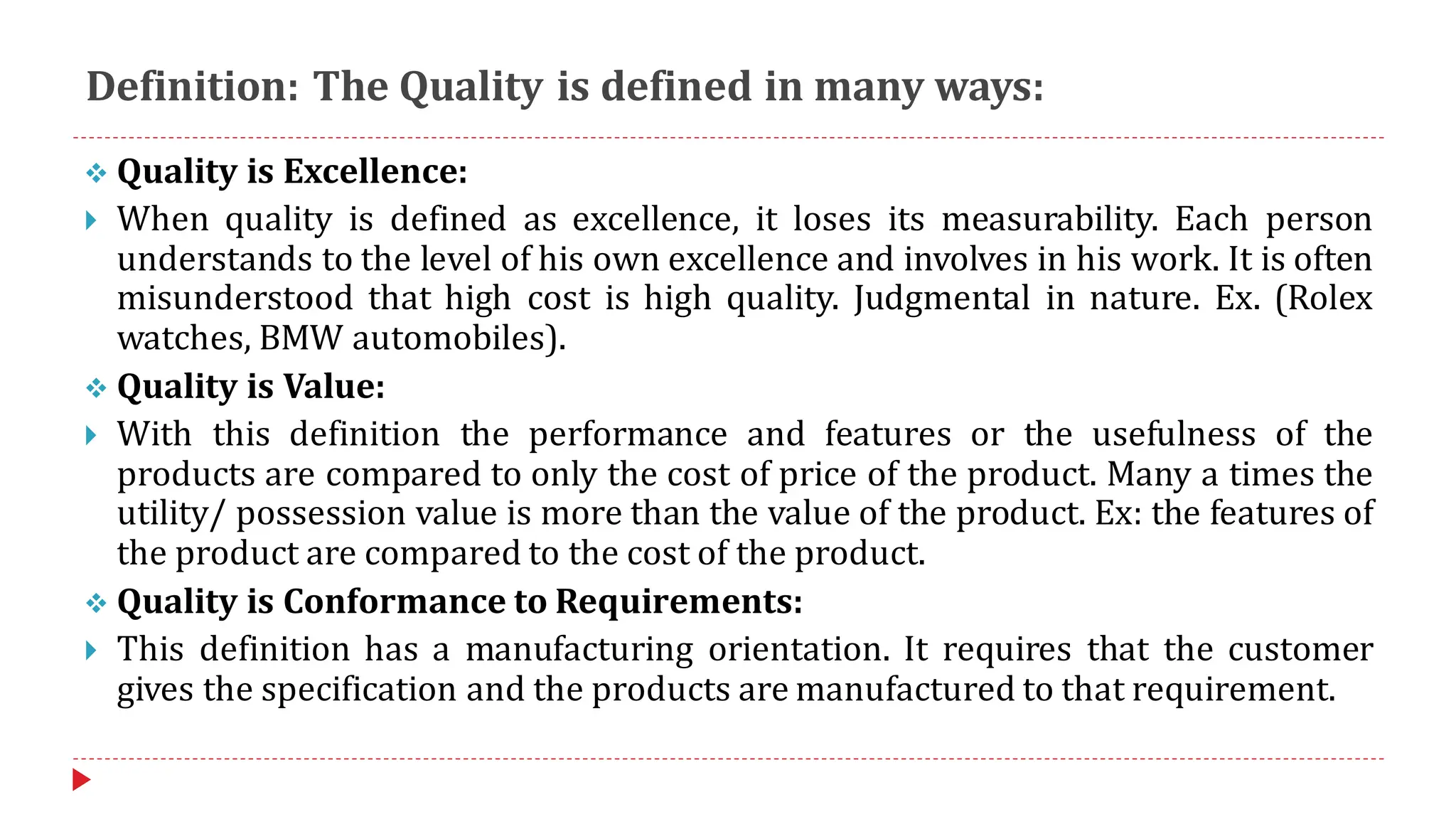
Definition: The Qualityis defined in many ways:
❖ Quality is Excellence:
When quality is defined as excellence, it loses its measurability. Each person
understands to the level of his own excellence and involves in his work. It is often
misunderstood that high cost is high quality. Judgmental in nature. Ex. (Rolex
watches, BMW automobiles).
❖ Quality is Value:
With this definition the performance and features or the usefulness of the
products are compared to only the cost of price of the product. Many a times the
utility/ possession value is more than the value of the product. Ex: the features of
the product are compared to the cost of the product.
❖ Quality is Conformance to Requirements:
This definition has a manufacturing orientation. It requires that the customer
gives the specification and the products are manufactured to that requirement.
8.
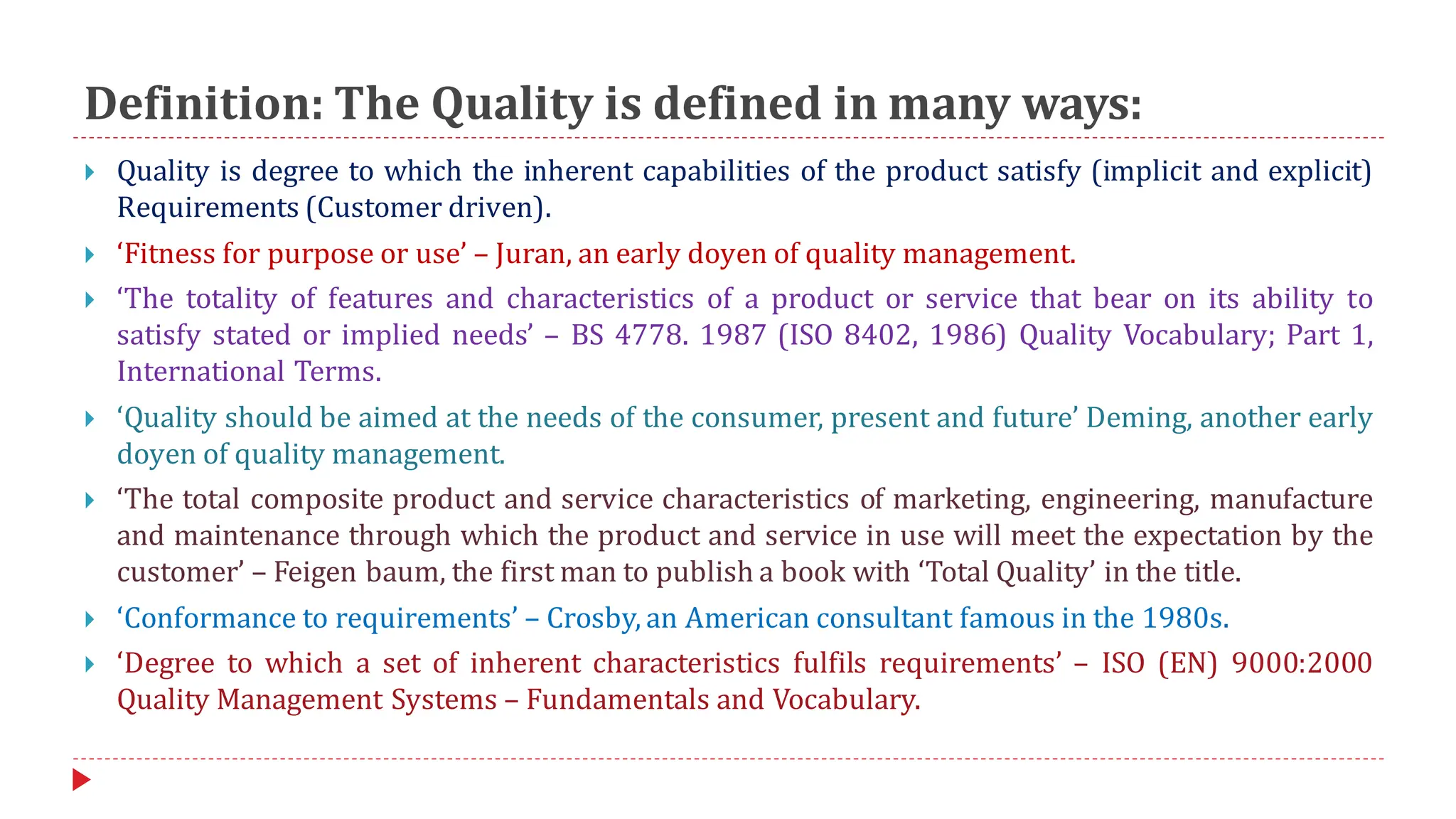
Definition: The Qualityis defined in many ways:
Quality is degree to which the inherent capabilities of the product satisfy (implicit and explicit)
Requirements (Customer driven).
‘Fitness for purpose or use’ – Juran, an early doyen of quality management.
‘The totality of features and characteristics of a product or service that bear on its ability to
satisfy stated or implied needs’ – BS 4778. 1987 (ISO 8402, 1986) Quality Vocabulary; Part 1,
International Terms.
‘Quality should be aimed at the needs of the consumer, present and future’ Deming, another early
doyen of quality management.
‘The total composite product and service characteristics of marketing, engineering, manufacture
and maintenance through which the product and service in use will meet the expectation by the
customer’ – Feigen baum, the first man to publish a book with ‘Total Quality’ in the title.
‘Conformance to requirements’ – Crosby, an American consultant famous in the 1980s.
‘Degree to which a set of inherent characteristics fulfils requirements’ – ISO (EN) 9000:2000
Quality Management Systems – Fundamentals and Vocabulary.
9.
Need for Quality
Good quality of goods and services can provide an organization with
competitive edge.
Goodquality reduces costs due to productreturns, reworkand scrap.
Good quality increases productivity, profits and other measures of success
such as brand image, product image and company goodwill.
Most importantly, good quality generates satisfied customers today and
tomorrow.
Good quality creates an atmosphere for high employee morale, which
improves productivity.
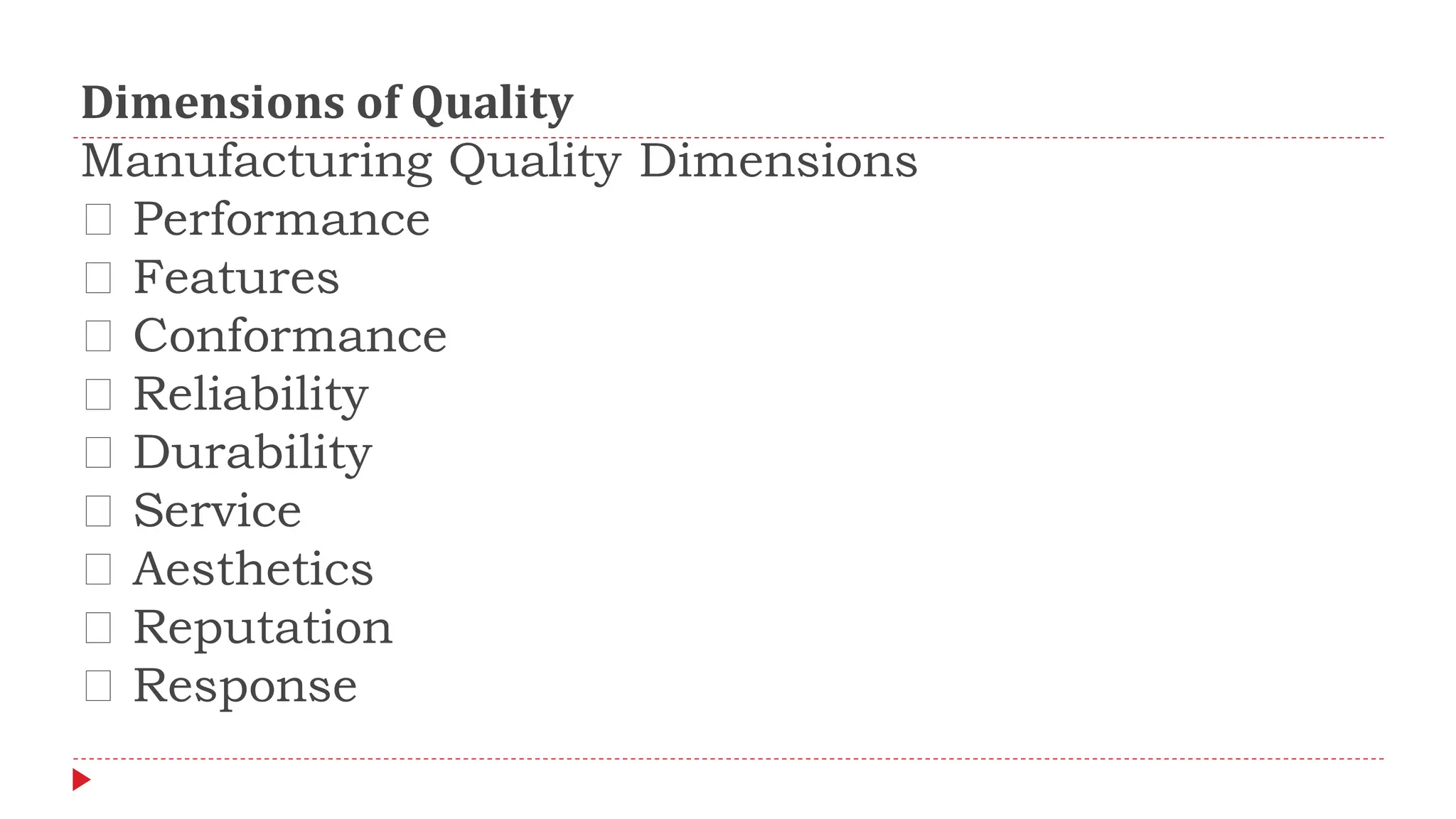
Dimensions of Quality
ManufacturingQuality Dimensions
Performance
Features
Conformance
Reliability
Durability
Service
Aesthetics
Reputation
Response
13.
Dimensions of Quality
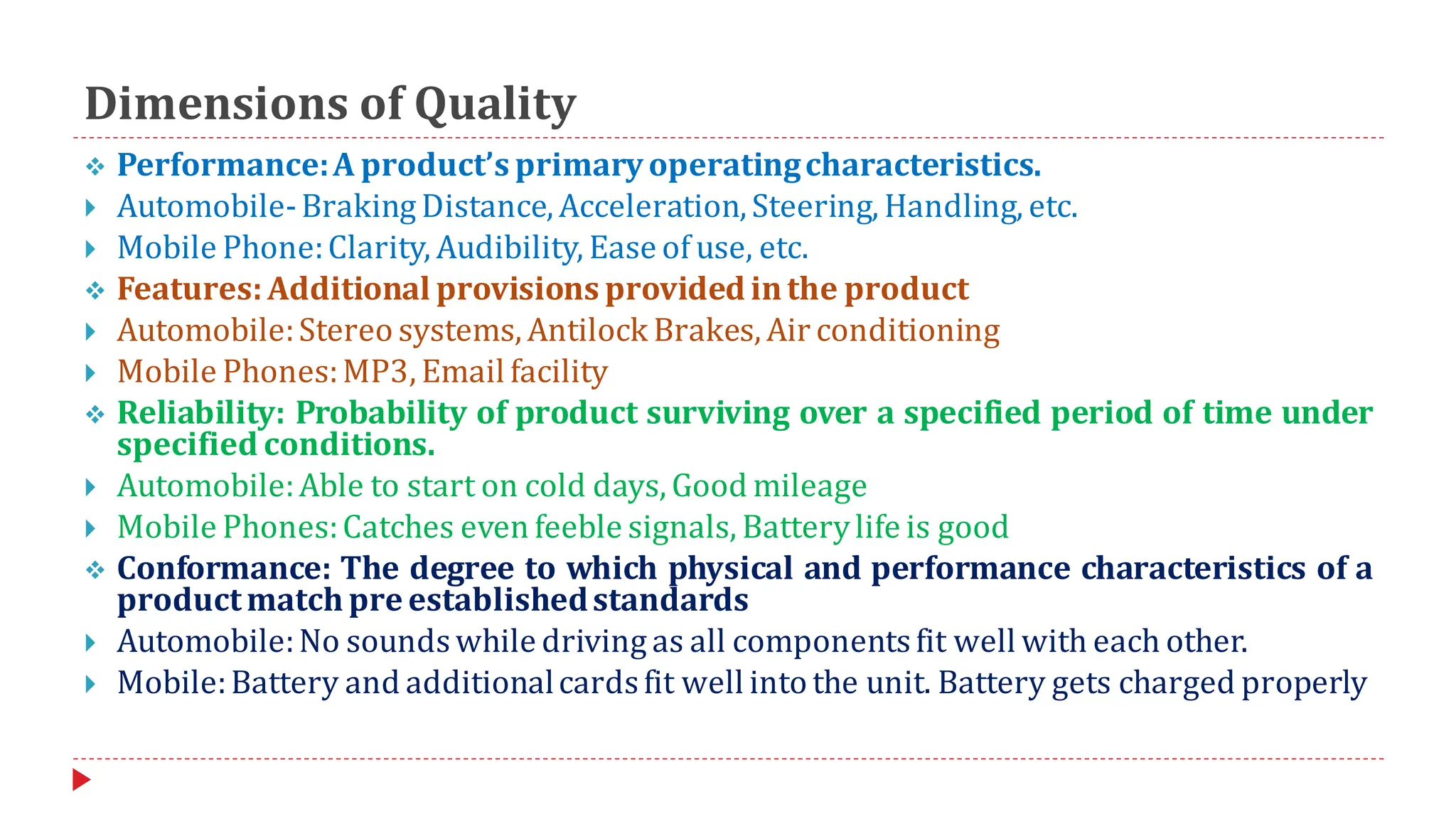
❖Performance:A product’s primaryoperatingcharacteristics.
Automobile-Braking Distance, Acceleration,Steering, Handling, etc.
Mobile Phone:Clarity, Audibility, Ease of use, etc.
❖ Features:Additional provisions provided inthe product
Automobile:Stereo systems, Antilock Brakes, Air conditioning
Mobile Phones:MP3, Email facility
❖ Reliability: Probability of product surviving over a specified period of time under
specified conditions.
Automobile:Able to start on cold days, Good mileage
Mobile Phones:Catches even feeble signals, Batterylife is good
❖ Conformance: The degree to which physical and performance characteristics of a
productmatch pre establishedstandards
Automobile:No soundswhile driving as all componentsfit well with each other.
Mobile:Battery and additionalcardsfit well into the unit. Battery gets charged properly
14.
Dimensions of Quality
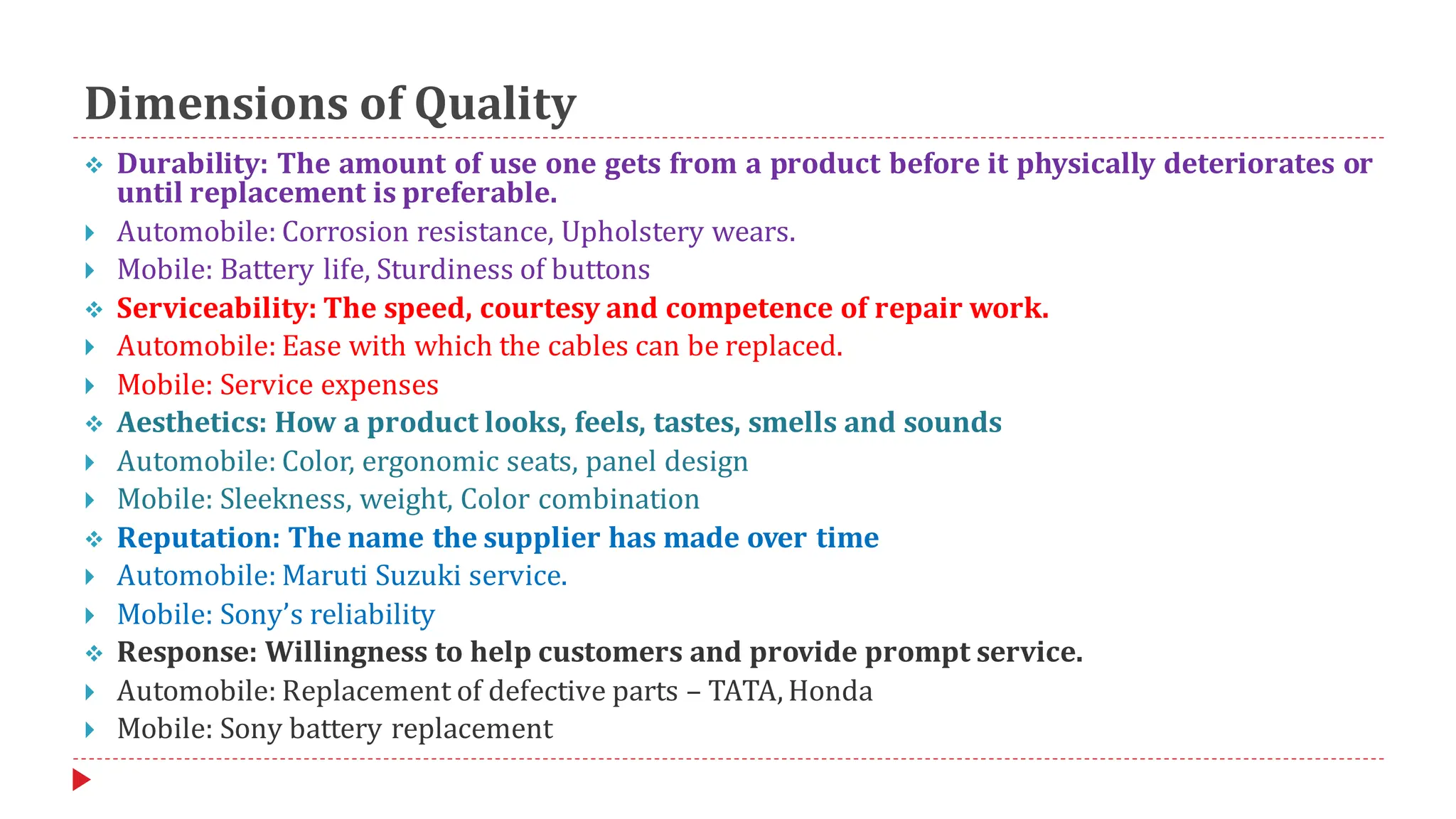
❖Durability: The amount of use one gets from a product before it physically deteriorates or
until replacement is preferable.
Automobile: Corrosion resistance, Upholstery wears.
Mobile: Battery life, Sturdiness of buttons
❖ Serviceability: The speed, courtesy and competence of repair work.
Automobile: Ease with which the cables can be replaced.
Mobile: Service expenses
❖ Aesthetics: How a product looks, feels, tastes, smells and sounds
Automobile: Color, ergonomic seats, panel design
Mobile: Sleekness, weight, Color combination
❖ Reputation: The name the supplier has made over time
Automobile: Maruti Suzuki service.
Mobile: Sony’s reliability
❖ Response: Willingness to help customers and provide prompt service.
Automobile: Replacement of defective parts – TATA, Honda
Mobile: Sony battery replacement
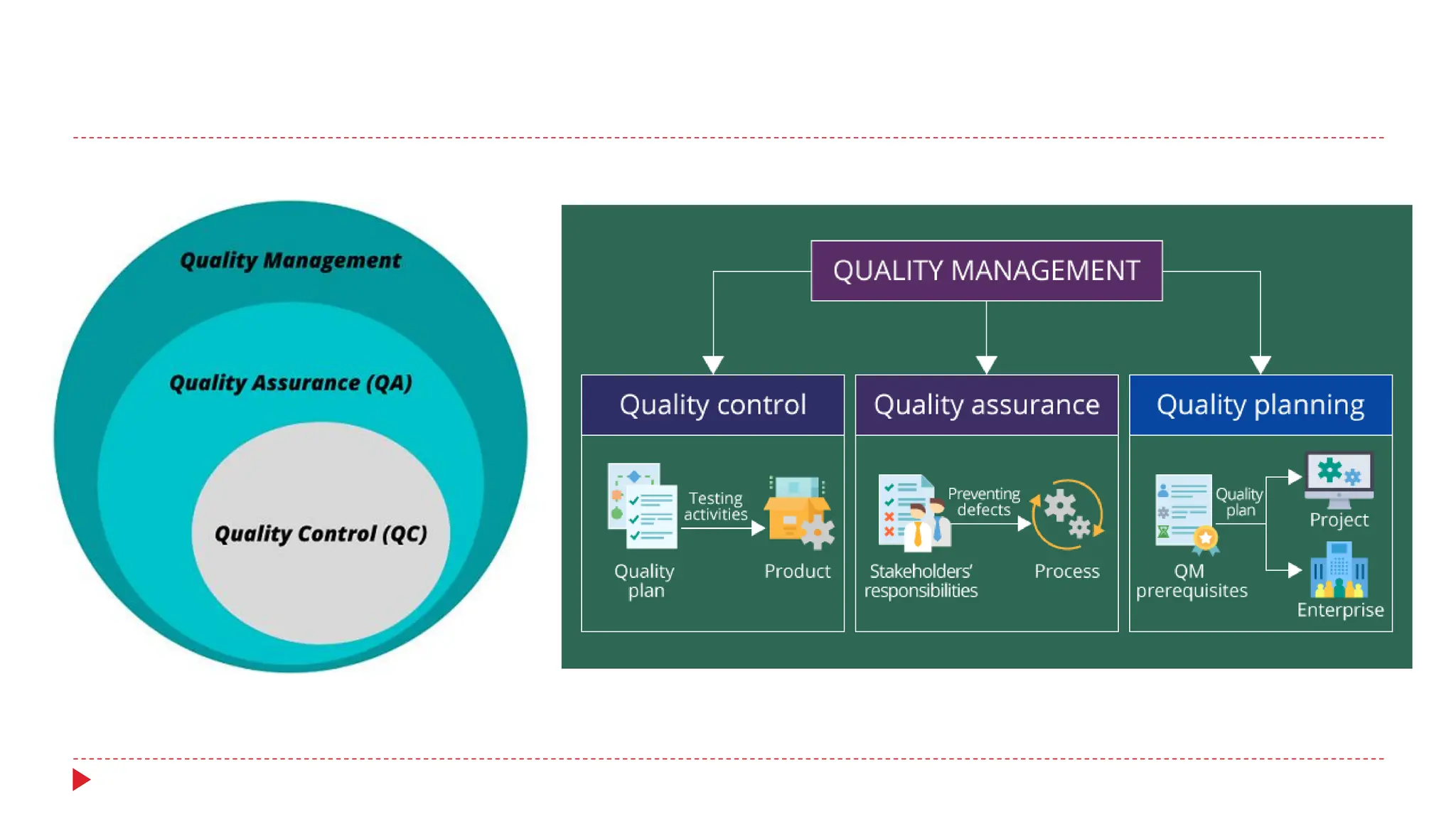
Quality Assurance: -
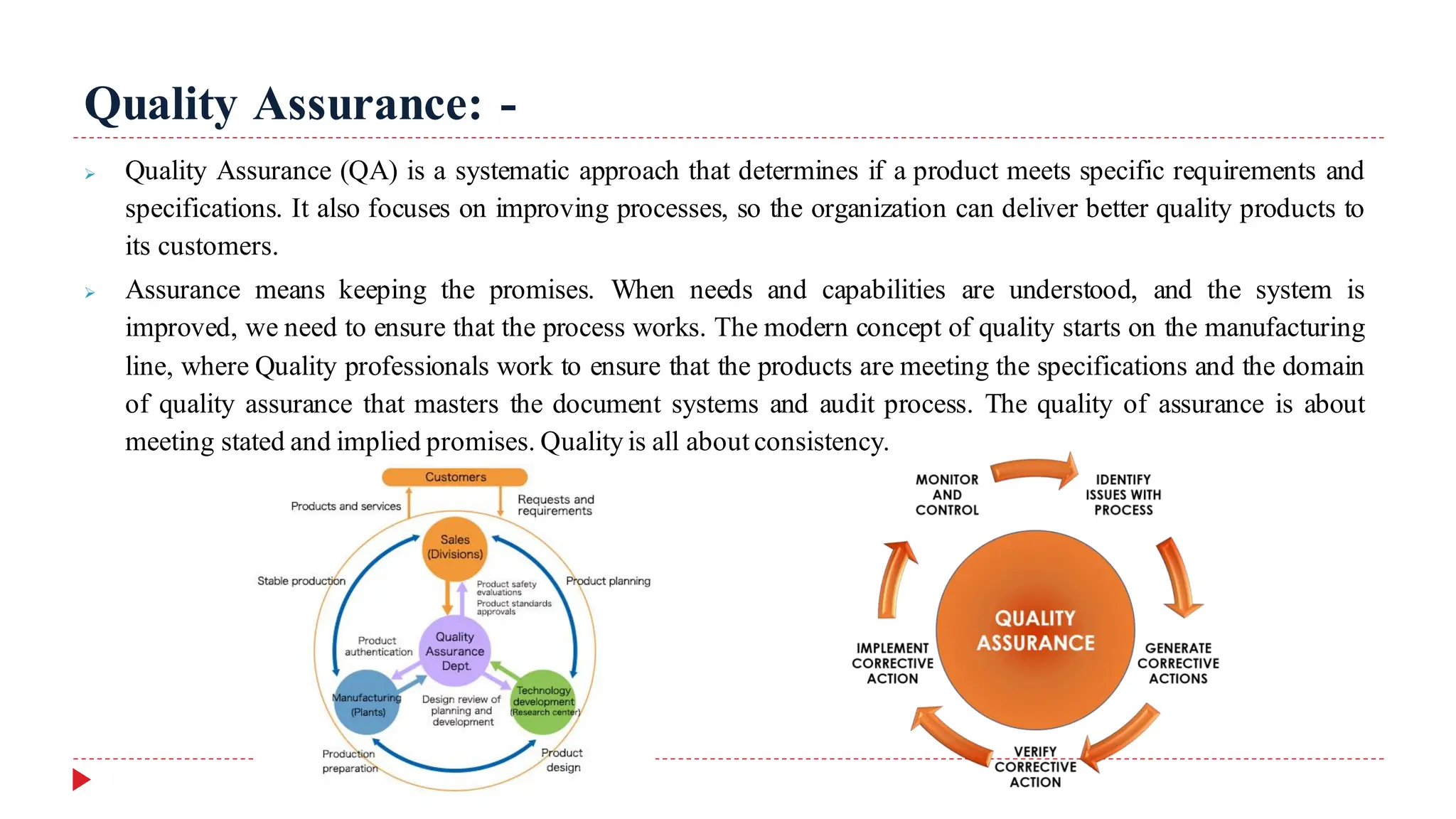
➢Quality Assurance (QA) is a systematic approach that determines if a product meets specific requirements and
specifications. It also focuses on improving processes, so the organization can deliver better quality products to
its customers.
➢ Assurance means keeping the promises. When needs and capabilities are understood, and the system is
improved, we need to ensure that the process works. The modern concept of quality starts on the manufacturing
line, where Quality professionals work to ensure that the products are meeting the specifications and the domain
of quality assurance that masters the document systems and audit process. The quality of assurance is about
meeting stated and implied promises. Quality is all about consistency.
17.
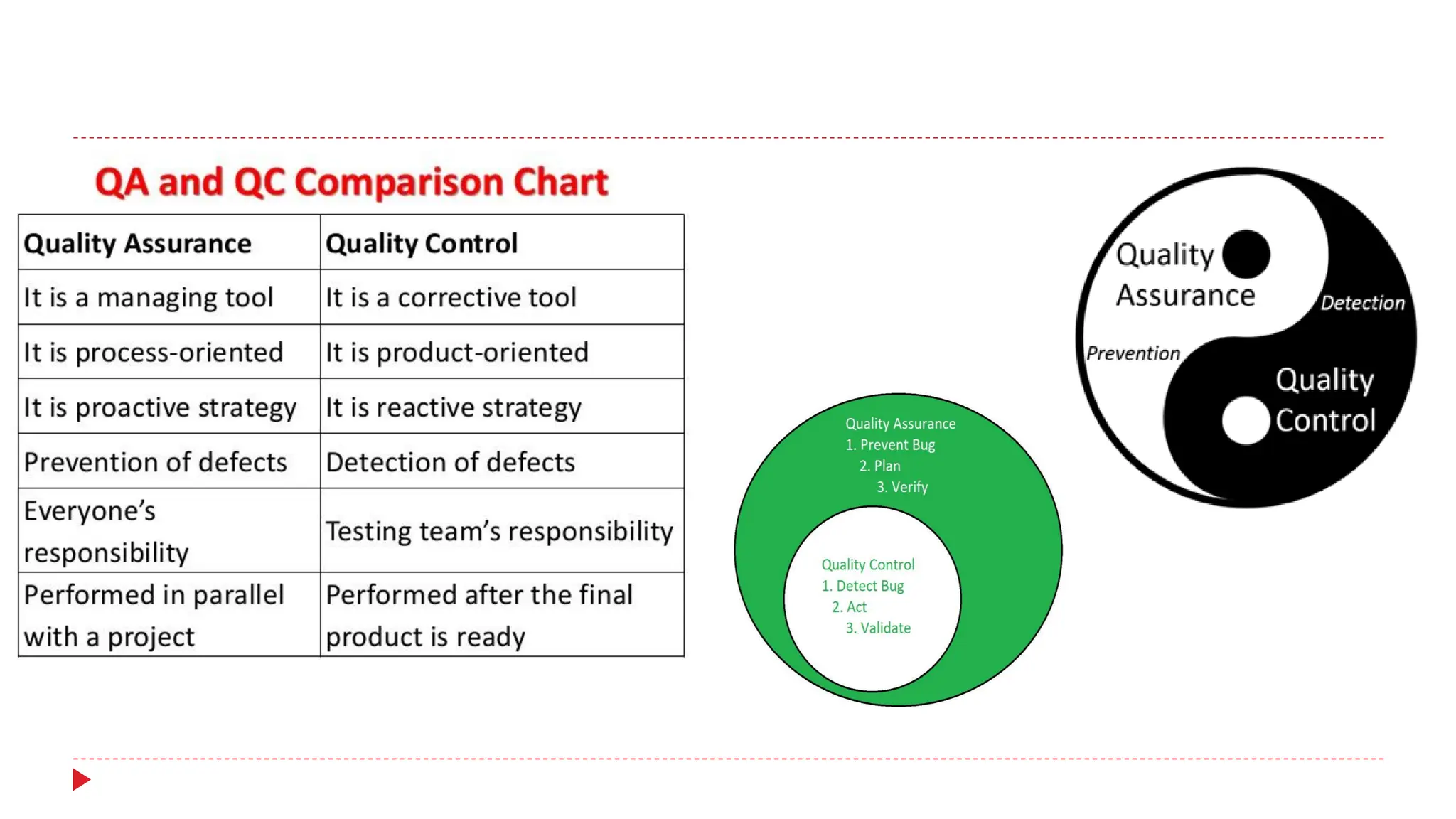
Quality Control:
Qualitycontrol, or QC for short, is a process by
which entities review the quality of all factors
involved in production.
Controls include product inspection, where every
product is examined visually, and often using a
stereo microscope for fine detail before the product
is sold into the externalmarket.
Inspectors will be provided with lists and
descriptions of unacceptable product defects such
as cracksor surface blemishesfor example.
Quality control emphasizes testing of products to
uncover defects and reporting to management who
make the decision to allow or deny product release,
whereas quality assurance attempts to improve and
stabilize production (and associated processes) to
avoid, or at least minimize, issues which led to the
defect(s) in the first place.
20.
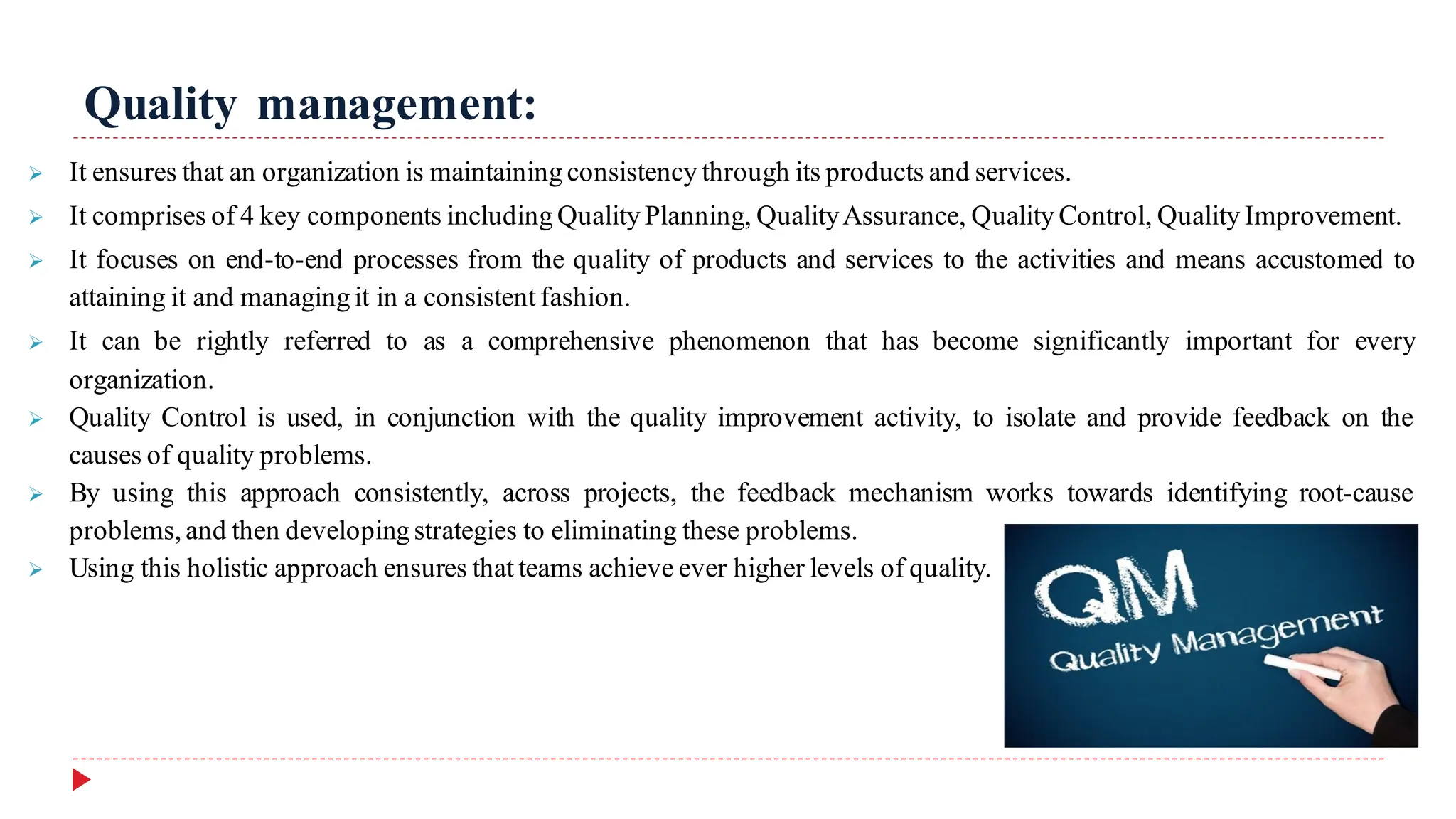
Quality management:
➢ Itensures that an organization is maintaining consistency through its products and services.
➢ It comprises of 4 key components including QualityPlanning, QualityAssurance, Quality Control, Quality Improvement.
➢ It focuses on end-to-end processes from the quality of products and services to the activities and means accustomed to
attaining it and managingit in a consistent fashion.
➢ It can be rightly referred to as a comprehensive phenomenon that has become significantly important for every
organization.
➢ Quality Control is used, in conjunction with the quality improvement activity, to isolate and provide feedback on the
causes of quality problems.
➢ By using this approach consistently, across projects, the feedback mechanism works towards identifying root-cause
problems,and then developingstrategies to eliminating these problems.
➢ Using this holistic approach ensures that teams achieve ever higher levels of quality.
22.
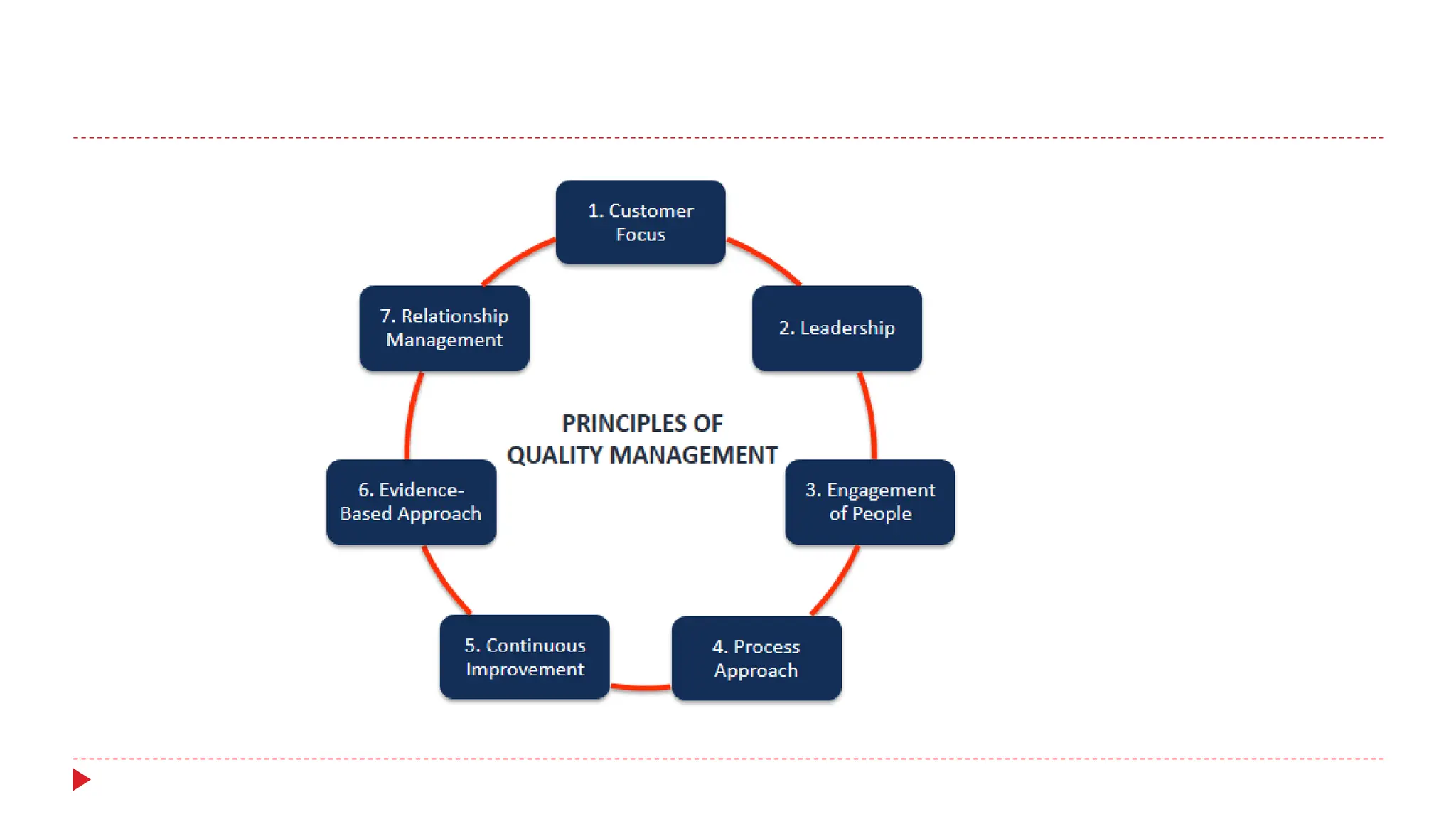
Principles of QualityManagement:
Quality management adopts a number of management principles that can be used by top management
to guide their organizationstowardsimprovedperformance. The principles include:
Customerfocus
Since the organizations depend on their customers, therefore they should understand current and future
customer needs, should meet customer requirements and try to exceed the expectations of customers.
An organization attains customer focus when all people in the organization know both the internal and
external customers and also what customer requirements must be met to ensure that both the internal
and external customersare satisfied.
Leadership
Leaders of an organization establish unity of purpose and direction of it. They should go for creation
and maintenance of such an internal environment, in which people can become fully involved in
achievingtheorganization's qualityobjective.
Involvement of people
People at all levels of an organization are the essence of it. Their complete involvement enables their
abilitiesto be usedfor the benefit of the organization.
23.
Principles of QualityManagement:
Process approach
The desired result can be achieved when activities and related resources are managed in an
organization as process.
System approach to management
An organization's effectiveness and efficiency in achieving its quality objectives are contributed by
identifying, understanding and managing all interrelated processes as a system.
Continual improvement
One of the permanent quality objectives of an organization should be the continual improvement
of its overall performance.
Factual approach to decision making
Effectivedecisions are always basedon the data analysis and information.
Mutually beneficial supplier relationships
Since an organization and its suppliers are interdependent, therefore a mutually beneficial
relationship between them increases the ability of both to add value.
These eight principles form the basis for the quality management system standard ISO
9001:2008.
24.
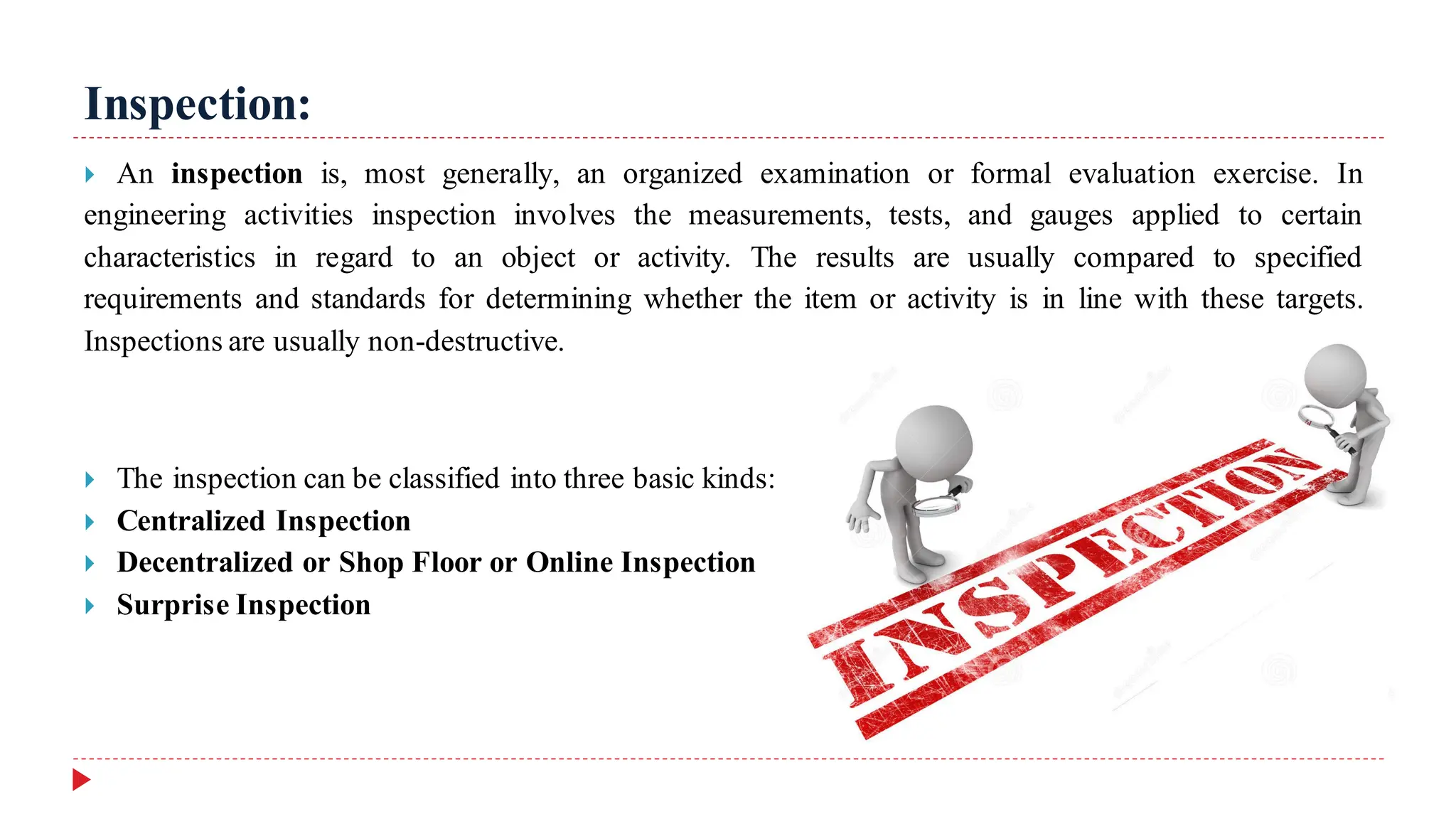
Inspection:
An inspectionis, most generally, an organized examination or formal evaluation exercise. In
engineering activities inspection involves the measurements, tests, and gauges applied to certain
characteristics in regard to an object or activity. The results are usually compared to specified
requirements and standards for determining whether the item or activity is in line with these targets.
Inspections are usually non-destructive.
The inspection can be classified into three basic kinds:
Centralized Inspection
Decentralized or Shop Floor or Online Inspection
Surprise Inspection
25.
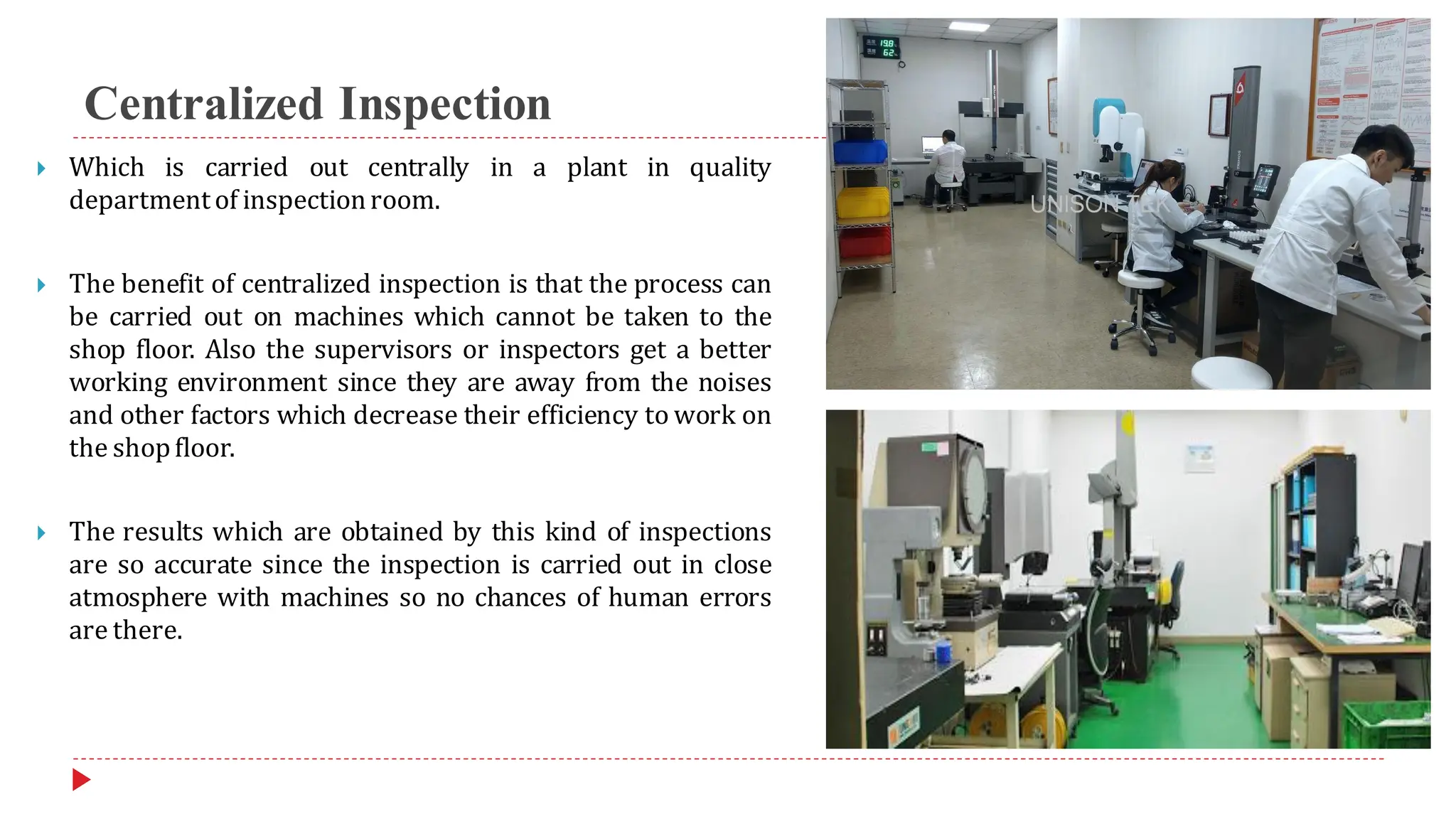
Centralized Inspection
Whichis carried out centrally in a plant in quality
departmentof inspectionroom.
The benefit of centralized inspection is that the process can
be carried out on machines which cannot be taken to the
shop floor. Also the supervisors or inspectors get a better
working environment since they are away from the noises
and other factors which decrease their efficiency to work on
the shopfloor.
The results which are obtained by this kind of inspections
are so accurate since the inspection is carried out in close
atmosphere with machines so no chances of human errors
are there.
26.
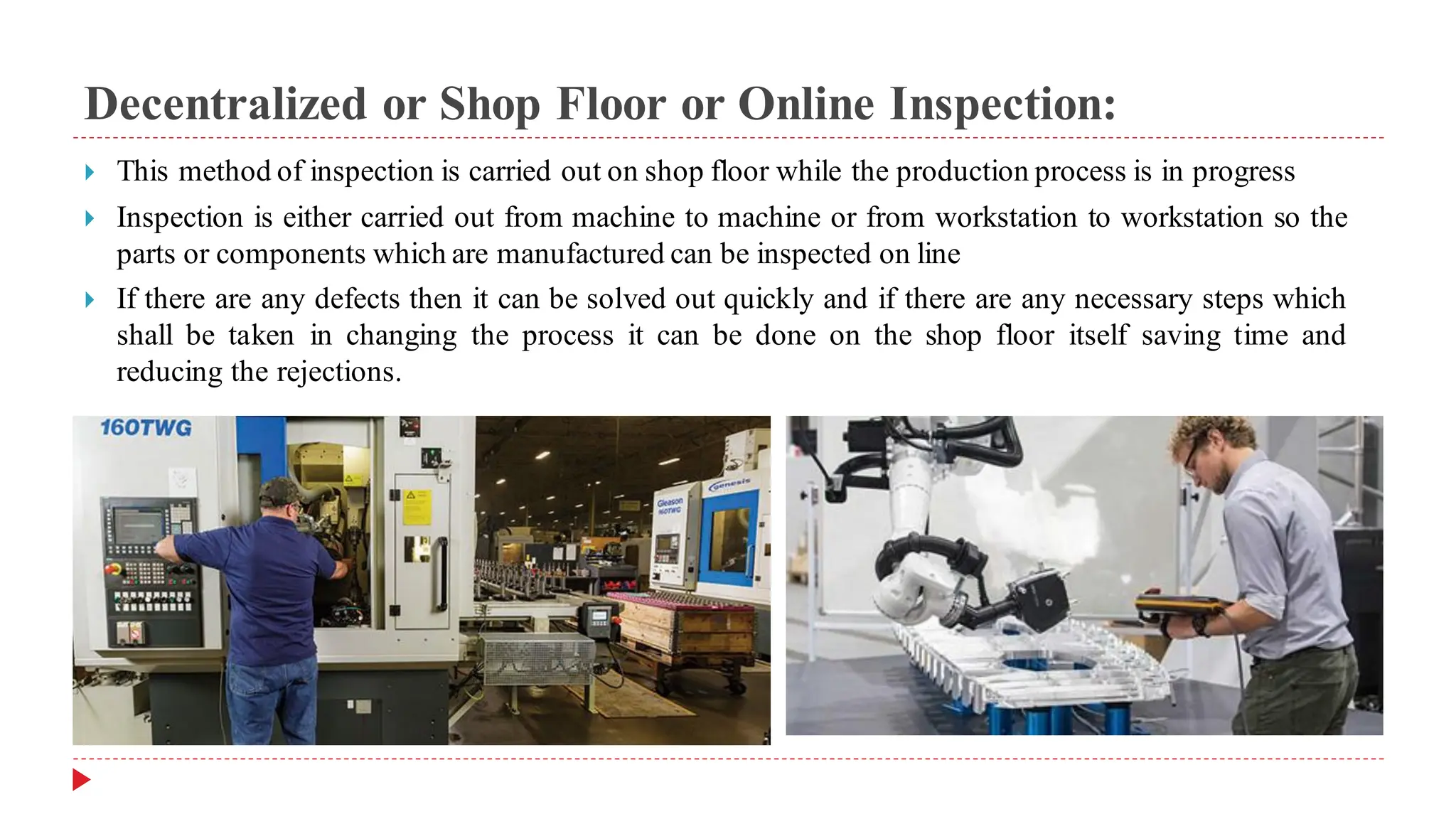
Decentralized or ShopFloor or Online Inspection:
This method of inspection is carried out on shop floor while the production process is in progress
Inspection is either carried out from machine to machine or from workstation to workstation so the
parts or components which are manufactured can be inspected on line
If there are any defects then it can be solved out quickly and if there are any necessary steps which
shall be taken in changing the process it can be done on the shop floor itself saving time and
reducing the rejections.
27.
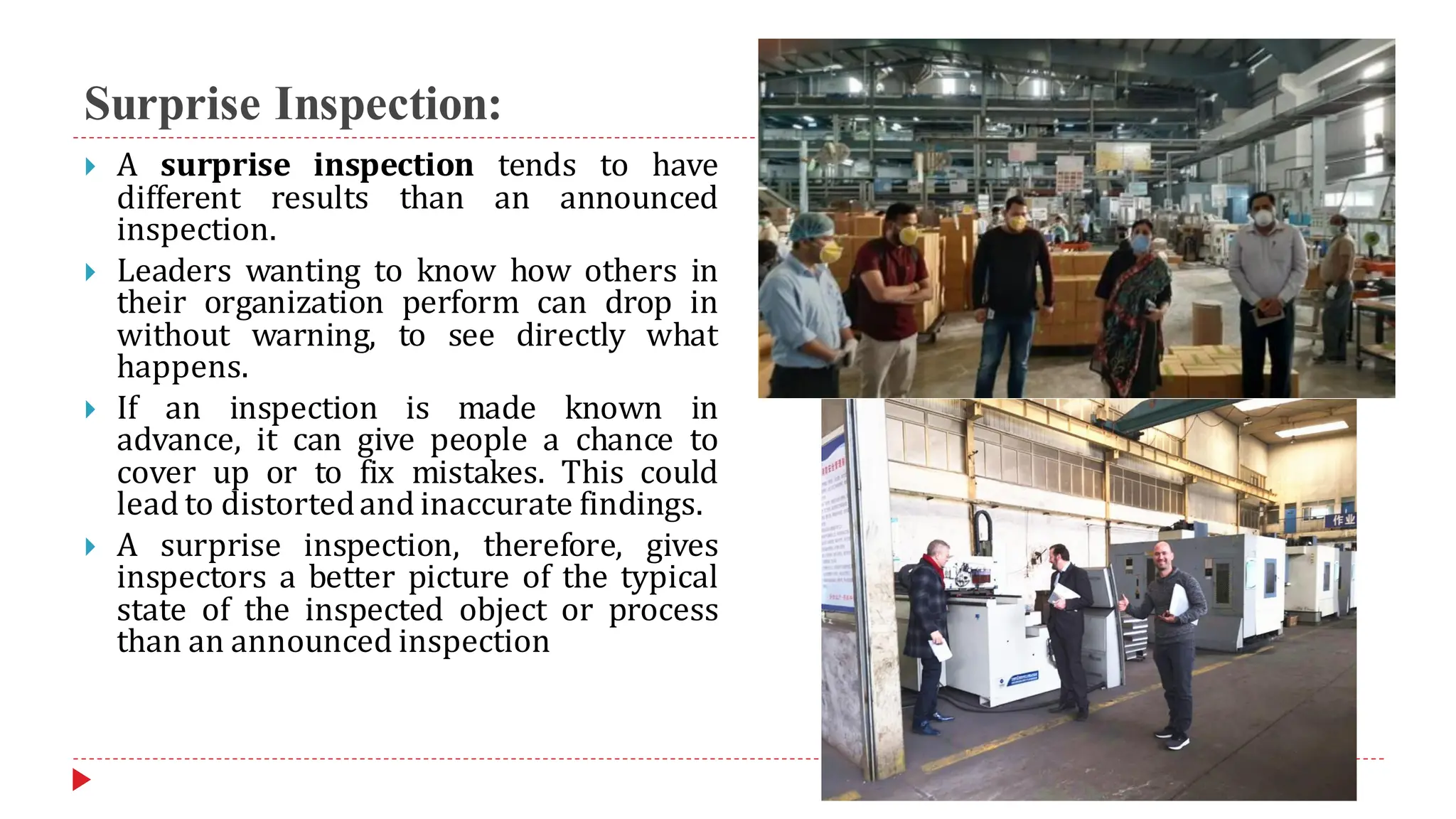
Surprise Inspection:
Asurprise inspection tends to have
different results than an announced
inspection.
Leaders wanting to know how others in
their organization perform can drop in
without warning, to see directly what
happens.
If an inspection is made known in
advance, it can give people a chance to
cover up or to fix mistakes. This could
lead to distortedand inaccurate findings.
A surprise inspection, therefore, gives
inspectors a better picture of the typical
state of the inspected object or process
than an announced inspection