TOTAL QUALITY MANAGEMENT
                         by
                    Muhammad Asif
                   Faculty IQTM-PU
                   F     lt IQTM PU
Ex Quality Control Officer Schering Asia GmbH Pakistan
    Ex Provincial Inspector Of Drugs
                      Lahore (PCS)
                  asif@iqtm.pu.edu.pk
                      @q p          p
BASIC CONCEPTS OF QUALITY

             Quality
             Grade
           Inspection
         Quality control
       Quality assurance
     Quality management
   Total quality management
         q     y      g
         ISO standards
QUALITY
  A subjective term for which each
  person has his or her own
  definition.
– Characteristics of a product that bears
 on it’s ability to satisfy the stated or
 implied needs
– A product or service free of
  deficiencies.
  d fi i     i
                                     (ASQ)
• PHILIP CROSBY’S IDEA OF
  QUALITY

• Quality is not comparative
• No high or poor quality
• A product either conforms to
  specifications or not
• Quality is an attribute
• Not a variable
• JURAN’S IDEA OF QUALITY

• FITNESS FOR THE PURPOSE
• Focus on this idea helps prevent over
  specifications of product or services
• Over specifications adds to cost
• Is against right first time performance
Dimensions of Product Quality
•   Performance
•   Aesthetics
    A th ti
•   Special features: convenience, high
    technology
•   Safety
         y
•   Reliability
• Conformance ( ti pre-established
              (meeting   t bli h d
    standards)
• Durability
• Service after sale
Service Quality
1.
1 Time & Timeliness
   –customer waiting time, completed on time
2. Completeness
   –customer gets all they asked for
    customer
3. Courtesy
   –treatment by employees
4.
4 Consistency
   –same level of service for all customers
5. Accessibility & Convenience
   –ease of obtaining service
    ease
6. Accuracy
   –performed right every time
7.
7 Responsiveness
   –reactions to unusual situations
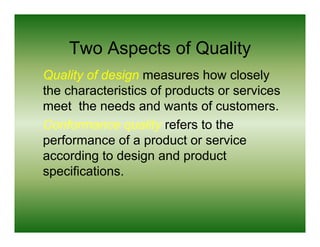
Two Aspects of Quality
Quality of design measures how closely
the characteristics of products or services
meet the needs and wants of customers
                               customers.
Conformance quality refers to the
performance of a product or service
according to design and product
specifications.
specifications
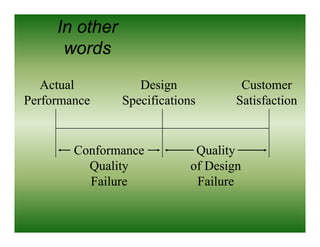
In other
      words
   Actual          Design             Customer
Performance     Specifications       Satisfaction


        Conformance           Quality
          Q
          Quality
                y                   g
                             of Design
          Failure             Failure
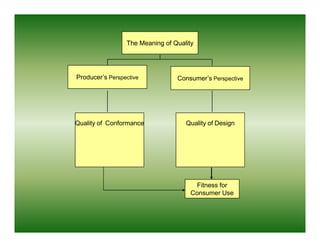
The Meaning of Q
                           g Quality
                                   y


Producer s
Producer’s Perspective         Consumer’s P
                               C       ’ Perspective
                                                ti


Quality of Conformance           Quality of Design


                                     Fitness for
                                   Consumer Use
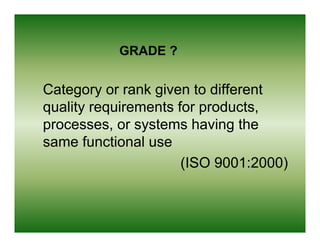
GRADE ?


Category or rank given to different
quality requirements for products
                         products,
processes, or systems having the
same f nctional use
       functional se
                      (
                      (ISO 9001:2000)
                                    )
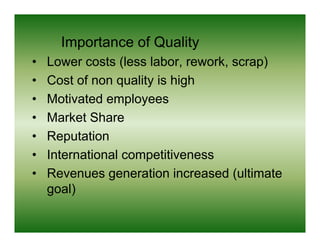
Importance of Quality
•   Lower costs (less labor, rework, scrap)
•   Cost f
    C t of non quality i hi h
                    lit is high
•   Motivated employees
•   Market Share
•   Reputation
•   International competitiveness
•   Revenues generation i
    R                  ti increased ( lti t
                                   d (ultimate
    goal)
INSPECTION

• It is the sorting / segregation of Non conforming
  items from the conforming items
• Means separation of
  Defective items from the right items
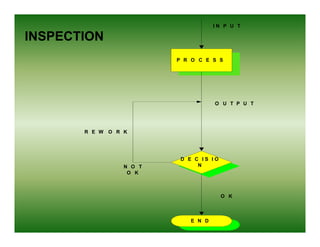
IN P U T

INSPECTION
                         P R O C E S S


                                    O U T P U T


       R E W O R K


                          D E C IS IO
                 N O T         N
                  O K


                                        O K


                            E N D
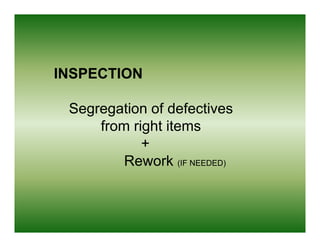
INSPECTION

 Segregation of defectives
     from right items
            +
         Rework (IF NEEDED)
QUALITY CONTROL


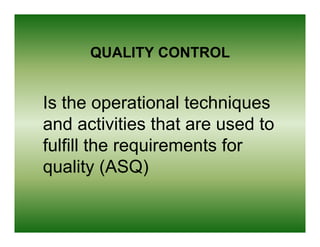
Is the operational techniques
and activities that are used to
fulfill the
f lfill th requirements f
               i      t for
quality (ASQ)
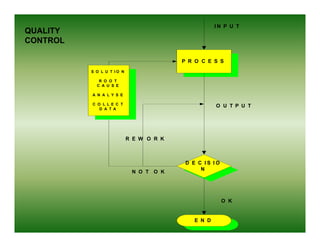
IN P U T
QUALITY
CONTROL

                                         P R O C E S S
          S O L U T IO N

             R O O T
            C A U S E

          A N A L Y S E

          C O L L E C T                             O U T P U T
             D A T A


                           R E W O R K


                                          D E C IS IO
                                               N
                            N O T O K


                                                        O K


                                            E N D
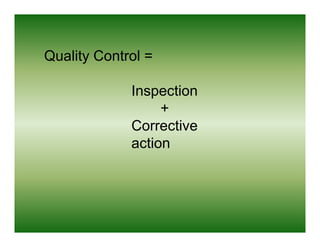
Quality Control =

             Inspection
                  +
             Corrective
             action
               ti
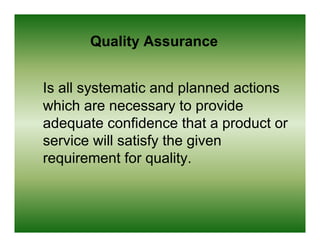
Quality Assurance


Is all systematic and planned actions
which are necessary to provide
adequate confidence that a product or
service will satisfy the given
requirement for quality.
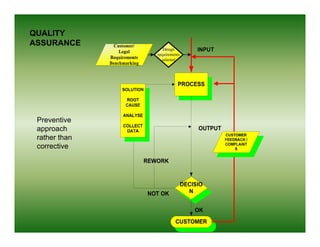
QUALITY
ASSURANCE
 SSU    C


 Preventive
 approach
 rather than
 corrective
SO WHAT QA ACTUALLY IS
•     QA covers the whole life of product
•     It includes

    1. Product
    2. Process
    3. Customer
Quality Management

Is a systematic set of operating
procedures which i company wide,
      d       hi h is            id
documented, implemented and
maintained while ensuring the growth
of business in a consistent manner
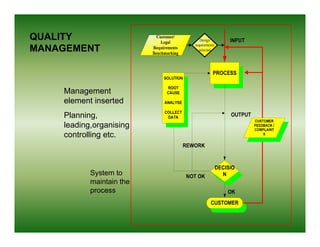
QUALITY
MANAGEMENT


    Management
    element inserted
    Planning,
    leading,organising
    controlling etc.


           System to
           maintain the
           process
So QMS is meant to establish a framework of
reference to ensure that every time process is
performed,
performed the same information method
                       information, method,
skills, and controls are used and applied in a
consistent manner
            manner.
ISO Standards

• A set of quality standards governing the
      t f     lit t d d            i th
  documentation requirement of a system
• ISO 9001:2000 (QMS)
• ISO 14001:2004 (EMS)
                     (    )
• ISO 17025 (GLP)
• SA 8000 (Social Accountability Std not
                                  Std.not
  ISO Std.)
TOTAL QUALITY MANAGEMENT

 The comprehensive approach towards
 quality management system
 The process of individual &
      p
 organizational development the
 p p
 purpose of which is to increase the
 level of satisfaction of all the
 stakeholders
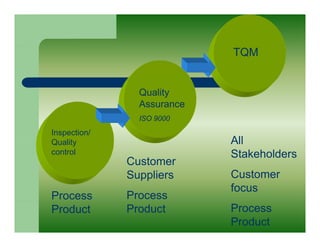
TQM


                Quality
                Assurance
                ISO 9000
Inspection/
Quality                     All
control                     Stakeholders
              Customer
              Suppliers     Customer
                            C t
                            focus
Process       Process
Product       Product       Process
                            Product
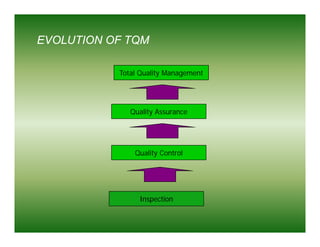
EVOLUTION OF TQM

           Total Quality Management
                 Q     y     g


              Quality Assurance


               Quality Control


                Inspection
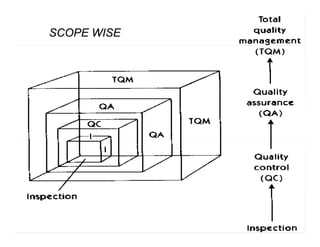
SCOPE WISE
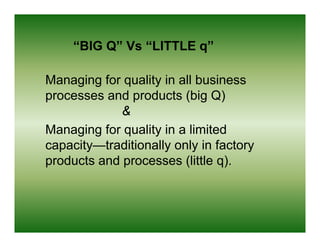
“BIG Q Vs “LITTLE q
      BIG Q”    LITTLE q”

Managing f quality i all b i
M      i for     lit in ll business
processes and products (big Q)
             &
Managing for quality in a limited
capacity—traditionally only in factory
products and processes (little q).
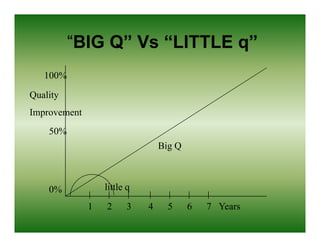
“BIG Q Vs “LITTLE q
           BIG Q”    LITTLE q”
   100%

Quality
Improvement
    50%
                                 Big Q


    0%            little q
              1   2      3   4     5     6   7 Years
TIME FOR QUESTIONS

Tqm basic concepts-of_quality_comp_mode

  • 1.
    TOTAL QUALITY MANAGEMENT by Muhammad Asif Faculty IQTM-PU F lt IQTM PU Ex Quality Control Officer Schering Asia GmbH Pakistan Ex Provincial Inspector Of Drugs Lahore (PCS) asif@iqtm.pu.edu.pk @q p p
  • 2.
    BASIC CONCEPTS OFQUALITY Quality Grade Inspection Quality control Quality assurance Quality management Total quality management q y g ISO standards
  • 3.
    QUALITY Asubjective term for which each person has his or her own definition. – Characteristics of a product that bears on it’s ability to satisfy the stated or implied needs – A product or service free of deficiencies. d fi i i (ASQ)
  • 4.
    • PHILIP CROSBY’SIDEA OF QUALITY • Quality is not comparative • No high or poor quality • A product either conforms to specifications or not • Quality is an attribute • Not a variable
  • 5.
    • JURAN’S IDEAOF QUALITY • FITNESS FOR THE PURPOSE • Focus on this idea helps prevent over specifications of product or services • Over specifications adds to cost • Is against right first time performance
  • 6.
    Dimensions of ProductQuality • Performance • Aesthetics A th ti • Special features: convenience, high technology • Safety y • Reliability • Conformance ( ti pre-established (meeting t bli h d standards) • Durability • Service after sale
  • 7.
    Service Quality 1. 1 Time& Timeliness –customer waiting time, completed on time 2. Completeness –customer gets all they asked for customer 3. Courtesy –treatment by employees
  • 8.
    4. 4 Consistency –same level of service for all customers 5. Accessibility & Convenience –ease of obtaining service ease 6. Accuracy –performed right every time 7. 7 Responsiveness –reactions to unusual situations
  • 9.
    Two Aspects ofQuality Quality of design measures how closely the characteristics of products or services meet the needs and wants of customers customers. Conformance quality refers to the performance of a product or service according to design and product specifications. specifications
  • 10.
    In other words Actual Design Customer Performance Specifications Satisfaction Conformance Quality Q Quality y g of Design Failure Failure
  • 11.
    The Meaning ofQ g Quality y Producer s Producer’s Perspective Consumer’s P C ’ Perspective ti Quality of Conformance Quality of Design Fitness for Consumer Use
  • 12.
    GRADE ? Category orrank given to different quality requirements for products products, processes, or systems having the same f nctional use functional se ( (ISO 9001:2000) )
  • 13.
    Importance of Quality • Lower costs (less labor, rework, scrap) • Cost f C t of non quality i hi h lit is high • Motivated employees • Market Share • Reputation • International competitiveness • Revenues generation i R ti increased ( lti t d (ultimate goal)
  • 14.
    INSPECTION • It isthe sorting / segregation of Non conforming items from the conforming items • Means separation of Defective items from the right items
  • 15.
    IN P UT INSPECTION P R O C E S S O U T P U T R E W O R K D E C IS IO N O T N O K O K E N D
  • 16.
    INSPECTION Segregation ofdefectives from right items + Rework (IF NEEDED)
  • 17.
    QUALITY CONTROL Is theoperational techniques and activities that are used to fulfill the f lfill th requirements f i t for quality (ASQ)
  • 18.
    IN P UT QUALITY CONTROL P R O C E S S S O L U T IO N R O O T C A U S E A N A L Y S E C O L L E C T O U T P U T D A T A R E W O R K D E C IS IO N N O T O K O K E N D
  • 19.
    Quality Control = Inspection + Corrective action ti
  • 20.
    Quality Assurance Is allsystematic and planned actions which are necessary to provide adequate confidence that a product or service will satisfy the given requirement for quality.
  • 21.
    QUALITY ASSURANCE SSU C Preventive approach rather than corrective
  • 22.
    SO WHAT QAACTUALLY IS • QA covers the whole life of product • It includes 1. Product 2. Process 3. Customer
  • 23.
    Quality Management Is asystematic set of operating procedures which i company wide, d hi h is id documented, implemented and maintained while ensuring the growth of business in a consistent manner
  • 24.
    QUALITY MANAGEMENT Management element inserted Planning, leading,organising controlling etc. System to maintain the process
  • 25.
    So QMS ismeant to establish a framework of reference to ensure that every time process is performed, performed the same information method information, method, skills, and controls are used and applied in a consistent manner manner.
  • 26.
    ISO Standards • Aset of quality standards governing the t f lit t d d i th documentation requirement of a system • ISO 9001:2000 (QMS) • ISO 14001:2004 (EMS) ( ) • ISO 17025 (GLP) • SA 8000 (Social Accountability Std not Std.not ISO Std.)
  • 27.
    TOTAL QUALITY MANAGEMENT The comprehensive approach towards quality management system The process of individual & p organizational development the p p purpose of which is to increase the level of satisfaction of all the stakeholders
  • 28.
    TQM Quality Assurance ISO 9000 Inspection/ Quality All control Stakeholders Customer Suppliers Customer C t focus Process Process Product Product Process Product
  • 29.
    EVOLUTION OF TQM Total Quality Management Q y g Quality Assurance Quality Control Inspection
  • 30.
  • 31.
    “BIG Q Vs“LITTLE q BIG Q” LITTLE q” Managing f quality i all b i M i for lit in ll business processes and products (big Q) & Managing for quality in a limited capacity—traditionally only in factory products and processes (little q).
  • 32.
    “BIG Q Vs“LITTLE q BIG Q” LITTLE q” 100% Quality Improvement 50% Big Q 0% little q 1 2 3 4 5 6 7 Years
  • 33.