OBJECTIVES
• To know the definition of benchmarking
• To know the triggers for benchmarking
• To know the types of benchmarking
• To know what are the reasons for benchmarking
• To know the steps in identifying what to benchmark
• To know the benchmarking process
• To know what are the reasons why benchmarkingefforts fail.
INTRODUCTION
Benchmarkingwill helpin identifyingthe current level of
performance of the processes in the organization and bringing
themup to the level of the best processes. It can be used to
compare product features also.
We will learnthe following concepts pertainingto processes, namely
Business Process Benchmarking (BPB), one of the tools of TQM.
BENCHMARKING
• is a processof comparisonof two or more
products, services, processes or
organizational practices.
• standard or point of reference
• “a basisfor establishing rational
performancegoals through the search for
industry best practices that will leadto
superiorperformance”
• BusinessProcessBenchmarking is
comparing a businessprocesswiththebest
processin that area.
TRIGGERS FOR BENCHMARKING
Two Categories of Benchmarking
Problembasedbenchmarking
Process basedbenchmarking
Problem based benchmarking
• Arises out of a problemin the organization
• Some of the triggers that couldmotivate the organization to carry
out benchmarkingare:
a. Adverse feedback fromcustomer
b. Increasing quality cost
c. Alarming error rates
d. Increase in cycle time
Process based benchmarking
• It is initiated as a part of processimprovementstrategyof the
organization.
• Benchmarking arises out of the following:
a. Defined mission
b. Defined objectives
c. Defined priorities
Monday, 30 January 2017 Xavier Institute of Management, Jabalpur 8
Types Of Benchmarking
Performance or operational benchmarking:
It involves – pricing, technical quality, features and other quality.
Process or functional benchmarking:
It involves processes such as billing, order entry or employee training.
Strategic benchmarking:
Examines how companies compute and seeks the winning strategies that have
led to competitive advantage and market success.
Monday, 30 January 2017 Xavier Institute of Management, Jabalpur 9
Types Of Benchmarking
Performance or operational benchmarking:
It involves – pricing, technical quality, features and other quality.
Process or functional benchmarking:
It involves processes such as billing, order entry or employee training.
Strategic benchmarking:
Examines how companies compute and seeks the winning strategies that have
led to competitive advantage and market success.
REASONS FOR BENCHMARKING
• Benchmarkingis carried out to bringout clearly and objectively the
real status with regardto the performance of the organization as
well as the processes.
• Benchmarkingis a way to improve the processesand reach the top.
• Benchmarkinghas to be carried out periodically so as to maintain
the leadershipposition
• It is a powerful and effective tool when used for right reasons.
STEPS IN IDENTIFYING WHAT TO BENCHMARK
Select processes
Determine vital measures
Prioritize processes and
measures
Select Processes
• It is important to select the
right processesfor
benchmarking.
• To identify all the processes,
there is no bettermethod
than formulatinga process
flow chart of the
organization.
Determine Vital Measures
• The measures are to be documented.
• One should select a few vital performance measures for each
process for benchmarking.
Prioritize Processes
• A duly constituted teamfor prioritization shouldcarry out an
objective study.
• The teamassign priority to the processes to be benchmarked in
the organization.
BENCHMARKING PROCESS
Selection of a process
improvement team
Preparea project
description
Identificationof
benchmarking
partners
Adopt a suitable
benchmarkingprocess
model
Carryout
benchmarking
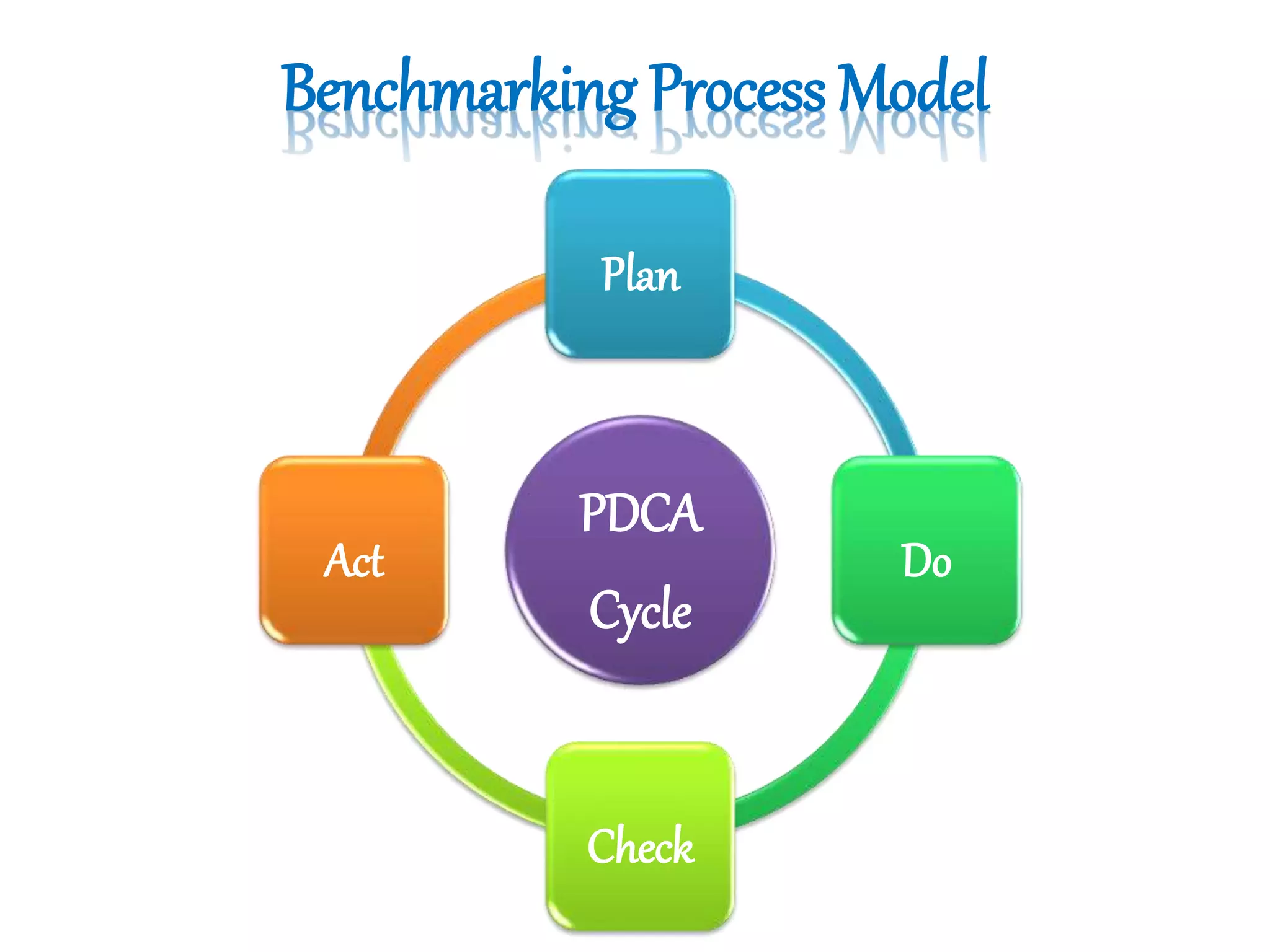
Benchmarking Process Model
PDCA
Cycle
Plan
Do
Check
Act
Planning Phase
• The improvement team
holds discussions and
prepares a blueprint for
the project including
performance measurement
of processes.
Do Phase
• The teamvisits the partner and studies their process and notes
down the performance.
• The new process is implementedon a pilot basis, the
performance of the improved process is measured and a report
is prepared.
Act Phase
• Periodic measurementsare carriedout to confirmeffectiveness
of the process.
REASONS FOR FAILURE OF BENCHMARKING
• Lack of commitment
• Wrongselection of process
• Not being cost effective
• Wrongselectionof team members
• Under estimating the time required
• Not positioningthe benchmarking within a
larger strategy
• Lack of involvement of management

Business Process Benchmarking

  • 2.
    OBJECTIVES • To knowthe definition of benchmarking • To know the triggers for benchmarking • To know the types of benchmarking • To know what are the reasons for benchmarking • To know the steps in identifying what to benchmark • To know the benchmarking process • To know what are the reasons why benchmarkingefforts fail.
  • 3.
    INTRODUCTION Benchmarkingwill helpin identifyingthecurrent level of performance of the processes in the organization and bringing themup to the level of the best processes. It can be used to compare product features also. We will learnthe following concepts pertainingto processes, namely Business Process Benchmarking (BPB), one of the tools of TQM.
  • 4.
    BENCHMARKING • is aprocessof comparisonof two or more products, services, processes or organizational practices. • standard or point of reference • “a basisfor establishing rational performancegoals through the search for industry best practices that will leadto superiorperformance” • BusinessProcessBenchmarking is comparing a businessprocesswiththebest processin that area.
  • 5.
    TRIGGERS FOR BENCHMARKING TwoCategories of Benchmarking Problembasedbenchmarking Process basedbenchmarking
  • 6.
    Problem based benchmarking •Arises out of a problemin the organization • Some of the triggers that couldmotivate the organization to carry out benchmarkingare: a. Adverse feedback fromcustomer b. Increasing quality cost c. Alarming error rates d. Increase in cycle time
  • 7.
    Process based benchmarking •It is initiated as a part of processimprovementstrategyof the organization. • Benchmarking arises out of the following: a. Defined mission b. Defined objectives c. Defined priorities
  • 8.
    Monday, 30 January2017 Xavier Institute of Management, Jabalpur 8 Types Of Benchmarking Performance or operational benchmarking: It involves – pricing, technical quality, features and other quality. Process or functional benchmarking: It involves processes such as billing, order entry or employee training. Strategic benchmarking: Examines how companies compute and seeks the winning strategies that have led to competitive advantage and market success.
  • 9.
    Monday, 30 January2017 Xavier Institute of Management, Jabalpur 9 Types Of Benchmarking Performance or operational benchmarking: It involves – pricing, technical quality, features and other quality. Process or functional benchmarking: It involves processes such as billing, order entry or employee training. Strategic benchmarking: Examines how companies compute and seeks the winning strategies that have led to competitive advantage and market success.
  • 10.
    REASONS FOR BENCHMARKING •Benchmarkingis carried out to bringout clearly and objectively the real status with regardto the performance of the organization as well as the processes. • Benchmarkingis a way to improve the processesand reach the top. • Benchmarkinghas to be carried out periodically so as to maintain the leadershipposition • It is a powerful and effective tool when used for right reasons.
  • 11.
    STEPS IN IDENTIFYINGWHAT TO BENCHMARK Select processes Determine vital measures Prioritize processes and measures
  • 12.
    Select Processes • Itis important to select the right processesfor benchmarking. • To identify all the processes, there is no bettermethod than formulatinga process flow chart of the organization.
  • 13.
    Determine Vital Measures •The measures are to be documented. • One should select a few vital performance measures for each process for benchmarking.
  • 14.
    Prioritize Processes • Aduly constituted teamfor prioritization shouldcarry out an objective study. • The teamassign priority to the processes to be benchmarked in the organization.
  • 15.
    BENCHMARKING PROCESS Selection ofa process improvement team Preparea project description Identificationof benchmarking partners Adopt a suitable benchmarkingprocess model Carryout benchmarking
  • 16.
  • 17.
    Planning Phase • Theimprovement team holds discussions and prepares a blueprint for the project including performance measurement of processes.
  • 18.
    Do Phase • Theteamvisits the partner and studies their process and notes down the performance.
  • 19.
    • The newprocess is implementedon a pilot basis, the performance of the improved process is measured and a report is prepared.
  • 20.
    Act Phase • Periodicmeasurementsare carriedout to confirmeffectiveness of the process.
  • 21.
    REASONS FOR FAILUREOF BENCHMARKING • Lack of commitment • Wrongselection of process • Not being cost effective • Wrongselectionof team members • Under estimating the time required • Not positioningthe benchmarking within a larger strategy • Lack of involvement of management