Quality for Service
Organizations

 Implementation of ISO 9001:2000 for
 Service Sector
Overview
   ISO is the International Organization for Standardization.
   It is made up of national standards institutes from countries large
    and small, industrialized, developing or in transition in all regions of
    the world
   ISO develops voluntary technical standards, which add value to all
    type of business applications
   ISO –non governmental sector-establish in 1947
   ISO standards help raise levels of quality, safety, reliability,
    efficiency, compatibility and interchangeability and provide these
    benefits at an economical cost.
What are Standards
   Standards are documented agreements containing
    technical specification or other precise criteria to be
    used consistently as rules, guidelines or definition of
    charactics, to ensure that materials, products,
    processes and services are fit for their purpose
How are ISO standard developed
in Service Sector?
   ISO follows principles.
    ◦ Consensus
    ◦ Industry Wide
    ◦ Voluntary

    On this principles ISO can be applied to
    all service sectors
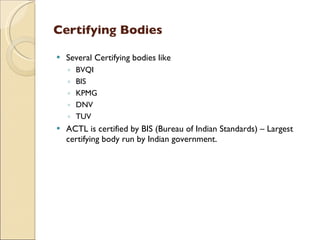
Certifying Bodies

   Several Certifying bodies like
    ◦   BVQI
    ◦   BIS
    ◦   KPMG
    ◦   DNV
    ◦   TUV
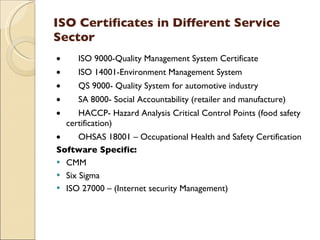
ISO Certificates in Different Service
Sector
•        ISO 9000-Quality Management System Certificate
•        ISO 14001-Environment Management System
•        QS 9000- Quality System for automotive industry
•        SA 8000- Social Accountability (retailer and manufacture)
•        HACCP- Hazard Analysis Critical Control Points (food safety
    certification)
•        OHSAS 18001 – Occupational Health and Safety Certification
Software Specific:
 CMM
 Six Sigma
 ISO 27000 – (Internet security Management)
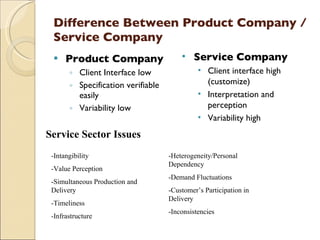
Difference Between Product Company /
 Service Company
     Product Company                   • Service Company
       ◦ Client Interface low                 • Client interface high
       ◦ Specification verifiable               (customize)
         easily                               • Interpretation and
       ◦ Variability low                        perception
                                              • Variability high
Service Sector Issues
 -Intangibility                     -Heterogeneity/Personal 
                                    Dependency 
 -Value Perception 
                                    -Demand Fluctuations 
 -Simultaneous Production and 
 Delivery                           -Customer’s Participation in 
                                    Delivery 
 -Timeliness 
                                    -Inconsistencies 
 -Infrastructure 
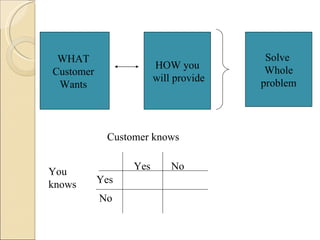
WHAT                                  Solve 
                      HOW you          Whole
Customer 
                      will provide    problem 
 Wants 


             Customer knows

                  Yes     No
You 
knows   Yes
            No
What is Quality
     Meeting agreed requirements between organization and
      customer
     Full feeling legal requirements
     Full feeling your own organization’s requirements

Purpose of Quality
 •Customer Satisfaction
 •Consistency of Service/Production 

“ The Quality of Product is largely determined by the
Quality of the process that is used to develop and maintain
it.”- By juran, Deming. Based on TQM
What is Quality Management
System
 ISO 9000, the international standard specifies Quality Management
  System, requirement for use where an organization’s capability to
  provide confirming products and/or services needs to be
  demonstrated.
 ISO 9000 is aimed primarily at achieving CUSTOMER
  SATISFACTION by meeting customer and applicable
  regulatory requirements through application of the system, its
  continual improvement and the prevention of non-conformities at
  all stages.
 The standard requirements are generic and apply to all product
  categories and any industry sector.
 It is applicable to all type and sizes of organizations and can also be
  used by internal and external parties.
QMS Aspects
1. Management Responsibility
2. Resource Management (Men, Material,
   Money and Methods)
3. Making & Delivering a Product
4. Monitoring & Improving your
   Product/Process
3. Making & Delivering Product

 PDCA-Plan, Do, Check, Act Cycle
 Quality Plan
 Customer Requirement
 Purchase
 Production/Service Plan
Quality Plan

•   Means what you want?
•   How you going to achieve your goal?
•   More detail quality plan more effect to customers
•   What we provide, how, when etc.
•   Detail plan depends on customer, service etc
•   If you have proper plan, you can offer missing things.
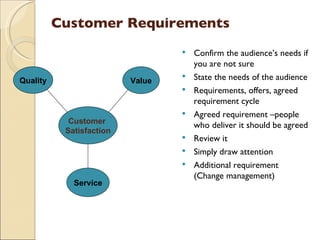
Customer Requirements
                                     Confirm the audience’s needs if
                                      you are not sure
Quality                   Value
                                     State the needs of the audience
                                     Requirements, offers, agreed
                                      requirement cycle
                                     Agreed requirement –people
            Customer
                                      who deliver it should be agreed
           Satisfaction
                                     Review it
                                     Simply draw attention
                                     Additional requirement
                                      (Change management)
             Service
Purchase

a.   Item, service, subcontract
b.   Have a process for selecting vendors
c.   Method of verifying if this vendor will be
     suitable for your organization
d.   “Purchase order”- complete details of
     product/service you want
e.   Verify your received product
f.   Evaluate/monitor performance of vendor
Production/Service Plan

a.   Production/service schedule plan
     depends on business nature (how)
b.   Equipments
c.   Instruments
d.   Work instruction
e.   Periodic /In process checking-Inspection
f.   Calibrated instruments.
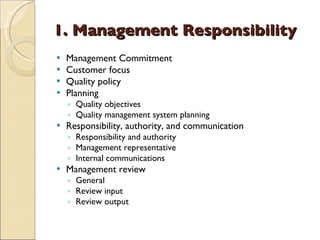
1. Management Responsibility
   Management Commitment
   Customer focus
   Quality policy
   Planning
    ◦ Quality objectives
    ◦ Quality management system planning
   Responsibility, authority, and communication
    ◦ Responsibility and authority
    ◦ Management representative
    ◦ Internal communications
   Management review
    ◦ General
    ◦ Review input
    ◦ Review output
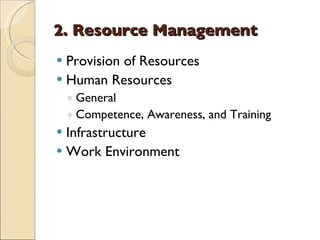
2. Resource Management
 Provision of Resources
 Human Resources
    ◦ General
    ◦ Competence, Awareness, and Training
 Infrastructure
 Work Environment
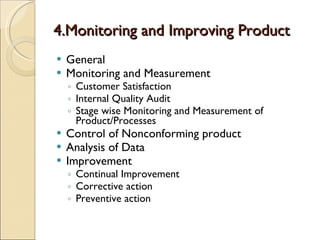
4.Monitoring and Improving Product
   General
   Monitoring and Measurement
    ◦ Customer Satisfaction
    ◦ Internal Quality Audit
    ◦ Stage wise Monitoring and Measurement of
      Product/Processes
   Control of Nonconforming product
   Analysis of Data
   Improvement
    ◦ Continual Improvement
    ◦ Corrective action
    ◦ Preventive action
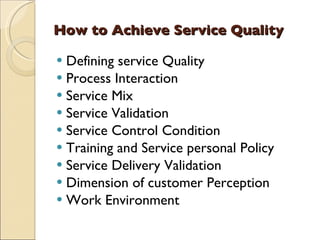
How to Achieve Service Quality

 Defining service Quality
 Process Interaction
 Service Mix
 Service Validation
 Service Control Condition
 Training and Service personal Policy
 Service Delivery Validation
 Dimension of customer Perception
 Work Environment
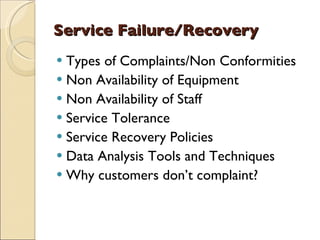
Service Failure/Recovery
 Types of Complaints/Non Conformities
 Non Availability of Equipment
 Non Availability of Staff
 Service Tolerance
 Service Recovery Policies
 Data Analysis Tools and Techniques
 Why customers don’t complaint?
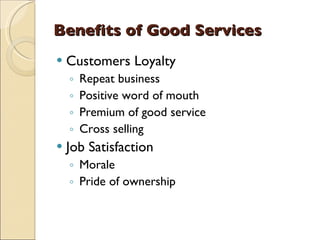
Benefits of Good Services
   Customers Loyalty
    ◦   Repeat business
    ◦   Positive word of mouth
    ◦   Premium of good service
    ◦   Cross selling
   Job Satisfaction
    ◦ Morale
    ◦ Pride of ownership
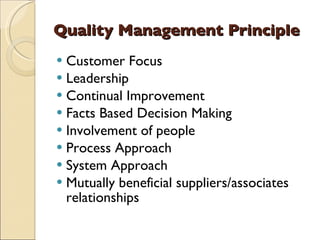
Quality Management Principle
 Customer Focus
 Leadership
 Continual Improvement
 Facts Based Decision Making
 Involvement of people
 Process Approach
 System Approach
 Mutually beneficial suppliers/associates
  relationships
Steps in ISO

There are various points which defines the way a
company or an organization can get the certificate.
Quality For Service Organizations

Quality For Service Organizations

  • 1.
    Quality for Service Organizations Implementation of ISO 9001:2000 for Service Sector
  • 2.
    Overview  ISO is the International Organization for Standardization.  It is made up of national standards institutes from countries large and small, industrialized, developing or in transition in all regions of the world  ISO develops voluntary technical standards, which add value to all type of business applications  ISO –non governmental sector-establish in 1947  ISO standards help raise levels of quality, safety, reliability, efficiency, compatibility and interchangeability and provide these benefits at an economical cost.
  • 3.
    What are Standards  Standards are documented agreements containing technical specification or other precise criteria to be used consistently as rules, guidelines or definition of charactics, to ensure that materials, products, processes and services are fit for their purpose
  • 4.
    How are ISOstandard developed in Service Sector?  ISO follows principles. ◦ Consensus ◦ Industry Wide ◦ Voluntary On this principles ISO can be applied to all service sectors
  • 5.
    Certifying Bodies  Several Certifying bodies like ◦ BVQI ◦ BIS ◦ KPMG ◦ DNV ◦ TUV
  • 6.
    ISO Certificates inDifferent Service Sector •        ISO 9000-Quality Management System Certificate •        ISO 14001-Environment Management System •        QS 9000- Quality System for automotive industry •        SA 8000- Social Accountability (retailer and manufacture) •        HACCP- Hazard Analysis Critical Control Points (food safety certification) •        OHSAS 18001 – Occupational Health and Safety Certification Software Specific:  CMM  Six Sigma  ISO 27000 – (Internet security Management)
  • 7.
    Difference Between ProductCompany / Service Company  Product Company • Service Company ◦ Client Interface low • Client interface high ◦ Specification verifiable (customize) easily • Interpretation and ◦ Variability low perception • Variability high Service Sector Issues -Intangibility  -Heterogeneity/Personal  Dependency  -Value Perception  -Demand Fluctuations  -Simultaneous Production and  Delivery  -Customer’s Participation in  Delivery  -Timeliness  -Inconsistencies  -Infrastructure 
  • 8.
    WHAT  Solve  HOW you Whole Customer   will provide  problem  Wants  Customer knows Yes No You  knows Yes No
  • 9.
    What is Quality  Meeting agreed requirements between organization and customer  Full feeling legal requirements  Full feeling your own organization’s requirements Purpose of Quality •Customer Satisfaction •Consistency of Service/Production  “ The Quality of Product is largely determined by the Quality of the process that is used to develop and maintain it.”- By juran, Deming. Based on TQM
  • 10.
    What is QualityManagement System  ISO 9000, the international standard specifies Quality Management System, requirement for use where an organization’s capability to provide confirming products and/or services needs to be demonstrated.  ISO 9000 is aimed primarily at achieving CUSTOMER SATISFACTION by meeting customer and applicable regulatory requirements through application of the system, its continual improvement and the prevention of non-conformities at all stages.  The standard requirements are generic and apply to all product categories and any industry sector.  It is applicable to all type and sizes of organizations and can also be used by internal and external parties.
  • 11.
    QMS Aspects 1. ManagementResponsibility 2. Resource Management (Men, Material, Money and Methods) 3. Making & Delivering a Product 4. Monitoring & Improving your Product/Process
  • 12.
    3. Making &Delivering Product  PDCA-Plan, Do, Check, Act Cycle  Quality Plan  Customer Requirement  Purchase  Production/Service Plan
  • 13.
    Quality Plan • Means what you want? • How you going to achieve your goal? • More detail quality plan more effect to customers • What we provide, how, when etc. • Detail plan depends on customer, service etc • If you have proper plan, you can offer missing things.
  • 14.
    Customer Requirements  Confirm the audience’s needs if you are not sure Quality Value  State the needs of the audience  Requirements, offers, agreed requirement cycle  Agreed requirement –people Customer who deliver it should be agreed Satisfaction  Review it  Simply draw attention  Additional requirement (Change management) Service
  • 15.
    Purchase a. Item, service, subcontract b. Have a process for selecting vendors c. Method of verifying if this vendor will be suitable for your organization d. “Purchase order”- complete details of product/service you want e. Verify your received product f. Evaluate/monitor performance of vendor
  • 16.
    Production/Service Plan a. Production/service schedule plan depends on business nature (how) b. Equipments c. Instruments d. Work instruction e. Periodic /In process checking-Inspection f. Calibrated instruments.
  • 17.
    1. Management Responsibility  Management Commitment  Customer focus  Quality policy  Planning ◦ Quality objectives ◦ Quality management system planning  Responsibility, authority, and communication ◦ Responsibility and authority ◦ Management representative ◦ Internal communications  Management review ◦ General ◦ Review input ◦ Review output
  • 18.
    2. Resource Management Provision of Resources  Human Resources ◦ General ◦ Competence, Awareness, and Training  Infrastructure  Work Environment
  • 19.
    4.Monitoring and ImprovingProduct  General  Monitoring and Measurement ◦ Customer Satisfaction ◦ Internal Quality Audit ◦ Stage wise Monitoring and Measurement of Product/Processes  Control of Nonconforming product  Analysis of Data  Improvement ◦ Continual Improvement ◦ Corrective action ◦ Preventive action
  • 20.
    How to AchieveService Quality  Defining service Quality  Process Interaction  Service Mix  Service Validation  Service Control Condition  Training and Service personal Policy  Service Delivery Validation  Dimension of customer Perception  Work Environment
  • 21.
    Service Failure/Recovery  Typesof Complaints/Non Conformities  Non Availability of Equipment  Non Availability of Staff  Service Tolerance  Service Recovery Policies  Data Analysis Tools and Techniques  Why customers don’t complaint?
  • 22.
    Benefits of GoodServices  Customers Loyalty ◦ Repeat business ◦ Positive word of mouth ◦ Premium of good service ◦ Cross selling  Job Satisfaction ◦ Morale ◦ Pride of ownership
  • 23.
    Quality Management Principle Customer Focus  Leadership  Continual Improvement  Facts Based Decision Making  Involvement of people  Process Approach  System Approach  Mutually beneficial suppliers/associates relationships
  • 24.
    Steps in ISO Thereare various points which defines the way a company or an organization can get the certificate.