Leadership For TQM


THE MANAGEMENT AND CONTROL OF QUALITY, 5e, © 2002 South-Western/Thomson LearningTM   1
Leadership
       • The ability to positively influence
         people and systems to have a
         meaningful impact and achieve results.
       • Leadership is a prerequisite to all
         strategy and action plans, it cannot be
         delegated.


                                                                               2
THE MANAGEMENT AND CONTROL OF QUALITY, 5e, © 2002 South-Western/Thomson LearningTM
Strategic Planning

      • The process of envisioning an
        organization’s future and developing
        the necessary procedures and
        operations to achieve that future.


                                                                               3
THE MANAGEMENT AND CONTROL OF QUALITY, 5e, © 2002 South-Western/Thomson LearningTM
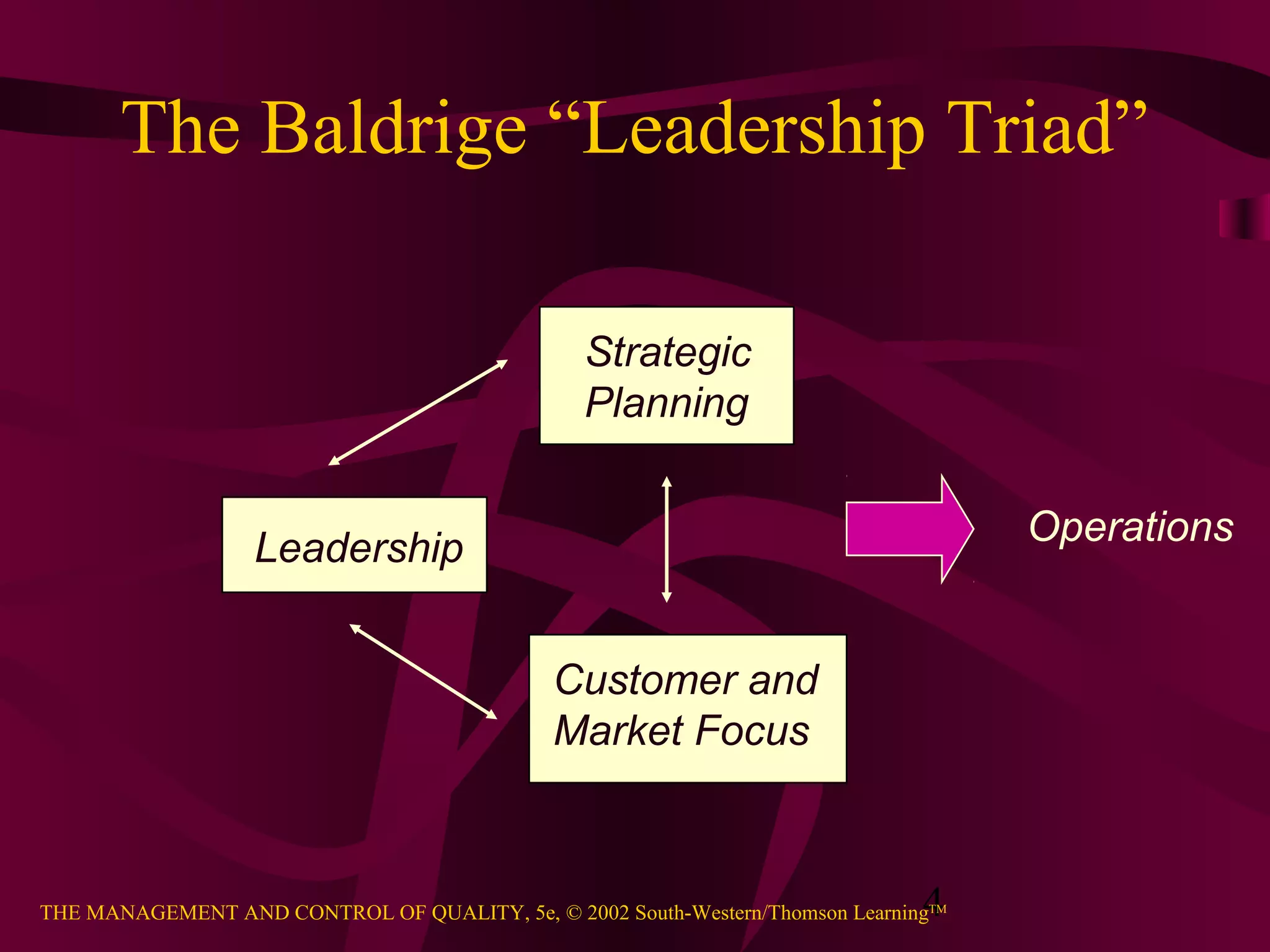
The Baldrige “Leadership Triad”

                                                 Strategic
                                                 Planning

                                                                                     Operations
                   Leadership


                                              Customer and
                                              Market Focus


                                                                               4
THE MANAGEMENT AND CONTROL OF QUALITY, 5e, © 2002 South-Western/Thomson LearningTM
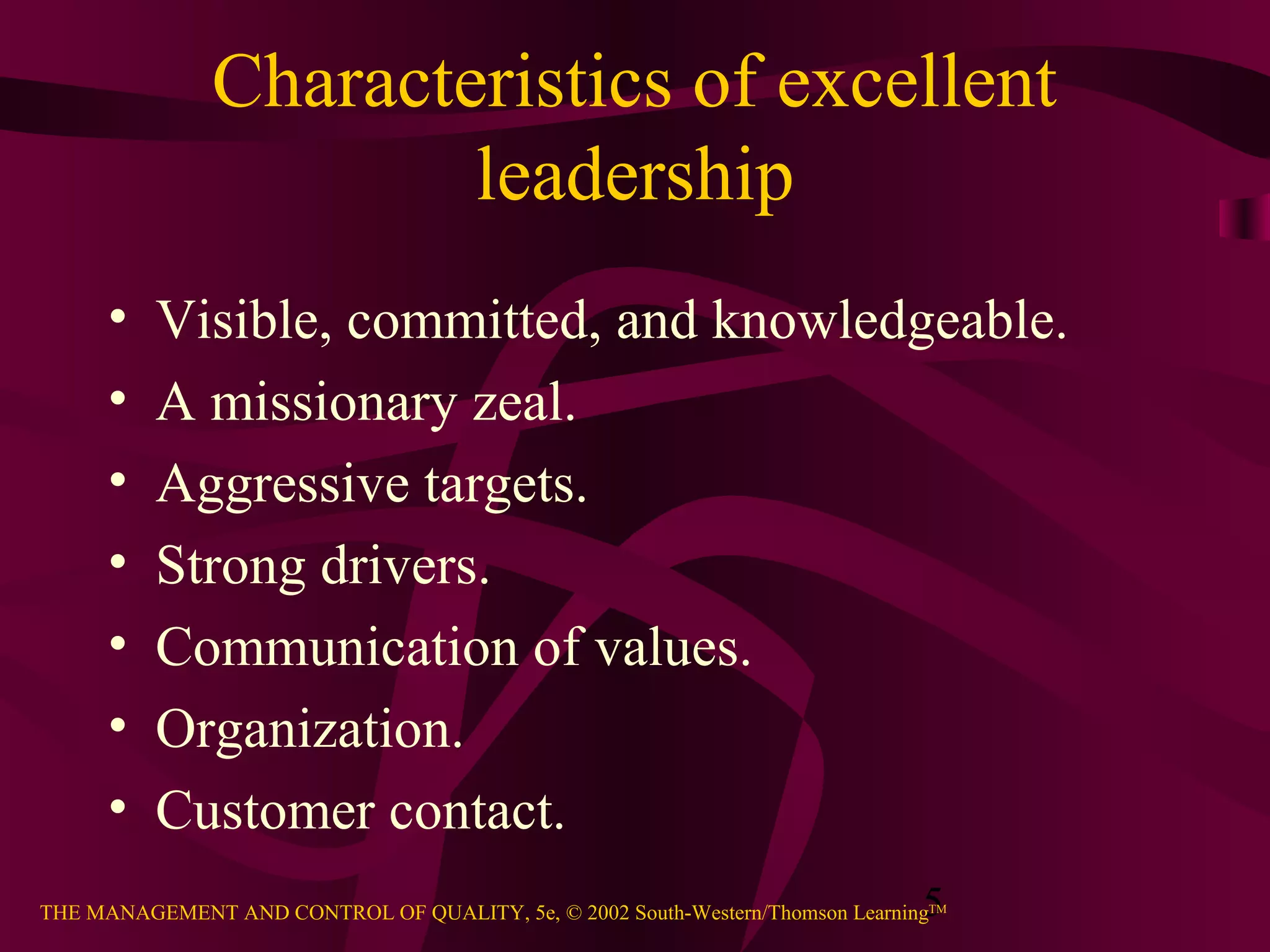
Characteristics of excellent
                       leadership
      •   Visible, committed, and knowledgeable.
      •   A missionary zeal.
      •   Aggressive targets.
      •   Strong drivers.
      •   Communication of values.
      •   Organization.
      •   Customer contact.
                                                                               5
THE MANAGEMENT AND CONTROL OF QUALITY, 5e, © 2002 South-Western/Thomson LearningTM
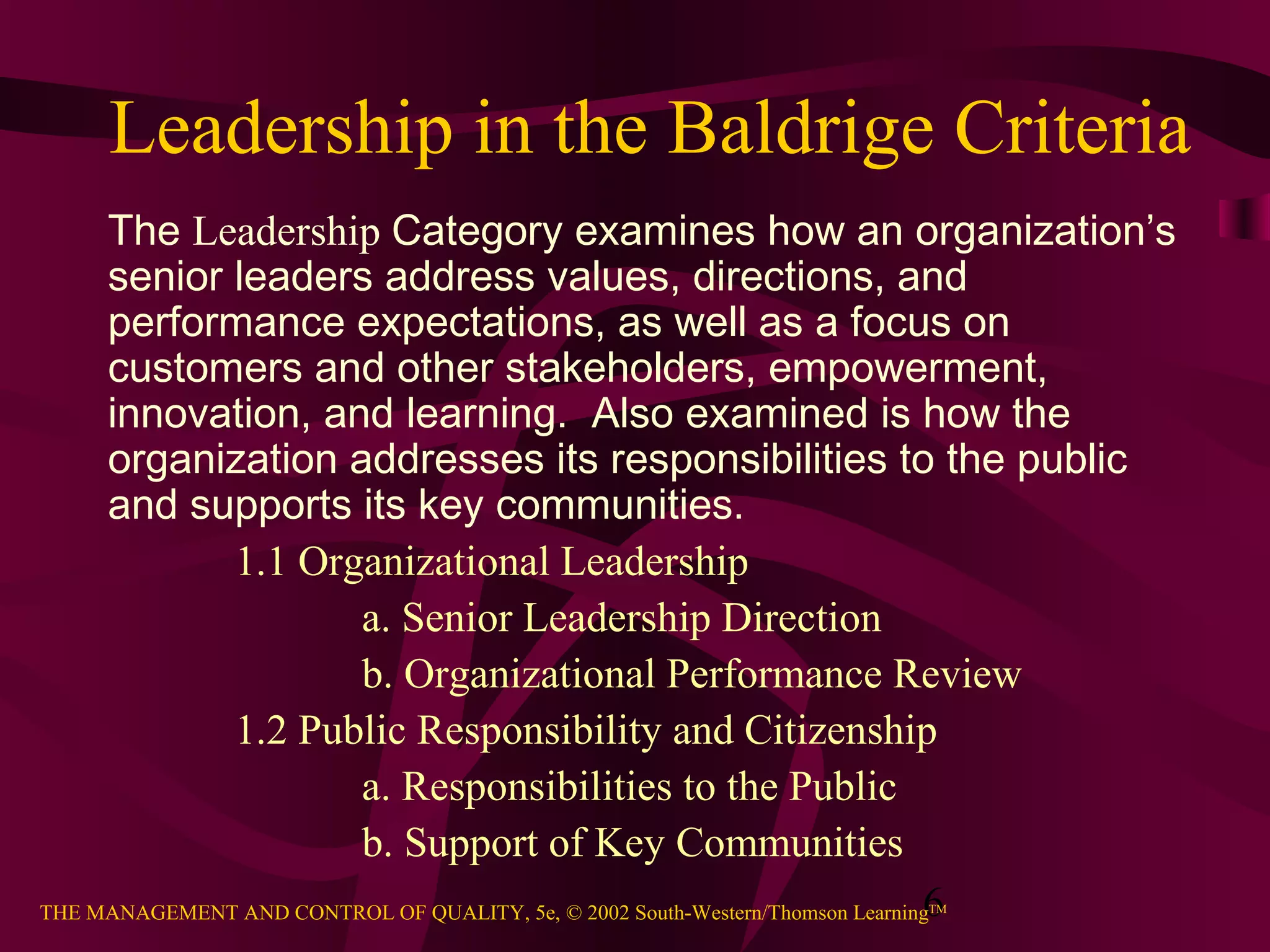
Leadership in the Baldrige Criteria
     The Leadership Category examines how an organization’s
     senior leaders address values, directions, and
     performance expectations, as well as a focus on
     customers and other stakeholders, empowerment,
     innovation, and learning. Also examined is how the
     organization addresses its responsibilities to the public
     and supports its key communities.
              1.1 Organizational Leadership
                        a. Senior Leadership Direction
                        b. Organizational Performance Review
              1.2 Public Responsibility and Citizenship
                        a. Responsibilities to the Public
                        b. Support of Key Communities
                                                                               6
THE MANAGEMENT AND CONTROL OF QUALITY, 5e, © 2002 South-Western/Thomson Learning
                                                              TM
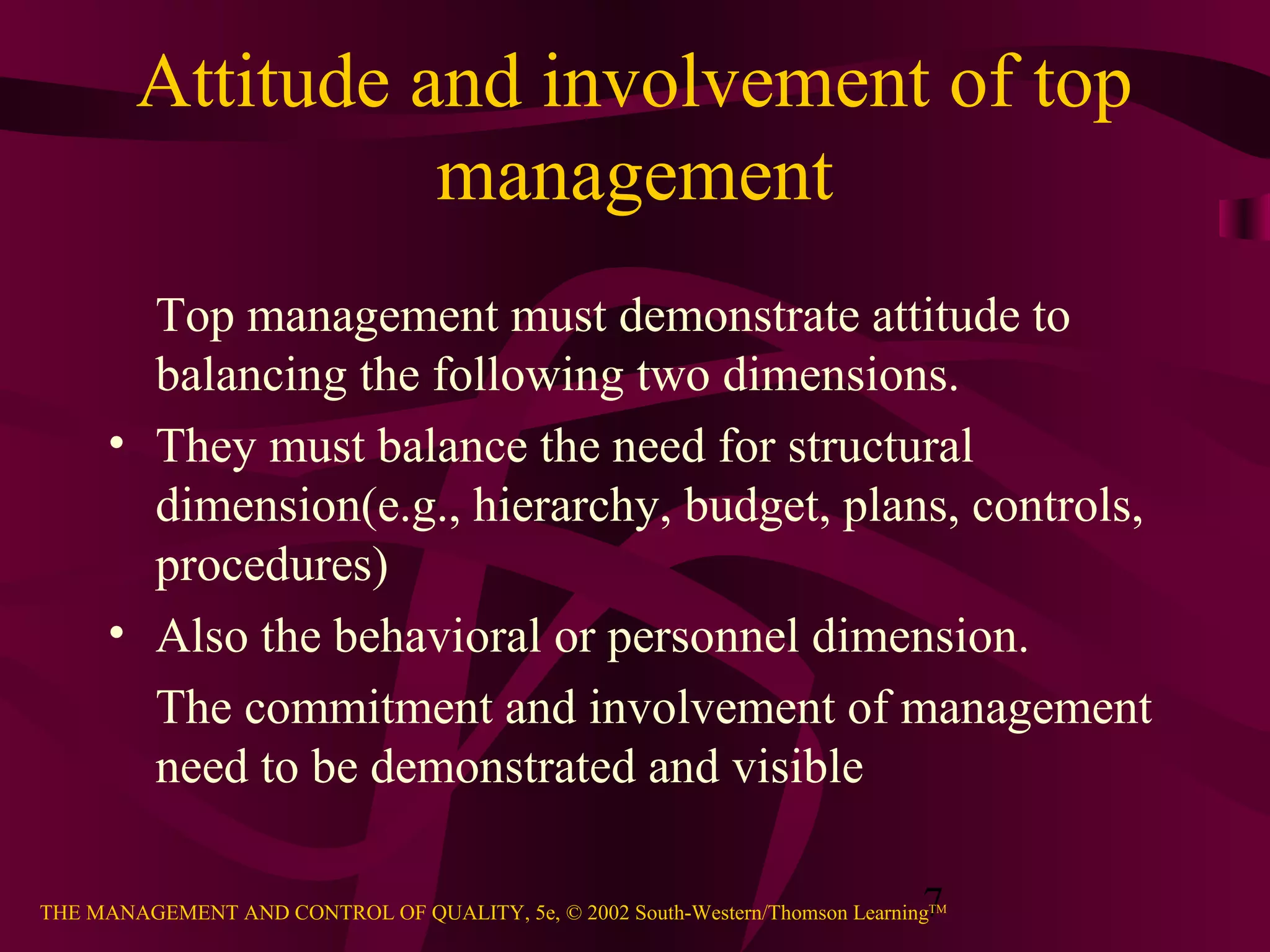
Attitude and involvement of top
                  management
        Top management must demonstrate attitude to
        balancing the following two dimensions.
      • They must balance the need for structural
        dimension(e.g., hierarchy, budget, plans, controls,
        procedures)
      • Also the behavioral or personnel dimension.
        The commitment and involvement of management
        need to be demonstrated and visible

                                                                               7
THE MANAGEMENT AND CONTROL OF QUALITY, 5e, © 2002 South-Western/Thomson LearningTM
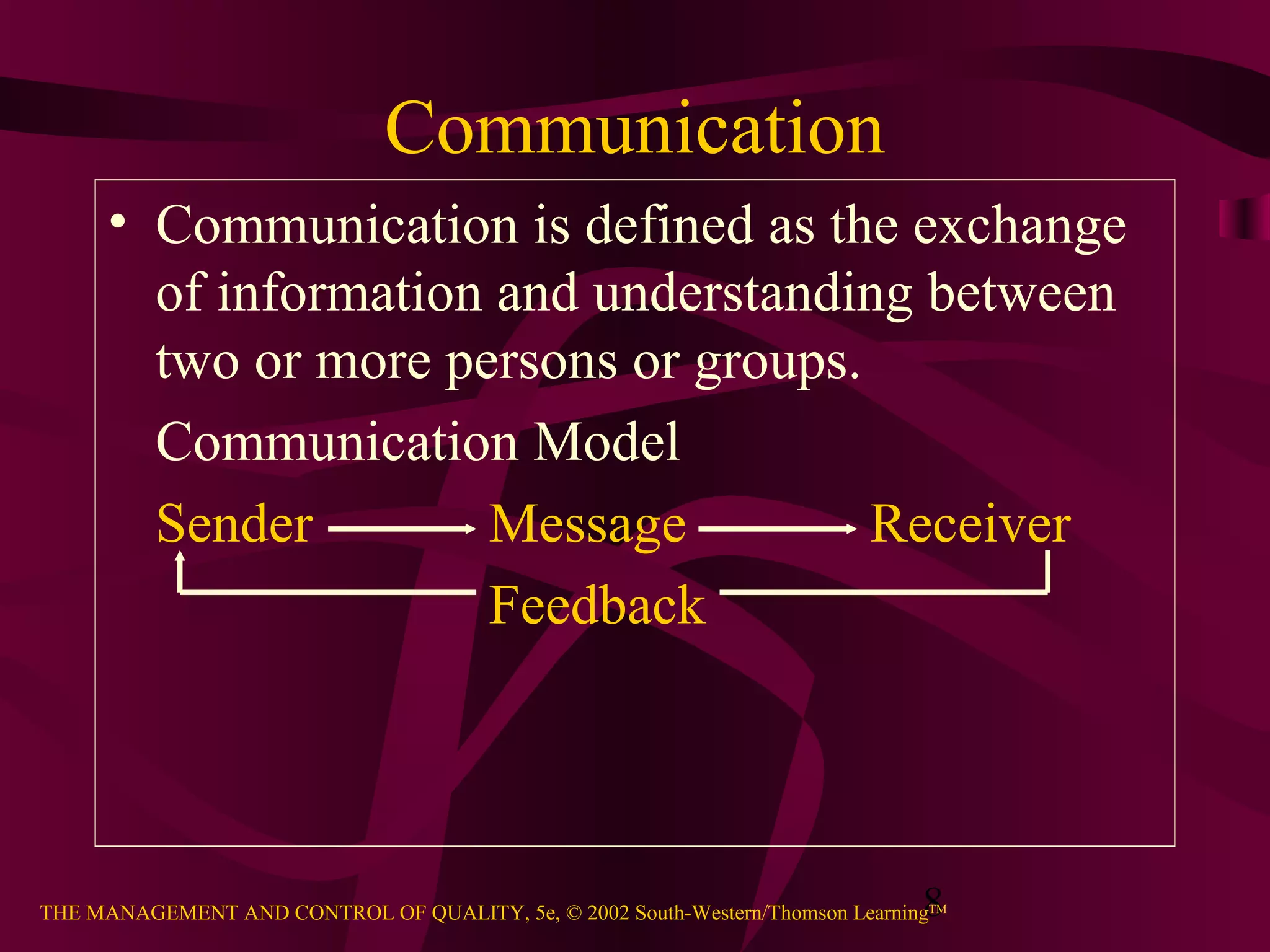
Communication
      • Communication is defined as the exchange
        of information and understanding between
        two or more persons or groups.
        Communication Model
        Sender        Message          Receiver
                      Feedback


                                                                               8
THE MANAGEMENT AND CONTROL OF QUALITY, 5e, © 2002 South-Western/Thomson LearningTM
The vehicles for communicating about quality
        are selected components of TQM system:

      • Training and development for both managers and
        employees.
      • Participation at all levels in establishing
        benchmarks and measures of process quality.
      • Empowerment of employees.
      • Quality assurance in all organization processes.
      • Human resource management system that
        facilitate contributions at all levels.

                                                                               9
THE MANAGEMENT AND CONTROL OF QUALITY, 5e, © 2002 South-Western/Thomson LearningTM
Culture
      • Culture is the pattern of shared belief and
        values that provide the members of an
        organization rules of behavior or
        accepted norms for conducting operation.
      • Corporate culture is a company’s value
        system and its collection of guiding
        principles
      • Cultural values often seen in mission and
        vision statements
      • Culture reflected by management policies
        and actions
                                                                               10
THE MANAGEMENT AND CONTROL OF QUALITY, 5e, © 2002 South-Western/Thomson LearningTM
Embedding a Culture of Quality
 • The basic vehicle for embedding an organizational
   culture is a teaching process in which desired behavior
   and activities are learned through experience, symbols,
   and explicit behavior.
 • Change can be accomplished, but it is difficult
 • Imposed change will be resisted
 • Full cooperation, commitment, and participation by all
   levels of management is essential
 • Change takes time
 • You might not get positive results at first
 • Change might go in unintended directions
                                                                               11
THE MANAGEMENT AND CONTROL OF QUALITY, 5e, © 2002 South-Western/Thomson LearningTM
Management System
           Quality management system are vehicles for change and
           should be designed to integrate all areas, not only the
           quality assurance department. They are directed toward
           achievement and commitment to purpose through four
           universal processes:
    (1)    The specialization of task responsibilities through structure
    (2)    The provision of information systems that enable employees
           to know what they need to do in order to achieve goals.
    (3)    The necessary achievement to result through action plans and
           projects
    (4)    Control through the establishment of benchmarks, standards,
           and feedback.


                                                                               12
THE MANAGEMENT AND CONTROL OF QUALITY, 5e, © 2002 South-Western/Thomson LearningTM
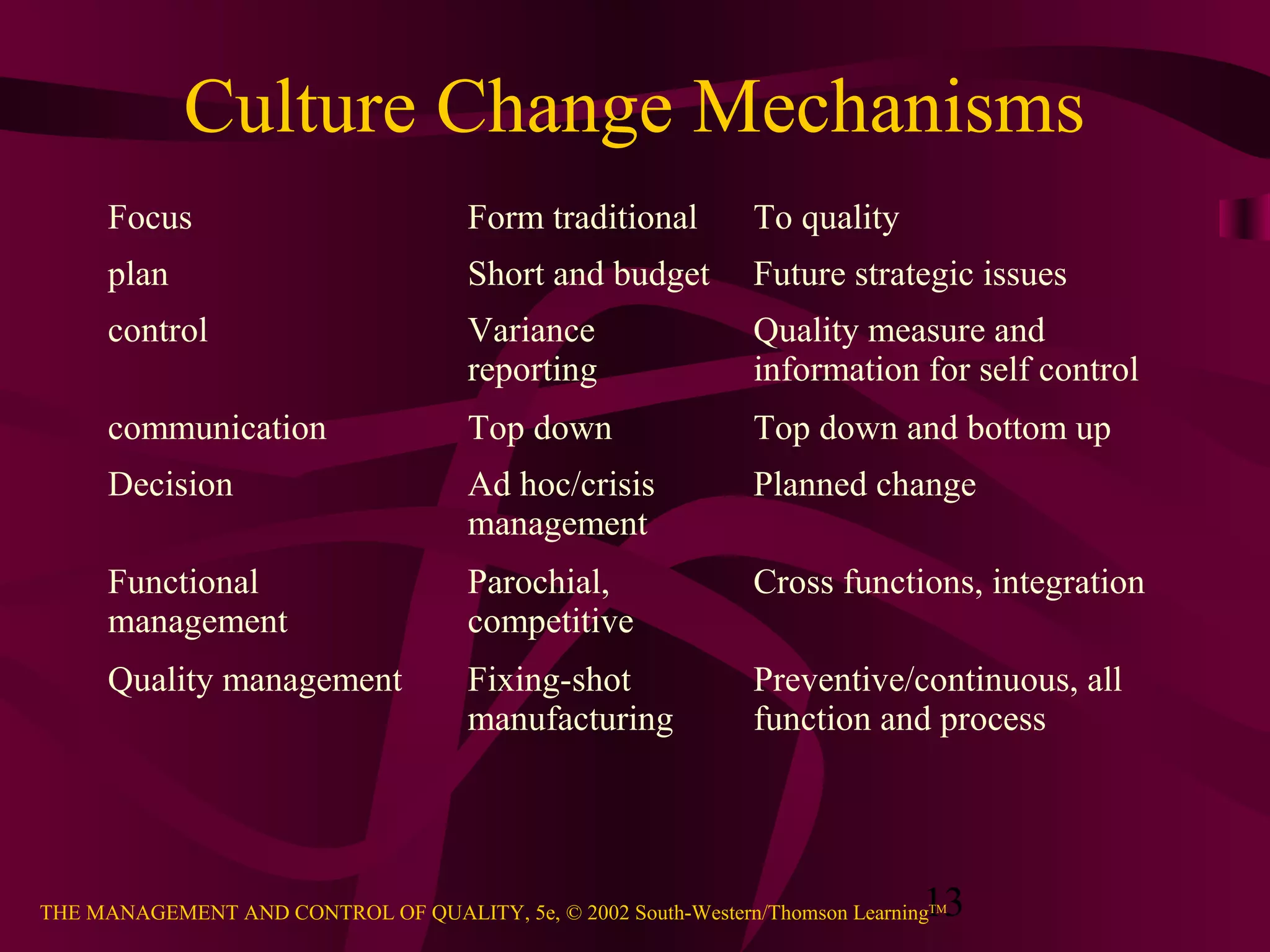
Culture Change Mechanisms
      Focus                           Form traditional          To quality
      plan                            Short and budget          Future strategic issues
      control                         Variance                  Quality measure and
                                      reporting                 information for self control
      communication                   Top down                  Top down and bottom up
      Decision                        Ad hoc/crisis             Planned change
                                      management
      Functional                      Parochial,                Cross functions, integration
      management                      competitive
      Quality management              Fixing-shot               Preventive/continuous, all
                                      manufacturing             function and process


                                                                               13
THE MANAGEMENT AND CONTROL OF QUALITY, 5e, © 2002 South-Western/Thomson LearningTM
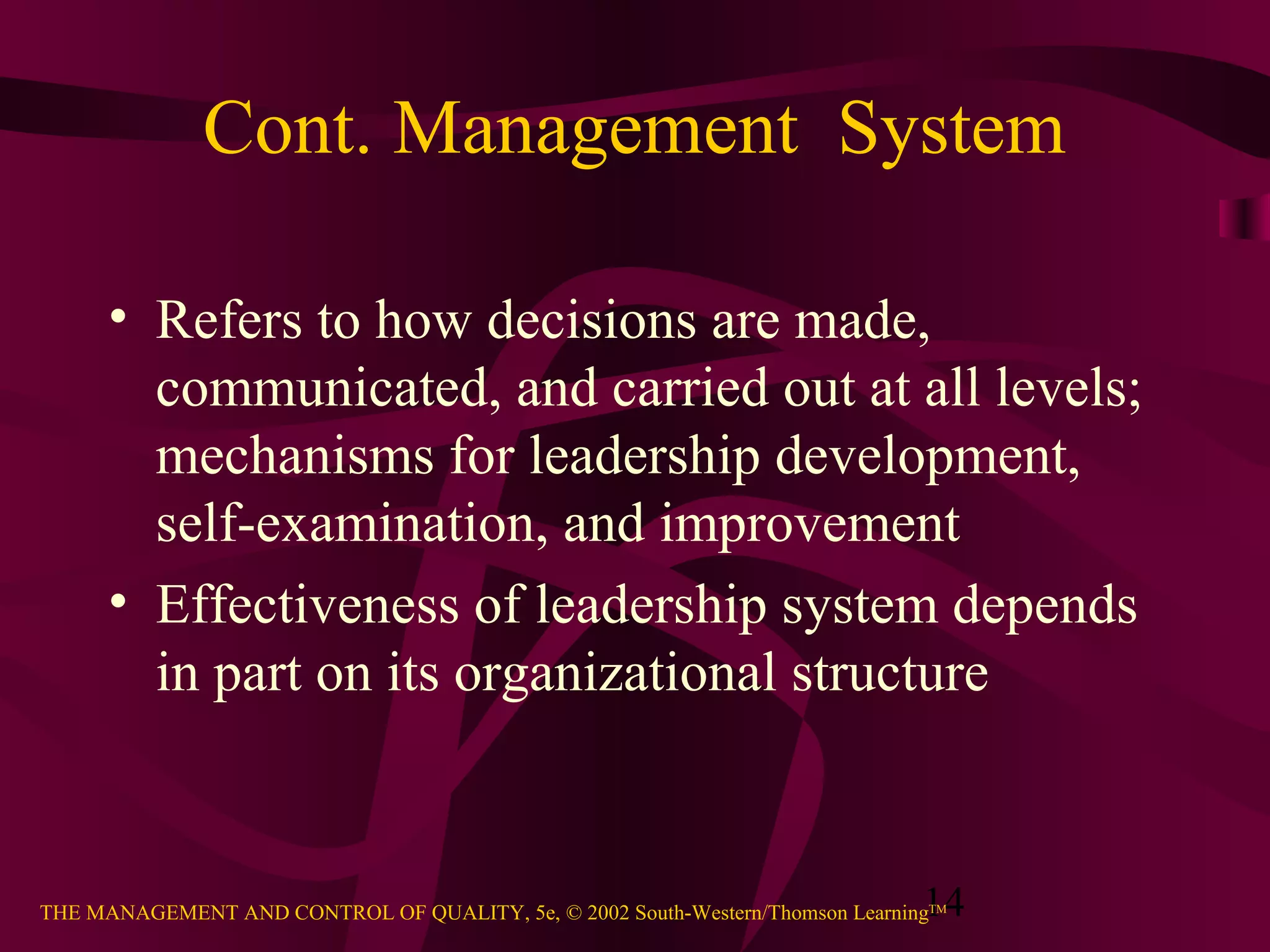
Cont. Management System

      • Refers to how decisions are made,
        communicated, and carried out at all levels;
        mechanisms for leadership development,
        self-examination, and improvement
      • Effectiveness of leadership system depends
        in part on its organizational structure


                                                                               14
THE MANAGEMENT AND CONTROL OF QUALITY, 5e, © 2002 South-Western/Thomson LearningTM
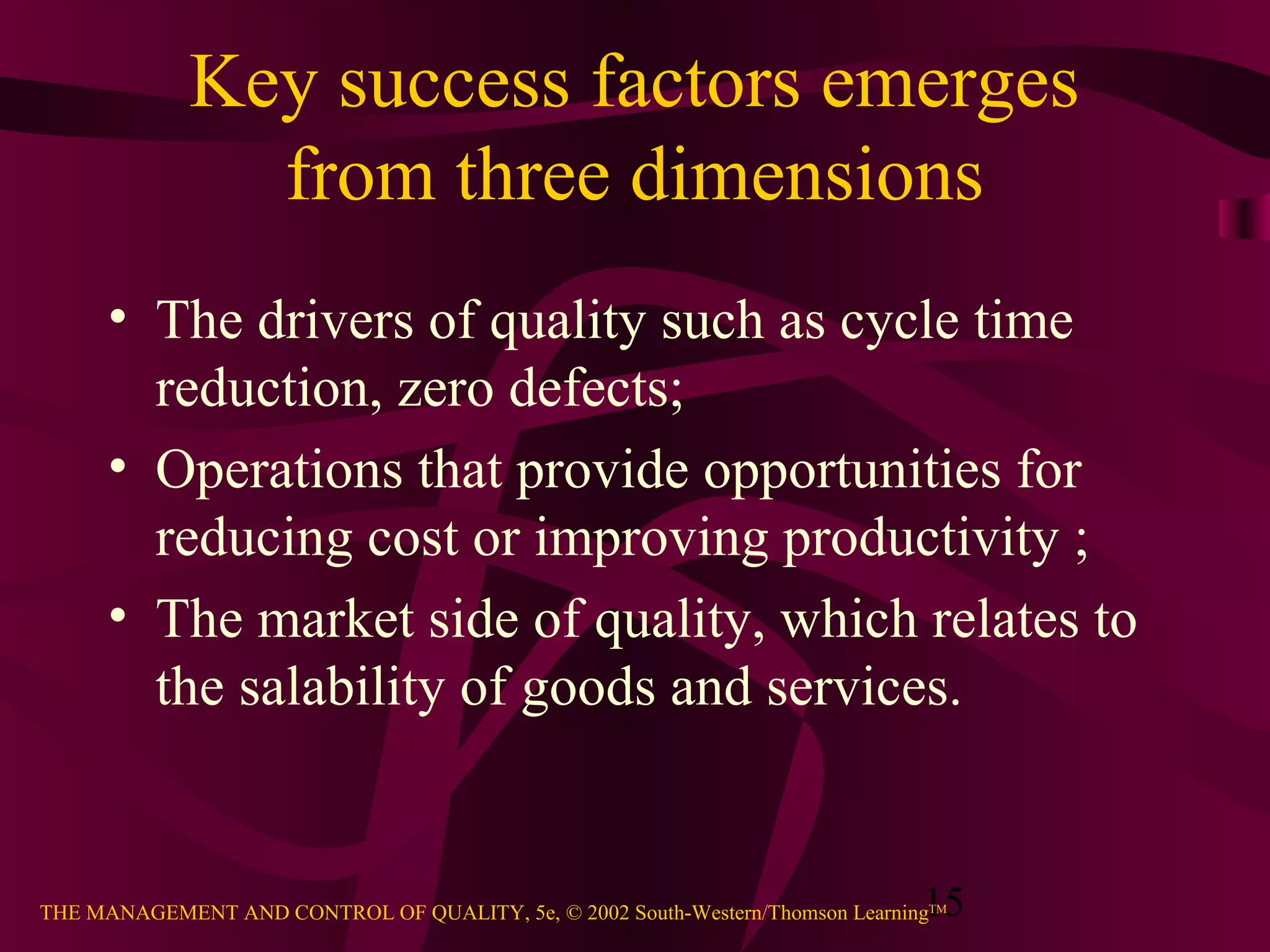
Key success factors emerges
               from three dimensions
      • The drivers of quality such as cycle time
        reduction, zero defects;
      • Operations that provide opportunities for
        reducing cost or improving productivity ;
      • The market side of quality, which relates to
        the salability of goods and services.


                                                                               15
THE MANAGEMENT AND CONTROL OF QUALITY, 5e, © 2002 South-Western/Thomson LearningTM
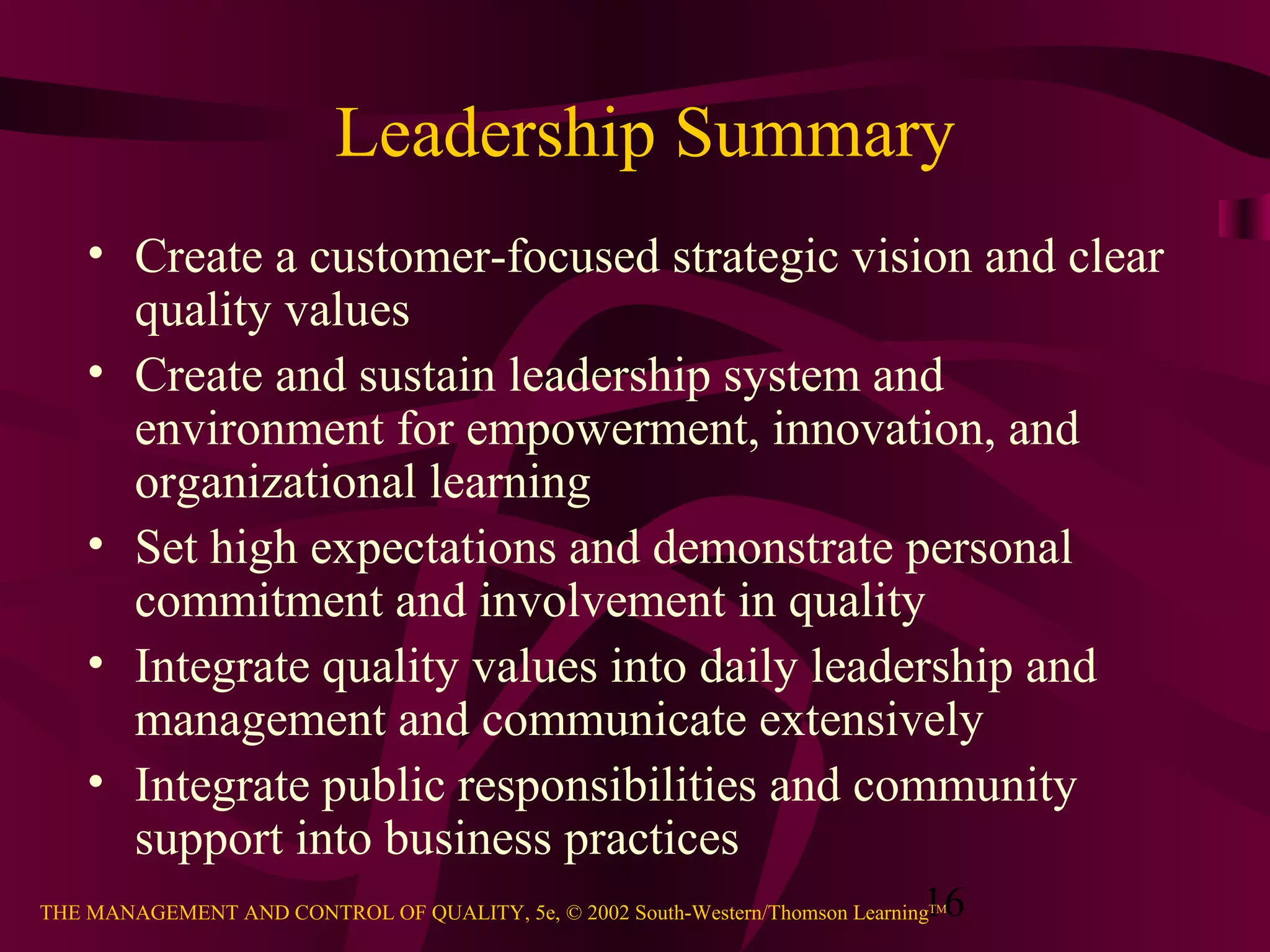
Leadership Summary
    • Create a customer-focused strategic vision and clear
      quality values
    • Create and sustain leadership system and
      environment for empowerment, innovation, and
      organizational learning
    • Set high expectations and demonstrate personal
      commitment and involvement in quality
    • Integrate quality values into daily leadership and
      management and communicate extensively
    • Integrate public responsibilities and community
      support into business practices
                                                                               16
THE MANAGEMENT AND CONTROL OF QUALITY, 5e, © 2002 South-Western/Thomson LearningTM

Tqm ch 02

  • 1.
    Leadership For TQM THEMANAGEMENT AND CONTROL OF QUALITY, 5e, © 2002 South-Western/Thomson LearningTM 1
  • 2.
    Leadership • The ability to positively influence people and systems to have a meaningful impact and achieve results. • Leadership is a prerequisite to all strategy and action plans, it cannot be delegated. 2 THE MANAGEMENT AND CONTROL OF QUALITY, 5e, © 2002 South-Western/Thomson LearningTM
  • 3.
    Strategic Planning • The process of envisioning an organization’s future and developing the necessary procedures and operations to achieve that future. 3 THE MANAGEMENT AND CONTROL OF QUALITY, 5e, © 2002 South-Western/Thomson LearningTM
  • 4.
    The Baldrige “LeadershipTriad” Strategic Planning Operations Leadership Customer and Market Focus 4 THE MANAGEMENT AND CONTROL OF QUALITY, 5e, © 2002 South-Western/Thomson LearningTM
  • 5.
    Characteristics of excellent leadership • Visible, committed, and knowledgeable. • A missionary zeal. • Aggressive targets. • Strong drivers. • Communication of values. • Organization. • Customer contact. 5 THE MANAGEMENT AND CONTROL OF QUALITY, 5e, © 2002 South-Western/Thomson LearningTM
  • 6.
    Leadership in theBaldrige Criteria The Leadership Category examines how an organization’s senior leaders address values, directions, and performance expectations, as well as a focus on customers and other stakeholders, empowerment, innovation, and learning. Also examined is how the organization addresses its responsibilities to the public and supports its key communities. 1.1 Organizational Leadership a. Senior Leadership Direction b. Organizational Performance Review 1.2 Public Responsibility and Citizenship a. Responsibilities to the Public b. Support of Key Communities 6 THE MANAGEMENT AND CONTROL OF QUALITY, 5e, © 2002 South-Western/Thomson Learning TM
  • 7.
    Attitude and involvementof top management Top management must demonstrate attitude to balancing the following two dimensions. • They must balance the need for structural dimension(e.g., hierarchy, budget, plans, controls, procedures) • Also the behavioral or personnel dimension. The commitment and involvement of management need to be demonstrated and visible 7 THE MANAGEMENT AND CONTROL OF QUALITY, 5e, © 2002 South-Western/Thomson LearningTM
  • 8.
    Communication • Communication is defined as the exchange of information and understanding between two or more persons or groups. Communication Model Sender Message Receiver Feedback 8 THE MANAGEMENT AND CONTROL OF QUALITY, 5e, © 2002 South-Western/Thomson LearningTM
  • 9.
    The vehicles forcommunicating about quality are selected components of TQM system: • Training and development for both managers and employees. • Participation at all levels in establishing benchmarks and measures of process quality. • Empowerment of employees. • Quality assurance in all organization processes. • Human resource management system that facilitate contributions at all levels. 9 THE MANAGEMENT AND CONTROL OF QUALITY, 5e, © 2002 South-Western/Thomson LearningTM
  • 10.
    Culture • Culture is the pattern of shared belief and values that provide the members of an organization rules of behavior or accepted norms for conducting operation. • Corporate culture is a company’s value system and its collection of guiding principles • Cultural values often seen in mission and vision statements • Culture reflected by management policies and actions 10 THE MANAGEMENT AND CONTROL OF QUALITY, 5e, © 2002 South-Western/Thomson LearningTM
  • 11.
    Embedding a Cultureof Quality • The basic vehicle for embedding an organizational culture is a teaching process in which desired behavior and activities are learned through experience, symbols, and explicit behavior. • Change can be accomplished, but it is difficult • Imposed change will be resisted • Full cooperation, commitment, and participation by all levels of management is essential • Change takes time • You might not get positive results at first • Change might go in unintended directions 11 THE MANAGEMENT AND CONTROL OF QUALITY, 5e, © 2002 South-Western/Thomson LearningTM
  • 12.
    Management System Quality management system are vehicles for change and should be designed to integrate all areas, not only the quality assurance department. They are directed toward achievement and commitment to purpose through four universal processes: (1) The specialization of task responsibilities through structure (2) The provision of information systems that enable employees to know what they need to do in order to achieve goals. (3) The necessary achievement to result through action plans and projects (4) Control through the establishment of benchmarks, standards, and feedback. 12 THE MANAGEMENT AND CONTROL OF QUALITY, 5e, © 2002 South-Western/Thomson LearningTM
  • 13.
    Culture Change Mechanisms Focus Form traditional To quality plan Short and budget Future strategic issues control Variance Quality measure and reporting information for self control communication Top down Top down and bottom up Decision Ad hoc/crisis Planned change management Functional Parochial, Cross functions, integration management competitive Quality management Fixing-shot Preventive/continuous, all manufacturing function and process 13 THE MANAGEMENT AND CONTROL OF QUALITY, 5e, © 2002 South-Western/Thomson LearningTM
  • 14.
    Cont. Management System • Refers to how decisions are made, communicated, and carried out at all levels; mechanisms for leadership development, self-examination, and improvement • Effectiveness of leadership system depends in part on its organizational structure 14 THE MANAGEMENT AND CONTROL OF QUALITY, 5e, © 2002 South-Western/Thomson LearningTM
  • 15.
    Key success factorsemerges from three dimensions • The drivers of quality such as cycle time reduction, zero defects; • Operations that provide opportunities for reducing cost or improving productivity ; • The market side of quality, which relates to the salability of goods and services. 15 THE MANAGEMENT AND CONTROL OF QUALITY, 5e, © 2002 South-Western/Thomson LearningTM
  • 16.
    Leadership Summary • Create a customer-focused strategic vision and clear quality values • Create and sustain leadership system and environment for empowerment, innovation, and organizational learning • Set high expectations and demonstrate personal commitment and involvement in quality • Integrate quality values into daily leadership and management and communicate extensively • Integrate public responsibilities and community support into business practices 16 THE MANAGEMENT AND CONTROL OF QUALITY, 5e, © 2002 South-Western/Thomson LearningTM

Editor's Notes

  • #15 CRI Steering committee of 4 sets directions, frequent interaction with employees, review performance daily, formal monthly evaluations and OFIs