Chapter 2Chapter 2
Facility ManagementFacility Management
Facility ManagersFacility Managers
 A facility managerA facility manager’s most important’s most important
constituents are the customers and employees.constituents are the customers and employees.
 Facility managers must report to numerousFacility managers must report to numerous
stakeholders.stakeholders.
 A. Politicians,A. Politicians,
 B. Independent partiesB. Independent parties
What is Facility Management?What is Facility Management?
 Managing sport and public assembly facilitiesManaging sport and public assembly facilities
is often referred to as facility management,is often referred to as facility management,
and the people who perform the task/duties areand the people who perform the task/duties are
called facility managers.called facility managers.
 The art and science of managing a facility toThe art and science of managing a facility to
help meet the facilityhelp meet the facility’s objectives, goals, and’s objectives, goals, and
mission.mission.
What is Facility Management?What is Facility Management?
 Facility management entails a broad array ofFacility management entails a broad array of
disciplines including, but not limited to:disciplines including, but not limited to:
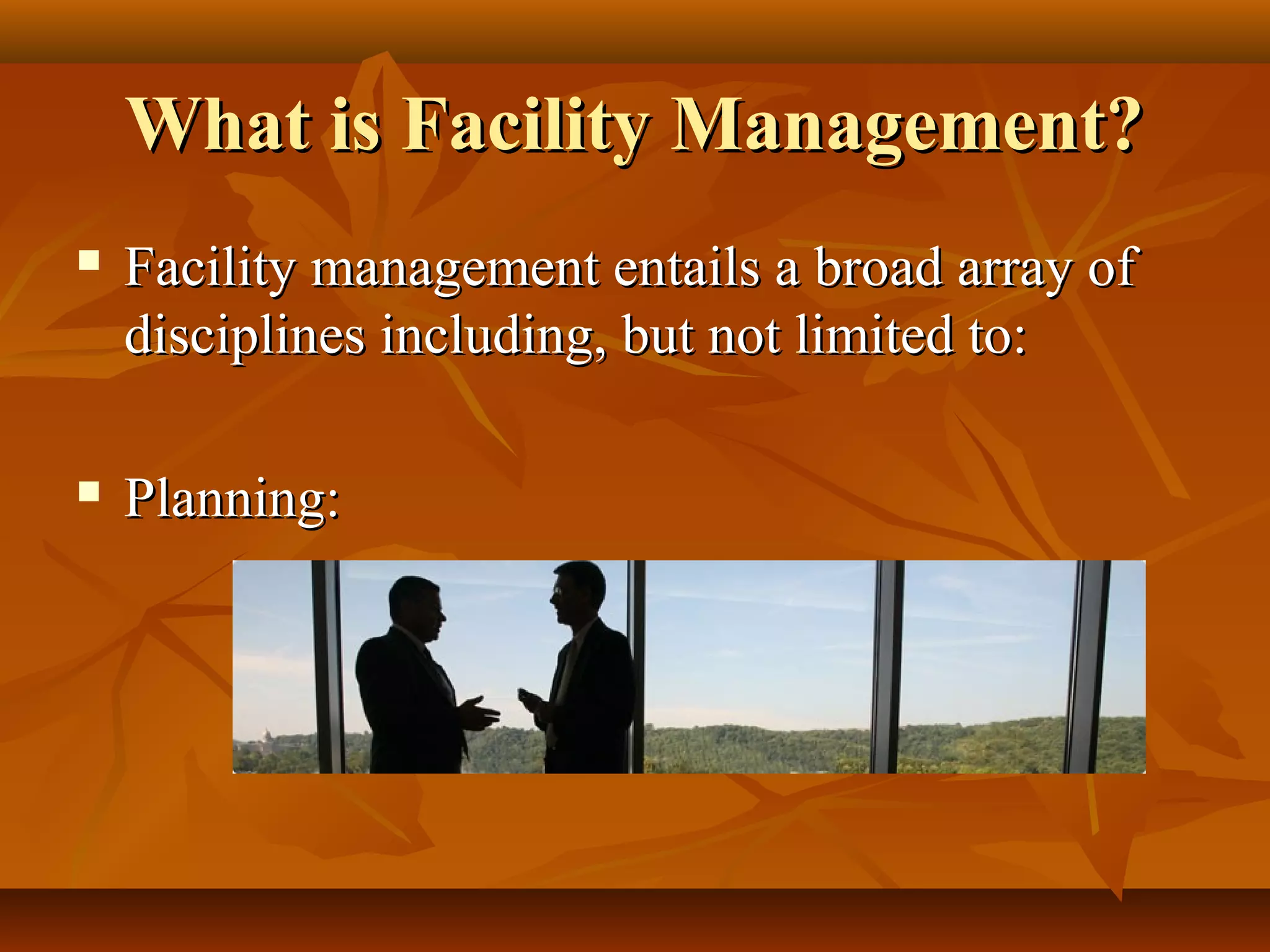
 Planning:Planning:
What is Facility Management?What is Facility Management?
 DesigningDesigning
What is Facility Management?What is Facility Management?
 Leasing:Leasing:
What is Facility Management?What is Facility Management?
 Space Planning:Space Planning:
What is Facility Management?What is Facility Management?
 Project Management:Project Management:
What is Facility Management?What is Facility Management?
 Capital ManagementCapital Management
What is Facility Management?What is Facility Management?
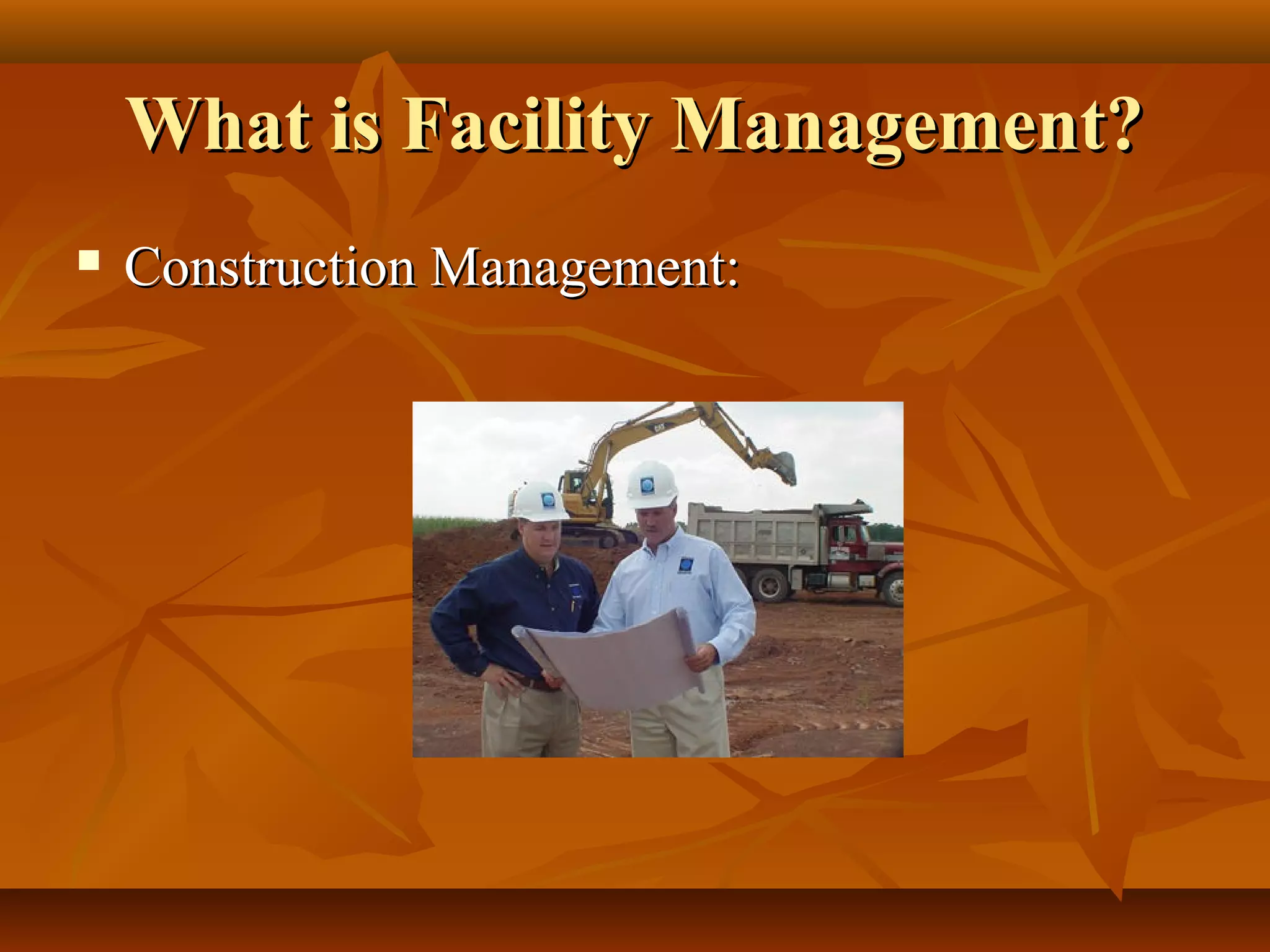
 Construction Management:Construction Management:
What is Facility Management?What is Facility Management?
 Property Management:Property Management:
What is Facility Management?What is Facility Management?
 Facility MarketingFacility Marketing
What is Facility Management?What is Facility Management?
 Building and Operation Management:Building and Operation Management:
What is Facility Management?What is Facility Management?
 Planning:Planning:
What is Facility Management?What is Facility Management?
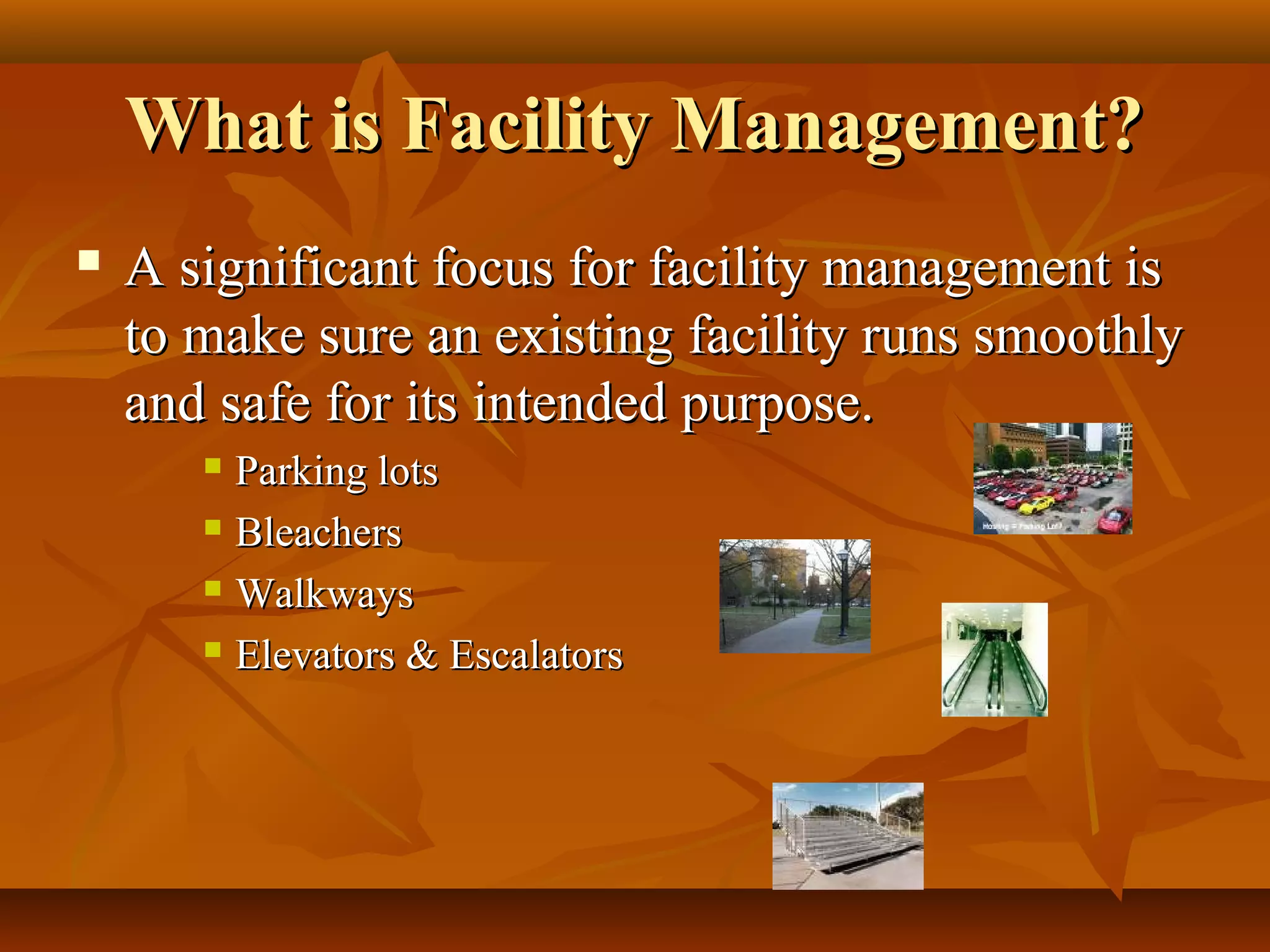
 A significant focus for facility management isA significant focus for facility management is
to make sure an existing facility runs smoothlyto make sure an existing facility runs smoothly
and safe for its intended purpose.and safe for its intended purpose.
 Parking lotsParking lots
 BleachersBleachers
 WalkwaysWalkways
 Elevators & EscalatorsElevators & Escalators
Facility ManagementFacility Management
 SummarySummary
 Facility management entails every aspect ofFacility management entails every aspect of
making sure a building is operating efficientlymaking sure a building is operating efficiently
in terms of safety, revenue production, tenantin terms of safety, revenue production, tenant
satisfaction, and preventive maintenance.satisfaction, and preventive maintenance.
The Facility ManagerThe Facility Manager
 Is the person responsible for coordinating allIs the person responsible for coordinating all
the employees and entities involved in thethe employees and entities involved in the
facility to ensure that they work on behalf offacility to ensure that they work on behalf of
the facility and help meet its short and longthe facility and help meet its short and long
term goals and objectives.term goals and objectives.
The Facility ManagerThe Facility Manager
 In a small facility, the facility owner may beIn a small facility, the facility owner may be
the manager and can be responsible forthe manager and can be responsible for
opening and closing the facility as well asopening and closing the facility as well as
painting the walls and cleaning the rest rooms.painting the walls and cleaning the rest rooms.
The Facility ManagerThe Facility Manager
 For a large facility may have several hundredFor a large facility may have several hundred
full – and part-time employees handlingfull – and part-time employees handling
everything, from cleanup crews to ushers andeverything, from cleanup crews to ushers and
ticket takers.ticket takers.
 Because of the diverse duties each facilityBecause of the diverse duties each facility
manager faces, facility management can bemanager faces, facility management can be
considered both an art and a science.considered both an art and a science.
ResponsibilitiesResponsibilities
According to the International Facility ManagementAccording to the International Facility Management
Association (IFMA), facility managers are the critical elementAssociation (IFMA), facility managers are the critical element
to implement any facility management plan and they need toto implement any facility management plan and they need to
understand and appreciate several distinct functions including:understand and appreciate several distinct functions including:
 planning-both long and short-term;planning-both long and short-term;
 financial forecasting;financial forecasting;
 property acquisition and disposal;property acquisition and disposal;
 specifying work responsibility and space utilization;specifying work responsibility and space utilization;
 architectural and engineering planning and management;architectural and engineering planning and management;
 managing all phases of construction and renovation work;managing all phases of construction and renovation work;
 managing maintenance systems and protocols;managing maintenance systems and protocols;
 managing all operations from administrative functions tomanaging all operations from administrative functions to
security protocols.security protocols.
Management and OrganizationManagement and Organization
 Planning all facility activitiesPlanning all facility activities
 Organizing all personnel in appropriate departmentsOrganizing all personnel in appropriate departments
that optimize effectivenessthat optimize effectiveness
 Develop short intermediate and short terms plansDevelop short intermediate and short terms plans
 Develop an inventory of available space and manageDevelop an inventory of available space and manage
that spacethat space
 Have a strong appreciation and understanding ofHave a strong appreciation and understanding of
building design/planning, architectural design,building design/planning, architectural design,
engineering design, code/zoning complianceengineering design, code/zoning compliance
 Managing furniture and equipment for such area asManaging furniture and equipment for such area as
concessions, locker rooms, and press boxconcessions, locker rooms, and press box
Management and OrganizationManagement and Organization
 Focus significant effort on budgeting, accounting, andFocus significant effort on budgeting, accounting, and
economic forecastingeconomic forecasting
 Managing construction projects or moving from oneManaging construction projects or moving from one
area of facility to anotherarea of facility to another
 Spend significant time on operations, maintenance,Spend significant time on operations, maintenance,
and repairsand repairs
 9/11, deal with security and life safety concerns9/11, deal with security and life safety concerns
 Supervise general administrative departmentSupervise general administrative department
FACILITY MANAGEMENTFACILITY MANAGEMENT
When surveyed, facility mangers haveWhen surveyed, facility mangers have
highlighted that maintenance in fact absorbshighlighted that maintenance in fact absorbs
the greatest amount of their time (17%)the greatest amount of their time (17%)
followed by space management (14%), interiorfollowed by space management (14%), interior
design (11%), and budgeting and forecastingdesign (11%), and budgeting and forecasting
(9%).(9%).
ConstituentsConstituents
 CustomersCustomers
 promoterspromoters
 TenantsTenants
 Ticket buyersTicket buyers
 Attending the eventAttending the event
 Make sure that people can attend events withinMake sure that people can attend events within
the facility in a safe and secure manner.the facility in a safe and secure manner.
ConstituentsConstituents
 Internal ConstituentsInternal Constituents
 Boards/ownersBoards/owners
 EmployeesEmployees
 CoworkersCoworkers
 Interest in the facilityInterest in the facility
 Mission and meets its goalsMission and meets its goals
 MotivatingMotivating
 Decisions makingDecisions making
ConstituentsConstituents
 External ConstituentsExternal Constituents
 BankersBankers ExecutivesExecutives
 PoliticiansPoliticians Others/influence the facilityOthers/influence the facility
 MediaMedia
 The facility manager must reach beyond theThe facility manager must reach beyond the
facility to those who can exert influence on thefacility to those who can exert influence on the
facility.facility.
Managerial FunctionsManagerial Functions
 MissionMission
 The overall ideal the facility wants to achieve;The overall ideal the facility wants to achieve;
it focuses on general terms such asit focuses on general terms such as
profitability, quality service, and workplace.profitability, quality service, and workplace.
 It is impossible to plan without knowing what is toIt is impossible to plan without knowing what is to
be accomplished.be accomplished.
 It should states the end result envisioned by theIt should states the end result envisioned by the
facilityfacility ‘s owner and encompasses the goals and‘s owner and encompasses the goals and
objectives critical for the facility’s success.objectives critical for the facility’s success.
Managerial FunctionsManagerial Functions
 PlanningPlanning
 Focuses on setting goals and objectives andFocuses on setting goals and objectives and
then developing the plan to reach those goalsthen developing the plan to reach those goals
and objectives.and objectives.
 Short and long terms goalsShort and long terms goals
 What to do, when to do it and how to do itWhat to do, when to do it and how to do it
 Blueprint for the futureBlueprint for the future
Managerial FunctionsManagerial Functions
 PlanningPlanning
 Strategic plans –Strategic plans –
 are designed to help achieve the highest-levelare designed to help achieve the highest-level
goals and objectives for the facility; that is whygoals and objectives for the facility; that is why
they are often called master plan.they are often called master plan.
Managerial FunctionsManagerial Functions
 Operational plans –Operational plans –
 Are more detailed and are used to help carry outAre more detailed and are used to help carry out
the strategic plans. Operational plans can includethe strategic plans. Operational plans can include
single-use operational plans that may apply to asingle-use operational plans that may apply to a
one-time event.one-time event.
Managerial FunctionsManagerial Functions
 Functional plan –Functional plan –
 Focus on what operational plans are designed toFocus on what operational plans are designed to
accomplish; marketing plan and safety plans areaccomplish; marketing plan and safety plans are
examples.examples.
Managerial FunctionsManagerial Functions
 Contingency plan –Contingency plan –
 Are plans that can be used if one of the other plansAre plans that can be used if one of the other plans
fail and the facility has to pursue another strategy.fail and the facility has to pursue another strategy.
Managerial FunctionsManagerial Functions
 Goals and ObjectivesGoals and Objectives
 Goals are a specific directive and objectivesGoals are a specific directive and objectives
focuses on how to reach a goal.focuses on how to reach a goal.
Managerial FunctionsManagerial Functions
 Strategic goals –Strategic goals –
 Are set by the highest-level managers and areAre set by the highest-level managers and are
introduced to affect and empower the overallintroduced to affect and empower the overall
facility for the log run.facility for the log run.
 Often focus on broader aspect such as marketOften focus on broader aspect such as market
share, profitability, industry leader position, orshare, profitability, industry leader position, or
changes in the facility.changes in the facility.
Managerial FunctionsManagerial Functions
 Tactical goals –Tactical goals –
 Are often introduced by midlevel managers andAre often introduced by midlevel managers and
focus on what needs to be accomplished to reachfocus on what needs to be accomplished to reach
the strategic goals.the strategic goals.
Managerial FunctionsManagerial Functions
 Operational goals –Operational goals –
 Are set by low-level managers and are more short-Are set by low-level managers and are more short-
termterm
Managerial FunctionsManagerial Functions
 Management by Objective (MBO)Management by Objective (MBO)
 Managers and employees can work together toManagers and employees can work together to
develop realistic and achievable objectives thatdevelop realistic and achievable objectives that
make both parties happymake both parties happy
Managerial FunctionsManagerial Functions
 Short-Term PlanningShort-Term Planning
 Typically cover less than one year and focus onTypically cover less than one year and focus on
activities that may have a sense of emergency.activities that may have a sense of emergency.
 Long –Term PlanningLong –Term Planning
 Focus on long-term projections, which can beFocus on long-term projections, which can be
influenced by political, geographical, andinfluenced by political, geographical, and
economic trends.economic trends.
Managerial FunctionsManagerial Functions
 Business PlanBusiness Plan
 Examines the product, marketing, legal,Examines the product, marketing, legal,
financial, and general business outlook for afinancial, and general business outlook for a
facility.facility.
 The road map for any facility that helpsThe road map for any facility that helps
identify the product and market as well as theidentify the product and market as well as the
legal and financial outlook.legal and financial outlook.
Managerial FunctionsManagerial Functions
 Building load capacityBuilding load capacity
 How much weight the roof or rigging can support.How much weight the roof or rigging can support.
 Current economic conditionsCurrent economic conditions
 Demographic breakdown of expected fansDemographic breakdown of expected fans
Managerial FunctionsManagerial Functions
 OrganizingOrganizing
 Refer to a blend of human resource management andRefer to a blend of human resource management and
leadership.leadership.
 One of the most difficult tasks for a manager is to assign theOne of the most difficult tasks for a manager is to assign the
right person with the right skills and interests to a given job.right person with the right skills and interests to a given job.
Organizational flowchartOrganizational flowchart
Facility Owner(s)
Operation’s Professional services Marketing
The flowchart shows who reports to whom and what lines ofThe flowchart shows who reports to whom and what lines of
managerial/supervisory responsibility are.managerial/supervisory responsibility are.
Managerial FunctionsManagerial Functions
 ImplementingImplementing
 Refers to executing goals and objectives withRefers to executing goals and objectives with
the appropriate personnel.the appropriate personnel.
 ControllingControlling
 Involves evaluating the results for individualsInvolves evaluating the results for individuals
who report to the manager and providingwho report to the manager and providing
appropriate feedback, whether positive orappropriate feedback, whether positive or
negative.negative.
Space Planning and AllocationSpace Planning and Allocation
 Developing an inventory of available spaceDeveloping an inventory of available space
 Allocating available spaceAllocating available space
 Managing existing spaceManaging existing space
 Forecasting the possible future demand forForecasting the possible future demand for
spacespace
Architectural/Engineering PlanningArchitectural/Engineering Planning
and Designand Design
 All facets of building design and planningAll facets of building design and planning
 Architectural design of the buildingArchitectural design of the building
 Engineering design of building systemsEngineering design of building systems
 Estimating construction costsEstimating construction costs
 Planning future maintenance needsPlanning future maintenance needs
 Planning for disasters that might befall the facilityPlanning for disasters that might befall the facility
 Procuring all necessary code/zoning complianceProcuring all necessary code/zoning compliance
 Documenting all phases of the design and estimating processDocumenting all phases of the design and estimating process
 Planning for renovations and future construction projectsPlanning for renovations and future construction projects
Workplace Planning, Allocation, andWorkplace Planning, Allocation, and
ManagementManagement
 Workplace planning and designWorkplace planning and design
 Furniture, equipment, and furnishingFurniture, equipment, and furnishing
specifications, acquisition, and managementspecifications, acquisition, and management
 Analyzing maintenance needs and establishingAnalyzing maintenance needs and establishing
appropriate maintenance programsappropriate maintenance programs
 Planning concession, locker room, press box,Planning concession, locker room, press box,
and related areasand related areas
 Art and memorabilia acquisition andArt and memorabilia acquisition and
managementmanagement
Budgeting, Accounting andBudgeting, Accounting and
Economic ForecastingEconomic Forecasting
 Budgeting for both the short and long-termBudgeting for both the short and long-term
 Developing and implementing capital,Developing and implementing capital,
administrative, operations and maintenanceadministrative, operations and maintenance
budgetsbudgets
 Implementing appropriate accounting andImplementing appropriate accounting and
expense tracking systemsexpense tracking systems
 Insuring economic justifications are accurateInsuring economic justifications are accurate
and making any necessary changesand making any necessary changes
Real Estate Acquisition,Real Estate Acquisition,
Management and DisposalManagement and Disposal
 Site selection, evaluation, and acquisitionSite selection, evaluation, and acquisition
 Facility purchase or leasingFacility purchase or leasing
 Facility or land sale/disposalFacility or land sale/disposal
Construction Project ManagementConstruction Project Management
 Interviewing and hiring the right professionals,Interviewing and hiring the right professionals,
construction and trade personnelconstruction and trade personnel
 Total project, construction, and procurementTotal project, construction, and procurement
managementmanagement
 Preparation ofPreparation of “as built” documentation“as built” documentation
Alteration, Renovation, andAlteration, Renovation, and
Workplace InstallationsWorkplace Installations
 Alteration and renovation managementAlteration and renovation management
 Installing furniture, data communicationInstalling furniture, data communication
wiring, voice communication wiring, andwiring, voice communication wiring, and
security related wiring and equipmentsecurity related wiring and equipment
 Customizing and final touchesCustomizing and final touches
 Move managementMove management
Operations, Maintenance, andOperations, Maintenance, and
RepairsRepairs
 Exterior maintenance of the building envelope (shell), roof, and windowsExterior maintenance of the building envelope (shell), roof, and windows
 Implementing various maintenance systems such as preventive,Implementing various maintenance systems such as preventive,
breakdown, cyclical, grounds, road, and custodial maintenancebreakdown, cyclical, grounds, road, and custodial maintenance
 Pest and rodent controlPest and rodent control
 Crowd management and ticketing disputesCrowd management and ticketing disputes
 Trash and recycling disposalTrash and recycling disposal
 Hazardous (chemicals, asbestos, air quality, PCBs, etc…) management andHazardous (chemicals, asbestos, air quality, PCBs, etc…) management and
disposaldisposal
 OSHA compliance and facility safetyOSHA compliance and facility safety
 Energy management to reduce costsEnergy management to reduce costs
 Inventory management and procurementInventory management and procurement
 Repair of system componentsRepair of system components
 Disaster recovery and preventionDisaster recovery and prevention
Telecommunications and OtherTelecommunications and Other
Technology ManagementTechnology Management
 Maintaining wiring and equipmentMaintaining wiring and equipment
 Providing appropriate ventilation and securityProviding appropriate ventilation and security
for computer roomsfor computer rooms
 Network management and documentationNetwork management and documentation
Security and Life-SafetySecurity and Life-Safety
ManagementManagement
 Insuring code compliance on a continuousInsuring code compliance on a continuous
basisbasis
 Operating the facility in a safe mannerOperating the facility in a safe manner
 Crime prevention through environmentalCrime prevention through environmental
design (CPTED)design (CPTED)
 Preparing for disasters with mock drillsPreparing for disasters with mock drills
 Developing and implementing safety policies,Developing and implementing safety policies,
procedures and goalsprocedures and goals
General Administrative ServicesGeneral Administrative Services
 Food services for employeesFood services for employees
 Mail and photocopy centersMail and photocopy centers
 Transportation and vehicle/fleet maintenanceTransportation and vehicle/fleet maintenance
departmentsdepartments
 On site gym/day care managementOn site gym/day care management
CAFMCAFM
 Over the years Computer-Aided Facility ManagementOver the years Computer-Aided Facility Management
((CAFMCAFM) has grown to include any technology) has grown to include any technology
platform that assist a facility manager in running aplatform that assist a facility manager in running a
facility. There are six primary areas where CAFMfacility. There are six primary areas where CAFM
has been applied and they are as follows:has been applied and they are as follows:
 Space & Asset ManagementSpace & Asset Management
 CADCAD
 Capital Planning & Facility Condition AssessmentCapital Planning & Facility Condition Assessment
 Maintenance & OperationsMaintenance & Operations
 Real Estate & Property ManagementReal Estate & Property Management
 Support TechnologiesSupport Technologies
Space & Asset ManagementSpace & Asset Management
 Space and asset managementSpace and asset management focuses on occupancyfocuses on occupancy
information, space planning, asset purchasing, maintaining,information, space planning, asset purchasing, maintaining,
and tracking, and move management. Space planning canand tracking, and move management. Space planning can
examine the future growth needs of a facility to helpexamine the future growth needs of a facility to help
determine how much additional space might be required. Ifdetermine how much additional space might be required. If
the current occupant utilizes 100 square feet per employeethe current occupant utilizes 100 square feet per employee
and there are 100 employees then the utilized facility spaceand there are 100 employees then the utilized facility space
is 10,000 square feet (100 sq. ft. x 100 employees). If theis 10,000 square feet (100 sq. ft. x 100 employees). If the
workforce is anticipated to grow 10 percent the next year theworkforce is anticipated to grow 10 percent the next year the
occupant will need 11,000 square feet to house the currentoccupant will need 11,000 square feet to house the current
employees and the anticipated 10 additional employees.employees and the anticipated 10 additional employees.
The CAFM program can examine the current floor spaceThe CAFM program can examine the current floor space
and determine if additional space is available and where toand determine if additional space is available and where to
most efficiently and economically place the new employees.most efficiently and economically place the new employees.
CADCAD
 AA CADCAD system is used to plan and design thesystem is used to plan and design the
floor plan for the facility to optimize flowfloor plan for the facility to optimize flow
and function. Through examining floorand function. Through examining floor
plans and redesigning the workspace aplans and redesigning the workspace a
business can become more productive in thebusiness can become more productive in the
same basic location. For example, ifsame basic location. For example, if
inventory can be moved to a more assessableinventory can be moved to a more assessable
location, it could save employee time andlocation, it could save employee time and
potential wear/tear on a facility.potential wear/tear on a facility.
Capital Planning & FacilityCapital Planning & Facility
Condition AssessmentCondition Assessment
 TheThe capital planning and facility conditioncapital planning and facility condition
assessmentassessment component tracks the current conditioncomponent tracks the current condition
of the facility and associated equipment to improveof the facility and associated equipment to improve
the facilitythe facility’s operation, maintenance, and’s operation, maintenance, and
management. This component utilizes amanagement. This component utilizes a life-cyclelife-cycle
costingcosting plan for any needed maintenance and minorplan for any needed maintenance and minor
repairs before neglect might cause a major repair.repairs before neglect might cause a major repair.
The capital planning components helps identifyThe capital planning components helps identify
what facility components (i.e. the roof) orwhat facility components (i.e. the roof) or
equipment (i.e. facility vehicles) will need to beequipment (i.e. facility vehicles) will need to be
replaced, when it will need to be replaced, and howreplaced, when it will need to be replaced, and how
much it will cost to replace.much it will cost to replace.
Maintenance & OperationsMaintenance & Operations
 TheThe maintenance and operationmaintenance and operation componentcomponent
of a CAFM program often incorporates aof a CAFM program often incorporates a
Computer Maintenance Management SystemComputer Maintenance Management System
(CMMS) since it can help track any(CMMS) since it can help track any
component of the facility that needs to becomponent of the facility that needs to be
fixed/maintained to more effectively utilizefixed/maintained to more effectively utilize
maintenance personnel. Informationmaintenance personnel. Information
gathered through this process can begathered through this process can be
incorporated into a spreadsheet to highlightincorporated into a spreadsheet to highlight
any inefficiencies or cost overruns.any inefficiencies or cost overruns.
Real Estate and Property ManagementReal Estate and Property Management
 TheThe Real estate and property managementReal estate and property management
component of a CAFM program could help acomponent of a CAFM program could help a
large company with multiple facilities. If thelarge company with multiple facilities. If the
company has multiple facilities includingcompany has multiple facilities including
some that are leased or if they in fact aresome that are leased or if they in fact are
leasing some of their extra space thisleasing some of their extra space this
component helps track all the space and howcomponent helps track all the space and how
it is being purchased, managed, and disposedit is being purchased, managed, and disposed
of.of.
Support TechnologiesSupport Technologies
 Support technologiesSupport technologies utilizes variousutilizes various
computer applications to streamline thecomputer applications to streamline the
entire facility management process orentire facility management process or
integrate other CAFM components. Thisintegrate other CAFM components. This
category can include project managementcategory can include project management
and tracking, document management andand tracking, document management and
storage, accounting and finance functions,storage, accounting and finance functions,
and a host of other reports and functions thatand a host of other reports and functions that
can be pulled from other CAFM componentscan be pulled from other CAFM components

Chapter 2 Facilities Management

  • 1.
    Chapter 2Chapter 2 FacilityManagementFacility Management
  • 2.
  • 3.
    Facility ManagersFacility Managers A facility managerA facility manager’s most important’s most important constituents are the customers and employees.constituents are the customers and employees.  Facility managers must report to numerousFacility managers must report to numerous stakeholders.stakeholders.  A. Politicians,A. Politicians,  B. Independent partiesB. Independent parties
  • 4.
    What is FacilityManagement?What is Facility Management?  Managing sport and public assembly facilitiesManaging sport and public assembly facilities is often referred to as facility management,is often referred to as facility management, and the people who perform the task/duties areand the people who perform the task/duties are called facility managers.called facility managers.  The art and science of managing a facility toThe art and science of managing a facility to help meet the facilityhelp meet the facility’s objectives, goals, and’s objectives, goals, and mission.mission.
  • 5.
    What is FacilityManagement?What is Facility Management?  Facility management entails a broad array ofFacility management entails a broad array of disciplines including, but not limited to:disciplines including, but not limited to:  Planning:Planning:
  • 6.
    What is FacilityManagement?What is Facility Management?  DesigningDesigning
  • 7.
    What is FacilityManagement?What is Facility Management?  Leasing:Leasing:
  • 8.
    What is FacilityManagement?What is Facility Management?  Space Planning:Space Planning:
  • 9.
    What is FacilityManagement?What is Facility Management?  Project Management:Project Management:
  • 10.
    What is FacilityManagement?What is Facility Management?  Capital ManagementCapital Management
  • 11.
    What is FacilityManagement?What is Facility Management?  Construction Management:Construction Management:
  • 12.
    What is FacilityManagement?What is Facility Management?  Property Management:Property Management:
  • 13.
    What is FacilityManagement?What is Facility Management?  Facility MarketingFacility Marketing
  • 14.
    What is FacilityManagement?What is Facility Management?  Building and Operation Management:Building and Operation Management:
  • 15.
    What is FacilityManagement?What is Facility Management?  Planning:Planning:
  • 16.
    What is FacilityManagement?What is Facility Management?  A significant focus for facility management isA significant focus for facility management is to make sure an existing facility runs smoothlyto make sure an existing facility runs smoothly and safe for its intended purpose.and safe for its intended purpose.  Parking lotsParking lots  BleachersBleachers  WalkwaysWalkways  Elevators & EscalatorsElevators & Escalators
  • 17.
    Facility ManagementFacility Management SummarySummary  Facility management entails every aspect ofFacility management entails every aspect of making sure a building is operating efficientlymaking sure a building is operating efficiently in terms of safety, revenue production, tenantin terms of safety, revenue production, tenant satisfaction, and preventive maintenance.satisfaction, and preventive maintenance.
  • 18.
    The Facility ManagerTheFacility Manager  Is the person responsible for coordinating allIs the person responsible for coordinating all the employees and entities involved in thethe employees and entities involved in the facility to ensure that they work on behalf offacility to ensure that they work on behalf of the facility and help meet its short and longthe facility and help meet its short and long term goals and objectives.term goals and objectives.
  • 19.
    The Facility ManagerTheFacility Manager  In a small facility, the facility owner may beIn a small facility, the facility owner may be the manager and can be responsible forthe manager and can be responsible for opening and closing the facility as well asopening and closing the facility as well as painting the walls and cleaning the rest rooms.painting the walls and cleaning the rest rooms.
  • 20.
    The Facility ManagerTheFacility Manager  For a large facility may have several hundredFor a large facility may have several hundred full – and part-time employees handlingfull – and part-time employees handling everything, from cleanup crews to ushers andeverything, from cleanup crews to ushers and ticket takers.ticket takers.  Because of the diverse duties each facilityBecause of the diverse duties each facility manager faces, facility management can bemanager faces, facility management can be considered both an art and a science.considered both an art and a science.
  • 21.
    ResponsibilitiesResponsibilities According to theInternational Facility ManagementAccording to the International Facility Management Association (IFMA), facility managers are the critical elementAssociation (IFMA), facility managers are the critical element to implement any facility management plan and they need toto implement any facility management plan and they need to understand and appreciate several distinct functions including:understand and appreciate several distinct functions including:  planning-both long and short-term;planning-both long and short-term;  financial forecasting;financial forecasting;  property acquisition and disposal;property acquisition and disposal;  specifying work responsibility and space utilization;specifying work responsibility and space utilization;  architectural and engineering planning and management;architectural and engineering planning and management;  managing all phases of construction and renovation work;managing all phases of construction and renovation work;  managing maintenance systems and protocols;managing maintenance systems and protocols;  managing all operations from administrative functions tomanaging all operations from administrative functions to security protocols.security protocols.
  • 22.
    Management and OrganizationManagementand Organization  Planning all facility activitiesPlanning all facility activities  Organizing all personnel in appropriate departmentsOrganizing all personnel in appropriate departments that optimize effectivenessthat optimize effectiveness  Develop short intermediate and short terms plansDevelop short intermediate and short terms plans  Develop an inventory of available space and manageDevelop an inventory of available space and manage that spacethat space  Have a strong appreciation and understanding ofHave a strong appreciation and understanding of building design/planning, architectural design,building design/planning, architectural design, engineering design, code/zoning complianceengineering design, code/zoning compliance  Managing furniture and equipment for such area asManaging furniture and equipment for such area as concessions, locker rooms, and press boxconcessions, locker rooms, and press box
  • 23.
    Management and OrganizationManagementand Organization  Focus significant effort on budgeting, accounting, andFocus significant effort on budgeting, accounting, and economic forecastingeconomic forecasting  Managing construction projects or moving from oneManaging construction projects or moving from one area of facility to anotherarea of facility to another  Spend significant time on operations, maintenance,Spend significant time on operations, maintenance, and repairsand repairs  9/11, deal with security and life safety concerns9/11, deal with security and life safety concerns  Supervise general administrative departmentSupervise general administrative department
  • 24.
    FACILITY MANAGEMENTFACILITY MANAGEMENT Whensurveyed, facility mangers haveWhen surveyed, facility mangers have highlighted that maintenance in fact absorbshighlighted that maintenance in fact absorbs the greatest amount of their time (17%)the greatest amount of their time (17%) followed by space management (14%), interiorfollowed by space management (14%), interior design (11%), and budgeting and forecastingdesign (11%), and budgeting and forecasting (9%).(9%).
  • 25.
    ConstituentsConstituents  CustomersCustomers  promoterspromoters TenantsTenants  Ticket buyersTicket buyers  Attending the eventAttending the event  Make sure that people can attend events withinMake sure that people can attend events within the facility in a safe and secure manner.the facility in a safe and secure manner.
  • 26.
    ConstituentsConstituents  Internal ConstituentsInternalConstituents  Boards/ownersBoards/owners  EmployeesEmployees  CoworkersCoworkers  Interest in the facilityInterest in the facility  Mission and meets its goalsMission and meets its goals  MotivatingMotivating  Decisions makingDecisions making
  • 27.
    ConstituentsConstituents  External ConstituentsExternalConstituents  BankersBankers ExecutivesExecutives  PoliticiansPoliticians Others/influence the facilityOthers/influence the facility  MediaMedia  The facility manager must reach beyond theThe facility manager must reach beyond the facility to those who can exert influence on thefacility to those who can exert influence on the facility.facility.
  • 28.
    Managerial FunctionsManagerial Functions MissionMission  The overall ideal the facility wants to achieve;The overall ideal the facility wants to achieve; it focuses on general terms such asit focuses on general terms such as profitability, quality service, and workplace.profitability, quality service, and workplace.  It is impossible to plan without knowing what is toIt is impossible to plan without knowing what is to be accomplished.be accomplished.  It should states the end result envisioned by theIt should states the end result envisioned by the facilityfacility ‘s owner and encompasses the goals and‘s owner and encompasses the goals and objectives critical for the facility’s success.objectives critical for the facility’s success.
  • 29.
    Managerial FunctionsManagerial Functions PlanningPlanning  Focuses on setting goals and objectives andFocuses on setting goals and objectives and then developing the plan to reach those goalsthen developing the plan to reach those goals and objectives.and objectives.  Short and long terms goalsShort and long terms goals  What to do, when to do it and how to do itWhat to do, when to do it and how to do it  Blueprint for the futureBlueprint for the future
  • 30.
    Managerial FunctionsManagerial Functions PlanningPlanning  Strategic plans –Strategic plans –  are designed to help achieve the highest-levelare designed to help achieve the highest-level goals and objectives for the facility; that is whygoals and objectives for the facility; that is why they are often called master plan.they are often called master plan.
  • 31.
    Managerial FunctionsManagerial Functions Operational plans –Operational plans –  Are more detailed and are used to help carry outAre more detailed and are used to help carry out the strategic plans. Operational plans can includethe strategic plans. Operational plans can include single-use operational plans that may apply to asingle-use operational plans that may apply to a one-time event.one-time event.
  • 32.
    Managerial FunctionsManagerial Functions Functional plan –Functional plan –  Focus on what operational plans are designed toFocus on what operational plans are designed to accomplish; marketing plan and safety plans areaccomplish; marketing plan and safety plans are examples.examples.
  • 33.
    Managerial FunctionsManagerial Functions Contingency plan –Contingency plan –  Are plans that can be used if one of the other plansAre plans that can be used if one of the other plans fail and the facility has to pursue another strategy.fail and the facility has to pursue another strategy.
  • 34.
    Managerial FunctionsManagerial Functions Goals and ObjectivesGoals and Objectives  Goals are a specific directive and objectivesGoals are a specific directive and objectives focuses on how to reach a goal.focuses on how to reach a goal.
  • 35.
    Managerial FunctionsManagerial Functions Strategic goals –Strategic goals –  Are set by the highest-level managers and areAre set by the highest-level managers and are introduced to affect and empower the overallintroduced to affect and empower the overall facility for the log run.facility for the log run.  Often focus on broader aspect such as marketOften focus on broader aspect such as market share, profitability, industry leader position, orshare, profitability, industry leader position, or changes in the facility.changes in the facility.
  • 36.
    Managerial FunctionsManagerial Functions Tactical goals –Tactical goals –  Are often introduced by midlevel managers andAre often introduced by midlevel managers and focus on what needs to be accomplished to reachfocus on what needs to be accomplished to reach the strategic goals.the strategic goals.
  • 37.
    Managerial FunctionsManagerial Functions Operational goals –Operational goals –  Are set by low-level managers and are more short-Are set by low-level managers and are more short- termterm
  • 38.
    Managerial FunctionsManagerial Functions Management by Objective (MBO)Management by Objective (MBO)  Managers and employees can work together toManagers and employees can work together to develop realistic and achievable objectives thatdevelop realistic and achievable objectives that make both parties happymake both parties happy
  • 39.
    Managerial FunctionsManagerial Functions Short-Term PlanningShort-Term Planning  Typically cover less than one year and focus onTypically cover less than one year and focus on activities that may have a sense of emergency.activities that may have a sense of emergency.  Long –Term PlanningLong –Term Planning  Focus on long-term projections, which can beFocus on long-term projections, which can be influenced by political, geographical, andinfluenced by political, geographical, and economic trends.economic trends.
  • 40.
    Managerial FunctionsManagerial Functions Business PlanBusiness Plan  Examines the product, marketing, legal,Examines the product, marketing, legal, financial, and general business outlook for afinancial, and general business outlook for a facility.facility.  The road map for any facility that helpsThe road map for any facility that helps identify the product and market as well as theidentify the product and market as well as the legal and financial outlook.legal and financial outlook.
  • 41.
    Managerial FunctionsManagerial Functions Building load capacityBuilding load capacity  How much weight the roof or rigging can support.How much weight the roof or rigging can support.  Current economic conditionsCurrent economic conditions  Demographic breakdown of expected fansDemographic breakdown of expected fans
  • 42.
    Managerial FunctionsManagerial Functions OrganizingOrganizing  Refer to a blend of human resource management andRefer to a blend of human resource management and leadership.leadership.  One of the most difficult tasks for a manager is to assign theOne of the most difficult tasks for a manager is to assign the right person with the right skills and interests to a given job.right person with the right skills and interests to a given job.
  • 43.
    Organizational flowchartOrganizational flowchart FacilityOwner(s) Operation’s Professional services Marketing The flowchart shows who reports to whom and what lines ofThe flowchart shows who reports to whom and what lines of managerial/supervisory responsibility are.managerial/supervisory responsibility are.
  • 44.
    Managerial FunctionsManagerial Functions ImplementingImplementing  Refers to executing goals and objectives withRefers to executing goals and objectives with the appropriate personnel.the appropriate personnel.  ControllingControlling  Involves evaluating the results for individualsInvolves evaluating the results for individuals who report to the manager and providingwho report to the manager and providing appropriate feedback, whether positive orappropriate feedback, whether positive or negative.negative.
  • 45.
    Space Planning andAllocationSpace Planning and Allocation  Developing an inventory of available spaceDeveloping an inventory of available space  Allocating available spaceAllocating available space  Managing existing spaceManaging existing space  Forecasting the possible future demand forForecasting the possible future demand for spacespace
  • 46.
    Architectural/Engineering PlanningArchitectural/Engineering Planning andDesignand Design  All facets of building design and planningAll facets of building design and planning  Architectural design of the buildingArchitectural design of the building  Engineering design of building systemsEngineering design of building systems  Estimating construction costsEstimating construction costs  Planning future maintenance needsPlanning future maintenance needs  Planning for disasters that might befall the facilityPlanning for disasters that might befall the facility  Procuring all necessary code/zoning complianceProcuring all necessary code/zoning compliance  Documenting all phases of the design and estimating processDocumenting all phases of the design and estimating process  Planning for renovations and future construction projectsPlanning for renovations and future construction projects
  • 47.
    Workplace Planning, Allocation,andWorkplace Planning, Allocation, and ManagementManagement  Workplace planning and designWorkplace planning and design  Furniture, equipment, and furnishingFurniture, equipment, and furnishing specifications, acquisition, and managementspecifications, acquisition, and management  Analyzing maintenance needs and establishingAnalyzing maintenance needs and establishing appropriate maintenance programsappropriate maintenance programs  Planning concession, locker room, press box,Planning concession, locker room, press box, and related areasand related areas  Art and memorabilia acquisition andArt and memorabilia acquisition and managementmanagement
  • 48.
    Budgeting, Accounting andBudgeting,Accounting and Economic ForecastingEconomic Forecasting  Budgeting for both the short and long-termBudgeting for both the short and long-term  Developing and implementing capital,Developing and implementing capital, administrative, operations and maintenanceadministrative, operations and maintenance budgetsbudgets  Implementing appropriate accounting andImplementing appropriate accounting and expense tracking systemsexpense tracking systems  Insuring economic justifications are accurateInsuring economic justifications are accurate and making any necessary changesand making any necessary changes
  • 49.
    Real Estate Acquisition,RealEstate Acquisition, Management and DisposalManagement and Disposal  Site selection, evaluation, and acquisitionSite selection, evaluation, and acquisition  Facility purchase or leasingFacility purchase or leasing  Facility or land sale/disposalFacility or land sale/disposal
  • 50.
    Construction Project ManagementConstructionProject Management  Interviewing and hiring the right professionals,Interviewing and hiring the right professionals, construction and trade personnelconstruction and trade personnel  Total project, construction, and procurementTotal project, construction, and procurement managementmanagement  Preparation ofPreparation of “as built” documentation“as built” documentation
  • 51.
    Alteration, Renovation, andAlteration,Renovation, and Workplace InstallationsWorkplace Installations  Alteration and renovation managementAlteration and renovation management  Installing furniture, data communicationInstalling furniture, data communication wiring, voice communication wiring, andwiring, voice communication wiring, and security related wiring and equipmentsecurity related wiring and equipment  Customizing and final touchesCustomizing and final touches  Move managementMove management
  • 52.
    Operations, Maintenance, andOperations,Maintenance, and RepairsRepairs  Exterior maintenance of the building envelope (shell), roof, and windowsExterior maintenance of the building envelope (shell), roof, and windows  Implementing various maintenance systems such as preventive,Implementing various maintenance systems such as preventive, breakdown, cyclical, grounds, road, and custodial maintenancebreakdown, cyclical, grounds, road, and custodial maintenance  Pest and rodent controlPest and rodent control  Crowd management and ticketing disputesCrowd management and ticketing disputes  Trash and recycling disposalTrash and recycling disposal  Hazardous (chemicals, asbestos, air quality, PCBs, etc…) management andHazardous (chemicals, asbestos, air quality, PCBs, etc…) management and disposaldisposal  OSHA compliance and facility safetyOSHA compliance and facility safety  Energy management to reduce costsEnergy management to reduce costs  Inventory management and procurementInventory management and procurement  Repair of system componentsRepair of system components  Disaster recovery and preventionDisaster recovery and prevention
  • 53.
    Telecommunications and OtherTelecommunicationsand Other Technology ManagementTechnology Management  Maintaining wiring and equipmentMaintaining wiring and equipment  Providing appropriate ventilation and securityProviding appropriate ventilation and security for computer roomsfor computer rooms  Network management and documentationNetwork management and documentation
  • 54.
    Security and Life-SafetySecurityand Life-Safety ManagementManagement  Insuring code compliance on a continuousInsuring code compliance on a continuous basisbasis  Operating the facility in a safe mannerOperating the facility in a safe manner  Crime prevention through environmentalCrime prevention through environmental design (CPTED)design (CPTED)  Preparing for disasters with mock drillsPreparing for disasters with mock drills  Developing and implementing safety policies,Developing and implementing safety policies, procedures and goalsprocedures and goals
  • 55.
    General Administrative ServicesGeneralAdministrative Services  Food services for employeesFood services for employees  Mail and photocopy centersMail and photocopy centers  Transportation and vehicle/fleet maintenanceTransportation and vehicle/fleet maintenance departmentsdepartments  On site gym/day care managementOn site gym/day care management
  • 56.
    CAFMCAFM  Over theyears Computer-Aided Facility ManagementOver the years Computer-Aided Facility Management ((CAFMCAFM) has grown to include any technology) has grown to include any technology platform that assist a facility manager in running aplatform that assist a facility manager in running a facility. There are six primary areas where CAFMfacility. There are six primary areas where CAFM has been applied and they are as follows:has been applied and they are as follows:  Space & Asset ManagementSpace & Asset Management  CADCAD  Capital Planning & Facility Condition AssessmentCapital Planning & Facility Condition Assessment  Maintenance & OperationsMaintenance & Operations  Real Estate & Property ManagementReal Estate & Property Management  Support TechnologiesSupport Technologies
  • 57.
    Space & AssetManagementSpace & Asset Management  Space and asset managementSpace and asset management focuses on occupancyfocuses on occupancy information, space planning, asset purchasing, maintaining,information, space planning, asset purchasing, maintaining, and tracking, and move management. Space planning canand tracking, and move management. Space planning can examine the future growth needs of a facility to helpexamine the future growth needs of a facility to help determine how much additional space might be required. Ifdetermine how much additional space might be required. If the current occupant utilizes 100 square feet per employeethe current occupant utilizes 100 square feet per employee and there are 100 employees then the utilized facility spaceand there are 100 employees then the utilized facility space is 10,000 square feet (100 sq. ft. x 100 employees). If theis 10,000 square feet (100 sq. ft. x 100 employees). If the workforce is anticipated to grow 10 percent the next year theworkforce is anticipated to grow 10 percent the next year the occupant will need 11,000 square feet to house the currentoccupant will need 11,000 square feet to house the current employees and the anticipated 10 additional employees.employees and the anticipated 10 additional employees. The CAFM program can examine the current floor spaceThe CAFM program can examine the current floor space and determine if additional space is available and where toand determine if additional space is available and where to most efficiently and economically place the new employees.most efficiently and economically place the new employees.
  • 58.
    CADCAD  AA CADCADsystem is used to plan and design thesystem is used to plan and design the floor plan for the facility to optimize flowfloor plan for the facility to optimize flow and function. Through examining floorand function. Through examining floor plans and redesigning the workspace aplans and redesigning the workspace a business can become more productive in thebusiness can become more productive in the same basic location. For example, ifsame basic location. For example, if inventory can be moved to a more assessableinventory can be moved to a more assessable location, it could save employee time andlocation, it could save employee time and potential wear/tear on a facility.potential wear/tear on a facility.
  • 59.
    Capital Planning &FacilityCapital Planning & Facility Condition AssessmentCondition Assessment  TheThe capital planning and facility conditioncapital planning and facility condition assessmentassessment component tracks the current conditioncomponent tracks the current condition of the facility and associated equipment to improveof the facility and associated equipment to improve the facilitythe facility’s operation, maintenance, and’s operation, maintenance, and management. This component utilizes amanagement. This component utilizes a life-cyclelife-cycle costingcosting plan for any needed maintenance and minorplan for any needed maintenance and minor repairs before neglect might cause a major repair.repairs before neglect might cause a major repair. The capital planning components helps identifyThe capital planning components helps identify what facility components (i.e. the roof) orwhat facility components (i.e. the roof) or equipment (i.e. facility vehicles) will need to beequipment (i.e. facility vehicles) will need to be replaced, when it will need to be replaced, and howreplaced, when it will need to be replaced, and how much it will cost to replace.much it will cost to replace.
  • 60.
    Maintenance & OperationsMaintenance& Operations  TheThe maintenance and operationmaintenance and operation componentcomponent of a CAFM program often incorporates aof a CAFM program often incorporates a Computer Maintenance Management SystemComputer Maintenance Management System (CMMS) since it can help track any(CMMS) since it can help track any component of the facility that needs to becomponent of the facility that needs to be fixed/maintained to more effectively utilizefixed/maintained to more effectively utilize maintenance personnel. Informationmaintenance personnel. Information gathered through this process can begathered through this process can be incorporated into a spreadsheet to highlightincorporated into a spreadsheet to highlight any inefficiencies or cost overruns.any inefficiencies or cost overruns.
  • 61.
    Real Estate andProperty ManagementReal Estate and Property Management  TheThe Real estate and property managementReal estate and property management component of a CAFM program could help acomponent of a CAFM program could help a large company with multiple facilities. If thelarge company with multiple facilities. If the company has multiple facilities includingcompany has multiple facilities including some that are leased or if they in fact aresome that are leased or if they in fact are leasing some of their extra space thisleasing some of their extra space this component helps track all the space and howcomponent helps track all the space and how it is being purchased, managed, and disposedit is being purchased, managed, and disposed of.of.
  • 62.
    Support TechnologiesSupport Technologies Support technologiesSupport technologies utilizes variousutilizes various computer applications to streamline thecomputer applications to streamline the entire facility management process orentire facility management process or integrate other CAFM components. Thisintegrate other CAFM components. This category can include project managementcategory can include project management and tracking, document management andand tracking, document management and storage, accounting and finance functions,storage, accounting and finance functions, and a host of other reports and functions thatand a host of other reports and functions that can be pulled from other CAFM componentscan be pulled from other CAFM components