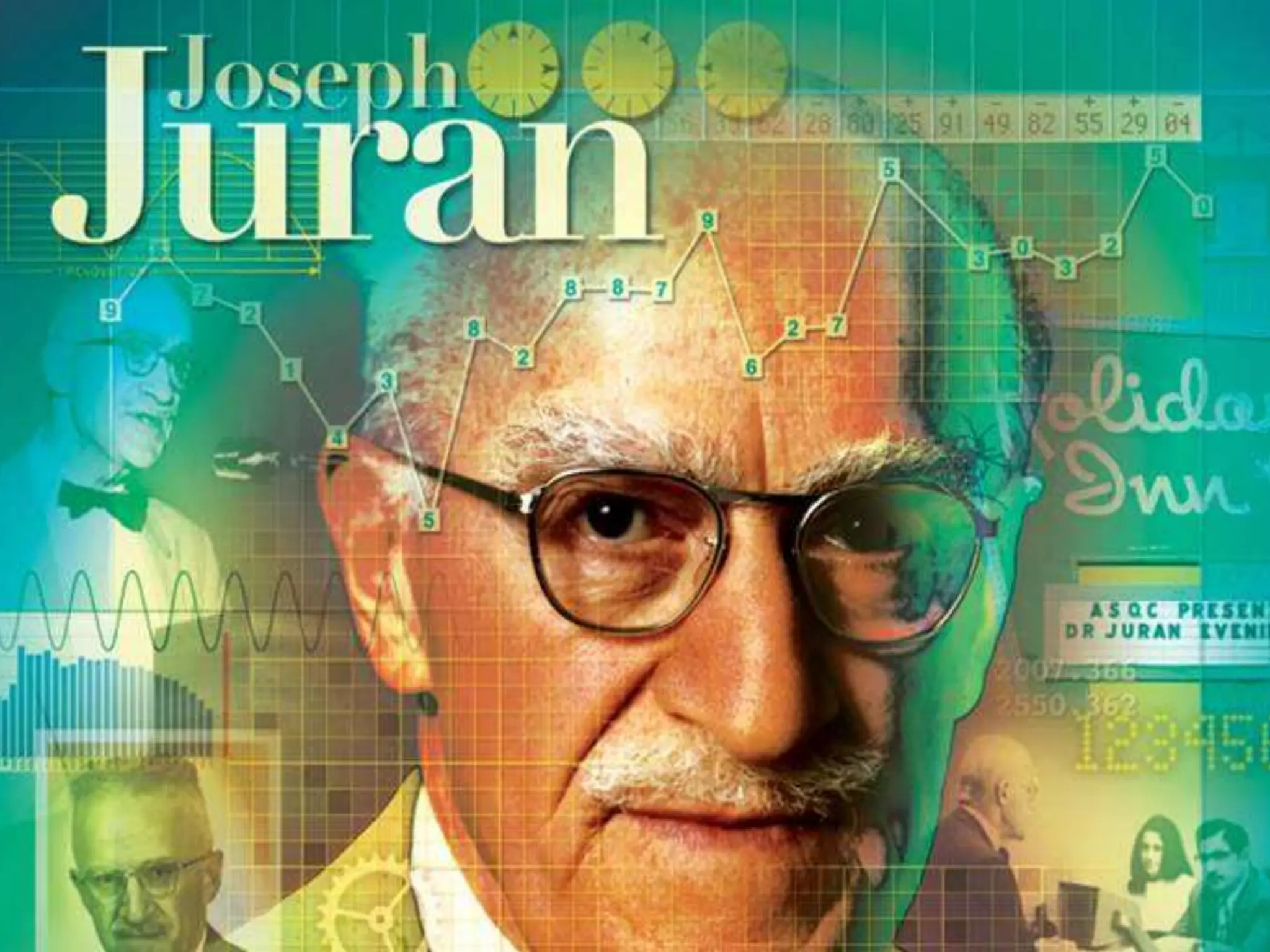
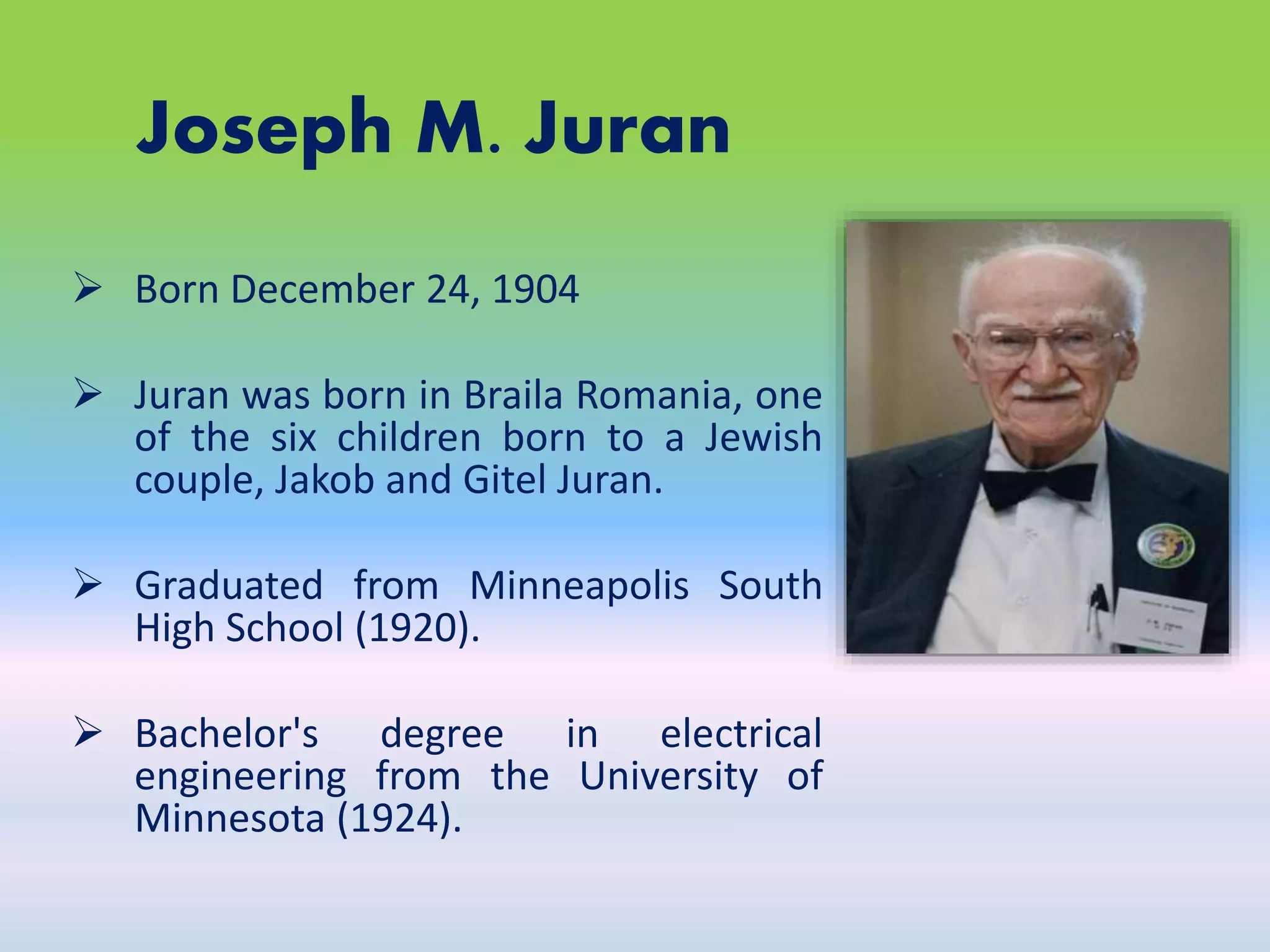
Joseph M. Juran
 Born December 24, 1904
 Juran was born in Braila Romania, one
of the six children born to a Jewish
couple, Jakob and Gitel Juran.
 Graduated from Minneapolis South
High School (1920).
 Bachelor's degree in electrical
engineering from the University of
Minnesota (1924).
 His first job was Troubleshooting in
the Complaint Department. In
1925, Bell Labs proposed that
Hawthorne Works personnel be
trained in its newly
developed Statistical sampling and
control chart techniques.
 Founder of the consulting firm of
Juran Institute, Inc.
 Concerned with the wider aspects
of management, beyond quality
Joseph M. Juran
Books
• Managerial breakthrough. Revised ed. New York, McGraw-Hill,
1994. (First published in 1964)
• With Gryna, F. Quality planning and analysis. New York, McGraw-
Hill, 1993
• Juran on quality by design. New York, Free Press, 1992
• Juran on leadership for quality. New York, Free Press, 1989
• Juran on planning for quality. New York, Free Press, 1988
• Juran's quality control handbook. 4th ed. New York, McGraw-Hill,
1988
• Managerial breakthrough. New York, McGraw-Hill, 1964
Contribution
• Voice of the Customer (VOC)
• Internal Customer
• Cost quality
• Quality
• Juran Trilogy
• Juran 10 Steps to quality improvement
• Breakthrough Concept
• Pareto Principle
Voice of the Customer (VOC)
• The Voice of the Customer (VOC) describes
the spoken and unspoken true needs of the
recipient of one’s goods or services.
• The customer can be both internal and
external, and its voice cannot be overlooked.
Internal Customer
Internal Customer
• the Customer was not just the end customer
and that each person along the has an
internal customer.
• each person along the chain, from product
designer to final user, is a supplier and a
customer.
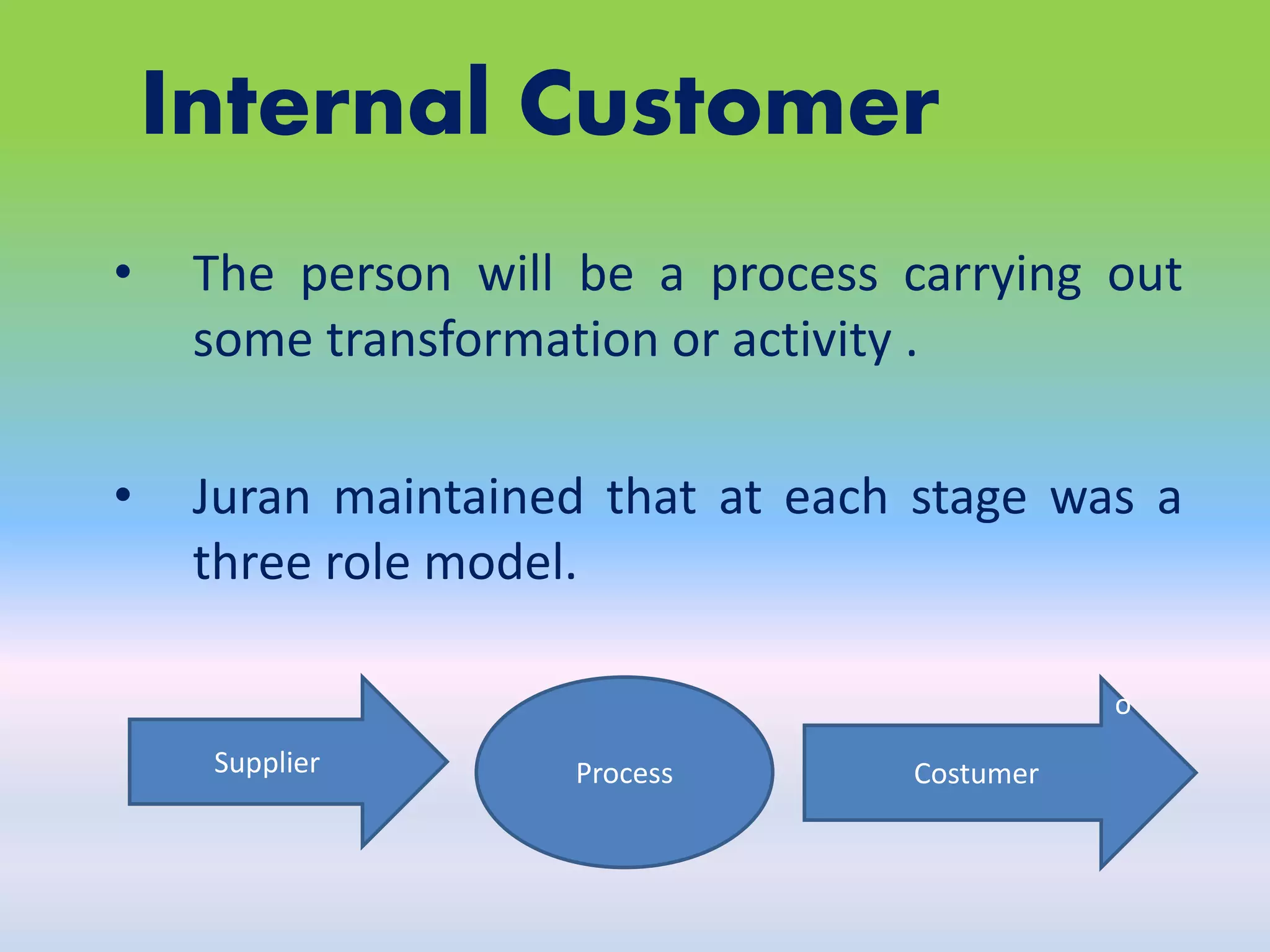
Supplier Process Costumer
Internal Customer
• The person will be a process carrying out
some transformation or activity .
• Juran maintained that at each stage was a
three role model.
o
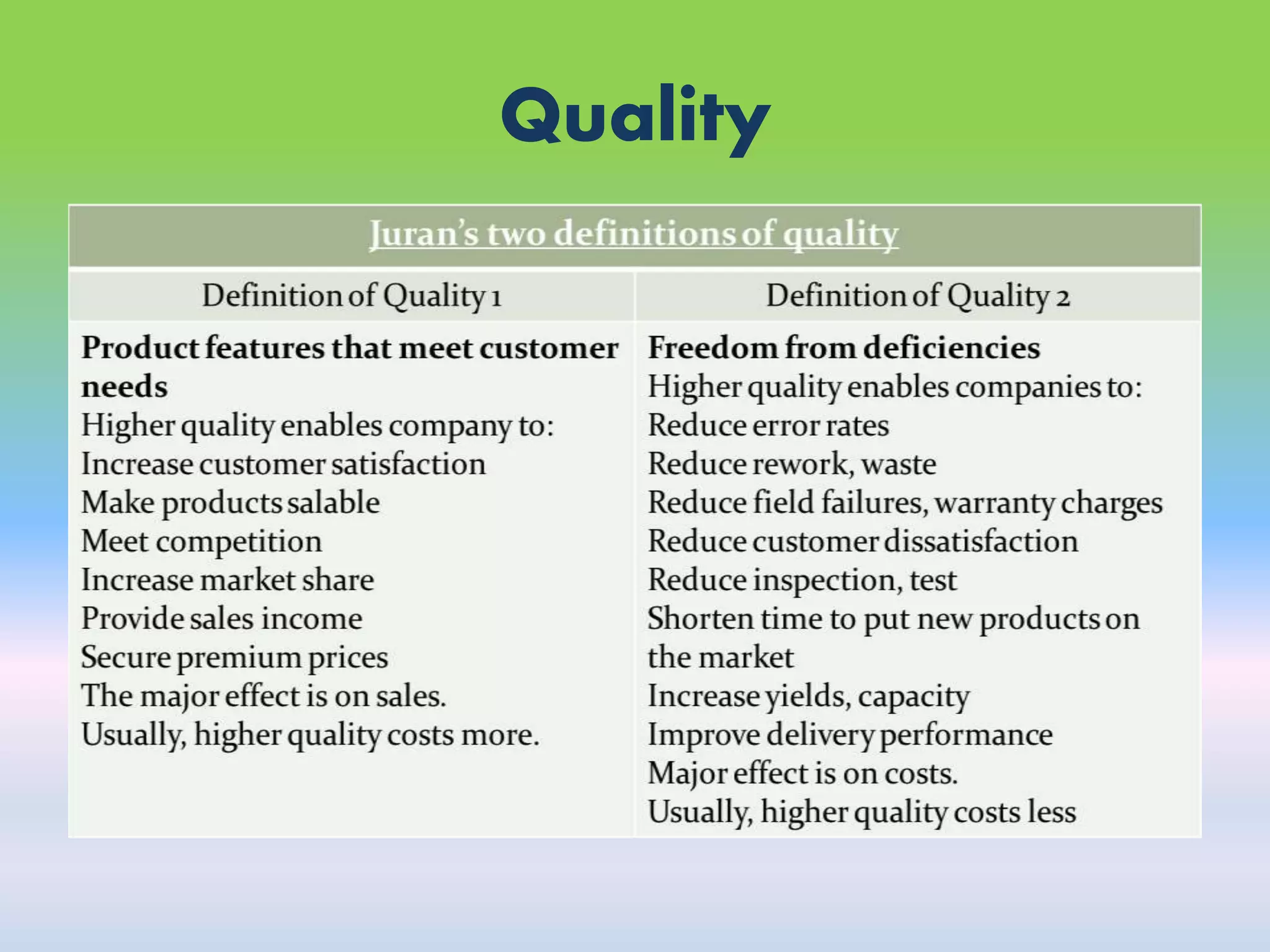
Quality
Juran classifies the cost of quality
into three classes are
1. Failure costs:
• Scrap, rework, corrective actions, warranty
claims, customer complaints, and loss of
customer.
2. Appraisal costs:
• Inspection, compliance auditing and
investigations.
3. Prevention costs:
• Training, preventive auditing and process
improvement implementation.
• Juran demonstrated the potential for
increased profits that would result if the cost
of poor quality could be reduced.
Juran classifies the cost of quality
into three classes are
J.M. Juran’s Trilogy
• Trilogy shows how an organization can improve every
aspect by better understanding of the relationship
between processes that plan, control and improve
quality as well as business results.
• In 1951, the first edition of Juran’s quality control
handbook was published.
 .
J.M. Juran’s Trilogy
• To attain quality, it is well to begin by establishing
the “vision” for the organization, along with policies
and goals.
3 component
• Quality Planning
• Quality Improvement
• Quality Control
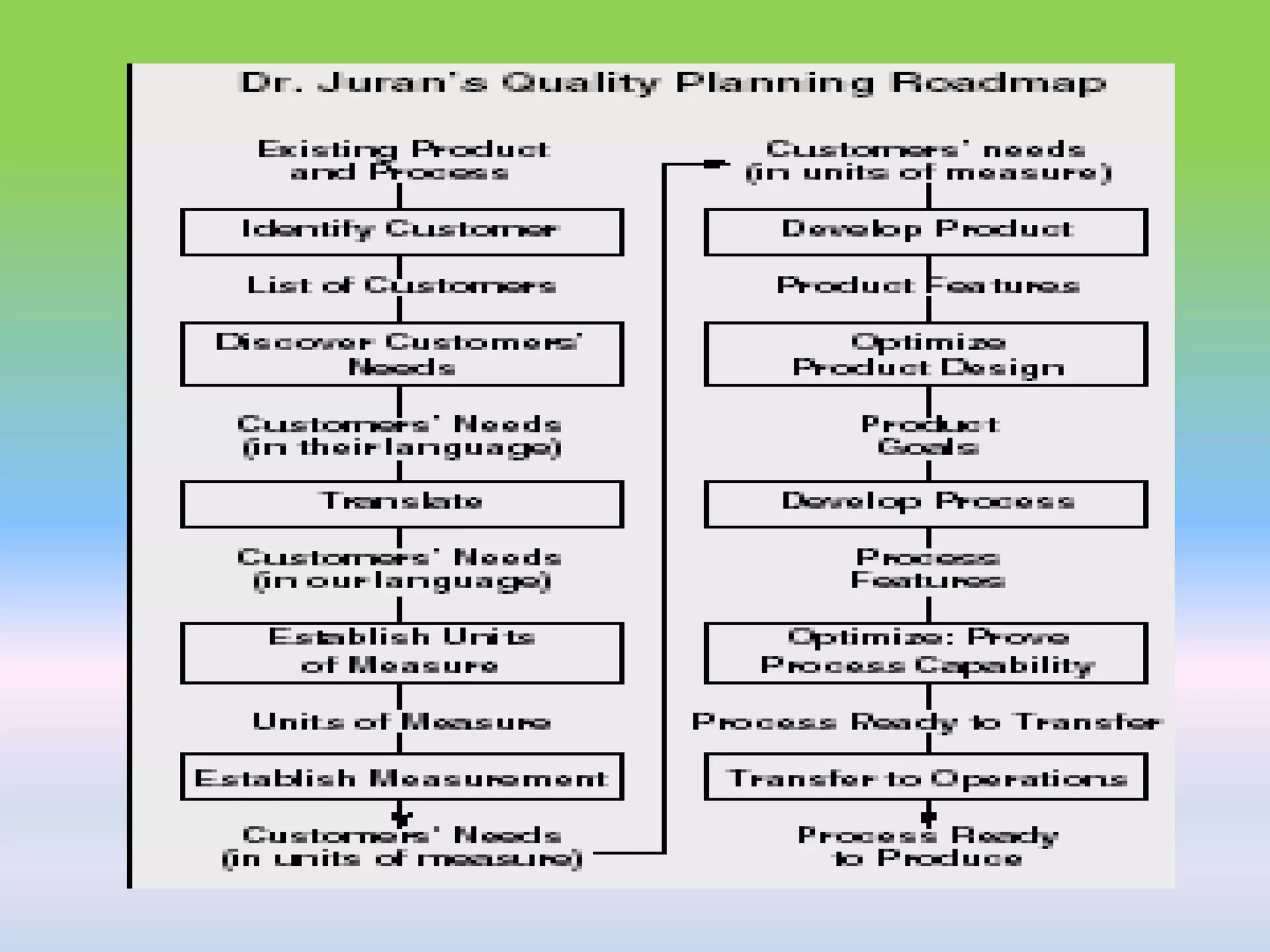
Quality Planning
• Establish quality goals.
• Identify who the customers are.
• Determine the needs of the customers.
• Develop product features that respond
to customer’s needs.
• Develop processes able to produce the
product features.
• Establish process controls; transfer the
plans to the operating forces.
Quality Control
• Evaluate actual performance.
• Compare actual performance with quality
goals.
• Act on the difference.
PLANNED ACTUAL DIFFERENCE
Quality Improvement
• Prove the need Establish the infrastructure
• Identify the improvement projects.
• Establish project teams.
• Provide the teams with resources, training,
and motivation to.
• Diagnose the causes Stimulate remedies.
• Establish controls to hold the gains.
Juran 10 Steps of Quality
improvement
1. Build awareness of the need and opportunity
for improvement
2. Set goals for improvement
3. Organise to reach the goals
4. Provide training
5. Carry out projects to solve problem
Juran 10 Steps of Quality
improvement
6. Report progress
7. Give recognition
8. Communication result
9. Keep score
10. maintain momentum by making annual
improvement part of the regular systems and
process of the company.
Breakthrough Concept
• Like Deming cycle, Juran’s breakthrough
concerns itself with the product/service life
cycle.
• In essence, this splits it up into two areas :
1, “journey from symptom to cause
2. “journey from cause to remedy”.
The Pareto Principle
• Realized that pareto distribution applied to much more than
just the wealth of the population
• Applied Pareto’s principle (80/20) to Quality Control
• Recognized that 20% of the defects were causing 80% of the
problem
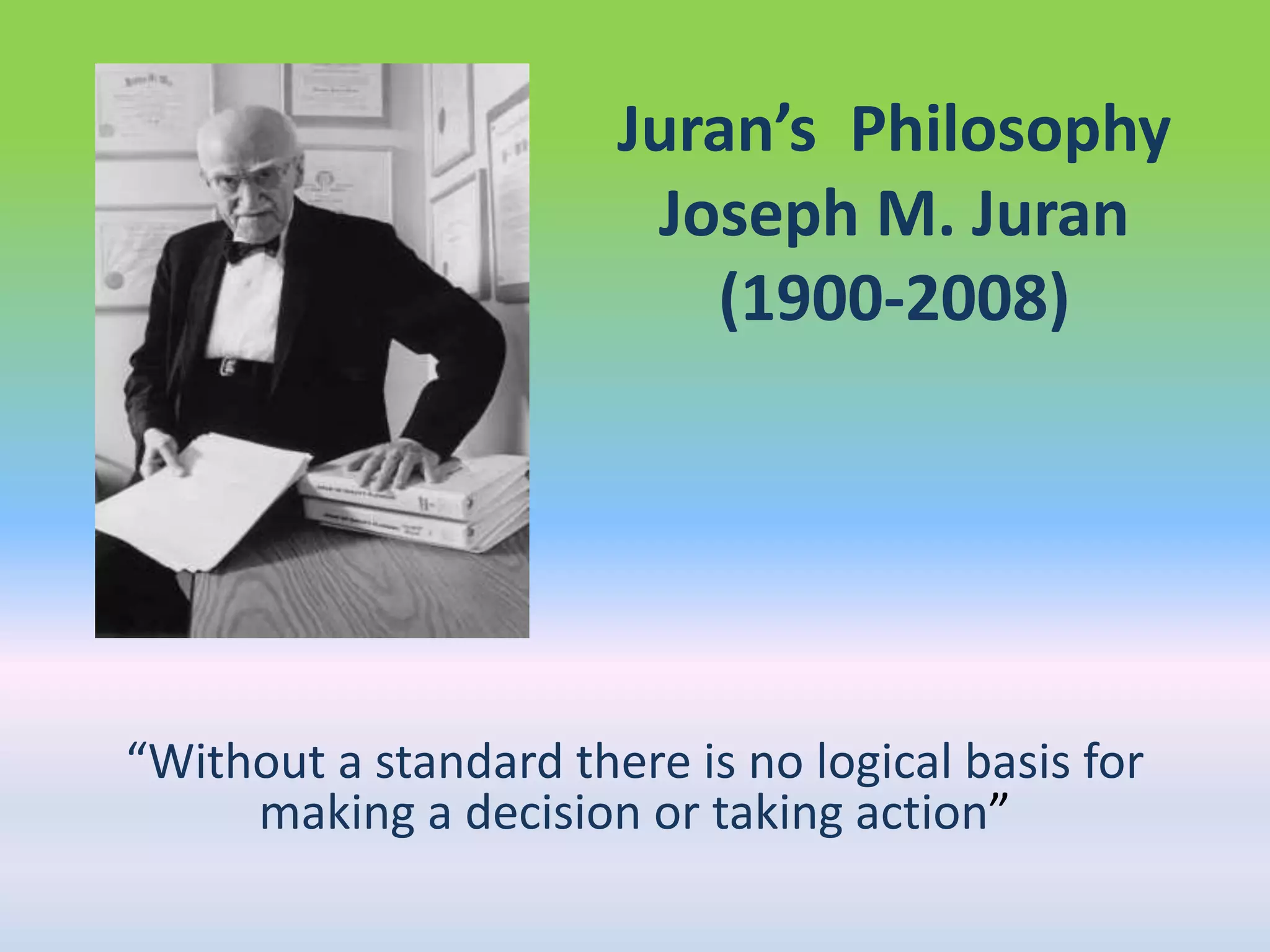
Juran’s Philosophy
Joseph M. Juran
(1900-2008)
“Without a standard there is no logical basis for
making a decision or taking action”
• The end 

Joseph juran contribution to tqm

  • 2.
    Joseph M. Juran Born December 24, 1904  Juran was born in Braila Romania, one of the six children born to a Jewish couple, Jakob and Gitel Juran.  Graduated from Minneapolis South High School (1920).  Bachelor's degree in electrical engineering from the University of Minnesota (1924).
  • 3.
     His firstjob was Troubleshooting in the Complaint Department. In 1925, Bell Labs proposed that Hawthorne Works personnel be trained in its newly developed Statistical sampling and control chart techniques.  Founder of the consulting firm of Juran Institute, Inc.  Concerned with the wider aspects of management, beyond quality Joseph M. Juran
  • 4.
    Books • Managerial breakthrough.Revised ed. New York, McGraw-Hill, 1994. (First published in 1964) • With Gryna, F. Quality planning and analysis. New York, McGraw- Hill, 1993 • Juran on quality by design. New York, Free Press, 1992 • Juran on leadership for quality. New York, Free Press, 1989 • Juran on planning for quality. New York, Free Press, 1988 • Juran's quality control handbook. 4th ed. New York, McGraw-Hill, 1988 • Managerial breakthrough. New York, McGraw-Hill, 1964
  • 6.
    Contribution • Voice ofthe Customer (VOC) • Internal Customer • Cost quality • Quality • Juran Trilogy • Juran 10 Steps to quality improvement • Breakthrough Concept • Pareto Principle
  • 7.
    Voice of theCustomer (VOC) • The Voice of the Customer (VOC) describes the spoken and unspoken true needs of the recipient of one’s goods or services. • The customer can be both internal and external, and its voice cannot be overlooked.
  • 8.
    Internal Customer Internal Customer •the Customer was not just the end customer and that each person along the has an internal customer. • each person along the chain, from product designer to final user, is a supplier and a customer.
  • 9.
    Supplier Process Costumer InternalCustomer • The person will be a process carrying out some transformation or activity . • Juran maintained that at each stage was a three role model. o
  • 10.
  • 11.
    Juran classifies thecost of quality into three classes are 1. Failure costs: • Scrap, rework, corrective actions, warranty claims, customer complaints, and loss of customer. 2. Appraisal costs: • Inspection, compliance auditing and investigations.
  • 12.
    3. Prevention costs: •Training, preventive auditing and process improvement implementation. • Juran demonstrated the potential for increased profits that would result if the cost of poor quality could be reduced. Juran classifies the cost of quality into three classes are
  • 13.
    J.M. Juran’s Trilogy •Trilogy shows how an organization can improve every aspect by better understanding of the relationship between processes that plan, control and improve quality as well as business results. • In 1951, the first edition of Juran’s quality control handbook was published.  .
  • 14.
    J.M. Juran’s Trilogy •To attain quality, it is well to begin by establishing the “vision” for the organization, along with policies and goals. 3 component • Quality Planning • Quality Improvement • Quality Control
  • 15.
    Quality Planning • Establishquality goals. • Identify who the customers are. • Determine the needs of the customers. • Develop product features that respond to customer’s needs. • Develop processes able to produce the product features. • Establish process controls; transfer the plans to the operating forces.
  • 17.
    Quality Control • Evaluateactual performance. • Compare actual performance with quality goals. • Act on the difference. PLANNED ACTUAL DIFFERENCE
  • 18.
    Quality Improvement • Provethe need Establish the infrastructure • Identify the improvement projects. • Establish project teams. • Provide the teams with resources, training, and motivation to. • Diagnose the causes Stimulate remedies. • Establish controls to hold the gains.
  • 19.
    Juran 10 Stepsof Quality improvement 1. Build awareness of the need and opportunity for improvement 2. Set goals for improvement 3. Organise to reach the goals 4. Provide training 5. Carry out projects to solve problem
  • 20.
    Juran 10 Stepsof Quality improvement 6. Report progress 7. Give recognition 8. Communication result 9. Keep score 10. maintain momentum by making annual improvement part of the regular systems and process of the company.
  • 21.
    Breakthrough Concept • LikeDeming cycle, Juran’s breakthrough concerns itself with the product/service life cycle. • In essence, this splits it up into two areas : 1, “journey from symptom to cause 2. “journey from cause to remedy”.
  • 22.
    The Pareto Principle •Realized that pareto distribution applied to much more than just the wealth of the population • Applied Pareto’s principle (80/20) to Quality Control • Recognized that 20% of the defects were causing 80% of the problem
  • 23.
    Juran’s Philosophy Joseph M.Juran (1900-2008) “Without a standard there is no logical basis for making a decision or taking action”
  • 24.