DISCOVER . LEARN. EMPOWER
TOPIC OF PRESENTATION
Introduction to Quality
University School of Business
(MBA)
SUBJECT NAME: Operations & Quality Management
SUBJECT CODE: 21BAT632
Simmi Dhyani
Introduction to Quality
Whatis Quality?
•Traditional thinking would say that Quality is conference to
specifications,that is does the product do what it designed to
do?
•One is Quality Assurance which is the "prevention of
defects", such as the deployment of a Quality Management
System and preventative activities like FMEA.
•The other is Quality Control which is the "detection of
defects", most commonly associated with testing which takes
place within a Quality Management System typically
referred to as Verification and Validation.
Cont
2
5.
Introduction to Quality
•"Conformance to requirements". The difficulty
with this is that the requirements may not fully
represent what the customer wants; Crosby treats
this as a separate problem.
• "Fitness for use". Fitness is defined by the
customer.
• A two-dimensional model of quality. The quality
has two dimensions: "must-be quality" and
"attractive quality". The former is near to the
"fitness for use"
3
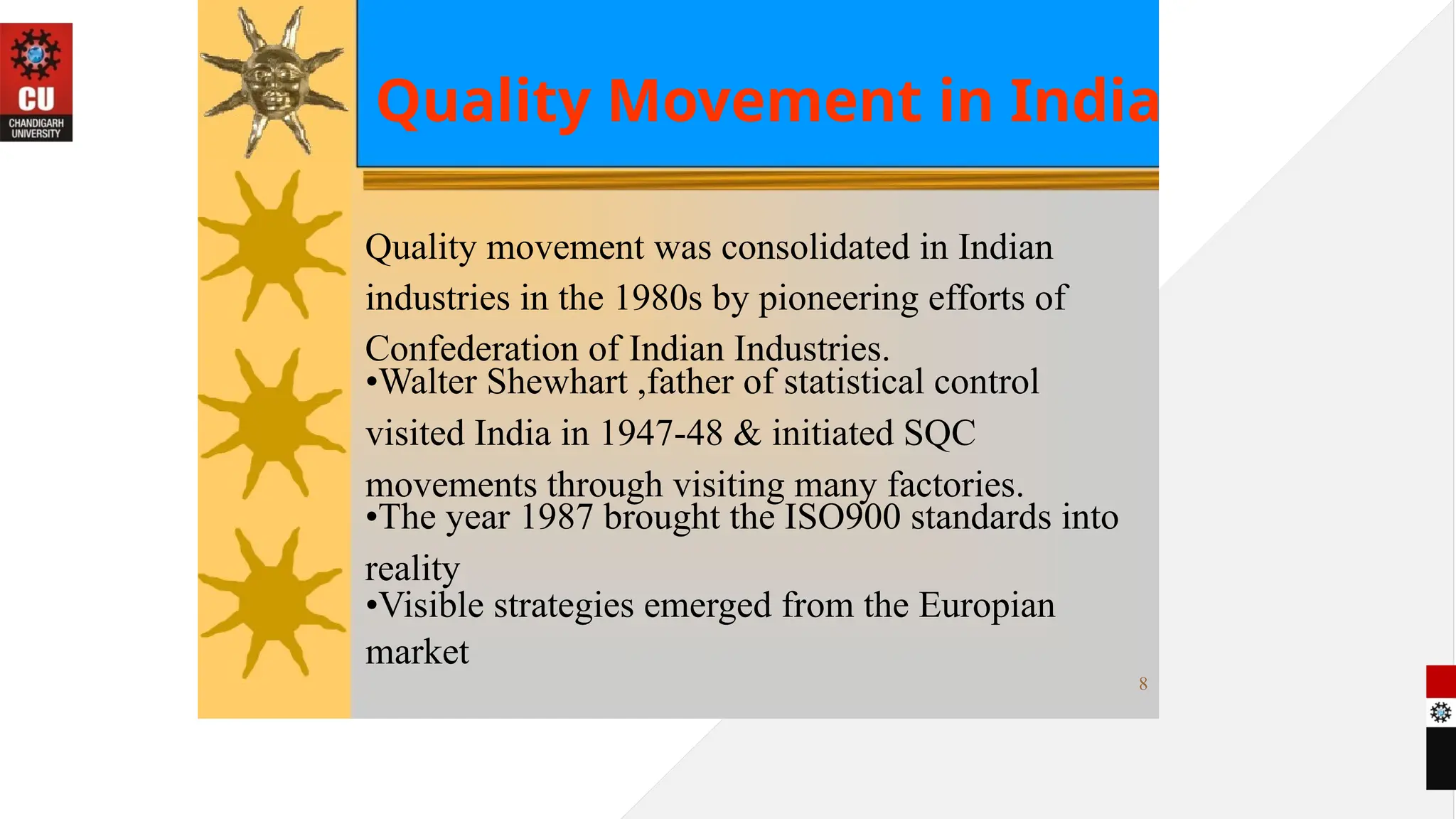
Quality Movement inIndia
Quality movement was consolidated in Indian
industries in the 1980s by pioneering efforts of
Confederation of Indian Industries.
•Walter Shewhart ,father of statistical control
visited India in 1947-48 & initiated SQC
movements through visiting many factories.
•The year 1987 brought the ISO900 standards into
reality
•Visible strategies emerged from the Europian
market
8
11.
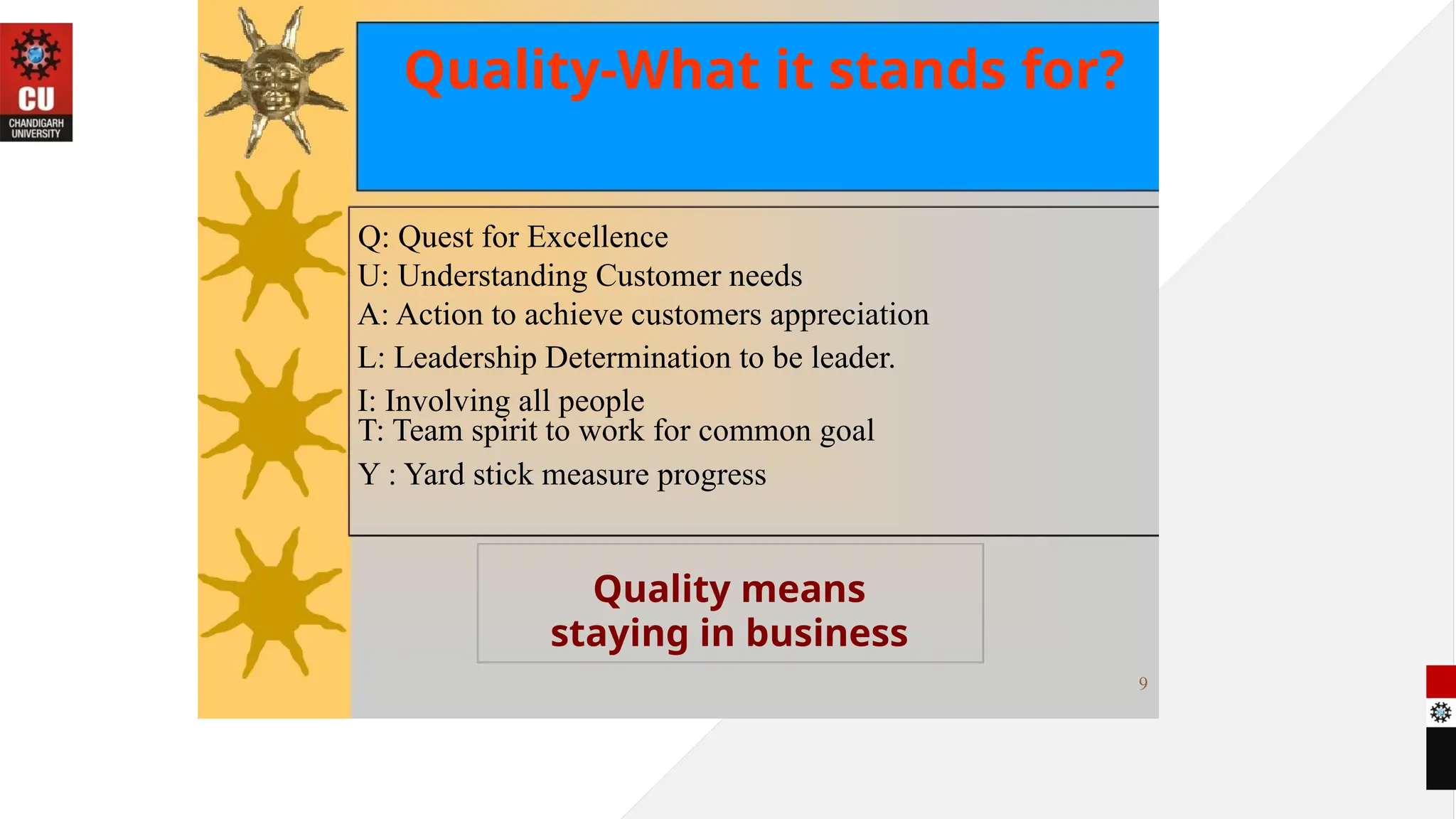
Quality-What it standsfor?
Q: Quest for Excellence
U: Understanding Customer needs
A: Action to achieve customers appreciation
L: Leadership Determination to be leader.
I: Involving all people
T: Team spirit to work for common goal
Y : Yard stick measure progress
Quality means
staying in business
9
12.
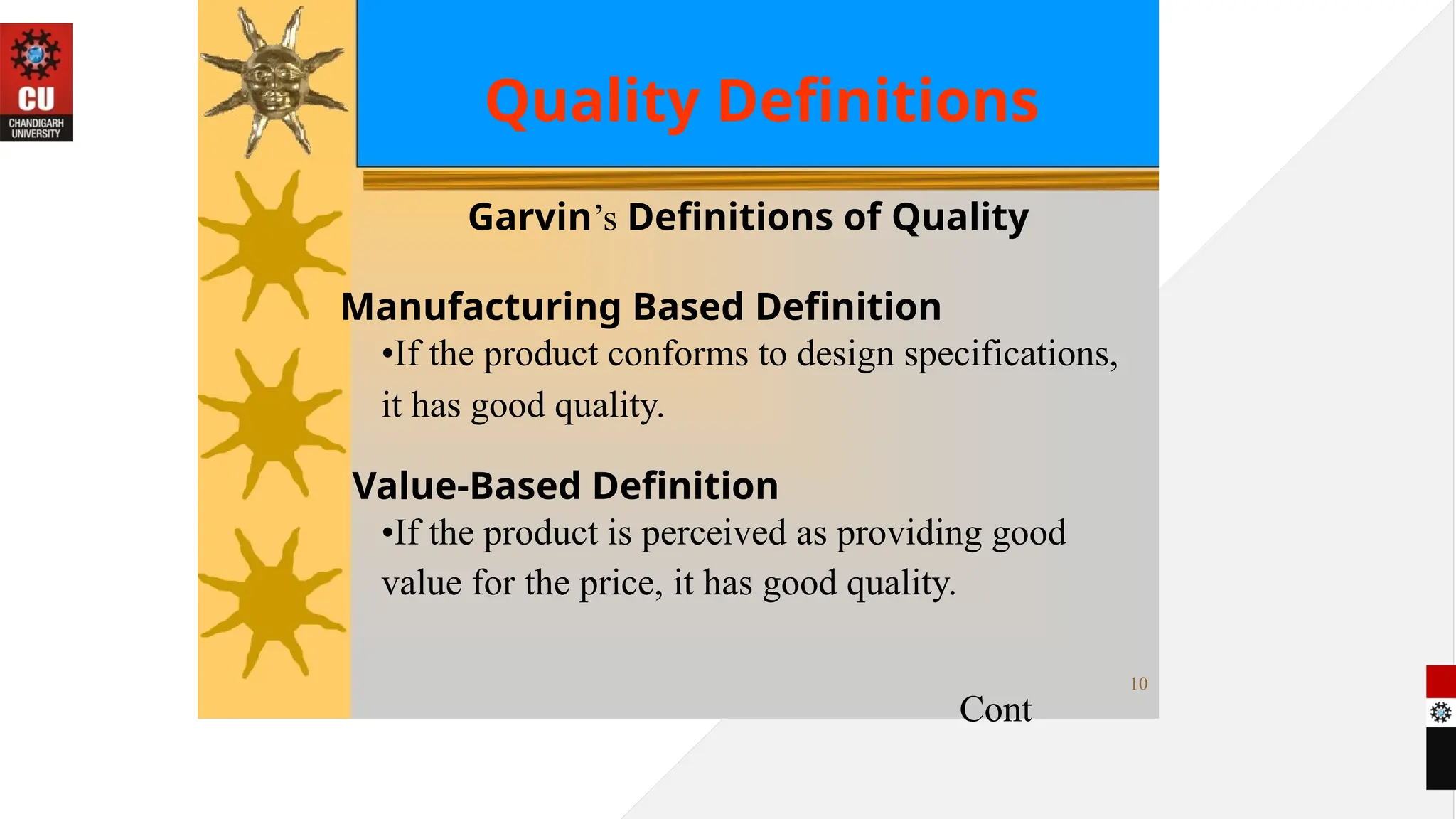
Quality Definitions
Garvin’s Definitionsof Quality
Manufacturing Based Definition
•If the product conforms to design specifications,
it has good quality.
Value-Based Definition
•If the product is perceived as providing good
value for the price, it has good quality.
10
Cont
13.
Quality Definitions
Garvin’s Definitionsof Quality
•Transcendent Definition
•Quality is something that is intuitively
understood but nearly impossible to
communicate such as beauty or love.
•Product-Based Definition
•Quality is found in the components and
attributes of a product.
•User-Based Definition
•If the customer is satisfied, the product has good
quality.
14.
Quality Definitions
Quality isdefined as:
•The ability of product or services to meet
customer needs.
•The totality of features and characteristics of a
product or services that bears on its ability to
satisfy stated or implied needs.
•Meeting or exceeding Customer requirements
now and in future
Cont.
12
15.
Quality Definitions
Other definitionsof Quality are:
•Quality is a measure of how closely a goods or
service confirms to specified standards or
specifications
•Quality is meeting or exceeding customers
requirement.
•Quality can be described as doing right things,right
time ,first time & every time
•Quality is a means to an end
13
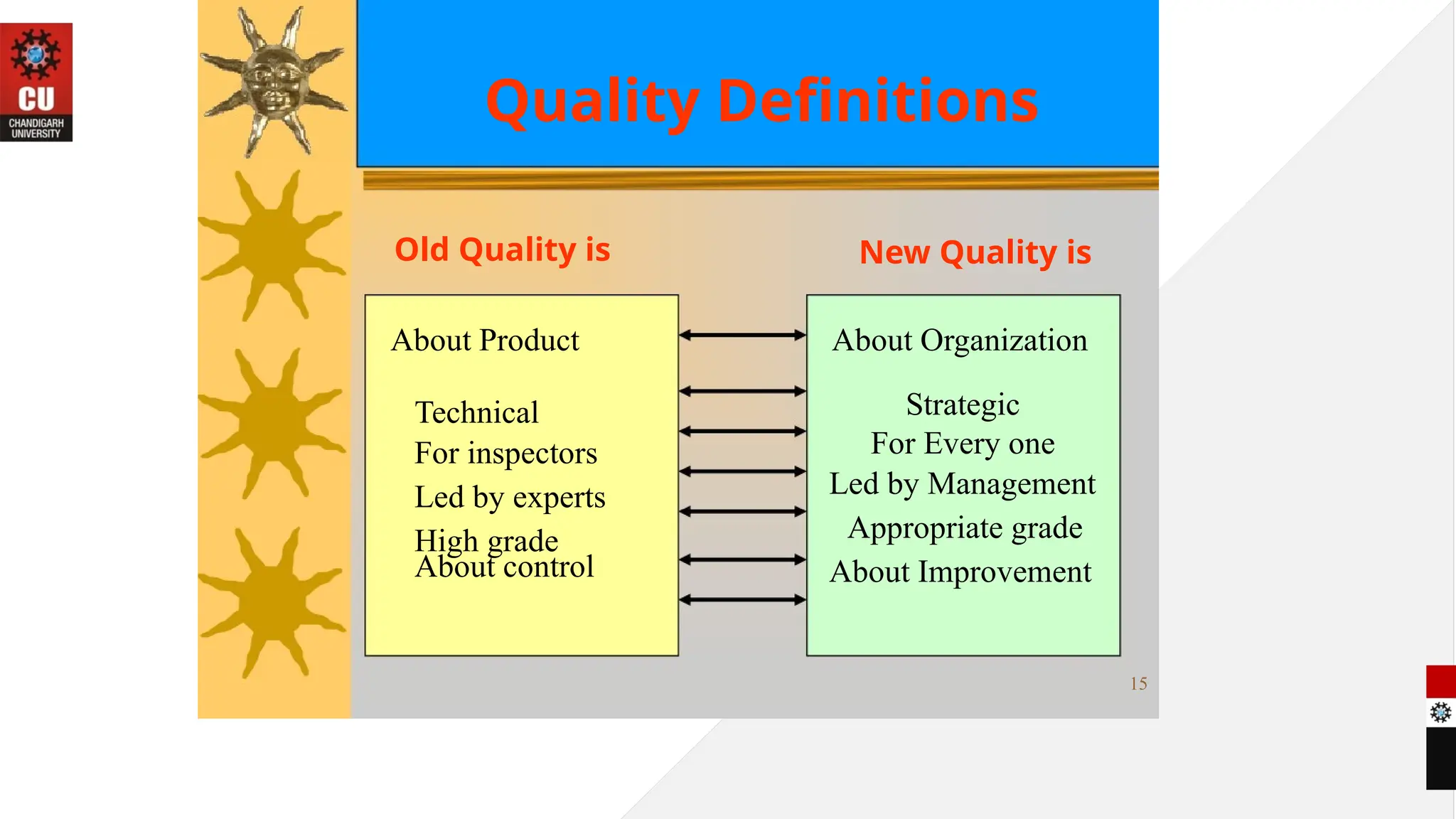
Quality Definitions
Old Qualityis
About Product
Technical
For inspectors
Led by experts
High grade
About control
New Quality is
About Organization
Strategic
For Every one
Led by Management
Appropriate grade
About Improvement
15
18.
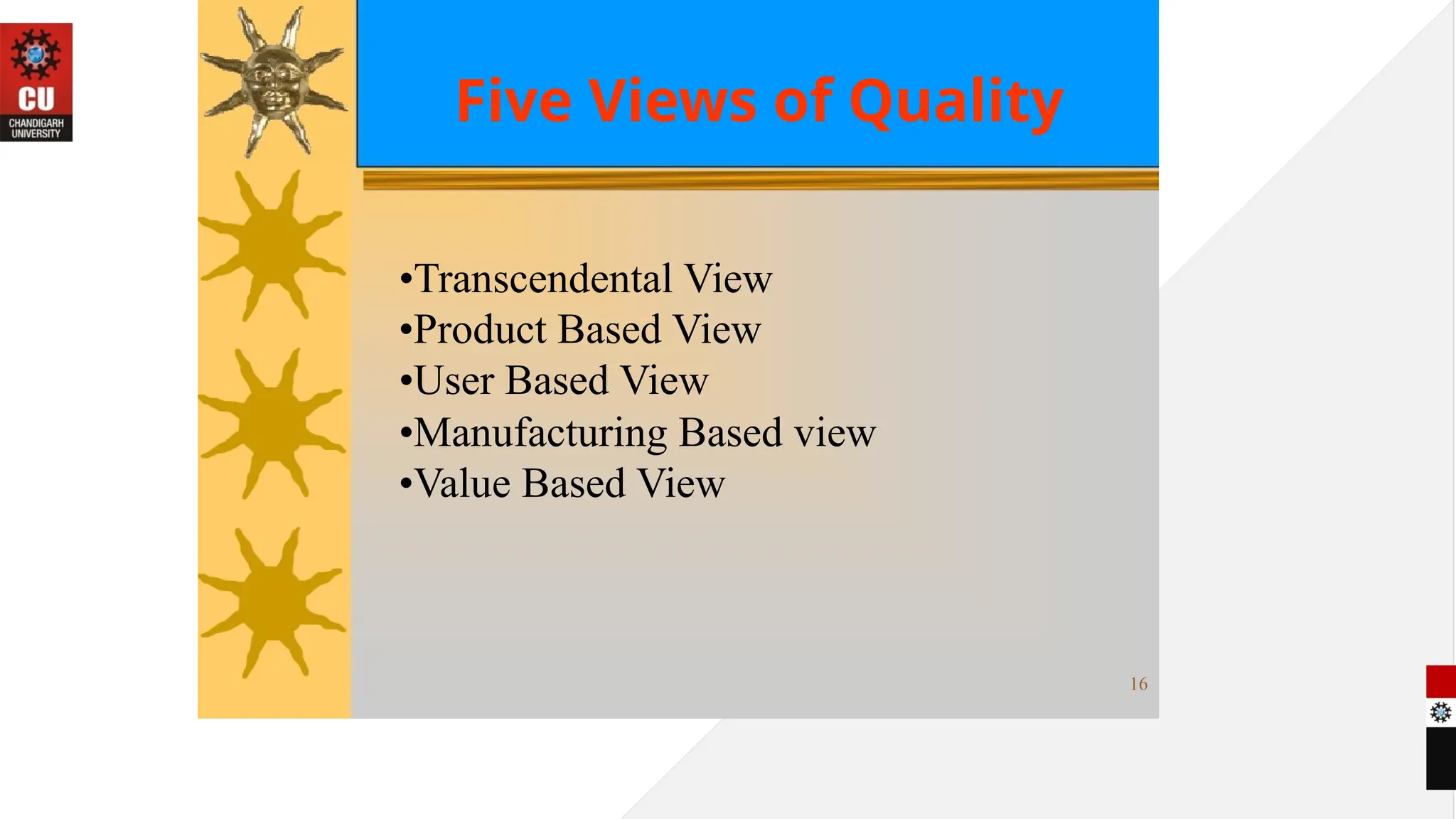
Five Views ofQuality
•Transcendental View
•Product Based View
•User Based View
•Manufacturing Based view
•Value Based View
16
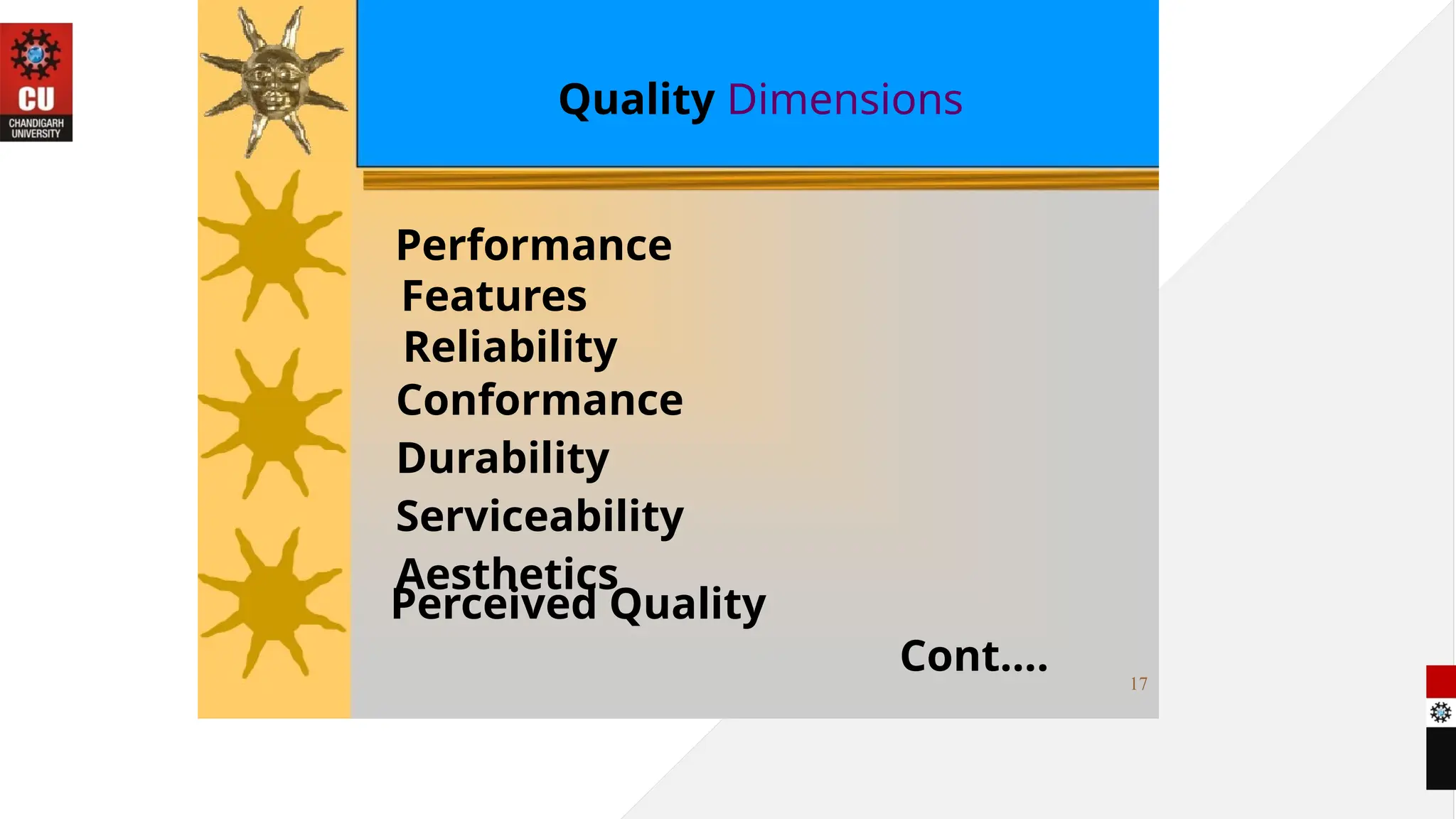
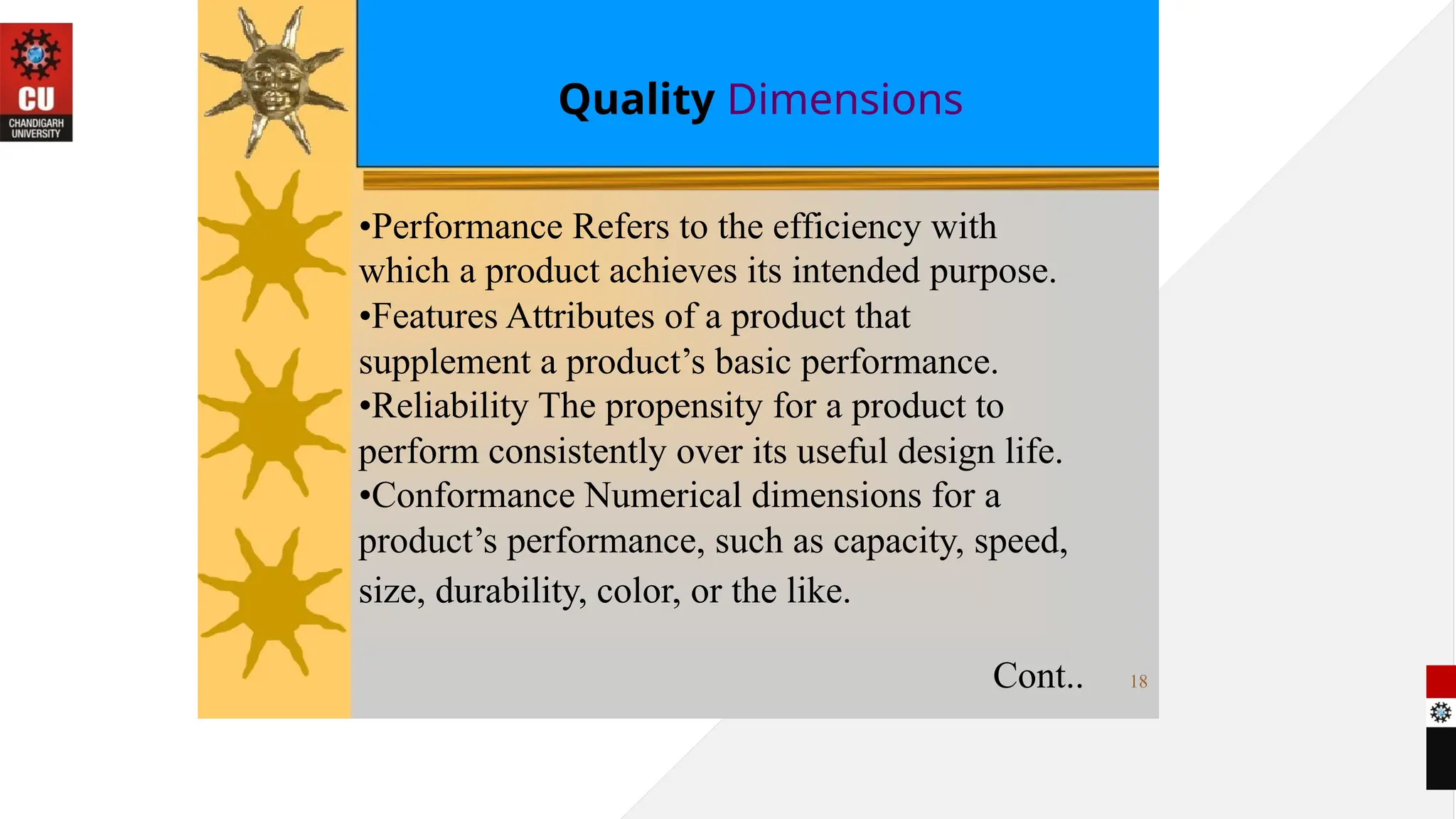
Quality Dimensions
•Performance Refersto the efficiency with
which a product achieves its intended purpose.
•Features Attributes of a product that
supplement a product’s basic performance.
•Reliability The propensity for a product to
perform consistently over its useful design life.
•Conformance Numerical dimensions for a
product’s performance, such as capacity, speed,
size, durability, color, or the like.
Cont.. 18
21.
Quality Dimensions
•Durability Thedegree to which a product
tolerates stress or trauma without failing.
•Serviceability
•Ease of repair.
•Aesthetics
•Subjective sensory characteristics such as
taste, feel, sound, look, and smell.
•Perceived Quality
•Based on customer opinion. Customers imbue
products and services with their understanding
of their goodness. Cont
19
22.
Quality Dimensions
•Include thephysical appearance of the service
facility, the equipment, the personnel, and the
communication material.
•Service Reliability
•Differs from product reliability in that it relates
to the ability of the service provider to perform
the promised service dependably and accurately.
•Responsiveness
•The willingness of the service provider to be
helpful and prompt in providing service.
20
23.
Types of Quality
•IndifferentQuality:That customer does not notice
•Expected Quality:Is the quality that customer
expects
•One dimensional Quality:is the quality the
customer expects but that does not necessarily
result in lots of order
•Exiting Quality is the quality that exceeds
customer requirements
24.
Customer driven Quality
Qualityis meeting or exceeding customer
expectations.
•Directing attention toward satisfying and
delivering value to the customer.
•Tools for Influencing Customer Perceptions of
Quality
•Price and advertising are the primary tools for
influencing customer perceptions of quality, but are
imperfect mechanisms.
Cont..22
25.
Customer driven Quality
•Focuson Service
•Another important contribution of the marketing
perspective has been the focus on service.
•Customer service surveys are important tools for
assessing the multiple dimensions of quality.
•In short Customer Driven Quality is meeting or
exceeding customer expectation.
23
26.
Quality in productionSystems
Production is the process of converting the
resources available to an organization into products
Goods & services.Quality involved in following
areas:
•Nature of Engineering Perspective
•Engineers are interested in applying mathematical
problem solving skills and models to the problems
of business and industry.
•Two of the major emphases in engineering
•Product design
•Process design
27.
Quality in productionSystems
•Product Design Engineering
•Involves all of those activities associated with
developing a product from concept development to
final design and implementation.
•Product design life cycle
•Key to quality as quality is assured at the design
stage.
•Concurrent engineering
•The simultaneous performance of product and
process design activities.
25
28.
Quality in productionSystems
•Related Concepts
•Life Testing
•Is a facet of reliability engineering that concerns
itself with determining whether a product will fail
under controlled conditions during a specified life.
•Is applied so that a back up system can take over
for the failed primary system.
•Statistical Process Control
•Is concerned with monitoring process capability
and process stability.
26
29.
Three levels ofQuality
1 Organizational Level
At organizational level ,quality concerns
center
ton meeting external customer requirements
2. At process level
Organizational units are classified as functions or
departments such as marketing design,product
3.Performance level(Job level)
These standards include requirements
for
accuracy,completeness
27
30.
Determinants of Quality
Severalactivities are necessary to achieve
Quality they are:
• Quality of Design
• Quality capability of production processes
• Quality of conformance
• Quality of customer service
•Organization Quality culture
28
31.
Quality & competitiveadvantage
One of the critical drivers of business success is
having a unique competitive advantage.
•Most managers understand that to attract a larger
share of the market, or find enough customers
prepared to pay a premium price, they must provide
something of greater value than their competition.
•For most managers, competitive advantage boils
down to providing superior quality and service.
Think about it. Is this what you are aiming for?
29
32.
Quality & competitiveadvantage
Competitive advantage denotes a firms ability to
achieve market superiority
Characteristics of a strong competitive advantage
identified by S.C Whelwright are:
•It is customer driven needs & wants
•It makes significant value to success of business
•It matches the organization's unique resources with
opportunities in the environment
•It is durable and lasting & difficult for competitors
to copy Cont..
30
33.
Quality & competitiveadvantage
•It provides a basis for further development
•It provides directions and motivation to the entire
organization
Customers don’t believe vague claims and they
don’t believe you, unless you can back up your
statement with irrefutable facts. The same goes for
service. What does better service mean? Is it faster,
more personal, more user friendly? How can you
support your claims?
31
34.
Quality & Profitability
GoodQuality can also pay off in higher profits
Several research studies undertaken by PIMS have
found that:
•Product Quality is important determinant of
business profitability
•Business that offer premium quality & services
have large market shares
•Quality is positively and significantly related to a
high return
•High Quality producers can usually change
premium price
35.
Quality as asource of value
Many customers regard Quality as a Important
source of value
•Improved reputation
•Easier selling
•Legal Implications
•Reduced lead time
•Enhanced Flexibility
•Improved Productivity
•Reduced Cost
•Employer pride
33
36.
Quality and personalvalues
•Today companies are asking employees to take
more responsibility for acting as the point of
contact between the organization and the
customer,to be team players & to provide more
effective & efficient customer service.
•Personal Quality may be thought of as personal
empowerment.
•Personal Quality is an essential ingredient to make
quality happens at work place
34
37.
Quality Drives theproductive Machine
Japanese manufactures are credited with populating
the notion that quality drives the productivity
machine
•This means If the production does it right first time
,& produces product and services which are defect
free,Waste is eliminated & costs are reduced.
•Productivity & Quality are often closely related
•Poor quality can adversely affected if defective
parts are reworked.
•Poor quality tolls & equipment can lead to injuries
&defective output
38.
References
TEXT BOOKS
• B.Mahadevan, 2007. Operations Management Theory and Practice, Pearson Education, Second Impression 2007. ISBN: 8177585649
• Dale H. Besterfiled, et at., 2006. Total Quality Management, Pearson Education Asia, Third Edition, Indian Reprint 2006. ISBN: 978-81-
317-3227-4
REFERENCE BOOKS
• R1 William J. Stevenson, 2018. Operations Management Mc Graw Hill Publications, 13th Edition ISBN: 9781259667473
• R2 James R. Evans and William M. Lindsay, 2012. “The Management and Control of Quality”, Cengage Learning, 8th Edition, First Indian
Edition, 2012. ISBN: 978032482706
• R3 Janakiraman. B and Gopal. R. K., 2006. “Total Quality Management-Text and Cases”, Prentice Hall (India) Pvt. Ltd., 2006. ISBN:
8120329953
Text Link:
• tyonote.com/what_is_quality/#:~:text=%208%20Dimensions%20of%20Quality%20%201%201,characteristics%20of%20products
%20and%20services%20meeting...%20More%20
Video Link:
• https://www.youtube.com/watch?v=ksMFVNCLjcY
38