PQT - Total Productive
Maintenance
TPM overview
2
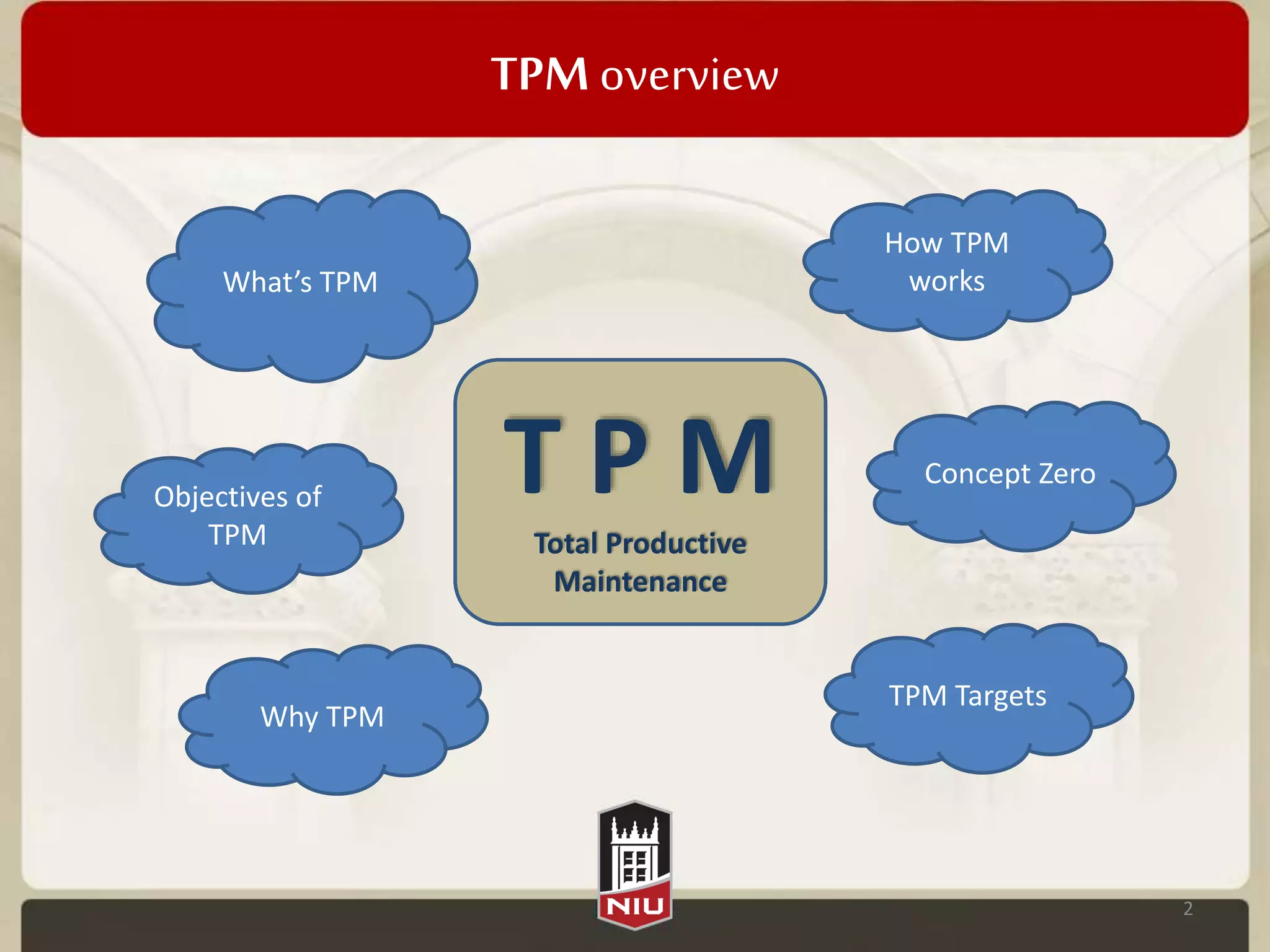
T P M
Total Productive
Maintenance
What’s TPM
How TPM
works
Concept Zero
TPM Targets
Why TPM
Objectives of
TPM
What’sT P M
• TPM wasdeveloped in the 1970's as amethodof involving
machineoperators in the preventive maintenanceof their
machines
– a reaction to increasing specialization and centralization of the maintenance
function that had createddivision-of-labor barriers between operators and the
maintenance of their machines and equipment.
– Also creating a sense of ownership in workers with Autonomous Maintenance
3
Objectives ofT P M
• Theoverriding objective ofTPMis the elimination ofLOSSES. Losses, or
waste, includes equipment downtime, defects, scrap, accidents, wasted energy,
and laborinefficiency.
• TPM was introduced to achieve some of the following important objectives:
– Safer working environment, Job security
– Producing goods with improved quality and machinereliability
– Improvedfinancial performance
– Producea low batch quantity at the earliest possible time.
– Goods send to the customers must benon defective
4
Why T P M
5
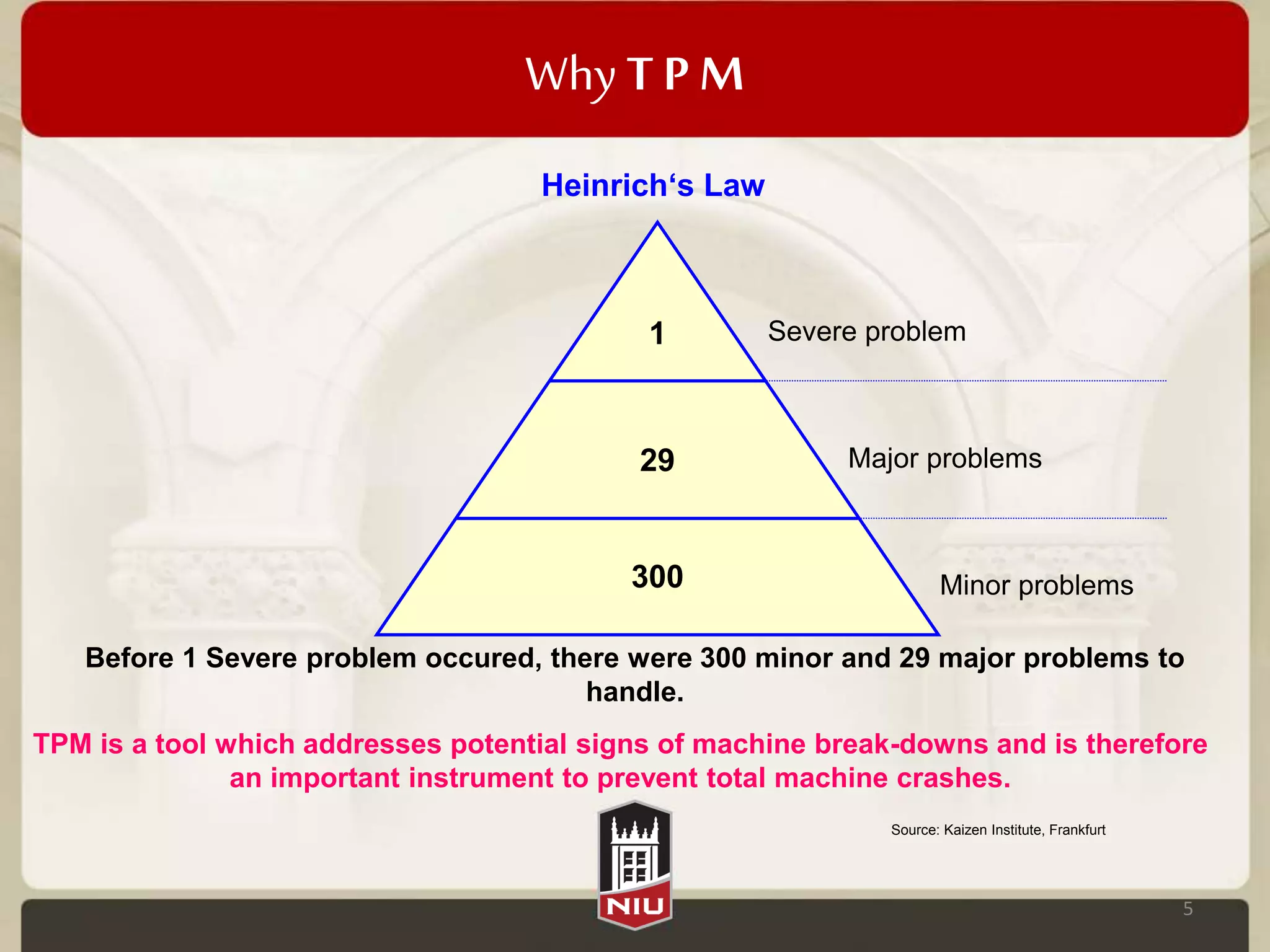
Before 1 Severe problem occured, there were 300 minor and 29 major problems to
handle.
Source: Kaizen Institute, Frankfurt
Heinrich‘s Law
TPM is a tool which addresses potential signs of machine break-downs and is therefore
an important instrument to prevent total machine crashes.
1
29
300
Severe problem
Minor problems
Major problems
Concept ZERO
• Thegoal of TPM isto driveallwastetozero: ZeroAccidents,Zero
Defects,ZeroBreakdowns.
• TheConcept of Zero is built upon Poka-Yoke, in the design of the process to make
it impossible to makeand pass on defects.
• Poka-Yoke concepts are also commonlyapplied to equipment to prevent
breakdowns.
• Poka (Mistakes), Yokeru(Avoid) orMistake Proofing (Japanese Term)
6
Performance Measure and 6 Losses
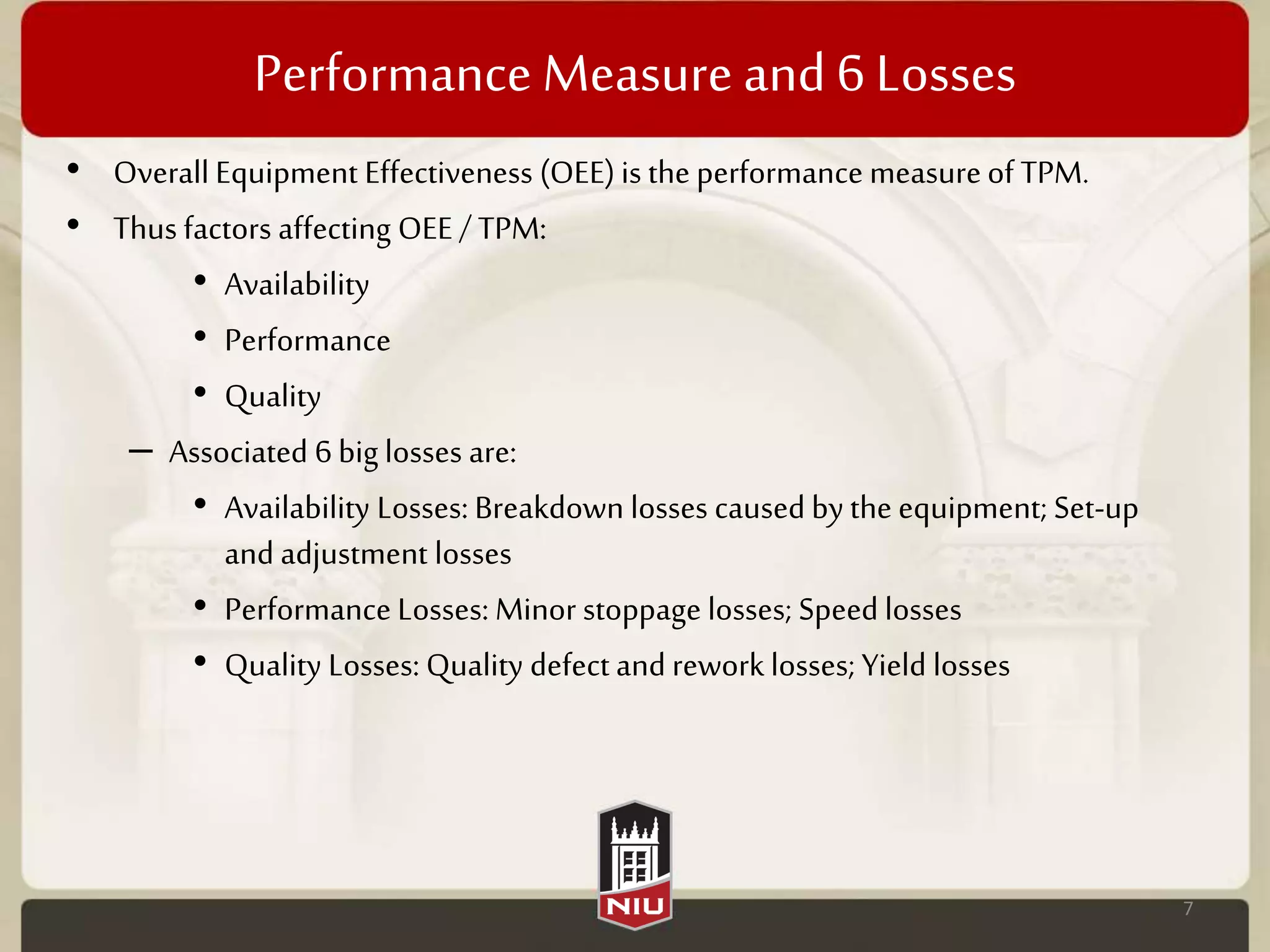
• Overall Equipment Effectiveness (OEE)is the performance measureof TPM.
• Thus factors affecting OEE/ TPM:
• Availability
• Performance
• Quality
– Associated 6 big losses are:
• Availability Losses: Breakdown losses causedby the equipment; Set-up
and adjustment losses
• Performance Losses: Minor stoppage losses; Speed losses
• Quality Losses: Quality defect and rework losses; Yield losses
7
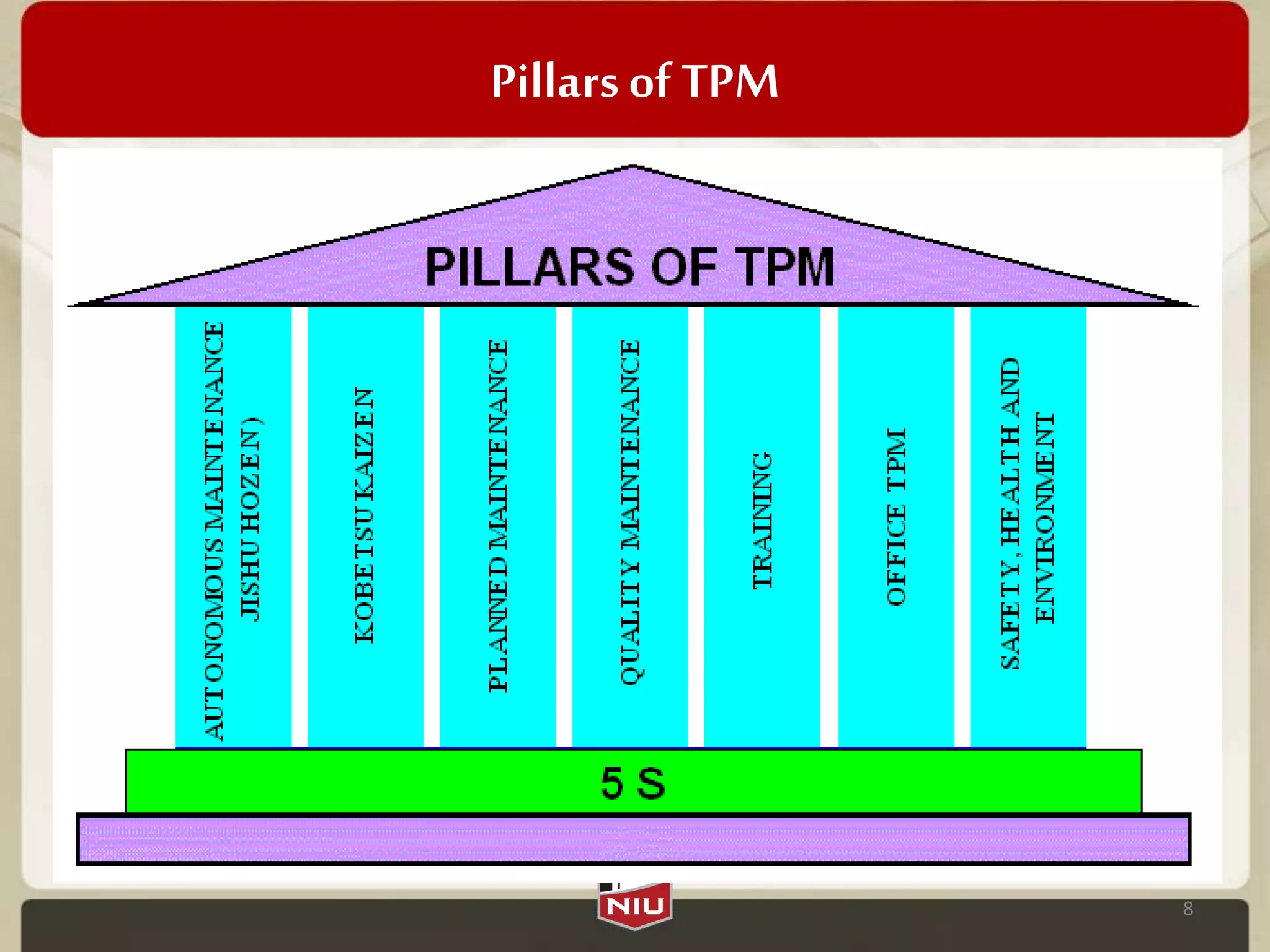
Pillarsof TPM
8
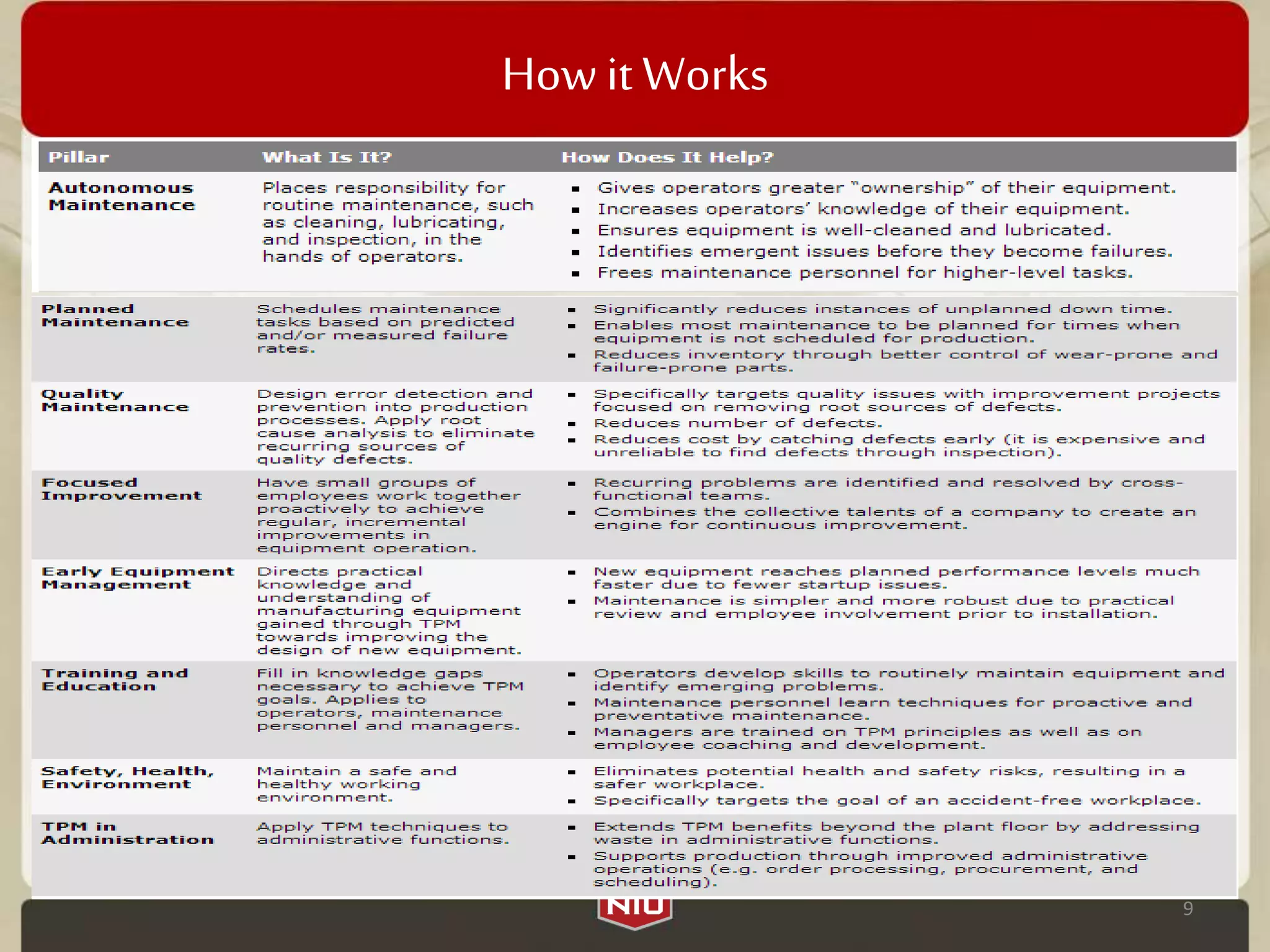
How it Works
9
Types ofMaintenance
• BreakdownMaintenance:Thisoccurs when equipment failsbut doesnot affect
production or operationor extracostsother than repairs
• PreventiveMaintenance:A dailymaintenancedesignedto maintainequipment
againstfailingand alsoimprovedhealthcondition
– PeriodicMaintenance:Atimebasedmaintenance
– PredictiveMaintenance:Maintenancebased on condition monitoringby
employingsurveillancesystem
• CorrectiveMaintenance:Redesigningequipmentwith weaknessto improve
reliability
• MaintenancePrevention:Thisindicatesdesignof new machineby Cross
functional teams afterthorough study on weaknessof current machines
10
TPM Targets
11
P roduction:
Obtain Minimum80% OPE (Overall Process Effectiveness)
Obtain Minimum90% OEE(Overall Equipment Effectiveness)
Runthe machineseven duringlunch.(Lunch is for operators and not for machines!)
Quality:
Operate in a manner,so that thereareno customer complaints.
C osts:
Reduce themanufacturingcost by 30%.
D elivery:
Achieve100%success indelivering the goods as requiredby the customer.
Safety:
Maintain a accident freeenvironment.
M aintenance:
Develop Multi-skilled and flexible workers. And Cross functionalteams

PQT - Total Productive Maintenance

  • 1.
    PQT - TotalProductive Maintenance
  • 2.
    TPM overview 2 T PM Total Productive Maintenance What’s TPM How TPM works Concept Zero TPM Targets Why TPM Objectives of TPM
  • 3.
    What’sT P M •TPM wasdeveloped in the 1970's as amethodof involving machineoperators in the preventive maintenanceof their machines – a reaction to increasing specialization and centralization of the maintenance function that had createddivision-of-labor barriers between operators and the maintenance of their machines and equipment. – Also creating a sense of ownership in workers with Autonomous Maintenance 3
  • 4.
    Objectives ofT PM • Theoverriding objective ofTPMis the elimination ofLOSSES. Losses, or waste, includes equipment downtime, defects, scrap, accidents, wasted energy, and laborinefficiency. • TPM was introduced to achieve some of the following important objectives: – Safer working environment, Job security – Producing goods with improved quality and machinereliability – Improvedfinancial performance – Producea low batch quantity at the earliest possible time. – Goods send to the customers must benon defective 4
  • 5.
    Why T PM 5 Before 1 Severe problem occured, there were 300 minor and 29 major problems to handle. Source: Kaizen Institute, Frankfurt Heinrich‘s Law TPM is a tool which addresses potential signs of machine break-downs and is therefore an important instrument to prevent total machine crashes. 1 29 300 Severe problem Minor problems Major problems
  • 6.
    Concept ZERO • Thegoalof TPM isto driveallwastetozero: ZeroAccidents,Zero Defects,ZeroBreakdowns. • TheConcept of Zero is built upon Poka-Yoke, in the design of the process to make it impossible to makeand pass on defects. • Poka-Yoke concepts are also commonlyapplied to equipment to prevent breakdowns. • Poka (Mistakes), Yokeru(Avoid) orMistake Proofing (Japanese Term) 6
  • 7.
    Performance Measure and6 Losses • Overall Equipment Effectiveness (OEE)is the performance measureof TPM. • Thus factors affecting OEE/ TPM: • Availability • Performance • Quality – Associated 6 big losses are: • Availability Losses: Breakdown losses causedby the equipment; Set-up and adjustment losses • Performance Losses: Minor stoppage losses; Speed losses • Quality Losses: Quality defect and rework losses; Yield losses 7
  • 8.
  • 9.
  • 10.
    Types ofMaintenance • BreakdownMaintenance:Thisoccurswhen equipment failsbut doesnot affect production or operationor extracostsother than repairs • PreventiveMaintenance:A dailymaintenancedesignedto maintainequipment againstfailingand alsoimprovedhealthcondition – PeriodicMaintenance:Atimebasedmaintenance – PredictiveMaintenance:Maintenancebased on condition monitoringby employingsurveillancesystem • CorrectiveMaintenance:Redesigningequipmentwith weaknessto improve reliability • MaintenancePrevention:Thisindicatesdesignof new machineby Cross functional teams afterthorough study on weaknessof current machines 10
  • 11.
    TPM Targets 11 P roduction: ObtainMinimum80% OPE (Overall Process Effectiveness) Obtain Minimum90% OEE(Overall Equipment Effectiveness) Runthe machineseven duringlunch.(Lunch is for operators and not for machines!) Quality: Operate in a manner,so that thereareno customer complaints. C osts: Reduce themanufacturingcost by 30%. D elivery: Achieve100%success indelivering the goods as requiredby the customer. Safety: Maintain a accident freeenvironment. M aintenance: Develop Multi-skilled and flexible workers. And Cross functionalteams