TOTAL QUALITY MANAGEMENT
CHAPTER NO. 7
CUSTOMER FOCUS AND
SATISFACTION
Quality begins and ends with
the customer.
Joel E. Ross
3
Key Customer Groups
• Organization level
– consumers
– external customers
– employees
– society
• Process level
– internal customer units or groups
• Performer level
– individual internal customers
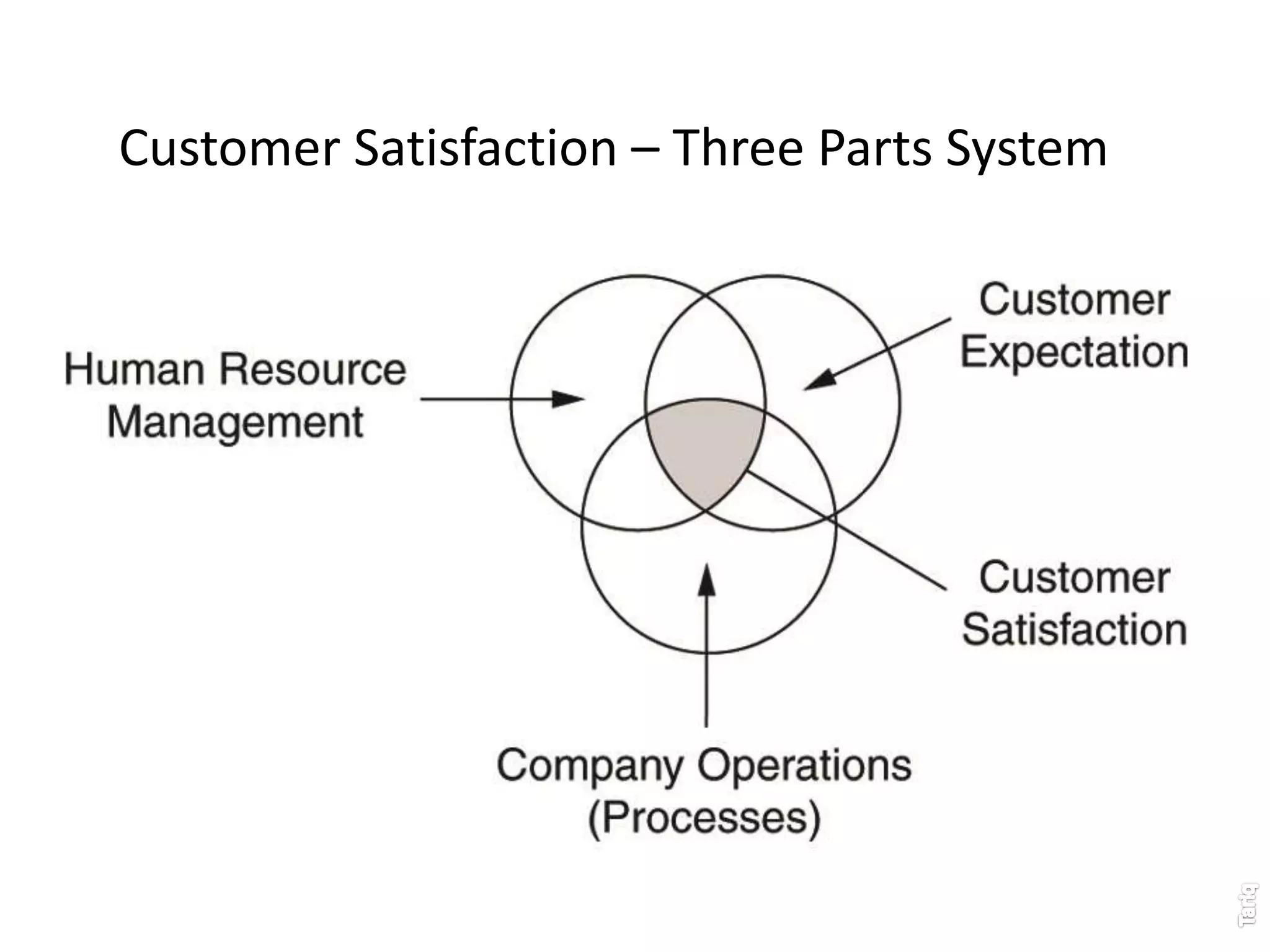
Customer Satisfaction – Three Parts System
5
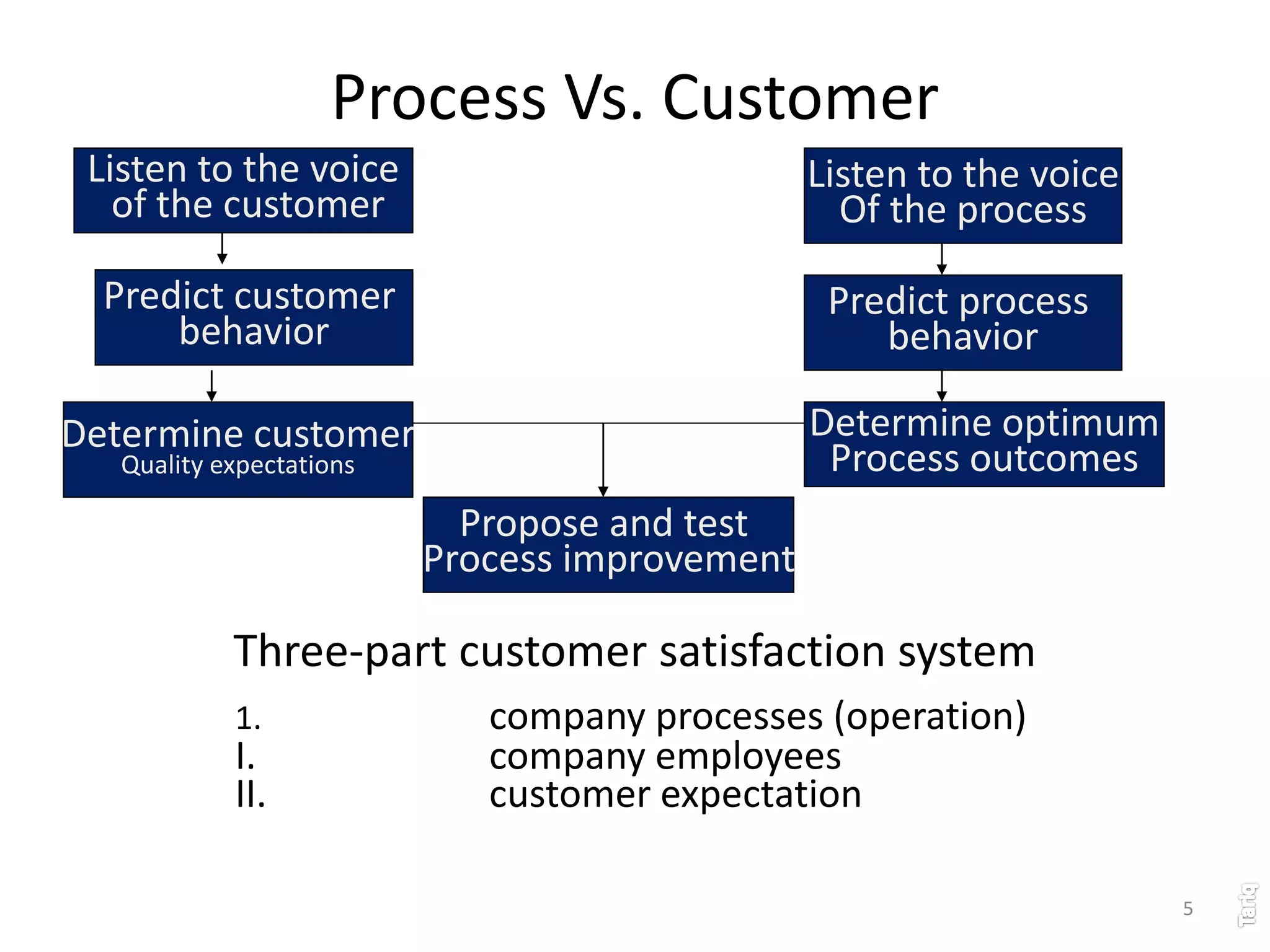
Process Vs. Customer
Three-part customer satisfaction system
1. company processes (operation)
I. company employees
II. customer expectation
Listen to the voice
of the customer
Predict customer
behavior
Determine customer
Quality expectations
Listen to the voice
Of the process
Predict process
behavior
Determine optimum
Process outcomes
Propose and test
Process improvement
Process & Customer
 Internal & External Customer Conflict.
 Defining Quality.
 Quality Focus.
 Market Break Points (Acceptance Level)
 The Driver of Customer Satisfaction:
 The Customer : The Expectations
 The Employee : What do they thin Customer
wants, the barriers to service &
recommendations for process improvement.
7
Internal Customers Conflict
• What products or services are produced?
• Who uses these products and services?
• Who do employees call, write to, or answer
questions for?
• Who supplies inputs to the process?
8
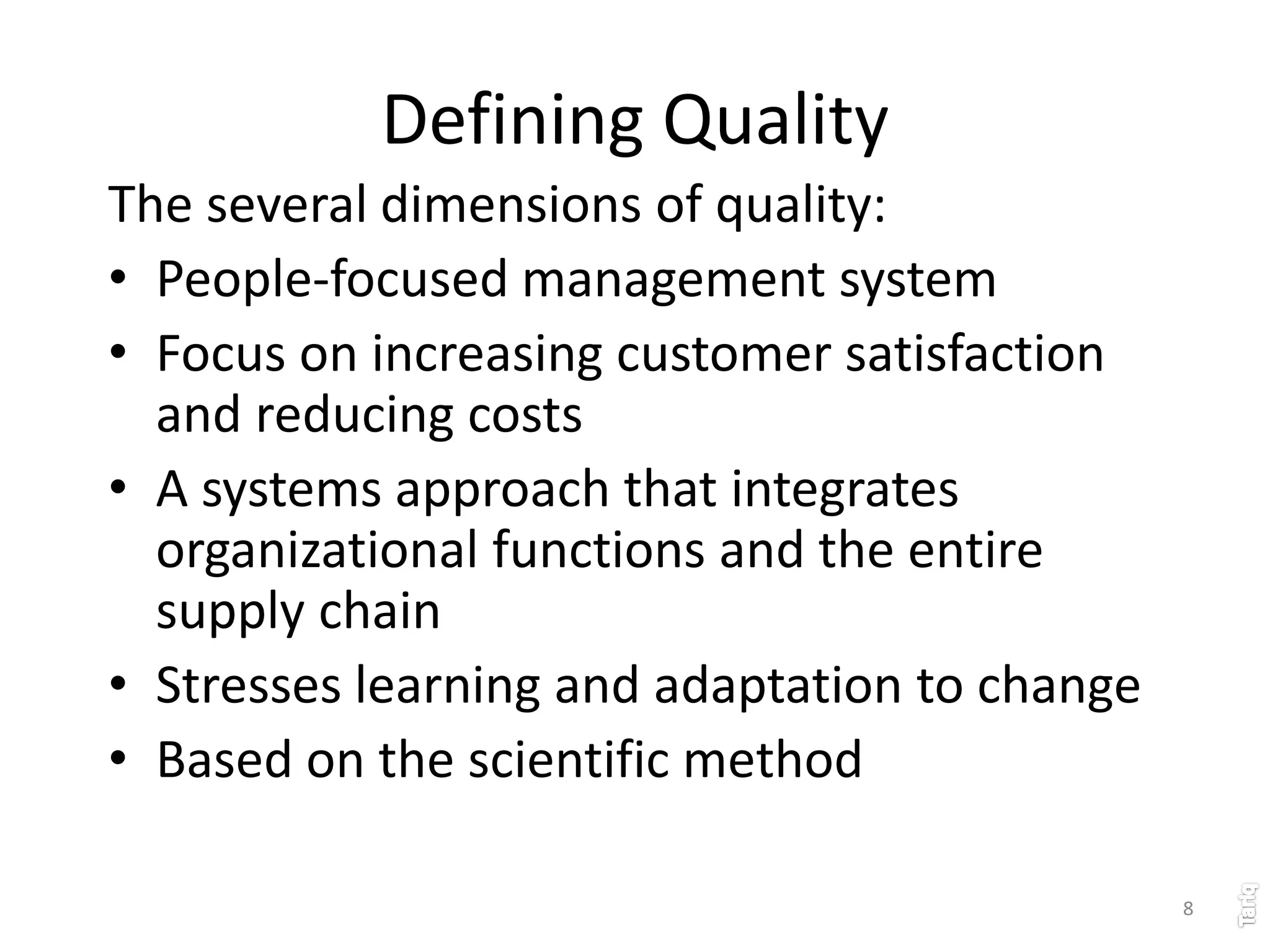
Defining Quality
The several dimensions of quality:
• People-focused management system
• Focus on increasing customer satisfaction
and reducing costs
• A systems approach that integrates
organizational functions and the entire
supply chain
• Stresses learning and adaptation to change
• Based on the scientific method
9
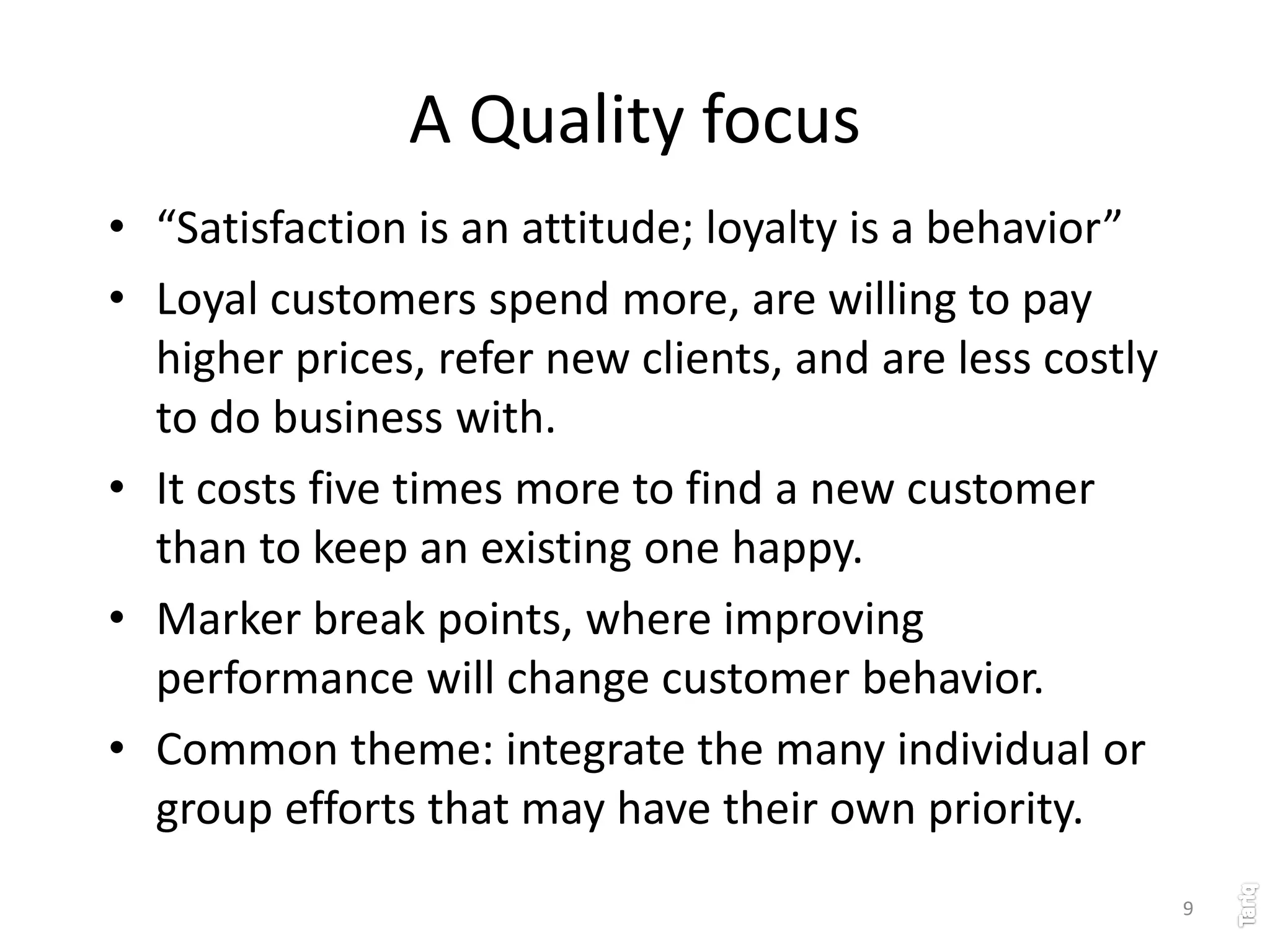
A Quality focus
• “Satisfaction is an attitude; loyalty is a behavior”
• Loyal customers spend more, are willing to pay
higher prices, refer new clients, and are less costly
to do business with.
• It costs five times more to find a new customer
than to keep an existing one happy.
• Marker break points, where improving
performance will change customer behavior.
• Common theme: integrate the many individual or
group efforts that may have their own priority.
10
A Quality Focus
Perceived
quality
Customer
complaints
Perceived
value
Customer
satisfaction
Customer
expectations Customer
loyalty
11
The Driver of Customer Satisfaction (1 of 2)
Key excellence indicators for customer satisfaction
• Service standards derived from customer requirements
• Understanding customer requirement
– Thoroughness/objectivity
– Customer types
– Product/service features
• Front-line empowerment (resolution)
• Strategic infrastructure support for front-line
employees
• Attention to hiring, training, attitude, morals for
employees
• High levels of satisfaction – customer awards
12
The Driver of Customer Satisfaction (2 of 2)
• Proactive management of relationships with
customer
• Use of all listening posts
– Surveys
– Product/service follow ups
– Complaints
– Turnover of customers
– Employees
• Quality requirements of market segments
– Survey go beyond current customers
– Commitment to customer
(trust/confidence/making good on word)
13
Reasons for Internal Quality Importance
External Customer satisfaction cannot increase unless
internal customer satisfaction does.
 No quality improvement effort can success without
employee buy-in and proactive participation.
 Focus on quality promotes a quality and
entrepreneurial Culture.
 Understanding of internal quality policy an aid in
communication and decision making.
 It is a significant criterion in Quality award.
14
Customer Retention And Profitability
Internal Service Quality
Employee Retention
External Service Quality
Customer Satisfaction
Profitability and customer Retention
Employee
Satisfaction
Customer
Retention
Profit
System
15
Service Quality And Customer Retention
Service companies measure cost of
customers who will not come back because
pf poor services. These are customer
defections and they have a substantial
impact on cost and profit. Indeed, it is
estimated that customer defections can have
a greater impact than economies of scale,
market share, or unit cost. Many companies
fail to measure defections, determine the
cause of defections, and improve the process
to reduce defections.
16
Internal Quality
Questions to be asked:
• What business processed you are involved in?
• Who is your customer?
• Who is your supplier?
• Are you meeting the expectations of your
customer?
• Are your suppliers meeting your expectations?
• How can the process be simplified and waste
eliminated
17
Buyer Supplier Relationship
• Implementation of TQM by both supplier &
customer.
• Long term commitment to TQM & to partnering
relationship between the parties.
• Reduction in supplier base.
• Get supplier involved in early stages of Research,
Development & Design.
• Benchmarking.
18
Buyer-Supplier Relationships
Requirements
and feedback
Requirements
and feedback
Your
Suppliers
Your
Processes
Your
Customers
Inputs Outputs
19
Measuring Customer Satisfaction
• Discover customer perceptions of business
effectiveness
• Compare company’s performance relative to
competitors
• Identify areas for improvement
• Track trends to determine if changes result in
improvements.
• Focus on negative aspects only.
• Complaints of Vocal few.
STEPS
• Develop Key Indicators.
• Collect data on Quality perception by customers.
20
Difficulties with Customer
Satisfaction Measurement
• Poor measurement schemes
• Failure to identify appropriate quality
dimensions
• Failure to weight dimensions appropriately
• Lack of comparison with leading competitors
• Failure to measure potential and former
customers
• Confusing loyalty with satisfaction
21
The Role Of Marketing And Sales
Marketing and sales are function charged with
gathering customer input but in many firms the
people in these function are unfamiliar with quality
improvement. Shortcomings in marketing as identified
by critics include:
• Partnering arrangement with dealers and distribution channels
• Focusing on the physical characteristics of products and
overlooking the related services
• Losing a sense of customer price sensitivity
• Not measuring or certifying suppliers such as advertisers
• Failing to perform cost/benefit analyses on promotion costs
• Losing markets to generics and house brands
22
The Sales Process
TQM become a part of sales and marketing
processes -- Selling, advertising, promoting,
innovating, distribution, pricing, and
packaging – as they relate to customer
satisfaction. sales a process that lends itself
to analysis and improvement for customer
satisfaction.
23
Getting Employee Input
• Employee input can be solicited concurrent with
customer research
• Identify barriers and solution to service and product
problem
• Serving as a customer-company interface
Employee surveys can measure
(1)TQM effectiveness (2) skill and behaviors
improvement (3) effectiveness of team problem-
solving process (4) outcomes of training (5) needs of
internal customer

TQM Chapter # 7 - Joel E. Ross

  • 1.
    TOTAL QUALITY MANAGEMENT CHAPTERNO. 7 CUSTOMER FOCUS AND SATISFACTION
  • 2.
    Quality begins andends with the customer. Joel E. Ross
  • 3.
    3 Key Customer Groups •Organization level – consumers – external customers – employees – society • Process level – internal customer units or groups • Performer level – individual internal customers
  • 4.
    Customer Satisfaction –Three Parts System
  • 5.
    5 Process Vs. Customer Three-partcustomer satisfaction system 1. company processes (operation) I. company employees II. customer expectation Listen to the voice of the customer Predict customer behavior Determine customer Quality expectations Listen to the voice Of the process Predict process behavior Determine optimum Process outcomes Propose and test Process improvement
  • 6.
    Process & Customer Internal & External Customer Conflict.  Defining Quality.  Quality Focus.  Market Break Points (Acceptance Level)  The Driver of Customer Satisfaction:  The Customer : The Expectations  The Employee : What do they thin Customer wants, the barriers to service & recommendations for process improvement.
  • 7.
    7 Internal Customers Conflict •What products or services are produced? • Who uses these products and services? • Who do employees call, write to, or answer questions for? • Who supplies inputs to the process?
  • 8.
    8 Defining Quality The severaldimensions of quality: • People-focused management system • Focus on increasing customer satisfaction and reducing costs • A systems approach that integrates organizational functions and the entire supply chain • Stresses learning and adaptation to change • Based on the scientific method
  • 9.
    9 A Quality focus •“Satisfaction is an attitude; loyalty is a behavior” • Loyal customers spend more, are willing to pay higher prices, refer new clients, and are less costly to do business with. • It costs five times more to find a new customer than to keep an existing one happy. • Marker break points, where improving performance will change customer behavior. • Common theme: integrate the many individual or group efforts that may have their own priority.
  • 10.
  • 11.
    11 The Driver ofCustomer Satisfaction (1 of 2) Key excellence indicators for customer satisfaction • Service standards derived from customer requirements • Understanding customer requirement – Thoroughness/objectivity – Customer types – Product/service features • Front-line empowerment (resolution) • Strategic infrastructure support for front-line employees • Attention to hiring, training, attitude, morals for employees • High levels of satisfaction – customer awards
  • 12.
    12 The Driver ofCustomer Satisfaction (2 of 2) • Proactive management of relationships with customer • Use of all listening posts – Surveys – Product/service follow ups – Complaints – Turnover of customers – Employees • Quality requirements of market segments – Survey go beyond current customers – Commitment to customer (trust/confidence/making good on word)
  • 13.
    13 Reasons for InternalQuality Importance External Customer satisfaction cannot increase unless internal customer satisfaction does.  No quality improvement effort can success without employee buy-in and proactive participation.  Focus on quality promotes a quality and entrepreneurial Culture.  Understanding of internal quality policy an aid in communication and decision making.  It is a significant criterion in Quality award.
  • 14.
    14 Customer Retention AndProfitability Internal Service Quality Employee Retention External Service Quality Customer Satisfaction Profitability and customer Retention Employee Satisfaction Customer Retention Profit System
  • 15.
    15 Service Quality AndCustomer Retention Service companies measure cost of customers who will not come back because pf poor services. These are customer defections and they have a substantial impact on cost and profit. Indeed, it is estimated that customer defections can have a greater impact than economies of scale, market share, or unit cost. Many companies fail to measure defections, determine the cause of defections, and improve the process to reduce defections.
  • 16.
    16 Internal Quality Questions tobe asked: • What business processed you are involved in? • Who is your customer? • Who is your supplier? • Are you meeting the expectations of your customer? • Are your suppliers meeting your expectations? • How can the process be simplified and waste eliminated
  • 17.
    17 Buyer Supplier Relationship •Implementation of TQM by both supplier & customer. • Long term commitment to TQM & to partnering relationship between the parties. • Reduction in supplier base. • Get supplier involved in early stages of Research, Development & Design. • Benchmarking.
  • 18.
    18 Buyer-Supplier Relationships Requirements and feedback Requirements andfeedback Your Suppliers Your Processes Your Customers Inputs Outputs
  • 19.
    19 Measuring Customer Satisfaction •Discover customer perceptions of business effectiveness • Compare company’s performance relative to competitors • Identify areas for improvement • Track trends to determine if changes result in improvements. • Focus on negative aspects only. • Complaints of Vocal few. STEPS • Develop Key Indicators. • Collect data on Quality perception by customers.
  • 20.
    20 Difficulties with Customer SatisfactionMeasurement • Poor measurement schemes • Failure to identify appropriate quality dimensions • Failure to weight dimensions appropriately • Lack of comparison with leading competitors • Failure to measure potential and former customers • Confusing loyalty with satisfaction
  • 21.
    21 The Role OfMarketing And Sales Marketing and sales are function charged with gathering customer input but in many firms the people in these function are unfamiliar with quality improvement. Shortcomings in marketing as identified by critics include: • Partnering arrangement with dealers and distribution channels • Focusing on the physical characteristics of products and overlooking the related services • Losing a sense of customer price sensitivity • Not measuring or certifying suppliers such as advertisers • Failing to perform cost/benefit analyses on promotion costs • Losing markets to generics and house brands
  • 22.
    22 The Sales Process TQMbecome a part of sales and marketing processes -- Selling, advertising, promoting, innovating, distribution, pricing, and packaging – as they relate to customer satisfaction. sales a process that lends itself to analysis and improvement for customer satisfaction.
  • 23.
    23 Getting Employee Input •Employee input can be solicited concurrent with customer research • Identify barriers and solution to service and product problem • Serving as a customer-company interface Employee surveys can measure (1)TQM effectiveness (2) skill and behaviors improvement (3) effectiveness of team problem- solving process (4) outcomes of training (5) needs of internal customer