1
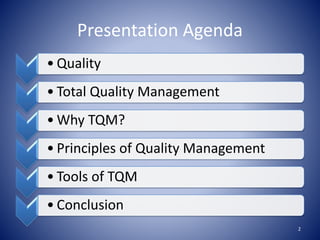
Presentation Agenda
• Quality
• Total Quality Management
• Why TQM?
• Principles of Quality Management
• Tools of TQM
• Conclusion
2
Quality
• Sum total of features .
• Satisfies Need.
• Subjective in nature.
• Dimensions – Performance, Reliability, Serviceability,
Appearance, Safety, etc.
3
Total Quality Management
Aims to hold all parties involved in the production process
accountable for overall product quality.
Reducing errors in manufacturing, streamlining SCM,
improving customer experience, etc.
A continuous process for managing quality and perpetual
improvement.
4
Why TQM?
Make an organisation more competitive.
New culture which will enable growth and
longevity.
Working environment where everyone can
succeed.
Reduce stress, waste and friction.
Build teams, partnerships and co-operation.
5
Principles of Quality Management
Customer focused
organisation
Involvement of people
System Approach
Leadership
Process Approach
Continual Improvement
Factual Approach
Mutually Beneficial
Supplier Relationships
6
Tools
of
TQM
7
Statistical Control Chart
- Study how a process changes over time.
- Data are plotted in time order.
- Has a central line for average, an upper line for upper control
limit and a lower line for lower limit.
- Lines are determined from historical data.
- Compare current data to these lines and get conclusion
whether the variation is consistent or is unpredictable.
Upper Control Limit
Lower Control Limit
8
Acceptance Sampling
A statistical technique used to take
a decision regarding acceptance or
rejection of a lot without having to
examine the entire lot.
9
Six Sigma
Goal of near perfection in meeting
customer requirements.
Cultural change effort for greater
customer, satisfaction, profitability and
competitiveness.
Driven by close understanding of
customer needs, disciplined use of facts,
data, statistical analysis.
Diligent attention to managing, improving
and reinventing business processes.
10
Define
Measure
Analyze
Design
Validate
Improve
Control
Continuous Improvement Reengineering
Six Sigma Improvement Methods
DMAIC DMADV
11
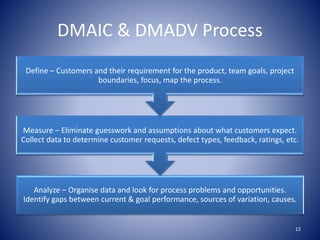
DMAIC & DMADV Process
Analyze – Organise data and look for process problems and opportunities.
Identify gaps between current & goal performance, sources of variation, causes.
Measure – Eliminate guesswork and assumptions about what customers expect.
Collect data to determine customer requests, defect types, feedback, ratings, etc.
Define – Customers and their requirement for the product, team goals, project
boundaries, focus, map the process.
12
DMAIC
Improve – Generate
solutions to fix problems
by correcting root causes
with innovation,
technology & discipline.
Control – Insure
improvements once
implemented ‘’hold the
gains’’ rather than revert
the problem.
13
DMADV
Design
• Develop detailed design for new
process. Create control & testing plan
for new design. Use tools such as
simulation, benchmarking, etc.
Validate
• Test design with pilot implementation.
If successful, develop & execute on full
scale. Tools – flowcharts, work
documentation, etc.
14
Benchmarking
• A method for identifying and
importing best practices in order to
improve performance.
• The process of learning, adapting,
and measuring outstanding practices
and processes from any organization
to improve performance.
15
Business Process Reengineering
It involves radical redesign of core business
processes to improve productivity.
Companies start with a blank sheet and rethink to
adopt a new value system with increased emphasis
on customer needs.
Two key areas – Redesign functional organizations
into cross-functional teams & use technology to
improve data dissemination & decision making.
16
Kaizen
System of continuous improvement in quality,
technology, processes, culture, productivity, safety,
etc.
It involves setting standards and then continually
improving those standards. To support the higher
standards Kaizen also involves providing the
training, materials and supervision.
Quality circles, automation, suggestion systems,
just-in-time delivery, Kanban and 5S are all
included within the Kaizen system of running a
business.
17
Kanban
Kanban is a visual signal that’s used to
trigger an action. Roughly translated, it
means “card you can see.”
Kanban is a card with an inventory
number that’s attached to a part. Right
before the part is installed, the kanban
card is detached and sent up the supply
chain as a request for another part.
18
Quality Circles
Quality Circles are small, voluntary groups of
employees set up to meet periodically for a specific
purpose.
Pinpointing, examining, analyzing and solving problems
in areas including knowledge management, innovation,
work relations, quality, productivity, safety, cost, etc.
Enhancing communication between employees and
management on the above areas.
19
Quality Certification
A certification mark certifies the nature or
origin of the goods or services to which it has
been applied.
For example: region or location or origin,
materials of construction, method or mode
of manufacture or provision, quality
assurance, etc.
Some certifications are: ISO 9000, ISO
9001:2000, ISI mark, Agmark, BIS Hallmark,
etc.
20
Conclusion
TQM has become a vital cornerstone to gain a
competitive edge, productivity and high
customer satisfaction.
21
Thank
You
22

Total Quality Management

  • 1.
  • 2.
    Presentation Agenda • Quality •Total Quality Management • Why TQM? • Principles of Quality Management • Tools of TQM • Conclusion 2
  • 3.
    Quality • Sum totalof features . • Satisfies Need. • Subjective in nature. • Dimensions – Performance, Reliability, Serviceability, Appearance, Safety, etc. 3
  • 4.
    Total Quality Management Aimsto hold all parties involved in the production process accountable for overall product quality. Reducing errors in manufacturing, streamlining SCM, improving customer experience, etc. A continuous process for managing quality and perpetual improvement. 4
  • 5.
    Why TQM? Make anorganisation more competitive. New culture which will enable growth and longevity. Working environment where everyone can succeed. Reduce stress, waste and friction. Build teams, partnerships and co-operation. 5
  • 6.
    Principles of QualityManagement Customer focused organisation Involvement of people System Approach Leadership Process Approach Continual Improvement Factual Approach Mutually Beneficial Supplier Relationships 6
  • 7.
  • 8.
    Statistical Control Chart -Study how a process changes over time. - Data are plotted in time order. - Has a central line for average, an upper line for upper control limit and a lower line for lower limit. - Lines are determined from historical data. - Compare current data to these lines and get conclusion whether the variation is consistent or is unpredictable. Upper Control Limit Lower Control Limit 8
  • 9.
    Acceptance Sampling A statisticaltechnique used to take a decision regarding acceptance or rejection of a lot without having to examine the entire lot. 9
  • 10.
    Six Sigma Goal ofnear perfection in meeting customer requirements. Cultural change effort for greater customer, satisfaction, profitability and competitiveness. Driven by close understanding of customer needs, disciplined use of facts, data, statistical analysis. Diligent attention to managing, improving and reinventing business processes. 10
  • 11.
  • 12.
    DMAIC & DMADVProcess Analyze – Organise data and look for process problems and opportunities. Identify gaps between current & goal performance, sources of variation, causes. Measure – Eliminate guesswork and assumptions about what customers expect. Collect data to determine customer requests, defect types, feedback, ratings, etc. Define – Customers and their requirement for the product, team goals, project boundaries, focus, map the process. 12
  • 13.
    DMAIC Improve – Generate solutionsto fix problems by correcting root causes with innovation, technology & discipline. Control – Insure improvements once implemented ‘’hold the gains’’ rather than revert the problem. 13
  • 14.
    DMADV Design • Develop detaileddesign for new process. Create control & testing plan for new design. Use tools such as simulation, benchmarking, etc. Validate • Test design with pilot implementation. If successful, develop & execute on full scale. Tools – flowcharts, work documentation, etc. 14
  • 15.
    Benchmarking • A methodfor identifying and importing best practices in order to improve performance. • The process of learning, adapting, and measuring outstanding practices and processes from any organization to improve performance. 15
  • 16.
    Business Process Reengineering Itinvolves radical redesign of core business processes to improve productivity. Companies start with a blank sheet and rethink to adopt a new value system with increased emphasis on customer needs. Two key areas – Redesign functional organizations into cross-functional teams & use technology to improve data dissemination & decision making. 16
  • 17.
    Kaizen System of continuousimprovement in quality, technology, processes, culture, productivity, safety, etc. It involves setting standards and then continually improving those standards. To support the higher standards Kaizen also involves providing the training, materials and supervision. Quality circles, automation, suggestion systems, just-in-time delivery, Kanban and 5S are all included within the Kaizen system of running a business. 17
  • 18.
    Kanban Kanban is avisual signal that’s used to trigger an action. Roughly translated, it means “card you can see.” Kanban is a card with an inventory number that’s attached to a part. Right before the part is installed, the kanban card is detached and sent up the supply chain as a request for another part. 18
  • 19.
    Quality Circles Quality Circlesare small, voluntary groups of employees set up to meet periodically for a specific purpose. Pinpointing, examining, analyzing and solving problems in areas including knowledge management, innovation, work relations, quality, productivity, safety, cost, etc. Enhancing communication between employees and management on the above areas. 19
  • 20.
    Quality Certification A certificationmark certifies the nature or origin of the goods or services to which it has been applied. For example: region or location or origin, materials of construction, method or mode of manufacture or provision, quality assurance, etc. Some certifications are: ISO 9000, ISO 9001:2000, ISI mark, Agmark, BIS Hallmark, etc. 20
  • 21.
    Conclusion TQM has becomea vital cornerstone to gain a competitive edge, productivity and high customer satisfaction. 21
  • 22.