TOTAL QUALITY MANAGEMENT
CHAPTER NO. 5
HRD & MANAGEMENT
INVOLVEMENT:
It is the concept of intrinsic motivation i.e.
Involvement Decision Making. Employee
involvement is the process of empowering
numbers of an organization to make
decisions & to solve problems appropriate
to their level in the organization.
TRAINING & DEVELOPMENT
Increase involvement means more responsibility which requires high skill
level. This can be achieved through training.
ADDITIONAL BENEFITS:
1. Improved Communication
2. Change of Corporate Culture
3. Demonstration of Management Commitment to Quality
TRAINING CATEGORIES:
1. Reinforcement of quality message & basic skill remedial.
2. Job Skill requirement.
3. Knowledge about principle of TQM which includes
Problem Solving techniques, Problem Analysis, Statistical Process
Quality, Quality Measurement Group Process & Group Decision Making.
TRAINING & DEVELOPMENT
1. Quality Awareness.
2. Quality Measurement.
3. Process Management & Defect Prevention.
4. Team Building & Quality Circle Training.
5. Focus on Customer & Markets
6. Statistics & Statistical Methods
7. Taguchi Methods
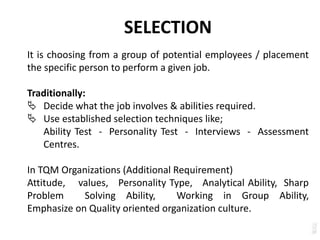
SELECTION
It is choosing from a group of potential employees / placement
the specific person to perform a given job.
Traditionally:
 Decide what the job involves & abilities required.
 Use established selection techniques like;
Ability Test - Personality Test - Interviews - Assessment
Centres.
In TQM Organizations (Additional Requirement)
Attitude, values, Personality Type, Analytical Ability, Sharp
Problem Solving Ability, Working in Group Ability,
Emphasize on Quality oriented organization culture.
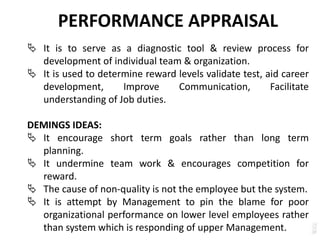
PERFORMANCE APPRAISAL
 It is to serve as a diagnostic tool & review process for
development of individual team & organization.
 It is used to determine reward levels validate test, aid career
development, Improve Communication, Facilitate
understanding of Job duties.
DEMINGS IDEAS:
 It encourage short term goals rather than long term
planning.
 It undermine team work & encourages competition for
reward.
 The cause of non-quality is not the employee but the system.
 It is attempt by Management to pin the blame for poor
organizational performance on lower level employees rather
than system which is responding of upper Management.
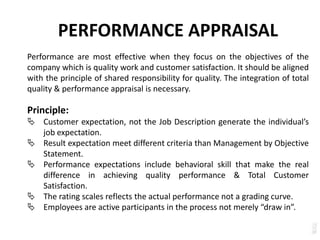
PERFORMANCE APPRAISAL
Performance are most effective when they focus on the objectives of the
company which is quality work and customer satisfaction. It should be aligned
with the principle of shared responsibility for quality. The integration of total
quality & performance appraisal is necessary.
Principle:
 Customer expectation, not the Job Description generate the individual’s
job expectation.
 Result expectation meet different criteria than Management by Objective
Statement.
 Performance expectations include behavioral skill that make the real
difference in achieving quality performance & Total Customer
Satisfaction.
 The rating scales reflects the actual performance not a grading curve.
 Employees are active participants in the process not merely “draw in”.
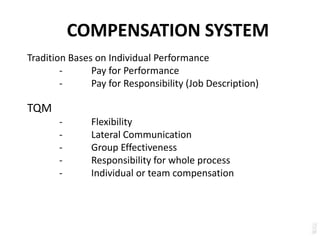
COMPENSATION SYSTEM
Tradition Bases on Individual Performance
- Pay for Performance
- Pay for Responsibility (Job Description)
TQM
- Flexibility
- Lateral Communication
- Group Effectiveness
- Responsibility for whole process
- Individual or team compensation

TQM Chapter 5 - Joel E. Ross

  • 1.
    TOTAL QUALITY MANAGEMENT CHAPTERNO. 5 HRD & MANAGEMENT
  • 2.
    INVOLVEMENT: It is theconcept of intrinsic motivation i.e. Involvement Decision Making. Employee involvement is the process of empowering numbers of an organization to make decisions & to solve problems appropriate to their level in the organization.
  • 3.
    TRAINING & DEVELOPMENT Increaseinvolvement means more responsibility which requires high skill level. This can be achieved through training. ADDITIONAL BENEFITS: 1. Improved Communication 2. Change of Corporate Culture 3. Demonstration of Management Commitment to Quality TRAINING CATEGORIES: 1. Reinforcement of quality message & basic skill remedial. 2. Job Skill requirement. 3. Knowledge about principle of TQM which includes Problem Solving techniques, Problem Analysis, Statistical Process Quality, Quality Measurement Group Process & Group Decision Making.
  • 4.
    TRAINING & DEVELOPMENT 1.Quality Awareness. 2. Quality Measurement. 3. Process Management & Defect Prevention. 4. Team Building & Quality Circle Training. 5. Focus on Customer & Markets 6. Statistics & Statistical Methods 7. Taguchi Methods
  • 5.
    SELECTION It is choosingfrom a group of potential employees / placement the specific person to perform a given job. Traditionally:  Decide what the job involves & abilities required.  Use established selection techniques like; Ability Test - Personality Test - Interviews - Assessment Centres. In TQM Organizations (Additional Requirement) Attitude, values, Personality Type, Analytical Ability, Sharp Problem Solving Ability, Working in Group Ability, Emphasize on Quality oriented organization culture.
  • 6.
    PERFORMANCE APPRAISAL  Itis to serve as a diagnostic tool & review process for development of individual team & organization.  It is used to determine reward levels validate test, aid career development, Improve Communication, Facilitate understanding of Job duties. DEMINGS IDEAS:  It encourage short term goals rather than long term planning.  It undermine team work & encourages competition for reward.  The cause of non-quality is not the employee but the system.  It is attempt by Management to pin the blame for poor organizational performance on lower level employees rather than system which is responding of upper Management.
  • 7.
    PERFORMANCE APPRAISAL Performance aremost effective when they focus on the objectives of the company which is quality work and customer satisfaction. It should be aligned with the principle of shared responsibility for quality. The integration of total quality & performance appraisal is necessary. Principle:  Customer expectation, not the Job Description generate the individual’s job expectation.  Result expectation meet different criteria than Management by Objective Statement.  Performance expectations include behavioral skill that make the real difference in achieving quality performance & Total Customer Satisfaction.  The rating scales reflects the actual performance not a grading curve.  Employees are active participants in the process not merely “draw in”.
  • 8.
    COMPENSATION SYSTEM Tradition Baseson Individual Performance - Pay for Performance - Pay for Responsibility (Job Description) TQM - Flexibility - Lateral Communication - Group Effectiveness - Responsibility for whole process - Individual or team compensation