Chapter 2 Section 2
Bodies of Water
And
Landforms
I. Bodies of Water
A.Ocean Motion
1. The ocean circulates through currents, waves,
tides.
2. Currents act like rivers flowing through the ocean.
3. Waves are swells or ridges produced by winds.
4. Tides are the regular rising and falling of the
ocean
a. created by gravitational pull of the moon or
sun.
5. Motion of ocean helps distribute heat on the
planet.
a. winds are heated and cooled by ocean water.
B. Hydrologic Cycle
1. Hydrologic Cycle—cycle of water between
atmosphere, oceans, earth
C. Lakes, Rivers, and Streams
1. Lakes hold more than 95% of the earth’s fresh
water.
2. Freshwater lakes, like the Great Lakes, are result of
glacial action.
3. Saltwater lakes form when outlet to sea is cut off:
a. streams and rivers carry salts into lake.
b. salts build up with nowhere to go.
4. Rivers and streams carry water to and from
larger bodies of water.
5. Tributaries are smaller rivers, streams that
feed into larger ones.
6. Drainage basin—area drained by river and
its tributaries.
D. Ground Water
1. Ground water—water held in the pores of
rock.
2. Water table—level at which the rock is
saturated.
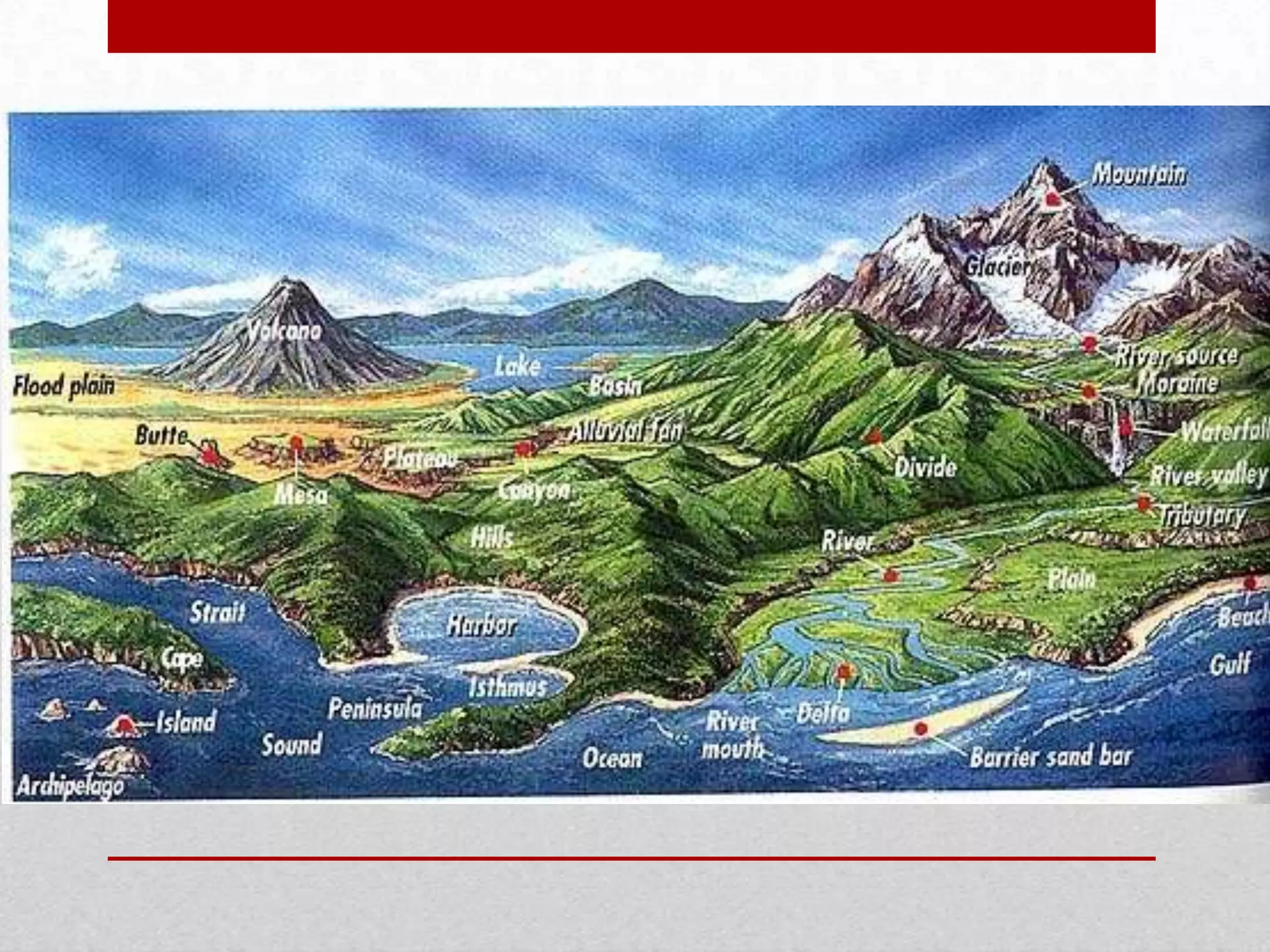
E.Landforms
1. Landforms are naturally formed features on
Earth’s surface
F.Oceanic Landforms
1. Continental shelf—sea floor from continent’s
edge to deep ocean.
2. Sea floor has ridges, valleys, canyons, plains,
mountain ranges.
3. Islands are formed by volcanoes, sand, or coral
deposits.
Chapter 2 section 2

Chapter 2 section 2

  • 1.
    Chapter 2 Section2 Bodies of Water And Landforms
  • 2.
    I. Bodies ofWater A.Ocean Motion 1. The ocean circulates through currents, waves, tides. 2. Currents act like rivers flowing through the ocean. 3. Waves are swells or ridges produced by winds. 4. Tides are the regular rising and falling of the ocean a. created by gravitational pull of the moon or sun. 5. Motion of ocean helps distribute heat on the planet. a. winds are heated and cooled by ocean water.
  • 3.
    B. Hydrologic Cycle 1.Hydrologic Cycle—cycle of water between atmosphere, oceans, earth C. Lakes, Rivers, and Streams 1. Lakes hold more than 95% of the earth’s fresh water. 2. Freshwater lakes, like the Great Lakes, are result of glacial action. 3. Saltwater lakes form when outlet to sea is cut off: a. streams and rivers carry salts into lake. b. salts build up with nowhere to go.
  • 4.
    4. Rivers andstreams carry water to and from larger bodies of water. 5. Tributaries are smaller rivers, streams that feed into larger ones. 6. Drainage basin—area drained by river and its tributaries. D. Ground Water 1. Ground water—water held in the pores of rock. 2. Water table—level at which the rock is saturated.
  • 5.
    E.Landforms 1. Landforms arenaturally formed features on Earth’s surface F.Oceanic Landforms 1. Continental shelf—sea floor from continent’s edge to deep ocean. 2. Sea floor has ridges, valleys, canyons, plains, mountain ranges. 3. Islands are formed by volcanoes, sand, or coral deposits.