Physical Geography of the United States and Canada:
A Land of Contrasts
North America’s vast and varied landscape and
abundant resources have attracted immigrants and
shaped the development of the United States and
Canada.
NEXT
SECTION 1 Landforms and Resources
SECTION 2 Climate and Vegetation
Physical Geography
Looking at the Earth
NEXT
SECTION 3 Human-Environment Interaction
NEXT
Section 1
Landforms and
Resources
• The United States and Canada have vast
lands and abundant resources.
• These two countries share many of the same
landforms.
Landscape Influenced Development
Anglo America
• U.S., Canada: former British colonies, most people
speak English
• Strong economic and political ties with one another
Landforms and Resources
SECTION
1
NEXT
Continued . . .
Vast Lands
• Canada second largest country in the world by area;
U.S. third
• Together they cover one-eighth of the earth’s land
surface
SECTION
1
NEXT
Abundant Resources
• Landmass and natural resources attract immigrants
to both countries
• U.S. and Canada have developed into global
economic powers
continued Landscape Influenced Development
Many and Varied Landforms
Major Landforms
• All major landforms are found in U.S. and Canada
• The two countries share mountain chains and
interior plains
SECTION
1
NEXT
Continued . . .
The Eastern Lowlands
• Atlantic Coastal Plain extends from Delaware down
to Florida
• Gulf Coastal Plain goes from Florida, along Gulf of
Mexico, to Texas
• Piedmont—low plateau between coastal plains,
Appalachian Highlands
SECTION
1
NEXT
The Appalachian Highlands
• Appalachian Mountains run 1,600 miles from
Newfoundland to Alabama
- include Green and Catskill mountains in the
north
- Blue Ridge and Great Smoky mountains in
the south
• More than 400 million years old
• Erosion has created gentle slopes, peaks from
1,200–2,400 feet
• The Appalachian Trail is a scenic hiking path along
the chain
continued Many and Varied Landforms
Continued . . .
SECTION
1
NEXT
The Interior Lowlands
• Glaciers leveled the land, left fertile soil
• Interior Plains extend from Appalachians to
Missouri River
• Great Plains extend from Missouri River to
Rocky Mountains
• Canadian Shield—vast, flat area around Hudson
Bay
continued Many and Varied Landforms
Continued . . .
SECTION
1
NEXT
The Western Mountains, Plateaus, and
Basins
• Rocky Mountains run 3,000 miles from Alaska to
New Mexico
• Relatively young: 80 million years old
• Less erosion means rugged, 12,000-foot, snow-
covered peaks
• Continental Divide—the line of highest points along
the Rockies
- separates rivers that flow eastward from those
that flow westward
continued Many and Varied Landforms
Continued . . .
The Western Mountains, Plateaus, and Basins
• Other Pacific mountain ranges: Sierra Nevada,
Cascade
• Continent’s highest peak: Mt. McKinley in Alaska
• Major earthquake activity in Pacific ranges
• Between ranges and Rockies: cliffs, canyons, basins
(low desert)
SECTION
1
NEXT
continued Many and Varied Landforms
The Islands
• Canada’s large, northern islands: Ellesmere,
Victoria, Baffin
• U.S.: Aleutians (Alaska), Hawaiian (politically, not
geographically)
Resources Shape Ways of Life
Oceans and Waterways
• U.S. and Canada are bounded by:
- Atlantic, Pacific, Arctic oceans
- Gulf of Mexico
• Countries have many large, inland rivers and lakes
that provide:
- transportation, hydroelectric power, irrigation,
fresh water, fisheries
SECTION
1
NEXT
Continued . . .
SECTION
1
NEXT
Oceans and Waterways
• Great Lakes: Huron, Ontario, Michigan, Erie,
and Superior
• Mississippi-Missouri-Ohio river system:
continent’s longest, busiest
• Mackenzie River: longest in Canada, crosses
Northwest Territories
continued Resources Shape Ways of Life
Continued . . .
SECTION
1
NEXT
Land and Forests
• Fertile soil helps make North America world’s
leading food exporter
• Large forests yield lumber and other products
Minerals and Fossil Fuels
• Mineral quantity and variety make rapid
industrialization possible
- Canadian Shield: iron ore, nickel, copper,
gold, uranium
- Appalachians, Great Plains: coal
- Gulf of Mexico: oil, natural gas
• U.S.: biggest energy consumer; gets most of
Canada’s energy exports
continued Resources Shape Ways of Life
NEXT
Section 2
Climate and Vegetation
• Almost every type of climate is found in the
50 United States because they extend over
such a large area north to south.
• Canada’s cold climate is related to its
location in the far northern latitudes.
Shared Climates and Vegetation
U.S. and Canada Climates
• U.S. has more climate zones than Canada
• U.S.: moderate mid-latitudes, Canada: colder high
latitudes
Climate and Vegetation
SECTION
2
NEXT
Continued . . .
Colder Climates
• Arctic coast is tundra: huge, treeless plain with long,
cold winters
- some permafrost—permanently frozen ground
• Rockies and Pacific ranges are highland: colder,
sparse vegetation
- affect weather in lower areas: block Arctic air, trap
Pacific moisture
SECTION
2
NEXT
Moderate Climates
• North central, northeast U.S, southern Canada
are humid continental
- cold winters; warm summers; heavy agriculture
• Pacific coast has marine west coast climate
- warm summers; long, mild, rainy winters;
mixed vegetation
- climate affected by ocean currents, coastal
mountains, westerlies
- prevailing westerlies—middle-latitude winds
blowing west to east
continued Shared Climates and Vegetation
Differences in Climate and Vegetation
Milder Climates
• Much of U.S. located south of 40 degrees N latitude
- milder, dry, and tropical climates
• Southern states are humid subtropical
- hot summers; mild winters; long growing season
for variety of crops
• Central, southern California coasts have
Mediterranean climate
- dry, warm summers; mild, rainy winters; fruits,
vegetables grow well
SECTION
2
Continued . . .
NEXT
SECTION
2
NEXT
Dry Climates
• Great Plains, northern Great Basin semiarid: dry
with short grasses
• Southwest is hot, dry desert, including Mojave
and Sonoran deserts
continued Differences in Climate and Vegetation
Tropical Climates
• Hawaii is tropical wet: rain forests, temps around 70
degrees F
- Mount Waialeale on Kauai Island is one of the
wettest spots on earth
• South Florida is tropical wet and dry: warm with tall
grasses
- Everglades—swampland covering 4,000
square miles
Effects of Extreme Weather
Natural Hazards
• Warm Gulf air clashes with cold Canadian air over
the Great Plains
- creates thunderstorms, tornadoes, blizzards
• Hurricanes sweep the Gulf and Atlantic coasts in
summer and fall
• Heavy rains cause floods along big rivers like the
Mississippi
• Heat, lack of rain bring droughts, dust storms, forest
fires
SECTION
2
NEXT
NEXT
Section 3
Human-Environment
Interaction
• Humans have dramatically changed the
face of North America.
• European settlements in the United States
and Canada expanded from east to west.
Settlement and Agriculture Alter the Land
Settlement
• Before humans, land changed due to natural forces:
weather, erosion
• Human settlers adapted to, and changed, the
environment
• First North Americans were nomads, moving from
place to place
- migrated from Asia over Beringia, a land bridge
from Siberia to Alaska
- hunted, fished, and gathered plants; settled near
rivers and streams
Human-Environment Interaction
SECTION
3
NEXT
Continued . . .
SECTION
3
NEXT
Agriculture
• Agriculture replaced hunting and gathering
3,000 years ago
• Settlements became permanent
- cut down trees for houses, plow fields, dig
irrigation ditches
- plant corn, beans, squash
• Today U.S. and Canada are leading agriculture
exporters
continued Settlement and Agriculture Alter the Land
Building Cities
Where Cities Grow
• Water access a major factor in how towns begin,
develop
• Other factors: landscape, climate, weather, natural
resources
SECTION
3
NEXT
Continued . . .
Montreal—Adapting to the Weather
• Canada’s second-largest city; major port located on
island in Quebec
- meeting of St. Lawrence and Ottawa rivers make it
important trade site
• French build permanent settlement in 1642 at base
of Mount Royal
• Cold winters force people to stay inside and build
underground areas
SECTION
3
NEXT
Los Angeles—Creating Urban Sprawl
• Mild climate and the ocean bring thousands to
area in early 1900s
- once-small Spanish settlement expanded into
valleys and foothills
• Becomes U.S.’s second-largest city in 1980s
- problems: air pollution, low water supply,
earthquake area
• Los Angeles has spread out over a large area
- city proper: 469 square miles; metropolitan
area: 4,060 square miles
continued Building Cities
Overcoming Distances
Trails and Inland Waterways
• First natives go east, south down Pacific coast;
some remain north
• Europeans colonize the east coast then go inland,
creating trails
- national and Wilderness roads, Oregon and Santa
Fe trails
- use Mississippi and Ohio rivers; build canals
- Erie Canal—first navigable water link between
Atlantic, Great Lakes
SECTION
3
NEXT
Continued . . .
SECTION
3
NEXT
Trails and Inland Waterways
• St. Lawrence Seaway—deepwater ship route
built by U.S. and Canada
• Connects Great Lakes to Atlantic by way of St.
Lawrence River
• Gated-off sections called locks raise and lower
the water and ships
• Large ocean vessels can get to industrial and
agricultural heartland
continued Overcoming Distances
Continued . . .
SECTION
3
NEXT
Transcontinental Railroads
• Transcontinental—from the Atlantic Ocean to
the Pacific Ocean
• Builders of early-1800s railroads face many
natural barriers
- workers cut down forests, bridge streams,
tunnel through mountains
• First U.S. transcontinental railroad: 1860; first
Canadian: 1885
• Move goods, people; promote economic
development, national unity
• Today U.S. has world’s largest rail system;
Canada, third largest
continued Overcoming Distances
Continued . . .
SECTION
3
NEXT
National Highway Systems
• Arrival of automobile spurs roadbuilding in early
20th
century
• Today U.S. has 4 million miles of roads, Canada
has 560,000 miles
• Large Canadian highways connect major southern
cities from east to west
- Trans-Canada Highway: 4,860 miles,
Newfoundland to British Columbia
• U.S. interstate highway system: 46,000-mile
network begun in 1950s
continued Overcoming Distances
NEXT
This is the end of the chapter presentation of
lecture notes. Click the HOME or EXIT button.
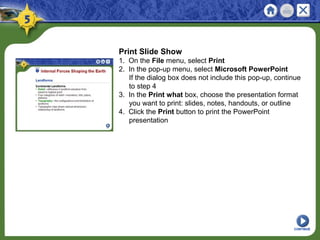
Print Slide Show
1. On the File menu, select Print
2. In the pop-up menu, select Microsoft PowerPoint
If the dialog box does not include this pop-up, continue
to step 4
3. In the Print what box, choose the presentation format
you want to print: slides, notes, handouts, or outline
4. Click the Print button to print the PowerPoint
presentation
CONTINUE

Chapter 5

  • 1.
    Physical Geography ofthe United States and Canada: A Land of Contrasts North America’s vast and varied landscape and abundant resources have attracted immigrants and shaped the development of the United States and Canada. NEXT
  • 2.
    SECTION 1 Landformsand Resources SECTION 2 Climate and Vegetation Physical Geography Looking at the Earth NEXT SECTION 3 Human-Environment Interaction
  • 3.
    NEXT Section 1 Landforms and Resources •The United States and Canada have vast lands and abundant resources. • These two countries share many of the same landforms.
  • 4.
    Landscape Influenced Development AngloAmerica • U.S., Canada: former British colonies, most people speak English • Strong economic and political ties with one another Landforms and Resources SECTION 1 NEXT Continued . . . Vast Lands • Canada second largest country in the world by area; U.S. third • Together they cover one-eighth of the earth’s land surface
  • 5.
    SECTION 1 NEXT Abundant Resources • Landmassand natural resources attract immigrants to both countries • U.S. and Canada have developed into global economic powers continued Landscape Influenced Development
  • 6.
    Many and VariedLandforms Major Landforms • All major landforms are found in U.S. and Canada • The two countries share mountain chains and interior plains SECTION 1 NEXT Continued . . . The Eastern Lowlands • Atlantic Coastal Plain extends from Delaware down to Florida • Gulf Coastal Plain goes from Florida, along Gulf of Mexico, to Texas • Piedmont—low plateau between coastal plains, Appalachian Highlands
  • 7.
    SECTION 1 NEXT The Appalachian Highlands •Appalachian Mountains run 1,600 miles from Newfoundland to Alabama - include Green and Catskill mountains in the north - Blue Ridge and Great Smoky mountains in the south • More than 400 million years old • Erosion has created gentle slopes, peaks from 1,200–2,400 feet • The Appalachian Trail is a scenic hiking path along the chain continued Many and Varied Landforms Continued . . .
  • 8.
    SECTION 1 NEXT The Interior Lowlands •Glaciers leveled the land, left fertile soil • Interior Plains extend from Appalachians to Missouri River • Great Plains extend from Missouri River to Rocky Mountains • Canadian Shield—vast, flat area around Hudson Bay continued Many and Varied Landforms Continued . . .
  • 9.
    SECTION 1 NEXT The Western Mountains,Plateaus, and Basins • Rocky Mountains run 3,000 miles from Alaska to New Mexico • Relatively young: 80 million years old • Less erosion means rugged, 12,000-foot, snow- covered peaks • Continental Divide—the line of highest points along the Rockies - separates rivers that flow eastward from those that flow westward continued Many and Varied Landforms Continued . . .
  • 10.
    The Western Mountains,Plateaus, and Basins • Other Pacific mountain ranges: Sierra Nevada, Cascade • Continent’s highest peak: Mt. McKinley in Alaska • Major earthquake activity in Pacific ranges • Between ranges and Rockies: cliffs, canyons, basins (low desert) SECTION 1 NEXT continued Many and Varied Landforms The Islands • Canada’s large, northern islands: Ellesmere, Victoria, Baffin • U.S.: Aleutians (Alaska), Hawaiian (politically, not geographically)
  • 11.
    Resources Shape Waysof Life Oceans and Waterways • U.S. and Canada are bounded by: - Atlantic, Pacific, Arctic oceans - Gulf of Mexico • Countries have many large, inland rivers and lakes that provide: - transportation, hydroelectric power, irrigation, fresh water, fisheries SECTION 1 NEXT Continued . . .
  • 12.
    SECTION 1 NEXT Oceans and Waterways •Great Lakes: Huron, Ontario, Michigan, Erie, and Superior • Mississippi-Missouri-Ohio river system: continent’s longest, busiest • Mackenzie River: longest in Canada, crosses Northwest Territories continued Resources Shape Ways of Life Continued . . .
  • 13.
    SECTION 1 NEXT Land and Forests •Fertile soil helps make North America world’s leading food exporter • Large forests yield lumber and other products Minerals and Fossil Fuels • Mineral quantity and variety make rapid industrialization possible - Canadian Shield: iron ore, nickel, copper, gold, uranium - Appalachians, Great Plains: coal - Gulf of Mexico: oil, natural gas • U.S.: biggest energy consumer; gets most of Canada’s energy exports continued Resources Shape Ways of Life
  • 14.
    NEXT Section 2 Climate andVegetation • Almost every type of climate is found in the 50 United States because they extend over such a large area north to south. • Canada’s cold climate is related to its location in the far northern latitudes.
  • 15.
    Shared Climates andVegetation U.S. and Canada Climates • U.S. has more climate zones than Canada • U.S.: moderate mid-latitudes, Canada: colder high latitudes Climate and Vegetation SECTION 2 NEXT Continued . . . Colder Climates • Arctic coast is tundra: huge, treeless plain with long, cold winters - some permafrost—permanently frozen ground • Rockies and Pacific ranges are highland: colder, sparse vegetation - affect weather in lower areas: block Arctic air, trap Pacific moisture
  • 16.
    SECTION 2 NEXT Moderate Climates • Northcentral, northeast U.S, southern Canada are humid continental - cold winters; warm summers; heavy agriculture • Pacific coast has marine west coast climate - warm summers; long, mild, rainy winters; mixed vegetation - climate affected by ocean currents, coastal mountains, westerlies - prevailing westerlies—middle-latitude winds blowing west to east continued Shared Climates and Vegetation
  • 17.
    Differences in Climateand Vegetation Milder Climates • Much of U.S. located south of 40 degrees N latitude - milder, dry, and tropical climates • Southern states are humid subtropical - hot summers; mild winters; long growing season for variety of crops • Central, southern California coasts have Mediterranean climate - dry, warm summers; mild, rainy winters; fruits, vegetables grow well SECTION 2 Continued . . . NEXT
  • 18.
    SECTION 2 NEXT Dry Climates • GreatPlains, northern Great Basin semiarid: dry with short grasses • Southwest is hot, dry desert, including Mojave and Sonoran deserts continued Differences in Climate and Vegetation Tropical Climates • Hawaii is tropical wet: rain forests, temps around 70 degrees F - Mount Waialeale on Kauai Island is one of the wettest spots on earth • South Florida is tropical wet and dry: warm with tall grasses - Everglades—swampland covering 4,000 square miles
  • 19.
    Effects of ExtremeWeather Natural Hazards • Warm Gulf air clashes with cold Canadian air over the Great Plains - creates thunderstorms, tornadoes, blizzards • Hurricanes sweep the Gulf and Atlantic coasts in summer and fall • Heavy rains cause floods along big rivers like the Mississippi • Heat, lack of rain bring droughts, dust storms, forest fires SECTION 2 NEXT
  • 20.
    NEXT Section 3 Human-Environment Interaction • Humanshave dramatically changed the face of North America. • European settlements in the United States and Canada expanded from east to west.
  • 21.
    Settlement and AgricultureAlter the Land Settlement • Before humans, land changed due to natural forces: weather, erosion • Human settlers adapted to, and changed, the environment • First North Americans were nomads, moving from place to place - migrated from Asia over Beringia, a land bridge from Siberia to Alaska - hunted, fished, and gathered plants; settled near rivers and streams Human-Environment Interaction SECTION 3 NEXT Continued . . .
  • 22.
    SECTION 3 NEXT Agriculture • Agriculture replacedhunting and gathering 3,000 years ago • Settlements became permanent - cut down trees for houses, plow fields, dig irrigation ditches - plant corn, beans, squash • Today U.S. and Canada are leading agriculture exporters continued Settlement and Agriculture Alter the Land
  • 23.
    Building Cities Where CitiesGrow • Water access a major factor in how towns begin, develop • Other factors: landscape, climate, weather, natural resources SECTION 3 NEXT Continued . . . Montreal—Adapting to the Weather • Canada’s second-largest city; major port located on island in Quebec - meeting of St. Lawrence and Ottawa rivers make it important trade site • French build permanent settlement in 1642 at base of Mount Royal • Cold winters force people to stay inside and build underground areas
  • 24.
    SECTION 3 NEXT Los Angeles—Creating UrbanSprawl • Mild climate and the ocean bring thousands to area in early 1900s - once-small Spanish settlement expanded into valleys and foothills • Becomes U.S.’s second-largest city in 1980s - problems: air pollution, low water supply, earthquake area • Los Angeles has spread out over a large area - city proper: 469 square miles; metropolitan area: 4,060 square miles continued Building Cities
  • 25.
    Overcoming Distances Trails andInland Waterways • First natives go east, south down Pacific coast; some remain north • Europeans colonize the east coast then go inland, creating trails - national and Wilderness roads, Oregon and Santa Fe trails - use Mississippi and Ohio rivers; build canals - Erie Canal—first navigable water link between Atlantic, Great Lakes SECTION 3 NEXT Continued . . .
  • 26.
    SECTION 3 NEXT Trails and InlandWaterways • St. Lawrence Seaway—deepwater ship route built by U.S. and Canada • Connects Great Lakes to Atlantic by way of St. Lawrence River • Gated-off sections called locks raise and lower the water and ships • Large ocean vessels can get to industrial and agricultural heartland continued Overcoming Distances Continued . . .
  • 27.
    SECTION 3 NEXT Transcontinental Railroads • Transcontinental—fromthe Atlantic Ocean to the Pacific Ocean • Builders of early-1800s railroads face many natural barriers - workers cut down forests, bridge streams, tunnel through mountains • First U.S. transcontinental railroad: 1860; first Canadian: 1885 • Move goods, people; promote economic development, national unity • Today U.S. has world’s largest rail system; Canada, third largest continued Overcoming Distances Continued . . .
  • 28.
    SECTION 3 NEXT National Highway Systems •Arrival of automobile spurs roadbuilding in early 20th century • Today U.S. has 4 million miles of roads, Canada has 560,000 miles • Large Canadian highways connect major southern cities from east to west - Trans-Canada Highway: 4,860 miles, Newfoundland to British Columbia • U.S. interstate highway system: 46,000-mile network begun in 1950s continued Overcoming Distances
  • 29.
    NEXT This is theend of the chapter presentation of lecture notes. Click the HOME or EXIT button.
  • 30.
    Print Slide Show 1.On the File menu, select Print 2. In the pop-up menu, select Microsoft PowerPoint If the dialog box does not include this pop-up, continue to step 4 3. In the Print what box, choose the presentation format you want to print: slides, notes, handouts, or outline 4. Click the Print button to print the PowerPoint presentation CONTINUE