Chapter 2 , Section
                                        World Geography


                                           Chapter 2
 Climates and Ecosystems


  Copyright © 2003 by Pearson Education, Inc., publishing as Prentice Hall, Upper Saddle River, NJ. All rights reserved.
Chapter 2 , Section
                                        World Geography


                             Chapter 2: Climates and Ecosystems


ction 1: Weather and Climate

ction 2: Ecosystems


  Copyright © 2003 by Pearson Education, Inc., publishing as Prentice Hall, Upper Saddle River, NJ. All rights reserved.
Chapter 2 , Section 1

Weather and Climate

         • How are weather and climate affected by
           the relative positions of the earth and the
           sun?
         • How do wind and ocean currents
           redistribute the sun’s heat?
         • What factors influence the world’s climate
           regions?
         • Why is climatic change a cause for
           concern?
Chapter 2 , Section 1

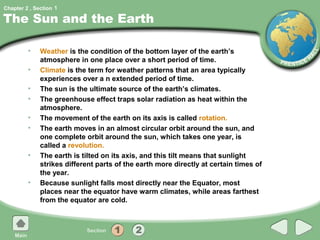
The Sun and the Earth

         •    Weather is the condition of the bottom layer of the earth’s
              atmosphere in one place over a short period of time.
         •    Climate is the term for weather patterns that an area typically
              experiences over a n extended period of time.
         •    The sun is the ultimate source of the earth’s climates.
         •    The greenhouse effect traps solar radiation as heat within the
              atmosphere.
         •    The movement of the earth on its axis is called rotation.
         •    The earth moves in an almost circular orbit around the sun, and
              one complete orbit around the sun, which takes one year, is
              called a revolution.
         •    The earth is tilted on its axis, and this tilt means that sunlight
              strikes different parts of the earth more directly at certain times of
              the year.
         •    Because sunlight falls most directly near the Equator, most
              places near the equator have warm climates, while areas farthest
              from the equator are cold.
Chapter 2 , Section 1

Distributing the Sun’s Heat
Chapter 2 , Section 1

Distributing the Sun’s Heat


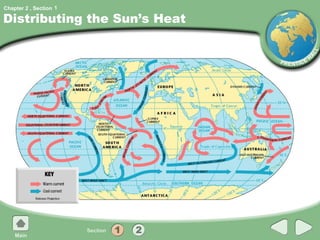
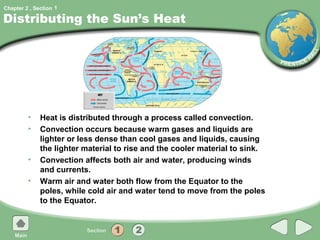
         •    Heat is distributed through a process called convection.
         •    Convection occurs because warm gases and liquids are
              lighter or less dense than cool gases and liquids, causing
              the lighter material to rise and the cooler material to sink.
         •    Convection affects both air and water, producing winds
              and currents.
         •    Warm air and water both flow from the Equator to the
              poles, while cold air and water tend to move from the poles
              to the Equator.
Chapter 2 , Section 1

Influences on Climate


         •    Precipitation, which includes all the forms of water that fall from
              the atmosphere to the earth’s surface, affects climate.
         •    Large bodies of water affect surrounding climates because water
              temperatures change much more slowly than land temperatures.
         •    Coastal areas tend to have milder climates, while the great
              central areas of continents in the Northern Hemisphere have
              continental climates, with cold winters and hot summers.
         •    Higher elevations can have colder climates than lower elevations.
         •    Nearby landforms, such as large desert areas, inland mountains,
              and forests, can influence climate.
         •    Large cities tend to have higher temperatures than the
              surrounding areas, creating what are called microclimates.
Chapter 2 , Section 1

Changing Climates

         • Many climate changes result from changes in
           nature, but more may now be caused by
           human action.
         • Increasing amounts of carbon dioxide and
           other substances in the atmosphere may lead
           to global warming.
         • Global warming may partially melt polar ice
           caps, resulting in higher ocean levels,
           flooding of low-lying areas, and changes in
           precipitation.
         • Some scientists theorize that global warming
           may be largely due to natural cyclical
           changes.
Chapter 2 , Section 1

Section 1 Review

         What process distributes heat through the air and the water?
            a) convection
            b) rotation
            c) revolution
            d) precipitation

         How does a large body of water affect nearby climates?
            a) It makes the climate warmer.
            b) It makes the climate cooler.
            c) It makes the climate milder.
            d) It makes the climate harsher.


         Want to connect to the World Geography link for this section? Click Here!
Chapter 2 , Section 1

Section 1 Review

         What process distributes heat through the air and the water?
            a) convection
            b) rotation
            c) revolution
            d) precipitation

         How does a large body of water affect nearby climates?
            a) It makes the climate warmer.
            b) It makes the climate cooler.
            c) It makes the climate milder.
            d) It makes the climate harsher.


         Want to connect to the World Geography link for this section? Click Here!
Chapter 2 , Section 2

Ecosystems

         • What conditions affect life in an
           ecosystem?
         • Why are there different kinds of forests?
         • Where are grasslands located?
         • How does life survive in harsh deserts
           and tundras?
Chapter 2 , Section 2

Ecosystems

         • An ecosystem is formed by the interaction of
           plant life, animal life, and the physical
           environment where they live.
         • The survival and growth of life in an ecosystem is
           affected by various physical conditions, such as
           climate, sunlight, temperature, precipitation,
           elevation, soil, and landforms.
         • A change in one aspect of an ecosystem leads to
           other changes.
         • The growth of human populations has led to
           dramatic changes in ecosystems.
         • A biome is a type of ecosystem that can be found
           in various regions of the world.
Chapter 2 , Section 2

Forest Regions

               Tropical Rain Forest                     Mid-Latitude Forest
       Tropical rain forests exist in warm      Most trees in the middle latitudes are
       areas near the Equator with heavy        deciduous, shedding their leaves
       rainfall.                                during one season.
       Tropical rain forests support an         This forest type once covered much
       immense diversity of plant and animal    of Europe, eastern Asia, and eastern
       life.                                    North America, but was largely
                                                cleared away for agriculture.

                 Coniferous Forest                      Other Forest Types
       Coniferous forests, named for the        In most places, forest regions
       cones that carry their seeds, exist in   overlap; a mixed region has both
       the colder parts of the middle           coniferous and deciduous trees.
       latitudes.
                                                Chaparral has small evergreen trees
       The needles of these trees expose        and low bushes, adapted to a climate
       only a small surface to the cold, and    with wet winters and dry summers.
       so can remain on the tree in winter.
Chapter 2 , Section 2

Grasslands

         Tropical Grasslands                   Temperate Grasslands
         •   Huge tropical grasslands,         •  Grasslands in cooler parts of
             called savannas, grow in warm        the world are called by several
             areas near the equator.              names.
         •   During the wet season, grasses    •  The temperate grasslands in
             grow tall and green, which then      North America are called
             die above ground in the dry          prairies.
             season.                           •  Much of the original prairie
         •   A third season is a time of          grasses have been plowed
             natural wildfires, which             under to provide farmland.
             encourage new grasses to          •  Cool, dry, temperate grasslands
             grow.                                in Northern Eurasia and central
         •   Herbivores, or plant-eating          Asia are called steppes and are
             animals, graze on the grasses.       similar to the Great Plains in
         •   Carnivores, are meat-eating          North America.
             animals whose survival            •  The pampas of Argentina and
             depends on thriving herbivore        veld of South Africa are also
             populations.                         temperate grasslands.
Chapter 2 , Section 2

Deserts and Tundras

         •    Deserts have many plants and animals adapted to
              survive with almost no water.
         •    Many desert animals get all the water they need from
              seeds, plants, or eating other animals.
         •    Tundra regions are where temperatures are always cool
              or cold; only specialized plants and animals can survive
              there.
         •    Alpine tundra exists in high mountains, where no trees
              grow.
         •    In arctic tundra, plants must be able to survive cold
              temperatures and go without sunlight for most of the
              winter.
         •    Some parts of the tundra contain permafrost, a layer of
              soil just below the surface that stays permanently
              frozen.
Chapter 2 , Section 2

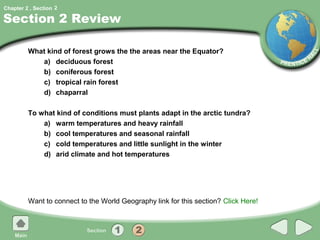
Section 2 Review

         What kind of forest grows the the areas near the Equator?
            a) deciduous forest
            b) coniferous forest
            c) tropical rain forest
            d) chaparral

         To what kind of conditions must plants adapt in the arctic tundra?
             a) warm temperatures and heavy rainfall
             b) cool temperatures and seasonal rainfall
             c) cold temperatures and little sunlight in the winter
             d) arid climate and hot temperatures


         Want to connect to the World Geography link for this section? Click Here!
Chapter 2 , Section 2

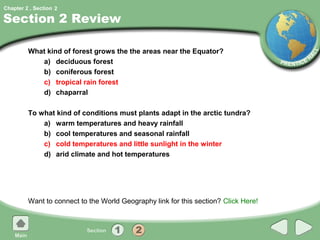
Section 2 Review

         What kind of forest grows the the areas near the Equator?
            a) deciduous forest
            b) coniferous forest
            c) tropical rain forest
            d) chaparral

         To what kind of conditions must plants adapt in the arctic tundra?
             a) warm temperatures and heavy rainfall
             b) cool temperatures and seasonal rainfall
             c) cold temperatures and little sunlight in the winter
             d) arid climate and hot temperatures


         Want to connect to the World Geography link for this section? Click Here!

Chapter 2

  • 1.
    Chapter 2 ,Section World Geography Chapter 2 Climates and Ecosystems Copyright © 2003 by Pearson Education, Inc., publishing as Prentice Hall, Upper Saddle River, NJ. All rights reserved.
  • 2.
    Chapter 2 ,Section World Geography Chapter 2: Climates and Ecosystems ction 1: Weather and Climate ction 2: Ecosystems Copyright © 2003 by Pearson Education, Inc., publishing as Prentice Hall, Upper Saddle River, NJ. All rights reserved.
  • 3.
    Chapter 2 ,Section 1 Weather and Climate • How are weather and climate affected by the relative positions of the earth and the sun? • How do wind and ocean currents redistribute the sun’s heat? • What factors influence the world’s climate regions? • Why is climatic change a cause for concern?
  • 4.
    Chapter 2 ,Section 1 The Sun and the Earth • Weather is the condition of the bottom layer of the earth’s atmosphere in one place over a short period of time. • Climate is the term for weather patterns that an area typically experiences over a n extended period of time. • The sun is the ultimate source of the earth’s climates. • The greenhouse effect traps solar radiation as heat within the atmosphere. • The movement of the earth on its axis is called rotation. • The earth moves in an almost circular orbit around the sun, and one complete orbit around the sun, which takes one year, is called a revolution. • The earth is tilted on its axis, and this tilt means that sunlight strikes different parts of the earth more directly at certain times of the year. • Because sunlight falls most directly near the Equator, most places near the equator have warm climates, while areas farthest from the equator are cold.
  • 5.
    Chapter 2 ,Section 1 Distributing the Sun’s Heat
  • 6.
    Chapter 2 ,Section 1 Distributing the Sun’s Heat • Heat is distributed through a process called convection. • Convection occurs because warm gases and liquids are lighter or less dense than cool gases and liquids, causing the lighter material to rise and the cooler material to sink. • Convection affects both air and water, producing winds and currents. • Warm air and water both flow from the Equator to the poles, while cold air and water tend to move from the poles to the Equator.
  • 7.
    Chapter 2 ,Section 1 Influences on Climate • Precipitation, which includes all the forms of water that fall from the atmosphere to the earth’s surface, affects climate. • Large bodies of water affect surrounding climates because water temperatures change much more slowly than land temperatures. • Coastal areas tend to have milder climates, while the great central areas of continents in the Northern Hemisphere have continental climates, with cold winters and hot summers. • Higher elevations can have colder climates than lower elevations. • Nearby landforms, such as large desert areas, inland mountains, and forests, can influence climate. • Large cities tend to have higher temperatures than the surrounding areas, creating what are called microclimates.
  • 8.
    Chapter 2 ,Section 1 Changing Climates • Many climate changes result from changes in nature, but more may now be caused by human action. • Increasing amounts of carbon dioxide and other substances in the atmosphere may lead to global warming. • Global warming may partially melt polar ice caps, resulting in higher ocean levels, flooding of low-lying areas, and changes in precipitation. • Some scientists theorize that global warming may be largely due to natural cyclical changes.
  • 9.
    Chapter 2 ,Section 1 Section 1 Review What process distributes heat through the air and the water? a) convection b) rotation c) revolution d) precipitation How does a large body of water affect nearby climates? a) It makes the climate warmer. b) It makes the climate cooler. c) It makes the climate milder. d) It makes the climate harsher. Want to connect to the World Geography link for this section? Click Here!
  • 10.
    Chapter 2 ,Section 1 Section 1 Review What process distributes heat through the air and the water? a) convection b) rotation c) revolution d) precipitation How does a large body of water affect nearby climates? a) It makes the climate warmer. b) It makes the climate cooler. c) It makes the climate milder. d) It makes the climate harsher. Want to connect to the World Geography link for this section? Click Here!
  • 11.
    Chapter 2 ,Section 2 Ecosystems • What conditions affect life in an ecosystem? • Why are there different kinds of forests? • Where are grasslands located? • How does life survive in harsh deserts and tundras?
  • 12.
    Chapter 2 ,Section 2 Ecosystems • An ecosystem is formed by the interaction of plant life, animal life, and the physical environment where they live. • The survival and growth of life in an ecosystem is affected by various physical conditions, such as climate, sunlight, temperature, precipitation, elevation, soil, and landforms. • A change in one aspect of an ecosystem leads to other changes. • The growth of human populations has led to dramatic changes in ecosystems. • A biome is a type of ecosystem that can be found in various regions of the world.
  • 13.
    Chapter 2 ,Section 2 Forest Regions Tropical Rain Forest Mid-Latitude Forest Tropical rain forests exist in warm Most trees in the middle latitudes are areas near the Equator with heavy deciduous, shedding their leaves rainfall. during one season. Tropical rain forests support an This forest type once covered much immense diversity of plant and animal of Europe, eastern Asia, and eastern life. North America, but was largely cleared away for agriculture. Coniferous Forest Other Forest Types Coniferous forests, named for the In most places, forest regions cones that carry their seeds, exist in overlap; a mixed region has both the colder parts of the middle coniferous and deciduous trees. latitudes. Chaparral has small evergreen trees The needles of these trees expose and low bushes, adapted to a climate only a small surface to the cold, and with wet winters and dry summers. so can remain on the tree in winter.
  • 14.
    Chapter 2 ,Section 2 Grasslands Tropical Grasslands Temperate Grasslands • Huge tropical grasslands, • Grasslands in cooler parts of called savannas, grow in warm the world are called by several areas near the equator. names. • During the wet season, grasses • The temperate grasslands in grow tall and green, which then North America are called die above ground in the dry prairies. season. • Much of the original prairie • A third season is a time of grasses have been plowed natural wildfires, which under to provide farmland. encourage new grasses to • Cool, dry, temperate grasslands grow. in Northern Eurasia and central • Herbivores, or plant-eating Asia are called steppes and are animals, graze on the grasses. similar to the Great Plains in • Carnivores, are meat-eating North America. animals whose survival • The pampas of Argentina and depends on thriving herbivore veld of South Africa are also populations. temperate grasslands.
  • 15.
    Chapter 2 ,Section 2 Deserts and Tundras • Deserts have many plants and animals adapted to survive with almost no water. • Many desert animals get all the water they need from seeds, plants, or eating other animals. • Tundra regions are where temperatures are always cool or cold; only specialized plants and animals can survive there. • Alpine tundra exists in high mountains, where no trees grow. • In arctic tundra, plants must be able to survive cold temperatures and go without sunlight for most of the winter. • Some parts of the tundra contain permafrost, a layer of soil just below the surface that stays permanently frozen.
  • 16.
    Chapter 2 ,Section 2 Section 2 Review What kind of forest grows the the areas near the Equator? a) deciduous forest b) coniferous forest c) tropical rain forest d) chaparral To what kind of conditions must plants adapt in the arctic tundra? a) warm temperatures and heavy rainfall b) cool temperatures and seasonal rainfall c) cold temperatures and little sunlight in the winter d) arid climate and hot temperatures Want to connect to the World Geography link for this section? Click Here!
  • 17.
    Chapter 2 ,Section 2 Section 2 Review What kind of forest grows the the areas near the Equator? a) deciduous forest b) coniferous forest c) tropical rain forest d) chaparral To what kind of conditions must plants adapt in the arctic tundra? a) warm temperatures and heavy rainfall b) cool temperatures and seasonal rainfall c) cold temperatures and little sunlight in the winter d) arid climate and hot temperatures Want to connect to the World Geography link for this section? Click Here!