UNIT 3: PHYSICAL GEOGRAPHY: WATER
1- WHERE IS WATER FOUND?
2- WHAT ARE RIVERS?
3- WHAT ARE OCEANS AND SEAS?
4- WHAT ARE CURRENTS, TIDES AND WAVES?
5- WHAT ARE LAKES?
6- WHAT ARE GROUND WATER AND GLACIERS
FOUND?
7- WHAT PROBLEMS ARE RELATED TO WATER
TODAY?
UNIT 3: PHYSICAL GEOGRAPHY: WATER
OBJECTIVES
Review the water cycle
Learn about water on Earth: Rivers, lakes, sea, oceans
Identify the effects of human action on environment
Interpret graphs
Suggest solutions to problems caused by human action
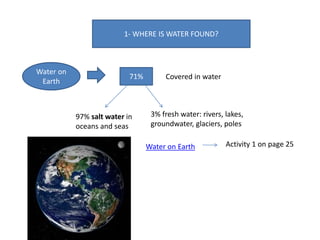
1- WHERE IS WATER FOUND?
Water on
Earth
71%
97% salt water in
oceans and seas
Covered in water
3% fresh water: rivers, lakes,
groundwater, glaciers, poles
Water on Earth Activity 1 on page 25
1- WHERE IS WATER FOUND?
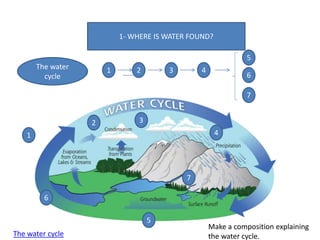
The water
cycle
1
2 3
4
5
6
7
1 2 3 4
5
6
7
The water cycle
Make a composition explaining
the water cycle.
2- WHAT ARE RIVERS?
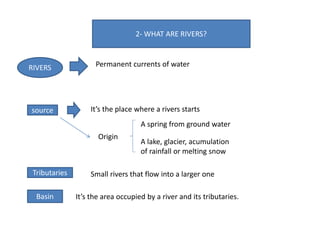
RIVERS Permanent currents of water
source It’s the place where a rivers starts
Origin
A spring from ground water
A lake, glacier, acumulation
of rainfall or melting snow
Tributaries Small rivers that flow into a larger one
Basin It’s the area occupied by a river and its tributaries.
2- WHAT ARE RIVERS?
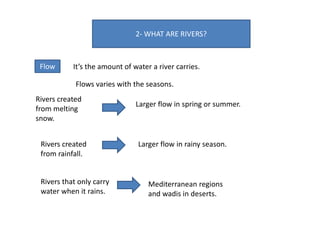
Flow It’s the amount of water a river carries.
Rivers created
from melting
snow.
Larger flow in spring or summer.
Flows varies with the seasons.
Rivers created
from rainfall.
Larger flow in rainy season.
Rivers that only carry
water when it rains.
Mediterranean regions
and wadis in deserts.
2- WHAT ARE RIVERS?
The
importance
of rivers
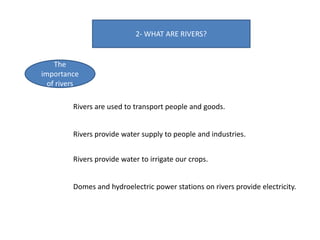
Rivers are used to transport people and goods.
Rivers provide water supply to people and industries.
Rivers provide water to irrigate our crops.
Domes and hydroelectric power stations on rivers provide electricity.
2- WHAT ARE RIVERS?
Define the following concepts: river, source, tributarie,
basin, flow, canal, reservoir
Explain the different types of rivers according to its flow
Why rivers are so important to human beings?
3- What are oceans and seas?
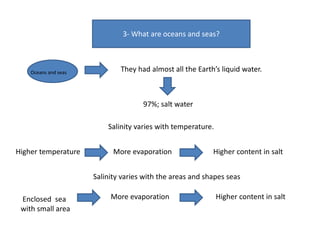
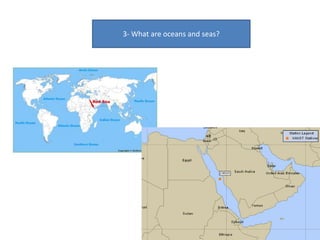
Oceans and seas They had almost all the Earth’s liquid water.
97%; salt water
Salinity varies with temperature.
Higher temperature More evaporation Higher content in salt
Salinity varies with the areas and shapes seas
Enclosed sea
with small area
More evaporation Higher content in salt
3- What are oceans and seas?
The importance of
oceans and seas
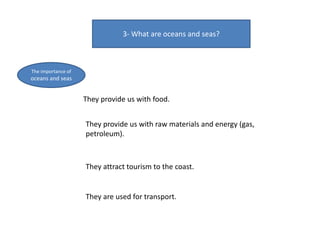
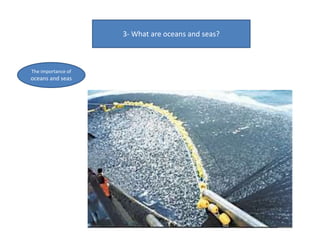
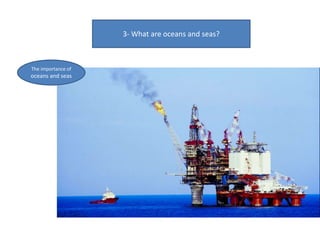
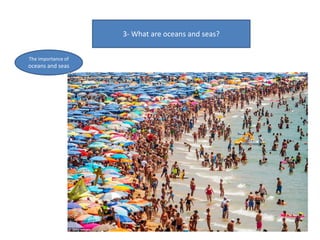
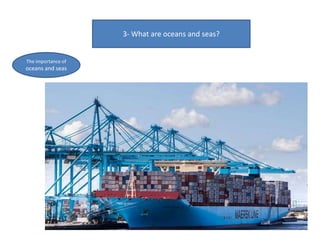
They provide us with food.
They provide us with raw materials and energy (gas,
petroleum).
They attract tourism to the coast.
They are used for transport.
3- What are oceans and seas?
The importance of
oceans and seas
3- What are oceans and seas?
The importance of
oceans and seas
3- What are oceans and seas?
The importance of
oceans and seas
3- What are oceans and seas?
The importance of
oceans and seas
3- What are oceans and seas?
How does oceans and seas salinity varies?
Why are oceans and seas so important to human beings?
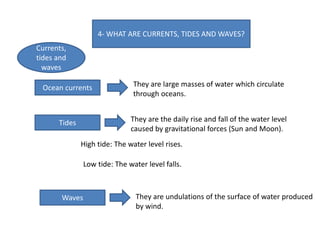
4- WHAT ARE CURRENTS, TIDES AND WAVES?
Currents,
tides and
waves
Ocean currents
Tides
Waves
They are large masses of water which circulate
through oceans.
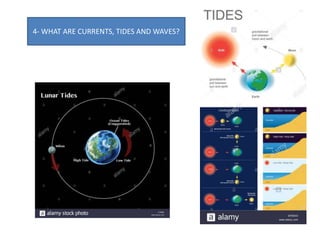
They are the daily rise and fall of the water level
caused by gravitational forces (Sun and Moon).
They are undulations of the surface of water produced
by wind.
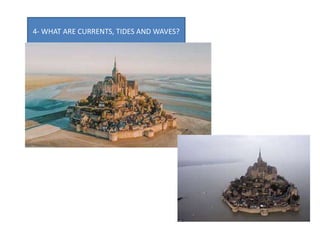
High tide: The water level rises.
Low tide: The water level falls.
4- WHAT ARE CURRENTS, TIDES AND WAVES?
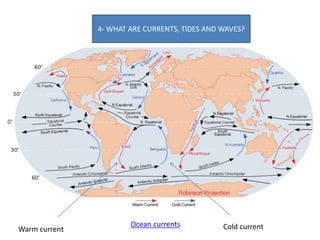
Ocean currents
Warm current Cold current
4- WHAT ARE CURRENTS, TIDES AND WAVES?
5- What are lakes?
Lake It’s a permanent mass of water which have accumulated
inland.
It´’s a lake of salt water.
Inland
sea
Water in lakes origin
Precipitation
Rivers and ground water
Glaciers
5- What are lakes?
The world’s
biggest
lakes
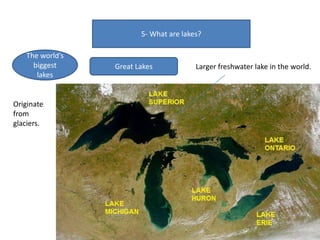
Great Lakes
Originate
from
glaciers.
Larger freshwater lake in the world.
5- What are lakes?
The world’s
biggest
lakes
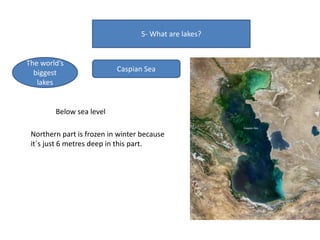
Caspian Sea
Below sea level
Northern part is frozen in winter because
it´s just 6 metres deep in this part.
5- What are lakes?
The world’s
biggest
lakes
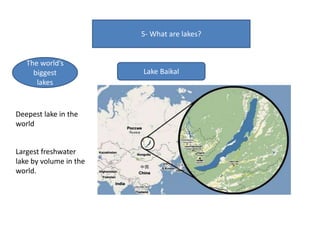
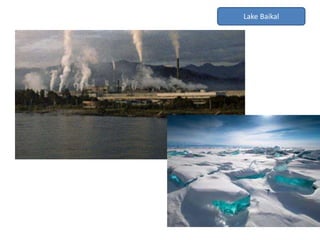
Lake Baikal
Deepest lake in the
world
Largest freshwater
lake by volume in the
world.
Lake Baikal
5- What are lakes?
The world’s
biggest
lakes
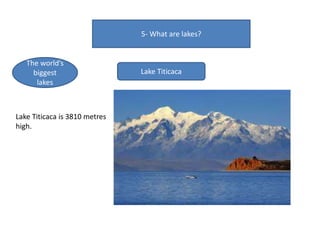
Lake Titicaca
Lake Titicaca is 3810 metres
high.
5- What are lakes?
The world’s
biggest
lakes
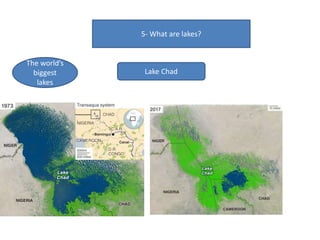
Lake Chad
5- What are lakes?
The world’s
biggest
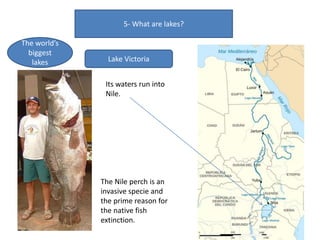
lakes Lake Victoria
The Nile perch is an
invasive specie and
the prime reason for
the native fish
extinction.
Its waters run into
Nile.
5- What are lakes?
Define lake and inland sea.
Which are the most important lakes in the world? Why? In which
continent are located?
6- WHERE ARE GROUND WATER AND
GLACIERS FOUND?
Groundwater
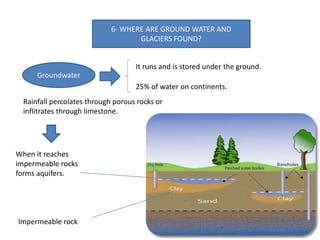
It runs and is stored under the ground.
25% of water on continents.
Rainfall percolates through porous rocks or
inflitrates through limestone.
When it reaches
impermeable rocks
forms aquifers.
Impermeable rock
6- WHERE ARE GROUND WATER AND
GLACIERS FOUND?
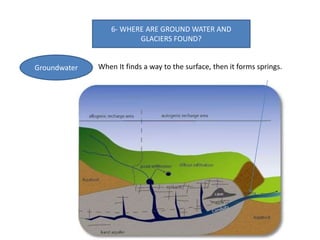
Groundwater When It finds a way to the surface, then it forms springs.
6- WHERE ARE GROUND WATER AND
GLACIERS FOUND?
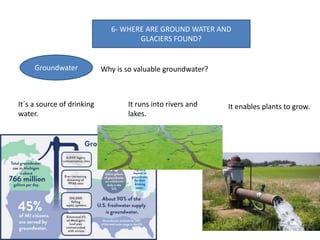
Groundwater Why is so valuable groundwater?
It´s a source of drinking
water.
It runs into rivers and
lakes.
It enables plants to grow.
6- WHERE ARE GROUND WATER AND
GLACIERS FOUND?
Glaciers
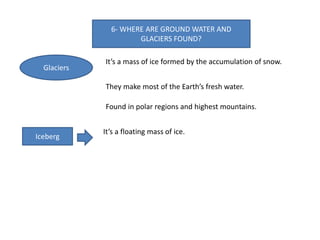
They make most of the Earth’s fresh water.
It’s a mass of ice formed by the accumulation of snow.
Found in polar regions and highest mountains.
Iceberg
It’s a floating mass of ice.
6- WHERE ARE GROUND WATER AND
GLACIERS FOUND?
What is groundwater?
What is an aquifer? How is it formed?
Why is so valuable groundwater?
What is a glacier? Where can be found?
What is an iceberg?
7- What problems are related to water today?
Water consumption
and distribution
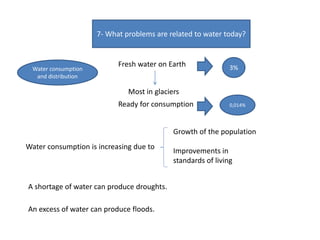
Fresh water on Earth 3%
Ready for consumption 0,014%
Most in glaciers
Water consumption is increasing due to
Growth of the population
Improvements in
standards of living
An excess of water can produce floods.
A shortage of water can produce droughts.
7- What problems are related to water today?
Water pollution
and acid rain
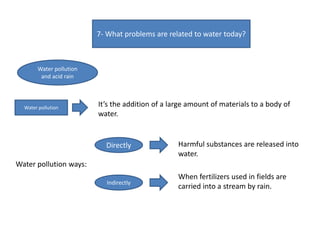
Water pollution
It’s the addition of a large amount of materials to a body of
water.
Water pollution ways:
Directly
Indirectly
Harmful substances are released into
water.
When fertilizers used in fields are
carried into a stream by rain.
7- What problems are related to water today?
Water pollution
and acid rain
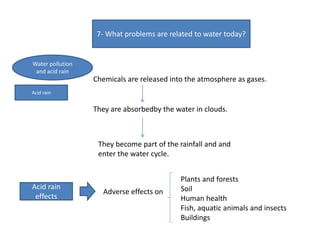
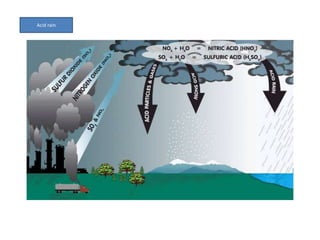
Acid rain
Chemicals are released into the atmosphere as gases.
They are absorbedby the water in clouds.
They become part of the rainfall and and
enter the water cycle.
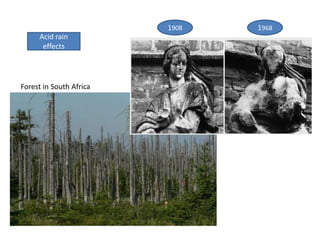
Acid rain
effects
Adverse effects on
Plants and forests
Soil
Human health
Fish, aquatic animals and insects
Buildings
Acid rain
Acid rain
effects
1908 1968
Forest in South Africa
7- What problems are related to water today?
Which percentage of water on Earth is fresn water?
Which percentage of water is ready for consumption? Why?
Why water consumption is increasing?
Which are the problems associated to excess or shortage of water?
How is acid rain formed?
Which are the acid rain effects?

Unit 3 water

  • 1.
    UNIT 3: PHYSICALGEOGRAPHY: WATER 1- WHERE IS WATER FOUND? 2- WHAT ARE RIVERS? 3- WHAT ARE OCEANS AND SEAS? 4- WHAT ARE CURRENTS, TIDES AND WAVES? 5- WHAT ARE LAKES? 6- WHAT ARE GROUND WATER AND GLACIERS FOUND? 7- WHAT PROBLEMS ARE RELATED TO WATER TODAY?
  • 2.
    UNIT 3: PHYSICALGEOGRAPHY: WATER OBJECTIVES Review the water cycle Learn about water on Earth: Rivers, lakes, sea, oceans Identify the effects of human action on environment Interpret graphs Suggest solutions to problems caused by human action
  • 3.
    1- WHERE ISWATER FOUND? Water on Earth 71% 97% salt water in oceans and seas Covered in water 3% fresh water: rivers, lakes, groundwater, glaciers, poles Water on Earth Activity 1 on page 25
  • 4.
    1- WHERE ISWATER FOUND? The water cycle 1 2 3 4 5 6 7 1 2 3 4 5 6 7 The water cycle Make a composition explaining the water cycle.
  • 5.
    2- WHAT ARERIVERS? RIVERS Permanent currents of water source It’s the place where a rivers starts Origin A spring from ground water A lake, glacier, acumulation of rainfall or melting snow Tributaries Small rivers that flow into a larger one Basin It’s the area occupied by a river and its tributaries.
  • 6.
    2- WHAT ARERIVERS? Flow It’s the amount of water a river carries. Rivers created from melting snow. Larger flow in spring or summer. Flows varies with the seasons. Rivers created from rainfall. Larger flow in rainy season. Rivers that only carry water when it rains. Mediterranean regions and wadis in deserts.
  • 7.
    2- WHAT ARERIVERS? The importance of rivers Rivers are used to transport people and goods. Rivers provide water supply to people and industries. Rivers provide water to irrigate our crops. Domes and hydroelectric power stations on rivers provide electricity.
  • 8.
    2- WHAT ARERIVERS? Define the following concepts: river, source, tributarie, basin, flow, canal, reservoir Explain the different types of rivers according to its flow Why rivers are so important to human beings?
  • 9.
    3- What areoceans and seas? Oceans and seas They had almost all the Earth’s liquid water. 97%; salt water Salinity varies with temperature. Higher temperature More evaporation Higher content in salt Salinity varies with the areas and shapes seas Enclosed sea with small area More evaporation Higher content in salt
  • 10.
    3- What areoceans and seas?
  • 11.
    3- What areoceans and seas? The importance of oceans and seas They provide us with food. They provide us with raw materials and energy (gas, petroleum). They attract tourism to the coast. They are used for transport.
  • 12.
    3- What areoceans and seas? The importance of oceans and seas
  • 13.
    3- What areoceans and seas? The importance of oceans and seas
  • 14.
    3- What areoceans and seas? The importance of oceans and seas
  • 15.
    3- What areoceans and seas? The importance of oceans and seas
  • 16.
    3- What areoceans and seas? How does oceans and seas salinity varies? Why are oceans and seas so important to human beings?
  • 17.
    4- WHAT ARECURRENTS, TIDES AND WAVES? Currents, tides and waves Ocean currents Tides Waves They are large masses of water which circulate through oceans. They are the daily rise and fall of the water level caused by gravitational forces (Sun and Moon). They are undulations of the surface of water produced by wind. High tide: The water level rises. Low tide: The water level falls.
  • 18.
    4- WHAT ARECURRENTS, TIDES AND WAVES? Ocean currents Warm current Cold current
  • 19.
    4- WHAT ARECURRENTS, TIDES AND WAVES?
  • 20.
    4- WHAT ARECURRENTS, TIDES AND WAVES?
  • 21.
    5- What arelakes? Lake It’s a permanent mass of water which have accumulated inland. It´’s a lake of salt water. Inland sea Water in lakes origin Precipitation Rivers and ground water Glaciers
  • 22.
    5- What arelakes? The world’s biggest lakes Great Lakes Originate from glaciers. Larger freshwater lake in the world.
  • 23.
    5- What arelakes? The world’s biggest lakes Caspian Sea Below sea level Northern part is frozen in winter because it´s just 6 metres deep in this part.
  • 24.
    5- What arelakes? The world’s biggest lakes Lake Baikal Deepest lake in the world Largest freshwater lake by volume in the world.
  • 25.
  • 26.
    5- What arelakes? The world’s biggest lakes Lake Titicaca Lake Titicaca is 3810 metres high.
  • 27.
    5- What arelakes? The world’s biggest lakes Lake Chad
  • 28.
    5- What arelakes? The world’s biggest lakes Lake Victoria The Nile perch is an invasive specie and the prime reason for the native fish extinction. Its waters run into Nile.
  • 29.
    5- What arelakes? Define lake and inland sea. Which are the most important lakes in the world? Why? In which continent are located?
  • 30.
    6- WHERE AREGROUND WATER AND GLACIERS FOUND? Groundwater It runs and is stored under the ground. 25% of water on continents. Rainfall percolates through porous rocks or inflitrates through limestone. When it reaches impermeable rocks forms aquifers. Impermeable rock
  • 31.
    6- WHERE AREGROUND WATER AND GLACIERS FOUND? Groundwater When It finds a way to the surface, then it forms springs.
  • 32.
    6- WHERE AREGROUND WATER AND GLACIERS FOUND? Groundwater Why is so valuable groundwater? It´s a source of drinking water. It runs into rivers and lakes. It enables plants to grow.
  • 33.
    6- WHERE AREGROUND WATER AND GLACIERS FOUND? Glaciers They make most of the Earth’s fresh water. It’s a mass of ice formed by the accumulation of snow. Found in polar regions and highest mountains. Iceberg It’s a floating mass of ice.
  • 34.
    6- WHERE AREGROUND WATER AND GLACIERS FOUND? What is groundwater? What is an aquifer? How is it formed? Why is so valuable groundwater? What is a glacier? Where can be found? What is an iceberg?
  • 35.
    7- What problemsare related to water today? Water consumption and distribution Fresh water on Earth 3% Ready for consumption 0,014% Most in glaciers Water consumption is increasing due to Growth of the population Improvements in standards of living An excess of water can produce floods. A shortage of water can produce droughts.
  • 36.
    7- What problemsare related to water today? Water pollution and acid rain Water pollution It’s the addition of a large amount of materials to a body of water. Water pollution ways: Directly Indirectly Harmful substances are released into water. When fertilizers used in fields are carried into a stream by rain.
  • 37.
    7- What problemsare related to water today? Water pollution and acid rain Acid rain Chemicals are released into the atmosphere as gases. They are absorbedby the water in clouds. They become part of the rainfall and and enter the water cycle. Acid rain effects Adverse effects on Plants and forests Soil Human health Fish, aquatic animals and insects Buildings
  • 38.
  • 39.
  • 40.
    7- What problemsare related to water today? Which percentage of water on Earth is fresn water? Which percentage of water is ready for consumption? Why? Why water consumption is increasing? Which are the problems associated to excess or shortage of water? How is acid rain formed? Which are the acid rain effects?