Bodies of Water and Landforms Ch. 2, Sec. 2
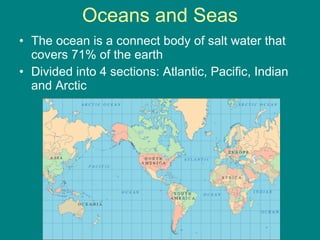
Oceans and Seas The ocean is a connect body of salt water that covers 71% of the earth Divided into 4 sections: Atlantic, Pacific, Indian and Arctic
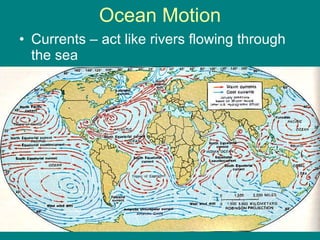
Ocean Motion Currents – act like rivers flowing through the sea
Ocean Motion Waves – Swells or ridges produced by winds
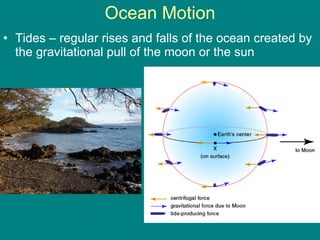
Ocean Motion Tides – regular rises and falls of the ocean created by the gravitational pull of the moon or the sun
Hydrologic Cycle Continuous circulation of water between the atmosphere, the oceans and the earth 1-water evaporates    2-water exists as vapor in atmosphere    3-vapor cools, condenses and falls back to earth    4-water soaks into ground
 
Ground Water Water held in the pores of rocks Water table  – level at which the rock is saturated
The water table isn’t constant.  It raises or lowers depending on seasonal recharge from rain and also from how much is pumped out.
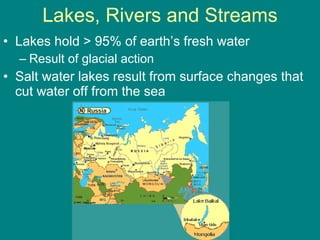
Lakes, Rivers and Streams Lakes hold > 95% of earth’s fresh water Result of glacial action  Salt water lakes result from surface changes that cut water off from the sea
Dead Sea
That’s because the water is so much denser than you that it makes you naturally buoyant. Just don’t get the water in your eyes.  It’ll sting.
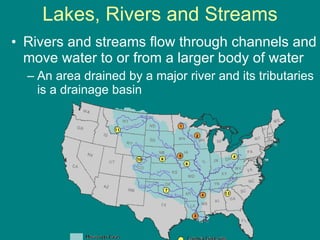
Lakes, Rivers and Streams Rivers and streams flow through channels and move water to or from a larger body of water An area drained by a major river and its tributaries is a drainage basin
Continental shelf The point at which the edge of the continent drops off to the deep part of the ocean. Oceanic Landforms
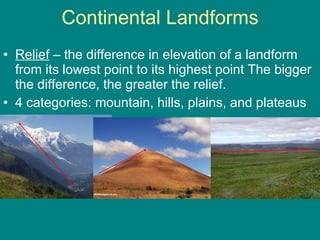
Continental Landforms Relief  – the difference in elevation of a landform from its lowest point to its highest point The bigger the difference, the greater the relief. 4 categories: mountain, hills, plains, and plateaus
Topography is the combination and distribution of different landforms in an area
Major Landforms Island  – a body of land surrounded by water
Swamp  – a lowland region that is saturated by water
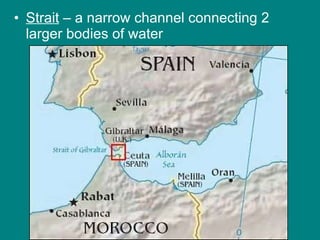
Strait  – a narrow channel connecting 2 larger bodies of water
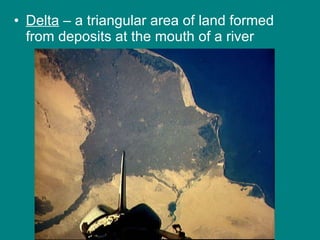
Delta  – a triangular area of land formed from deposits at the mouth of a river
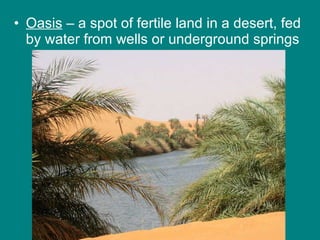
Oasis  – a spot of fertile land in a desert, fed by water from wells or underground springs
Plateau  – a broad, flat area of land higher than the surrounding land
Prairie  – a large, level area of grassland with few or no trees
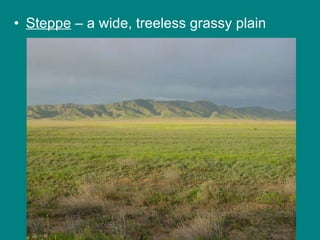
Steppe  – a wide, treeless grassy plain
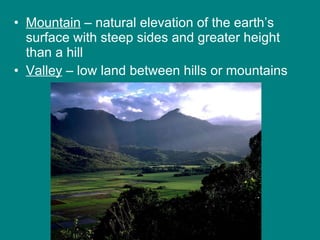
Mountain  – natural elevation of the earth’s surface with steep sides and greater height than a hill Valley  – low land between hills or mountains
Glacier  – a large ice mass that moves slowly down a mountain or over land
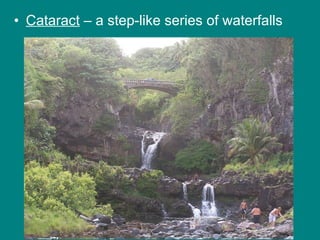
Cataract  – a step-like series of waterfalls
Cliff  – the steep, almost vertical edge of a hill, mountain or plain
Group Landform Project!!! In your assigned group, work  together  to create a map of an imaginary continent on your piece of construction paper. This is a physical map only, so your group will not need to include borders or cities.  Group One: Landforms on Page 34 Group Two: Landforms on Page 35

Ch. 2, sec. 2 Water and Landforms

  • 1.
  • 2.
    Bodies of Waterand Landforms Ch. 2, Sec. 2
  • 3.
    Oceans and SeasThe ocean is a connect body of salt water that covers 71% of the earth Divided into 4 sections: Atlantic, Pacific, Indian and Arctic
  • 4.
    Ocean Motion Currents– act like rivers flowing through the sea
  • 5.
    Ocean Motion Waves– Swells or ridges produced by winds
  • 6.
    Ocean Motion Tides– regular rises and falls of the ocean created by the gravitational pull of the moon or the sun
  • 7.
    Hydrologic Cycle Continuouscirculation of water between the atmosphere, the oceans and the earth 1-water evaporates  2-water exists as vapor in atmosphere  3-vapor cools, condenses and falls back to earth  4-water soaks into ground
  • 8.
  • 9.
    Ground Water Waterheld in the pores of rocks Water table – level at which the rock is saturated
  • 10.
    The water tableisn’t constant. It raises or lowers depending on seasonal recharge from rain and also from how much is pumped out.
  • 11.
    Lakes, Rivers andStreams Lakes hold > 95% of earth’s fresh water Result of glacial action Salt water lakes result from surface changes that cut water off from the sea
  • 12.
  • 13.
    That’s because thewater is so much denser than you that it makes you naturally buoyant. Just don’t get the water in your eyes. It’ll sting.
  • 14.
    Lakes, Rivers andStreams Rivers and streams flow through channels and move water to or from a larger body of water An area drained by a major river and its tributaries is a drainage basin
  • 15.
    Continental shelf Thepoint at which the edge of the continent drops off to the deep part of the ocean. Oceanic Landforms
  • 16.
    Continental Landforms Relief – the difference in elevation of a landform from its lowest point to its highest point The bigger the difference, the greater the relief. 4 categories: mountain, hills, plains, and plateaus
  • 17.
    Topography is thecombination and distribution of different landforms in an area
  • 18.
    Major Landforms Island – a body of land surrounded by water
  • 19.
    Swamp –a lowland region that is saturated by water
  • 20.
    Strait –a narrow channel connecting 2 larger bodies of water
  • 21.
    Delta –a triangular area of land formed from deposits at the mouth of a river
  • 22.
    Oasis –a spot of fertile land in a desert, fed by water from wells or underground springs
  • 23.
    Plateau –a broad, flat area of land higher than the surrounding land
  • 24.
    Prairie –a large, level area of grassland with few or no trees
  • 25.
    Steppe –a wide, treeless grassy plain
  • 26.
    Mountain –natural elevation of the earth’s surface with steep sides and greater height than a hill Valley – low land between hills or mountains
  • 27.
    Glacier –a large ice mass that moves slowly down a mountain or over land
  • 28.
    Cataract –a step-like series of waterfalls
  • 29.
    Cliff –the steep, almost vertical edge of a hill, mountain or plain
  • 30.
    Group Landform Project!!!In your assigned group, work together to create a map of an imaginary continent on your piece of construction paper. This is a physical map only, so your group will not need to include borders or cities. Group One: Landforms on Page 34 Group Two: Landforms on Page 35