Chapter 21 Section 3
China, Japan, and the Koreas
Jason M. Hauck
I. China after Mao
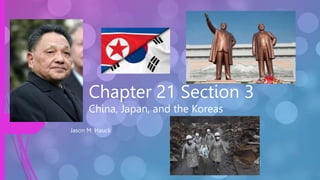
A.After the death of Mao Zedong, Den Xiaoping called
for Four Modernizations;
1. Industry, agriculture, technology and national defense.
2. China had been isolated for more than 20 years.
a.To make up for lost time, the government invited foreign
investors to China. They also, sent thousands of students abroad
to study science, technology, and modern business techniques.
B. A new agricultural policy began.
1. Collective farms could now lease land to peasants who paid rent to the
collective.
a. Anything produced above the value of the rent could be sold for profit.
2. China began to make strides to end its poverty and underdevelopment
problems.
3. Per Capita income doubled during the 1980s.
C.Despite these achievements, many complained that
Xiaoping’s program had not achieved a fifth modernization,
democracy.
1. People could not criticize the Communist Party.
2. Calls for democracy often resulted in long prison sentences.
D.In the late 1980s Chinese citizens called for better living
conditions and greater freedom.
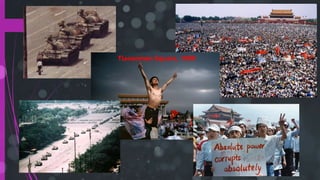
1. The 1989 student revolt in Tiananmen Square called for the end of
government corruption.
2. Xiaoping ordered tanks and troops to crush the revolt.
a. Between 500 and 2,000 were killed.
E. From the 90s through the 2000s, China began to take an
active role in its area of the world.
Tiananmen Square, 1989
II.Chinese Society and Economy
A.From the start, the Communist
Parts wanted to create a new kind
of citizen, one who would give the
utmost for the good of all China.
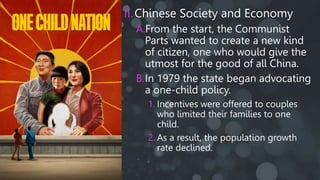
B.In 1979 the state began advocating
a one-child policy.
1. Incentives were offered to couples
who limited their families to one
child.
2. As a result, the population growth
rate declined.
C.During the 1990s, industrial growth rates remained
high, leading to predictions that China would
become one of the economic superpowers of the
21st century.
D.Due to rapid economic change, workers in Chinese
factories complain about poor working conditions
and low salaries, leading to unrest.
III.Japan
A.Between 1950 and 1990, Japan became the
greatest exporting nation in the world.
1. 2nd largest economy after the United States.
2. At the end of the 1980s, a collapse in the real
estate market caused an economic downturn.
3. Over the last 20 years, Japan has experienced
deflation. This has led pessimism among the
Japanese youth.
a.China passed Japan in 2010 as the 2nd largest economy.
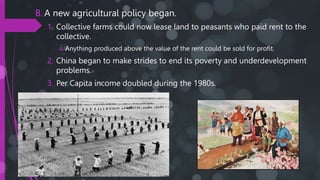
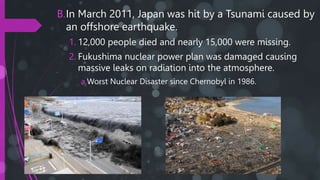
B.In March 2011, Japan was hit by a Tsunami caused by
an offshore earthquake.
1. 12,000 people died and nearly 15,000 were missing.
2. Fukushima nuclear power plan was damaged causing
massive leaks on radiation into the atmosphere.
a.Worst Nuclear Disaster since Chernobyl in 1986.
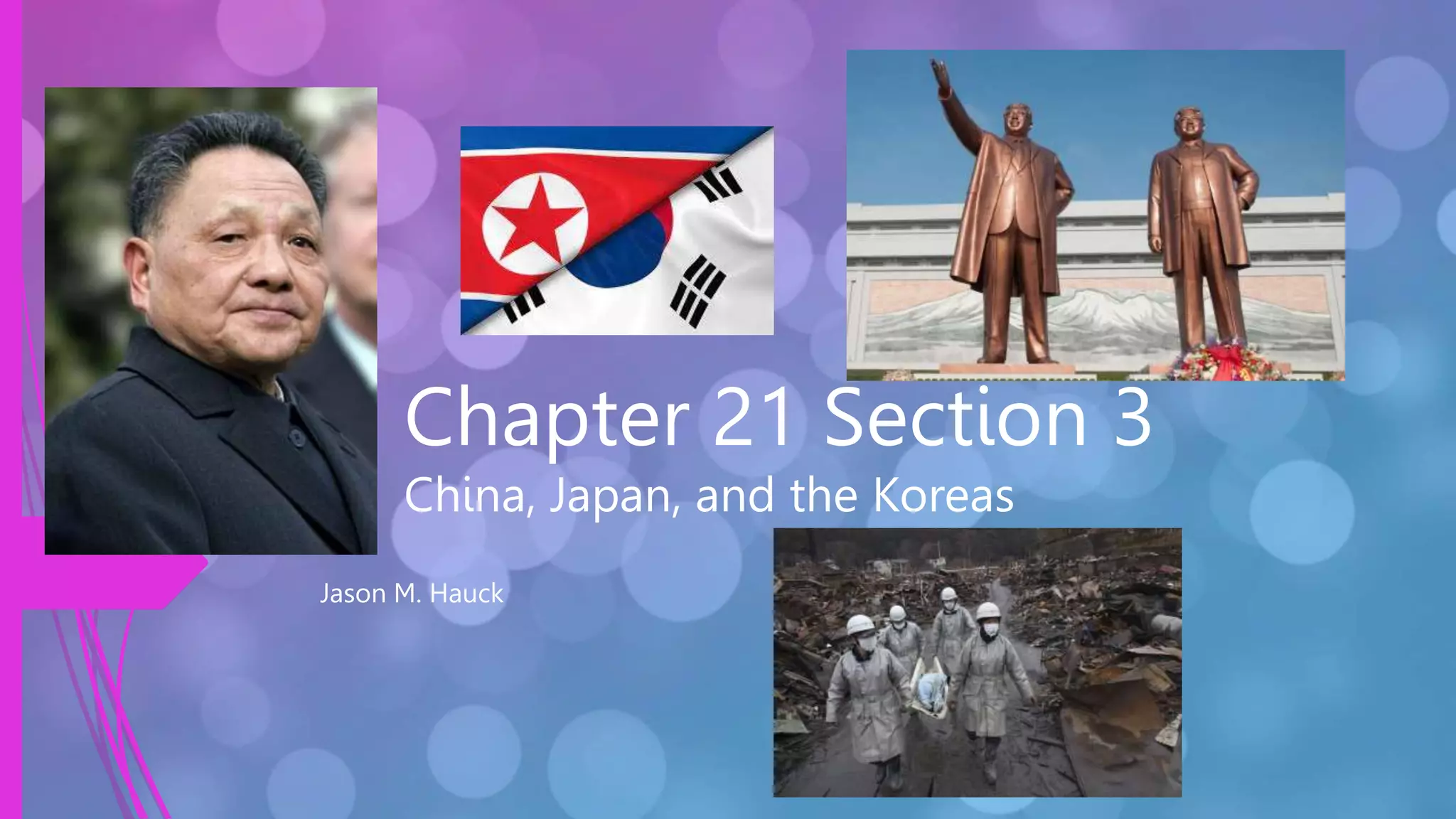
IV.The Koreas
A.Although the Korean War ended in 1953, political
tensions between North and South Korea continue
to threaten the peace between the two countries.
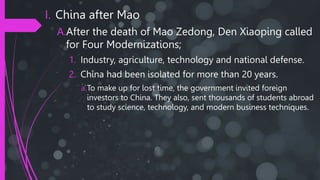
B.Since 1990, North Korea remained an isolated
country under a military dictatorship led by Kim
Jong Il.
1. Kim attempted to secure his country by creating a
nuclear program.
a.In 2008, North Korea was persuaded to suspend its nuclear
program.
C.Internal problems continue to plague North Korea.
1. Famines during the 1990s led North Korea to seek help from the
UN and US.
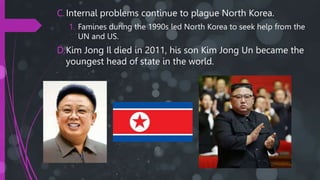
D.Kim Jong Il died in 2011, his son Kim Jong Un became the
youngest head of state in the world.
E.South Korea has experienced a growing democracy
since the 1989 elections removed former military
leaders and replaced when with civilian leaders.
F.The Korean peninsula has recently experienced
military tensions.
1. 2007 South Korea pushed for North Korea to abandon
their nuclear program.
2. 2010 sinking of a S. Korean ship killing 46 soldiers.
G.South Korea is changing rapidly as almost
every household has high-speed internet and
cell phones.
1. South Korean television and movies have been
popular throughout Asia.
2.Education remains the number one priority for
South Korea.
a.3rd Largest group of foreign students in the United
States.

Chapter 21 Section 3.pptx

  • 1.
    Chapter 21 Section3 China, Japan, and the Koreas Jason M. Hauck
  • 2.
    I. China afterMao A.After the death of Mao Zedong, Den Xiaoping called for Four Modernizations; 1. Industry, agriculture, technology and national defense. 2. China had been isolated for more than 20 years. a.To make up for lost time, the government invited foreign investors to China. They also, sent thousands of students abroad to study science, technology, and modern business techniques.
  • 3.
    B. A newagricultural policy began. 1. Collective farms could now lease land to peasants who paid rent to the collective. a. Anything produced above the value of the rent could be sold for profit. 2. China began to make strides to end its poverty and underdevelopment problems. 3. Per Capita income doubled during the 1980s.
  • 4.
    C.Despite these achievements,many complained that Xiaoping’s program had not achieved a fifth modernization, democracy. 1. People could not criticize the Communist Party. 2. Calls for democracy often resulted in long prison sentences. D.In the late 1980s Chinese citizens called for better living conditions and greater freedom. 1. The 1989 student revolt in Tiananmen Square called for the end of government corruption. 2. Xiaoping ordered tanks and troops to crush the revolt. a. Between 500 and 2,000 were killed. E. From the 90s through the 2000s, China began to take an active role in its area of the world.
  • 5.
  • 6.
    II.Chinese Society andEconomy A.From the start, the Communist Parts wanted to create a new kind of citizen, one who would give the utmost for the good of all China. B.In 1979 the state began advocating a one-child policy. 1. Incentives were offered to couples who limited their families to one child. 2. As a result, the population growth rate declined.
  • 7.
    C.During the 1990s,industrial growth rates remained high, leading to predictions that China would become one of the economic superpowers of the 21st century. D.Due to rapid economic change, workers in Chinese factories complain about poor working conditions and low salaries, leading to unrest.
  • 8.
    III.Japan A.Between 1950 and1990, Japan became the greatest exporting nation in the world. 1. 2nd largest economy after the United States. 2. At the end of the 1980s, a collapse in the real estate market caused an economic downturn. 3. Over the last 20 years, Japan has experienced deflation. This has led pessimism among the Japanese youth. a.China passed Japan in 2010 as the 2nd largest economy.
  • 9.
    B.In March 2011,Japan was hit by a Tsunami caused by an offshore earthquake. 1. 12,000 people died and nearly 15,000 were missing. 2. Fukushima nuclear power plan was damaged causing massive leaks on radiation into the atmosphere. a.Worst Nuclear Disaster since Chernobyl in 1986.
  • 10.
    IV.The Koreas A.Although theKorean War ended in 1953, political tensions between North and South Korea continue to threaten the peace between the two countries. B.Since 1990, North Korea remained an isolated country under a military dictatorship led by Kim Jong Il. 1. Kim attempted to secure his country by creating a nuclear program. a.In 2008, North Korea was persuaded to suspend its nuclear program.
  • 11.
    C.Internal problems continueto plague North Korea. 1. Famines during the 1990s led North Korea to seek help from the UN and US. D.Kim Jong Il died in 2011, his son Kim Jong Un became the youngest head of state in the world.
  • 12.
    E.South Korea hasexperienced a growing democracy since the 1989 elections removed former military leaders and replaced when with civilian leaders. F.The Korean peninsula has recently experienced military tensions. 1. 2007 South Korea pushed for North Korea to abandon their nuclear program. 2. 2010 sinking of a S. Korean ship killing 46 soldiers.
  • 13.
    G.South Korea ischanging rapidly as almost every household has high-speed internet and cell phones. 1. South Korean television and movies have been popular throughout Asia. 2.Education remains the number one priority for South Korea. a.3rd Largest group of foreign students in the United States.