Chapter 3 – Weather & Climate
World Climate Regions
1. Tropical Humid

7. Humid Subtropical

2. Tropical Wet &

8. Humid Continental

Dry

9. Subarctic

3. Arid (Desert)

10. Tundra

4. Semiarid

11. Ice Cap

5. Mediterranean

12. Highland (Alpine)

6. Marine West Coast
Tropical Humid
•
•
•
•
•
•
•

Little variation in temperature over the year.
It is always hot with a daily average temperature of 80
degrees Fahrenheit.
Rains on a daily basis and yearly average rainfall is
usually more than 80 inches.
Found in Central and South America, as well as Africa
,South Asia (India), Southeast Asia and Indonesia .
Associated with Rainforests and Jungles.
Found along the Equator or areas close to the
Equator.
http://www.blueplanetbiomes.org/rainforest.htm
Tropical
Wet & Dry
•

This sub region has a rainy
season in the summer and

•
•
•

•

a dry season in winter.
Temperatures are cooler in the dry season.
Yearly rainfall is less than a Tropical Humid Climate.
Tropical Wet & Dry climates are found next to tropical
humid climates in Africa, South & Central America, and
parts of Asia.
The Savannah of Africa is a prime example.
ARID(DESERT)
•

•

•

Deserts are categorized by the amount annual
rainfall received.
Deserts receive less than 10 inches of rainfall
per year.
Hot deserts (Sahara) have low humidity and
high temperatures during the day. At night the
temperature falls because the dry air cannot
hold heat well.
http://www.blueplanetbiomes.org/desert.htm
Semiarid
•

•
•

•

This sub-region does not receive much
precipitation at all – Usually about 16 inches per
year.
Summers are hot and winters are mild to cold.
This climate is located in the interior of
continents, or in a zone around deserts.
Much of the American west falls into this climate
type.
Mediterranean
• Primarily found surrounding the
Mediterranean Sea.
• Summers are dry and hot while winters
are cool and rainy.
• Supports a dense human population and
rich agricultural activity.
• Many of the first great human civilizations
thrived in this climate.
http://www.blueplanetbiomes.org/med_chaparral.htm
Marine West
Coast
• Located close to the oceans and is frequently cloudy,
foggy, and damp.
• Warm ocean waters off the coast moderates and keeps
temperatures relatively constant throughout the year.
• Precipitation is evenly distributed
throughout the year.
• Rains a lot throughout the year.
• Seattle, WA (Pacific Northwest)
• London, England
Humid Subtropical
•
•

•
•
•

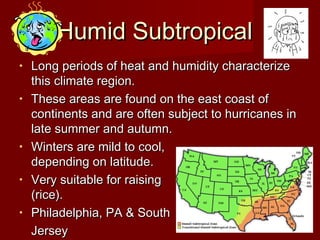
Long periods of heat and humidity characterize
this climate region.
These areas are found on the east coast of
continents and are often subject to hurricanes in
late summer and autumn.
Winters are mild to cool,
depending on latitude.
Very suitable for raising
crops,
(rice).
Philadelphia, PA & South
Jersey
Humid
Continental
•

•

•

•
•

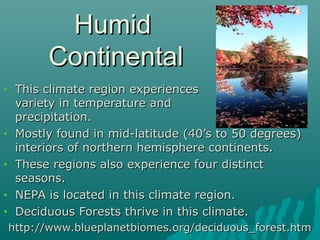
This climate region experiences
a
variety in temperature and
precipitation.
Mostly found in mid-latitude (40’s to 50 degrees)
interiors of northern hemisphere continents.
These regions also experience four distinct
seasons.
NEPA is located in this climate region.
Deciduous Forests thrive in this climate.
http://www.blueplanetbiomes.org/deciduous_forest.htm
SUBARCTIC

• Evergreen forests called “TAIGA”
cover the lands in this climate region.
• Huge temperature variations occur between
summer and winter.
• Summers are short and cool while the winters
are long & extremely cold.
• Temperatures at freezing
or below last five to eight
months of the year.
• Boreal Forest
http://www.blueplanetbiomes.org/taiga.htm
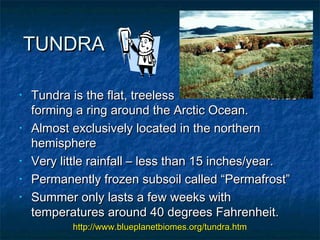
TUNDRA
•

•

•
•
•

Tundra is the flat, treeless
lands
forming a ring around the Arctic Ocean.
Almost exclusively located in the northern
hemisphere
Very little rainfall – less than 15 inches/year.
Permanently frozen subsoil called “Permafrost”
Summer only lasts a few weeks with
temperatures around 40 degrees Fahrenheit.
http://www.blueplanetbiomes.org/tundra.htm
Ice Cap
•
•
•

•

•

Snow, ice, and permanently freezing
temperatures characterize this region.
So cold it rarely snows.
This region is sometimes referred to as a Polar
Desert because it receives less than 10 inches
of precipitation per year.
o

Coldest temperature = -128.6 F (Vostok,
Antarctica)
Found only on the continent of Antarctica
HIGHLANDS
(Alpine)
Highland climates vary depending
upon four factors:
1. Latitude
2. Elevation (Altitude)
3. Topography
4. Continental Location
http://www.blueplanetbiomes.org/alpine.htm
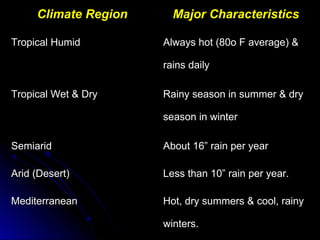
Climate Region
Tropical Humid

Major Characteristics
Always hot (80o F average) &
rains daily

Tropical Wet & Dry

Rainy season in summer & dry
season in winter

Semiarid

About 16” rain per year

Arid (Desert)

Less than 10” rain per year.

Mediterranean

Hot, dry summers & cool, rainy
winters.
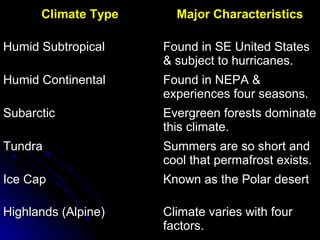
Climate Type

Major Characteristics

Humid Subtropical

Found in SE United States
& subject to hurricanes.

Humid Continental

Found in NEPA &
experiences four seasons.

Subarctic

Evergreen forests dominate
this climate.

Tundra

Summers are so short and
cool that permafrost exists.
Known as the Polar desert

Ice Cap
Highlands (Alpine)

Climate varies with four
factors.

World climates

  • 1.
    Chapter 3 –Weather & Climate
  • 2.
    World Climate Regions 1.Tropical Humid 7. Humid Subtropical 2. Tropical Wet & 8. Humid Continental Dry 9. Subarctic 3. Arid (Desert) 10. Tundra 4. Semiarid 11. Ice Cap 5. Mediterranean 12. Highland (Alpine) 6. Marine West Coast
  • 3.
    Tropical Humid • • • • • • • Little variationin temperature over the year. It is always hot with a daily average temperature of 80 degrees Fahrenheit. Rains on a daily basis and yearly average rainfall is usually more than 80 inches. Found in Central and South America, as well as Africa ,South Asia (India), Southeast Asia and Indonesia . Associated with Rainforests and Jungles. Found along the Equator or areas close to the Equator. http://www.blueplanetbiomes.org/rainforest.htm
  • 4.
    Tropical Wet & Dry • Thissub region has a rainy season in the summer and • • • • a dry season in winter. Temperatures are cooler in the dry season. Yearly rainfall is less than a Tropical Humid Climate. Tropical Wet & Dry climates are found next to tropical humid climates in Africa, South & Central America, and parts of Asia. The Savannah of Africa is a prime example.
  • 5.
    ARID(DESERT) • • • Deserts are categorizedby the amount annual rainfall received. Deserts receive less than 10 inches of rainfall per year. Hot deserts (Sahara) have low humidity and high temperatures during the day. At night the temperature falls because the dry air cannot hold heat well. http://www.blueplanetbiomes.org/desert.htm
  • 6.
    Semiarid • • • • This sub-region doesnot receive much precipitation at all – Usually about 16 inches per year. Summers are hot and winters are mild to cold. This climate is located in the interior of continents, or in a zone around deserts. Much of the American west falls into this climate type.
  • 7.
    Mediterranean • Primarily foundsurrounding the Mediterranean Sea. • Summers are dry and hot while winters are cool and rainy. • Supports a dense human population and rich agricultural activity. • Many of the first great human civilizations thrived in this climate. http://www.blueplanetbiomes.org/med_chaparral.htm
  • 8.
    Marine West Coast • Locatedclose to the oceans and is frequently cloudy, foggy, and damp. • Warm ocean waters off the coast moderates and keeps temperatures relatively constant throughout the year. • Precipitation is evenly distributed throughout the year. • Rains a lot throughout the year. • Seattle, WA (Pacific Northwest) • London, England
  • 9.
    Humid Subtropical • • • • • Long periodsof heat and humidity characterize this climate region. These areas are found on the east coast of continents and are often subject to hurricanes in late summer and autumn. Winters are mild to cool, depending on latitude. Very suitable for raising crops, (rice). Philadelphia, PA & South Jersey
  • 10.
    Humid Continental • • • • • This climate regionexperiences a variety in temperature and precipitation. Mostly found in mid-latitude (40’s to 50 degrees) interiors of northern hemisphere continents. These regions also experience four distinct seasons. NEPA is located in this climate region. Deciduous Forests thrive in this climate. http://www.blueplanetbiomes.org/deciduous_forest.htm
  • 11.
    SUBARCTIC • Evergreen forestscalled “TAIGA” cover the lands in this climate region. • Huge temperature variations occur between summer and winter. • Summers are short and cool while the winters are long & extremely cold. • Temperatures at freezing or below last five to eight months of the year. • Boreal Forest http://www.blueplanetbiomes.org/taiga.htm
  • 12.
    TUNDRA • • • • • Tundra is theflat, treeless lands forming a ring around the Arctic Ocean. Almost exclusively located in the northern hemisphere Very little rainfall – less than 15 inches/year. Permanently frozen subsoil called “Permafrost” Summer only lasts a few weeks with temperatures around 40 degrees Fahrenheit. http://www.blueplanetbiomes.org/tundra.htm
  • 13.
    Ice Cap • • • • • Snow, ice,and permanently freezing temperatures characterize this region. So cold it rarely snows. This region is sometimes referred to as a Polar Desert because it receives less than 10 inches of precipitation per year. o Coldest temperature = -128.6 F (Vostok, Antarctica) Found only on the continent of Antarctica
  • 14.
    HIGHLANDS (Alpine) Highland climates varydepending upon four factors: 1. Latitude 2. Elevation (Altitude) 3. Topography 4. Continental Location http://www.blueplanetbiomes.org/alpine.htm
  • 15.
    Climate Region Tropical Humid MajorCharacteristics Always hot (80o F average) & rains daily Tropical Wet & Dry Rainy season in summer & dry season in winter Semiarid About 16” rain per year Arid (Desert) Less than 10” rain per year. Mediterranean Hot, dry summers & cool, rainy winters.
  • 16.
    Climate Type Major Characteristics HumidSubtropical Found in SE United States & subject to hurricanes. Humid Continental Found in NEPA & experiences four seasons. Subarctic Evergreen forests dominate this climate. Tundra Summers are so short and cool that permafrost exists. Known as the Polar desert Ice Cap Highlands (Alpine) Climate varies with four factors.