Physical Geography
Climate and Vegetation
Climate is created by the sun’s solar energy
interacting with the earth’s land, water, and air. In
turn, climate and soil shape the earth’s vegetation.
NEXT
SECTION 1 Seasons and Weather
SECTION 2 Climate
TODAY’S ISSUES
Climate and Vegetation
NEXT
SECTION 3
SECTION 4
World Climate Regions
Soils and Vegetation
NEXT
• Seasons and weather occur because of the
changing position of the earth in relation to
the sun.
• Weather extremes are related to location on
earth.
Section 1
Seasons and Weather
Seasons
Seasons and Weather
SECTION
1
NEXT
Earth’s Tilt
• Earth is tilted at a 23.5° angle relative to the sun
• Areas of Earth get more, less direct sun at different
times of year
• The seasons are related to the earth’s tilt and
revolution
• The solstice marks beginning of summer, winter
- sun’s rays directly overhead at noon at furthest
points north and south
• The equinox marks the beginning of spring and
autumn
- day and night are equal in length
Weather
Weather and Climate
• Weather—atmospheric conditions at a particular
location and time
• Climate—weather conditions at one location over
long a period
• Example: Northern Russia has a cold climate
SECTION
1
NEXT
What Causes the Weather?
• Sun: amount of solar energy received
• Water vapor: determines whether there will be
precipitation
• Precipitation—water droplets falling as rain, snow,
sleet, hail
• Cloud cover: clouds may hold water vapor
Continued . . .
SECTION
1
NEXT
What Causes the Weather?
• Landforms and bodies of water
- water heats slowly, loses heat slowly
- land heats rapidly, loses heat rapidly
• Elevation: as elevation increases, air becomes
thinner
- thin air cannot hold moisture
• Air movement: distributes moisture and solar energy
continued Weather
Continued . . .
SECTION
1
NEXT
Precipitation
• Precipitation comes about when:
- warm air rises, cools, loses ability to hold water
vapor
- water vapor condenses into droplets
- water droplets form clouds
- heavy clouds release droplets as rain, snow
continued Weather
Continued . . .
SECTION
1
NEXT
Precipitation
• Three types of precipitation
- convectional
- orthographic
- frontal
• Rain shadow—land on leeward side of hills,
mountains
- little precipitation in rain shadow
continued Weather
Continued . . .
SECTION
1
NEXT
Hurricanes
• Huge storms called hurricanes, or typhoons in
Asia:
- form over warm, tropical ocean waters
- hit land with heavy rain, high winds, storm surge
Tornadoes
• Tornado—a powerful, funnel-shaped column of
spiraling air:
- born from strong thunderstorms
- capable of immense damage
continued Weather
SECTION
1
NEXT
Weather Extremes
Blizzards
• Blizzard—heavy snowstorm with strong winds,
reduced visibility
Droughts
• Drought: long period of time with either no or
minimal rainfall
Floods
• Water spreads out over normally dry land
NEXT
• Climate reflects the seasonal patterns of
weather for a location over a long period of
time.
• Global climatic changes may be natural or
human-made.
Section 2
Climate
Factors Affecting Climate
Wind Currents
• Wind, ocean currents help distribute sun’s heat
worldwide
• Convection—upward motion of air that transfers
heat in atmosphere
• Coriolis effect is the bending of winds due to Earth’s
rotation
Climate
NEXT
SECTION
2
Ocean Currents
• Resembles rivers flowing in the ocean
• Warm water flows away from equator toward poles
• Cold, polar water flows back toward equator
Continued . . .
NEXT
Zones of Latitude
• Low, or tropical latitude
- hot all year round
• Middle, or temperate latitude
- warm summers and cold winters
• High, or polar latitude
- cold all year round
SECTION
2
continued Factors Affecting Climate
Continued . . .
SECTION
2
NEXT
Elevation
• Elevation is the distance above sea level
• As elevation increases, climate gets colder
Topography
• Topography: landforms and their distribution in an
area
• Landforms, especially mountains, affect climate
continued Factors Affecting Climate
SECTION
2
NEXT
Changes in Climate
El Niño
• El Niño—winds push warm Pacific Ocean waters
toward the Americas
• La Niña—winds push warm waters toward Australia
and Asia
• Both cause natural, worldwide changes in climate
Global Warming
• Gradual warming of the earth’s atmosphere
• Greenhouse effect—the earth warms due to
trapped solar energy
NEXT
• Temperature and precipitation define climate
regions.
Section 3
World Climate Regions
• Broad climate definitions help to identify
variations in weather at a location over the
course of a year.
Defining a Climate Region
Typical Weather
• Temperature and precipitation define climate
• Location, topography, elevation may impact climate
• Five general climate regions:
- tropical (low-latitude)
- dry
- mid-latitude
- high latitude
- highland
Defining a Climate Region
NEXT
SECTION
3
Types of Climates
Tropical Wet
• Always hot; daily rainfall adds up to more than 80”
annually
NEXT
SECTION
3
Tropical Wet and Dry
• Warm, wet summer season; cooler, dry winter
season
Semiarid
• Hot summers; mild to cold winters; little precipitation
Desert
• Two kinds of desert—hot, cool/cold; less than 10”
rain per year
Continued . . .
Mediterranean
• Summers dry and hot; winters cool and rainy
NEXT
SECTION
3
Marine West Coast
• Moderate temperatures; frequently cloudy, foggy,
damp
Humid Subtropical
• Long periods of summer heat and humidity; winters
mild to cool
Humid Continental
• Great variety of temperature, precipitation; four
distinct seasons
continued Types of Climates
Continued . . .
Subarctic
• Summers are short and cool; winters are long and
very cold
NEXT
SECTION
3
Tundra
• Tundra—flat, treeless ring of lands around the
Arctic Ocean
• Very little precipitation; summer temperatures
around 40°F.
• Permafrost is the constantly frozen subsoil found in
this region
Ice Cap
• Snow, ice, permanently freezing temperatures
continued Types of Climates
Continued . . .
NEXT
SECTION
3
Highlands
• Climate varies with latitude, elevation, topography,
location
continued Types of Climates
NEXT
• Soil and climate help to determine the
vegetation of a region.
Section 4
Soils and Vegetation
• Human land use alters the vegetation in both
positive and negative ways.
Soil Regions
Shaping Human Existence
• Soil is a thin layer of weathered rock, humus, air,
water
• Topsoil refers to the top 6” of soil
• Soil characteristics vary with climate
• Type of soil determines type of vegetation that can
be supported
• Type of vegetation determines type of possible
human activity
Soils and Vegetation
NEXT
SECTION
4
Vegetation Regions
Natural Environments
• Ecosystem—interdependent community of plants
and animals
• Biome—the ecosystem of a region
• Biomes are further divided into:
- forest
- grassland
- desert
- tundra
NEXT
SECTION
4
Continued . . .
NEXT
SECTION
4
Forestlands
• Forest regions categorized by trees they support—
broadleaf or needle
• Deciduous—broadleaf trees: maple, oak, birch,
cottonwood
- mostly in Northern Hemisphere
• Rain forest—tropical forest covered with broadleaf
trees
• Coniferous—needle leaf trees; cone bearing: pine,
fir, cedar
- mostly in Northern Hemisphere
• Deciduous and coniferous trees together form
mixed forest
continued Vegetation Regions
Continued . . .
NEXT
SECTION
4
Grasslands
• Flat regions with few trees
• A savanna is a tropical grassland
• Steppe, or prairie, are temperate grasslands of
Northern Hemisphere
Desert and Tundra
• Plants in these regions have adapted to climate
extremes:
- tundra plants (mosses, lichen) hug the ground
- desert plants (cacti, sagebrush) conserve water,
withstand heat
continued Vegetation Regions
Human Impact on the Environment
NEXT
SECTION
4
Altering the Landscape
• Humans either adapt to land, or alter it to meet their
needs
• Some human activities that affect the environment:
- building dams
- installing irrigation systems
- planting crops
- slashing and burning vegetation
This is the end of the chapter presentation of
lecture notes. Click the HOME or EXIT button.
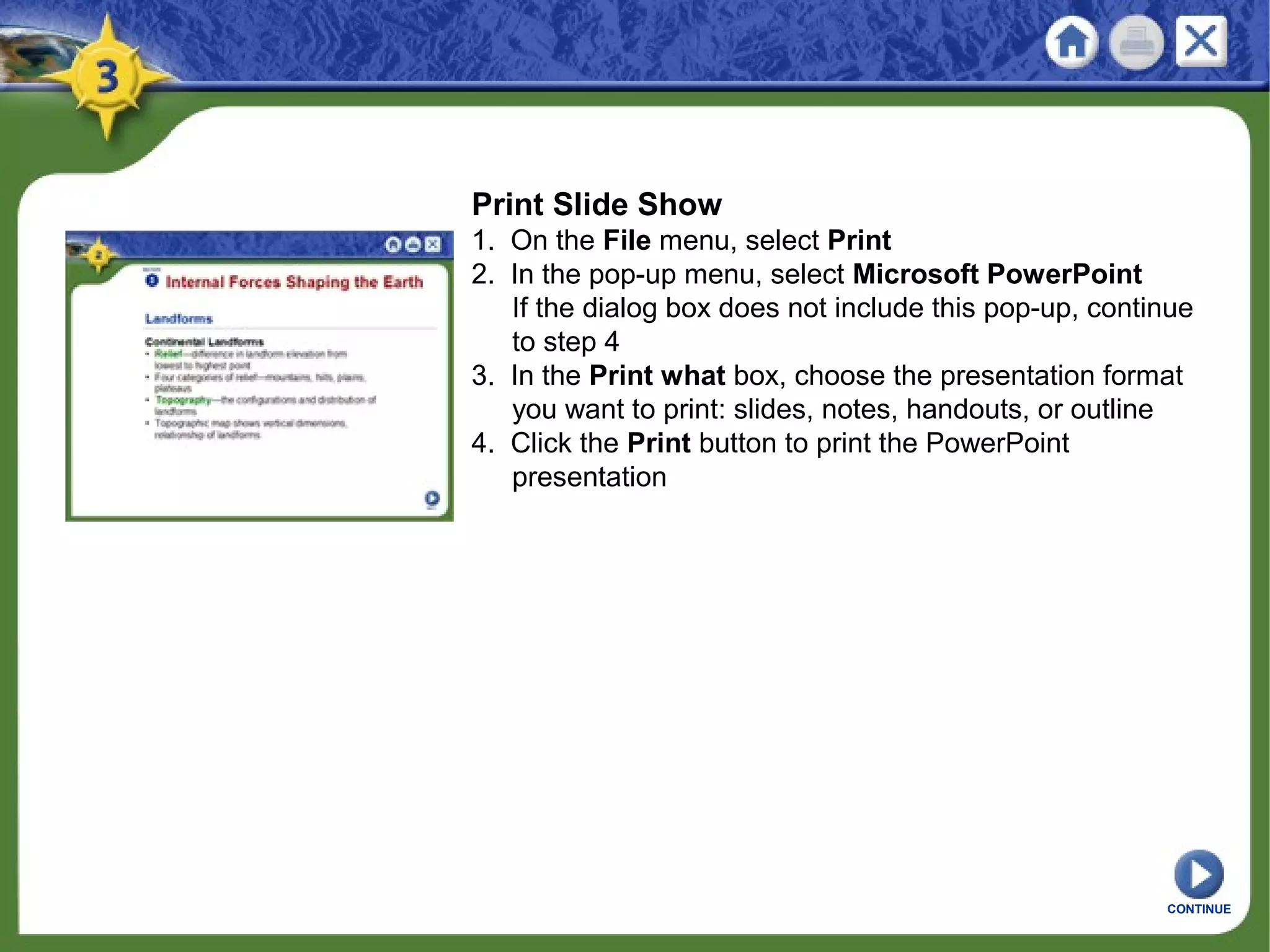
Print Slide Show
1. On the File menu, select Print
2. In the pop-up menu, select Microsoft PowerPoint
If the dialog box does not include this pop-up, continue
to step 4
3. In the Print what box, choose the presentation format
you want to print: slides, notes, handouts, or outline
4. Click the Print button to print the PowerPoint
presentation
CONTINUE

Chapter 3

  • 1.
    Physical Geography Climate andVegetation Climate is created by the sun’s solar energy interacting with the earth’s land, water, and air. In turn, climate and soil shape the earth’s vegetation. NEXT
  • 2.
    SECTION 1 Seasonsand Weather SECTION 2 Climate TODAY’S ISSUES Climate and Vegetation NEXT SECTION 3 SECTION 4 World Climate Regions Soils and Vegetation
  • 3.
    NEXT • Seasons andweather occur because of the changing position of the earth in relation to the sun. • Weather extremes are related to location on earth. Section 1 Seasons and Weather
  • 4.
    Seasons Seasons and Weather SECTION 1 NEXT Earth’sTilt • Earth is tilted at a 23.5° angle relative to the sun • Areas of Earth get more, less direct sun at different times of year • The seasons are related to the earth’s tilt and revolution • The solstice marks beginning of summer, winter - sun’s rays directly overhead at noon at furthest points north and south • The equinox marks the beginning of spring and autumn - day and night are equal in length
  • 5.
    Weather Weather and Climate •Weather—atmospheric conditions at a particular location and time • Climate—weather conditions at one location over long a period • Example: Northern Russia has a cold climate SECTION 1 NEXT What Causes the Weather? • Sun: amount of solar energy received • Water vapor: determines whether there will be precipitation • Precipitation—water droplets falling as rain, snow, sleet, hail • Cloud cover: clouds may hold water vapor Continued . . .
  • 6.
    SECTION 1 NEXT What Causes theWeather? • Landforms and bodies of water - water heats slowly, loses heat slowly - land heats rapidly, loses heat rapidly • Elevation: as elevation increases, air becomes thinner - thin air cannot hold moisture • Air movement: distributes moisture and solar energy continued Weather Continued . . .
  • 7.
    SECTION 1 NEXT Precipitation • Precipitation comesabout when: - warm air rises, cools, loses ability to hold water vapor - water vapor condenses into droplets - water droplets form clouds - heavy clouds release droplets as rain, snow continued Weather Continued . . .
  • 8.
    SECTION 1 NEXT Precipitation • Three typesof precipitation - convectional - orthographic - frontal • Rain shadow—land on leeward side of hills, mountains - little precipitation in rain shadow continued Weather Continued . . .
  • 9.
    SECTION 1 NEXT Hurricanes • Huge stormscalled hurricanes, or typhoons in Asia: - form over warm, tropical ocean waters - hit land with heavy rain, high winds, storm surge Tornadoes • Tornado—a powerful, funnel-shaped column of spiraling air: - born from strong thunderstorms - capable of immense damage continued Weather
  • 10.
    SECTION 1 NEXT Weather Extremes Blizzards • Blizzard—heavysnowstorm with strong winds, reduced visibility Droughts • Drought: long period of time with either no or minimal rainfall Floods • Water spreads out over normally dry land
  • 11.
    NEXT • Climate reflectsthe seasonal patterns of weather for a location over a long period of time. • Global climatic changes may be natural or human-made. Section 2 Climate
  • 12.
    Factors Affecting Climate WindCurrents • Wind, ocean currents help distribute sun’s heat worldwide • Convection—upward motion of air that transfers heat in atmosphere • Coriolis effect is the bending of winds due to Earth’s rotation Climate NEXT SECTION 2 Ocean Currents • Resembles rivers flowing in the ocean • Warm water flows away from equator toward poles • Cold, polar water flows back toward equator Continued . . .
  • 13.
    NEXT Zones of Latitude •Low, or tropical latitude - hot all year round • Middle, or temperate latitude - warm summers and cold winters • High, or polar latitude - cold all year round SECTION 2 continued Factors Affecting Climate Continued . . .
  • 14.
    SECTION 2 NEXT Elevation • Elevation isthe distance above sea level • As elevation increases, climate gets colder Topography • Topography: landforms and their distribution in an area • Landforms, especially mountains, affect climate continued Factors Affecting Climate
  • 15.
    SECTION 2 NEXT Changes in Climate ElNiño • El Niño—winds push warm Pacific Ocean waters toward the Americas • La Niña—winds push warm waters toward Australia and Asia • Both cause natural, worldwide changes in climate Global Warming • Gradual warming of the earth’s atmosphere • Greenhouse effect—the earth warms due to trapped solar energy
  • 16.
    NEXT • Temperature andprecipitation define climate regions. Section 3 World Climate Regions • Broad climate definitions help to identify variations in weather at a location over the course of a year.
  • 17.
    Defining a ClimateRegion Typical Weather • Temperature and precipitation define climate • Location, topography, elevation may impact climate • Five general climate regions: - tropical (low-latitude) - dry - mid-latitude - high latitude - highland Defining a Climate Region NEXT SECTION 3
  • 18.
    Types of Climates TropicalWet • Always hot; daily rainfall adds up to more than 80” annually NEXT SECTION 3 Tropical Wet and Dry • Warm, wet summer season; cooler, dry winter season Semiarid • Hot summers; mild to cold winters; little precipitation Desert • Two kinds of desert—hot, cool/cold; less than 10” rain per year Continued . . .
  • 19.
    Mediterranean • Summers dryand hot; winters cool and rainy NEXT SECTION 3 Marine West Coast • Moderate temperatures; frequently cloudy, foggy, damp Humid Subtropical • Long periods of summer heat and humidity; winters mild to cool Humid Continental • Great variety of temperature, precipitation; four distinct seasons continued Types of Climates Continued . . .
  • 20.
    Subarctic • Summers areshort and cool; winters are long and very cold NEXT SECTION 3 Tundra • Tundra—flat, treeless ring of lands around the Arctic Ocean • Very little precipitation; summer temperatures around 40°F. • Permafrost is the constantly frozen subsoil found in this region Ice Cap • Snow, ice, permanently freezing temperatures continued Types of Climates Continued . . .
  • 21.
    NEXT SECTION 3 Highlands • Climate varieswith latitude, elevation, topography, location continued Types of Climates
  • 22.
    NEXT • Soil andclimate help to determine the vegetation of a region. Section 4 Soils and Vegetation • Human land use alters the vegetation in both positive and negative ways.
  • 23.
    Soil Regions Shaping HumanExistence • Soil is a thin layer of weathered rock, humus, air, water • Topsoil refers to the top 6” of soil • Soil characteristics vary with climate • Type of soil determines type of vegetation that can be supported • Type of vegetation determines type of possible human activity Soils and Vegetation NEXT SECTION 4
  • 24.
    Vegetation Regions Natural Environments •Ecosystem—interdependent community of plants and animals • Biome—the ecosystem of a region • Biomes are further divided into: - forest - grassland - desert - tundra NEXT SECTION 4 Continued . . .
  • 25.
    NEXT SECTION 4 Forestlands • Forest regionscategorized by trees they support— broadleaf or needle • Deciduous—broadleaf trees: maple, oak, birch, cottonwood - mostly in Northern Hemisphere • Rain forest—tropical forest covered with broadleaf trees • Coniferous—needle leaf trees; cone bearing: pine, fir, cedar - mostly in Northern Hemisphere • Deciduous and coniferous trees together form mixed forest continued Vegetation Regions Continued . . .
  • 26.
    NEXT SECTION 4 Grasslands • Flat regionswith few trees • A savanna is a tropical grassland • Steppe, or prairie, are temperate grasslands of Northern Hemisphere Desert and Tundra • Plants in these regions have adapted to climate extremes: - tundra plants (mosses, lichen) hug the ground - desert plants (cacti, sagebrush) conserve water, withstand heat continued Vegetation Regions
  • 27.
    Human Impact onthe Environment NEXT SECTION 4 Altering the Landscape • Humans either adapt to land, or alter it to meet their needs • Some human activities that affect the environment: - building dams - installing irrigation systems - planting crops - slashing and burning vegetation
  • 28.
    This is theend of the chapter presentation of lecture notes. Click the HOME or EXIT button.
  • 29.
    Print Slide Show 1.On the File menu, select Print 2. In the pop-up menu, select Microsoft PowerPoint If the dialog box does not include this pop-up, continue to step 4 3. In the Print what box, choose the presentation format you want to print: slides, notes, handouts, or outline 4. Click the Print button to print the PowerPoint presentation CONTINUE