Next 
World Geography 
Chapter 3 
Weather and Climate 
The Big Idea 
The sun, location, wind, water, and mountains affect weather and climate. 
Main Ideas 
• While weather is short term, climate is a region’s average weather over a long period. 
• The amount of sun at a given location is affected by Earth’s tilt, movement, and shape. 
• Wind and water move heat around Earth, affecting how warm or wet a place is. 
• Mountains influence temperature and precipitation. 
Copyright © by Houghton Mifflin Harcourt Publishing Company
World Geography 
Chapter 3 
Main Idea 1: While weather is short term, climate is a region’s average weather 
over a long period. 
Weather 
• The short-term changes in the air for a given place and time 
• Temperature and precipitation from hour to hour or day to day 
• Weather is unpredictable 
Climate 
• A region’s average weather conditions over a long period 
• The expected more predictable weather for a place based on data 
and experience 
Next Previous 
Copyright © by Houghton Mifflin Harcourt Publishing Company
World Geography 
Chapter 3 
Main Idea 2: The amount of sun at a given location is affected by Earth’s tilt, 
movement, and shape. 
Movement 
• As Earth revolves 
around the sun, the 
part of Earth that is 
tilted toward the 
sun changes during 
the year, thus 
creating the 
seasons. 
Next Previous 
Copyright © by Houghton Mifflin Harcourt Publishing Company 
Shape 
• Earth’s spherical shape 
means that the sun’s 
rays directly strike the 
equator, but only 
somewhat strike the 
poles. 
• The farther from the 
equator, or the higher 
the latitude, the colder 
the climate. 
Tilt 
• The part of the Earth 
tilted toward the sun 
receives more solar 
energy than the part 
tilted away from the 
sun.
World Geography 
Chapter 3 
Main Idea 3: Wind and water move heat around Earth, affecting how warm or wet 
a place is. 
• Air and water warmed by the sun are constantly on the 
move, making different areas of Earth warmer or 
cooler. 
• Wind, or the sideways movement of air, blows in great 
streams around the planet. 
• Prevailing winds are winds that blow in the same 
direction over large areas of Earth 
Next Previous 
Copyright © by Houghton Mifflin Harcourt Publishing Company
World Geography 
Chapter 3 
Wind 
• Weight of air 
– Cold air is heavier than warm air. 
– When air cools, it gets heavier and sinks. 
– When air warms, it gets lighter and rises. 
– As warm air rises, cooler air moves in to take its place, creating wind. 
• The rising, sinking, and flowing of air creates Earth’s prevailing wind patterns. 
– At the equator, hot air rises and flows toward the poles. 
– At the poles, cold air sinks and flows toward the equator. 
– Earth’s rotation causes prevailing winds to curve east or west. 
• Prevailing winds can make a region warmer or colder and drier or wetter. 
Next Previous 
Copyright © by Houghton Mifflin Harcourt Publishing Company
World Geography 
Chapter 3 
Water and Wind 
• Ocean currents—large streams of surface seawater driven by 
winds—move heat around Earth. 
– Carry warm or cool water to different areas 
– Water’s temperature affects air temperature near it. 
• Large bodies of water, such as an ocean or sea, also affect 
climate. 
–Water heats and cools more slowly than land does. 
– Large bodies of water make the temperature of the land 
nearby milder. 
• The place where two air masses of different temperatures or 
moisture content meet is a front. 
– Can produce rain, snow, thunderstorms, and blizzards 
Next Previous 
Copyright © by Houghton Mifflin Harcourt Publishing Company
World Geography 
Chapter 3 
Storms 
Thunderstorms 
• Produce rain, lightning, and thunder 
• Most common in spring and summer 
Blizzards 
• Produce strong winds and large amounts of snow 
Tornadoes 
• Small, rapidly twisting funnel of air that touches the ground 
Hurricanes and Typhoons 
• Large, rotating storms that form over tropical waters in the Atlantic Ocean 
(hurricanes) or Pacific Ocean (typhoons). 
• Produce drenching rains, strong winds, and storm surges 
• Largest, most destructive storms 
Next Previous 
Copyright © by Houghton Mifflin Harcourt Publishing Company
World Geography 
Chapter 3 
Main Idea 4: Mountains influence temperature and precipitation. 
• Mountains can influence an area’s climate by affecting both 
temperature and precipitation. 
• Temperature decreases with elevation, the height on Earth’s 
surface above sea level. 
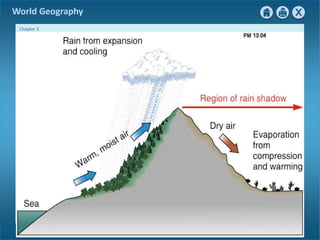
• Mountains also create wet and dry areas. 
– Air blowing against mountains is forced to rise. 
– As the air rises, it cools and precipitation falls. 
–This effect produces a rain shadow, a dry area on the 
mountainside facing away from the direction of the 
wind. 
Next Previous 
Copyright © by Houghton Mifflin Harcourt Publishing Company
World Geography 
Chapter 3 
Next Previous 
Copyright © by Houghton Mifflin Harcourt Publishing Company
World Geography 
Chapter 3 
World Climates 
The Big Idea 
Earth’s five major climate zones are identified by temperature, precipitation, and plant life. 
Main Ideas 
• Geographers use temperature, precipitation, and plant life to identify climate zones. 
• Tropical climates are wet and warm, while dry climates receive little or no rain. 
• Temperate climates have the most seasonal change. 
• Polar climates are cold and dry, while highland climates change with elevation. 
Next Previous 
Copyright © by Houghton Mifflin Harcourt Publishing Company
World Geography 
Chapter 3 
Main Idea 1: Geographers use temperature, precipitation, and plant life to identify 
climate zones. 
• Earth is divided into five general climate zones. 
– Tropical—occur near the equator, in low latitudes 
– Temperate—occur about halfway between the 
equator and the poles, in the middle latitudes 
– Polar—occur near the poles, in the high latitudes 
– Dry—occurs at many different latitudes 
– Highland—occurs at many different latitudes 
• Geographers divide some climate zones into more 
specific climate regions. 
Next Previous 
Copyright © by Houghton Mifflin Harcourt Publishing Company
World Geography 
Chapter 3 
Main Idea 2: Tropical climates are wet and warm, while dry climates receive little or 
no rain. 
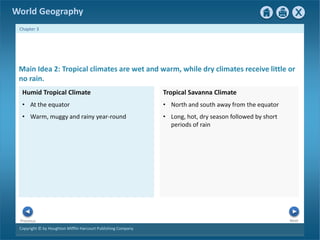
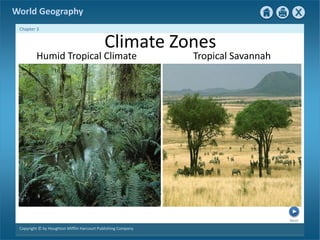
Humid Tropical Climate 
• At the equator 
• Warm, muggy and rainy year-round 
Next Previous 
Copyright © by Houghton Mifflin Harcourt Publishing Company 
Tropical Savanna Climate 
• North and south away from the equator 
• Long, hot, dry season followed by short 
periods of rain
Next 
World Geography 
Chapter 3 
Climate Zones 
Humid Tropical Climate Tropical Savannah 
Copyright © by Houghton Mifflin Harcourt Publishing Company
World Geography 
Chapter 3 
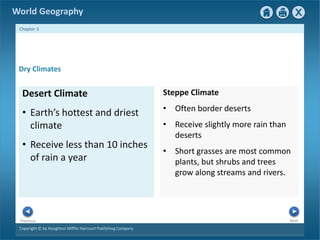
Dry Climates 
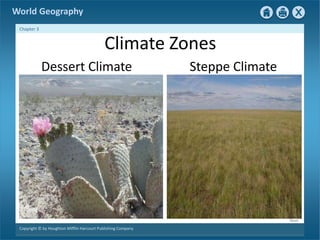
Desert Climate 
• Earth’s hottest and driest 
climate 
• Receive less than 10 inches 
of rain a year 
Next Previous 
Copyright © by Houghton Mifflin Harcourt Publishing Company 
Steppe Climate 
• Often border deserts 
• Receive slightly more rain than 
deserts 
• Short grasses are most common 
plants, but shrubs and trees 
grow along streams and rivers.
Next 
World Geography 
Chapter 3 
Climate Zones 
Dessert Climate Steppe Climate 
Copyright © by Houghton Mifflin Harcourt Publishing Company
World Geography 
Chapter 3 
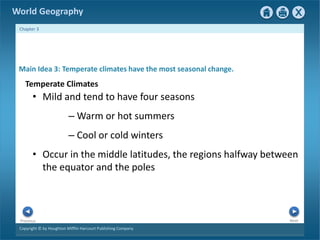
Main Idea 3: Temperate climates have the most seasonal change. 
Temperate Climates 
• Mild and tend to have four seasons 
– Warm or hot summers 
– Cool or cold winters 
• Occur in the middle latitudes, the regions halfway between 
the equator and the poles 
Next Previous 
Copyright © by Houghton Mifflin Harcourt Publishing Company
World Geography 
Chapter 3 
Temperate Climates 
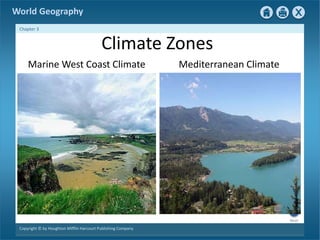
Mediterranean 
• Sunny, pleasant climate occurring mainly in coastal areas 
• Summers hot, dry, and sunny; winters mild and somewhat wet 
Humid Subtropical 
• Occurs along east coasts near the tropics 
• Summers are hot and muggy; winters are mild 
• Storms occur year-round. 
Marine West Coast 
• Occurs on west coasts where winds carry moisture in from the seas 
• Mild temperatures year-round 
Humid Continental 
• Occurs closer to the poles, in the upper-middle latitudes 
• Four distinct seasons Next 
Previous 
Copyright © by Houghton Mifflin Harcourt Publishing Company
Next 
World Geography 
Chapter 3 
Climate Zones 
Marine West Coast Climate Mediterranean Climate 
Copyright © by Houghton Mifflin Harcourt Publishing Company
World Geography 
Chapter 3 
Main Idea 4: Polar climates are cold and dry, while highland climates change with 
elevation. 
Next 
Previous 
Copyright © by Houghton Mifflin Harcourt Publishing Company 
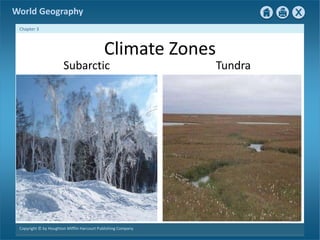
Tundra Climate 
• Coastal areas along the Arctic 
Ocean 
• Long, bitterly cold winters 
• In some parts is permafrost, or 
permanently frozen layers of soil 
Ice Cap Climate 
• North and South poles 
• Temperature lows of more than - 
120F 
• Snow and ice remain year-round, 
but little precipitation 
Highland Climate 
• Found on mountains 
• Includes polar climates plus 
others; several climates in one 
• As you go up a mountain, 
temperatures drop and plant life 
grows sparser. 
Subarctic Climate 
• Occurs mainly in Northern 
hemisphere south of Arctic Ocean 
• Winters are long and bitterly cold; 
summers short and cool 
• Below freezing half the year
Next 
World Geography 
Chapter 3 
Climate Zones 
Subarctic Tundra 
Copyright © by Houghton Mifflin Harcourt Publishing Company
World Geography 
Chapter 3 
Natural Environments 
The Big Idea 
Plants, animals, and the environment, including soil, interact and affect one another. 
Main Ideas 
• The environment and life are interconnected and exist in a fragile balance. 
• Soils play an important role in the environment. 
Next Previous 
Copyright © by Houghton Mifflin Harcourt Publishing Company
World Geography 
Chapter 3 
Main Idea 1: The environment and life are interconnected and exist in a fragile 
balance. 
• Plants and animals live where they are suited to the environment, 
or surroundings. 
–Factors such as temperature, rainfall, and soil conditions 
limit options of where they can live. 
• Ecosystem—a group of plants and animals that depend on each 
other for survival and the environment in which they live 
– Formed from connections between living things and the 
environment 
– Changes to the environment can change ecosystems 
Next Previous 
Copyright © by Houghton Mifflin Harcourt Publishing Company
World Geography 
Chapter 3 
Main Idea 2: Soils play an important role in the environment. 
• Soils help determine what plants will grow and how 
well. 
• Fertile soils are rich in minerals can support abundant 
life 
• Soils can lose fertility in many ways. 
–Erosion 
–Planting the same crops over and over 
• When soil becomes worn out, it cannot support as 
many plants. 
– Can lead to desertification, the spread of 
desertlike conditions 
Next Previous 
Copyright © by Houghton Mifflin Harcourt Publishing Company
World Geography 
Chapter 3 
Natural Resources 
The Big Idea 
The sun, location, wind, water, and mountains affect weather and climate. 
Main Ideas 
• Earth provides valuable resources for our use. 
• Energy resources provide fuel, heat, and electricity. 
• Mineral resources include metals, rocks, and salt. 
• Resources shape people’s lives and countries’ wealth. 
Next Previous 
Copyright © by Houghton Mifflin Harcourt Publishing Company
World Geography 
Chapter 3 
Main Idea 1: Earth provides valuable resources for our use. 
Next Previous 
Copyright © by Houghton Mifflin Harcourt Publishing Company 
Types of Natural 
Resources 
• Renewable 
resources are 
resources Earth 
replaces naturally. 
• Nonrenewable 
resources are 
resources that 
cannot be replaced; 
they will run out 
one day. 
Using Natural 
Resources 
• A natural resource is 
any material in 
nature that people 
use and value.
World Geography 
Chapter 3 
Main Idea 2: Energy resources provide fuel, heat, and electricity. 
Nonrenewable Energy Resources 
• Most energy we use comes from 
fossil fuels, nonrenewable 
resources that formed from the 
remains of ancient plants and 
animals. 
- Coal 
- Petroleum 
- Natural gas 
Next Previous 
Copyright © by Houghton Mifflin Harcourt Publishing Company 
Renewable Energy Resources 
• Will not run out 
• Generally better for the environment 
• Hydroelectric power—the 
production of electricity from 
waterpower 
• Wind is used to power wind turbines 
that create electricity. 
• Solar power and geothermal energy— 
heat from within Earth—can heat 
water for homes and be turned into 
electricity
World Geography 
Chapter 3 
Nuclear Energy 
• Obtained by splitting atoms 
• Uses the metal uranium, so some consider it a 
nonrenewable resource 
• Produces dangerous wastes that must be stored for 
thousands of years before they are safe 
Next Previous 
Copyright © by Houghton Mifflin Harcourt Publishing Company
World Geography 
Chapter 3 
Main Idea 4: Resources shape people’s lives and countries’ wealth. 
• The natural resources available to people affect their lifestyles and needs. 
– People in areas with many natural resources sometimes have 
more choices on ways to dress, eat, live, travel, and entertain 
themselves. 
• Availability of natural resources affects countries’ economies. 
– The many resources available in the United States have helped it 
become one of the world’s wealthiest economies. 
– Countries with few natural resources often have weak 
economies. 
Next Previous 
Copyright © by Houghton Mifflin Harcourt Publishing Company

Ch.3 climate, enviroment, and resources

  • 1.
    Next World Geography Chapter 3 Weather and Climate The Big Idea The sun, location, wind, water, and mountains affect weather and climate. Main Ideas • While weather is short term, climate is a region’s average weather over a long period. • The amount of sun at a given location is affected by Earth’s tilt, movement, and shape. • Wind and water move heat around Earth, affecting how warm or wet a place is. • Mountains influence temperature and precipitation. Copyright © by Houghton Mifflin Harcourt Publishing Company
  • 2.
    World Geography Chapter3 Main Idea 1: While weather is short term, climate is a region’s average weather over a long period. Weather • The short-term changes in the air for a given place and time • Temperature and precipitation from hour to hour or day to day • Weather is unpredictable Climate • A region’s average weather conditions over a long period • The expected more predictable weather for a place based on data and experience Next Previous Copyright © by Houghton Mifflin Harcourt Publishing Company
  • 3.
    World Geography Chapter3 Main Idea 2: The amount of sun at a given location is affected by Earth’s tilt, movement, and shape. Movement • As Earth revolves around the sun, the part of Earth that is tilted toward the sun changes during the year, thus creating the seasons. Next Previous Copyright © by Houghton Mifflin Harcourt Publishing Company Shape • Earth’s spherical shape means that the sun’s rays directly strike the equator, but only somewhat strike the poles. • The farther from the equator, or the higher the latitude, the colder the climate. Tilt • The part of the Earth tilted toward the sun receives more solar energy than the part tilted away from the sun.
  • 4.
    World Geography Chapter3 Main Idea 3: Wind and water move heat around Earth, affecting how warm or wet a place is. • Air and water warmed by the sun are constantly on the move, making different areas of Earth warmer or cooler. • Wind, or the sideways movement of air, blows in great streams around the planet. • Prevailing winds are winds that blow in the same direction over large areas of Earth Next Previous Copyright © by Houghton Mifflin Harcourt Publishing Company
  • 5.
    World Geography Chapter3 Wind • Weight of air – Cold air is heavier than warm air. – When air cools, it gets heavier and sinks. – When air warms, it gets lighter and rises. – As warm air rises, cooler air moves in to take its place, creating wind. • The rising, sinking, and flowing of air creates Earth’s prevailing wind patterns. – At the equator, hot air rises and flows toward the poles. – At the poles, cold air sinks and flows toward the equator. – Earth’s rotation causes prevailing winds to curve east or west. • Prevailing winds can make a region warmer or colder and drier or wetter. Next Previous Copyright © by Houghton Mifflin Harcourt Publishing Company
  • 6.
    World Geography Chapter3 Water and Wind • Ocean currents—large streams of surface seawater driven by winds—move heat around Earth. – Carry warm or cool water to different areas – Water’s temperature affects air temperature near it. • Large bodies of water, such as an ocean or sea, also affect climate. –Water heats and cools more slowly than land does. – Large bodies of water make the temperature of the land nearby milder. • The place where two air masses of different temperatures or moisture content meet is a front. – Can produce rain, snow, thunderstorms, and blizzards Next Previous Copyright © by Houghton Mifflin Harcourt Publishing Company
  • 7.
    World Geography Chapter3 Storms Thunderstorms • Produce rain, lightning, and thunder • Most common in spring and summer Blizzards • Produce strong winds and large amounts of snow Tornadoes • Small, rapidly twisting funnel of air that touches the ground Hurricanes and Typhoons • Large, rotating storms that form over tropical waters in the Atlantic Ocean (hurricanes) or Pacific Ocean (typhoons). • Produce drenching rains, strong winds, and storm surges • Largest, most destructive storms Next Previous Copyright © by Houghton Mifflin Harcourt Publishing Company
  • 8.
    World Geography Chapter3 Main Idea 4: Mountains influence temperature and precipitation. • Mountains can influence an area’s climate by affecting both temperature and precipitation. • Temperature decreases with elevation, the height on Earth’s surface above sea level. • Mountains also create wet and dry areas. – Air blowing against mountains is forced to rise. – As the air rises, it cools and precipitation falls. –This effect produces a rain shadow, a dry area on the mountainside facing away from the direction of the wind. Next Previous Copyright © by Houghton Mifflin Harcourt Publishing Company
  • 9.
    World Geography Chapter3 Next Previous Copyright © by Houghton Mifflin Harcourt Publishing Company
  • 10.
    World Geography Chapter3 World Climates The Big Idea Earth’s five major climate zones are identified by temperature, precipitation, and plant life. Main Ideas • Geographers use temperature, precipitation, and plant life to identify climate zones. • Tropical climates are wet and warm, while dry climates receive little or no rain. • Temperate climates have the most seasonal change. • Polar climates are cold and dry, while highland climates change with elevation. Next Previous Copyright © by Houghton Mifflin Harcourt Publishing Company
  • 11.
    World Geography Chapter3 Main Idea 1: Geographers use temperature, precipitation, and plant life to identify climate zones. • Earth is divided into five general climate zones. – Tropical—occur near the equator, in low latitudes – Temperate—occur about halfway between the equator and the poles, in the middle latitudes – Polar—occur near the poles, in the high latitudes – Dry—occurs at many different latitudes – Highland—occurs at many different latitudes • Geographers divide some climate zones into more specific climate regions. Next Previous Copyright © by Houghton Mifflin Harcourt Publishing Company
  • 12.
    World Geography Chapter3 Main Idea 2: Tropical climates are wet and warm, while dry climates receive little or no rain. Humid Tropical Climate • At the equator • Warm, muggy and rainy year-round Next Previous Copyright © by Houghton Mifflin Harcourt Publishing Company Tropical Savanna Climate • North and south away from the equator • Long, hot, dry season followed by short periods of rain
  • 13.
    Next World Geography Chapter 3 Climate Zones Humid Tropical Climate Tropical Savannah Copyright © by Houghton Mifflin Harcourt Publishing Company
  • 14.
    World Geography Chapter3 Dry Climates Desert Climate • Earth’s hottest and driest climate • Receive less than 10 inches of rain a year Next Previous Copyright © by Houghton Mifflin Harcourt Publishing Company Steppe Climate • Often border deserts • Receive slightly more rain than deserts • Short grasses are most common plants, but shrubs and trees grow along streams and rivers.
  • 15.
    Next World Geography Chapter 3 Climate Zones Dessert Climate Steppe Climate Copyright © by Houghton Mifflin Harcourt Publishing Company
  • 16.
    World Geography Chapter3 Main Idea 3: Temperate climates have the most seasonal change. Temperate Climates • Mild and tend to have four seasons – Warm or hot summers – Cool or cold winters • Occur in the middle latitudes, the regions halfway between the equator and the poles Next Previous Copyright © by Houghton Mifflin Harcourt Publishing Company
  • 17.
    World Geography Chapter3 Temperate Climates Mediterranean • Sunny, pleasant climate occurring mainly in coastal areas • Summers hot, dry, and sunny; winters mild and somewhat wet Humid Subtropical • Occurs along east coasts near the tropics • Summers are hot and muggy; winters are mild • Storms occur year-round. Marine West Coast • Occurs on west coasts where winds carry moisture in from the seas • Mild temperatures year-round Humid Continental • Occurs closer to the poles, in the upper-middle latitudes • Four distinct seasons Next Previous Copyright © by Houghton Mifflin Harcourt Publishing Company
  • 18.
    Next World Geography Chapter 3 Climate Zones Marine West Coast Climate Mediterranean Climate Copyright © by Houghton Mifflin Harcourt Publishing Company
  • 19.
    World Geography Chapter3 Main Idea 4: Polar climates are cold and dry, while highland climates change with elevation. Next Previous Copyright © by Houghton Mifflin Harcourt Publishing Company Tundra Climate • Coastal areas along the Arctic Ocean • Long, bitterly cold winters • In some parts is permafrost, or permanently frozen layers of soil Ice Cap Climate • North and South poles • Temperature lows of more than - 120F • Snow and ice remain year-round, but little precipitation Highland Climate • Found on mountains • Includes polar climates plus others; several climates in one • As you go up a mountain, temperatures drop and plant life grows sparser. Subarctic Climate • Occurs mainly in Northern hemisphere south of Arctic Ocean • Winters are long and bitterly cold; summers short and cool • Below freezing half the year
  • 20.
    Next World Geography Chapter 3 Climate Zones Subarctic Tundra Copyright © by Houghton Mifflin Harcourt Publishing Company
  • 21.
    World Geography Chapter3 Natural Environments The Big Idea Plants, animals, and the environment, including soil, interact and affect one another. Main Ideas • The environment and life are interconnected and exist in a fragile balance. • Soils play an important role in the environment. Next Previous Copyright © by Houghton Mifflin Harcourt Publishing Company
  • 22.
    World Geography Chapter3 Main Idea 1: The environment and life are interconnected and exist in a fragile balance. • Plants and animals live where they are suited to the environment, or surroundings. –Factors such as temperature, rainfall, and soil conditions limit options of where they can live. • Ecosystem—a group of plants and animals that depend on each other for survival and the environment in which they live – Formed from connections between living things and the environment – Changes to the environment can change ecosystems Next Previous Copyright © by Houghton Mifflin Harcourt Publishing Company
  • 23.
    World Geography Chapter3 Main Idea 2: Soils play an important role in the environment. • Soils help determine what plants will grow and how well. • Fertile soils are rich in minerals can support abundant life • Soils can lose fertility in many ways. –Erosion –Planting the same crops over and over • When soil becomes worn out, it cannot support as many plants. – Can lead to desertification, the spread of desertlike conditions Next Previous Copyright © by Houghton Mifflin Harcourt Publishing Company
  • 24.
    World Geography Chapter3 Natural Resources The Big Idea The sun, location, wind, water, and mountains affect weather and climate. Main Ideas • Earth provides valuable resources for our use. • Energy resources provide fuel, heat, and electricity. • Mineral resources include metals, rocks, and salt. • Resources shape people’s lives and countries’ wealth. Next Previous Copyright © by Houghton Mifflin Harcourt Publishing Company
  • 25.
    World Geography Chapter3 Main Idea 1: Earth provides valuable resources for our use. Next Previous Copyright © by Houghton Mifflin Harcourt Publishing Company Types of Natural Resources • Renewable resources are resources Earth replaces naturally. • Nonrenewable resources are resources that cannot be replaced; they will run out one day. Using Natural Resources • A natural resource is any material in nature that people use and value.
  • 26.
    World Geography Chapter3 Main Idea 2: Energy resources provide fuel, heat, and electricity. Nonrenewable Energy Resources • Most energy we use comes from fossil fuels, nonrenewable resources that formed from the remains of ancient plants and animals. - Coal - Petroleum - Natural gas Next Previous Copyright © by Houghton Mifflin Harcourt Publishing Company Renewable Energy Resources • Will not run out • Generally better for the environment • Hydroelectric power—the production of electricity from waterpower • Wind is used to power wind turbines that create electricity. • Solar power and geothermal energy— heat from within Earth—can heat water for homes and be turned into electricity
  • 27.
    World Geography Chapter3 Nuclear Energy • Obtained by splitting atoms • Uses the metal uranium, so some consider it a nonrenewable resource • Produces dangerous wastes that must be stored for thousands of years before they are safe Next Previous Copyright © by Houghton Mifflin Harcourt Publishing Company
  • 28.
    World Geography Chapter3 Main Idea 4: Resources shape people’s lives and countries’ wealth. • The natural resources available to people affect their lifestyles and needs. – People in areas with many natural resources sometimes have more choices on ways to dress, eat, live, travel, and entertain themselves. • Availability of natural resources affects countries’ economies. – The many resources available in the United States have helped it become one of the world’s wealthiest economies. – Countries with few natural resources often have weak economies. Next Previous Copyright © by Houghton Mifflin Harcourt Publishing Company