Chapter 18.4
1. Explain what is meant by solubility product
constants, and calculate their values.
2. Calculate solubilities using solubility product
constants.
3. Carry out calculations to predict whether
precipitates will form when solutions are combined.
• A saturated solution contains the maximum amount
of solute possible at a given temperature in
equilibrium with an undissolved excess of the
substance.
• A saturated solution is not necessarily a concentrated
solution.
• The equilibrium principles developed in this chapter
apply to all saturated solutions of sparingly soluble
salts.
• The heterogeneous equilibrium system in a saturated solution of
silver chloride containing an excess of the solid salt is
represented by

-
AgCl( ) Ag ( Cl ( )s aq) + aq
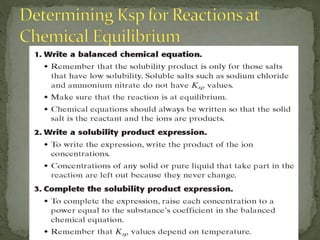
• The solubility product constant, Ksp, of a substance is the
product of the molar concentrations of its ions in a saturated
solution, each raised to the power that is the coefficient of that
ion in the balanced chemical equation.
• The equation for the solubility equilibrium expression for the
dissolution reaction of AgCl is
spK -
[Ag ][Cl ]

• The equilibrium expression is written without including the
solid species.
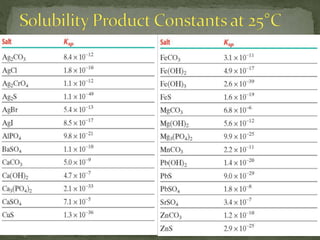
• The numerical value of Ksp can be determined from solubility
data.
• For a saturated solution of CaF2, the equilibrium
equation is
spK 2 – 2
[Ca ][F ]

 
2 –
2CaF ( ) Ca ( ) 2F ( )s aq aq
• The expression for the solubility product constant is
• The solubility of CaF2 is is 8.6  10−3/100 g of water at
25°C. Expressed in moles per liter this concentration
becomes 1.1  10−3 mol/L.
• CaF2 dissociates to yield twice as many F− ions as Ca2+
ions.
[Ca2+] = 1.1  10−3 mol/L [F− ] = 2.2  10−3 mol/L
 
spK 2 2
[Ca ][F ]
spK –3 3 2
(1.1 10 )(2.2 10 )
  
Ksp = 5.3  10-9
• Calculations of Ksp ordinarily should be limited to
two significant figures.
• The solubility product constant is an equilibrium
constant representing the product of the molar
concentrations of its ions in a saturated solution.
• The solubility of a solid is an equilibrium position that
represents the amount of the solid required to form a
saturated solution with a specific amount of solvent.
• It has only one value for a given solid at a given temperature.
• It has an infinite number of possible values at a given
temperature and is dependent on other conditions, such as
the presence of a common ion.
• Calculate the solubility product constant, Ksp ,for copper(I)
chloride, CuCl, given that the solubility of this compound at
25°C is 1.08  10–2 g/100. g H2O.
2
2 2
1 g H Og CuCl 1000 mL 1 molCuCl
solubility in mol/L
100. g H O 1 mL H O 1 L g CuCl
   
 
–
CuCl( ) Cu ( ) Cl ( )s aq aq
Ksp=[Cu+][Cl–]
Unknown: Ksp
Given: solubility of CuCl = 1.08  10−2 g CuCl/100. g H2O
Solution:
[Cu+] = [Cl–] = solubility in mol/L
–2
2
2 2
solubility in mol/L
1 g H O1.08 10 g CuCl 1000 mL 1 molCuCl
100. g H O 1 mL H O 1 L 99.0 g CuCl


   
1.09  10-3 mol/L CuCl
Ksp = (1.09  10-3)(1.09  10-3) =
1.19  10-6
[Cu+] = [Cl–]=1.09  10-3 mol/L
• The solubility product constant can be used to
determine the solubility of a sparingly soluble salt.
 
2 2–
3 3BaCO ( ) Ba ( ) CO ( )s aq aq
spK 2 2– –9
3[Ba ][CO ] 5.1 10
  
x2 2–
3[Ba ] [CO ]
 
2
spK x x x2 2– –9
3[Ba ][CO ] ( )( ) 5.1 10
    
x –9 –5
5.1 10 7.1 10   
• The molar solubility of BaCO3 is 7.1  10−5 mol/L.
• How many moles of barium carbonate, BaCO3, can be
dissolved in 1 L of water at 25°C?
1. Calculate the solubility of silver bromide, AgBr, in mol/L,
using the Ksp value for this compound.
Given: Ksp = 5.0 10−13
Unknown: solubility of AgBr
Solution:
[Ag+] = [Br−], so let [Ag+] = x and [Br−] = x
 s aq) + aqAgBr( ) Ag ( Br ( )
spK –
[Ag ][Br ]

spK x x x– 2
[Ag ][Br ] ( )( )
  
x2 –13
5.0 10 
x –13
5.0 10 
7
–13
solubility
7
of AgBr 5.
.1 1
0 10
0 mol/L
  

• The equilibrium condition does not require that the
two ion concentrations be equal. Equilibrium will still
be established so that the ion product does not exceed
the value of Ksp for the system.
• If the ion product is less than the value of Ksp at a
particular temperature, the solution is unsaturated.
• If the ion product is greater than the value for Ksp,
solid precipitates.
• Unequal quantities of BaCl2 and Na2CO3 are dissolved
in water and the solutions are mixed.
• If the ion product exceeds the Ksp of BaCO3, a precipitate of
BaCO3 forms.
• Precipitation continues until the ion concentrations
decrease to the point at which equals the Ksp.
• The solubility product can be used to predict whether a
precipitate forms when two solutions are mixed.
1. Will a precipitate form if 20.0 mL of 0.010 M BaCl2 is mixed
with 20.0 mL of 0.0050 M Na2SO4?
Given: concentration of BaCl2 = 0.010 M
volume of BaCl2 = 20.0 mL
concentration of Na2SO4 = 0.0050 M
volume of Na2SO4 = 20.0 mL
Unknown: whether a precipitate forms
Solution: The two possible new pairings of ions are NaCl and
BaSO4. BaSO4 is a sparingly soluble salt.
 
2 2–
4 4BaSO ( ) Ba ( ) SO ( )s aq aq
spK 2 2– –10
4[Ba ][SO ] 1.1 10
  
2
20.010 mol Ba
0.020 L 0.000 20 mol Ba
1 L


 
2
2–
2–4
–
4
4
0.0050 mol SO
0.020 L 0.000 10 mol SO
1 L
mol SO ion:
 
mol Ba2+ ion:
total volume of solution:
0.020 L + 0.020 L = 0.040 L
concentration Ba2+ ion in combined solution:
2
–3 20.000 20 mol Ba
5.0 10 mol/L Ba
0.040 L


 
2–
–3
2–
4
4
2–
4
0
co
.000 10 mol SO
2.5 10 mol/L SO
0.040 L
ncentration SO ion in combined solution :
 
the ion product:
2 2– –3 –3 –5
4[Ba ][SO ] (5.0 10 )(2.5 10 ) 1.2 10
    
spK
–5 –10
2 2–
4
1.2 10 1.1 10
[Ba ][SO ]
  
 Precipitation occurs.
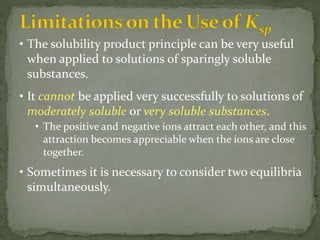
• The solubility product principle can be very useful
when applied to solutions of sparingly soluble
substances.
• It cannot be applied very successfully to solutions of
moderately soluble or very soluble substances.
• The positive and negative ions attract each other, and this
attraction becomes appreciable when the ions are close
together.
• Sometimes it is necessary to consider two equilibria
simultaneously.
Chapter 18.4 : Solubility Equilibrium

Chapter 18.4 : Solubility Equilibrium

  • 1.
  • 2.
    1. Explain whatis meant by solubility product constants, and calculate their values. 2. Calculate solubilities using solubility product constants. 3. Carry out calculations to predict whether precipitates will form when solutions are combined.
  • 3.
    • A saturatedsolution contains the maximum amount of solute possible at a given temperature in equilibrium with an undissolved excess of the substance. • A saturated solution is not necessarily a concentrated solution. • The equilibrium principles developed in this chapter apply to all saturated solutions of sparingly soluble salts.
  • 4.
    • The heterogeneousequilibrium system in a saturated solution of silver chloride containing an excess of the solid salt is represented by  - AgCl( ) Ag ( Cl ( )s aq) + aq • The solubility product constant, Ksp, of a substance is the product of the molar concentrations of its ions in a saturated solution, each raised to the power that is the coefficient of that ion in the balanced chemical equation. • The equation for the solubility equilibrium expression for the dissolution reaction of AgCl is spK - [Ag ][Cl ]  • The equilibrium expression is written without including the solid species. • The numerical value of Ksp can be determined from solubility data.
  • 5.
    • For asaturated solution of CaF2, the equilibrium equation is spK 2 – 2 [Ca ][F ]    2 – 2CaF ( ) Ca ( ) 2F ( )s aq aq • The expression for the solubility product constant is • The solubility of CaF2 is is 8.6  10−3/100 g of water at 25°C. Expressed in moles per liter this concentration becomes 1.1  10−3 mol/L.
  • 7.
    • CaF2 dissociatesto yield twice as many F− ions as Ca2+ ions. [Ca2+] = 1.1  10−3 mol/L [F− ] = 2.2  10−3 mol/L   spK 2 2 [Ca ][F ] spK –3 3 2 (1.1 10 )(2.2 10 )    Ksp = 5.3  10-9 • Calculations of Ksp ordinarily should be limited to two significant figures.
  • 9.
    • The solubilityproduct constant is an equilibrium constant representing the product of the molar concentrations of its ions in a saturated solution. • The solubility of a solid is an equilibrium position that represents the amount of the solid required to form a saturated solution with a specific amount of solvent. • It has only one value for a given solid at a given temperature. • It has an infinite number of possible values at a given temperature and is dependent on other conditions, such as the presence of a common ion.
  • 10.
    • Calculate thesolubility product constant, Ksp ,for copper(I) chloride, CuCl, given that the solubility of this compound at 25°C is 1.08  10–2 g/100. g H2O. 2 2 2 1 g H Og CuCl 1000 mL 1 molCuCl solubility in mol/L 100. g H O 1 mL H O 1 L g CuCl       – CuCl( ) Cu ( ) Cl ( )s aq aq Ksp=[Cu+][Cl–] Unknown: Ksp Given: solubility of CuCl = 1.08  10−2 g CuCl/100. g H2O Solution: [Cu+] = [Cl–] = solubility in mol/L
  • 11.
    –2 2 2 2 solubility inmol/L 1 g H O1.08 10 g CuCl 1000 mL 1 molCuCl 100. g H O 1 mL H O 1 L 99.0 g CuCl       1.09  10-3 mol/L CuCl Ksp = (1.09  10-3)(1.09  10-3) = 1.19  10-6 [Cu+] = [Cl–]=1.09  10-3 mol/L
  • 12.
    • The solubilityproduct constant can be used to determine the solubility of a sparingly soluble salt.   2 2– 3 3BaCO ( ) Ba ( ) CO ( )s aq aq spK 2 2– –9 3[Ba ][CO ] 5.1 10    x2 2– 3[Ba ] [CO ]   2 spK x x x2 2– –9 3[Ba ][CO ] ( )( ) 5.1 10      x –9 –5 5.1 10 7.1 10    • The molar solubility of BaCO3 is 7.1  10−5 mol/L. • How many moles of barium carbonate, BaCO3, can be dissolved in 1 L of water at 25°C?
  • 13.
    1. Calculate thesolubility of silver bromide, AgBr, in mol/L, using the Ksp value for this compound. Given: Ksp = 5.0 10−13 Unknown: solubility of AgBr Solution: [Ag+] = [Br−], so let [Ag+] = x and [Br−] = x  s aq) + aqAgBr( ) Ag ( Br ( ) spK – [Ag ][Br ]  spK x x x– 2 [Ag ][Br ] ( )( )    x2 –13 5.0 10  x –13 5.0 10  7 –13 solubility 7 of AgBr 5. .1 1 0 10 0 mol/L    
  • 14.
    • The equilibriumcondition does not require that the two ion concentrations be equal. Equilibrium will still be established so that the ion product does not exceed the value of Ksp for the system. • If the ion product is less than the value of Ksp at a particular temperature, the solution is unsaturated. • If the ion product is greater than the value for Ksp, solid precipitates.
  • 15.
    • Unequal quantitiesof BaCl2 and Na2CO3 are dissolved in water and the solutions are mixed. • If the ion product exceeds the Ksp of BaCO3, a precipitate of BaCO3 forms. • Precipitation continues until the ion concentrations decrease to the point at which equals the Ksp. • The solubility product can be used to predict whether a precipitate forms when two solutions are mixed.
  • 16.
    1. Will aprecipitate form if 20.0 mL of 0.010 M BaCl2 is mixed with 20.0 mL of 0.0050 M Na2SO4? Given: concentration of BaCl2 = 0.010 M volume of BaCl2 = 20.0 mL concentration of Na2SO4 = 0.0050 M volume of Na2SO4 = 20.0 mL Unknown: whether a precipitate forms Solution: The two possible new pairings of ions are NaCl and BaSO4. BaSO4 is a sparingly soluble salt.
  • 17.
      2 2– 44BaSO ( ) Ba ( ) SO ( )s aq aq spK 2 2– –10 4[Ba ][SO ] 1.1 10    2 20.010 mol Ba 0.020 L 0.000 20 mol Ba 1 L     2 2– 2–4 – 4 4 0.0050 mol SO 0.020 L 0.000 10 mol SO 1 L mol SO ion:   mol Ba2+ ion:
  • 18.
    total volume ofsolution: 0.020 L + 0.020 L = 0.040 L concentration Ba2+ ion in combined solution: 2 –3 20.000 20 mol Ba 5.0 10 mol/L Ba 0.040 L     2– –3 2– 4 4 2– 4 0 co .000 10 mol SO 2.5 10 mol/L SO 0.040 L ncentration SO ion in combined solution :   the ion product: 2 2– –3 –3 –5 4[Ba ][SO ] (5.0 10 )(2.5 10 ) 1.2 10      spK –5 –10 2 2– 4 1.2 10 1.1 10 [Ba ][SO ]     Precipitation occurs.
  • 19.
    • The solubilityproduct principle can be very useful when applied to solutions of sparingly soluble substances. • It cannot be applied very successfully to solutions of moderately soluble or very soluble substances. • The positive and negative ions attract each other, and this attraction becomes appreciable when the ions are close together. • Sometimes it is necessary to consider two equilibria simultaneously.