Chemistry 1011 Slot 5 1
Chemistry 1011
TOPIC
Solubility Equilibrium
TEXT REFERENCE
Masterton and Hurley Chapter 16.1
Chemistry 1011 Slot 5 2
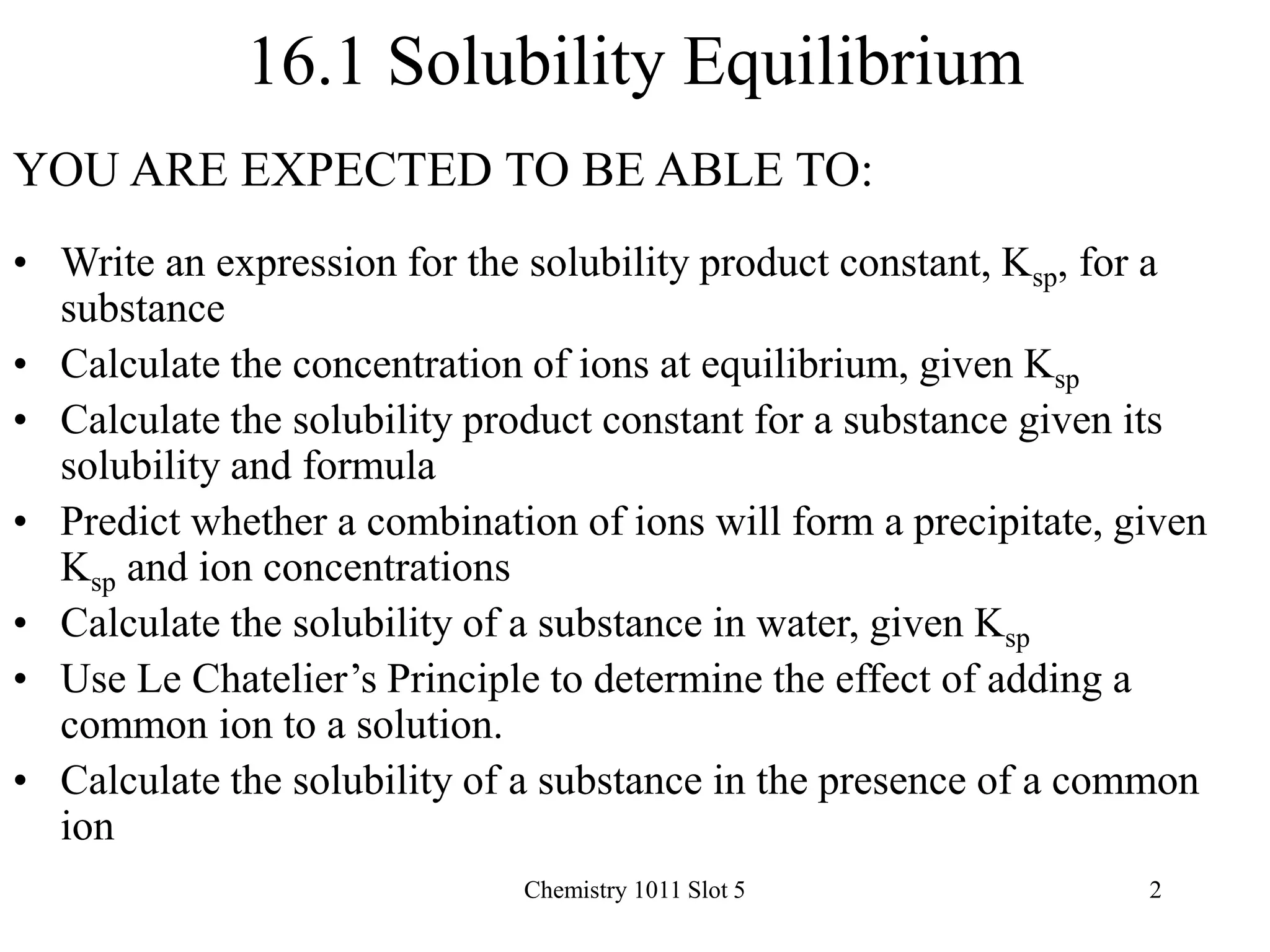
16.1 Solubility Equilibrium
YOU ARE EXPECTED TO BE ABLE TO:
• Write an expression for the solubility product constant, Ksp, for a
substance
• Calculate the concentration of ions at equilibrium, given Ksp
• Calculate the solubility product constant for a substance given its
solubility and formula
• Predict whether a combination of ions will form a precipitate, given
Ksp and ion concentrations
• Calculate the solubility of a substance in water, given Ksp
• Use Le Chatelier’s Principle to determine the effect of adding a
common ion to a solution.
• Calculate the solubility of a substance in the presence of a common
ion
Chemistry 1011 Slot 5 3
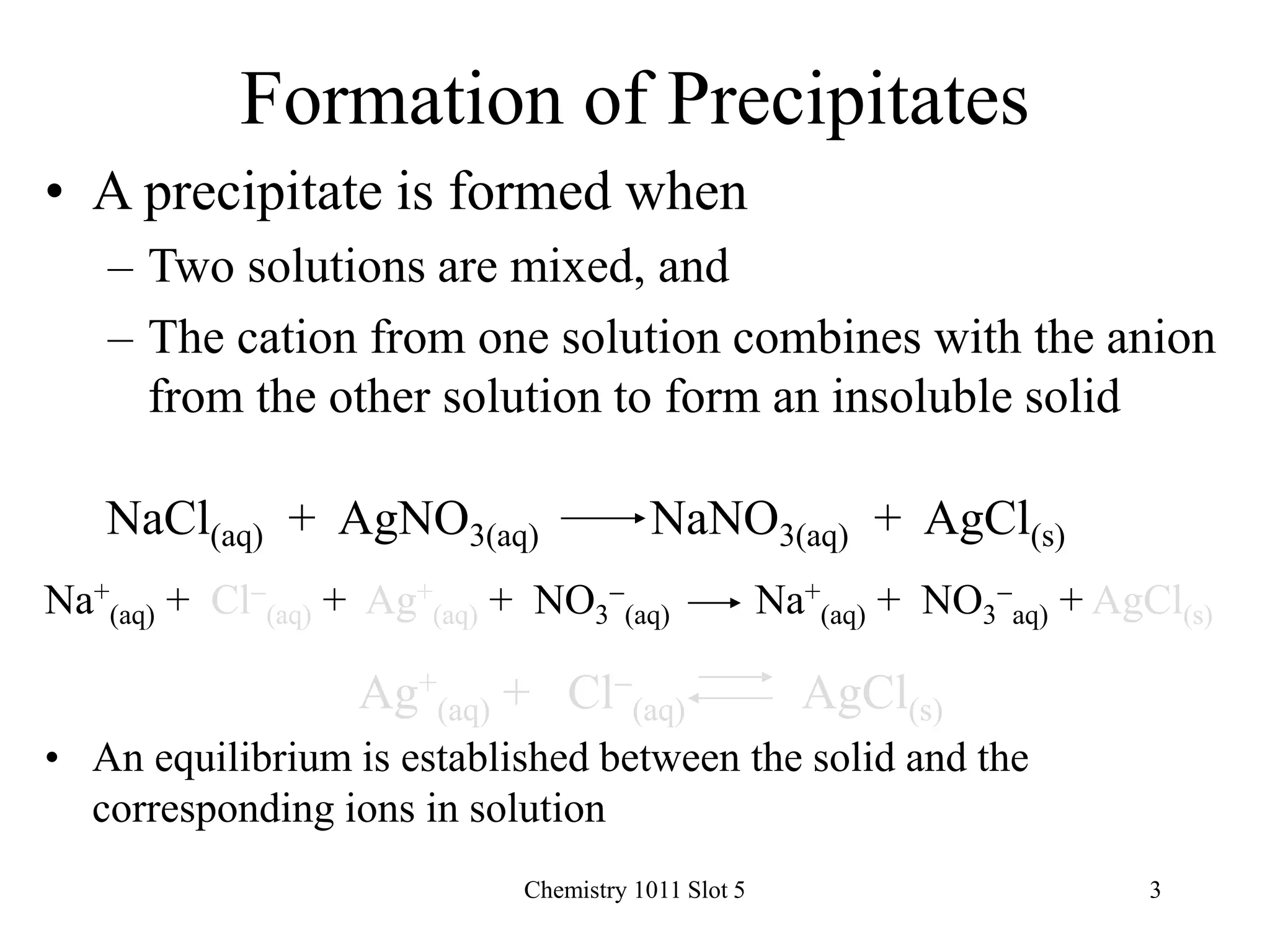
Formation of Precipitates
• A precipitate is formed when
– Two solutions are mixed, and
– The cation from one solution combines with the anion
from the other solution to form an insoluble solid
NaCl(aq) + AgNO3(aq) NaNO3(aq) + AgCl(s)
Na+
(aq) + Cl-
(aq) + Ag+
(aq) + NO3
-
(aq) Na+
(aq) + NO3
-
aq) + AgCl(s)
Ag+
(aq) + Cl-
(aq) AgCl(s)
• An equilibrium is established between the solid and the
corresponding ions in solution
Chemistry 1011 Slot 5 4
Solubility Equilibrium
AgCl(s) Ag+
(aq) + Cl-
(aq)
• An expression can be written for the equilibrium
constant:
Ksp = [Ag+]x[Cl-]
• [solid] does not appear in the equilibrium
constant expression
• Ksp is known as the solubility product constant
• Solubility product data are normally measured at
25oC
Chemistry 1011 Slot 5 5
Determining Ion Concentrations
Ag3PO4(s) 3Ag+
(aq) + PO4
3-
(aq)
Ksp = [Ag+]3x[PO4
3-] = 1 x 10-16
PbCl2(s) Pb2+
(aq) + 2Cl-
(aq)
Ksp = [Pb2+]x[Cl-]2 = 1.7 x 10⁻⁵
Q: Calculate [Pb2+] and [Cl-] in a solution of PbCl2 at 25oC
[Cl-] = 2 x [Pb2+]
Ksp = [Pb2+] x [2Pb2+]2 = 1.7 x 10⁻⁵
Ksp = 4 [Pb2+]3 = 1.7 x 10⁻⁵
[Pb2+] = 1.6 x 10⁻² mol/L [Cl-] = 3.2 x 10⁻² mol/L
Chemistry 1011 Slot 5 6
Calculating Ksp
• The solubility of a salt can be determined by experiment
• Ksp for the salt can be determined from these results
• Q: The solubility of magnesium hydroxide is found to be 8.4 x 10⁻⁴
g/100cm3 at 25oC. Find Ksp
Mg(OH)2(s) Mg2+
(aq) + 2OH-
(aq)
Ksp = [Mg2+]x[OH-]2 = ??
Solubility = 8.4 x 10⁻⁴ g/100cm3 at 18oC
Solubility = (8.4 x 10-4)g x 1000cm3/L = 1.44 x 10⁻⁴ mol/L
58.3 g/mol 100cm3
[Mg2+] = 1.44 x 10⁻⁴ mol/L; [OH-] = 2.88 x 10⁻⁴ mol/L
Ksp = [Mg2+]x[OH-]2 = 1.2 x 10⁻¹¹
Chemistry 1011 Slot 5 7
Determining Precipitate Formation
• To determine whether a precipitate will form
when two solutions are mixed:
1. Determine the concentrations of the reacting ions in
the mixture
2. Calculate the ion product, P
3. Compare the ion product, P, with Ksp
4. If P > Ksp then precipitate will form
5. If P < Ksp then no precipitate
6. If P = then no precipitate – solution is saturated
Chemistry 1011 Slot 5 8
Determining Precipitate Formation
Q: Will a precipitate form when 5.0mL of 1.0 x 10⁻³ mol/L silver
nitrate is added to 5.0mL of 1.0 x 10⁻⁵ mol/L potassium chromate?
Ksp Ag2CrO4 = 1.0 x 10⁻¹²
2AgNO3(aq) + K2CrO4(aq) 2KNO3(aq) + Ag2CrO4(s)
2Ag+
(aq) + CrO4
2-
(aq) Ag2CrO4(s)
Ksp = [Ag+]2 x [CrO4
2-] = 1.0 x 10⁻¹²
[Ag+] = 5.0 x 10⁻⁴ mol/L
[CrO4
2-] = 5.0 x 10⁻⁶ mol/L
Ion Product, P = [Ag+]2 x [CrO4
2-] = (5.0 x 10⁻⁴ )2 x (5.0 x 10-6 )
P = 1.25 x 10⁻¹²
P > Ksp A precipitate will form
Chemistry 1011 Slot 5 9
Determining Precipitate Formation
Q: 1.0 mL of 1.0 mol/L barium chloride is added
to 10.0 mL of a solution containing a small
amount of magnesium sulfate. Determine the
minimum concentration of magnesium sulfate
that will cause a precipitate to form.
Ksp BaSO4 = 1.1 x 10⁻¹⁰
Chemistry 1011 Slot 5 10
Determining Precipitate Formation
• 1.0 mL of 1.0 mol/L barium chloride is added to 10.0 mL of a solution containing a small
amount of magnesium sulfate. Determine the minimum concentration of magnesium sulfate
that will cause a precipitate to form. Ksp BaSO4 = 1.1 x 10⁻¹⁰
BaCl2(aq) + MgSO4(aq) MgCl2(aq) + BaSO4(s)
Ba2+
(aq) + SO4
2-
(aq) BaSO4(s)
Ksp = [Ba2+]x[SO4
2-] = 1.1 x 10⁻¹⁰
[Ba2+] = 1.0 x 10-3L x 1.0 mol/L  1.00 x 10⁻²L = 1.0 x 10⁻¹ mol/L
[SO4
2-] = x mol/L
Ksp = [Ba2+]x[SO4
2-] = (1.0 x 10⁻¹ ) x (x) = 1.1 x 10⁻¹⁰
x = [SO4
2-] = minimum [MgSO4] =1.1 x 10⁻¹⁰ mol/L
Chemistry 1011 Slot 5 11
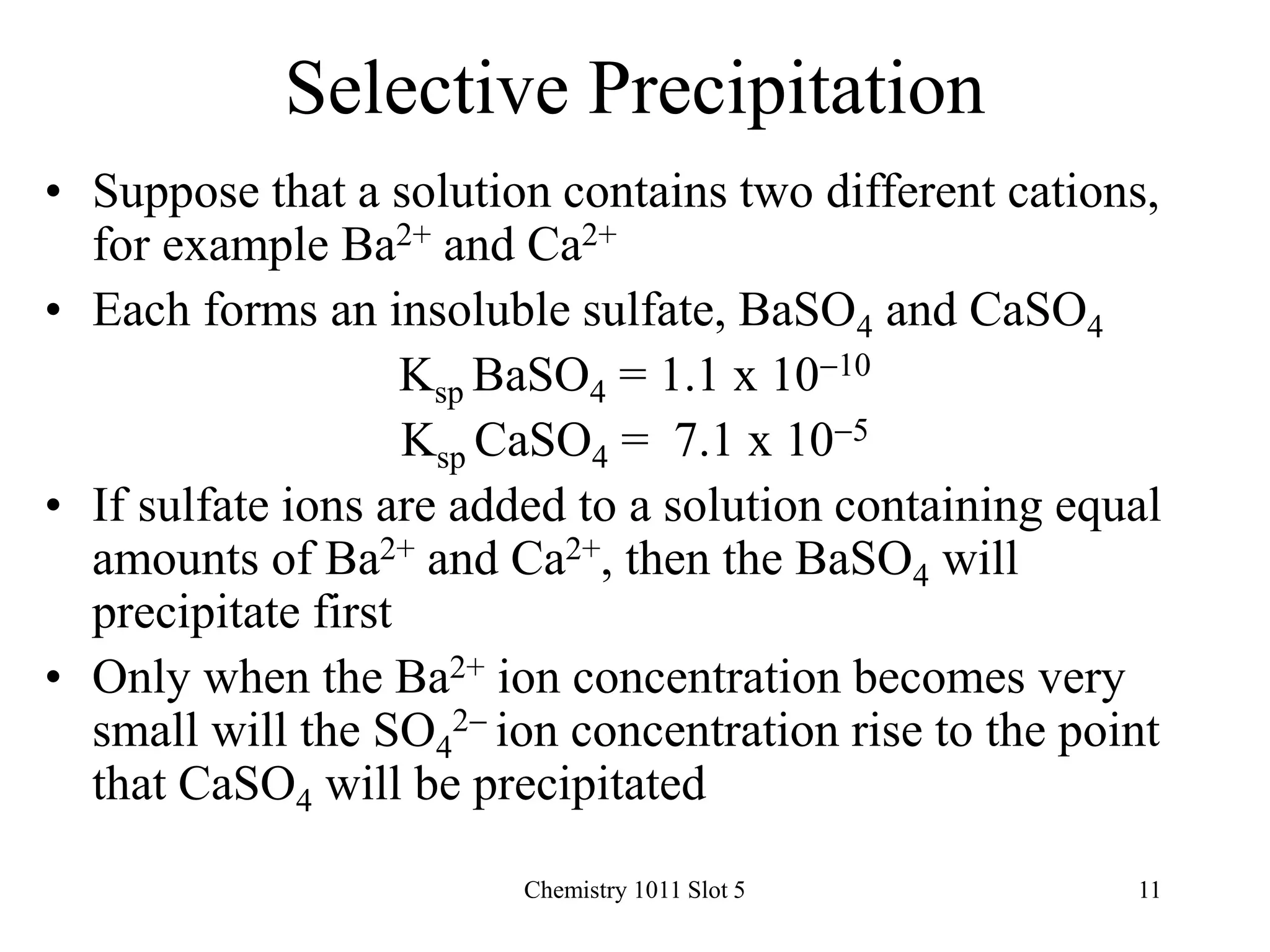
Selective Precipitation
• Suppose that a solution contains two different cations,
for example Ba2+ and Ca2+
• Each forms an insoluble sulfate, BaSO4 and CaSO4
Ksp BaSO4 = 1.1 x 10⁻¹⁰
Ksp CaSO4 = 7.1 x 10⁻⁵
• If sulfate ions are added to a solution containing equal
amounts of Ba2+ and Ca2+, then the BaSO4 will
precipitate first
• Only when the Ba2+ ion concentration becomes very
small will the SO4
2- ion concentration rise to the point
that CaSO4 will be precipitated
Chemistry 1011 Slot 5 12
Determining Solubility
• The solubility, s, of a salt can be determined from Ksp data
Q: Determine the solubility of lead chloride in water at 25oC. Ksp =
1.7 x 10⁻⁵
Let solubility of lead chloride = s mol/L
• For every mole of PbCl2 that dissolves,
1 mole of Pb2+
(aq) and 2 moles of Cl-
(aq) are formed
PbCl2(s) Pb2+
(aq) + 2Cl-
(aq)
[Pb2+] = s mol/L
[Cl-] = 2 x [Pb2+] = 2s mol/L
Ksp = [Pb2+]x[Cl-]2 = (s) x(2s)2 = 1.7 x 10⁻⁵
4s3 = 1.7 x 10⁻⁵
s = 1.6 x 10⁻² mol/L (Can also be expressed in grams/Litre)
Chemistry 1011 Slot 5 13
The Common Ion Effect
• The presence of a common ion will reduce the solubility
of an ionic salt (Le Chatelier)
• If a common ion is added to a saturated solution of a salt,
then the salt will be precipitated (Le Chatelier)
For example, CaCO3 is less soluble in a solution
containing CO3
2- ions than in pure water
CaCO3(s) Ca2+
(aq) + CO3
2-
(aq)
Ksp = [Ca2+] x [CO3
2-] = 4.9 x 10⁻⁹
Chemistry 1011 Slot 5 14
The Common Ion Effect
CaCO3(s) Ca2+
(aq) + CO3
2-
(aq)
Ksp = [Ca2+] x [CO3
2-] = 4.9 x 10⁻⁹
• Solubility of CaCO3 = [Ca2+]
• In pure water
[Ca2+] = [CO3
2-] = (4.9 x 10⁻⁹) = 7.0 x 10⁻⁵ mol/L
Solubility of CaCO3 in 1.0 x 10⁻¹ sodium carbonate solution = ???
• [CO3
2-] = 1.0 x 10⁻¹ mol/L (ignore CO3
2- from CaCO3 )
• [Ca2+] = Ksp = 4.9 x 10-9 = 4.9 x 10⁻⁸ mol/L
[CO3
2-] 1.0 x 10⁻¹
Chemistry 1011 Slot 5 15
One More Example
• Ksp for manganese II hydroxide is 1.2 x 10⁻¹¹
• Solid sodium hydroxide is added slowly to a 0.10 mol/L
solution of manganese II chloride. What will be the pH when
a precipitate forms?
Mn(OH)2(s) Mn2+
(aq) + 2OH-
(aq)
Ksp = [Mn2+] x [OH-]2 = 1.2 x 10⁻¹¹
• [Mn2+] = 0.10 mol/L
• [OH-] =  Ksp  [Mn2+] =  1.2 x 10⁻¹¹  0.10
= 1.1 x 10⁻⁵ mol/L
• pH = 9.0

Solubility and solubility product, examples .ppt

  • 1.
    Chemistry 1011 Slot5 1 Chemistry 1011 TOPIC Solubility Equilibrium TEXT REFERENCE Masterton and Hurley Chapter 16.1
  • 2.
    Chemistry 1011 Slot5 2 16.1 Solubility Equilibrium YOU ARE EXPECTED TO BE ABLE TO: • Write an expression for the solubility product constant, Ksp, for a substance • Calculate the concentration of ions at equilibrium, given Ksp • Calculate the solubility product constant for a substance given its solubility and formula • Predict whether a combination of ions will form a precipitate, given Ksp and ion concentrations • Calculate the solubility of a substance in water, given Ksp • Use Le Chatelier’s Principle to determine the effect of adding a common ion to a solution. • Calculate the solubility of a substance in the presence of a common ion
  • 3.
    Chemistry 1011 Slot5 3 Formation of Precipitates • A precipitate is formed when – Two solutions are mixed, and – The cation from one solution combines with the anion from the other solution to form an insoluble solid NaCl(aq) + AgNO3(aq) NaNO3(aq) + AgCl(s) Na+ (aq) + Cl- (aq) + Ag+ (aq) + NO3 - (aq) Na+ (aq) + NO3 - aq) + AgCl(s) Ag+ (aq) + Cl- (aq) AgCl(s) • An equilibrium is established between the solid and the corresponding ions in solution
  • 4.
    Chemistry 1011 Slot5 4 Solubility Equilibrium AgCl(s) Ag+ (aq) + Cl- (aq) • An expression can be written for the equilibrium constant: Ksp = [Ag+]x[Cl-] • [solid] does not appear in the equilibrium constant expression • Ksp is known as the solubility product constant • Solubility product data are normally measured at 25oC
  • 5.
    Chemistry 1011 Slot5 5 Determining Ion Concentrations Ag3PO4(s) 3Ag+ (aq) + PO4 3- (aq) Ksp = [Ag+]3x[PO4 3-] = 1 x 10-16 PbCl2(s) Pb2+ (aq) + 2Cl- (aq) Ksp = [Pb2+]x[Cl-]2 = 1.7 x 10⁻⁵ Q: Calculate [Pb2+] and [Cl-] in a solution of PbCl2 at 25oC [Cl-] = 2 x [Pb2+] Ksp = [Pb2+] x [2Pb2+]2 = 1.7 x 10⁻⁵ Ksp = 4 [Pb2+]3 = 1.7 x 10⁻⁵ [Pb2+] = 1.6 x 10⁻² mol/L [Cl-] = 3.2 x 10⁻² mol/L
  • 6.
    Chemistry 1011 Slot5 6 Calculating Ksp • The solubility of a salt can be determined by experiment • Ksp for the salt can be determined from these results • Q: The solubility of magnesium hydroxide is found to be 8.4 x 10⁻⁴ g/100cm3 at 25oC. Find Ksp Mg(OH)2(s) Mg2+ (aq) + 2OH- (aq) Ksp = [Mg2+]x[OH-]2 = ?? Solubility = 8.4 x 10⁻⁴ g/100cm3 at 18oC Solubility = (8.4 x 10-4)g x 1000cm3/L = 1.44 x 10⁻⁴ mol/L 58.3 g/mol 100cm3 [Mg2+] = 1.44 x 10⁻⁴ mol/L; [OH-] = 2.88 x 10⁻⁴ mol/L Ksp = [Mg2+]x[OH-]2 = 1.2 x 10⁻¹¹
  • 7.
    Chemistry 1011 Slot5 7 Determining Precipitate Formation • To determine whether a precipitate will form when two solutions are mixed: 1. Determine the concentrations of the reacting ions in the mixture 2. Calculate the ion product, P 3. Compare the ion product, P, with Ksp 4. If P > Ksp then precipitate will form 5. If P < Ksp then no precipitate 6. If P = then no precipitate – solution is saturated
  • 8.
    Chemistry 1011 Slot5 8 Determining Precipitate Formation Q: Will a precipitate form when 5.0mL of 1.0 x 10⁻³ mol/L silver nitrate is added to 5.0mL of 1.0 x 10⁻⁵ mol/L potassium chromate? Ksp Ag2CrO4 = 1.0 x 10⁻¹² 2AgNO3(aq) + K2CrO4(aq) 2KNO3(aq) + Ag2CrO4(s) 2Ag+ (aq) + CrO4 2- (aq) Ag2CrO4(s) Ksp = [Ag+]2 x [CrO4 2-] = 1.0 x 10⁻¹² [Ag+] = 5.0 x 10⁻⁴ mol/L [CrO4 2-] = 5.0 x 10⁻⁶ mol/L Ion Product, P = [Ag+]2 x [CrO4 2-] = (5.0 x 10⁻⁴ )2 x (5.0 x 10-6 ) P = 1.25 x 10⁻¹² P > Ksp A precipitate will form
  • 9.
    Chemistry 1011 Slot5 9 Determining Precipitate Formation Q: 1.0 mL of 1.0 mol/L barium chloride is added to 10.0 mL of a solution containing a small amount of magnesium sulfate. Determine the minimum concentration of magnesium sulfate that will cause a precipitate to form. Ksp BaSO4 = 1.1 x 10⁻¹⁰
  • 10.
    Chemistry 1011 Slot5 10 Determining Precipitate Formation • 1.0 mL of 1.0 mol/L barium chloride is added to 10.0 mL of a solution containing a small amount of magnesium sulfate. Determine the minimum concentration of magnesium sulfate that will cause a precipitate to form. Ksp BaSO4 = 1.1 x 10⁻¹⁰ BaCl2(aq) + MgSO4(aq) MgCl2(aq) + BaSO4(s) Ba2+ (aq) + SO4 2- (aq) BaSO4(s) Ksp = [Ba2+]x[SO4 2-] = 1.1 x 10⁻¹⁰ [Ba2+] = 1.0 x 10-3L x 1.0 mol/L  1.00 x 10⁻²L = 1.0 x 10⁻¹ mol/L [SO4 2-] = x mol/L Ksp = [Ba2+]x[SO4 2-] = (1.0 x 10⁻¹ ) x (x) = 1.1 x 10⁻¹⁰ x = [SO4 2-] = minimum [MgSO4] =1.1 x 10⁻¹⁰ mol/L
  • 11.
    Chemistry 1011 Slot5 11 Selective Precipitation • Suppose that a solution contains two different cations, for example Ba2+ and Ca2+ • Each forms an insoluble sulfate, BaSO4 and CaSO4 Ksp BaSO4 = 1.1 x 10⁻¹⁰ Ksp CaSO4 = 7.1 x 10⁻⁵ • If sulfate ions are added to a solution containing equal amounts of Ba2+ and Ca2+, then the BaSO4 will precipitate first • Only when the Ba2+ ion concentration becomes very small will the SO4 2- ion concentration rise to the point that CaSO4 will be precipitated
  • 12.
    Chemistry 1011 Slot5 12 Determining Solubility • The solubility, s, of a salt can be determined from Ksp data Q: Determine the solubility of lead chloride in water at 25oC. Ksp = 1.7 x 10⁻⁵ Let solubility of lead chloride = s mol/L • For every mole of PbCl2 that dissolves, 1 mole of Pb2+ (aq) and 2 moles of Cl- (aq) are formed PbCl2(s) Pb2+ (aq) + 2Cl- (aq) [Pb2+] = s mol/L [Cl-] = 2 x [Pb2+] = 2s mol/L Ksp = [Pb2+]x[Cl-]2 = (s) x(2s)2 = 1.7 x 10⁻⁵ 4s3 = 1.7 x 10⁻⁵ s = 1.6 x 10⁻² mol/L (Can also be expressed in grams/Litre)
  • 13.
    Chemistry 1011 Slot5 13 The Common Ion Effect • The presence of a common ion will reduce the solubility of an ionic salt (Le Chatelier) • If a common ion is added to a saturated solution of a salt, then the salt will be precipitated (Le Chatelier) For example, CaCO3 is less soluble in a solution containing CO3 2- ions than in pure water CaCO3(s) Ca2+ (aq) + CO3 2- (aq) Ksp = [Ca2+] x [CO3 2-] = 4.9 x 10⁻⁹
  • 14.
    Chemistry 1011 Slot5 14 The Common Ion Effect CaCO3(s) Ca2+ (aq) + CO3 2- (aq) Ksp = [Ca2+] x [CO3 2-] = 4.9 x 10⁻⁹ • Solubility of CaCO3 = [Ca2+] • In pure water [Ca2+] = [CO3 2-] = (4.9 x 10⁻⁹) = 7.0 x 10⁻⁵ mol/L Solubility of CaCO3 in 1.0 x 10⁻¹ sodium carbonate solution = ??? • [CO3 2-] = 1.0 x 10⁻¹ mol/L (ignore CO3 2- from CaCO3 ) • [Ca2+] = Ksp = 4.9 x 10-9 = 4.9 x 10⁻⁸ mol/L [CO3 2-] 1.0 x 10⁻¹
  • 15.
    Chemistry 1011 Slot5 15 One More Example • Ksp for manganese II hydroxide is 1.2 x 10⁻¹¹ • Solid sodium hydroxide is added slowly to a 0.10 mol/L solution of manganese II chloride. What will be the pH when a precipitate forms? Mn(OH)2(s) Mn2+ (aq) + 2OH- (aq) Ksp = [Mn2+] x [OH-]2 = 1.2 x 10⁻¹¹ • [Mn2+] = 0.10 mol/L • [OH-] =  Ksp  [Mn2+] =  1.2 x 10⁻¹¹  0.10 = 1.1 x 10⁻⁵ mol/L • pH = 9.0