Chapter 18.2
1. Discuss the factors that disturb equilibrium.
2. Discuss conditions under which reactions go
to completion.
3. Describe the common-ion effect.
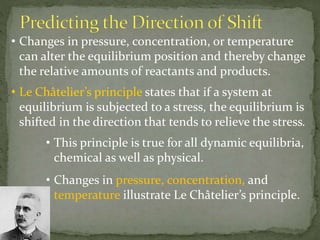
• Changes in pressure, concentration, or temperature
can alter the equilibrium position and thereby change
the relative amounts of reactants and products.
• Le Châtelier’s principle states that if a system at
equilibrium is subjected to a stress, the equilibrium is
shifted in the direction that tends to relieve the stress.
• This principle is true for all dynamic equilibria,
chemical as well as physical.
• Changes in pressure, concentration, and
temperature illustrate Le Châtelier’s principle.
• A change in pressure affects only equilibrium
systems in which gases are involved.
• For changes in pressure to affect the system, the
total number of moles of gas on the left side of the
equation must be different from the total number
of moles of gas on the right side of the equation.
• An increase in pressure is an applied stress.
• It causes an increase in the concentrations of all
species.
• The system can reduce the total pressure by
reducing the number of molecules.
2 2 3N ( ) 3H ( ) 2NH ( )g + g g
4 molecules of gas 2 molecules of gas
• When pressure is applied, the equilibrium will shift to the
right, and produce more NH3.
• By shifting to the right, the system can reduce the total
number of molecules. This leads to a decrease in pressure.
The Haber process for the synthesis of ammonia
• Even though changes in pressure may shift the
equilibrium position, they do not affect the value of
the equilibrium constant.
• The introduction of an inert gas, such as helium, into
the reaction vessel increases the total pressure in the
vessel. But it does not change the partial pressures of
the reaction gases present.
• Increasing pressure by adding a gas that is not
a reactant or a product cannot affect the
equilibrium position of the reaction system.
• An increase in the concentration of a reactant is a stress on
the equilibrium system.
 A B C D
• An increase in the concentration of A creates a stress.
• To relieve the stress, some of the added A reacts with B to
form products C and D.
• The equilibrium is reestablished with a higher concentration
of A than before the addition and a lower concentration of B.
• Changes in concentration have no effect on the
value of the equilibrium constant.
• Such changes have an equal effect on the numerator and
the denominator of the chemical equilibrium
expression.
• The concentrations of pure solids and liquids do not
change, and are not written in the equilibrium
expression.
• When a solvent, such as water, in a system involving
acids and bases, is in an equilibrium equation, it is not
included in the equilibrium expression.
• High pressure favors the reverse reaction.
• Low pressure favors the formation of CO2.
• Because both CaO and CaCO3 are solids, changing
their amounts will not change the equilibrium
concentration of CO2.
3 2CaCO ( ) CaO( ) CO ( )s s + g
2K [CO ]
• Reversible reactions are exothermic in one direction
and endothermic in the other.
• The effect of changing the temperature of an
equilibrium mixture depends on which of the
opposing reactions is endothermic and which is
exothermic.
• The addition of energy in the form of heat shifts the
equilibrium so that energy is absorbed. This favors
the endothermic reaction.
• The removal of energy favors the exothermic reaction.
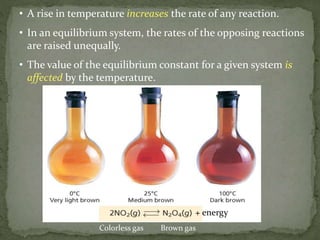
• A rise in temperature increases the rate of any reaction.
• In an equilibrium system, the rates of the opposing reactions
are raised unequally.
• The value of the equilibrium constant for a given system is
affected by the temperature.
+ energy
Colorless gas Brown gas
• The synthesis of ammonia by the Haber process is
exothermic.
2 2 3N ( ) 3H ( ) 2NH ( ) 92 kJg + g g +
• A high temperature favors the decomposition of ammonia,
the endothermic reaction.
• At low temperatures, the forward reaction is too slow
to be commercially useful.
• The temperature used represents a compromise
between kinetic and equilibrium requirements.
• Catalysts have no effect on relative equilibrium
amounts.
• They only affect the rates at which equilibrium is
reached.
• Catalysts increase the rates of forward and reverse
reactions in a system by equal factors. Therefore, they do
not affect K.
• Some reactions involving compounds formed by the chemical
interaction of ions in solutions appear to go to completion in the
sense that the ions are almost completely removed from
solution.
• The extent to which reacting ions are removed from solution
depends on the solubility of the compound formed and, if the
compound is soluble, on the degree of ionization.
• Formation of a Gas
H2CO3(aq) H2O(l) + CO2(g)
• This reaction goes practically to completion because one of the
products, CO2, escapes as a gas if the container is open to the air.
Formation of a Precipitate
   
 
aq + aq + aq + aq
aq + aq + s
3
3
Na ( ) Cl ( ) Ag ( ) NO ( )
Na ( ) NO ( ) AgCl( )
• If chemically equivalent amounts of the two solutes are mixed,
almost all of the Ag+ ions and Cl− ions combine and separate
from the solution as a precipitate of AgCl.
• AgCl is only very sparingly soluble in water.
• The reaction thus effectively goes to completion because an
essentially insoluble product is formed.
Formation of a Slightly Ionized Product
• Neutralization reactions between H3O+ ions from aqueous acids
and OH− ions from aqueous bases result in the formation of
water molecules, which are only slightly ionized.
   
 
aq + aq + aq + aq
aq + aq + aq
3
2
H O ( ) Na ( ) Cl ( ) OH ( )
Na ( ) Cl ( ) 2H O( )
 
aq + aq aq3 2 (net ionic equation)H O ( ) OH ( ) 2H O( )
• Hydronium ions and hydroxide ions are almost entirely
removed from the solution.
• The reaction effectively runs to completion because the
product is only slightly ionized.
Common-Ion Effect
• The phenomenon in which the addition of an ion common to
two solutes brings about precipitation or reduced ionization is
an example of the common-ion effect.
 
g + l aq + aq2 3HCl( ) H O( ) H O ( ) Cl ( )
 s aq + aqNaCl( ) Na ( ) Cl ( )
• Example: hydrogen chloride gas is bubbled into a
saturated solution of sodium chloride.
• As the hydrogen chloride dissolves in sufficient
quantity, it increases the concentration of Cl− ions in
the solution, which is a stress on the equilibrium
system.
• The system can compensate by forming some solid
NaCl. The NaCl precipitates out, relieving the stress of
added chloride.
• The new equilibrium has a greater concentration of Cl−
ions but a decreased concentration of Na+ ions.
 s aq + aqNaCl( ) Na ( ) Cl ( )
• The common-ion effect is also observed when one ion
species of a weak electrolyte is added in excess to a
solution.
• Small additions of sodium acetate,NaCH3COO, to a solution
containing acetic acid increase the acetate ion
concentration.
• The equilibrium then shifts in the direction that uses up
some of the acetate ions. More molecules of acetic acid are
formed, and the concentration of hydronium ions is reduced.

–
3 2 3 3CH COOH(aq) H O( ) H O ( ) CH COO ( )+ l aq + aq
• In general, the addition of a salt with an ion common to the
solution of a weak electrolyte reduces the ionization of the
electrolyte.

Chapter 18.2 : Shifting Equilibrium

  • 1.
  • 2.
    1. Discuss thefactors that disturb equilibrium. 2. Discuss conditions under which reactions go to completion. 3. Describe the common-ion effect.
  • 3.
    • Changes inpressure, concentration, or temperature can alter the equilibrium position and thereby change the relative amounts of reactants and products. • Le Châtelier’s principle states that if a system at equilibrium is subjected to a stress, the equilibrium is shifted in the direction that tends to relieve the stress. • This principle is true for all dynamic equilibria, chemical as well as physical. • Changes in pressure, concentration, and temperature illustrate Le Châtelier’s principle.
  • 4.
    • A changein pressure affects only equilibrium systems in which gases are involved. • For changes in pressure to affect the system, the total number of moles of gas on the left side of the equation must be different from the total number of moles of gas on the right side of the equation. • An increase in pressure is an applied stress. • It causes an increase in the concentrations of all species. • The system can reduce the total pressure by reducing the number of molecules.
  • 5.
    2 2 3N( ) 3H ( ) 2NH ( )g + g g 4 molecules of gas 2 molecules of gas • When pressure is applied, the equilibrium will shift to the right, and produce more NH3. • By shifting to the right, the system can reduce the total number of molecules. This leads to a decrease in pressure. The Haber process for the synthesis of ammonia
  • 6.
    • Even thoughchanges in pressure may shift the equilibrium position, they do not affect the value of the equilibrium constant. • The introduction of an inert gas, such as helium, into the reaction vessel increases the total pressure in the vessel. But it does not change the partial pressures of the reaction gases present. • Increasing pressure by adding a gas that is not a reactant or a product cannot affect the equilibrium position of the reaction system.
  • 7.
    • An increasein the concentration of a reactant is a stress on the equilibrium system.  A B C D • An increase in the concentration of A creates a stress. • To relieve the stress, some of the added A reacts with B to form products C and D. • The equilibrium is reestablished with a higher concentration of A than before the addition and a lower concentration of B.
  • 8.
    • Changes inconcentration have no effect on the value of the equilibrium constant. • Such changes have an equal effect on the numerator and the denominator of the chemical equilibrium expression. • The concentrations of pure solids and liquids do not change, and are not written in the equilibrium expression. • When a solvent, such as water, in a system involving acids and bases, is in an equilibrium equation, it is not included in the equilibrium expression.
  • 9.
    • High pressurefavors the reverse reaction. • Low pressure favors the formation of CO2. • Because both CaO and CaCO3 are solids, changing their amounts will not change the equilibrium concentration of CO2. 3 2CaCO ( ) CaO( ) CO ( )s s + g 2K [CO ]
  • 10.
    • Reversible reactionsare exothermic in one direction and endothermic in the other. • The effect of changing the temperature of an equilibrium mixture depends on which of the opposing reactions is endothermic and which is exothermic. • The addition of energy in the form of heat shifts the equilibrium so that energy is absorbed. This favors the endothermic reaction. • The removal of energy favors the exothermic reaction.
  • 11.
    • A risein temperature increases the rate of any reaction. • In an equilibrium system, the rates of the opposing reactions are raised unequally. • The value of the equilibrium constant for a given system is affected by the temperature. + energy Colorless gas Brown gas
  • 12.
    • The synthesisof ammonia by the Haber process is exothermic. 2 2 3N ( ) 3H ( ) 2NH ( ) 92 kJg + g g + • A high temperature favors the decomposition of ammonia, the endothermic reaction. • At low temperatures, the forward reaction is too slow to be commercially useful. • The temperature used represents a compromise between kinetic and equilibrium requirements.
  • 14.
    • Catalysts haveno effect on relative equilibrium amounts. • They only affect the rates at which equilibrium is reached. • Catalysts increase the rates of forward and reverse reactions in a system by equal factors. Therefore, they do not affect K.
  • 15.
    • Some reactionsinvolving compounds formed by the chemical interaction of ions in solutions appear to go to completion in the sense that the ions are almost completely removed from solution. • The extent to which reacting ions are removed from solution depends on the solubility of the compound formed and, if the compound is soluble, on the degree of ionization. • Formation of a Gas H2CO3(aq) H2O(l) + CO2(g) • This reaction goes practically to completion because one of the products, CO2, escapes as a gas if the container is open to the air.
  • 16.
    Formation of aPrecipitate       aq + aq + aq + aq aq + aq + s 3 3 Na ( ) Cl ( ) Ag ( ) NO ( ) Na ( ) NO ( ) AgCl( ) • If chemically equivalent amounts of the two solutes are mixed, almost all of the Ag+ ions and Cl− ions combine and separate from the solution as a precipitate of AgCl. • AgCl is only very sparingly soluble in water. • The reaction thus effectively goes to completion because an essentially insoluble product is formed.
  • 17.
    Formation of aSlightly Ionized Product • Neutralization reactions between H3O+ ions from aqueous acids and OH− ions from aqueous bases result in the formation of water molecules, which are only slightly ionized.       aq + aq + aq + aq aq + aq + aq 3 2 H O ( ) Na ( ) Cl ( ) OH ( ) Na ( ) Cl ( ) 2H O( )   aq + aq aq3 2 (net ionic equation)H O ( ) OH ( ) 2H O( ) • Hydronium ions and hydroxide ions are almost entirely removed from the solution. • The reaction effectively runs to completion because the product is only slightly ionized.
  • 18.
    Common-Ion Effect • Thephenomenon in which the addition of an ion common to two solutes brings about precipitation or reduced ionization is an example of the common-ion effect.   g + l aq + aq2 3HCl( ) H O( ) H O ( ) Cl ( )  s aq + aqNaCl( ) Na ( ) Cl ( ) • Example: hydrogen chloride gas is bubbled into a saturated solution of sodium chloride.
  • 19.
    • As thehydrogen chloride dissolves in sufficient quantity, it increases the concentration of Cl− ions in the solution, which is a stress on the equilibrium system. • The system can compensate by forming some solid NaCl. The NaCl precipitates out, relieving the stress of added chloride. • The new equilibrium has a greater concentration of Cl− ions but a decreased concentration of Na+ ions.  s aq + aqNaCl( ) Na ( ) Cl ( )
  • 21.
    • The common-ioneffect is also observed when one ion species of a weak electrolyte is added in excess to a solution. • Small additions of sodium acetate,NaCH3COO, to a solution containing acetic acid increase the acetate ion concentration. • The equilibrium then shifts in the direction that uses up some of the acetate ions. More molecules of acetic acid are formed, and the concentration of hydronium ions is reduced.  – 3 2 3 3CH COOH(aq) H O( ) H O ( ) CH COO ( )+ l aq + aq • In general, the addition of a salt with an ion common to the solution of a weak electrolyte reduces the ionization of the electrolyte.