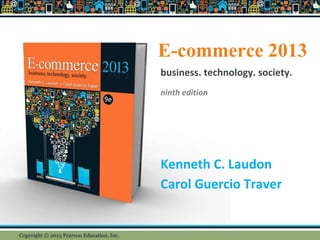
E-commerce 2013
Kenneth C. Laudon
Carol Guercio Traver
business. technology. society.
ninth edition
Copyright © 2013 Pearson Education, Inc.
Chapter 10
Online Content and Media
Copyright © 2013 Pearson Education, Inc.
Class Discussion
Facebook and the Emerging Internet
Broadcast System (IBS)
■ What types of online videos have you
watched online, and on what devices?
■ What sites have given you the best overall
viewing or entertainment experience, and
why?
■ What advantages does watching traditional
television have over watching online TV and
films?
Copyright © 2013 Pearson Education, Inc. Slide 10-*
Trends in Online Content, 2012–2013
■ Vertical integration: Distributors enter
content production business
■ Netflix transitions to TV show distribution
■ Online viewing begins to challenge TV, cable,
DVD rentals
■ E-book sales rise to 50% all book sales
■ Digital music sales top physical sales
■ Console games stagnate as online, social,
casual games soar
Copyright © 2013 Pearson Education, Inc. Slide 10-*
Trends in Online Content (cont.)
Copyright © 2013 Pearson Education, Inc. Slide 10-*
■ Four Internet titans compete for
ownership of online content ecosystem:
Apple, Google, Amazon, and Facebook
■ Amazon’s e-book reader expands to
tablet
■ Tablet sales grow to 50% of PC sales
■ Content consumption goes mobile
■ Cloud storage grows to serve market for
mobile computing
Content Audience and Market
■ Average American adult spends 4,200
hrs/yr consuming various media
■ 2012 media revenues: $488 billion
■ Over 77% of the hours spent consuming
TV, radio, Internet
■ 2.8 hrs/day on Internet
■ Internet usage doesn’t reduce TV
viewingCopyright © 2013 Pearson Education, Inc. Slide 10-*
Media Consumption
Figure 10.1, Page 647
Copyright © 2013 Pearson Education, Inc. Slide 10-*
SOURCE: Based on data from eMarketer, Inc., 2012a, authors’ estimates
Internet and Traditional Media
■ Cannibalization vs. complementarity
❖ Does time on Internet reduce time spent with other media?
❖ Books, newspapers, magazines, phone, radio
■ Internet users
❖ Spend relatively less time with traditional media
❖ Consume more media of all types than non-Internet users
❖ often “multitask” with media consumption
■ Multimedia—reduces cannibalization impact
for some visual, aural media
Copyright © 2013 Pearson Education, Inc. Slide 10-*
Media Revenues by Channel
Figure 10.2, Page 649
Copyright © 2013 Pearson Education, Inc. Slide 10-*
SOURCE: Based on data from industry sources; authors’ estimates.
Digital Content Delivery Models
■ Online content delivery revenue models
❖Subscription
❖A la carte
❖Advertising supported (free/freemium)
■ Free content can drive users to paid
content
■ Users increasingly paying for high-
quality, unique content
Copyright © 2013 Pearson Education, Inc. Slide 10-*
Online Content Consumption 2012
Figure 10.3 Page 650
Copyright © 2013 Pearson Education, Inc. Slide 10-*
SOURCE: Based on data from industry sources; authors’ estimates.
Free or Fee?
■ Early years: Internet audience expected free
content but willing to accept advertising
❖ Early content was low quality
■ With advent of high-quality content, fee
models successful
❖ iTunes
❖ 80 million buy from legal music sites
❖ YouTube cooperating with Hollywood production
studios
Copyright © 2013 Pearson Education, Inc. Slide 10-*
Digital Rights Management (DRM)
■ DRM: Technical and legal means to
protect digital content from unlimited
reproduction and distribution
■ Issue often cast as moral contest
■ Telecommunications and device
industries benefit from increased traffic
❖23% of global Internet traffic is stolen material
Copyright © 2013 Pearson Education, Inc. Slide 10-*
Media Industry Structure
■ Three separate segments
❖ Print
❖ Movies
❖ Music
■ Each dominated by few key players with little
crossover
■ Larger media ecosystem
❖ Millions of individuals, entrepreneurs
❖ Blogs, YouTube, independent music bands, etc.
Copyright © 2013 Pearson Education, Inc. Slide 10-*
Media Convergence
■ Technological convergence:
❖Hybrid devices
■ Content convergence:
❖Three aspects: Design, production, distribution
❖New tools for digital editing and processing
■ Industry convergence:
❖Merger of media enterprises into firms that
create and cross-market content on different
platforms
Copyright © 2013 Pearson Education, Inc. Slide 10-*
Convergence and the Transformation
of Content: Books
Figure 10.6, Page 656
Copyright © 2013 Pearson Education, Inc. Slide 10-*
Making a Profit with Online Content
■ 25% users will pay for some content
■ Four factors required to charge for
online content
❖Focused market
❖Specialized content
❖Sole source monopoly
❖High perceived net value
■ Portion of perceived customer value that can be attributed to
fact that content is available on the Internet
Copyright © 2013 Pearson Education, Inc. Slide 10-*
Online Publishing Industry
■ $82 billion based originally in print,
moving rapidly to Internet
■ Three segments
❖Online newspapers
❖E-books
❖Online magazines
Copyright © 2013 Pearson Education, Inc. Slide 10-*
Online Newspapers
■ Most troubled segment of publishing
industry
❖ Failure to protect content from free distribution
❖ 60% have reduced staff
■ However:
❖ Online readership growing at over 10%
❖ Mobiles, tablets provide new avenues
❖ More users willing to pay for premium content
❖ Aggregators are recognizing need for high-quality
content to distribute and use for advertisements
Copyright © 2013 Pearson Education, Inc. Slide 10-*
Monthly Unique Visitors at Online
Newspapers
Figure 10.8, Page 661
Copyright © 2013 Pearson Education, Inc. Slide 10-*
SOURCE: Based on data from Myers, 2012
Newspaper Business Models
■ Initially fee-based, then free, and now
beginning a return to fee-based
■ Newspaper headlines are primary content on
Google News, Yahoo News
■ New York Times now charging for premium
access
■ Newspaper efforts to ally with Internet titans
■ New reader devices with reader apps
Copyright © 2013 Pearson Education, Inc. Slide 10-*
Insight on Society: Class Discussion
Can Apps and Videos Save Newspapers?
Copyright © 2013 Pearson Education, Inc. Slide 10-*
■ Have you read a newspaper using an app?
■ Have you paid for any online newspaper or article?
How much would you pay for a single article?
■ Would you prefer to watch online news videos
produced by a TV station or by a newspaper such as
the New York Times?
■ What other opportunities could help the industry
recover from the decline in print sales?
Challenges: Disruptive Technologies
■ Newspapers: A classic case of disruptive
technology?
■ Industry still in flux
❖Newspapers have significant assets:
■ Content
■ Readership
■ Local advertising
■ Audience (wealthier, older, better educated)
❖Online audience will continue to grow in
numbers and sophistication
Copyright © 2013 Pearson Education, Inc. Slide 10-*
E-books and Online Publishing
■ E-book sales have exploded in recent
years—$4.2 billion in 2012
■ New channel for self-publishing authors
❖ Amanda Hocking’s My Blood Approves (2010)
■ Evolution
❖ Project Gutenberg (1970s)
❖ Voyager’s books on CD (1990s)
❖ Adobe’s PDF format
Copyright © 2013 Pearson Education, Inc. Slide 10-*
New Digital Ecosystems
■ E-book hardware, software, combined with
online megastores
❖Amazon Kindle: Linked to Amazon store and
cloud storage
❖Apple iPad: Multipurpose tablet, linked to Apple
stores
■ Authors able to bypass traditional agent,
publisher channels
■ DRM more effective for than music industry
Copyright © 2013 Pearson Education, Inc. Slide 10-*
Challenges of E-book Platform
■ Cannibalization
❖ Fewer physical sales
❖ More e-book sales, more purchases of readers
■ Finding the right business model
❖ Wholesale model
■ Retailers pay wholesale price and establish retail price
❖ Agency model
■ Distributor as agent must charge publisher’s retail price
■ Converging technologies
❖ Interactive books
❖ iBook Author, iBook Textbooks
Copyright © 2013 Pearson Education, Inc. Slide 10-*
E-book Sales
Figure 10.9, Page 666
Copyright © 2013 Pearson Education, Inc. Slide 10-*
SOURCE: Based on data from eMarketer, 2012b.
Magazines Rebound
■ Magazine circulation plummets 1980–2012
❖ Rise in online video and online news readership, and
increases costs of color printing,
■ 2001: 22 million
■ 2011: 11 million
■ 2012: Digital magazine readership doubled to
3.29 million copies
❖ Tablets a major factor
■ Magazine aggregators
Copyright © 2013 Pearson Education, Inc. Slide 10-*
Insight on Business: Class Discussion
Read All About It: Rival Digital
Newsstands Fight
Copyright © 2013 Pearson Education, Inc. Slide 10-*
■ What advantages and disadvantages do
digital newsstands offer to publishers?
■ Do you use an app or digital newsstand to
read magazines? Which ones?
■ How does the experience of reading a
magazine on a tablet or smartphone
compare to reading a physical magazine?
Online Entertainment Industry
■ Four traditional players, one newcomer
❖Television
❖Radio broadcasting
❖Hollywood films
❖Music
❖Video games (new arrival)
Copyright © 2013 Pearson Education, Inc. Slide 10-*
Online Entertainment Industry
■ Internet is transforming industry:
❖Platform development:
■ Smartphones, tablets, music platform
■ Online streaming and cloud storage
■ Social networks as distributors
❖Viable business models
■ Music subscription services
■ Closed platforms that eliminate need for DRM
❖Widespread growth of broadband
Copyright © 2013 Pearson Education, Inc. Slide 10-*
Online Entertainment Audience Size
■ Online “traditional” entertainment
❖Online video has largest audiences, followed by
music, games
■ User-generated content:
❖Substitutes for and complements traditional
commercial entertainment
❖Two dimensions:
■ User focus
■ User control
❖Sites that offer high levels of both will grow
Copyright © 2013 Pearson Education, Inc. Slide 10-*
Projected Growth in Online Entertainment
Figure 10.11, Page 688
Copyright © 2013 Pearson Education, Inc. Slide 10-*
SOURCES: Based on data from industry sources; authors’ estimates.
Television and Premium Video
■ TV industry transitioning to new delivery
platforms
■ OTT: Over-the-top (Internet) delivery
■ Three factors in TV industry transformation
❖ Broadband penetration
❖ New mobile platforms
❖ Willing industry with library of high-quality content
■ Social network influences
■ Hulu: Joint venture of industry players
Copyright © 2013 Pearson Education, Inc. Slide 10-*
Movies
■ Mobile and tablet growth fueling demand for
online movies
■ Unlike music industry, no one distributor
dominates
■ Three types of online movie sales
■ Subscription video on demand (SVOD)
■ Transactional video on demand (TVOD)
■ Electronic sell-through
■ Reduced DVD sales
■ Release windows system
Copyright © 2013 Pearson Education, Inc. Slide 10-*
Online Movie Business
Share of Movie Revenues
Figure 10.14, page 683
Copyright © 2013 Pearson Education, Inc. Slide 10-*
Music
■ Most changed of content industries
■ Move from physical to digital product
■ Unbundling of single songs
■ Distributor market dominated by Apple
■ 2011—Digital revenues account for 52%
of all revenues
■ Streaming services—fastest growth
■ Variety of revenue models
Copyright © 2013 Pearson Education, Inc. Slide 10-*
Consumer Spending on Digital Music
Figure 10.15, page 687
Copyright © 2013 Pearson Education, Inc. Slide 10-*
Games
■ Online gaming has had explosive growth
■ Types of online gamers
■ Casual
■ Social
■ Mobile—fastest growing market
■ Console
■ Business models in flux
■ Most online/mobile games offered for free
Copyright © 2013 Pearson Education, Inc. Slide 10-*
Online Gaming Audience
Figure 10.16, page 689
Copyright © 2013 Pearson Education, Inc. Slide 10-*
Online Entertainment
Industry Structure
■ Inefficient, fractured:
❖Many players and forces shape industry
■ Reorganization of value chain needed
for aggressive move to Web
■ Possible alternative models
❖Content owner direct model
❖Internet aggregator model
❖Internet innovator model
Copyright © 2013 Pearson Education, Inc. Slide 10-*
Insight on Technology: Class Discussion
Hollywood and the Internet:
Let’s Cut a Deal
Copyright © 2013 Pearson Education, Inc. Slide 10-*
■ What challenges has the Internet posed to
traditional Hollywood movie distribution? What is
the biggest challenge?
■ Can Internet distribution work with the “release
window” strategy?
■ Do you think Hollywood is doing a better job of
protecting its content than the music industry?
■ What is the most realistic and profitable path
forward for the Hollywood film industry?
Copyright © 2013 Pearson Education, Inc. Slide 10-*

Chapter 10

  • 1.
    E-commerce 2013 Kenneth C.Laudon Carol Guercio Traver business. technology. society. ninth edition Copyright © 2013 Pearson Education, Inc.
  • 2.
    Chapter 10 Online Contentand Media Copyright © 2013 Pearson Education, Inc.
  • 3.
    Class Discussion Facebook andthe Emerging Internet Broadcast System (IBS) ■ What types of online videos have you watched online, and on what devices? ■ What sites have given you the best overall viewing or entertainment experience, and why? ■ What advantages does watching traditional television have over watching online TV and films? Copyright © 2013 Pearson Education, Inc. Slide 10-*
  • 4.
    Trends in OnlineContent, 2012–2013 ■ Vertical integration: Distributors enter content production business ■ Netflix transitions to TV show distribution ■ Online viewing begins to challenge TV, cable, DVD rentals ■ E-book sales rise to 50% all book sales ■ Digital music sales top physical sales ■ Console games stagnate as online, social, casual games soar Copyright © 2013 Pearson Education, Inc. Slide 10-*
  • 5.
    Trends in OnlineContent (cont.) Copyright © 2013 Pearson Education, Inc. Slide 10-* ■ Four Internet titans compete for ownership of online content ecosystem: Apple, Google, Amazon, and Facebook ■ Amazon’s e-book reader expands to tablet ■ Tablet sales grow to 50% of PC sales ■ Content consumption goes mobile ■ Cloud storage grows to serve market for mobile computing
  • 6.
    Content Audience andMarket ■ Average American adult spends 4,200 hrs/yr consuming various media ■ 2012 media revenues: $488 billion ■ Over 77% of the hours spent consuming TV, radio, Internet ■ 2.8 hrs/day on Internet ■ Internet usage doesn’t reduce TV viewingCopyright © 2013 Pearson Education, Inc. Slide 10-*
  • 7.
    Media Consumption Figure 10.1,Page 647 Copyright © 2013 Pearson Education, Inc. Slide 10-* SOURCE: Based on data from eMarketer, Inc., 2012a, authors’ estimates
  • 8.
    Internet and TraditionalMedia ■ Cannibalization vs. complementarity ❖ Does time on Internet reduce time spent with other media? ❖ Books, newspapers, magazines, phone, radio ■ Internet users ❖ Spend relatively less time with traditional media ❖ Consume more media of all types than non-Internet users ❖ often “multitask” with media consumption ■ Multimedia—reduces cannibalization impact for some visual, aural media Copyright © 2013 Pearson Education, Inc. Slide 10-*
  • 9.
    Media Revenues byChannel Figure 10.2, Page 649 Copyright © 2013 Pearson Education, Inc. Slide 10-* SOURCE: Based on data from industry sources; authors’ estimates.
  • 10.
    Digital Content DeliveryModels ■ Online content delivery revenue models ❖Subscription ❖A la carte ❖Advertising supported (free/freemium) ■ Free content can drive users to paid content ■ Users increasingly paying for high- quality, unique content Copyright © 2013 Pearson Education, Inc. Slide 10-*
  • 11.
    Online Content Consumption2012 Figure 10.3 Page 650 Copyright © 2013 Pearson Education, Inc. Slide 10-* SOURCE: Based on data from industry sources; authors’ estimates.
  • 12.
    Free or Fee? ■Early years: Internet audience expected free content but willing to accept advertising ❖ Early content was low quality ■ With advent of high-quality content, fee models successful ❖ iTunes ❖ 80 million buy from legal music sites ❖ YouTube cooperating with Hollywood production studios Copyright © 2013 Pearson Education, Inc. Slide 10-*
  • 13.
    Digital Rights Management(DRM) ■ DRM: Technical and legal means to protect digital content from unlimited reproduction and distribution ■ Issue often cast as moral contest ■ Telecommunications and device industries benefit from increased traffic ❖23% of global Internet traffic is stolen material Copyright © 2013 Pearson Education, Inc. Slide 10-*
  • 14.
    Media Industry Structure ■Three separate segments ❖ Print ❖ Movies ❖ Music ■ Each dominated by few key players with little crossover ■ Larger media ecosystem ❖ Millions of individuals, entrepreneurs ❖ Blogs, YouTube, independent music bands, etc. Copyright © 2013 Pearson Education, Inc. Slide 10-*
  • 15.
    Media Convergence ■ Technologicalconvergence: ❖Hybrid devices ■ Content convergence: ❖Three aspects: Design, production, distribution ❖New tools for digital editing and processing ■ Industry convergence: ❖Merger of media enterprises into firms that create and cross-market content on different platforms Copyright © 2013 Pearson Education, Inc. Slide 10-*
  • 16.
    Convergence and theTransformation of Content: Books Figure 10.6, Page 656 Copyright © 2013 Pearson Education, Inc. Slide 10-*
  • 17.
    Making a Profitwith Online Content ■ 25% users will pay for some content ■ Four factors required to charge for online content ❖Focused market ❖Specialized content ❖Sole source monopoly ❖High perceived net value ■ Portion of perceived customer value that can be attributed to fact that content is available on the Internet Copyright © 2013 Pearson Education, Inc. Slide 10-*
  • 18.
    Online Publishing Industry ■$82 billion based originally in print, moving rapidly to Internet ■ Three segments ❖Online newspapers ❖E-books ❖Online magazines Copyright © 2013 Pearson Education, Inc. Slide 10-*
  • 19.
    Online Newspapers ■ Mosttroubled segment of publishing industry ❖ Failure to protect content from free distribution ❖ 60% have reduced staff ■ However: ❖ Online readership growing at over 10% ❖ Mobiles, tablets provide new avenues ❖ More users willing to pay for premium content ❖ Aggregators are recognizing need for high-quality content to distribute and use for advertisements Copyright © 2013 Pearson Education, Inc. Slide 10-*
  • 20.
    Monthly Unique Visitorsat Online Newspapers Figure 10.8, Page 661 Copyright © 2013 Pearson Education, Inc. Slide 10-* SOURCE: Based on data from Myers, 2012
  • 21.
    Newspaper Business Models ■Initially fee-based, then free, and now beginning a return to fee-based ■ Newspaper headlines are primary content on Google News, Yahoo News ■ New York Times now charging for premium access ■ Newspaper efforts to ally with Internet titans ■ New reader devices with reader apps Copyright © 2013 Pearson Education, Inc. Slide 10-*
  • 22.
    Insight on Society:Class Discussion Can Apps and Videos Save Newspapers? Copyright © 2013 Pearson Education, Inc. Slide 10-* ■ Have you read a newspaper using an app? ■ Have you paid for any online newspaper or article? How much would you pay for a single article? ■ Would you prefer to watch online news videos produced by a TV station or by a newspaper such as the New York Times? ■ What other opportunities could help the industry recover from the decline in print sales?
  • 23.
    Challenges: Disruptive Technologies ■Newspapers: A classic case of disruptive technology? ■ Industry still in flux ❖Newspapers have significant assets: ■ Content ■ Readership ■ Local advertising ■ Audience (wealthier, older, better educated) ❖Online audience will continue to grow in numbers and sophistication Copyright © 2013 Pearson Education, Inc. Slide 10-*
  • 24.
    E-books and OnlinePublishing ■ E-book sales have exploded in recent years—$4.2 billion in 2012 ■ New channel for self-publishing authors ❖ Amanda Hocking’s My Blood Approves (2010) ■ Evolution ❖ Project Gutenberg (1970s) ❖ Voyager’s books on CD (1990s) ❖ Adobe’s PDF format Copyright © 2013 Pearson Education, Inc. Slide 10-*
  • 25.
    New Digital Ecosystems ■E-book hardware, software, combined with online megastores ❖Amazon Kindle: Linked to Amazon store and cloud storage ❖Apple iPad: Multipurpose tablet, linked to Apple stores ■ Authors able to bypass traditional agent, publisher channels ■ DRM more effective for than music industry Copyright © 2013 Pearson Education, Inc. Slide 10-*
  • 26.
    Challenges of E-bookPlatform ■ Cannibalization ❖ Fewer physical sales ❖ More e-book sales, more purchases of readers ■ Finding the right business model ❖ Wholesale model ■ Retailers pay wholesale price and establish retail price ❖ Agency model ■ Distributor as agent must charge publisher’s retail price ■ Converging technologies ❖ Interactive books ❖ iBook Author, iBook Textbooks Copyright © 2013 Pearson Education, Inc. Slide 10-*
  • 27.
    E-book Sales Figure 10.9,Page 666 Copyright © 2013 Pearson Education, Inc. Slide 10-* SOURCE: Based on data from eMarketer, 2012b.
  • 28.
    Magazines Rebound ■ Magazinecirculation plummets 1980–2012 ❖ Rise in online video and online news readership, and increases costs of color printing, ■ 2001: 22 million ■ 2011: 11 million ■ 2012: Digital magazine readership doubled to 3.29 million copies ❖ Tablets a major factor ■ Magazine aggregators Copyright © 2013 Pearson Education, Inc. Slide 10-*
  • 29.
    Insight on Business:Class Discussion Read All About It: Rival Digital Newsstands Fight Copyright © 2013 Pearson Education, Inc. Slide 10-* ■ What advantages and disadvantages do digital newsstands offer to publishers? ■ Do you use an app or digital newsstand to read magazines? Which ones? ■ How does the experience of reading a magazine on a tablet or smartphone compare to reading a physical magazine?
  • 30.
    Online Entertainment Industry ■Four traditional players, one newcomer ❖Television ❖Radio broadcasting ❖Hollywood films ❖Music ❖Video games (new arrival) Copyright © 2013 Pearson Education, Inc. Slide 10-*
  • 31.
    Online Entertainment Industry ■Internet is transforming industry: ❖Platform development: ■ Smartphones, tablets, music platform ■ Online streaming and cloud storage ■ Social networks as distributors ❖Viable business models ■ Music subscription services ■ Closed platforms that eliminate need for DRM ❖Widespread growth of broadband Copyright © 2013 Pearson Education, Inc. Slide 10-*
  • 32.
    Online Entertainment AudienceSize ■ Online “traditional” entertainment ❖Online video has largest audiences, followed by music, games ■ User-generated content: ❖Substitutes for and complements traditional commercial entertainment ❖Two dimensions: ■ User focus ■ User control ❖Sites that offer high levels of both will grow Copyright © 2013 Pearson Education, Inc. Slide 10-*
  • 33.
    Projected Growth inOnline Entertainment Figure 10.11, Page 688 Copyright © 2013 Pearson Education, Inc. Slide 10-* SOURCES: Based on data from industry sources; authors’ estimates.
  • 34.
    Television and PremiumVideo ■ TV industry transitioning to new delivery platforms ■ OTT: Over-the-top (Internet) delivery ■ Three factors in TV industry transformation ❖ Broadband penetration ❖ New mobile platforms ❖ Willing industry with library of high-quality content ■ Social network influences ■ Hulu: Joint venture of industry players Copyright © 2013 Pearson Education, Inc. Slide 10-*
  • 35.
    Movies ■ Mobile andtablet growth fueling demand for online movies ■ Unlike music industry, no one distributor dominates ■ Three types of online movie sales ■ Subscription video on demand (SVOD) ■ Transactional video on demand (TVOD) ■ Electronic sell-through ■ Reduced DVD sales ■ Release windows system Copyright © 2013 Pearson Education, Inc. Slide 10-*
  • 36.
    Online Movie Business Shareof Movie Revenues Figure 10.14, page 683 Copyright © 2013 Pearson Education, Inc. Slide 10-*
  • 37.
    Music ■ Most changedof content industries ■ Move from physical to digital product ■ Unbundling of single songs ■ Distributor market dominated by Apple ■ 2011—Digital revenues account for 52% of all revenues ■ Streaming services—fastest growth ■ Variety of revenue models Copyright © 2013 Pearson Education, Inc. Slide 10-*
  • 38.
    Consumer Spending onDigital Music Figure 10.15, page 687 Copyright © 2013 Pearson Education, Inc. Slide 10-*
  • 39.
    Games ■ Online gaminghas had explosive growth ■ Types of online gamers ■ Casual ■ Social ■ Mobile—fastest growing market ■ Console ■ Business models in flux ■ Most online/mobile games offered for free Copyright © 2013 Pearson Education, Inc. Slide 10-*
  • 40.
    Online Gaming Audience Figure10.16, page 689 Copyright © 2013 Pearson Education, Inc. Slide 10-*
  • 41.
    Online Entertainment Industry Structure ■Inefficient, fractured: ❖Many players and forces shape industry ■ Reorganization of value chain needed for aggressive move to Web ■ Possible alternative models ❖Content owner direct model ❖Internet aggregator model ❖Internet innovator model Copyright © 2013 Pearson Education, Inc. Slide 10-*
  • 42.
    Insight on Technology:Class Discussion Hollywood and the Internet: Let’s Cut a Deal Copyright © 2013 Pearson Education, Inc. Slide 10-* ■ What challenges has the Internet posed to traditional Hollywood movie distribution? What is the biggest challenge? ■ Can Internet distribution work with the “release window” strategy? ■ Do you think Hollywood is doing a better job of protecting its content than the music industry? ■ What is the most realistic and profitable path forward for the Hollywood film industry?
  • 43.
    Copyright © 2013Pearson Education, Inc. Slide 10-*