Chapter 1
Introducing digital marketing
NUR AQILAH BINTI ZAINUDIN
BM2403B
Learning objectives
• Evaluate the relevance of digital platforms and digital media to
marketing
• Evaluate the advantages and challenges of digital media
• Identify the key differences between customer communications for
digital marketing and traditional marketing.
INTRODUCTION
• Positioning = customers perception of the product and brand offering
relative to those of competitors
• Target marketing strategy = evaluation and selection of appropriate
customer segments and the development of appropriate offers
• Online value proposition = statement of the benefit of online service that
reinforces that core proposition and differ from organisation offline
offering
• Value proposition = benefits or value a brand offers to customer in its
product and service
Key Features of Digital Marketing Strategy
Be aligned with business strategy
Use clear objectives for business and
brand development
Be consistent with the types of customer
Support customer journey
Manage online customer lifecycle
APPLICATIONS OF DIGITAL MARKETING
• Advertising medium
• Direct-response medium
• Platform for sales transaction
• Lead generation method
• Distribution channel
• Customer service merchanism
• Relationship building medium
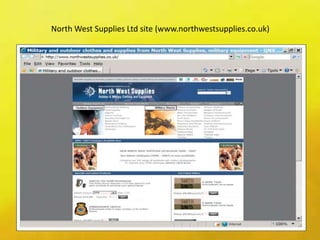
North West Supplies Ltd site (www.northwestsupplies.co.uk)
How do digital technologies
support marketing
Identifying – the
Internet can be used
for marketing
research to find out
customers’ needs
and wants
Anticipating – the
Internet provides an
additional channel by
which customers can
access information
and make purchases
– evaluating this
demand is key to
governing resource
allocation to e-
marketing.
Satisfying – a key
success factor in e-
marketing is
achieving customer
satisfaction through
the electronic
channel, which
raises issues such
as: is the site easy to
use, does it perform
adequately, what is
the standard of
associated customer
service and how are
physical products
dispatched?
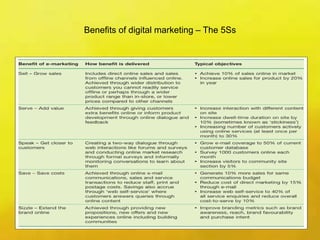
Benefits of digital marketing – The 5Ss
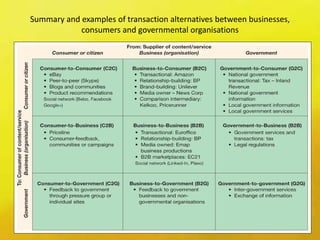
Summary and examples of transaction alternatives between businesses,
consumers and governmental organisations
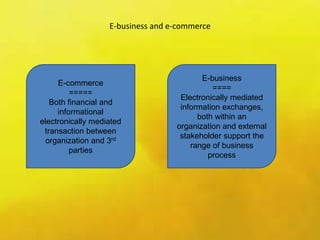
E-business and e-commerce
E-commerce
=====
Both financial and
informational
electronically mediated
transaction between
organization and 3rd
parties
E-business
====
Electronically mediated
information exchanges,
both within an
organization and external
stakeholder support the
range of business
process
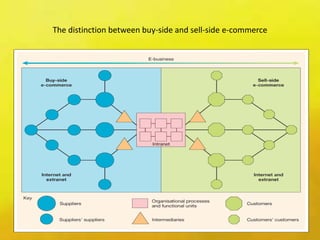
The distinction between buy-side and sell-side e-commerce
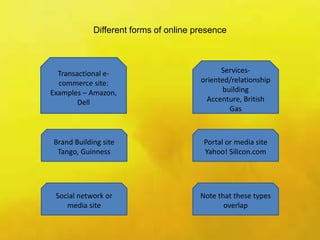
Different forms of online presence
Portal or media site
Yahoo! Silicon.com
Transactional e-
commerce site:
Examples – Amazon,
Dell
Brand Building site
Tango, Guinness
Social network or
media site
Note that these types
overlap
Services-
oriented/relationship
building
Accenture, British
Gas
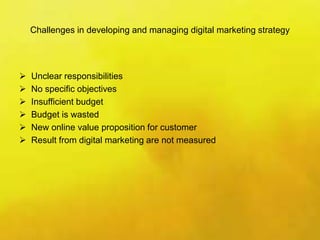
Challenges in developing and managing digital marketing strategy
 Unclear responsibilities
 No specific objectives
 Insufficient budget
 Budget is wasted
 New online value proposition for customer
 Result from digital marketing are not measured
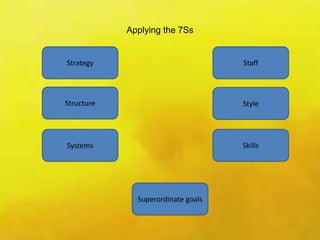
Applying the 7Ss
Structure
Strategy
Systems
Superordinate goals
Staff
Style
Skills
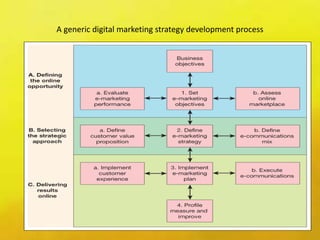
A generic digital marketing strategy development process
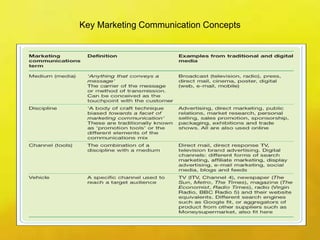
Key Marketing Communication Concepts
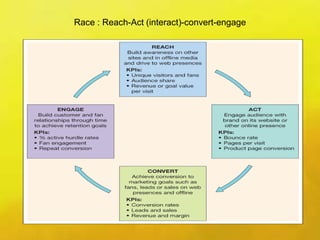
Race : Reach-Act (interact)-convert-engage
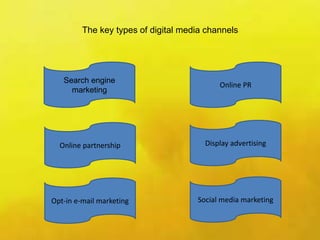
The key types of digital media channels
Search engine
marketing
Online partnership
Opt-in e-mail marketing
Online PR
Display advertising
Social media marketing
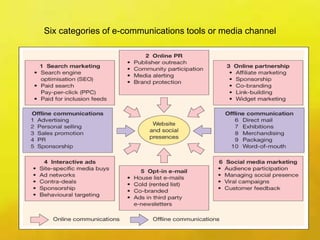
Six categories of e-communications tools or media channel
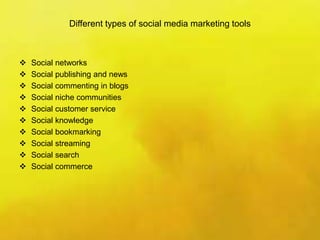
Different types of social media marketing tools
 Social networks
 Social publishing and news
 Social commenting in blogs
 Social niche communities
 Social customer service
 Social knowledge
 Social bookmarking
 Social streaming
 Social search
 Social commerce
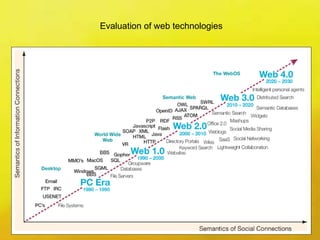
Evaluation of web technologies
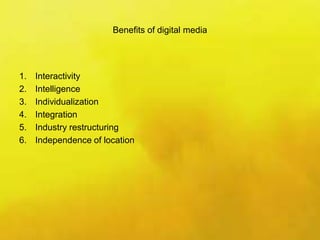
Benefits of digital media
1. Interactivity
2. Intelligence
3. Individualization
4. Integration
5. Industry restructuring
6. Independence of location
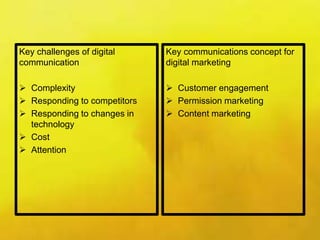
Key challenges of digital
communication
 Complexity
 Responding to competitors
 Responding to changes in
technology
 Cost
 Attention
Key communications concept for
digital marketing
 Customer engagement
 Permission marketing
 Content marketing
SUMMARY
• Digital marketing refers to the use of digital technology platforms,
combined with traditional media, to achieve marketing objectives.
• A customer centric approach to digital marketing considers the
needs of a range of customers using techniques such as persona
and customer scenarios.
• Electronic commerce refers to both electronically mediated financial
and informational transaction
• Interaction with customer, suppliers and distributors occur across the
internet.

Chapter 1 DIGITAL MARKETING

  • 1.
    Chapter 1 Introducing digitalmarketing NUR AQILAH BINTI ZAINUDIN BM2403B
  • 2.
    Learning objectives • Evaluatethe relevance of digital platforms and digital media to marketing • Evaluate the advantages and challenges of digital media • Identify the key differences between customer communications for digital marketing and traditional marketing.
  • 3.
    INTRODUCTION • Positioning =customers perception of the product and brand offering relative to those of competitors • Target marketing strategy = evaluation and selection of appropriate customer segments and the development of appropriate offers • Online value proposition = statement of the benefit of online service that reinforces that core proposition and differ from organisation offline offering • Value proposition = benefits or value a brand offers to customer in its product and service
  • 4.
    Key Features ofDigital Marketing Strategy Be aligned with business strategy Use clear objectives for business and brand development Be consistent with the types of customer Support customer journey Manage online customer lifecycle
  • 5.
    APPLICATIONS OF DIGITALMARKETING • Advertising medium • Direct-response medium • Platform for sales transaction • Lead generation method • Distribution channel • Customer service merchanism • Relationship building medium
  • 6.
    North West SuppliesLtd site (www.northwestsupplies.co.uk)
  • 7.
    How do digitaltechnologies support marketing Identifying – the Internet can be used for marketing research to find out customers’ needs and wants Anticipating – the Internet provides an additional channel by which customers can access information and make purchases – evaluating this demand is key to governing resource allocation to e- marketing. Satisfying – a key success factor in e- marketing is achieving customer satisfaction through the electronic channel, which raises issues such as: is the site easy to use, does it perform adequately, what is the standard of associated customer service and how are physical products dispatched?
  • 8.
    Benefits of digitalmarketing – The 5Ss
  • 9.
    Summary and examplesof transaction alternatives between businesses, consumers and governmental organisations
  • 10.
    E-business and e-commerce E-commerce ===== Bothfinancial and informational electronically mediated transaction between organization and 3rd parties E-business ==== Electronically mediated information exchanges, both within an organization and external stakeholder support the range of business process
  • 11.
    The distinction betweenbuy-side and sell-side e-commerce
  • 12.
    Different forms ofonline presence Portal or media site Yahoo! Silicon.com Transactional e- commerce site: Examples – Amazon, Dell Brand Building site Tango, Guinness Social network or media site Note that these types overlap Services- oriented/relationship building Accenture, British Gas
  • 13.
    Challenges in developingand managing digital marketing strategy  Unclear responsibilities  No specific objectives  Insufficient budget  Budget is wasted  New online value proposition for customer  Result from digital marketing are not measured
  • 14.
  • 15.
    A generic digitalmarketing strategy development process
  • 16.
  • 17.
    Race : Reach-Act(interact)-convert-engage
  • 18.
    The key typesof digital media channels Search engine marketing Online partnership Opt-in e-mail marketing Online PR Display advertising Social media marketing
  • 19.
    Six categories ofe-communications tools or media channel
  • 20.
    Different types ofsocial media marketing tools  Social networks  Social publishing and news  Social commenting in blogs  Social niche communities  Social customer service  Social knowledge  Social bookmarking  Social streaming  Social search  Social commerce
  • 21.
    Evaluation of webtechnologies
  • 22.
    Benefits of digitalmedia 1. Interactivity 2. Intelligence 3. Individualization 4. Integration 5. Industry restructuring 6. Independence of location
  • 23.
    Key challenges ofdigital communication  Complexity  Responding to competitors  Responding to changes in technology  Cost  Attention Key communications concept for digital marketing  Customer engagement  Permission marketing  Content marketing
  • 24.
    SUMMARY • Digital marketingrefers to the use of digital technology platforms, combined with traditional media, to achieve marketing objectives. • A customer centric approach to digital marketing considers the needs of a range of customers using techniques such as persona and customer scenarios. • Electronic commerce refers to both electronically mediated financial and informational transaction • Interaction with customer, suppliers and distributors occur across the internet.